Future Shock: season 3 of the Second Life machinima series

Future Shock: sci-fi machinima

I first wrote about Future Shock, an ambitious Second Life Machinima series produced by Pryda Parx, in September 2016, when the first part in the series was released, and then revisited the project at the start of 2017.

Since then, the series has grown through a second season, and Pryda has edited the episodes on both together into two special Director’s Cut versions, the first running to just over 23 minutes and the second to a touch over 32 minutes (see Future Shock: the machinima continues, for more on both the Director’s Cuts and the second season).

Now, through November and December 2019, the third and final season of the series is being made available for viewing through Pryda’s You Tube channel.

Future Shock is perhaps one of the most ambitious machinima activities to be attempted in Second Life, a 25-episode story arc split across three seasons of episodes (8, 9 and 8 per season). Set at some point in the future, the story presents a somewhat dystopian / semi-cyberpunk world where technology infiltrates every part of people’s lives, a seemingly protective blanket for all whilst also offering the means for personal gratification and escapism through the intertwining of their physical and virtual lives.

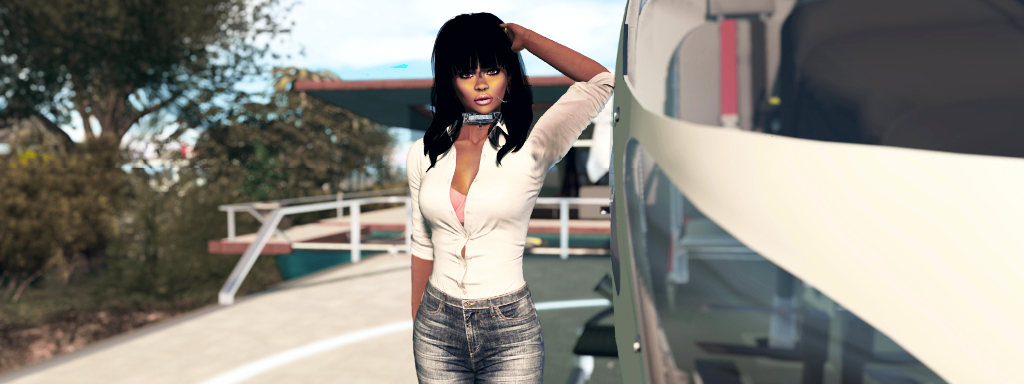
Future Shock protagonist Tracy Grayling

The latter can take the form of immersion into user-defined virtual worlds where dreams and desires are made a reality, and in the physical world, the ability for people to physically augment / redefine / rebuild their own bodies to suit their desires, in a world where everything is defined by a person’s net worth, or IP Credit (draw your own conclusions from the use of “IP”). This IP Credit can be enhanced through a variety of ways – agreeing to complete tasks that are assigned an IP value, for example.

So long as a person’s IP remains positive, then all is well. But should it decline continuously, then things can become hard; and should it zero-out completely, they can find themselves clinically and harshly dealt with. And this latter point is also the case for any who question the apparent benevolence and societal rules of the overseeing technology.

A particular point of uniqueness is the non-linear storytelling technique Pryda has used. The first season, for example, tells the story from the perspective of Tracy Grayling, dropping us into the middle of her life which appears – like the lives of so many – to be self-centred, living in this world of morally questionable ethics, in which people view their time in terms of raising themselves to the next line in a balance sheet, simply to be able to make themselves “better” physically or virtually than their peers. However, is this really so, or is she – wittingly or otherwise – an agent provocateur?

This makes the first season something of a mystery thriller: much is going on, but it’s hard to determine where it is leading. At the same time, we are drawn into the the story via Pryda’s visual technique of contrasting the “real” world, filmed in flat grey and minimal, hard colour (blue, red, white), with the promise of a virtual nirvana rich in colour. In the second season, the events witnessed by Tracy are seen from an entirely different perspective: that of those apparently fighting the controlling technology. This both adds to the depth of the underpinning mystery whilst also given greater context to the first season, making the primary arc of the core storyline clearer.

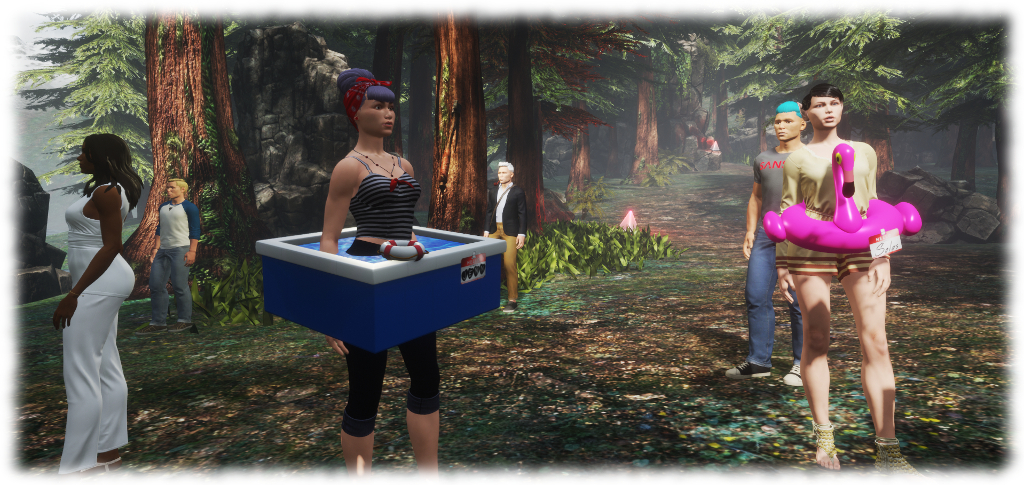
Tracy Grayling – in avatar form (r) – meets with the leader of the rebels in virtual space

With the third season, the story threads revealed in the first two seasons intertwine and draw us through a further eight episodes to the series climax.

The first part of the third season (and episode 17 overall), Brotherly Assistant is now available on You Tube. While on Thursday, November 14th, there will be a special in-world showing of episode 17 and the premier of episode 18, A Proposition, at the Grand Ballroom, Embrace Aphrodite Island (rated Adult), and the two episodes will be followed by a showing of the Director’s cut of the first season. All who are interested are invited to attend.

I don’t want to say too much about the third season – having been fortunate enough to be offered the chance to view it in advance – simply because I do not want to spoil it for others who have followed the first two seasons, or who wish to catch up with things by watching them now. What I will say is that throughout all three seasons, Pryda has woven a layered story that is worth watching throughout and – considering her own admission that season one was a case of “learn as you go” for her in terms of machinima making – one that demonstrates her growth as filmographer and storyteller.

Should you wish to catch up with the story, please follow the links below.

April reports on the SL Marketplace mix-up

On November 4th, some users on the Marketplace who accessed their account page ended up seeing some account details for another user currently logged-in to the Marketplace at the same time.

The user account page gives a user’s SL account name, L$ balance, a small portion of their activity on the  Marketplace activity, their wish lists, received gifts list, and the obfuscated version of their e-mail address (e.g. i****@g****.com, designed to provide the user with enough information to identify their own e-mail address without revealing it to others).

Multiple bug reports on the issue were raised with Linden Lab, and at least one forum thread was raised on the subject, with some pointing to the Marketplace maintenance that was in progress as a possible cause – and they were right, as the Lab’s Second Life Operations Manager has revealed in a blog post (Report on the Recent Marketplace Issue), that reads in part:

We’ve been working to make the Second Life Marketplace more robust and handle higher numbers of page views at once. Due to a change made this morning, the user account page got cached when we didn’t mean for it to be. Once we realised what had happened, we rolled back the changes immediately and deleted all of our caches. No other parts of Second Life were impacted.

Our engineering teams are now working with our QA (quality assurance) team to make sure we develop better testing for this in the future. We want to make sure we catch something like this long before it makes it out into the hands of Residents.

We’d like to extend a really big thank you to everyone who reported the issue to us the moment they saw it! Because of your vigilance we were able to react really quickly and limit the time that this misconfiguration was live. (Seriously, y’all rock! 💜)

We’re sorry this issue happened this morning. We’re working to make sure it never happens again, and developing better test procedures for use in the future.

While the error was unfortunate, and might have been a little discomforting for some who encountered it, the Lab estimates that no more than 500 users visited the account page during the time the issue could occur, and not all of them were given the wrong page to view.

Where the issue did occur, April notes that it did so at random, and randomly selected the incorrect page to be displayed, so it was impossible for a user to “pick” another user’s information and intentionally view it. She also notes that it was not possible to either make purchases via an incorrect account page, or to make any changes to the page.

As always, details in full in April’s blog post – and many thanks to her again for providing an explanation of the issue and what is being done to hopefully avoid future repetitions.

Linden Lab’s management team expands: congrats to Grumpity, Patch and Oz

© and ® Linden Lab

Back at the start of October, Beth MacBain pointed out on the forums that Patch Linden had received a promotion, to Vice President of Programme Operations.

At the time, I dropped Patch a line asking about his expended role – although as I didn’t hear back – and I did a quick check to see if his promotion had been reflected on the Lab’s official Management Team page.

Back then, the answer was no – possibly because I was a little quick on the draw. However, since then it has been updated – and it reveals that Patch is one of three senior staff with a specific focus on Second Life to gain a promotion to Vice President and join the Lab’s management team.

The other two – who have worked alongside Patch for some time as “the troika” (as Grumpity Linden puts it) who determine much of the product and feature direction for Second Life: Grumpity herself, who is now Vice President of Product (Second Life); and Oz Linden, who is now Vice President of Second Life Operations.

Linden Lab Management Team page, October 2019 – a line-up that now includes Oz, Patch and Grumpity Linden (highlighted)

Given this, I’d like to offer belated congratulations to Patch, Grumpity and Oz on their new positions. All three have contributed significantly to Second Life’s development over the years, and genuinely have the platform’s best interests at heart. If you’re unfamiliar with their backgrounds and their roles at the Lab, just hop over to the Lab’s Management Team page and click on their photos there (just scroll down the page to view them).

The October 2019 update to the Management Team page also reveals that the Lab’s General Council, Kelly Conway departed the company during the month.

Having been at the Lab since May 2013, Kelly was also a founding Director of Tilia Inc., where she oversaw the team responsible for regulatory compliance policies and procedures, including related to anti-fraud and anti-money laundering (AML) measures. She has now moved to Manticore Games, to take over the role of General Council there. I had some indirect dealings with Kelly over the years (mostly the results of assorted requests put to the Lab through Pete and Brett Linden that touched on Tilia, the Terms of Service, etc.), and would like to offer best wishes to her in her new role and company.

April offers a look at the October 2019 woes

The period of Thursday, October 24th through Sunday 27th October, 2019 saw Second Life encounter a rolling set of issues which finally came to a head on Sunday, October 27th. The issues affected many Second Life users and services from logging-in through to inventory / asset handling.

As has become the case with these matters, April Linden, the Second Life Operations Manager, has provided a post-mortem blog post on the issue and her team’s work in addressing the problems. And as always, her post provides insight into the complexities in keeping a platform such as Second Life running.

In short, the root cause of the weekend’s upsets lay not with and of the Second Life services but with one of the Lab’s network providers – and was exacerbated by the fact the first couple of times it happened – Thursday and Friday – it appeared to correct itself on both occasions before the Lab could fully identify the root cause.

April Linden

On Sunday, the problems started up again, but fortunately April’s team were able to pin down the issue and commence work with their provider – which obviously meant getting Second Life back on an even keel was pretty much in the hands of a third-party rather than being fully under the Lab’s control.

Our stuff was (and still is) working just fine, but we were getting intermittent errors and delays on traffic that was routed through one of our providers. We quickly opened a ticket with the network provider and started engaging with them. That’s never a fun thing to do because these are times when we’re waiting on hold on the phone with a vendor while Second Life isn’t running as well as it usually does.

After several hours trying to troubleshoot with the vendor, we decided to swing a bigger hammer and adjust our Internet routing. It took a few attempts, but we finally got it, and we were able to route around the problematic network. We’re still trying to troubleshoot with the vendor, but Second Life is back to normal again.

– Extract from April Linden’s blog post

As a result of the problems April’s team is working on moving some of the Lab’s services to make Second Life more resilient to similar incidents.

During the issues, some speculated if the problems were a result of the power outages being experienced in California at the time. As April notes, this was not the case – while Linden Lab’s head office is in San Francisco, the core servers and services are located in Arizona. However, resolving the issues from California were affected by the outages, again as April notes in her post.

It’s something I’ve noted before, and will likely state again: feedback like this from April, laying out what happened when SL encounters problems are always an educational  / invaluable read, not only explaining the issue itself, but in also providing worthwhile insight into the complexities of Second Life.

Remembering Darrius Gothly

Darrius Gothly

I received word from Torric Rodas today of the sad news of the passing of long-term Second Life resident and creator, Darrius Gothly.

Founder of the DG4SL range of products, Darrius had a wide range of interests in Second Life, and always sought to improve people’s SL experience through many of his products, whilst also being a very vocal member of the platform’s merchant community, offering both positive critiques of the Lab’s approach to its Marketplace environment and suggestions for improving it.

I did not know Darrius well, but I believe we became long distance friends outside of Second Life for long enough for me to appreciate him for his insight and integrity.

We first really got to know one another when he stepped in to try to address an age-old problem in Second Life: what happens when you pass out a load a landmarks for your store, club, region, etc., – and then are forced by circumstance / opportunity / whatever to relocate, other than to start revising all your LMs, push new ones out to visitors / customers / friends, try to get the word out through forums etc.

To explain: back in 2012, artist and creator Toysoldier Thor put forward an idea and feature request for “virtual landmarks” to present a means by which LMs need never go “stale” (see also: Virtual Landmarks: solving an age-old problem?).  As per Toy’s comments in a forum thread on the idea, for a time it looked like LL might be interested in implementing something along the lines of his suggestion (subject to other commitments / priorities). Sadly, nothing ever really came of this (nor of subsequent suggestions along similar lines). So, Enter Darrius.

I first got to know Darrius as he developed his Virtual Landmarks products

Taking a dive into things, he formulated a means by which Toy’s idea could be realised via an external service. In typical Darrius style, he also added elements such as web support (“VMurl”), stats reporting and support for “favourite places” to provide a comprehensive product. He dropped me a line about the product in December 2012, which resulted in my articleVirtual Landmarks: offering a solution to the age-old problem, and in my playing a very small role in testing the system.

As a result of that initial contact, Darrius and I became what might best be referred to as “pen friends” over the next few years, exchanging ideas and comments and holding forth with each other on a wide range of subjects, from “technical” chats about SL through to more esoteric matters – identity, anonymity and personal expression in VWs, the new user experience, perceptions about SL in other platforms / the worlds at large, etc. -, through to chatting about physical world home and family, health, and our mutual enjoyment of assorted film franchises, and even touching on politics on occasion.

Sadly, our conversations waned to the point of becoming non-existent for the last couple of years. At the time this happened, I was aware that Darrius was dealing with illness and couldn’t always get in-world / on-line perhaps as often as he would have liked, and I feel a certain amount of regret that I didn’t do more to keep our exchanges going. He didn’t believe in putting up walls between his SL persona and himself; whom you encountered through his avatar was very much Darrius himself: honest, up-front, friendly, caring, supportive and with a wonderful – and at times quite wicked (in a good way!) – sense of humour. He is someone who will be missed.

My sincere condolences to his family and to his close friends on their loss.


Note:

I understand from Torric and the London City website that the DG4SL team are attempting to ensure the popular Rental Beam service add-on for CasperLet is transitioned to new management so that it can continue to run as customers expect. Anyone with enquires about that service are asked to contact Mysti Nowles directly, rather than raising a support ticket. At this point, I do not have information on what will happen to other DG4SL products utilising back-end services (such as the VLM product) or who to contact about them. Should I come into such information, I will give an update here.

Second Life: parent/child script communication issues

On Friday, October 4th, 2019 Linden Lab blogged about the recent script related issues that caused widespread disruption (notably with rezzing systems) across Second Life following the SLS (Main) channel deployment made on Tuesday, September 24th, 2019, and which ultimately resulted in a complete rollback from the grid on the 27th/28th September.

As noted in my Simulator User Group Updates, the release that caused the problems  – simulator release 2019-09-06T22:03:53.530715, included a number of updates intended to improve overall script performance, including how scripts are scheduled and events are delivered. However, these changes resulted in an unintended impact which, due to the region sampling, was not revealed by the update initially being deployed to a release candidate (RC) channel on Wednesday, September 11th.

The October 4th blog post from Linden Lab indicates that improvements have been made to the code, and once deployed, these should help prevent a recurrence of the problem. As an aside, it has been hoped that these updates might have been deployed to an RC channel on Wednesday, October 2nd, but a last minute bug prevented this (see: Deploy Plan for the week of 2019-09-30), so the updates will likely be deployed during week #41 (commencing Monday, October 7th).

However, even with the fixes, there blog post goes on to note there are come best practices when using parent / child script communications between a parent object and a child it rezzes:

One common cause of problems is communication between objects immediately after one creates the other. When an object rezzes another object in-world using llRezObject or llRezAtRoot, the two objects frequently want to communicate, such as through calls to llRegionSayTo or llGiveInventory. The parent object receives an object_rez() event when the new object has been created, but it is never safe to assume that scripts in the new object have had a chance to run when the object_rez event is delivered. This means that the new object may not have initialised its listen() event or called llAllowInventoryDrop, so any attempt to send it messages or inventory could fail. The parent object should not begin sending messages or giving inventory from the object_rez() event, or even rely on waiting some time after that event. Instead, the parent(rezzer) and the child(rezzee) should perform a handshake to confirm that both sides are ready for any transfer. 

The blog post goes on to define the sequence of events between a parent and rezzed child object as they should occur, and provides sample code for such parent / child operations.

An important point to note with this is that when the fix from the Lab is re-deployed, any scripts that still exhibit these kinds of communication issues will likely need to be altered by their creator to match the recommendations provided by the blog post.

Those wishing to know more are invited to read the original blog post in full, and address and questions and / or feedback through the associated forum thread.