Loyalty, adoption, inspirational leadership … and SL

Simon Sinek probably isn’t a new name to a lot of people who may read this; nor, potentially, is his “Golden Circle” popularising the concept of “why”. But ever since Spikeheel Starr pointed me towards his TED presentation made last year (and now apparently the 19th most-viewed video on TED.com), I’ve found the ideas he expresses fascinating.

For one thing, I cannot help but agree with his example of Apple. This is a company that people like or loathe. Customers are intensely loyal and remain so, no matter what happens to dent the company’s reputation. Apple continue to top the charts with their products, despite the fact that – really – there is nothing that is that technically innovative about them. Why?

Well, as Sinek points out, Apple developed and has retained, the ability to inspire aspirational desire with its products. Take the famous Apple “1984” ad: it presents a clear message of that aspirational desire through a positive vision of non-conformity.

That approach has continued through to Apple’s messaging today, where the “what” might be more prominently placed – but it is still wrapped in the aspirational subtext of their messaging, “We’ve done this and it feels good, wouldn’t you like to have the ability to do it to?”

The Law of Diffusion

Further into his talk, Sinek touches on the law of diffusion of innovations, which caused me to think about Second Life.

In 2008, Mitch Kapor gave an address at SL5B in which he referred to the same law, and particularly the matter of what Geoffrey Moore refers to as crossing the chasm – moving a product from the status of early adoption to its use by an early majority (or “pragmatists”, as Mr. Kapor preferred to call them).

However, in his presentation, Mr. Kapor appeared to turn the issue of crossing the chasm entirely on its head. To him, it would appear that the early adopters – the “pioneers”, as Mr. Kapor called them – were anathema to SL’s future growth.
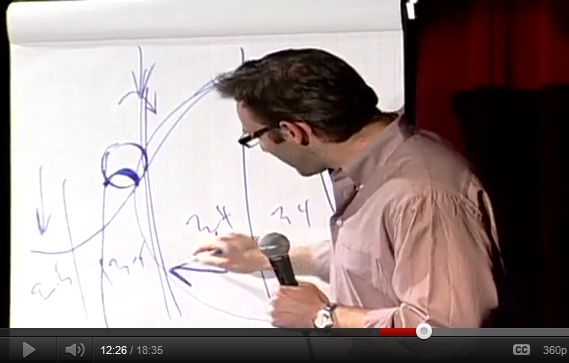
The early majority is gained through the early adopters

Yet, as Mr. Sinek points out – and Moore understood – the fact is that without the early adopters, the majority will not actually follow to adopt the product.

In short, by suggesting the early adopters might need to stand aside, Mitch Kapor appeared to completely miss an opportunity – as LL itself did, as I’ve previously noted.

And it is here, while watching Simon Sinek, that I again feel a renewed hope for Second Life – and more particularly, Linden Lab. Why?

Because everything that appears to be coming out of Linden Lab does now appears to be geared towards crossing their chasm in a manner Moore recommends and Sinek indicates: by leveraging their existing user-base.

Anyone attending the Lab’s presentations at SLCC this year cannot fail to have noticed this; all of them were, in one way or another, focused on the user community as a whole. Both Mark Viale (Viale Linden) and Brett Attwood (Brett Linden) in particular gave insight into LL’s change in philosophy that stands to benefit the user community and the company equally well.

In this respect, something has changed within Linden Lab over the course of this year; and it’s pretty obvious that – and I say this without any desire to sound like a fangirl – the “something” in question might at this point be Rod Humble.

Rod Humble embodies much of what Simon Sinek discusses about good leadership. Hearing him speak at SLCC and elsewhere and when reading interviews he’s given, Rod Humble unabashedly talks about his personal beliefs. It doesn’t matter whether the subject under discussion is Second Life or on matter of virtual identity; he strikes that emotive chord that resonates within us.

In short: he inspires trust.

It’s why we like Rod Humble. More than that – it’s why we need him right where he is.

Note: updated in 2019 due to video links to Apple ads being broken and forcing an alternative version of the “1984” ad to be embedded and reference to the AirPlay ad removed. 
Linden Lab issue Adult Gateway RFP

Que Niango, fresh from the Adult Conent User Group reports that Linden Lab have issued the following RFP:

===================

Linden Lab’s Adult Gateway Proposal

Goal: Enable the adult community to develop and quickly iterate upon a Zindra welcome/gateway experience for Residents interested in exploring adult content.

Situation: With “Zindra” as a primary search terms for adult content in SL, people are more likely to find and start at the current Zindra sim today as a result of its top search ranking. Unfortunately, the current Zindra region experience fails to encourage curious Residents to explore further.

For a number of reasons, it appears unlikely that a successful gateway experience could be efficiently developed and managed as a collaborative effort among Linden Lab and the Adult Content User Group (ACUG) using the existing Zindra region.

The Solution: A Resident controlled group will assume complete control of a prominently promoted Zindra/adult gateway (comprised of four regions).  The ZExpo four regions present a relatively easy way to setup Resident group ownership of the adult gateway experience. Upon conclusion of ZExpo 2011, these four region will be reassigned to a new group. This new group would be required to make tier contribution (setup fees waived) in exchange for group governing powers along with the exclusive use of “Zindra” name to guarantee top search ranking and Linden Lab’s active promotion in the Destination Guide. As the single mainland gateway for adult content, these regions would offer a unique opportunity to channel qualified Residents into high-quality, adult-related experiences.

Details:

  • Resident group to receive full group ownership of the four ZExpo mainland regions.
  • Group must contribute tier and pay $195/month for ea of the four regions or $780/month.
  • Use of Zindra name will be reserved exclusively for four regions, guaranteeing top placement in search.
  • Linden Lab agrees to promote four new “Zindra” regions in Destination Guide, as well as work with the group to promote the regions in additional marketing channels.
  • Linden Lab’s promotion contingent upon the group providing a positive experience for all Residents interested in adult content and reserves the right to cancel promotion at any time and may take actions in accordance with its Terms of Service and related policies and procedures.

Open Call for Proposals

Linden Lab will accept group proposals from all interested parties through September 12th, 2011.  Send proposals to community@lindenlab.com with title “Adult Welcome Proposal”

Proposals should include the following details:

  1. Proposed group members responsible for tier – max of four member (1 for each of the 4 regions). Please include links to each profile i.e.https://my.secondlife.com/Viale.Linden
  2. Answer the question: how will you develop and manage a good, compelling gateway experience for all residents (new and existing) interested in adult content? 
  3. How will you promote adult venues within Second Life ~ mainland and private regions?

===================

This RFP may appear novel, but it is entirely in keeping with Linden Lab’s desire to help promote sustainable communities within Second Life, as outlined during Viale’s Linden’s presentation (video) at SLCC 2011. Even so, one cannot help but wonder at how practical it will be; the Adult Content User Group at times appears to be very divided. As such, it’ll be interesting to see how this approach is going to be interpreted and what comes out of the actual implementation once the new tier group has been formed.

LL Affiliate Programme: Linkshare

Linden Lab provide an Affiliate Programme that allows anyone with a blog or website to promote Second Life via ads created using destinations contained within the Destination Guide. These ads can be placed within websites and blogs, and commission is earned based on the number of people using the ad to click-through and join Second Life (registrations made within 30 days of the initial click-through).

Note: the Affiliate programme also utilises the Google Affiliate Network via an AdSense account. This article only relates only to the use of the Linkshare Affiliate Network.

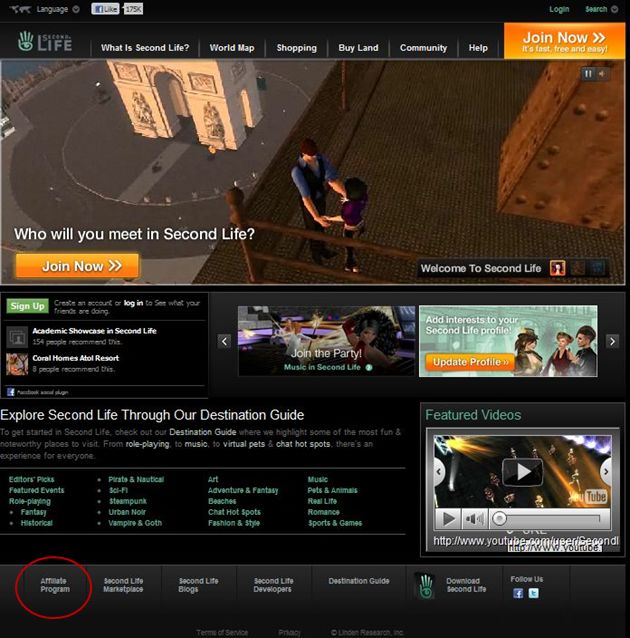
Affiliate programme button

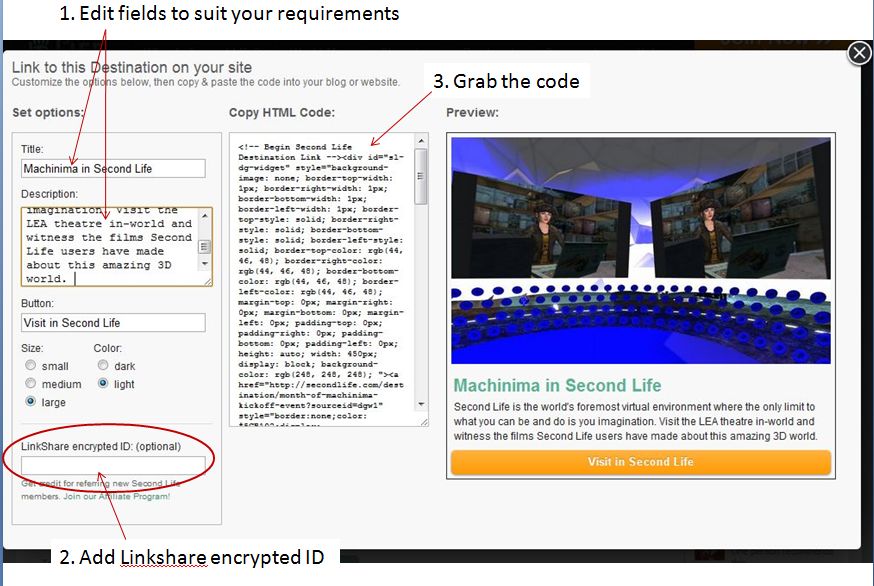
Whether you are a Second Life user with a website / blog who wishes to promote SL, or whether you have a specific in-world Destination you would like to link to the Affiliate Programme, the steps for using this capability are more-or-less the same:

Select an entry / your own entry in the Destination Guide
  • Sign-up to the affiliate programme (LL will get back to you on the status of your application within 5 working days)
  • Once you have been approved, pick the Destination Guide entry you wish to use within your website / blog (if you wish to use your own destination, and it is not already included in the Destination Guide, please also refer to the Destination Guide FAQ)
  • Click on the Create Ad Widget and compose a promotional advert based on the Destination you’ve chosen
  • Include your unique Linkshare encrypted ID (from Linkshare)
  • Copy the generated code and embed it within your website / blog.
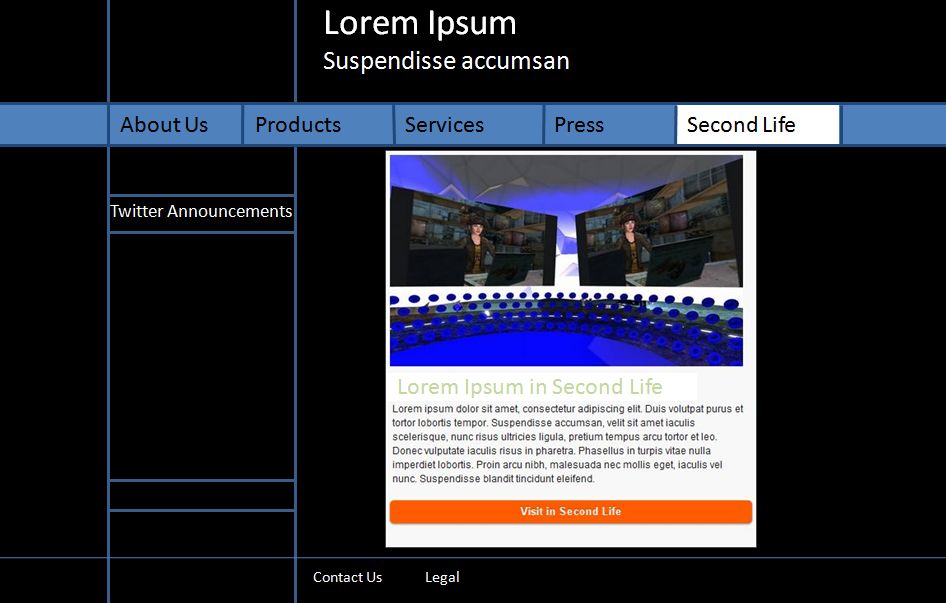
Embed code in your website / blog

Notes

  • Not all requests may be accepted into the programme
  • The Second Life Affiliate commission totals are tabulated every month. Linden Lab pays the Affiliate Network for all qualifying referrals. The Affiliate Network, in turn, distributes these commissions to all qualifying affiliates
  • I cannot answer specific questions on this – I’m just reporting on it!
  • The Affiliate Programme FAQ provides further information
  • The Create Ad widget FAQ provides specific information on using the widget to set-up an ad.

Four reasons why I’m excited about SL again

I’m feeling excited about SL again. It’s a novel experience after the last two or so years of feeling like I’m frequently shaking my head or burying my face in my hands so often.

It really started when Rod Humble started to make his presence felt. One could not help but feel that here is a man who – even if he claims he doesn’t understand Second Life – actually groks the potential of the platform on many levels. Since January, we’ve seen substantial progress on numerous fronts. True, it hasn’t always been quite what we wanted, or perhaps as far as we’ve wanted – but the positive results are undeniable in a number of areas. There may still be an almighty pile of things still sitting in the To Do box at the Lab, but no-one can hand-on-heart deny considerable effort has been put into trying to directly address matters of usability on a number of fronts, and to examine issues around user engagement and retention.

SLCC saw a round of talks and panels of Linden Lab staff that did much to reinforce the feeling that the Lab is back on the right track. What particularly excites me, are three things that have, I think, the potential to radically transform SL, and one that looks like it’s going to get some overdue focus. Namely:

  • Mesh
  • Gaming mechanics
  • Non-player characters (NPCs)
  • Prims

If we’re honest, the first iteration of mesh is already here; the capability is rolling-out across the Main grid, the code to support it within the Viewer is now at Beta and is available in at least one third-party Viewer with others set to follow, and mesh creations are slowly beginning to appear.

Mesh: opportunities

True, what we’re getting in the first release may not be what everyone wants, and there has been much angst on the technical side about the capability to produce SL-efficient mesh objects. It’s also fair to stay that it may not initially be as well-suited to some areas of content creation as it is to others. However, Linden Lab are aware of many of the issues (real and perceived) and are working towards trying to resolve those that they can over time. As Charlar Linden himself said at SLCC 2011, there will at some point be at least one “non-trivially sized” set of improvements to mesh to follow-up the initial roll-out.

But the fact is, doubts and angst aside, mesh can be transformative within Second Life on many levels beyond “traditional” content creation, for example:

  • It potentially offers new and previously unseen opportunities for creative collaboration as sim owners, groups and even businesses work with 3D artists to generate totally new and unique experiences within Second Life
  • It potentially takes the opportunities for practical prototyping to new levels, and well beyond anything that can be achieved with prims, something that might open the doors to other forms of collaborative efforts in both education and business
  • It can clearly bring an entirely new dimension to art within SL, be it static, mobile or through the lens of a camera; offering new ways for artists to express themselves visually both in-world and elsewhere.
Using gaming mechanics

Gaming mechanics also opens the door to many new possibilities, depending upon how they are implemented. At SLCC 2011, Gez and Esbee Linden gave a demonstration of the kind of thing LL staff have being playing with in order to better understand the mechanics of creation and the capabilities and limitations of SL, and how game-like mechanics might be used to enhance the SL experience. Even in a “rough” form, the results shine a light on a lot of potential, as Gez himself commented at the convention:

“Second Life itself is not a game.  However, you can make some great games inside of Second Life, and you can use game mechanics, and game tutorials, and game systems to help people become more engaged and comfortable in Second Life.”

It’s amazing to think of the opportunities that the considered implementation of game-like tools, mechanics and controls could bring to Second Life. Just consider role-play quests (as a single example) wherein there’s no need to don a HUD or faff with notecards – everything can be done immersively on-screen, via simple prompts or icons and using intuitive controls such as point-and-click and / or point-and-drag.

NPCs: New opportunities

Non-player characters (NPCs) offer a similar means for new an immersive interaction within a virtual world that potentially goes beyond the use of bots / scripted agents, as they could run without being attached to logged-in accounts. Little wonder, then that UK-based Daden Ltd., has been working on just such a capability for OpenSim, as Maria Korolov reported in Hypergrid Business this week.

NPCs can be applied to a wide range of uses within SL. Here’s just two:

  • Within training simulations, where they can add depth of experience for trainees and perhaps be programmed to react a number of different ways as a result of interactions with trainees, making training simulations a lot more dynamic
  • Within role-play environments, where they could be used to provide help and guidance to players, or present threats that need to be dealt with and so on, adding to the immersive experience in ways that again go beyond the use of account-based bots. And that’s just scratching the surface of opportunity.

Combined with the use of gaming mechanics, NPCs stand to give Second Life a new dimension in terms of the way people can engage with various offerings within SL, as well as providing those seeking to provide immersive experiences with a raft of new tools and opportunities.

NPC coding and Mesh…new opportunities for pets?

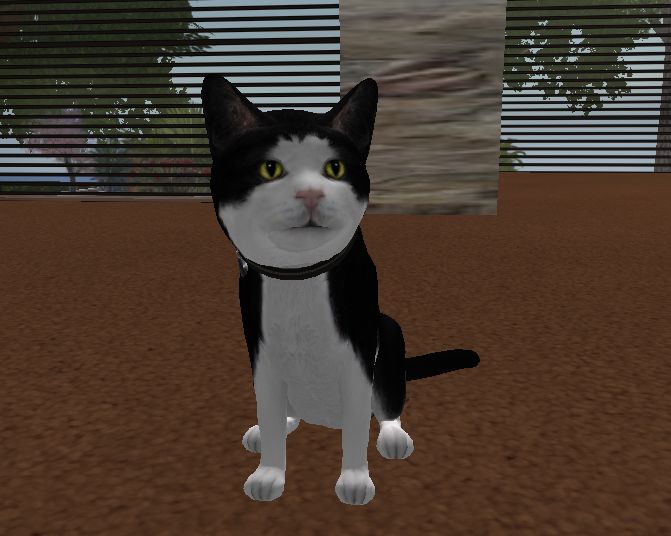
Even in more mundane settings, NPC capabilities could be used to create, say, the “next generation” of pets beyond the likes of Stitch on the left here; able to both interact and react to avatars and their environment beyond the current limitations seen in pets at present.

Finally, there is the humble prim. Even if you’re not enamoured with any of the above, there is no need to worry, as it seems new life is to be breathed into the prim – and possibly the tools we have to manipulate it.

Not only is the new 64m upper size limit coming into effect with the release of mesh, but it seems that prims are to become central to a “directed experience” in the future aimed encouraging people coming into SL to engage in the process of content creation and the collaborative opportunities offered by in-world building. From the way Durian described it, this “direct experience” will be one of a number that the Lab is considering as ways of further user engagement with Second Life, and having a focus on prims and in-world creation is perfectly aligned with Rodvik’s view that Second Life is a shared creative space.

That prims should get additional attention is only right and proper – they may not be perfect, but they offer a lot of opportunities for those without deep-seated artistic and technical skills (i.e. me), to get a lot of fun and enjoyment out of SL. In this respect, it was very pleasing to see members of the LL product team engaging so much with the tools themselves in an effort to better understand them and – perhaps – start looking at ways and means to improve them down the road.

So, yes, I’m feeling pretty positive about Second Life and the future. The road ahead may be a little bumpy, and not everything is going to happen at once, or – again – necessarily as some of us might like it to happen; but the promise is there – and the Lindens themselves seem as determined as the rest of us to make it real.

LL diversifying? What does that mean?

LL CEO Rod Humble

Potentially the most interesting comments to come out of Rod Humble’s presentation at SLCC 2011 were related to the fact that Linden Lab may be diversifying. These started early on when he announced:

“You are going to see Linden Lab working on new products as well as Second Life”.

While he refused to delve into specifics, it has led to speculation that he may be referring to what Hamlet Au refers to as a new “SL Light experience” that will utilise “the web and tablets”.

Hamlet was certainly in a position to ask Rod questions on the matter after the presentation, given he’s at SLCC; and so may have a greater insight than I; certainly, there is no denying Rod indicated that Linden Lab is eyeing-up the tablet marker where Second Life is concerned. However, I cannot help but speculate that Linden Lab is going after something a lot broader than just introducing a “light” version of SL when Rod refers to the growing tablet / mobile market.

Look at his comment, quoted above, for example. It clearly differentiates between Second Life and a product and whatever else Linden Lab has planned. This seems an odd statement to make if whatever is coming down the line is simply aimed at enhancing Second Life’s reach. It’s also a differentiation that came up again during the extensive Q&A session. Here’s what he said:

“The other massive opportunity and massive threat to on-line games and everyone in this room is the rise of tablet and mobile devices; and right now we don’t participate on those devices. So you will see us address for Second Life, but also for at least one new product, the area of tablets in particular and some mobile stuff as well.” [my emphasis]

Again, if Linden Lab are simply looking towards opportunities to extend Second Life’s reach, it seems odd that he clearly differentiates between Second Life and the “new products” in this comment.

So what else could he be referring to? Here’s where the speculation begins.

A recurring theme during the 45 minutes Rod was on stage was what I’m going to refer to “social involvement”, so much so that it is hard not to link them with his comments relating “new products”.To bullet-point some of the references:

  • He was at pains to emphasis the importance of people being able to define their own persona on-line and to be able to set their own barriers as to how much they reveal about themselves and how they establish divides or barriers between what the reveal / how they interact with others according to the environment / situation they are in
  • He also emphasised twice that Linden Lab believes that customer privacy is paramount, and that they will not do anything that betrays this
  • A number of his comments were around LL’s perception that people’s habits are changing with regards to Second Life, people are spending less time engaged in-world, but more time engaging socially about Second Life through various mediums – the new web profiles, Twitter, etc.

In this last point, he specifically points out, “By the way, I mentioned that Second Life was growing earlier…there’s a really interesting dynamic as well, is that many of the new users of Second Life are a very, er, very younger demographic…sort-of a mid-twenties, college age. And they also…they are generally spending less time in-world but more time socialising within Second Life social circles…and I think that’s really interesting.” He goes on to note that this is common in other on-line games and suggests that the onus for LL is to enhance this capability, “for our customers”.

Wen profiles: precursor to LL’s move towards wider on-line social involvement?

This would all seem to point towards Linden Lab moving more into the realm on on-line social involvement. It’s something they’ve tried, albeit on a very limited basis through the acquisition of Avatars United a couple of years back, which was ultimately discarded – which is not to say they ever gave up on the idea.

In many respects, it makes sense for the company to move into social involvement in a more premeditated manner, as a) this is clearly a growing market; b) through Second Life, they have been developing capabilities and knowledge ideally suited to the environment (i.e. through my.secondlife.com). What’s more, they are willing to step away from the likes of Facebook and Google+ and uphold the principles of pseudonymity and privacy, which could make such a move attractive to a broad audience.

Of course, it would be ridiculous to suggest that Linden Lab could in any way take-on the likes of Google or Facebook in the broadest sense; and I’m certainly not suggesting that.

But then, they don’t have to. By providing a set of social media tools that enable gamers, Second Life users and others to remain connected, to “meet” and discuss their interests, passions, plans, swap ideas, link-up with others and so on, they could potentially tap into a huge market, and offer them the ability to leverage technology and capability already developed that would not necessarily impact on their focus of “fixing” core issues and services within the Second Life platform itself.

There’s also the matter of diversification and revenue. Hamlet himself (rightly or wrongly, depending upon one’s standpoint) makes much of the current revenue stream enjoyed by Linden Lab (the “sale” of SL “land”) as being somewhat unsustainable – and over time, he may well be right. Ergo, it would make sense for LL to look at other opportunities and markets in which to generate new income. Although precisely how this might be achieved is harder to define, and worthy of a separate debated in and of itself.

It’s going to be interesting to see what is announced in the coming months and, equally, how Second Life users respond to whatever comes out of the Lab – particularly if it is seen as “taking effort away” from supporting Second Life. In this latter regard, assuming the new products are divorced from Second Life, LL will doubtless have a fine balancing act to perform where user happiness is concerned.

LL August blog update

Linden Lab today issued the second in their “monthly updates”, covering August. I’m still not sure I like this monthly approach to keeping us informed on things – particularly as most of the “news” is once again somewhat stale.

The new social aspects of web profiles get prominence in the update, unsurprisingly. I’ve nothing against the new system, but I do still wonder at how popular it will prove, compared to the likes (and convenience) of Twitter. I’ve used the Feed aspect a few times, but few of those on my Friends list appear especially captivated with the new toys.

The new-look Viewer 2 (2.8 onwards) log-in / splash screen gets a section as well. There are some things missing from this, as I’ve mentioned in my review of the new screen, and will be poking LL on the matter as well.

The new server-side controls that allow a region’s environment to be better controlled are also reviewed, as are the new privacy capabilities (“Hide Avatar”), which operate at parcel level. Passing mention is made on the work to improve payment methods, and mesh just about gets a look-in with the recent call for further Main grid volunteers.

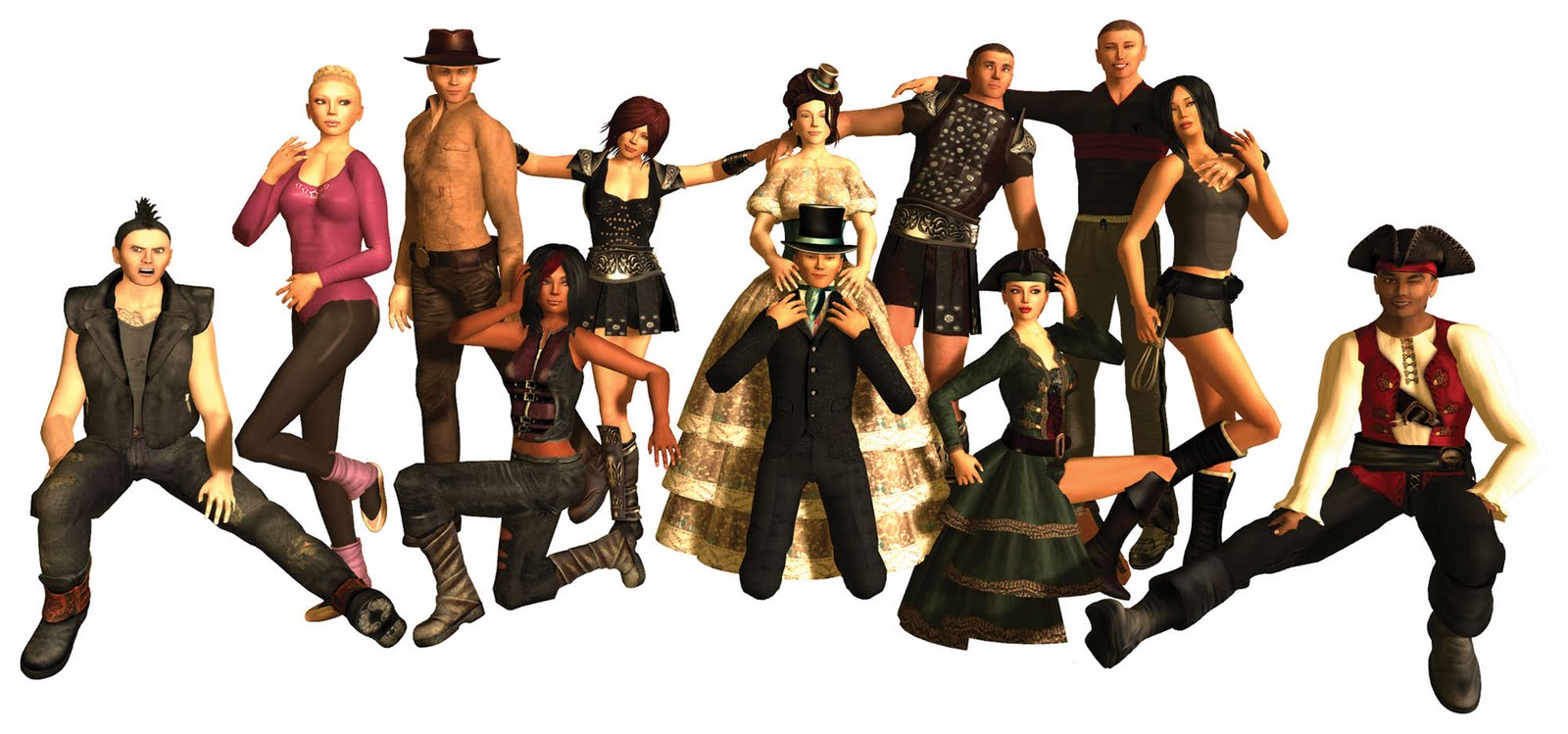
There are also some shiny new avatars for those to choose from when signing-up to SL / creating additional accounts:

New Avatar choices (image courtesy of Linden Lab)

Personally, the one piece of news the update contained – and most welcome it is, concerns e-mails from LL:

If you’ve unsubscribed to optional news and promotional emails in the past, you can now resubscribe to emails by category. It’s important that you enter the email address that’s connected to your SL account. These subscription options don’t affect the emails you receive for transactions, instant messages from friends and/or customer service responses.

The ability to opt-out of specific e-mail categories from LL has long been a failing of the system, and something I’ve critiqued in the past; that we can now do so on a more granular level is most welcome, and kudos to LL for listening to those of us who have complained over this lack of flexibility in the past.

As a round-up, the blog post is not bad, as an “update” for the month of August its, frankly, disappointing, containing very little that users most likely aren’t already aware of.