Controversy has recently been growing (yet again) around the so-called Justice League Unlimited within SL. This is a group of self-styled “law-enforcers” that has long been active in-world, supposedly protecting the innocent against dirty wrong-doers, with their avatars garbed in comic book superhero outfits.
Leaving aside their explicit violation of a certain comic book publisher’s IP rights – this group has long had a less than stellar reputation, and is not above overlooking inconveniences to their “duty” such as the Second Life Terms of Service. Evidence is now emerging that the JLU are (again / continuing to be) involved in RedZone-like data-gathering – and going a lot further in the process by attempting to put together dossiers on anyone in-world they consider a “threat”.
Avril Korman has written an excellent piece on the JLU’s activities, and it is a recommended read. For those that feel the same level of concern for the JLU’s activities as they did with RedZone, there is also an on-line petition aimed at Linden Lab to have the JLU’s activities properly scrutinised. You may also wish to consider adding your own e-signature.
It’s nigh-on two weeks since SLCC 2011, and I’m still on something of a buzz about Second Life.I’ve already given four reasons why I’m excited about the platform once more, in which I focused on in-world aspects. Here are some more, broader, reasons.
Rod Humble
LL CEO Rod Humble
Yes, I know I come off as something of a fangirl; but the fact is that in eight short months, Rod Humble has more of a positive impact on Linden Lab than perhaps either of his predecessors had for the period between late 2007 and January 2010, something I’ve commented upon in the past.
But since March, we’ve seen it reinforced in so many ways that Rod Humble has a clear and constructive vision for Second Life. Yes, there are still issues to be addressed in a number of areas, but in the last few months it’s been pretty evident that Rodvik has been gradually refocusing Linden Lab and laying good foundations for both technical and progressive growth in Second Life and the Lab. The re-worked sign-on process, the split with the Viewer modes that allows for faster development of new user-friendly functionality via the Basic mode, introducing the release, test, polish, test, polish approach to features and capabilities which – while frustrating at time – is starting to yield benefits.
He understands the need for both bringing-in new user and the twin needs to bothengage / retain them and to maintain engagement and enthusiasm for the platform among existing users. As we move into the latter half of the year, he’s indicated the focus will shift more towards the latter (engagement / retention), with more “polish” plus things like and overhaul of Premium Accounts to offer users more “at no extra cost”. We even have the promise of a significant marketing campaign through the end of the year / early 2012. These are all things to welcome.
Lindens are getting engaged in the platform
We’ve all complained about the lack of any real in-world Linden presence for a long, long time. That’s changing.
Members of the Product Team: Gez, Esbee and Durian (with Pete Linden or the right)
I’ve personally spent time in-world in the mesh sandboxes on the Main grid with both Dan Linden and Charlar Linden (even if I did confuse him 🙂 ). More importantly, the Product Team have been involved in in-world building, developing a game-based experience to help them understand the tools and limitations of in-world content creation.
Change in Philosophy
As Mark Viale (Viale Linden) said, there is a change in philosophy at Linden Lab – they’re looking to work more with the user base and “bring forward” communities and events and make sure they have good visibility through the likes of the new Viewer 3 log-in screen (which is being offered to TPVs to increase the visibility – hopefully they’ll take it up). We also have the opening of communications channels once more – e-mail addresses are front and centre, people are responding to IMs once more. We also have new and useful wiki portals being written that information the availability of information.
Within the Destination Guide, there is now the opportunity for communities and users to carry the message of Second Life out to the world through the Create Ad widget, while LL themselves are starting to work with communities to leverage awareness of Second Life – such as through the use of Machinima via YouTube, etc. All of this is very positive in terms of raising the visibility of SL as a vibrant platform.
The is something of a roadmap
Of course, there is still much to be done – and bringing-in users alone is not going to keep Second Life afloat, much less growing; Gwyneth Llewelwyn holds up a cautionary hand in this regard. However, when you look back just twelve months, just about the only thing we heard from LL was the need to bring users in – nothing else. That has now changed. Thought around retention and engagement is being put into the mix – and starting to be translated into positive actions.
…But one still cannot help but feel that there is a roadmap there, even if we’re not privy to all of it. This is actually a good feeling to have – and while many of us likely won’t feel comfortable with things until we see the in-world economy growing once more, and things like concurrency improve – it’s actually nice to be able to feel things are moving in the right direction, not only with technical aspects, but also within LL itself.
Alongside the arrival of mesh comes the new maximum size for native prims: 64m. It’s been somewhat overlooked in the rush to welcome mesh, but for many, it is something that has been looked forward to perhaps more than mesh itself.
Let’s face it, even with the availability of mega prims, building in-world has been hampered with the restrictions placed on prim sizing in Second Life; so the arrival of the new upper sizing limit of 64m is a popular move.
I’ve already written on the new size, and the fact that it means that many mega prims under the new upper limit can be treated as “natively-rezzed” prims (although there are some exceptions) – but it’s worth restating that far from going away with the arrival of mesh, prims look as though they are really about to come into their own.
For those that have shunned mega prims entirely (possibly out of concern as to whether or not LL might rescind their use at some point) can now re-work as they wish and economise their builds
Those who have used megas can also rebuild, particularly replacing those megas that have been created using skew, and which can cause prim drift issues in linksets. Even where megas have been used, they can still lead to comprimises due to the limitations placed on them in terms of sixing (even with the ability to cut & slice them), so there is potentially a lot to gain through re-working current mega-based builds.
Even builds using mega prims benefit
There is additionally the promise that prims themselves are to become the focus of a new “directed experience” for users entering Second Life, as the ability to create and collaboratively build within Second Life is recognised by Linden Lab as a tremendously powerful and attractive aspect of the platform.
Prims are also important because not all of us are going to be entirely comfortable around trying to get to grips with mesh – and even if we get over the various technical hurdles and get to grips with the technology needed to do so, there is still no guarantee we won’t end up stymied when it comes to getting stuff from a particular application outside of Second Life and actually in-world in such a way that it is efficient enough resource-wise to be viable.It is therefore important that we continue to have an avenue for creative expression.
So, yes, let’s all welcome mesh and hope it achieves what is hoped; but at the same time, let’s not forget the humble prim. I’ll leave you with a little video from Phaylen Fairchild, created for SL8B, and which perfectly frames the magic that prims have brought us over the years.
Mesh has been rolled-out to the Main grid. Doubtless, there will be some tweaking and nips and tucks, plus we already have the promise of further improvements / updates in the future – and the rendering code has yet to find its way into widespread use – but this is the start of something new and hopefully full of potential for SL.
Kkudos to Rodvik, Charlar, Runitai and all at Linden Lab and all those users who worked through the Beta programme and the Mesh/Live Volunteers programme for making this possible in Second Life.
YouTube is awash with mesh-related videos, but to mark the roll-out I thought I’d pin and handful of my favourites here.
And because it is so stunning, Rockerfaerie’s video of Claudia222 Jewell’s amazing creations:
Update Thursday August 25th: In a comment on the revised JIRA, Charlar Linden states: Charlar Linden updated SH-2341:Status: Expected Behavior (was: Open) Resolution: Not Applicable – thanks – this flag would have no effect, and is being removed soon.
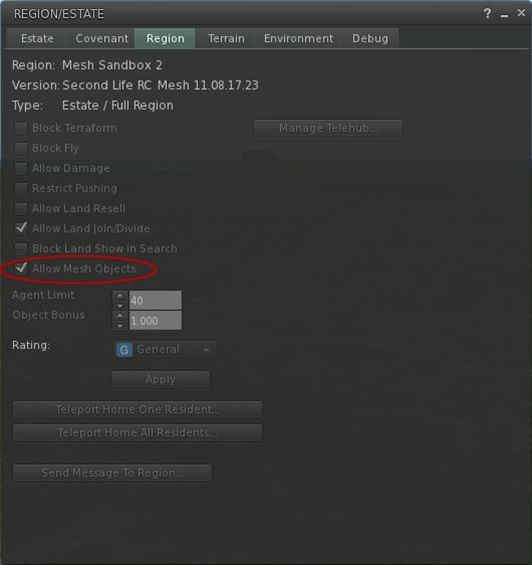
Ciaran Laval has been investigating mesh from a sim owner’s standpoint, and came upon the fact that LL have added new regional controls related to mesh.
New region setting
As Ciaran reports, the latest mesh-enabled Beta Viewer includes an option to allow / deny the rezzing of mesh objects within a region. By default, the option is set to ALLOW mesh, although currently, there appears to be a bit of a bug in the system – if you uncheck the option, it re-check itself on hitting APPLY. This may just be a hiccup in the Beta that LL are already aware of, but to be on the safe side, Ciaran has also raised a JIRA on the matter – be sure to WATCH it!
Given this issue with the option at present, it is not clear what will happen to mesh objects that are currently rezzed in-world should the option be toggled to disable mesh. Will they be returned, or will they fail to render in all viewers & any scripts they contain be disabled? One would hope for the latter (allowing for issues around collisions, physics, etc.), as the former could present a lot of angst.
The capability isn’t granular to the level of individual parcels, which is understandable given that mesh will impact an entire sim regardless of where it is placed. However, as things are refined and improved over time, it would be interesting to see if such granularity of control could be introduced in time.
Overall the addition of this capability is a very good move; mesh stands to be potentially very beneficial for Second Life, but it also carries not a few potential risks. Thus, the inclusion of this option allows estate / sim owners worried about negative impacts to disable mesh rendering from the start, allowing them to observe how mesh impacts the rest of the grid before opting to allow it.
Expect to see this option in main Viewer when the Beta is rolled over to a full release.