Update July 11th: Those impacted by the errors are reporting that their web profiles and feeds all appear to be displaying the correct pictures / information.
Update 16:35 UTC, July 9th: Some users appear to still be experiencing issues; LL have confirmed that the problem is not related to any compromise to their systems (which was unlikely anyway), but rather to a database issue. Soft Linden has requested that if anyone contacted SL Support about this issue, could they e-mail him with the details
Update 12:15 UTC, July 9th: The Grid Status page reports the “unscheduled maintenance” completed at 02:29 UTC. Again, it is unclear as to whether this work was in any way connected to the web profiles / my.secondlife issues, but my own feed history now appears to be displaying the “correct” information. Others are similarly reporting their own feeds seem to now be OK.
Update 01:47 UTC, July 9th: At 11:46 UTC (16:45 SLT) LL commenced a period of “unscheduled maintenance” on SL. Shortly thereafter people again reported that the my.secondlife.com feed were inaccessible (which had been the case on an intermittent basis alongside of the problems reported below). Whether the maintenance work – which references in-world services – also includes web profiles and my.secondlife.com is unclear. At the time of writing the maintenance work is still ongoing and feeds remain inaccessible.
Update: People from the US are reporting they are experiencing the issue as well, confirming the problem is more widespread than initial Twitter reports suggested.
Second Life users are reporting issues with my.secondlife.com. The problems are currently taking a number of forms:
The wrong pictures are showing up in people’s my.secondlife.com profiles
People’s posts are appearing in the wrong feeds
People are seeing posts from those they are not following appearing on their feeds.
Pallina60 Loon reports her Profile image appearing in Tifa Kobichenko’s my.secondlife.com feed
It is not clear how deep the problem runs, but many of those initially affected appear to be users based in Europe and there are concerns about accounts being compromised as a result of the issues. Issues are apparent whether viewing web profiles either via a browser or within the viewer.
There are some security concerns being voiced as well. While it is more likely that the issues are the result of a database error within LL’s servers rather than a deliberate hack or the result of the servers having been compromised, if you are affected and of a nervous disposition, you may want to consider changing your password.
Part of the issue on my feed: I’m receiving information on users I’ve not actually friended or am following
A JIRA has been raised on the issue – WEB-4844 – and you may want to check on your own feed and see if you are affected, particularly if you are in Europe. If you are, please ensure you WATCH the JIRA (votes do not count) and supply any information you can as to how the issue is affecting your web profile / feed in order to help bring it to LL’s attention.
Note this is a 2-page article. Use the page numbers at the end of the piece to page back and forth.
Today’s Metareality podcast covers, as usual, a lot of topics, including Cloud Party and, more particularly the possible alternative approach to mesh deformation as proposed (or possibly re-proposed, given LL apparently looked at the same idea last year) by RedPoly, and which I covered in an earlier report this week.
The panel for this panel for this week’s show comprised Kimberly Winnington, aka Gianna Borgnine in-world and Karl Stiefvater, Qarl Fizz in-world, who were joined by Cyclic Gearz and Geenz Spad.
While you can hear the broadcast in full over at Metareality, here’s a transcript of the discussion around the alternative means of mesh deformation.
[02:47] Gianna Borgnine (GB): So what is this new deformer, and how is it different? … For what I understand it works on bone definitions, is that right?
Geenz Spad
[03:07] Geenz Spad (GS): Well, basically yes, it uses several unused bones in the avatar skeleton … I guessing were used at some point to calculate the bounding box of the avatar on the server for collisions or similar. So, that’s mostly what it seems to be right now.
[03:30] Qarl Fizz (QF): I can probably add some more, but I should also specify that this is complete speculation because I haven’t had a chance to dig in … It seems like, yes, for the purposes of physics and maybe other stuff, at one point the Lindens had this approximation system put in so that when you dial your avatar sliders around, they have a basic gist of what your avatar looks like. And someone came up with the idea of using this information to do the deformation instead of the actual morphs themselves.
[04:10] GB: So, Cyclic, maybe you could answer this best: what about this is so appealing to the content creators?
[04:15] Cyclic Gearz (CG): Well, from my perspective, well, I make furniture mostly, but I still know a lot about design and stuff … And all my designer-friends who make clothes … and part of the most difficult and annoying process is having to make five separate sizes currently, because at the moment that’s the best option for attracting the most customers – having more sizes that fit more bodies – if they have a deformer that works as is, and they do the work outside of Second Life, it reduces the workflow, it reduces the time to make new things; [it] means that they can get more stuff out and therefore more customers are happy.
[04:55] GB: So my guess is, I mean I talked to a few different people and got a few different opinions, and it was interesting to see the different sides and probably the only person I talked to … who wasn’t as thrilled about it, other than some of the developers I talked to, was Maxwell Graf, who is always looking to get rid of extra sizes, so I thought he would be excited! But for him, one of the big things was that it still felt like so much extra work because now he’s back to weight painting, which is something he was trying to get away from with Qarl’s deformer … But the thing that, as a person who does not make mesh fashions … Right now at least, you’re sort-of weight painting, but you’re painting blind, because you have to upload it to see the effects of what you did. Is that right?
Avastar in use
[06:06] CG: Sometimes; it depends on how you make your mesh. For instance, with blender you can get a plugin which you can pay for called Avastar by Gaia Clary. That is a really good way of seeing what your weight painting does and has an affect. You can also get a free burn file for Blender which is called The Avatar Workbench, also from Gaia Clary, where it has got all the bones and stuff and you can see what it’s supposed to look like. But you do sort-of have to guess … if you’re not versed in mesh or anything like that, and weight painting at all, it can be quite daunting. So from that perspective, not having to weight paint would be better for newer creator, because they’d be able to build something in blender or a different commercial program and not have to weight painting, because that is really horrible stuff! But … I do think people need to learn these skills, because the skill you learn for making 3D in Second Life can be applied in real life for big jobs … you could go into the games industry making models and stuff; but if you can’t weight paint, you’re out of luck!
[07:22] GS: Personally, I used to be an artist before I was programmer, and 3D animation was something I was always very interested in, and I definitely know the pains of having to go through and paint a variety of different vertex weights for different bones and things like that. And one thing that seemed interesting to me to the new approach to a deformer that works across all viewers that support mesh is that … you have 20-something bones you currently have to rig if you really want something that really looks good and really deforms well on most avatars with regards to just an avatar moving around; now you have all these additional bones you now have to worry about. That really seems to be the biggest drawback here. Granted, there are ways to mitigate this, and as I was saying on Monday, someone should find a better workload for this if it’s really going to be a viable solution.
[08:19] GB: Which made you really unpopular…!
[08:23] GS: (Wryly) yes, because I’m a terrible person for suggesting something rational here, I guess!
[08:49] QF: So, I don’t know actually how this works, so may be you can help me, Geenz. So, what I said is true, right? These are like pseudo joints that the visual params modify to kinda …
[09:09] GS: … Kind-of get an idea of how big the collision capsule server-side should be – that’s what I’m guessing, you know? I could be wrong.
[09:12] QF: but you can’t visualise these in Blender at all, can you?
[09:18] GS: You pretty much have to manually add them currently.
[09:20] QF: So there’s no good way to … like Cyclic was saying, painting weights is hard, but you’re painting weights for … totally blind, right?
[09:33] GS: The worst part is here … there’s no guarantee that these will actually stick around in future versions of Second Life. I mean for all we know, after RedPoly outing it, Linden Lab may remove it in X number of months or they may keep it just because they’re afraid people began making content – and we know linden Lab’s policy on content breakage – So its either they’re going to break it now, or they’re not going to break it because people are going to make content with it. Danger of content breakage, here we go!
[10:10] GB: Well, Linden Lab is going to have to weigh-in at some point, because as it stands right now, it doesn’t deform around breasts or saddlebags or anything, so they would have to add in order to make it work right, right?
[10:23] GS: And on top of that, from what I can tell, the skeleton that’s being used is mostly just a rough approximation of the avatar itself in terms of its shape. That’s all you’re really going to need if you’re going to calculate a bounding box or a bounding capsule or something like that.
Partially as a result of there being something of a gap in the existing Content Creation User Group for the discussions on improving the state of content creation in SL, and as a result of RedPoly’s suggestions for improving the way in which mesh clothing fits, a new “informal” Content Creation User Group has been formed.
The organisers for the new group are Geenz Spad, Siddean Munro, Ellie Spot and Oz Linden. Geenz will be the chair for meetings, and Oz will act as the liaison with Linden Lab. It is intended for developers and content creators alike, with the aim of providing a collaborative atmosphere which will allow members to discuss features, workflows, and modifications with the aim of enhancing content creation for everyone on SL. As such, the focus of the new group will be:
To provide a forum in which content creators can voice their ideas and / or concerns about the overall state of content creation in SL
Encourage the spread of knowledge about content creation methodologies and tools
Suggest / discuss new ways to facilitate content creation in SL (including the use of new tools or possible improvements to the viewer)
To provide a focal-point where content creators can have questions answered and issues highlighted that might otherwise go unanswered in other user groups.
It is hoped that eventually, this new forum will be the means by which proposals for new functionality that will be beneficial to the community can be proposed and developed. This would in turn lead to prototypes being developed, with Linden Lab’s approval of said functionality, that will enable the potential enhancements to SL’s content creation capabilities to be demonstrated.
In chatting with me about the new group, Geenz had this to say, “As it stands, the Mesh Import User Group is for just that: mesh import; it’s not intended for discussing how we can make content creation better. The Open Development is for discussing things already in the open source programme’s development pipeline, so that’s not really the place to discuss this sort of thing either.
Geenz Spad, who will chair the new group’s meetings, standing of the stage where the meetings will be held
“Then of course you have the Scripting, Sim, and other groups, [and] discussing how we can improve content creation in general just doesn’t fit anywhere; it’s almost as if it’s in limbo. This is intended to fill that gap, while at the same time staying clear of the existing user groups in its purpose.”
A wiki page has been established for the group, and will contain meeting agendas, etc., and which also summarises the group’s function. The group itself will meet between 15:00-16:00 SLT on Tuesdays at the Hippotropolis Auditorium in SL, commencing on Tuesday 3rd July.
On June 7th, and missed in the build-up for SL9B, the Commerce Team issued a further update on the stains of ongoing work to fix various issues relating to both Direct Delivery and listings problems. This appears to be the latest in what seems to be monthly updates. The latest post reads:
06-07-2012 02:53 PM
Below is the updated set of outstanding issues with Direct Delivery and the Marketplace.
Direct Delivery
The following Direct Delivery issues have been verified, but have not yet been addressed:
WEB-4600 (Merchant Outbox failures): We have been working on this issue and will not shut down Magic Boxes until this is addressed. In some cases, logging out and in from the Marketplace and then the viewer may resolve this problem.
WEB-4554 (Test delivery permissions incorrect): This is currently under investigation.
Limited Quantity Support (Merchant does not have rights to copy the items for sale): This is currently being worked on. Magic Box migration will not be required until this is supported. (Note that Merchants can sell items that have next owner rights set to “No Copy”. Please see the Knowledge Base article on Object permissions for more details on how permissions work.)
Overall Marketplace
There are also several issues that occurred around the time of the Direct Delivery launch that we are still working to address, but are not issues with Direct Delivery.
WEB-4587 (Listings with the wrong images): This is currently under test.
WEB-4441 (Orders stuck in “Being Delivered” state): We have been able decrease the number of orders getting stuck and continue to work on preventing all orders from getting stuck.
WEB-4567 (Bulk delete fails for some merchants): We will evaluate the priority of this once we have completed the above Direct Delivery fixes and features.
WEB-4592 (Orders marked as “Delivery Partially Failed” on success): This is currently under investigation.
WEB-4696 (Deleted listings appearing in search results): We continue to investigate this issue.
WEB-2974 (Listing enhancement stuck in “Charging, cannot edit right now” state): We are investigating this issue.
WEB-4138 (Confirmation emails failing to deliver): We are currently investigating this issue.
In addition to the above issues, there have been reports of Direct Delivery purchases silently being delivered and the Merchant not getting paid (the order is marked as “Failed”). We have not been able to confirm this report and would like to investigate further, so please file a support ticket with details if you see this.
There’s been something of an ongoing discussion over the ever-excellent Metareality concerning the viability / attractiveness of a “new” Second Life – that is, a platform wherein Linden Lab starts over to present something new and overcomes the shortcomings of the SL grid as we know it today.
It’s an interesting – and entirely hypothetical – discussion point. Just how viable would a new Second Life be (if we assume the money was there to develop such a beast), both in terms of Linden Lab’s development of the platform and in people’s acceptance and use of it?
Well, some of the benefits that might come from such a product would be technical; doubtless things like the creaking mass of the asset server infrastructure could be addressed and made a lot more robust / scalable. Potentially the region / sim code could be completely overhauled to both improve stability and remove much of the “band aid” code that has, due to the nature of the platform, had to be applied to deal with various issues and bugs over the years rather than LL being able to dig deep and resolve them at source.
A new Second Life grid could also, I assume, be better geared towards handling the likes of mesh and other capabilities. Similarly, the Viewer could be revamped – and while this may draw boos and hisses – be kept closed, or perhaps licensed, to better control the growth of features and to ensure Viewer and server code remain better integrated.
There might also be the opportunity to directly address issues of accessibility through other means – tablets, web pages and mobile devices.
Would an “SL 2.0” allow the mobile / tablet markets to be better leveraged? (image: Lumiya for Second Life running on a Samsung Galaxy S2)
Social aspects might also be better integrated into the platform as well, for those who wish to use them. These are no to everyone’s cup-of tea, but that’s no reason to exclude such extensions / capabilities.
All of this could be massively to the good; but what about those of us already engaged in Second Life? Are we likely to leap onto the bandwagon of a “new” Second Life? Some undoubtedly would; but many of us probably wouldn’t for much the same reason as we don’t take a deep plunge into existing SL alternatives: we have an awful lot of what amounts to personal investment in our inventories, and if we can’t take it with us, the likelihood is, we aren’t going to go – not unless forced out of SL itself (which might easily see us giving LL the one-fingered salute and disappearing somewhere else entirely).
Of course, losing the current user base (or a good proportion thereof) might be seen as part and parcel of the risks involved in developing an updated platform – after all, with 16K-a-day sign-ups for the current platform, there is opportunity for LL to address initial retention head-on and harness a good percentage of that 16K and so not actually miss those of us who stay behind.
On the other hand, offering a migratory path from “SL 1.0” to “SL 2.0” would obviously be one way of alleviating issues around existing users, allowing LL to retain them and their loyalty while also avoiding initial issues of growing a new user base.
SL 2.0: The potential for better avatars?
However, offering such a path might itself create issues. One of the biggest potential benefits in an “SL 2.0” would be the ability to incorporate the infamous “avatar 2.0”, which has been the subject of speculation on-and-off since around mid-2007. This is something that is unlikely to happen within Second Life as it is because of a myriad of dependencies means a dramatic overhaul of the avatar could break things. As such, developing a new avatar form for “SL 2.0” could end up breaking compatibility with “SL 1.0” and render migration either problematic or (worse case) pointless.
Perhaps the biggest issue with any “SL 2.0” though, is not technical, but physical (so to speak). At the end of the day – and as Qarl comments in a recent Metareality podcast – a lot of issues relating to SL are actually centred on the relationship between users and Linden Lab itself. These take a variety of forms, some are justified (such as people feeling the company could be more forthcoming within consistent and more open communications and dialogue with the user base), others are completely unjustified (such as claims that LL are out to “kill” aspects of Second Life or that they act “maliciously” towards users).
Regardless of how justified or otherwise claims and arguments about LL are, the fact is that whatever the platform LL provides, the issues and arguments will likely continue. As such, there is a risk that any “new” SL could be taken to be “same s***, different shovel” by both sides of the relationship; users will continue to bemoan LL and LL will continue to feel they are in an uphill battle facing the same criticisms and complaints they face at the moment. This in turn could lead to both sides asking the question, “Why even bother?”
Over all of this, however, lies the biggest question of all: what, exactly, would LL achieve by taking such a route? It’s unlikely that “SL 2.0” would achieve any grater success than the current Second Life has achieved or has the potential to achieve, allowing for all the new capabilities being developed. Thus, any new variant of the platform is liable to end up occupying precisely the same niche as the current product, with more-or-less the same attractiveness to users and possibly the same grumbles and gripes – and this renders any idea of an SL 2.0 developed by LL pretty much moot. Far better that they focus efforts on improving and enhancing the current platform and in maintaining / increasing its relevancy.
Nevertheless, the idea is still an interesting discussion-point – well, for me, at least!
The continuing decline in the number of private regions in Second Life, as documented by Tyche Shepherd, is giving rise to no small amount of concern, some of which is taking the form of calls for Linden Lab to reduce tier.
Region losses: uncomfortable reading
Certainly, Tyche’s figures – a loss of 1138 regions in the first 22 weeks of 2012 – are sobering; but is cutting tier really the solution at this point in time? Is it actually possible? If not, what are the alternative?
On the surface, reducing tier might seem to be a logical option. We’re all aware that tier in SL is high – but just how practical would it be for Linden Lab to lower it? If truth be told, the answer is actually, “Not very” – and for a number of reasons which may not be entirely palatable to some, but which are nevertheless unavoidable. First and foremost is the fact that, like it or not, tier accounts for 80% of Linden Lab’s revenue, so any reduction is going to hit them very hard – and will do so for some time to come.
As it stands, the current decline in private sims amounts to around an average monthly drop in tier revenue of 0.8% per month to date through 2012 – a figure which includes the fact that tier revenue did in fact increase in March by some 1.1%. While this may sound a lot, the fact remains that overall, it is a gradual downward swing. A cut in tier is not; it is an immediate and lasting loss of revenue. Drop tier by 20% and that’s 20% of your revenue gone in a blink – and with absolutely no guarantee you can compensate for it.
Of course, it will be argued that any drop in tier will lead to an uptake in land sales which will compensate for the initial loss. However, the reality is that this is very far from guaranteed. Just because tier is lowered does not automatically equate to a sudden growth in land sales. Let’s face it, private estates are already struggling to fill their available land (and the fact that they are is also likely to be a factor fuelling the number of regions being returned to Linden Lab) – so why would they rush out to obtain even more sims on the strength of a tier reduction when the population currently isn’t there to warrant them doing so?
The one possible exception to this might be with Homestead sims. These might well enjoy an initial boom period as people opt to take advantage of the lower tier and migrate to them. However, this would be somewhat tempered by an increase in the number of surplus full regions being returned to LL that would also result from such a migration. Thus, while land may appear to grow as a result of the increased number of Homesteads, any corresponding growth in revenue for LL is liable to be much smaller, and unlikely to compensate for the tier cut itself.
The same goes for commercial enterprises: any cut in tier is an immediate increase in revenue for them – but it doesn’t mean they will rush out and set up even more stores across the grid. Why should they when the teleport can instantly bring people to their existing store? Additional stores don’t automatically translate into increased revenue – but they do incur increased costs, thus undercutting and gain made through a tier reduction. And while some might opt to take the plunge and expand – or even open new product lines in new stores – it is unlikely, overall, that a tier reduction is unlikely to bring about the renaissance of the mall in SL, for example, much less a quantifiable boost to the economy as a whole.
The cold hard truth is that however much a reduction in tier might individually benefit those of us who hold land within SL, it’s actually not going to do that much to stimulate the economy – and it will stand to benefit Linden Lab even less.
Nor is being “radical” the answer. While it is true that the one way of stimulating growth in SL is to grow the user base through increased user retention, etc., this has to be tempered with the fact that the infrastructure itself can only support so much. So while Second Life does need more users and a sustainable upswing in user retention, calls for LL to try to pull-in “millions” of users are misguided and will remain so until such time as the platform can handle large volumes of avatars in close proximity to one another on an ongoing basis. Bold and radical are only useful if they are actions taken with clear intent and realizable goals.
Which is not to say something shouldn’t be done to safeguard the future. The question is what that something should be.
And it is a question Linden Research has already taken steps to address – although not in the way many have guessed. Because the answer isn’t in the company trying to reduce tier – not yet, at least – or in doing anything else with Second Life itself. Rather, they are seeking to address it through their drive to diversify.
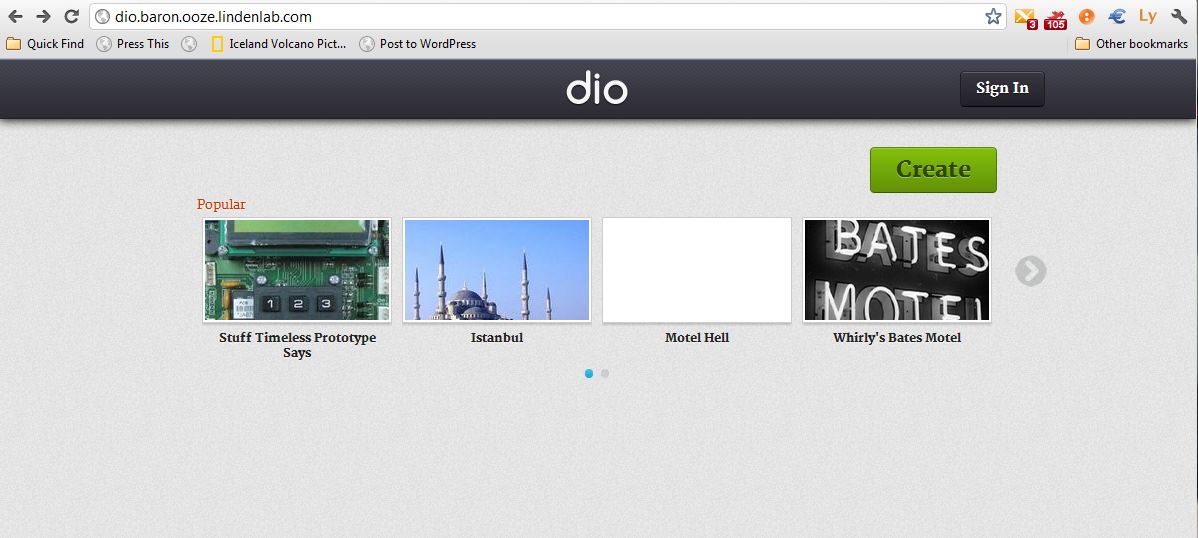
As has been reported far and wide across SL and other blogs, Linden Research is in the process of developing a portfolio of non-SL products, at least one of which, called Dio, is nearing readiness for closed beta testing. These products that are important for two key reasons:
They will open up new revenue streams to the company, thus reducing the strain on SL as the company’s single source of revenue, potentially allowing the company to be far more flexible in how it handles the platform fiscally;
They make Linden Research a far more attractive proposition for investors.
Dio: Linden Research closed beta almost ready?
Of course, it will take time for the revenue streams from the new non-SL products to mature. But as it stands, Linden Research perhaps has that time at their disposal, despite the current sim losses. In March, during a discussion on her blog, Tateru Nino estimated that the break point for LL in terms of private regions losses would be around 6,000 fewer sims than were on the grid at that time. Assuming the rate of decline in regions continues at its present rate, then LL will reach that break point about 24-30 month from now – which is potentially more than enough time for the revenues from these new products to make their presence felt.
Not that the company actually needs to wait that long. As mentioned above, the new products have the potential to benefit the company more immediately through inward investment through them. This is unlikely something that has been lost on either the management team or the board, especially given the mounting interest in, and speculation around, a new era of narrative games.
This may be of scant comfort to those of us feeling the pinch in Second Life right now – but the fact is that when it comes to tier and LL’s revenue, there is no easy answer, and any solution that is offered up is unlikely yield the anticipated benefits. Nor can the SL revenue model be easily or radically shifted. As such, the move to diversify into new product lines is perhaps the one means by which Linden Research can remodel its revenue streams without harming itself, and bring about the means by which it can take a more flexible approach to the management and operation of Second Life. If this is the case, then the company has perhaps shown itself to be far shrewder than people are prepared to credit.




 Inara Pey: Living in a Modemworld