Run silent, run deep: the SL Marketplace and eroding merchant trust

Update October 4th: Linden Lab have issued a forum post on this matter, please see LL updates on listing enhancements.

Linden Lab depend on land tier (server space, call it what you will) for  80%(ish) of their revenue. This places them in an awkward position vis-à-vis providing any form of tier easement, even if they wanted to (as I’ve commented before).

The remaining 20% comes from the likes of Premium membership, and more particularly, the SL Marketplace (SLMP). In the case of the latter, the revenue doesn’t only come from the 5% commission on goods sold through the Marketplace, a lot of it comes via the listing enhancements merchants are encouraged to pay for. These theoretically boost sales by placing items in places such as the SLMP home page, or on the Checkout pages, and are paid for on a 30, 15, or 7-day rolling subscription basis, costing merchants between approximately $5.00 and $12.00 USD a month per item, with some merchants paying over $200 USD per month for enhancements.
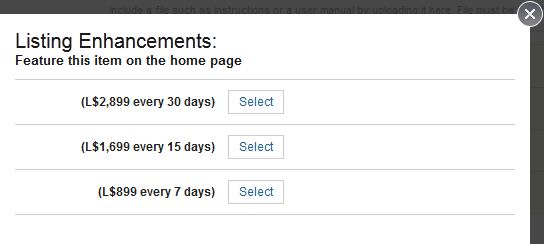
Listing enhancements – can amount to a pretty penny in outlay per item

Earlier this year, the system went haywire, failing to take due subscriptions for around a two-week period (JIRA WEB-4638). It was finally resolved by Linden Lab taking a single, large payment from merchants’ accounts. While people had no issue in paying for services rendered, the problems here were that a) next to no forewarning was given that accounts were about to be so debited, leaving many merchants with a sudden and unexplained drop in their account balances; and b) many were billed in excess of the two weeks subscriptions actually owed (with some reporting being billed for up to four weeks); while c) the billing information received made it hard for merchants to actually determine which of their listing enhancements had been billed, or even if the right enhancements had been billed.

This understandably led to some confusion within the merchant’s forum, and not a little upset, particularly as some merchants had also been faced with an inability to cancel some of their listing enhancements due to an ongoing issue with many items remaining stuck in a “locked” mode, preventing them from being edited – a situation itself which at the time was some 18 months old (and is now some two years old, and still awaiting resolution – see WEB-2974).

While merchants were refunded for any overcharging on their account as a result of the billing issue, the manner in which the situation was handled by LL resulted in something of a drop in trust where the Marketplace is concerned, and a number of merchants publicly indicated they would be ceasing in their use of enhanced listings.

At the end of July, the problem started again, and was raised as a topic for discussion in mid-August, as well as having a new JIRA (WEB-4927) raised against it. Neither the discussion thread nor the JIRA drew comment from the Commerce Team. Instead, a single payment was taken from all “at fault” accounts, again without any forewarning, and again with Merchants facing issues over what, precisely, they have been charged for, and whether those listings they have made payment against are actually active.

Failed subscriptions for August – courtesy Ry0ta Exonar

Again, the problem here is not so much that things Went Wrong and broke again – that’s pretty much taken to be the standard operating condition for the Marketplace nowadays – but how the Commerce Team managed the issue. Almost nothing was said on the matter (again), with the only communications forthcoming from the Commerce Team being a terse instruction not to re-open WEB-4638 after Ry0ta Exonar attempted to do so (hence WEB-4927), and a brief Marketplace dashboard message posted on September 28th, which simply said:

We are aware of some issues with Product Listing Enhancements. Keep an eye on the Grid Status page for more details.

With neither the dashboard message or Status page message actually stating what was about to be done.

So is it little wonder that merchants are again looking at listing enhancements with a jaundiced eye? Several have re-stated the fact that they will no longer participate in the process and others have stated they are terminating – either automatically or manually – their subscriptions. Given that LL are seeking to increase their non-tier related revenues, one would think that ensuring the one service which does so is run with a level of professionalism and communication that would not undermine customers’ faith in the service, or their willingness to place money into it.

Currently, and added to the rest of the ongoing litany of issues and problems with the Marketplace, this doesn’t appear to be the case.

Related Links

Of blogs and sundry thoughts

The Second Life Blog was once a place where the Lindens talked casually with you about policy, their projects, recent news, the future of SL, etc.  Residents regularly told us that they loved having access to such broad insight into the company and frequent communication with the full range of Lindens.  And Lindens loved the ongoing dialog with residents.

Sounds like something I might have said here – or you might have read from Tateru or a dozen other SL commentators. A harkening-back to the “good ol’ days”.

But it’s not. It’s actually from – wait for it – a Linden, who went on to say:

Over time however, as more Lindens came to participate, the blog got a bit manic. Some of you complained that reports of temporary performance issues would eclipse larger conversations related to long-term plans and features while others believed that tutorials and opinion pieces were distracting them from the hard news of inworld issues they needed to know about in order to run their businesses.

In other words, we outgrew our single channel blog […] We knew it was important to get back to using the blog as a key means of constructive two-way conversation with the community.

“We knew is was important to get back to using the blog as a key means of constructive … conversation…” How times have changed, hmmm?

These quotes come from the Linden Lab blog archive on WordPress. Written by Blue Linden (sadly gone in the re-organisation of June 2010), they demonstrate how much attitudes have changed within LL over the last three years.

The LL blog archive on WordPress

Continue reading “Of blogs and sundry thoughts”

Considering SL large regions

While reading the transcript of the Simulator User Group meeting of Tuesday 25th September as a part of preparing my last SL projects update, I came across an interesting exchange on the subject of large regions –  megaregions in OpenSim parlance – which gives some insight into the broad level of thinking about the platform that goes on within the Lab.

For those unfamiliar with the concept, a megaregion is essentially a number of standard 256×256 metre regions stitched together to present what appears to be a single large region. These are generally presented in terms of areas equivalent to 2×2 regions (i.e. 4 region in total) or 3×3 (equivalent to nine regions) and so on.

The Universal Campus designed for 4-region (2×2) megaregions, created by Michael Emory Cerquoni. The arrow indicates my avatar, to demonstrate the size of the build

Megaregions have been available within the OpenSim environment for the last few years, and are seen as means of providing far more space free from the terrors of region crossings, greatly facilitating a range of activities – flying, sailing, vehicle racing, etc., – although there are some limitations with them at present, which can make working with them difficult (parcel media tends to be restricted to the South-west corner “region” of a megaregion, for example, and elements such as terrain textures cannot currently be easily edited).

Second Life is very much geared to the 256×256 metre region, so it was surprising to come across a discussion on large regions in SL – and to learn that Linden Lab have in fact looked at them in some detail. The revelation came in a comment from Simon Linden, “Yeah, big regions have been a pet project of mine … unfortunately it’s an incredible hassle to get right,” he goes on to say, a short time later:

I’ve spent some serious time looking at large regions … it’s a huge project to do it right, involving a bunch of messaging changes to the viewer (like layer data, object positions, etc), region-to-region communication (all the neighbours) our back-end (the grid layout itself) … it touches almost everything in some way, which is why we’re where we are today 😛

Simon also indicated that he felt an ideal size for large regions – were they ever to happen – would be to a scale of 1 km on a side, rather than  1024m on a side (as would be the case if large regions were somehow “scaled up” from the current region size, as with OpenSim). However, this would mean breaking away from the current power of 2 approach to building Second Life, and might lead to position translation issues (as in translating the position known in one region to the relative position in a neighboring region), although Andrew Linden felt this might actually be easier to handle this in 1k blocks between neighbouring regions, rather than relaying on power of 2. When asked as to what would happen to the 24 metres per side which would be lost in scaling to 1000x1000m, rather than 1024×1024, Andrew suggested (semi-jokingly) that they’d be lost “To … boundary conditions.”

Large regions in SL would offer much to the sailing, flying, role-play and racing communities, were they possible

Were any change in region sizes to be undertaken, they would not be limited to just the simulator / server-side of things. The viewer itself is predicated on the power of 2 approach, being specifically geared to handling regions of 256m on a side (hence why megaregions in OpenSim have some limitations in terms of editing, etc.). So for large regions to work properly, it is likely that substantial changes would have to be made to the viewer – which even with the best will in the world, isn’t something which is going to happen any time soon, even were LL pondering looking beyond the theoreticals of large regions.

Nevertheless, the fact that the matter has been – and might still be – something some in Linden Lab are actively looking at, even at only the conceptual level, is interesting, and does tend to demonstrate that LL do think about the platform in somewhat radical ways.

Marketplace issues: September update

On September 20th, Commerce Team Linden provided a terse update to the ongoing problems related to direct delivery. The Update reads in full:

The transition from Magic Boxes to Direct Delivery has been extended indefinitely. We will be providing a 30-day warning before any shutdown actions are taken and will avoid doing this before peak holidays for the Marketplace (Halloween, Christmas/New Year’s, Valentine’s Day).

We are aware that some Merchants are still having problems with the Merchant Outbox. We are are working with TPVs and our internal development teams to address this issue.

The comment relating to TPV involvement possibly relates to  WEB-4600, VWR-28630/VWR-28631 and VWR-28629, although it has caused some confusion, as there appears to have been little or no recent discussion on matters between LL and at least one TPV team.

The update gives no further information on the status of the range of JIRA items related to the Marketplace which have been under investigation now for the greater part of 2012. These items comprise:

  • Limited Quantity Support Merchant does not have rights to copy the items for sale (no JIRA number supplied)
  • WEB-2974 (Listing enhancement stuck in “Charging, cannot edit right now” state)
  • WEB-4138 (Confirmation emails failing to deliver)
  • WEB-4441 (Orders stuck in “Being Delivered” state)
  • WEB-4554 (Test delivery permissions incorrect)
  • WEB-4567 (Bulk delete fails for some merchants)
  • WEB-4587 (listings with the wrong images)
  • WEB-4592 (Orders marked as “Delivery Partially Failed” on success)
  • WEB-4600 (Merchant Outbox failures)
  • WEB-4696 (Deleted listings appearing in search results)

Meanwhile, in the Marketplace release for September 26th, 2012, the Commerce Team did successfully change the “sent from” from email address to service@mail.Secondlife.com for all sales notification e-mails sent to merchants (this was previously no-reply@marketplace.secondlife.com). However, as no formal notification was apparently given on this change ahead of time, many merchants only discovered the change as a result of their e-mail applications treating incoming sales notifications with the new “from” address as spam …

Second Life RC channel server deploys cancelled

The server deploys planned for Wednesday September 26th have been cancelled. The news was given in a brief update to the the Sever Deploys blog post, which simply read:

UPDATE: There were blocking bugs found in both the RC’s planned for release this week. There will be no releases Wednesday morning. There will be no rolling restarts.

Oskar Linden also added a comment:

We found blocking issues during our pre-RC smoke tests. These issues will block the Wednesday morning RC releases. Regions will not be restarted.

Classified as maintenance releases, the deploys were to have included back-end configuration work designed to help SL run better on new and future hardware, and Baker Linden’s new Group Services code.

The postponement is the second time RC deploys have been cancelled in the last two weeks, with those planned for the week commencing 17th September being cancelled as a result of failing to pass QA testing.

As a result of last week’s RC cancellation, there was no main channel deploy on Tuesday 25th September. While the RC channel deploys might be rescheduled for later this week, depending on the severity of the reason for them being cancelled in the first place, if they do not take place then it is probable that there will be no main channel roll-out again next week.

LL’s new products aren’t the end of Second Life

It’s been interesting to watch reactions toLinden Lab’s recent announcement on the forthcoming launch of two of their new products – Creatorverse and Patterns.

While many have responded positively to the announcement, it is fair to say that some have not, categorising LL’s diversification as a sign that either the company given up on Second Life, or that the company can now only develop products or continue to develop SL rather than doing both. I find both attitudes completely unfathomable, although in the case of the latter, not entirely new. When it comes to even trivial, easy-to-make changes that are essentially crowd pleasers, there can often be a response from commentators who feel that company is only doing so at the expense of working on more serious matters – as if LL can only do one or the other.

Patterns: some see LL’s move to diversify as a sign the company has “given up” on SL (image courtesy of Linden Research Inc.)

They’re Still Working On It

The view that LL are developing new products because they’ve “given up” on Second life is one I find curious because in the 13 months following Rod Humble announcing the company would be diversifying, Linden Lab has clearly shown that it actually is continuing to develop and enhance SL – and what’s more, the work is taking place alongside the development of their new products. Since the beginning of 2012 alone we’ve seen LL:

  • Making what they refer to as being one of the largest investments in hardware and infrastructure for SL to date (which came on top of a major hardware investment in 2011)
  • Investing heavily in manpower, time and effort to bring greater and broader capabilities to Second Life, including:
    • Pathfinding
    • Materials processing – which should revolutionise how SL looks compared to modern games
    • A new HTTP library capability aimed at eliminating many of the major issues we’ve long complained about, with texture load times and large group loading / management fixes being the first two to rolling-off the development line
    • Advanced creation tools which will (permissions allowing) help enhance SL in a wide variety of ways
    • Re-working interest lists and object rezzing to develop a faster, more logical way in which objects are rezzed around us when we teleport in-world
    • Providing a new avatar baking process to eliminate bake fail
    • Developing multi-threading region crossing to help eliminate sim boundary issues
  • Purchasing a Havok sub-licence arrangement which, despite worries over TPVs and connectivity, could in the future yield significant improvements to SL through the provisioning of dedicated Havok libraries accessed by the viewer
  • Pro-actively working to find a new audience for SL through the forthcoming link-up with Steam
  • Working to nail down long-standing issues within the viewer – memory leaks and so on – in order to make the whole SL experience less prone to bumps, thumps and outright crashes
  • Seeking to improve their customer support, and working towards providing better assistance for TPV users where it is logical for them to do so.
Materials processing: enhancing Second Life

True, we may not necessarily like the way the company is developing the platform (pathfinding being the current bug-a-boo). There are also decisions the company has made and is making which may confound us or seem counter-intuitive; I’m still very much frustrated at their willingness to even engage in an ongoing one way dialogue towards users, for example. While such moves and decisions may well cause us concern and / or regret, they don’t actually point to the company as having “given up” on SL; and we shouldn’t confuse the two issues.

It’s Not Time Taken from SL

When it comes to the actual development of the new products themselves, there appears to be a misconception among some that LL has only been able to do so by taking time and resources away from Second Life. Yet, outside of senior management, this would hardly appear to be the case. For a start, and since mid-2011, Linden Lab has been recruiting very specialist skills aimed specifically at developing new products separate from SL itself. Secondly, we need to remember that in the case of at least two of the three new products we know about, the creative resources have (at least in part) come from outside of SL. Dio is being developed by Richard Evans and Emily Short, both formerly LittleTextPeople, a company acquired by LL and who have had little if anything to do with SL; while Patterns is being produced in partnership with games developers Free Range Software.

Continue reading “LL’s new products aren’t the end of Second Life”