Linden Lab has announce the coming introduction of a new account security mechanism: receipt of an e-mail notification when your account is being accessed from a previously unknown (aka “new” to the SL services) device.
Receipt of such e-mail notifications is something of a common standard for many platforms and on-line services, helping to provide an additional layer of protection against unauthorised attempts to access and use an account.
No actual date as to when this service will be going live is provided, but the Lab note that as it is rolled out, it is more important than ever that users make sure they have verified the e-mail address they use in association with their Second Life account.
We are going to be introducing an additional way for you to keep your account safe! When we detect that your viewer is being accessed from a new device, we’ll send you an email that looks like this:
SUBJECT: Important: [FIRSTNAME LASTNAME] used from a new machine to access Second Life.
Your Second Life account has been accessed from a new machine. If you recently logged in to Second Life from a new device you may ignore this mail.
Account: [FIRSTNAME LASTNAME] Time: [TIME IN SLT, example 2022-02-11 09:09.00 SLT] Originating IP Address: [IP ADDRESS OF NEW COMPUTER] If this was you, you don’t need to do anything. If not, we will help you secure your account: What To Do If Your Account Has Been Compromised.
This is a further measure in providing Second Life users with better account security; as a separate measure and in September 2021 Linden Lab implemented the first phase of multi-factor authentication, offered to users on an opt-in basis. This will soon be extended to include the viewer (see: 2022 CCUG and TPVD meetings week #5 summary and 2022 CCUG and TPVD meetings week #7 summary) – with further enhancements to the capability also being planned.
February / March are important months in the world of fashion, being the period when the “Big Four” cities – New York, London, Milan and Paris – each hold their own flavour of Fashion Week, giving home-grown and international designers and fashion houses opportunities to show off their collections and lines for the end-of-year autumn / winter season (with each city also hosting a further Fashion Week in September / October where they look towards the following year’s spring / summer season).
Over the last couple of years, these mega events have had to re-invent how they operate and reach their audiences thanks to Covid, with Zoom, Instagram, TikTok, AR and more all being experimented with and leveraged in one way or another. And while 2022 has seen many of the barriers to audience-based events relaxed (such that 5-day London Fashion Week, for example, will feature some 250 designers and fashion houses present their work to audiences at events across the city), some designers are retaining a virtual edge to their work, thanks largely to the all of the buzz around “the metaverse” and things like NFTs.
As reported by the likes of Vogue and Glamour UK, both the New York Fashion Week has, and the London Fashion Week will, feature designers with digital “metaverse” offerings – one of whom in particular has seen Second Life as having powerful relevance when it comes to fashion.
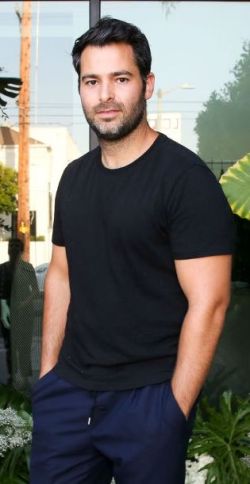
Designer Jonathan Simkhai
The individual in question is New York fashion designer and 2015 CFDA/Vogue Fashion Fund winner, Jonathan Simkhai. As a part of the New York Fashion Week event, he offered a special preview of some of his designs from his Autumn / Winter 2022 (AW22) collection at a special fashion show that took place in Second Life.
In all 11 pieces from the collection have been visualised for Second Life by none other than Mishi McDuff (aka Blueberryxx), founder and owner of SL’s popular Blueberry brand (and, I will admit, one of my go-to designers on the admittedly rare occasions I feel I need to spruce up my virtual wardrobe). In bringing the designs to SL, Blueberry has also given them a special “metaverse flair” – utilising the unique advantages of the digital world to offer twists to some of the items that cannot be replicated in the physical world – such as a sequined dress that gradually loses its embellishments and morphs into a bodysuit as the model walks the runway.
The items were presented to an invited audience of models, influencers, celebrities, and journalists from the fashion, technology and lifestyle industries. They had the opportunity to see the virtual items ahead of Simkhai presenting their physical world equivalents on the New York catwalk, so the guests could witness the virtual garments and their unique properties up close – and even try them on.
This may sound like something straight out of 2006-2008, when many physical world brands tried to hop into SL in the belief it would magically allow them to grow their market influence, but actually it isn’t. The Simkhai / Blueberry relationship is far more symbiotic and engaging, and for two reasons.
The first is that as well as being presented to invited guests, the Second Life Simkhai collection will be the subject of a series of catwalk shows open to Second Life residents on Thursday February 17th / Friday February 18th, with shows set hourly from 13:00 through 16:00 (inclusive – see the Destination Guide link at the end of this article). Not only will these serve to show the designs to the Second Life community, they will also – according to Vogue’s Maghan McDowell – allow SL users to purchase them at around L$1,000 per item.
The second reason is that Simhkai – who has already utilised the likes of Zoom and Instagram to engage with clients, customers and audiences and build “communities” – sees Second Life as a vibrant community into which he can tap in a bi-directional manner: he can bring his designs to a new, digital customer base, and he can offer existing customers a new and exciting way they can represent themselves, as he noted in talking to Maghan McDowell:
This is about introducing the brand to a new customer. And for my customer who might not feel like the metaverse means that much to her yet, this will be a nice introduction and discovery. My design philosophy is leaning into dichotomies or juxtapositions. We are all so obsessed about looking at fashion history, but this is really about looking forward and looking into the future, with Covid giving us a kick in the backside.
– Jonathan Simkhai, Vogue Magazine
In this, Blueberry is a particularly good partnership brand: not only has the brand achieved in excess of 20 million unit sales in the course of a decade, it has encouraged a loyal customer base, become a watchword for digital quality and also embraced platforms beyond SL. All of which adds up to the potential for a genuinely symbiotic relationship; given this, it will be interesting to see what comes of this initial experiment.
And how did Blueberry and Simkhai get their VIPs into SL? Rather ingeniously, as McDowell (again) explained in Vogue:
Before attending Simkhai’s virtual show, guests first submitted images that were turned into avatars, then selected which Simkhai piece they wanted their avatar to wear. Guests were dropped into the space via a link, viewing the collection — and other guests — from unique angles, just as they would in the physical world.
– Maghan McDowell
It’s a novel approach – one potentially not that easy to scale without a lot of work – but for small, specialised events, it is something that could help to get SL seen as a potential platform for a variety of events, presentations, etc., where previously it has been ignored. These may not do much to grow the platform’s retained and engaged user base, but that doesn’t mean they cannot help in terms of more focused engagement with the platform by a broad cross-section of possible audiences.
In covering the broader scope of fashion and technology – including the inevitable love affair with NFTs (albeit one with perhaps something more quantifiable for the purchaser that much of the dross / ponzi acts we’ve thus far seen) – the Vogue piece in particular makes for an engaging and informative read. It’s just a bloody shame that it sits behind a pay wall; hence why I include the Glamour piece; it is shorter and less detailed, but it does cover similar ground in talking about the Blueberry / Simkhai experiment and the “metaverse dabbling” (so to speak) of other designers such as Roksanda Ilinčić.
More is promised in terms of digital fashions in the coming year, and it really is good so see Second Life to be sitting pretty much at the centre of things at this point in time. Kudos to Mishi and Jonathan Simkhai in their collaboration; I genuinely hope it continues. And full marks to Jonathan Simkhai for not just going after the (yet to be proven) world of NFTs, but for leading from the front and dicing into the potential of Second Life.
I can’t operate in fear of being criticised, otherwise I would have quit this job six months into it. The bigger the risk, the bigger the reward. So many New York designers went to Paris to show — and we are going to the metaverse.
– Jonathan Simkhai, Vogue Magazine
With thank to Vikki Vortex for access to the Vogue article.
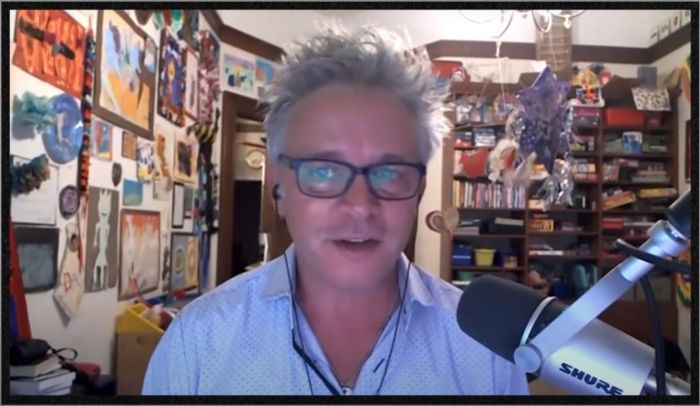
Philip Rosedale in Remember Second Life? It’s Now Taking On Big Tech’s Metaverse. Credit: The Wall Street Journal
If there is one thing that can certainly be said concerning the news that Philip Rosedale has “returned to Second Life” is that over the last few weeks it has certainly generated a lot of interest from the media.
I’ve already covered articles on Rosedale, Second Life and his views on “the metaverse” from the likes of Protocol (see here)¹, and VentureBeat / GamesBeat, c|net, and The Wall Street Journal (see here)² – admittedly with some speculation on my part on the case of the latter. More recently Wired and others have also covered SL, Rosedale and “the Metaverse”, and he has been interviewed by CNN, CNBC (the latter of which I’ve yet to summarise), and most recently, by The Wall Street Journal once more.
The latter takes the form of a video segment – embedded below – that features Rosedale taking about Second Life, its users and “the metaverse”, whilst comparing and contrasting SL with plans voiced by the likes of Facebook / Meta and Microsoft and touching on the Lab’s hopes for SL – including further hints at the direction in which the company is leaning in terms of upping the platform’s appal to a broader audience.
Running to 20 seconds short of 6 minutes, the video is actually a concise and honest look at SL, and comes complete with a careful underlining of the age of some of the in-world footage used – a refreshing touch given that so often we are confronted with “archival” images / footage of the platform that get presented without any cage context, and so can leave people thinking they are looking at SL as it appears today.
Starting with Zuckerberg enthusiastically stating how people will all “work, learn, play, shop” in “the metaverse”, the piece quickly reminds viewers that for Second Life, all of that promise is very much a case of “already there and doing all of that, thank you!”. It then offers a fairly accurate recap of SL’s history in terms of early attractiveness, user engagement, and gradual (if somewhat low-key overall) resurfacing of interest (which predates all the current “metaverse” hype by around 24 months). As such, it neatly packages:
The the history of SL and its longevity.
The broad attractiveness people have found with the platform – notably the appeal of content creation and the power of the economy SL has forged.
A frank, thumbnail look at some of the issues those coming into the platform face in trying to understand it (the IU, understanding avatar operation & customisation, finding others (particularly those of a like mind) with whom to interact, etc.
Slightly conversely with the above, it also underscores the fact that while complex to understand, SL’s avatar system is still incredibly powerful and well beyond anything the likes of Meta are considering.
The reiteration of the idea that virtual worlds down actually need VR or other headsets for engagement, and any focus on such hardware will, for a foreseeable future at least, remain a hurdle to potential engagement rather than a benefit
The openness in allowing some doubt about all the current hype around “the metaverse” to be expressed.
The underlining of LL’s approach to basic aspects of their platform in order to (hopefully) generate better user take-up and retention (e.g. improving performance, developing mobile support, improving (/simplifying) avatar user and the viewer’s UI).
The video also neatly encapsulates some of the problems “the metaverse” faces that appear to be outside of the thinking of Meta, etc. One of these is clearly stated by Rosedale: getting the vast majority of people simply comfortable with using avatars for tmany of their interactions. Like it or not, this is a stumbling block, and one Rosedale is correct in point out. Were it not, then after nigh-on 20 years, it would not be unfair to assume SL’s user base would likely be somewhat larger than its current 1 million active monthly users.
That said, this is also where the video is apparently a little too glib. In making the comparison between SL’s and Meta’s monthly active users (3.5 billion for the latter across its platforms), there is a suggestion that Meta has a big head start – but that’s hardly the case. If anything, I’d suggest the Meta has made its life that much harder compared to LL. Not only do they have to convince that 3.5 billion active user base of the need to swap away from doing much of what they do “in (first) person” – so to speak – to doing it with an avatar, they’ve also got to convince them to do so with a headset strapped to their faces. Given that currently, they probably have around 10 million headset users out of that 3.5 billion, they clearly have a huge mountain of their own to climb to get the rest to invest in headsets, even with a cash pot of up to US $10 billion to spend in doing so (which I assume includes money directly related to further headset development, etc.).
There are some wider holes in the piece that could be picked at – such as what the likes of Microsoft and Meta really mean by “interoperability” and the “movement of assets”, and whether, beyond some perfunctory basics they’ll really go down that path (after all, walled gardens are the best way to hold on to an audience – and their money); but at the end of the day this isn’t a piece on the metaverse per se. It’s about Second Life and its continuing relevance in the world today.
On Monday, January 31st, Linden Lab streamed a pre-recorded session of Lab Gab featuring the company’s Executive Chairman Brad Oberwager (Oberwolf Linden) and the Lab’s co-founder, Philip Rosedale, who recently re-joined Linden Lab in the capacity of a strategic advisor, having left in 2010 to work on a number of projects – most notably co-founding High Fidelity Incorporated in 2013.
The session was built around more than 300 questions submitted by users in the wake of the announcement that High Fidelity had invested in Linden Lab in terms of money, patents and personnel.
The following is a summary of the session, the full video of which is embedded at the end.
For ease of reference, I have broken this summary into heading based on the topics discussed through the session, and timestamps to the relevant start point in the video are provided for each.
Throughout the summary comments made by / questions directed towards Brad Oberwager are preceded by [BO] and those relating to or made by Philip Rosedale are preceded by [PR].
Note that audio extracts, where provided, have (as usual) been subject to some editing to remove pauses, repetition and the occasional aside that fall outside of the topic being discussed. This has been done with the aim of making it easier to follow the comments being made, and without changing the context or meaning of any of the statements made.
After leaving Linden Lab in 2010, went on to establish Coffee And Power (2010-2012), prior to co-founding High Fidelity, a company initially focused on building a VR headset-centric virtual world.
In 2019, the company concluded the current generation(s) of VR headsets would not be commercially successful enough to sustain a virtual world environment. So the company pivoted away from this in 2019 – see: High Fidelity changes direction: the reality of VR worlds today (& tomorrow?), High Fidelity changes direction (2) and High Fidelity changes direction (3): layoffs & shuttering apps and access), eventually opting to focus of 3D spatial audio.
The Spatial audio side of the business – which already has the software licensed to a number of customers – will continue, However, the company retained a core set of skills based around building VW technologies, and with Brad Oberwager coming into Linden Research in a very hands-on capacity, he and Philip reached agreement that there is a synergy between the VW expertise at Hi-Fi and the work LL is doing with SL.
His personal view is the Second Life is the place to explore where virtual reality might go next, as it remains the cutting edge example of what a virtual is, and what might be achieved within one.
On What the Investment Means for Second Life / LL and for High Fidelity
Looks at the relationship in three ways: personal, business and “meta”.
Personal: he and Philip have been friends for a long time. They share lot of personal time (e.g. travelling to and from Burning Man together, sharing walks and the occasional beer, etc.), and he has a lot of respect for Philip as well as liking him, and he is also a person he would like to emulate. Sees being able to connect with Philip within a business environment as “very gratifying”.
Business: running a platform like Second Life as a “great responsibility”, and fully acknowledges the platform is nothing without the users. So sees having someone with Philip’s vision to offer tactical and strategic input from outside of the company very beneficial.
“Meta”: believes that any / all consideration of “the metaverse” or of “metaverses” requires a moral compass. If it is left purely up to big corporations that generate their revenue through surveillance / behavioural monitoring (to deliver ads, content, etc.), could be “very dangerous”. In questioning of this approach and its associated technologies, he feels Philip has demonstrated he is that moral compass at this point in time, and is someone who continues to focus on serving and supporting users.
[PR]
In terms of Hi-Fi, the company retains a core team working on the spatial audio product, which is being licensed and will continue to be developed and licensed.
As an advisory role, is not responsible for day-to-day decision making with the Lab.
Meets with the various teams at Linden Lab as and when they specifically would like his input / ideas / perspective.
Very much appreciates being seen as a moral compass.
Also hopes that his experience as an engineer and product strategist can be put to practical use.
Personally enjoys becoming a voice at the table again in an environment where responsibility for the platform’s growth is shared between the company and the users.
On Their Friendship and Mutual Approach to SL / LL
[BO] Initially met around twelve years ago through mutual friends when taking a boat trip around San Francisco Bay. At the time Brad was trying to close his first major business deal and “acting like a goofball” and being “obnoxious” when he noticed Philip was watching him. Once on the trip, they started talking, which lead to dinner (with at least Philip’s wife – whom Brad has previously referred to as his “closest friend” – joining them).
[PR] notes that Brad had always shown an interest in Second Life, and when he happened to mention the Lab was looking to put itself up for sale, Brad was immediately interested in the opportunity presented.
[BO] On the subject of buying Linden Lab:
Understood that SL as a virtual world has different needs to those of LL as a company, so felt there was a real danger that had LL been purchased by an entity that didn’t understand the difference between the needs of the platform and the needs of a company, SL could have ended up being squeezed for revenue.
Took a much different view in acquiring the company, with a willingness to invest in a commitment to make the platform “better” – although he admits he is not that sure what “better” actually means.
As such, he acknowledges that running Linden Lab requires a “looseness” of approach and outlook that others might have missed.
[PR] Felt he left Linden Lab in 2010 without knowing whether or not he’d built a successful culture at the company whilst its CEO. However, believes that it has become apparent that it does take a special kind of company to steward Second Life. The fact that the culture within the company remains very similar to when he was CEO has both made him confident that the right choices were made and made returning to the company and the platform “easy”.
PR – On Returning to LL and His View on SL in 2022
If he could provide advice to Facebook, it would be “don’t do it”.
Particularly believes that the temptation for companies such as Facebook to enter the metaverse environment and attempt to parlay their surveillance / behavioural business model (utilising data gathered on users for the purposes of generating revenue through targeted ads and content) would be extremely harmful.
In contrast, Second Life has clearly demonstrated a fully scalable business model that operates purely on a fees-driven model, one that generates more revenue dollars per user per year than You Tube through its model, and probably than Facebook.
As such, believes the approach taken by LL / SL is much less prone to the risk of abuse and is safer than those espoused by the likes of Facebook and Google.
[BO]
Would add that as well as generating more money per user, Linden Lab also spends more per user.
Believes this is critical because a platform like You Tube is scale based: it relies on building a larger and larger audience, which in turn drives the surveillance / behavioural business model (more users means more adverts can be served and more revenue generated from advertisers, etc.).
The Second Life model, however is not just about user acquisition but is more equivalent to the physical world consumer model of supply and demand (or perhaps more properly for SL – demand and supply). So, the more closely links LL’s ability to generate revenue to its ability to offer capabilities and services to users, the more attractive it is for users to spend money on the platform.
As such, the decisions made by the likes of Facebook with regards to its platform will be very different to those made by the Lab for Second Life and its users.
The last full week of January 2022 saw Second Life experience a number of hiccups that causes no small amount of gnashing of teeth and rumblings from those of us affected.
With April Linden now departed, I wondered if we’d get any formal notification as to what what wrong – and on Monday January 31st, we indeed did, when the Lab blogged Recent Outages.
In short:
The week-long, if intermittent (for some) inventory issues: appear to have boiled down to an infrastructure overload, with an initial fix put in place followed by a back-end deployment it is hoped will prevent any recurrence.
The SLS Main channel restart freeze: for around 40% of the grid: a change in the simulator restart code resulted in some 12,000 simulators on the main grid attempting to re-start simultaneously, overloading the system, with many then hanging mid-restart. Steps have been taken to prevent this happening again.
Wednesday January 26th roll-out / rollback: an attempt to deploy (and then rollback) tools intended to help gather information on group chat performance hit problems, resulting in issues with login, group chat, and presence information, requiring Operations to intervene and crank the rollback.
The official post isn’t quite to April’s level of detail although it is chattier than the above, and provides all the info for who may need further info should it be required. 🙂 .
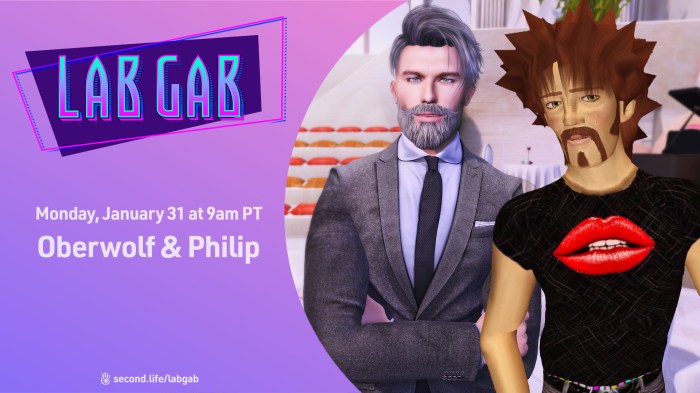
On Monday, January 31st, there will be a special pre-recorded edition of Lab Gab featuring Linden Lab’s Executive Chairman Brad Oberwager (Oberwolf Linden) and the Lab’s co-founder, Philip Rosedale.
As noted in an official press release and within this blog (and others), High Fidelity Incorporated, the company co-founded by Rosedale in 2013, following his departure from Linden Lab, has invested in Linden Lab, bringing with it an a influx of money, patents and new and returning skills.
Following the press release, the Lab also issued and official Second Life blog post on the matter, in which they invited Second Life users to submit questions that might be asked of Brad and Philip as a part of the session, in which they will also likely discuss the future of Linden Lab and and Second Life. They may also talk about the other recent news that the Lab’s subsidiary, Tilia has partnered with Unity to provide their solutions to Unity developers who wish to include virtual economy elements into their product offerings (see: Tilia Partners with Unity to Power Virtual Economies for Game and Metaverse Developers and Linden Lab announces Tilia partners with Unity “to power virtual economies”).
I hope to have a summary of the session available some time after it has streamed, but in the meantime, the salient details are summarised below.
Viewing Details
Time and Date: 09:00 SLT (17:00 UK / 18:00 CET) on Monday, January 31st, 2022
Watch on You Tube via this link (when the programme starts) or click the embedded viewer below.
 Linden Lab has announce the coming introduction of a new account security mechanism: receipt of an e-mail notification when your account is being accessed from a previously unknown (aka “new” to the SL services) device.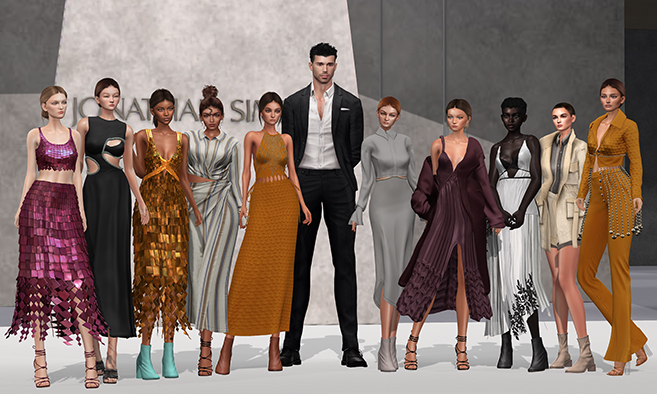

 Inara Pey: Living in a Modemworld