Update: At the time this article went to press, it appeared the daily restarts were still in progress (hence the reference to the restarts being Nov 17th-21st). Subsequent to this article appearing, the Lab updated the Grid Status report to indicate the work has actually bee completed, therefore the Lab’s blog post did in fact mark the end of the work.
The week of November 17th – 21st 2014 has been marked with daily periods of region restarts. Notice that these would be going on was first posted via a Grid Status update on Friday, November 14th.
As I noted in the first of my SL project updates for the week, Simon Linden indicated that restarts and the attendant maintenance was hardware-related, requiring servers to be taken down and physically opened-up, although precise details on what was being done was still scant.
In a blog post published on Thursday, November 20th, the Lab provided a detailed explanation on the reasons for the restarts, which reads in full:
Keeping the systems running the Second Life infrastructure operating smoothly is no mean feat. Our monitoring infrastructure keeps an eye on our machines every second, and a team of people work around the clock to ensure that Second Life runs smoothly. We do our best to replace failing systems pro actively and invisibly to Residents. Unfortunately, sometimes unexpected problems arise.
In late July, a hardware failure took down four of our latest-generation of simulator hosts. Initially, this was attributed to be a random failure, and the machine was sent off to our vendor for repair. In early October, a second failure took down another four machines. Two weeks later, another failure on another four hosts.
Each host lives inside a chassis along with three other hosts. These four hosts all share a common backplane that provides the hosts with power, networking and storage. The failures were traced to an overheating and subsequent failure of a component on these backplanes.
After exhaustive investigation with our vendor, the root cause of the failures turned out to be a hardware defect in a backplane component. We arranged an on-site visit by our vendor to locate, identify, and replace the affected backplanes. Members of our operations team have been working this week with our vendor in our data centre to inspect every potentially affected system and replace the defective component to prevent any more failures.
The region restarts that some of you have experienced this week were an unfortunate side-effect of this critical maintenance work. We have done our best to keep these restarts to a minimum as we understand just how disruptive a region restart can be. The affected machines have been repaired, and returned to service and we are confident that no more failures of this type will occur in the future. Thank you all for your patience and understanding as we have proceeded through the extended maintenance window this week.
Once again, it’s good to see that Landon Linden and his team are keeping the channels of communication open, and working to keep users appraised of what’s happening whenever and wherever is necessary / they can.
As noted by Ciaran Laval, Philip Rosedale appeared at the Gigaom Roadmap event held in San Francisco on November 18th and 19th. He was taking part in a (roughly) 30-minute discussion with Gigaom’s staff writer, Signe Brewster, entitled Designing Virtual Worlds, in which he explores the potential of virtual worlds when coupled with virtual reality, both in terms of High Fidelity and in general. In doing so, he touches on a number of topics and areas – including Second Life – providing some interesting insights into the technologies we see emerging today, aspects of on-line life that have been mentioned previously in reference to High Fidelity, such as the matter of identity, and what might influence or shape where VR is going.
This is very much a crystal ball type conversation such as the Engadget Expand NY panel discussion Linden Lab’s CEO Ebbe Altberg participated in at the start of November, inasmuch as it is something of an exploration of potential. However, given this is a more focused one-to-one conversation than the Engadget discussion, there is much more meat to be found in the roughly 31-minute long video.
Philip Rosedale in conversation with Gigaom’s Signe Brewster
Unsurprisingly, the initial part of the conversation focuses very much on the Oculus Rift, with Rosedale (also unsurprisingly, as they’re all potentially right) agreeing with the likes of the Engadget panel, Tony Parisi, Brendan Iribe, Mark Zurkerberg et al, that the Oculus Rift / games relationship is just the tip of the iceberg, and there there is so much more to be had that lies well beyond games. Indeed, he goes so far to define the Oculus / games experience as “ephemeral” compared to what might be coming in the future. Given the very nature of games, this is not an unreasonable summation, although his prediction that there will only be “one or two” big game titles for the Rift might upset a few people.
A more interesting part of the discussion revolves around the issue of identity, when encompasses more than one might expect, dealing with both the matter of how we use our own identity as a means of social interaction – through introducing ourselves, defining ourselves, and so on, and also how others actually relate to us, particularly in non-verbal ways (thus overlapping the conversation with non-verbal communications.
Identity is something Rosedale has given opinion on ion the past, notably through his essay on Identity in the Metaverse from March 2014 – recommended reading to anyone with an interest in the subject. The points raised are much more tightly encapsulated here in terms of how we use our name as a means of greeting, although the idea of of trust as an emerging currency in virtual environments is touched upon: just as in the physical world, we need to have the means to apply checks and balances to how much we reveal about ourselves to others on meeting them.
Can the facial expressions we use, exaggerated or otherwise, when talking with others be as much a part of out identity as our looks?
The overlap between identity and communication is graphically demonstrated in Rosedale’s relating of an experiment carried out at High Fidelity. This saw several members of the HiFi team talking on a subject, a 3D camera being used to capture their facial expressions and gestures, recording them against the same “default” HiFi avatar. When a recording of the avatar was selected at random and played by to HiFi staff sans any audio, they were still very quickly able to identify who the avatar represented, purely by a subconscious recognition of the way facial expression and any visible gestures were used.
This is actually a very important aspect when it comes to the idea of trust as virtual “currency”, as well as demonstrating how much more we may rely on non-verbal communication cues than we might otherwise realise. If we are able to identify people we know – as friends, as work colleagues, business associates, etc. – through such non-verbal behavioural prompts and cues, then establishing trust with others within a virtual medium which allows such non-verbal prompts to be accurately transmitted, can only more rapidly establish that exchange of trust, allowing for much more rapid progression into other areas of interaction and exchange.
Interaction and exchange also feature more broadly in the conversation. There is, for example the difference in the forms of interaction which take place within a video game and those we’re likely to encounter in a virtual space. Those used in games tend to be limited to what is required in the game itself – such as shooting a gun or running.
If 3D spaces can be made to operate as naturally as we function in the real world – such as when handing some something, as Mr. Rosedale is miming, might they become a more natural extension of our lives?
Obviously, interactions and exchanges in the physical world go well beyond this, and finding a means by which natural actions, such as the simple act of shaking hands or passing a document or file to another person can be either replaced by a recognisable virtual response, or replicated through a more natural approach than opening windows, selecting files, etc., is, Rosedale believes, potentially going to be key to a wider acceptance of VR and simulated environments in everyday life.
There’s a certain amount of truth in this, hence the high degree of R&D going on with input devices from gesture-based tools such as Leap Motion or haptic gloves or some other device. But at the same time, the mouse / trackpad / mouse aren’t going to go away overnight. There are still and essential part of our interactions with the laptops in front of us for carrying out a ranges of tasks that also aren’t going to vanish with the arrival and growth of VR. So any new tool may well have to be as easy and convenient to use as opening up a laptop and then starting to type.
Drawing an interesting, on a number of levels, comparison between the rise of the CD ROM and the impact of the Internet’s arrival, Rosedale suggests that really, we have no idea where virtual worlds might lead us simply because, as he points out, even now “we don’t get it yet”. The reality is that the potential for virtual spaces is so vast, it is easy to focus on X and Y and predict what’s going to happen, only to have Z arrive around the same time and completely alter perceptions and opportunities.
There are some things within the conversation that go unchallenged. For example, talking about wandering into a coffee shop, opening your laptop and then conducting business in a virtual space is expressed as a natural given. But really, even with the projected convenience of use, is this something people will readily accept? Will they want to be sitting at a table, waving hands around, staring intently into camera and sharing their business with the rest of the coffee shop in a manner that potentially goes beyond wibbling loudly and obnoxiously over a mobile phone? Will people want to do business against the clatter and noise and distractions of an entire coffee shop coming over their speakers / headphones from “the other end”? Will we want to be seated next to someone on the train who is given to waving arms and hands, presenting corner-eye distraction that goes beyond that encountered were they to simply open a laptop and type quietly? Or will we all simply shrug and do our best to ignore it, as we do with the mobile ‘phone wibblers of today?
That said, there is much that is covered with the discussion from what’s been learnt from the development of Second Life through to the influence of science-fiction on the entire VR/VW medium, with further focus on identity through the way people invest themselves in their avatar in between, until we arrive at the uncanny valley, and a potential means of crossing it: facial hair! As such, the video is a more than worthwhile listen, and I challenge anyone not to give Mr. Rosedale a sly smile of admiration as he slips-in a final mention of HiFi is such a way as to get the inquisitive twitching their whiskers and pulling-up the HiFi site in their browser to find out more.
Sarawak by Loverdag on Flickr, one of the images used in my rebuttal to Marlon McDonald’s article on SL
On Friday, November 14th, erstwhile contributor to Moviepilot,com Marlon McDonald wrote an article about Second Life which, is to say the least, predictably one-dimensional.
The item in question, entitled These Strange Stories Prove Second Life Isn’t The Dreamworld You Believed… takes as its rather predictable focus, the subject of pornography in Second Life. It’s lead to a fair level of upset among SL users – and rightly so; Mr. McDonald goes to considerable lengths to make his case by apparently passing on the opportunity to try the platform for himself, and instead dig through Google searches for articles that are anything up to seven years old (and none more recently written than three years ago).
Marlon McDonald: one-dimensional article
There is much that is wrong with the piece; not only does it present a one-side view of SL, it’s clearly intended as clickbait – if not for Moviepilot.com directly (although it doesn’t hurt them!), then certainly for Mr. McDonald himself, a regular contributor there, Most of what is wrong is easy to spot and cane be said through a comment on the piece. However, I opted to present a more direct rebuttal to the article through Moviepilot’s own pages, in the hopes of also reaching Mr. McDonald’s intended audience and perhaps persuading them to look on SL differently.
I don’t usually ask for page views – but in this case, I am. Not for myself, but to help the article get right up there alongside Mr. McDonald’s piece and truly give Moviepilot users an alternative point of view on SL. So please, if you wouldn’t mind, follow the link and have a read, Or if you’re tired of my writing – just follow the link and go make yourself a cup of tea / coffee!
In addition to the server maintenance taking place throughout this week, the Lab has announced an additional period of maintenance which will be taking place on Wednesday, November 19th. The Grid Status post announcing the work reads in full:
Scheduled Server Maintenance
[Posted 12:10 PM PDT, 18 November 2014] We will be performing additional scheduled maintenance on 19 November at approximately 1:00 AM PST. During this time, some residents may experience login issues and residents in-world may be logged off or experience degraded performance. Additionally, during this time Group Chat may fail. Please refrain from rezzing no-copy objects and making L$ transactions during this maintenance. Please check back here for updates.
In the run-up to the festive season, the Lab are using social media (though not, it seems their own forum) to ask residents a question.
In the Tell Us What You Want campaign, the Lab is enquiring:
We’re working on a holiday gift item for everyone and want to know: What item would be on your Second Life wishlist?
The question is being asked via Facebook and Twitter, Second Life enjoying a high level of visibility on both (although I’ve little doubt the use of Facebook will draw some humbugging grumbles!).
In terms of the responses so far, I’m actually not sure people are perhaps giving the kind of response the Lab has in mind. Requests range from from a couple of thousand Linden dollars a head through 24-hour day cycles on regions, volumetric Linden water, functional search, to lower tier (inevitably, even though not currently possible) and the return of gambling to the grid (not possible) – as well as a whole lot more in between, including, in so cases, what appear to be entire wish lists!
At the time of writing, only one person appears to have entered into the spirit of the direction the Lab would probably like the conversation to take:
Dean Takahashi has a new article up at VentureBeat’s GamesBeat column, featuring a conversation with CEO Ebbe Altberg.
I admit to finding the title of the article, Linden Lab explores VR for its next-generation virtual world (interview), a little bit of a misnomer, given the article actually covers more ground than just the Lab’s new platform and VR. In fact, it’s fair to say that much of the focus of the piece is on Blocksworld, and not the new VW platform – which doesn’t make the piece any less interesting a read.
Ebbe Altberg discusses the Lab’s next gen platform, Blocksworld and SL with VentureBeat
The article starts out by noting the company’s longevity and the fact that it has been in something of a transitional state (as we all know), divesting itself of almost all its existing products save Blocksworld and SL, while at the same time announcing it is heading down the road of building a new virtual world platform.
Takahashi suggests the reason for the Lab divesting itself of products is down to some of the products failing to have the right mix of talent, traction and resources to make their mark.
This is perhaps debatable; while Creatorverse and dio were perhaps lame ducks in terms of appeal, it has to be pointed out that both Versu and Patterns had potential – the former has since gone on to stand on its own two feet, and the latter already had a reasonable user-base even whilst still in a pre-release status (and its termination drew no small amount of upset from Patterns user on Steam).
In fairness to Ebbe Altberg, he does acknowledge the fact that some of the Lab’s nascent products didn’t really get a chance to grown their own legs, and that some of them might well have worked out for the good of the company. However, hard choices were required, the Lab really being too small to handle everything at once (and we know what happens when it grows beyond its means: remember, the June 2010 layoffs came after a sustained 18 months of recruiting that saw staffing numbers increase by 50% for no demonstrable increase in revenue).
Turning to the meat of the article, it has to be said the the recent sale of Desura had led to some questions over Blocksworld’s future. However, Altberg’s replies to Takahashi about that product should put paid to speculation:
We’re also very excited about Blocksworld. I don’t know if you’ve had a chance to check that out before, but it’s a small up-and-comer. It’s one of the portfolio of non-Second Life products that we decided to stick with. We liked the user experience, the ease of creation, and the audience it targets: a much younger demographic than Second Life. Also, right now, it’s iPad only. It gets us into a lot of experience dealing with a younger audience. … You need to think about ease of use and simplicity but still enable them to create really powerful things, as well as working with the new medium of mobile. We’ve had good progress with this product. It’s still early, but we have good traction. The kids love it.
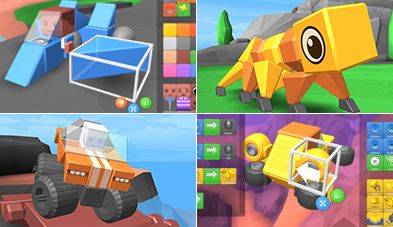
Linden Lab are said to be “very pleased” with Blocksworld’s performance
In addition, and further into the interview, Altberg indicates that the game has around 400,000 monthly users. How this translates to revenue flow beyond the actual purchase of the game is hard to judge. While additional building sets and expansion packs are available as in-game “purchases”, these are paid for through “coins” which users can earn, rather than having to necessarily buy. Even so, buying coins is the easier option, particularly where the expansion packs are concerned (see the video below), so there’s a reasonable chance that Blocksworld is proving a “nice little earner” for the Lab, even if it is nowhere on the scale of SL.
Beyond this, it would seem clear that the Lab have further plans to enhance Blocksworld, including the development of an in-game user-to-user economy, which will allow the sale of creations and builds between users, somewhat a-la SL. Also, Altberg’s statement that, “right now it’s iPad only”, suggests that an Android version of the game is still under consideration.
 Update: At the time this article went to press, it appeared the daily restarts were still in progress (hence the reference to the restarts being Nov 17th-21st). Subsequent to this article appearing, the Lab updated the Grid Status report to indicate the work has actually bee completed, therefore the Lab’s blog post did in fact mark the end of the work.