Gaming Islands: introducing users to Skill Games in Second Life

The new Gaming Islands - designed to introduce Second life users to Skill Gaming
The new Gaming Islands – designed to introduce Second life users to Skill Gaming

In a blog post on August 2nd, 2016, the Lab introduced their new Gaming Islands: regions designed to help Second Life users – particularly (but not exclusively), I would assume, new users – understand Skill Games in the platform, how they can play them (and why they may not be able to play them), together with a means to find them.

I’m not sure when these regions  – there appear to be two at present – opened, so whether the blog post has been timed to coincide with their launch or whether, like much that is in the blog post, they’ve been around a while but simply not promoted, is hard to tell. However, on reading about them, I jumped over to take a look – but before I get into the details, a quick bit of background.
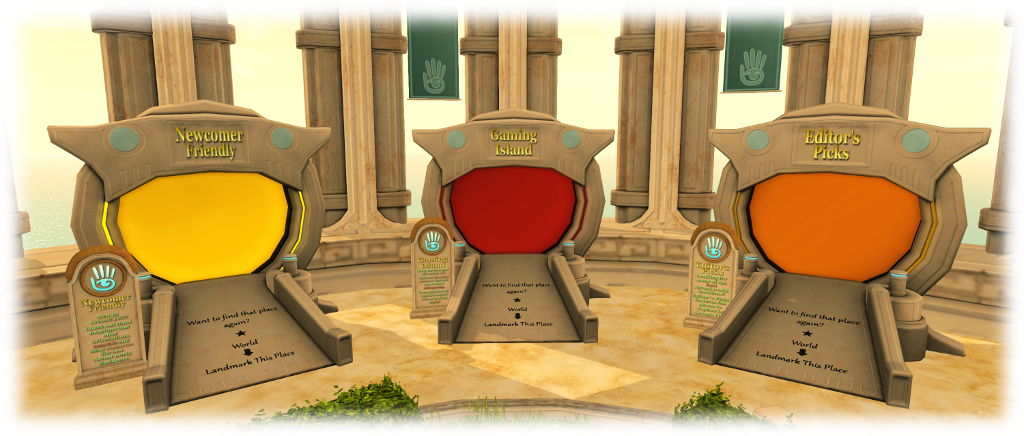
Incoming new users can find their way to the Gaming Islands via a dedicated teleport portal on the Social Islands
The Social Islands provide a dedicated teleport portal  to the Gaming Islands for new users; established users can reach them via the Portal Parks

Gambling laws in the USA and around the world can be complicated beasts. What some might consider to be gambling to others might be viewed a game of skill, and vice-versa. This makes determining what is and isn’t allowed and by whom a difficult practice, particularly where the Internet is concerned.

Because of all this complexity, the Lab banned gambling in Second Life, whilst allowing games of skill to remain. Then, in 2014, the Lab sought to further refine the kinds of skill games involving money and payouts which are permissible in SL through a complete overhaul of their Skill Gaming Policy, together with the introduction of new Skill Gaming regions where such games can be played.

The new Gaming Islands are designed to help SL residents understand what Skill Games are, where they can be played, the kinds of games they might encounter, how they can get to play them – and why, in some instances, they may not be allowed to access the regions where they can be played, and finally to offer a means to reach Skill Gaming regions.
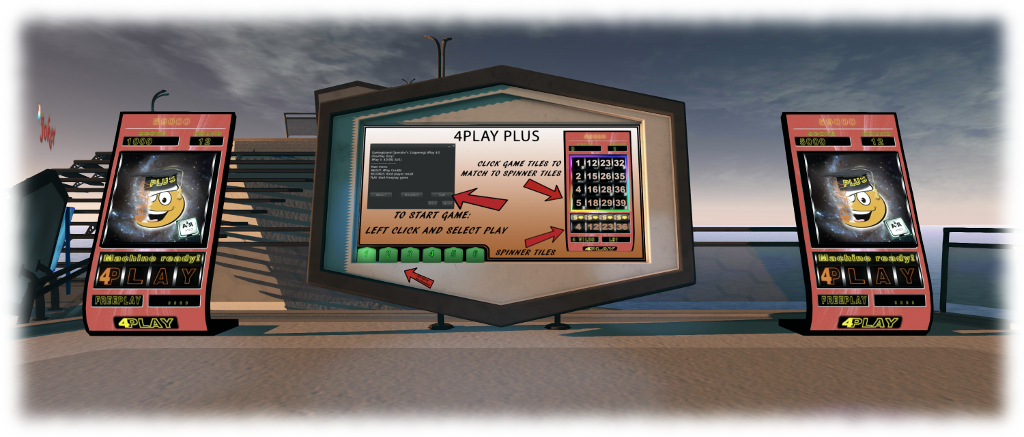
One of the example games in the Gaming Islands
Gaming Islands: one of the example games

To achieve this, the new Gaming Islands are split into four areas: the arrival point, a game play area; a Learn area which explains more about Skill Games in SL and how to access Skill Gaming Regions; and an Explore area which provides direct teleport portals to Skill Gaming regions provided by various in-world Skill Gaming Operators.

The game play area offers what appear to be “skill-based slot machine” games (yes, there are  such beasts in the physical world) with L$ pay-outs – although I have to admit, even after reading the instructions, I was unable to determine where the “skill” factor came into effect over and above the “chance” element (the requirement for Skill Games in SL is that their outcome “is determined by skill and is not contingent, in whole or in material part, upon chance”).

This is not to say that I think the games are not skill-based, but simply that – as a non-gambler / player of skill games, I simply didn’t get where skill enters into them, even after reading the instruction tabs. Perhaps this might indicate more practical explanations are required, or maybe it just indicates I just don’t get Skill Games. I’m also a little mystified as to why, more than an hour after I left one of the islands, the GamingIsland Operator made a small payment to my account – but hey-ho (addendum: apparently pay-outs are made at regular periods after play).
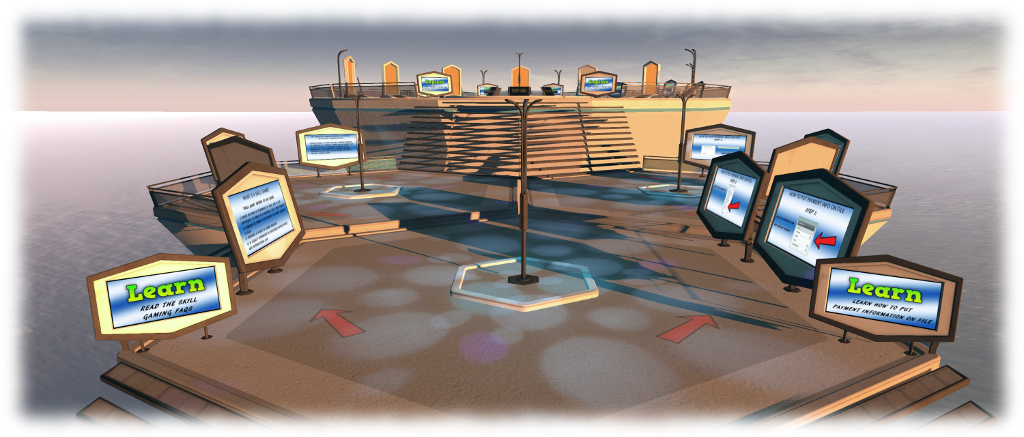
Gaming Islands Learn area - discover more about Skill Gaming and how to access Skill Gaming regions in SL
Gaming Islands: Learn area – discover more about Skill Gaming and how to access Skill Gaming regions in SL

The Learn area, designed to get people up-to-speed with Skill Gaming in SL, how they can ensure they are eligible to access Skill Gaming regions and why, even if they meet the SL criteria, they may still be unable to do so, is a little more straightforward.

To one side of the are a series of information boards designed to help people ensure they can access Skill Gaming region; on the other are explanations of what Lab’s define a Skill Game (lifted from the Second Life Skill Gaming FAQ), together with information on why, legally, some SL users may not be able to access Skill Gaming regions even if they meet the SL criteria for doing so. The split path perhaps isn’t the best approach here, given it might encourage some to simply go around one side and then up the stairs to the final section, but the use of teleport boards in the final section makes this a minor quibble.
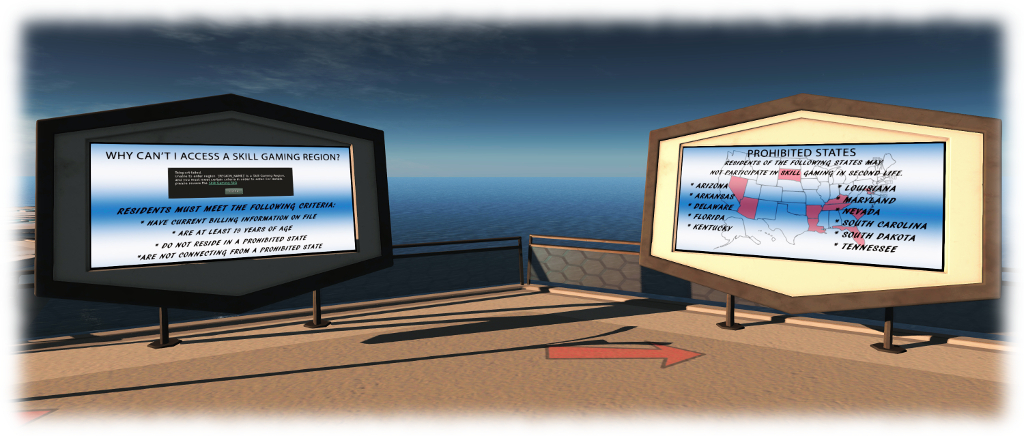
The Learn section of the Gaming Islands provide information on what is required to enter Skill Gaming regions (together with step-by-step instructions on ensuring the criteria is correct), and why, even if the SL criteria are met, some users may still not be allowed to access the regions
Gaming Islands: a more detailed look at a couple of the Learn area info boards, which explain what is required to enter Skill Gaming regions (step-by-step instructions to meet the requirements are provided on the other side of the  area), and why, even if the SL criteria are met, some users may still not be allowed to access the regions

This final section, entitled Explore, offers teleport portal directly to a number of Skill Gaming regions provided by different Skill Gaming Operators. Should anyone find they cannot use the teleport portal, boards between the portals will teleport them to the Learn section of the island where they can double-check they meet the SL / legal (in the case of US residents) requirements for accessing Skill Gaming regions.
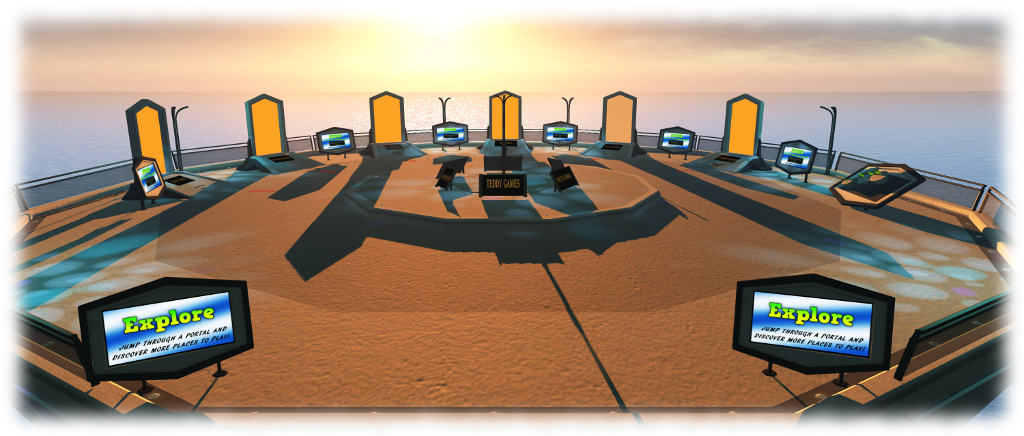
The Explore section of the Gaming Islands, with teleport portals
Gaming Islands: the Explore section with teleport portals

Skill Gaming isn’t to everyone’s interest, to be sure. However, providing information on what it is and how to find it is, I would suggest, a good idea, as is joining the dots for new users to be able to find their way to such regions, which give the opportunity to play for Linden Dollars. As it is, Skill Gaming operators pay a premium for their regions, and so providing a means by which they can obtain traffic on the same footing as other types of activity in SL is only fair.

In terms of the Gaming Islands layout, and my own problems in “getting” the games aside, the design is straightforward and does pretty much exactly what it says on the tin. Which is all one can ask, really.
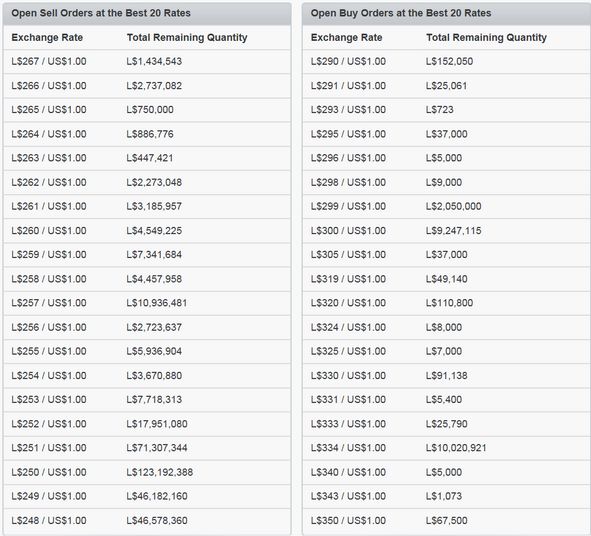

Grandfathered buy-down contributing to Lindex fluctuations?

The Lindex has been in a state of flux of late, something that has been the subject of discussion and speculation on a number of fronts. Reader Ample Clarity first pointed things out to me earlier last week via IM (I’ve been rather focused on other things of late, so haven’t been watching the broader news as much as I should), and I’ve been dipping in-and-out of conversations and reports on things since then.

The fluctuations started towards the end of 2015, and were perhaps first discussed on the pages of SL Universe. The discussion resumed in April, when further swings were noted,  causing additional concern among those looking to cash-out L$ balances, while sparking some of the more widespread discussion.

Lindex fluctuations (with thanks to Eku Zhong for the screen capture)

Various theories (and not a few conspiracies) have been put forward to explain what has been happening – although determining precisely what the cause is, is pretty much anyone’s guess. But purely in terms of the more recent fluctuations, New Worlds Notes (NWN) is promoting a theory which might just be plausible: that one (or more) large land estates have been liquidating L$ stocks in order to realise additional US dollar funds to take advantage of the Lab’s grandfathered buy-down offer.

The theory actually comes from Plurker T-Kesserex, who is quoted by NWN as saying:

I think it’s people cashing out to get capital for the $600 dollar sim price reduction … If you own 10 sims you need $6000, so that’s not easy without some cashing out.

At the start of the buy-down offer, Tyche Shepherd, of Grid Survey fame, estimated that around 85% of Homestead regions were already grandfathered, but only around 11% of full-priced regions of all types, leaving enormous potential in the market. During the first month, this figure increased to almost 21%, with the number of grandfathered full-priced regions rising from around 1,039 to 1960, demonstrating a thirst for conversion. Thus, the idea that one or more large estates might be liquidating L$ stocks to cover the cost of further conversions isn’t an unreasonable speculation.

But even if it is a fair assessment of the situation, it doesn’t offer any hint as to what  – market forces or otherwise – has been pushing at the Lindex since late 2015. Nor does it offer any comfort to those concerned about cashing out at a reasonable – or at least stable – rate. All that can be said for certain is that, if you have the need for L$ in your account, buying them hasn’t been this attractive in a good while.

In the Press: a voyage of discovery in Second Life

Second Life has again been getting some fair press coverage, both directly and directly, of late. I’ve already written about the platform either being the focus of, or looked at as part of, two interesting articles published in Motherboard. Also during the week, Second Life was written about on this side of the Atlantic, as first reported by Ciaran Laval.

On April 28th the on-line edition of France’s Le Monde carried an article focused on Second Life, written by  Morgane Tual.  Bearing the delightfully French title Absurde, créatif et débauché : dix ans après, « Second Life » est toujours bien vivant (Absurd, creative and debauched: ten years later, “Second Life” is still alive), it weaves a wonderful introduction to the platform which cannot fail to have those of us immersed in this digital world smiling and / or nodding in agreement.

Morgane Taul: an engaging article on Second Life
Morgane Tual: an engaging article on Second Life

This is very much a hands-on, through-the-eyes look at Second Life, good and bad, written with an unabashed honesty and wonderment. Opening with a description of her initial time in Second Life and a (first?) encounter with another resident, Ms. Tual quickly informs her readers where she is and why she is there – and hints that what she has to say might come as a surprise for who might have heard of the platform at some point:

Like me, some haggard and clumsy beginners landed on this strange beach to discover what remains of this game that occupied the headlines there about ten years. I expected to find, a decade later, a deserted world, ageing technology and a few cobwebs in the corners. It was exactly the opposite.

From this set-up we are lead on what is very much a personal voyage of discovery through Second Life. In it we encounter the realities of the platform – good and bad in equal measure,  each presented to us as they are encountered.

So it is we share in her wonder as she hops from place-to-place; her confusion (and that of others newcomers) in finding herself unceremoniously dumped at an infohub; the embarrassment that can occur simply as a result of clicking the wrong button, or in awkwardly accepting the help of another. We share in her delight in her discoveries of the music scene and in finding a place were she makes a new friend, Patti, a fellow French woman. From here we join her on a whirlwind tour of Second Life which take her to Hogwarts and thence via Star Wars, 221B Baker Street and a nightclub, to the Petit Trianon, Tatiana Dokuchic’s wonderful build in the Duché de Coeur, and a conversation with Tatiana herself.

Petit Trianon by Tatiana Dokuchic, featured in Absurde, créatif et débauché : dix ans après, « Second Life » est toujours bien vivant
Petit Trianon by Tatiana Dokuchic, featured in the Le Monde article by Morgane Tual

Interspersed with this are the assorted facts and figures from the Lab – the 900,000 monthly log-ins, the broad demographic, the economics of the platform, and so on, together with the usual potted history of the platform, all of which paints one of the clearest pictures of Second Life I’ve had the good fortune to read; one with a personal narrative free from the need to fall back on cliché or dogged by mocking observation.

Such is the narrative, we’re drawn directly into Ms. Tual’s experiences, all of which are related without judgement, but often with a real sense of joy and / or wonder. Of course, the sex is also there, but so too is the discovery that contrary to belief, Second life isn’t necessarily “all about the sex”, a point of view Ms. Tual fully embraces.

The breadth of possible engagement in Second Life is touched upon in other ways as well. Through the conversation with Tatiana, readers are introduced to the richness of opportunity for creativity in Second life. Art and entertainment are referred to – the latter supported by the inclusion of some hand-picked videos.

We also witness the tales of others, such as the guy who initially mocked the activities of SL users, regarding them as “losers”, only to himself become engrossed in the platform and all it offers. We are also – movingly – introduced to the way in which Second life bridges the physical / digital divide, very genuinely bringing people together when entire continents might otherwise separate them.

With videos and in-world images, personal tales, a frank narrative, Absurde, créatif et débauché : dix ans après, « Second Life » est toujours bien vivant is one of the most engaging pieces on second Life it has been my pleasure to read. Recommended.

In the Press: Motherboard looks at Second Life

There have been a couple of interesting articles which have appeared in Motherboard over the last couple of days which make interesting reading.

In the first, Men Are Working Out Their Issues By Playing As Their Lovers and Exes in RPGs, published on April 28th, Cecilia D’Anastasio looks at a little researched aspect of avatar use within Second Life and MMORPGs: using their capabilities to create avatars in the likeness of a ex- or current partner or spouse.

Cecilia D'Anastasio: writing on identity in the digital age
Cecilia D’Anastasio: writing on identity in the digital age

I’ve always enjoyed reading Ms. D’Anastasio’s pieces on matter of digital identity, and have previously written about her excellent Avatar IRL, which appeared almost exactly a year ago.

This new article examines a number of ways in which people – notably, but not exclusively, young male gamers – have created representations of current or past Significant Others in the virtual environments they use.

Some of the related stories are pretty innocent. From Second Life, for example, we learn that well-known boat designer Jacqueline Trudeau  uses an avatar “minutely resembling” her husband to help promote her designs, even though he seemingly has no interest in either the platform or his wife’s ability to generate an income through it.  Similarly,  Kevin D. Kramer, a Second Life DJ in his 50s, has designed an avatar modelled on his wife which they both use, candidly admitting it offers him the opportunity to buy gowns, dresses and outfits to surprise her with in ways he cannot easily replicate in the physical world.

However, some are much more disturbing in tone, notably the examples drawn from Skyrim and XCOM-2 where the motivation for creating likenesses of ex-partners be 20-something gamers as a means to exert greater (and not entirely positive) control over them, even to the point of subjugation, or to increase their own self-image as a “protector” of the women formerly in their lives.

The piece is certainly an interesting read, going by way of Nick Yee’s research into matters  of gender-bending as covered by his Daedalus Project (you can also learn more about his work on matters of avatar identity here and via Draxtor’s excellent interview with him), and including feedback from Dr. Jamie Banks of Department of Communication Studies, West Virginia University. However, it is not without potential fault.

There is an acknowledged lack of research in why people might create avatars in the likeness of former or current partners; as such, there is perhaps a bias present in the piece, which I did find undermined it in places.

For example, while it is hard to reconcile Dr. Banks’ view of creating avatars in the image of a former partner as a means of coping with the Skrim and XCOM2 examples cited (they are far too calculated in their creation and use), it doesn’t mean the idea doesn’t have merit in other possible cases. Unfortunately, any potential credence it might have is more-or-less directly thrown under the bus in the paragraph of the article following Dr. Banks’ comments.

There are other flaws evident in the writing as well. It is noted, for example, that one of the people who created a female avatar based on his ex-girlfriend has since been banned from an unrelated game. The reason for that ban isn’t specified and could be entirely unrelated to the issues being discussed in the article. Thus, the inclusion of this statement seems to serve no other purpose than to enhance the reader’s negative view they may already have of the individual.

However, given this is an aspect of the use of avatar-driven environments and MMOs that hasn’t really been deeply researched, the article does open the door to discussions on the subject, and may encourage a greater academic study of the issue.

In Why Is Second Life Still a Thing?, which appeared on April 29th, Emanuel Maiberg poses a question I suspect might be asked by a lot of journalists who have perhaps been previously familiar with the platform and are suddenly exposed to it once more.

In asking the question, Mr. Maiberg also does a fair job in answering it as well, and in doing so, takes the reader on a no hold barred tour of the platform, commencing with what has been it’s crucial differentiator over other, “prettier” platforms and games:

A crucial difference between Second Life and MMOs like World of Warcraft is that the latter are mostly fixed worlds. Once in awhile, developer Blizzard will introduce a new continent or reconfigure an existing location, but all players are guests in the world that Blizzard created. Second Life, by contrast, allows users to not only create their own avatars, but also to shape and create the world they’re in, importing their own 3D assets and modifying the world with the Linden Scripting Language.  

Emanuel Maiberg - a frank look at Second Life
Emanuel Maiberg – a frank look at Second Life

A potted history of the platform follows, together with an examination of much of what goes on in-world being referenced: art, education, user-generated transactions, and so on, together with the highs and lows the platform has seen. Of course, sex gets a fair mention within the piece; no surprises there, as it does both act as a draw for at least some of those coming into the platform (although equally, they may find their interests moving elsewhere once they are engaged in the platform), and it does contribute fairly to the platform’s economy.

Project Sansar is also touched upon – as is one of the core reasons why the Lab is keen to emphasise it is a platform designed to run alongside, rather than replace, Second Life. The very success of the latter and the level of investment users have within the system mean that displacing them anywhere else is at best exceptionally difficult; no other platform or service as thus far managed to achieve what Second Life invented in terms of environment, capabilities, user numbers and economical viability.

Those of us familiar with Second Life may not find much that is new in Mr. Maiberg’s piece, but that’s beside the point. What he offers is a frank look at the platform, free from bias or agenda but which fairly addresses many of the reasons which have made the platform a success in and of itself.

Overall, both pieces made for interesting reading.

New Social Islands helping new users get started in Second Life

The Experience Keys based Social Islands

In May 2015, I wrote about the Lab’s work in adding Experience keys to their Learning Islands, the first in-world destination for new users joining Second Life through the Lab’s sign-up process. At the time, Peter Gray, the Lab’s Director of Global Communications, indicated the approach was one of a number the Lab were experimenting with, while subsequent to the article, Ebbe Altberg indicated that Lab was continuing with A/B testing of various approaches to getting new users started in Second Life.

Thanks to a nudge from Cube Republic, I’ve had the opportunity of trying-out one of the more recent aspects of this work, by paying a visit to one of a set of four Social Islands, which form the second stop incoming users make on their initial journey in-world, and which have been both redesigned by the Lab and which now also use Experience Keys to help new users gain greater familiarity with using Second Life.

The new Social Islands offer something of a Graeco-Roman feel (top image), presenting a number of circular structures linked by broad stairways and paths, sitting within a rocky island landscape. On arrival, newcomers receive a HUD which attaches to the to left of their screen before stepping through a set of welcoming messages to get them started in their explorations.

The initial HUD messages (click for full size)

The HUD has a number of easy-to-understand icons (? = help; speaker icon = toggle HUD sounds on / off; – = minimise the HUD; Next Step = click to page through instructions, where relevant), and updates with messages and instructions as the user explores the island.

Central to the islands is a pavilion, where information boards provide basic help and support, and which provides access to the various activities on the island. The first of these can be accessed directly from the pavilion, and present users with the opportunity to practice using their camera, find out about building in Second Life and also learn about buying goods in-world and via the Marketplace.

The central pavilion in the new Social Islands includes information boards and - for those who have been involved in SL for a long time, the return of a familiar character from the days of the old Orientation Islands
The central pavilion in the new Social Islands includes information boards and – for those who have been involved in SL for a long time, the return of a familiar character from the days of the old Orientation Islands (right)

Stairs leading down to the ground level from the pavilion provide access to further activities, such as learning to interact with in-world objects at a beach bar or by using swings in an orchard, or learning the basics of vehicle driving by steering a boat through a course set over shark-infested water (swimming very inadvisable!), and so on.

As the HUD indicates, completion of the various tasks earns the user Linden Dollars. These are not added to the avatar’s account balance, but are indicated by a second HUD, which is attached as soon as the L$ start being earned. The balance obtained can then be used in the island’s shop to buy clothing, shoes, hair, and skins and shapes as means of introducing people to the concept of buying goods in Second Life.

The Advanced Camera Movement challenge
The Advanced Camera Movement challenge: use the camera control to move around the tower, touching and illuminating the red squares

A further section of the activities area offers a basic overview to in-world building, complete with a video overview courtesy of Magellan Linden and a couple of interactive elements. As an aside, I have to admit to being slightly bemused that a certain British Tabloid and a former south London community newspaper are featured in one of the demonstrations, simply because it was so unexpected.

The final part of the island is the portal area providing onward access to the rest of Second Life. This follows pretty much the same format as other versions of the Social island: a set of portals defined by category – art, role-play, popular places, editor’s picks from the Destination Guide, the Portal Parks, music and adult – which will deliver a user selecting one of them to one of several potential destinations. The portals are presented via a video providing more information on exploring SL, and users approaching them are presented with / advised to take a Landmark for the island so they can find their way back, if needed.

The new Social Islands include the same portal idea by which newcomers can continue their explorations of Second Life, but with some improvements over earlier versions

Continue reading “New Social Islands helping new users get started in Second Life”

Spring 2016 Premium membership discount

Springtime in the northern hemisphere brings with it many things. The changing of the clocks; the longer hours of daylight; the promise of sunshine … eventually; the inevitable turning of thoughts towards lawns and mowers. And the arrival of the Second Life Premium Discount.

The latest offer, launched on April 14th, 2016, see the usual 50% discount on the first instalment of the quarterly membership payment plan, reducing it to US $11.25 (the remaining quarters of the billing period remaining at US $22.50 (European users note that VAT is no longer applied to Premium subscriptions).

The Premium Discount is once again on offer, together with a set of Halloween gifts
The Premium Discount is once again on offer, together with a set of spring / summer gifts

The offer comes with another set of in-world gifts, available from the Premium gift kiosks, and this time takes the form of a set of garden furniture and accessories, namely a breakfast table with food provided in either a 16 LI set or a lower LOD 8 LI set; a garden bench, a set of garden trellises (one with flower heads and one without), plus a pair of plushies (bird and rabbit) which each come in versions which can be rezzed in-world or which can be held. The total LI for the in-world items (minus plushies) is 55 (or 47 when using the “Low LOD” food items),  which is rather a lot, coupled with some lacklustre texturing.

Spring 2016 gift: breakfast table and food and chairs, bench, trellises and plushies
Spring 2016 gift: breakfast table and food and chairs, bench, trellises and plushies.

I’ll state up-front that like a lot of people, I’m not a fan of Premium gifts of this type, and do much prefer the broader benefits the Lab has striven to offer of late: access to concierge support, the increase in the number of off-line IMs Premium members can access on next logging-in, and the increase in group slots from 42 to 60 for Premium members, and Experience Keys being available only for Premium members.

However, I also understand that offering benefits of this type isn’t necessarily easy, either, and nor is implementing many of the other ideas that have been put forwards, again as I discussed just over a year ago. In this respect, the Lab is caught between something of a rock and hard place on a number of levels. As such, whether or not to update will remain a consideration of broader issues (such as the added benefits mentioned above), rather than simply looking at perks like this alone.

For those who are interested in the latest offer, it expires on April 25, 2016, at 08:00 SLT. It comes with the usual small print, to whit:

To qualify for this promotion, you must 1) have an existing Second Life (“SL”) basic account or create a new account, and 2) select quarterly (every three months) billing for your SL account. The fifty percent (50%) discount will be applied to your first quarter’s bill and future quarters will be billed at the standard Premium Membership price (currently US$22.50 per quarter). Any Linden Dollar (L$) sign-up bonus will be applied to new accounts or accounts not previously upgraded to Premium Membership after the account has been active for forty-five (45) consecutive days.