Breaking the Viewers

As Tateru Nino points out, Oz Linden issued a stark warning yesterday when commenting on third-party Viewers (TPVs): “[A]ny Viewer that isn’t being actively maintained is going to start having fairly serious problems over the next months. We’re making a lot of changes… if viewers don’t keep up, things will break.” 

Now, Oz isn’t the most diplomatic of individuals, it has to be said; but a lot of people seem to be getting unnecessarily bent out of shape in response to his comments, apparently reading them as “You must swap to Viewer 2!” – which is certainly not what is being said.

Rather, he is pointing to the fact that with all that is coming down the line, there is a risk that some Viewer devs (particularly those working with the Viewer 1 / Snowglobe code who have to backport everything) may find their Viewers becoming obsolete. And his comment may well have merit.

While it is true that much of what has been developed for Viewer 2 has been backported to Viewer 1 TPVs (Display Names, multiple clothing layers, Avatar Physics, etc.), it is by no means certain that this will be possible going forward. for example, LL have already stated that Mesh objects will not render in Viewer 1, so it’s by no means clear if the code required to enable meshes to be visible can be integrated into the older Viewers. Similarly, they’ve also stated that the “Search 1” used by Viewer 1 is to be turned off at some point this year – leaving TPVs based on the code either without a search engine or needing to try to integrate with the Search used by Viewer 2. Therefore, there is a risk associated in staying with the Viewer 1 code base.

The Popularity Stakes

In the same meeting, Oz went on to say, “[T]that being said, we’re looking hard at what motivates people to stay on a 1.x viewer so that we can try to address those issues too,” a comment that was also met with a certain amount of derision, with people pointing to things like “usability”, performance and features as the major reasons why Viewer 2 “isn’t working”.

Much has been made of the Viewer 2 UI being “unusable”. At the risk of offending some, I think it fair to say this view is more reflective of people’s unwillingness to accept Viewer 2’s UI than it is of the usability of the interface.

Yes, there are quirks, annoyances, and things within the UI that could be a better than currently implemented – but none of them render the UI “unusable”. The fact is that *if* the Viewer 2 UI had been the de facto  UI for the last 4 or 5 years, and was now being replaced by the Viewer 1.x UI, many of those decrying the Viewer 2 UI to be “unusable” would be making the very same claim against the “new” V1 interface. I’m not being snide in saying this: I’m simply pointing to a reality of human nature; Viewer 1 is in our comfort zone, and it is naturally more attractive.

Performance has been an issue with Viewer 2. Many report tremendous downturns in performance when swapping to it; I’ve experienced it myself in the past. However, today I carried out a couple of (admittedly simple) tests*, measuring FPS rates and rezzing times for the four Viewers I routinely use together with the “official” Viewer 2 and the Kokua development viewer (more out of curiosity with the latter than an attempt to measure its actual performance). The results were surprising, as this table on average frame rates on sims occupied by 2 avatars and 12 avatars respectively demonstrates:
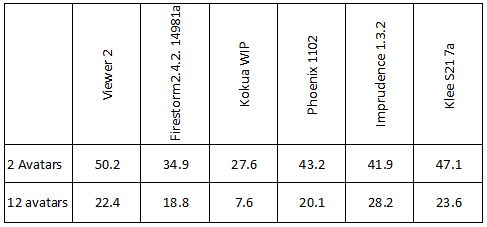
Viewer frame rates on sims occupied by 2 and 12 avatars respectively

In terms of rezzing (using a mall as my baseline), Viewer 2 again performed well. The fastest Viewer for rezzing was, unsurprisingly, Kirstenlee’s S21 (The KLee Viewers have always preformed pretty well on my PC), with Viewer 2 running it a close second. Again, given the use of the JPG2000 library with the official Viewer, this might not be so surprising, but it does perhaps point to Viewer 2 not being as slouchy as its reputation suggests.

Obviously, the test is entirely subjective; what works for me, may not work for you. But its interesting that the overall performance of the Viewer 2 is not so much an issue as it may have been just a few releases ago (when things like frame rates did have me grinding my teeth in frustration).

Giving People What They Want

Truth be told, if Oz wants to understand why people stick with Viewer 1.23.5-based Viewers (or for that matter prefer the likes of Firestorm over Viewer 2), then he only need to really consider one thing: features.

Firestorm in-world Profile display: fast, easy, fun

simply put: TPV developers give users the tools they want: client-side AOs, radar, massive improvements to the Windlight engine and sharable presets, and so on. All these have served to keep Viewer 1-based Viewers at the forefront of popularity.

In the Viewer 2 department, TPV developers are being as equally accommodating, providing features and options users are requesting while LL turn a deaf ear: in-world Profile viewing that avoids the use of the Web Profiles, inclusion of the Media Filter, options to replace the context menus with pie menus, and so on.

As TPVs based on the Viewer 2 / Snowstorm code base mature and inherit features from Viewer 1 TPVs, people will migrate to them and overcome their bias towards the UI.

When that happens, perhaps the only question that will be asked within Linden Lab will be, “Why is Viewer 2 still the minority Viewer?”  In reply to which, I can only say “check back here guys, and read that last few paragraphs…”

* Test information:

  • Hardware: Intel Q6600 Quad Core CPU, 2.6MHz, 4Gb RAM 320 GB hard drive @ 7200rpm
  • Graphics: GeForce Ge9800GT with 1Gb.
  • Viewer settings: Bandwidth 1500kbps; cache size 1024Mb; Draw distance: 384 metres; multi-threading enabled.
  • Sims used: 2-avatar test: Qiu Xiang; 12-avatar test: Mesmerize Dungeon.

Listening and hearing

On Friday, Rod Humble kicked-off what he promised (via Twitter), to be a resumption of communications from the Lab regarding what is going on around SL and the Lab’s efforts relating to it. At the same time, we also got an update on what we can expect in terms of news on Mesh by the end of the month.

Many have critiqued LL – and Rodvik – for their use of Twitter; a commentator on this very blog took issue in the way communications are being handled –  claiming LL had “missed the boat” in their efforts. I’ve also been critical of the Lab, not just recently but throughout the life of this blog, for their lack of prowess when it comes to listening and engaging.

But, as Tateru today points out – things are changing. Rodvik is not only listening, he’s hearing and reacting- and kudos to him for doing so.

Just a few weeks ago, Theia Magic and others were making constructive blog posts and Tweets on the state of the new user welcome areas (notably Ahern and the lack of coordinated help for new users. The abuse is something a group of us had a round-robin on one evening (again via Twitter), when two of us pointed out the absurdity that when it comes to the official forums, LL are so paranoid about language and misunderstandings, that they actually blanked the use of the name “Dick van Dyke” for fear of upsetting the teens (or their parents) – and yet anyone arriving like Ahern risks being subjected to the most foul written and verbal (if Voice enabled) abuse which LL apparently deemed as “acceptable”.

Whether it came about as a result of Rodvik’s involvement in Twitter exchanges is 100% clear (although his intervention in issues is a matter of record), he has confirmed the return of the Resident Help Network. This cannot be anything but a good move – providing it is properly managed and coordinated. LL cannot be expected to keep their thumb on the pulse of everything in SL, so the proper used of something like SHN could be of major benefit – and it hopefully represents a first real step towards practical re-engagement with the user community – something that has again been something of a bee in my bonnet.

Also on Twitter, and while it received largely positive feedback, the new user sign-up process was critiqued because it only features human avatars. Again, Rodvik took time out to respond to these comments – and in his latest post he advises us that LL are expanding the available choice of avatars, “We know that the beauty of Second Life is the diversity and richness of how we choose to represent ourselves inworld. So, we’re adding 12 animal and 12 Robots and soon we’ll have Vehicles too. Then, we’ll also commission another set of human avatars that represent a wider, more diverse audience.

Both of these responses indicate that not only is Rodvik – the man at the top  – listening, he’s hearing what is being said and reacting to it.

A critical part in communications – again, as Tateru notes – is feedback – and this is something that, while there are still frustrations over a number of issues – Rodvik is paving the way. His blog posts are refreshing as they provide information and feedback clearly, and place him squarely alongside Frank Ambrose (FJ Linden) for providing quality communications. LL aren’t out of the woods where the entire issue of company / user interaction / engagement is concerned, but Rodviks efforts on Twitter, and he openness in blogging are certain steps in the right direction.

Taking stock of your Inventory

The upcoming changes to the Marketplace – specifically, replacing the traditional in-world boxes with a Direct Delivery system is causing a lot of concern. Beta testing for the new system has begun – or is due to begin – shortly. However, even that isn’t without its problems, with people being asked – yet again – to sign-up “blind” to an NDA.

These changes to the Marketplace environment are part and parcel of a wider programme that used to go via the acronym AIS – the Avatar Inventory System. Now known as the Inventory API, this is an on-going series of improvements that are specifically targeting how inventory is handled between the Viewer, the Asset Server(s) that “store” your “inventory” (i.e. hold the “master” data for inventory items) and the simulator servers themselves. The idea appears to be to develop an extensible system that allows for better, more focused tweaking of the inventory handling code that, among other things, should allow Linden Lab to more readily identify and fix problems related to inventory management as well as making the inventory system more scalable and robust overall than is currently the case. Hopefully, this will provide:

  • A more stable inventory management environment, one that can comfortably handle active inventories of 60K+ per avatar without the current issues and frustrations people experience on hitting these levels (inexplicable inventory losses, inventory failing to load or constantly having to box-up “unused” inventory simply to get the damned inventory “list” to download to the Viewer in a reasonable space of time, etc.)
  • A more robust means of ensuring Viewer, simulator and asset server remain synchronised in terms of inventory asset data, leading to fewer user-experienced problems when moving around the grid in terms of object rezzing failures, etc.

Overall, the changes being planned are all to the good; one of the biggest banes of comfortable Second Life living is problems associated with inventory; as many are all too aware, when problems occur with inventory vanishing, 98% of the time users are effectively left to suck-it-and-see in attempts to resolve the problem using a variety of care-worn techniques such a manual cache clearing in the Viewer, frequent relogging, frequent sim hops and inventory loads – with (sadly and most irritatingly) an almost “well, t’ain’t our problem,” attitude from LL’s own help desk.

Discipline

However, the new system is not going to be all plain sailing. In order to work effectively, the new system apparently requires your inventory to be reasonably-well ordered and structured. In particular, Merchants using the new Direct Delivery system will have to have their goods specifically arranged and ordered, while there will be a limit as to the number of individual items that can be placed in a single folder (rumoured to be around the 650 mark).

Some have seen these requirements as being negative points against the new system; I have to say that personally, I find it hard to understand why. While it is true that many don’t manage their inventories that well, the fact of the matter is that we’re actually provided with a basic system of default – and protected – folders for inventory items by Linden Lab themselves (Body Parts, Clothing, Objects, etc.), which can be readily used to create a well-ordered  inventory system, providing one applies a little discipline.

I also suspect that the majority of merchants are like me, and already have a well-defined folder structure for their goods. While such systems more than likely won’t meet the requirements that the new Direct Delivery system, they do mean that merchants already have the necessary self-discipline to get their products sorted and ready for the new system. For others, many people already use the #RLV “shared folders” system – and not necessarily for BDSM-related items (although this is obviously its primary use); so again the concept of a well-ordered inventory may not be so alien to people as some may think.

Whether the new system will require an complete overhaul of a person’s inventory remains unclear; we’ve had the Client-side code in both Viewer 2.x and Viewer 1.x for night-on two years now with it impacting on everyday inventory manage, so again, undue critique of AIS / Inventory API in the widest sense  may be a little premature. And even if the new system doesn’t require widespread changes, for those that tend to leave everything in the top level of their inventory after unpacking (i.e. in folders directly under MY INVENTORY), the fact that Linden Lab are taking steps to try and make the inventory management system more robust might be seen as a reason to perhaps get things sorted.

If nothing else, the default folders provided by the Lab have a big advantage over user-created folders: they cannot be accidentally deleted. Ergo, moving, say, all of one’s clothing folders under CLOTHING, gives one (albeit small) measure of protection against accidentally right-clicking on a top level folder and deleting it and then purging it from Trash before you’ve taken stock of what you’ve done. Furthermore, and while I admittedly have no first-hand experience of this (I’ve always kept a very well-ordered inventory), there is much anecdotal evident that ordering your inventory within the default folders provided by LL decreases the chances of items becoming lost or vanishing.

Yes, there are issues around  some  of elements of the AIS / Inventory API – such as the Direct Delivery system  – in terms of the impact they’ll have elsewhere in Second Life (such as the impact on in-world stores on a variety of levels, some of which I touched on in my post on Direct Delivery itself. However, I’d respectfully suggest that such concerns are more a part of a wider dialogue that is required about the Marketplace in general, and its potential impact on in-world revenue streams – including LL’s tier-derived income – rather than restricting them to discussions on AIS / Inventory API in and of itself.

At the end of the day we’ve all suffered from inventory issues at one time or another. Given the woeful track record from LL in terms of helping people deal with the issues they encounter – such as frustratingly being able to see a portion of their inventory but be unable to use it, simply because the current system has “moved” folders up to the same level as MY INVENTORY, and thus made them inaccessible – then I’d tend to take the attitude that anything that comes along that decreases the chances of such errors occurring in future and which more readily enable LL to rectify inventory errors is to be welcomed; any additional effort required on our part to help get the system working more efficiently notwithstanding.

Twittering with Rodvik

Yesterday evening, Rodvik Linden – LL’s CEO Rod Humble – popped up on Twitter and chatted with some of us there in what was another of the warm an open conversations that have been a hallmark of his time at LL so far.

I actually came late-in-the-day to the conversation, logging-in to Twitter to catch this from Rodvik, replying to a comment on things SL:

@SecondLie I think we need to put purchasing into Basic first 🙂

Given the Basic mode of the Viewer is something that has been occupying my thoughts of late, I Tweeted in return:

@rodvik how about offering a better “step up”, help-wise from Basic to Advanced? – pointing to my recent post on the subject, and:

@rodvik If you keep adding functionality to the Basic mode, won’t you end up with…the Advanced mode?

I’ve no idea if Rodvik went and read the post in question; but it sparked something of a short discussion on the Basic mode and the Viewer in general in which he responded very positively to all making comments. In particular, he tweaked my curiosity with a reply to my suggestion that perhaps the Viewer should be made more modular:

@InaraPey Maybe yeah. Bagman keeps telling me that would be a good approach.

Bagman Linden is Jeff Petersen, the Lab’s newly-appointed VP of Engineering, and I have to admit, hearing that he’s thinking along similar lines  – and leaving my precious little ego well out of things – does raise my spirits, and it suggests that we just might be seeing a wholly new iteration of the Viewer at some point that may well achieve something Viewer 2 has so far failed to do. Going the modular route just – to me at least – seems the most common-sense approach to take; what isn’t clear is just how much effort it will take…

I also took the opportunity to both congratulate and tease Rodvik on the new Avatar sign-up pages. As reported yesterday, these are a superb step forward, but the lack of overall QA on their compatibility with all browsers really lets them down. Rodvik took the tease in good spirits:

@rodvik. The new sign-up process is very clean; hope the compatibility issues are sorted ASAP; they tend to defeat the hard work put in.

@InaraPey Thanks, yeah should be fixed quickly. Even with those the results have been amazing.

This comment is interesting, as it’s been stated that new user sign-ups are running as high as about 10K a day; although it’s hard to see this reflected in on-going concurrency, which has been dropping. I’d really like to know more as to what has been the effect of the new sign-up pages, and how badly things like new users ending up bewildered and confused by SL once they are here are affecting user retention.

Again, leaving aside any ego-boo I get from chatting with Rod Humble via Twitter, I found the time he took to address questions and suggestions as best he could to be refreshing and open. Of course, there is a temptation to bemoan the fact that while he is chatting on Twitter, the rest of LL seem to be engaged in an obstinate silence on their own Community Platform – but the fact is (and providing it goes beyond purely touchy-feely “niceness”), Twitter does offer an immediacy the CP lacks.

What would be good- and where Linden Lab are most definitely missing a trick – is in not having a Twitter feed or two on their own web pages. I really would recommend a couple of  live feeds from the likes of Rodvik and Pete “Ballyhoo” Linden direct to people’s Dashboards would prove very useful in demonstrating to users that LL are communicating.

So how about it, Rodvik, Pete?

SLM: How about some Direct Disclosure?

Yesterday, Brooke Linden blogged requesting SL Merchants volunteer to help with the new SL Marketplace Direct Delivery system. I actually missed the post, as unlike the old Jive system, news such as this doesn’t get pushed to the Featured News announcements on people’s dashboards, so you have to go hunting for the sodding information – which is about as pleasant as dropping a hardback edition of the OED on an exposed toe or two (and I speak from a position of authority on this latter point).

Direct Delivery (as it is now to be called) is a method by which the current Magic Boxes (themselves a hold-over from the days when SLM was still XStreet SL) can be replaced by a method to deliver items direct from a merchant’s inventory. This in itself is not a bad idea – some OS Grids actually already have such a system.

However, as it currently stands, the testing programme for this new system looks like it might not get out of the starting gate because Linden Lab seem hell-bent on keeping the whole thing a Sooper Sekrit to the point of absurdity.

  • There is no actual information on what the testing actually involves, beyond the broadest outlines (people will need to spend “several hours a week” involved in “trying to find problems” and “try out typical Marketplace Merchant activities”
  • There is no real information on how the system works, what set-up is entailed, how the Beta might impact a Merchant’s store and current delivery mechanisms, what additional overheads will be involved on the part of Merchants in order to actually position themselves in preparation for taking part in the programme
  • No information on what support will be available from Linden Lab for Merchants in the event of significant problems occurring that impact a Merchant’s ability to do business or which might adversely impact their reputation
  •  No information on what this is likely to do to inventory loads and organisation, etc., is provided.

The lack of such up-front information means that it is next to impossible for any Merchant to reasonably evaluate whether or not they should offer to participate – and this despite previous promises from Brooke that such information would be forthcoming.

Instead, Merchants are being asked to blindly sign a Non Disclosure Agreement (NDA) covering their involvement in the programme. On the one hand, this suggests that there is a high degree of paranoia evident at LL (an NDA is required for testing an enhancement to a product for which there is not credible competition in terms of scale? Is there something broader going on here that users are being kept in the dark about?). On the other hand, LL’s NDAs have in the past helped to create rifts between company and users, so the use of the term “(updated) NDA” in the sign-up form is already going down faster than a lead balloon among many well-established Merchants.

There are a myriad of other questions surrounding SLM as a whole, and precisely where LL are going with it.

While many are reporting that their SLM sales are growing (I’m one of them), in-world sales are equally declining for many (I’ve seen my own in-world sales significantly drop). Significant drops in-world sales calls into question the viability of keeping stores and shops open. After all, why pay $40-$100 a month in tier if you can achieve the same volume of sales for $2-$5 dollars a month in SLM commissions?  This in turn opens up the risk of land rentals plummeting as stores are closed down and Merchants re-focus their effort on web sales supported by perhaps a single, low-cost store, and thus further undermine an already fragile in-world economy.

At the same time, there cannot be any doubt that Search in the SLM works somewhat better than the Viewer 2 in-world Search; so why isn’t effort being put into actually sorting the latter out properly and making it possible for people to enjoy shopping in-world once more?

Make no mistake, there is a need for a service such as SLM, and a Direct Delivery mechanism such as appears to be under development would be a welcome addition to managing stocks. However, the manner in which LL are once more approaching what should be a relatively straightforward development and implementation of a worthwhile feature is fast becoming shrouded in frustration and mistrust.

So how about it Brooke – or better yet, Rodvik – can we please have some Direct Disclosure around the topic of Direct Delivery before we’re asked to sign our lives away…again…?

Advertising SL: the machinima effect

It’s been said many times that LL are pretty weak when it comes to promoting Second Life through advertising. Like their attempts at PR promotion for the platform (as opposed to the company), their approach is both lax and sporadic, rather than being proactive and focused.

When you consider that anyone with an interest in virtual worlds can barely flip a web page without hitting yet another ad for IMVU, you have to wonder at how LL can be so reticent to get out there and aggressively promote the platform on a continuous basis. Lets face it; when does SL tend to hit the headlines? Either when the Lab is facing a lawsuit (or when users are hitting each other over the head with legal claims such as the bunnies vs. horses situation) or when some erstwhile pundit is predicting the “imminent” demise / sell-off of the platform.

As readers will know, I’ve found LL’s lack of willingness to actively promote Second Life pretty frustrating over the years, and have commented on this a number of times – including quite recently.

I’m not alone in thinking this. Earlier today, Crap Mariner tweeted:

Linden Lab needs to make some ads like this for Second Life:http://www.youtube.com/watch?v=LC6nkqGEBBw&feature=autofb

It’s super advert. It prompted me to reply:

Or #LL should work with the machinima folk for suitable ads: say a competition; top 3 promoted on YT, SL.com, etc.

Which I think got us both thinking, as Crap followed up with a blog of his own even as I set out to blog here.

Next month is Machinima Month, in which the platform’s burgeoning machinima community is encouraged to participate, and to “encourage the creation of new work, and showcase existing work to the community and beyond”. As monthly rolling event supported by the Linden Endowment of the Arts, this is an excellent move on LL’s part.

But – as I hinted at in my Tweet, why not go further? Why not have a machinima competition: the top prize(s) being the active promotion of the resultant (time-limited) videos by LL (with full credit to the originators) throughout all channels available to LL – including things like an official You Tube channel and the SL Facebook page (both of which should be used to show-off the “winning” submissions from the month Machinima event overseen by the LEA).

The competition could be free-form (limited only by time length – say no longer than 1 minute), or be defined by specific content LL wish to see covered (in-world creativity, in-world entertainment, commerce, etc.) – with these aspects acting as categories for the competition.

Integrated into a broader-based advertising campaign (why not take a leaf from IMVU’s book?), a Machinima-based advertising approach such as this would score in three ways:

  • It engages the Lab directly with a talented section of the community who are capable of producing material that promotes the finest attributes of Second Life
  • It relieves the Lab of the burden of attempting to produce something themselves, while allowing them to determine what should be used through their own advertising / promotional channels (You Tube, the SL Facebook pages, etc.)
  • It provides a clear demonstration that Second Life is a collaborative platform, where user creativity is fully supported and encouraged by the Lab.

Art is an incredibly powerful tool for promotional purposes. Let’s see LL and the community leverage the creative potential with the platform to actively promote the platform.