When putting the “lab” back into “Linden Lab” might need more consideration

The recent Marketplace issues are not precisely news any more. LL are working to resolve matters, but in the meantime are coming under increasing backlash from users as in response to the overall management of the situation, both in terms of the manner in which the company has handled open communications with merchants on the matter and in the way the Marketplace as a whole has been handled over the years – which frankly, has been far from stellar.

My thoughts on LL’s handling of communications on the core issues is a matter of record here. Others feel the same way, so much so that a vexed comment from Sera Lok on Twitter lead to a response from Rodvik:

On the one hand, the honesty in Rodvik’s response is to be applauded. Free from BS, it speaks to the heart of the matter in many respects. However, it has to be said that one apology via Twitter isn’t actually enough.

Not One-off

The problem here is that the current Marketplace issues are not a one-off situation; the fact is that the Marketplace as a whole has effectively lurched from controversy to controversy ever since XStreet, its progenitor (so to speak), was purchased by Linden Lab back in January 2009. Indeed, some of the problems being experienced today are as a result of issues relating to the re-coding / relaunch of XStreet as the SL Marketplace back in 2010, as LL themselves note in updates to their forum posts on problems.  As such, it has caused merchants and SL commentators to give voice to the widespread sense of frustration many feel towards LL and their management of updates and changes:

And herein lies the rub: one can well understand the managing, maintaining and updating a beast such as Second Life, which has had an organic growth over its 10-plus years of life,  to be nothing short of a major headache. It’s a difficult and complicated monster to control without sometimes breaking things; but the same cannot be said of SLM. This is a product that was originally purchased  as XStreet in a reasonably robust and working form, thus LL had no reason to rush through its redevelopment  and implementation  – yet that appears to have been precisely what happened in the drive to replace XStreet with SLM.

There can be no excuse here: the entire process appears to have been mishandled from start to finish, frequently with deadlines seeming to come ahead of consideration as to whether code was ready and often missing critical functions.  Even the recent roll-out of Direct Delivery trod this all-too-familiar route; while merchants openly pleaded with the Commerce Team not to roll out DD without ANS (Automated Notification of Sale) with some even posting precisely why ANS is vital to many merchants. Yet, when launched, DD brought with it the statement that ANS would be enabled in “next couple of weeks” (a time frame which itself, unsurprisingly, has slipped given the ongoing problems).

“Putting the Lab back into Linden Lab”

In a recent interview with Games Industry,  Rod Humble indicated that one of his goals from the start of his tenure as CEO was to “put the ‘lab’ back into Linden Lab”. Well, the mark of a good lab is its ability to rigorously apply robust and consistent processes and procedures to the work it carries out. At the moment, particularly with reference to the company’s management of the Marketplace, it would appear that much more needs to be done before the “Lab” is anywhere near being back in “Linden Lab”.

While it is very good to know the team is “crunching hard” to resolve issues, one very much hopes that the outcome will be more than a simple “fix it and move on”, leaving the door for the same mistakes to again be made in handling future Marketplace updates. Rather, one hopes that a long, objective look will be taken as to how things are being managed and the necessary checks and balances implemented to ensure that product roll-outs are no longer subject to the poor level of quality that  – as Tateru points out in her Tweet – users have been forced to expect and accept over the years.
Related Links

LL: reaching out creatively

Back in the mists of time, I wrote several pieces centred on Linden Lab, one of which in particular, Business, Collaboration and Creative Growth, focused on the Lab’s relationship with the pool of talent it has at its fingertips: the user base.

In that piece, I bullet-pointed a number of ways in which engagement with the community could directly help market and promote Second Life as a whole, noting in closing:

“In short, Linden Lab needs to start collaborating with the user community once more and thinking more holistically about their product. Doing so isn’t going to solve all of SL’s woes (would it were that easy); but it will represent a major step in the right direction.”

Well, it appears that at least some of the holistic thinking is taking hold at the Lab, as the SL website log-in / splash page has been quietly undergoing an overhaul of late.

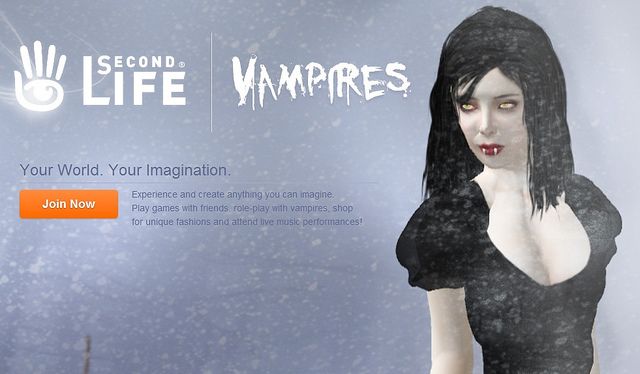
For a good while, the screen comprised a series of images that fell somewhat short of enticing – if not outright ugly. Perhaps the most famous of these was the “vampire in a snowstorm” image.

Camp-ire: the vampire-in-a-snowstorm log-in page image

Several commentators took LL to task over the images selection – which could at the time best be described as “vapid” – and earlier this year things started improving, with crisper images of avatars appearing, together with picture credits.

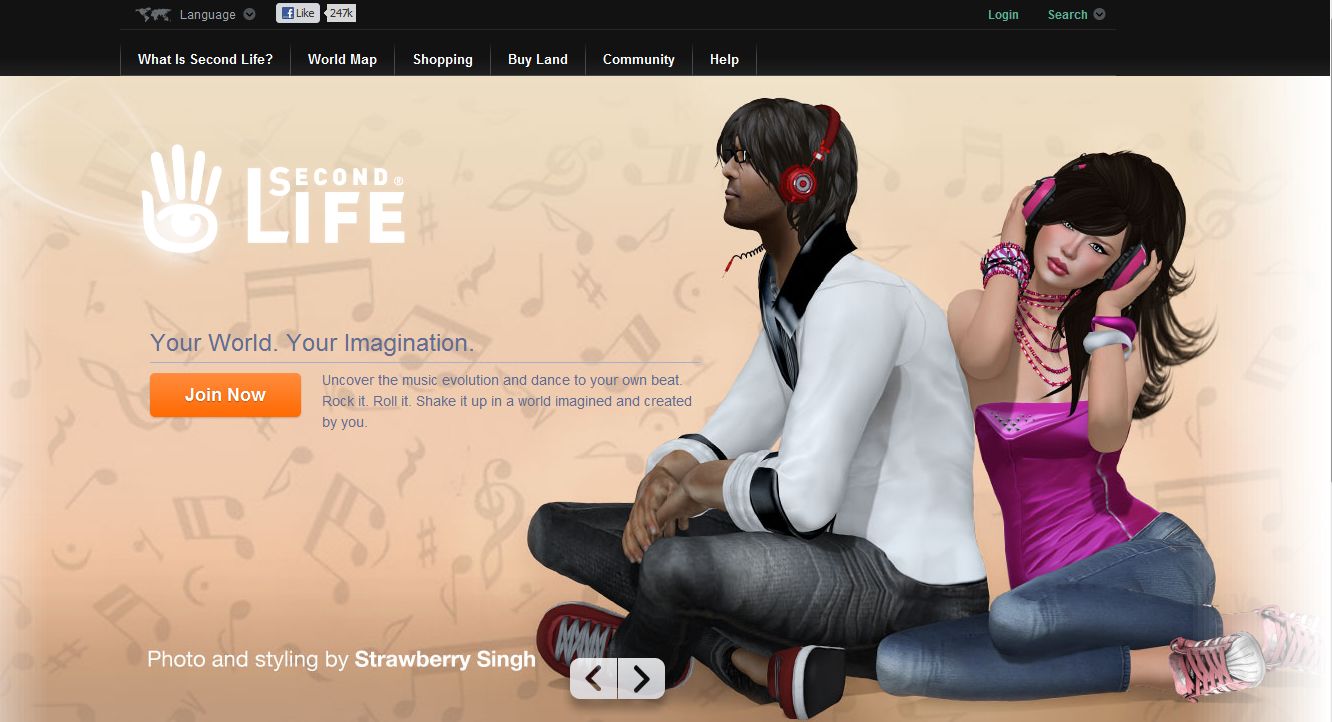
Now LL have gone the extra mile and not only engaged with some of best photographers and artists in SL to produce some really outstanding images for the log-in screen, they would appear to have started working on a theme-based approach to advertising SL through the splash page – the current theme being music. I caught sight of the new pages while browsing Strawberry Singh’s blog, but got sidetracked away from the new art by things like Havok sub-licencing and Marketplace updates, which became the focus of recent blog posts.

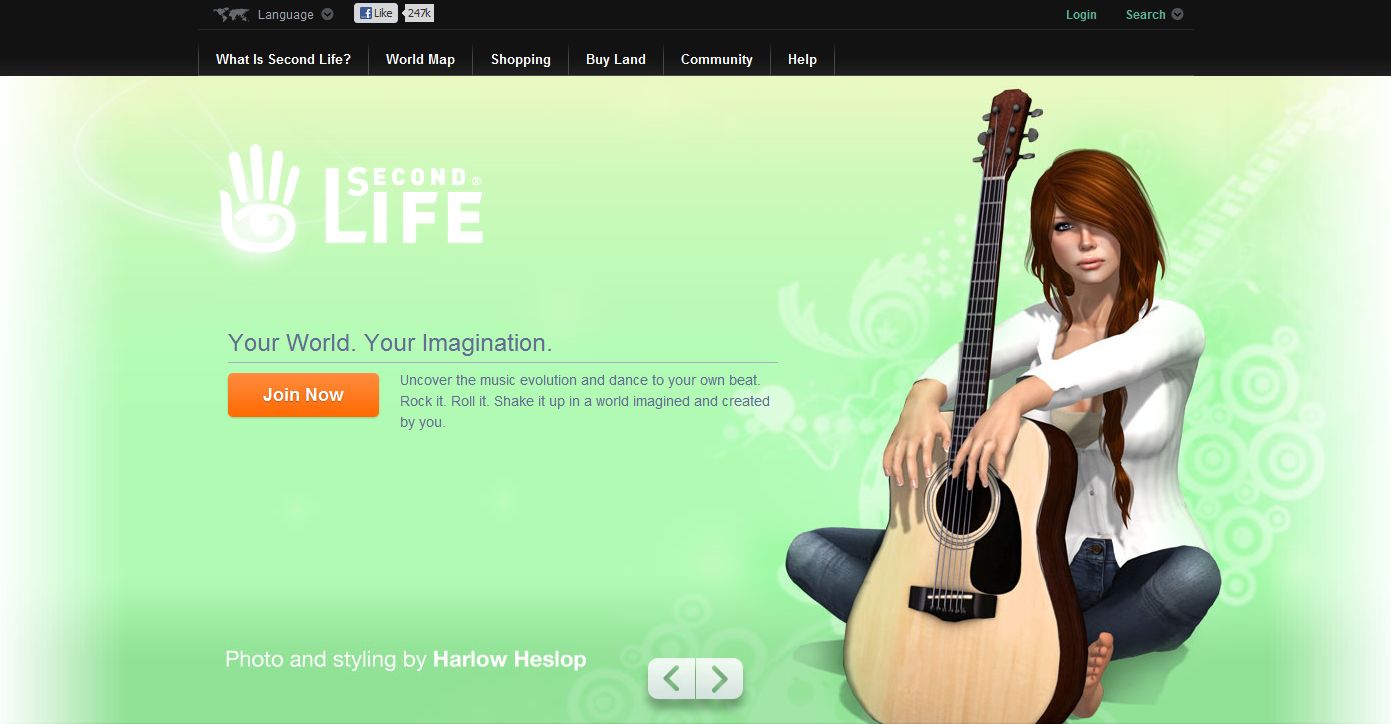
Strawberry is one of a number of SL artists who were asked by LL to produce music-themed images a few weeks ago, the other being Harlow Heslop, Miaa Rebane, siXX Yangtz and Harper Beresford, and Ivoni Miles. The results are simply spectacular.

Strawberry Singh’s SL log-in page artwork, featuring herself and Prad Prathivi

All of the images capture the heart of music entertainment in SL in all its diverse forms, with Strawberry’s in particular hinting at more – friendship and relationships. This is a fresh move from Linden Lab in combining user-generated images on a thematic basis to help promote SL and it is one to be applauded – and one I hope we’ll see more of – for how better to capture the rich diversity of Second Life other than by working with those intimately involved with it?

With efforts like this, it would be nice to see some kind of Destination Guide tie-in as well: perhaps with a special sub-category of “What’s Hot” appearing on the log-in screen carrying information on locations directly related to the image theme: in this case, a list of the currently hot live music venues in SL.

Harlow Heslop’s evocative image

After all, if music is being used to promote SL – then it makes sense for LL to provide the follow-through and help those drawn to SL as a result of the theme to actually  connect with the in-world music scene – or whatever the chosen promotional theme is.

Of course, this isn’t the first time LL have sought to work with members of the community, and it would be unfair to cast it as such. But given the way in which LL has been perceived to be retreating from direct engagement with the community over the last few years – a perception they have contributed in no small part themselves – this move is to be commended. Hopefully, it’ll be the first step along the way to the Lab working more directly with members of the user community to better promote SL and reach out to potential users. Certainly, there are many powerful tools that can be used in this regard – such as machinima, something I’ve again discussed elsewhere – and the talent to leverage those tools is rich within SL itself. I’ve little doubt that were this talent to be harnessed, the results would be beyond anything LL have themselves been able to produce using this incredible medium.

In the meantime, credit and thanks must go to Strawberry, Harlow and the other contributors to the artwork for their time and effort. So why not take a look at their work for yourself? (Remember you’ll have to log-out of the SL website in order to display the log-in / splash page and see the images.)

With thanks to Strawberry Singh.

Marketplace listing errors: LL needs to speak up

Update April 1st: LL issue revised DD migration deadline and updates on JIRAs related to Marketplace issues. 

For the last several days, there has been a serious issue with the SL Marketplace. I’ve reported, with updates, on the matter – as have others. The problem, which as I’ve noted in my original blog post, includes:

  • Listings on Marketplace stores do not match the actual items
  • Incorrect merchant attribution (products from Merchant X listed as belonging to Merchant Y, despite appearing in Merchant X’s store)
  • Products from one merchant appearing in stores belonging to other merchants
  • Items incorrectly priced
  • Incorrect ratings assigned to products (G-rated items appearing as Adult, etc.).

Note that a full list of JIRA on Marketplace issues is also available via Sera Lok and Sassy Romano.

Advice and feedback from the Lab on the issue has been sporadic at best. On the plus side, we have had a welcome apology for errors in the support team relating to the issue. However, feedback within the forum thread on the issues has otherwise been restricted to an attempt to provide advice on the issue which unfortunately, it doesn’t appear to work. Elsewhere, feedback has been restricted to a brief Grid Status page remark.

And therein lies a problem: many are completely unaware that there is an issue. As a result, we’re starting to see:

  •  Rising levels of accusations of “theft” among merchants as they come across what appears to be their own goods being listed by others
  • Well-intentioned customers raising concerns of product theft with merchants when they see incorrectly listed items
  • Growing concerns and confusion being voice through various product support groups in-world.

Linden Lab are somewhat caught between a rock and a hard place here. They are obviously trying to resolve the situation as quickly as possible, and in a manner that won’t in itself lead to further issues and problems: hence why calls to suspend the Marketplace appear to have gone unanswered. We simply do not know the extent of the issue and it would appear that there are at least as many merchants unaffected by the problem (such as myself) as there are merchants impacted by it. Therefore, it is entirely possible that were LL to suspend the Marketplace, the resultant uproar might be even greater than the upset the issue itself is causing.

However, LL do need to be more proactive in communicating the issue – not all merchants routinely read the Merchant’s forum and not everyone reads the Grid Status pages (unless there is something very noticeable “going wrong” in-world, such as teleports failing, rezzing issues, etc). Hence why the levels of misunderstanding are growing.

If the issue cannot be easily resolved – and this would appear to be the case, then more direct communication on the matter  – via e-mail, through all available channels such as the Land and Business blog, etc., would appear to be of an increasing necessity. The e-mail / blog post doesn’t need to delve into specifics but should at least outline the problem and indicate that the Lab is actively seeking to resolve the issue. Doing so would ensure merchants are informed, and potentially go a long way to stemming accusations of “theft” and / or fear of “copybotting”.

On a broader front, being seen to provide information would also help stem the rising tide of anger being directed at the Lab over this issue. Alongside the calls to suspend the Marketplace have also been calls to roll back the Marketplace database to a prior to this problem arising. There are more than likely practical reasons as to why this cannot be done; however, by not acknowledging such calls and at least outlining why a roll back cannot be done – or why there needs to be further investigation prior to committing to a roll-back if it turns out the idea is feasible – would again so much to lessen the resentment that  customers are feeling towards the Lab at this point in time.

It is again in situations like this where Linden Lab do themselves no favours, something I’ve recently touched upon. There are times when silence simply doesn’t work – yet all too frequently, silence is the main tool the Lab uses in dealing with a situation. It’s also an approach that reinforces the negative attitude many people feel towards the Lab, justified or otherwise.

Linden Lab has channels of communication open to it – and where e-mail is concerned, it’s not as if they’ve not used that channel to reach out to merchants in the past. Given the fact that even now, three days after the initial problem was first noticed, some people are still only just finding out about the problem – and in some cases leaping to the wrong conclusion – an advisory posted to the blog and / or e-mailed to merchants would seem to be a practical step to take, particularly as we are now facing the weekend with absolutely no indication as to whether the matter will be resolved sooner rather than later.

Related Links

Communications: It isn’t always the Lab

I’ve been somewhat critical towards Linden Lab were their overall approach to communications is concerned – although I’ve tried to temper my critiques with practical suggestions as to how things might be improved. I also hope that I’m not backward in coming forward to acknowledge those times when they do go out of their way to make the effort – such as with Oz standing front-and-centre regarding the recent TPV Policy changes.

However, when it comes to communications and impressions, the Lab is only one side of the coin. Whether we like it or not, we, as users can be as much to blame for the poor state of communications; we are quick and loud to anger when the Lab errs – or more particularly – is perceived to have erred, and we are equally slow to forgive.

I give emphasis to the concept of perception deliberately here. While there are times when taking the Lab to task may be justified, equally there are times when it is automatically assumed that whatever has happened, the Lab has acted with malice aforethought in a deliberate attempt to nefariously ruin the Second Life experience. Often in these circumstances, even the presentation of the most reasoned argument to the contrary will not prevent such views being publicly repeated to the point where the act of repetition itself establishes them as “fact”.

This was recently brought home to me once again by three inter-related incidents relating to a single code change that impacted a very specific use-case for RLV.  In all three, which included a wider exchange I had with someone in Tateru’s blog wherein the claim was again made that LL is a malicious entity, people were insistent that the code change was nothing less that “obvious” proof that LL were attempting to deliberately “break” RLV – and any evidence to the contrary was summarily dismissed.

It mattered not that the code change in question was a) limited in impact (one specific use of RLV restricted to two RC channels on the main grid); b) rolled back by Linden Lab at the earliest opportunity following a JIRA being raised; and that c) even if the underpinning issue itself couldn’t be fixed by LL, Marine Kelley (RLV’s creator) reported that it could be circumvented from within RLV. So the issue as a whole was hardly going to “break” RLV; nevertheless, people had made up their minds, and no discussion to the contrary would be heard  – even after the code change itself had been rolled back.

It’s a similar story with the mesh parametric deformer, where rumours are circulating that LL is trying to “kill” the project simply because they do not appear to be working on it; rumours that recently prompted Oz to comment on matters. Here the assumption is that  because Qarl released an alpha version of the code in January but it has yet to appear in the official SL Viewer, then LL must be trying to stop the project. That in the intervening months Qarl himself has been soliciting feedback from the community and refining the code, and has made further releases – any of which could have been adversely impacted by LL taking the code and developing it themselves – makes little difference to those who see LL’s lack of activity on the project as being somehow malicious.

I’ve dealt with the whole “LL is malicious” nonsense in both the recent and not-so-recent past, and I’m not going to re-harsh what I’ve said on those occasions now.  While it is right and proper to be critical of LL when the company does demonstrate poor judgement, it is also fair to say that there is also an onus on many within the community to stop treating every action or comment from Linden Lab as being adversarial in nature and / or intent.

Communications run both ways. While the onus is, as I’ve commented before, very much on LL needing to take the initial steps and start focusing as a company on more open and pro-active communications directly with the user community as a whole; it is equally important that we be prepared to lay aside subjective prejudices and preconceptions and make the effort to meet them half-way. Because if we don’t, then frankly, communications in either direction are liable to remain as dysfunctional as they’ve ever been.

New users: the shared experience

Note: This article has been taken to mean I was unaware of the Community Gateway programme. Not so; rather I wanted to focus on the Destination Islands in this piece. As it is, and subsequent to this being published, a comment was passed elsewhere indicating the new Destination Islands are in fact something of a collaborative effort between the Lab and residents. 

“Shared” is a word that has gained increasing prominence where Second Life is concerned over the last year. We’ve had Rod Humble talking about “shared creativity” and more recently, Oz raising the issue of the “shared experience”.  Now there would appear to be an opportunity available for LL to come together with members of the user community to share creativity in order to develop a shared experience that can be of great potential benefit.

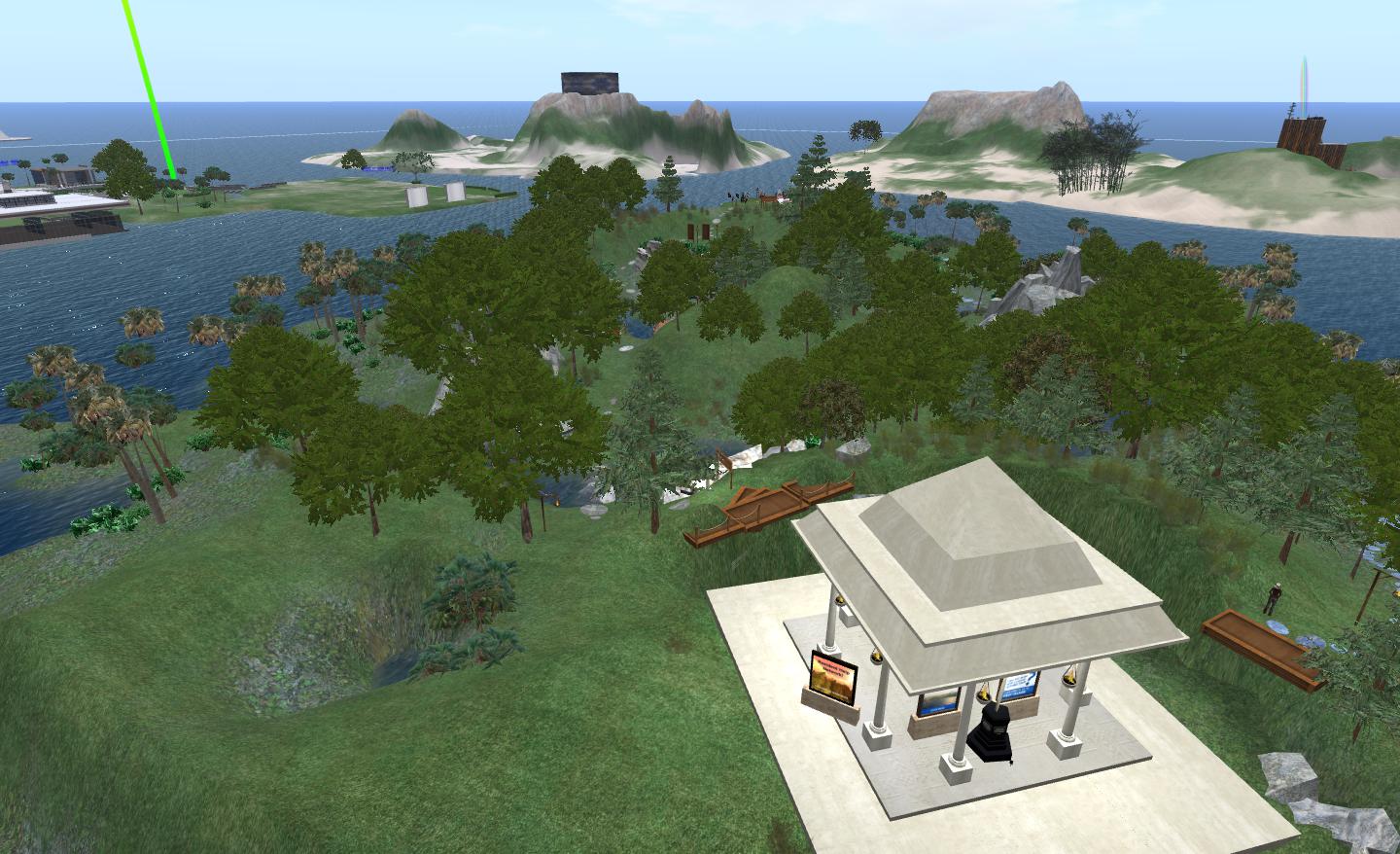
As I reported recently, LL have – at some point – launched a new range of “Destination Islands” to which new users are delivered. Currently, it’s hard to see what these regions actually achieve; they provide no introduction to SL, they don’t build on information given to the new user through the Viewer installation process, etc. As some have commented, they could even result in people thinking they’ve entered little more than a cartoon-based game with no obvious goal or function.

However, they are evidence that LL are still trying to address the issue of the “new user experience” by at least providing a means to direct newcomers to experiences they might be interested in. The problem is, the entire process is very hit-and-miss, and actually leaves much that is attractive about SL completely hidden – such as building and content creation.

New destination islands: low-key

It’s Not Easy

In fairness to the Lab, providing a means of supporting new users is no easy task. As we all tend to point out, SL cannot be taught in a day, and when one goes from talking about the “first hour experience” to the “first five hours experience” – as Mark Kingdon famously did – then something, somewhere is going more than a little pear-shaped when considering new users. At the same time LL have been presented with ample evidence that help centres that rely on direct user / user interaction don’t always work.

However, there is also a risk in going too far in the other direction as well and simply providing too little help and support – and this is the issue one tends to have with the new Destination Islands; they are minimalist in approach, both in terms of appearance and information, to the point of being mere way-stations that direct people elsewhere in SL without doing anything to help them understand where they are or what they might be doing.

How much better might it be if, rather than trying to deal with the “new user experience” without actually addressing it, LL were to seek to collaborate with the user community to provide a means by which new users entering Second Life for the first time are faced with an immersive, engaging experience that helps them understand the basic mechanisms in using the Viewer and the nuances of performing basic tasks SL before passing on elsewhere.

The Competitive Edge

This could be run as a form of a competition or a request for proposals (RFP) process, with Linden Lab providing a set of guidelines as to what is required, together with access to capabilities such as the new advanced creation tools, allowing those in the community to offer potential solutions / responses that meet the requirements /criteria in imaginative and innovative ways, with people free to work either individually or as a collaborative group.

Obviously, not every eventuality for user interaction in SL needs to be covered – just enough to get users reasonably acquainted with getting on with things in SL – and the experience could finish be delivering users to the style of portals currently positioned on the Destination Islands, allowing them to continue their adventures elsewhere. As such, potential criteria for the competition / proposal might be:

  • Provide users with sufficient information on using key aspects of the official Viewer 3.x UI – HOW TO, setting-up buttons, key menu options, etc.
  • How to walk, talk, IM perhaps leveraging HOW TO)
  • Provide an overview of inventory, including the basics of wearing clothing
  • Show how basic interaction with in-world objects work: opening doors, selecting and opening objects with contents
  • Use the advanced tools to demonstrate more advance interactions with in-world objects, such as opening an item and wearing the contents
  • Provide an introduction to building in SL, perhaps with some explanation of what sandboxes are

These criteria could be met through anything from simple read-and-do style notices, to practical demonstrations and / or by the user exploring an immersive build, where they walk a path of their choosing and encounter objects and information boards along the way and are encouraged to apply what they are learning along the way (an example of this might start with a simple door into a building / in a room with the words “click me” written on it to encourage someone to click & open it).

Linden Lab would then be free to select the entry / proposal that most closely fulfils their requirements and proceed to work with those responsible for the entry / proposal to develop and enhance the current Destination Islands.

Portals to more directed experiences might even be provided along the way; for example: those particularly drawn to in-world content creation might be offered a portal taking them to the Ivory Tower of Prims or on reaching the end of the experience, be offered a portal connected to various sandboxes across the grid.

In order to simplify understanding things like the UI, portals could perhaps be included to the gated Orientation Island regions (assuming these are to be continued, given there only appears to be one left & they could be made somewhat more relevant) or to platforms over the Destination Islands, where those who need it can obtain more in-depth guidance. In turn, portals from them could allow new users to find their way back to specific elements of the Destination Islands experience.

Gated Orientation Islands: fold them into the mix?

Such an approach potentially achieves three goals:

  • Relieve LL of the burden of having the physically devote a large amount of time and effort to the development of a “new user experience” while allowing them to retain control over how such an experience should be framed
  • Leverage the core experience and familiarity with SL that the user community has
  • Promote a collaborative, shared experience between the Lab and the user community that can be used to benefit new users, the community and the platform as a whole.

Add to that the capability to “regionalise” the experience by sign-up language (so that those whose primary language is, say, Portuguese, arrive in a Portuguese Destination Island for example), then so much the better. (This may already be the case for the current system, hence the number of Destination Islands already on the grid; I’ve simply no idea.)

Working in this manner isn’t entirely new to Linden Lab  – they’ve recently taken a similar approach elsewhere in terms of issuing an RFP. Admittedly, this approach might require a little more structure from LL to avoid cried of “foul!” from elsewhere – but providing the process is as transparent as possible, there is no reason why it shouldn’t result in a positive outcome. Were the approach to be run as a competition, involvement from users needn’t be limited to those presenting entries: there is no reason why selected users shouldn’t sit on the “judging panel”.

Some would inevitably find fault were LL to take the opportunity to generate a project this way, but overall, given the potential benefit it could bring, it’s hard to find a show-stopping fault with the idea.

New Destination Islands – help or hinder?

In a low-key move, Linden Lab has rolled-out what appears to be a “new” new user experience and which seems to utilise some of the new game controls LL are shortly to be rolling-out to the community as a whole. However, what it is precisely aimed at doing is unclear.

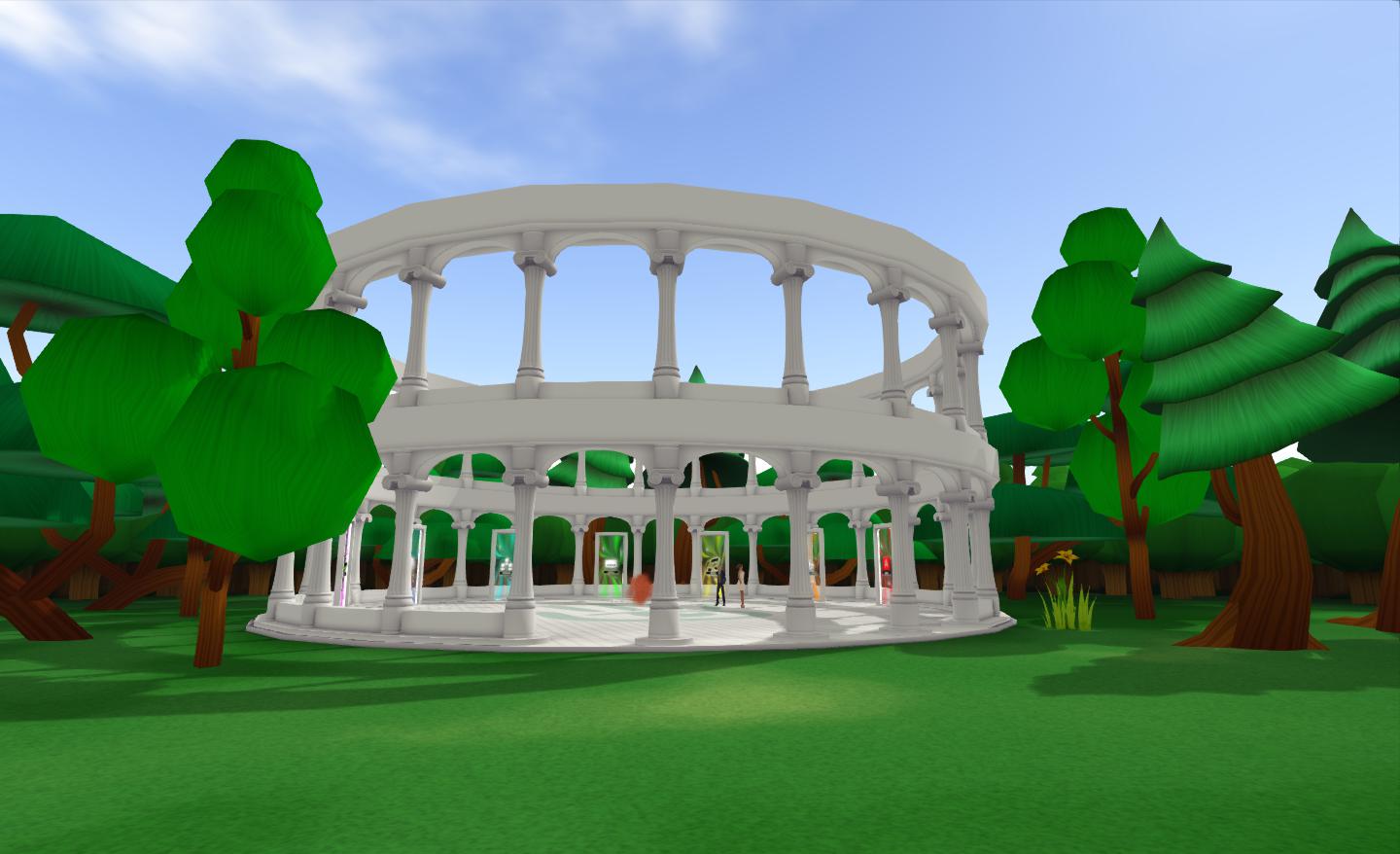
On signing-up to Second Life, new users (or those with a new avatar account) are now delivered to one of 24 Destination Islands.  Like Linden Realms, these are a group of identical regions, each containing mesh trees from the game, with a central coliseum-like structure towards the centre which forms the arrival-point for new users.

Once of the new Destination Islands

No real explanation is provided as to what the place represents or how to use it. Arrivals are instead presented with a series of glass-like doorways with arrows and footprints leading to them, and each with is own label.

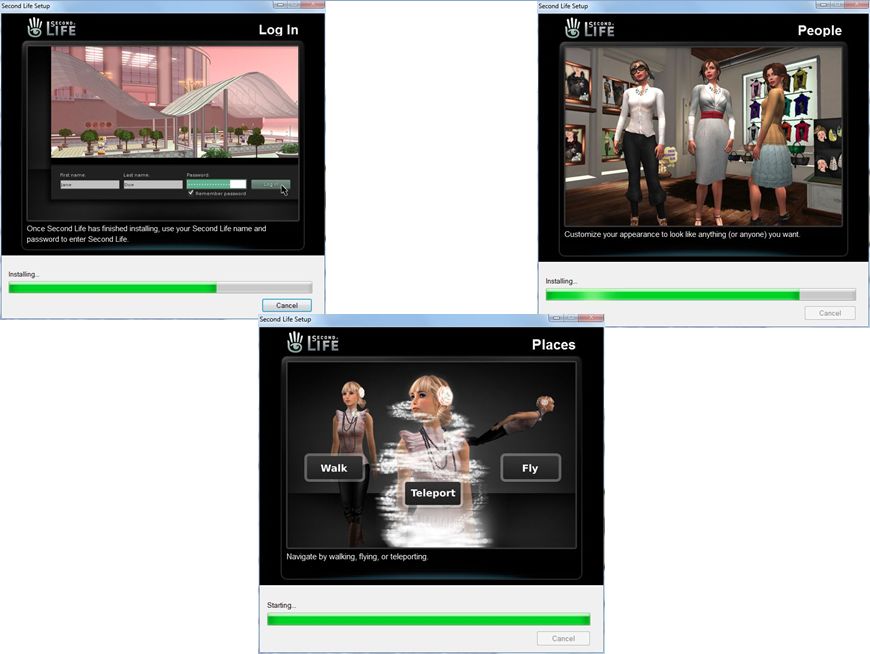
Information slides for those installing the SL Viewer for the very first time following sign-up

True, as a part of installing the Viewer for the first time (the download being a part of the sign-up process), new users are treated to a series of slides that provide a little more detail on using SL (see selected screen captures above), and they’ll have the Destination Guide open once they’ve logged-in to SL – but that’s it. Within the Destination Island areas there are no hints, tips or tutorials available to help the new user – there are just the seven doors (Art, Role-playing, Popular, Social, Music, Editor’s Picks and Adult), arrows and footprints.

Magical mystery tour

Walking through a portal will do two things: open the world-map at a potential destination and auto-teleport your avatar to a destination. Unless you’re using an unverified adult account and try the Adult portal. In this case you’ll simply get a flat nose and no explanation as to why. While an e-mail on this subject of adult verification is sent out to users as a part of the sign-up process, it would be nice if walking-into the door with an unverified account popped-up some kind of explanation rather than leaving people bouncing off the portal for no readily apparent reason.

Passing though other doors drops you into a destination based on the portal’s category. These appear to be selected at random from the Destination Guide. The process doesn’t seem entirely smooth: the world map opens during teleport (or it did for me. Twice), only to close on arrival. This is something that doesn’t happen in Linden Realms, so if the system i use at the Destination Islands is the same as the auto-teleport function used within LR, I assume this is a glitch that will be fixed, rather than a “feature” of the auto-teleport function.

Once you’ve left the Destination Islands there is no way back. Any attempt to teleport directly to them (assuming a new user understand the concept of teleporting) is met “Teleport Failed. You cannot teleport back to Help Island. Go to ‘Help Island Public’ to repeat the tutorial” and an OK button. Hence why you’ll have to create a new account if you want to test the system yourself.

OK, where next? What next?

This isn’t the solution you’re looking for?

Much – perhaps too much – has been made of the new user experience over the past few years. We’ve had talk of the “first hour”, the “first five hours” and, at the opposite end of the spectrum, “the first five minutes”. From comments he’s passed, it’s clear that Rod Humble is swayed towards the latter – that if you don’t capture the heart and mind of a new user in the first five minutes, then you’ve potentially lost them forever.

I’m not about to debate his wisdom on that one – but I will say that it’s hard to see how this approach actually improves matters. While one doesn’t necessarily need to have masses of information on display at the Destination Islands, having at least some guidance provided would, I’d have thought, be beneficial. Of course, this may be coming – in which case LL have rather put cart before horse in hooking-up the new islands to the sign-up process ahead of the information arriving.

This is where I think LL missed a step in merging-up the Basic and Advanced modes of the Viewer. In the former, we had a very good introductory series of tutorials in the form of the HOW TO pages. At the time I felt these could be enhanced, but overall they provided a good starting-point. While HOW TO is still evidenced in the Viewer in the form of a button – it would be useful if the installation process at least drew attention to it. Much better would be for HOW TO to be open by default until the first time it is manually closed (as with the Destination Guide). It wouldn’t solve all the issues in getting new users semi-oriented to SL, but it would at least help them feel comfortable with the Viewer UI – not everyone is happy with randomly pushing on-screen buttons and seeing what happens.

My experience demonstrated that people arriving at the same destination as myself were very confused as to what was happening and what they were supposed to be doing. The flow of people into the region I arrived in was fairly steady, but all of those stating they had just joined SL (and the number was around one or two arriving every few minutes) all pretty much had the same three questions:

  • What just happened?
  • Where am I?
  • What am I supposed to be doing?

Few had actually appreciated there was a HOW TO button (more-or-less the first thing I directed them to), and I found that doing so, and pointing them to functions such as Search,  was greeted with verbal facepalming, e.g.: “Well, it would help to be told that from the start!”

It’s hard to see how this system relates to the Public Help Islands, which are still active. There are no links between the two (other than the message displayed when trying to teleport directly to a Destination Island, as described above). Whether information from PHI will be incorporated into the Destination Islands is an unknown and remains to be seen.

Right now, I’m curious as to where this idea is going. Is it offered-up as delivered, or will there be enhancements based on feedback or observation (and if based on feedback, where do people give it?). As it stands, it’s hard to see how this system helps new users – although LL are doubtless in a far better position to make a call on this than my casual observations. I can’t help feel the approach, as currently presented is potentially as much a hindrance as anything else, and getting to grips with SL is still a matter of dogged determination on the part of those signing-up.

But then, this isn’t the easiest of issues to address, as we’ve seen over the years.

I’d like to keep an eye on if / how the new regions develop. As such I’ve held back with a new account on one of the islands to see if anything changes. If it does, I’ll be following-up here.

Related Links

New users: the shared experience