Linden Lab have added an update to their blog post on Received Items, requesting feedback.
That’s good.
The bad things are that people only have until 17:00 SLT today (1st March) in which to complete the survey, LL haven’t actually gone out of their way to tell anyone or anything about the survey. While the update is on the blog…there’s no dashboard link to the blog post itself.
My own thoughts on the idea are pretty clear, and from what I’ve seen, reaction to the system hasn’t been that great elsewhere. I’ve no idea if this is all part of the general stirring of thing inventory, a-la the Simplified Inventory Project Viewer, or what. However, if you have tried the system out, then now is the time (just!) to give some solid feedback to LL.
The survey link is there – or you can follow it right here. The survey itself is short and to the point, and shouldn’t take too long to complete.
The recent TPV Policy changes brought with them the news that the functionality of llRequestAgentStatus, popularly used to obtain someone’s actual on-line status would be changed at some point in the near future as a matter related to users’ privacy.
The ability to determine someone’s on-line status has been the subject of debate for some time now, as evidenced by JIRA SVC-4823. The JIRA itself has received a lot of attention since the news on the TPV Policy changes broke, which both highlights the level of concern where potentially legitimate uses of llRequestAgentStatus is concerned, but conversely doesn’t help the Lab clearly understand all cases where this is so.
Yesterday, Oz put on a request on the JIRA, thus:
Everyone…. I don’t know if this will help or not, but I’m going to give it a try and see….
We hear what you’ve all said, we understand the issues, and we’re going to discuss what we can and should do about them.
Nothing is final.
We appreciate that Phoenix is moving appropriately to remove the privacy violation from their next release, and hope that they’ll do that soon, but we understand that these things take time.
In order to help us to have a better understanding, I appeal to the many of you who are posting messages that essentially say “I agree – this will be bad for me too” as opposed to describing a specific use case not already described here (and thank you to the many posts that have done a good job describing use cases): please stop with these “me too” posts – they just make it harder to read the full stream (and yes, I at least am reading all of every comment). We know that for every use case there are many users… we don’t need each of them to post something
This is a fair and reasonable request, and while it is understandable the many want to add their name to one or more instances where the function does have a positive use, it’s also essential the LL get a fair chance to establish the how and where and what in terms of what needs to be done in order to avoid causing undue upset or pain in altering the functionality – if indeed this happens.
If you do have a potential user case that hasn’t been listed in the JIRA (or perhaps hasn’t been fully explained), then now is the time to help Linden Lab help you by providing a clear and concise explanation of how the function is used and how altering it could be detrimental to the SL experience. If you just want to add a “me too” comment, without specifics, I would encourage you to consider Oz’s plea and resist the temptation, so that LL stand more of a chance of sifting through the feedback and properly taking all they need to understand into account.
Again, you can reach the JIRA to add your examples by clicking here.
This slipped in under the radar yesterday – I almost missed it, but for a Reddit post from “Finethanks”: the Received Items Beta Launch.
Considered a part of Direct Delivery (and therefore technically already in beta), the Received Items functionality will actually be used to receive all incoming items reaching your inventory – notecards, snapshots, gifts, even items returned under parcel auto-return – as well as items being delivered via the upcoming Marketplace Direct Delivery system.
The blog post reporting the beta launch reads in full:
Look for Received Item in your inventory (Beta Viewer)
The Received Items Beta launches on Aditi today. Received Items is a new subsection of Inventory where all incoming items, including purchases, gifts, shared, and returned items, will be placed. Received Items is displayed in a separate section of your inventory panel in the Second Life Viewer, making it easier for Residents to see and manage incoming objects.
This Beta is a chance for Residents to try out these new capabilities. It also provides Second Life business owners with advance notice so they can plan for any additional communication or customer support around this upcoming change. The production deploy is currently planned for mid to late March, so please help to spread the word!
Because Received Items and Direct Delivery will use the new Received Items folder, both systems will launch together.If you would like to try out Received Items, please see the Received Items Beta instructions on the wiki. These instructions include pointers to Knowledge Base articles and ways to provide feedback.
You’ll need the latest SL Beta Viewer for testing, and may want to look at the Knowledge Base page as well. Aditi regions were testing is enabled are:
To access any of these regions, you’ll most likely need to log-in to Aditi first and then cut & paste he SLurls into your address bar, or use the World Map to reach them.
JIRA reports on the new functionality should be raised under the SVC project and categorised as “inventory”.
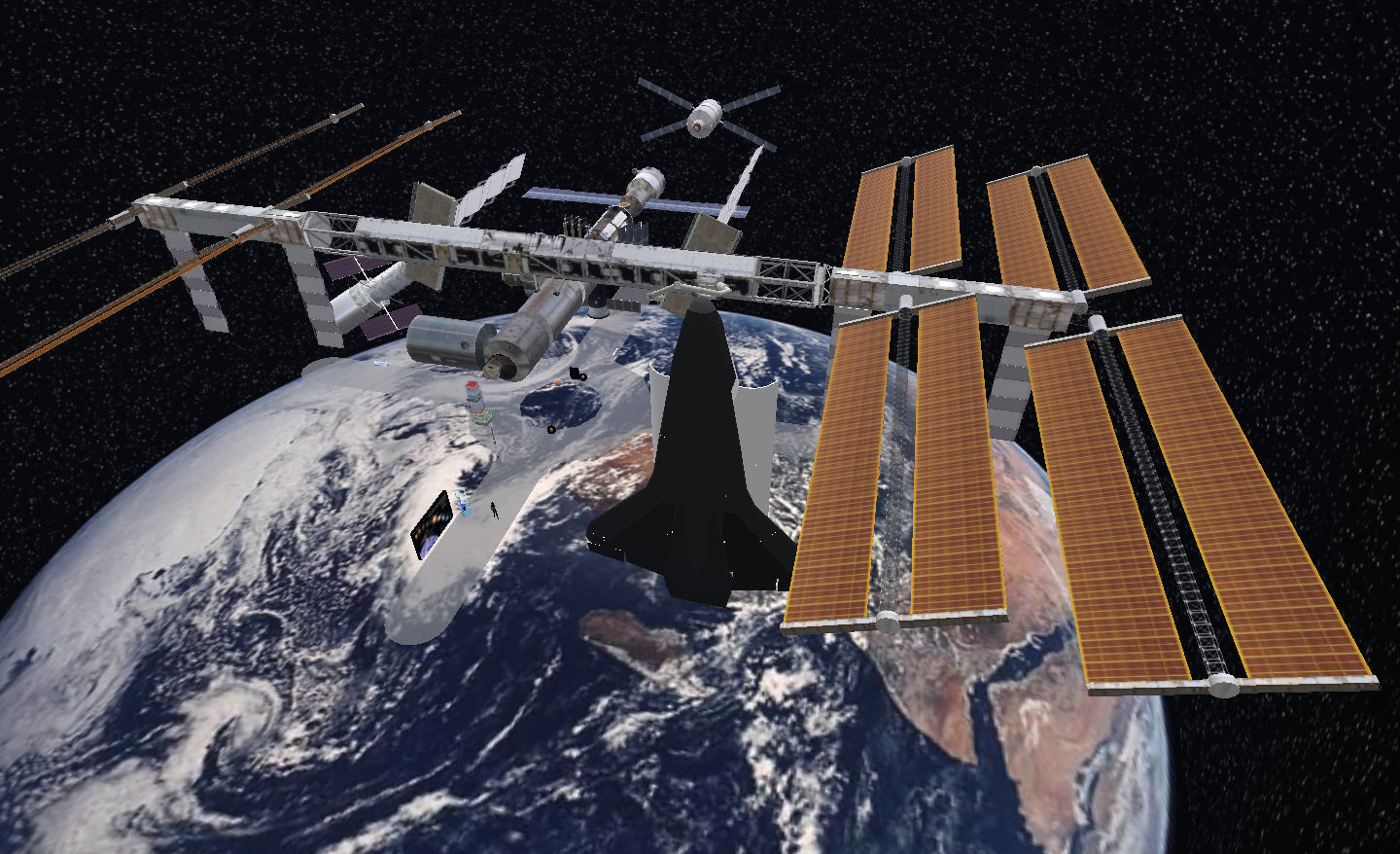
There has been some speculation circling as to the state-of-play with the International Spaceflight Museum in Second Life. The ever-vigilant Daniel Voyager first reported the sims had vanished from the SL map, alongside that of NASA’s CoLab sim (ISM is not in any way linked to, or affiliated with, NASA). since then, questions have popped up elsewhere regarding the status of the project.
ISM: Down – but far from out
As the ISM has been such a landmark feature of Second Life, I decided to contact Kat Lemieux, a prime mover behind the project, to find out what is happening and what the future might hold.
The first order of business was to establish why the ISM regions – Spaceport Alpha and Spaceport Bravo – had vanished from the grid. Rather than being “gone forever” from SL, their absence has been the result of a number of circumstances combining at the wrong time to leave bills unpaid. However, matters are in hand to get things up and running again, as Kat confirmed to me, “Right now I’m trying to straighten out an issue between PayPal and LL billing, but that should be resolved in a day or so, and the sims will be back soon afterwards.”
And when they are back – expect a grand re-opening party to be announced!
Nor does the good news end there.
While much is still in flux, and the longer-term future of the ISM needs to be carefully considered, Kat remains confident that it will continue to be a presence in SL and may even look towards opening “branch museums” on other suitable grids at some point – but the focus will remain on Second Life. “I don’t foresee ISM leaving SL completely as long as we can afford to stay,” she told me. “Several island owners have offered to host us on their land if we decide to sell the sims, but whatever we decide, SL is still where the people are, so we need to have a presence there.”
ISM has been cataloguing humanity’s achievements in space within Second Life since 2005
Other changes may be less obvious, but are important to the future running of the museum. The ISM Corporation, for example, has been wound down, and will be replaced by a more focused team working on the project. “Since we created it for the purpose of obtaining tax-exempt status, and that didn’t happen, there was no reason for it to continue, and it was just sucking up resources,” Kat explained in reference to the decision to wind-down the corporation – an understandable move in the circumstances. The ISM website, however, will be continuing, and updates are due to be put out in the near future – although again, initial focus will remain on getting the ISM regions back up and running smoothly in the short-term. In addition to the website, there are plans in hand to launch a public Facebook page for the ISM to help further raise the profile of the project.
As with all large-scale operations, ISM has had a few internal issues to deal with along the way that have tended to slow things down a little – fund-raising and business management being two of them, as Kat candidly explained to me. “Trying to pay for maintenance and running a business as opposed to playing with prims and textures just aren’t as much fun for the kinds of people who were initially attracted to starting the museum. Even running events, which we did quite a bit, wasn’t the same. That’s fair, as there is no law saying the same people have to enjoy every aspect of such an enterprise; but we didn’t seem to have enough of those willing to do the business side.” These aren’t issues that will easily go away, and one senses that if there is someone out there with the passion and drive to lend their weight to the project in these areas, their help and support would be most welcome.
But for now, things are looking decidedly bright for the ISM – and the current down-time will hopefully shortly become little more than an unscheduled interruption to what has been one of SL’s finest and most informative destinations since 2005.
If you would like to help support the ISM and volunteer your time and abilities, contact Kat Lemieux in-world. If you would like to show your support for the project via a donation, you can do so via PayPal to ismuseum-at-gmail.com (remember to replace the “-at-” with “@”!) or in Linden Dollars paid to AyeEss Emms in-world.
Update April 2012: The flight limit has been raised to 5,000m.
Nalates Urriah keeps her finger on the pulse where all things server and scripting are concerned, as well as keeping an eye on other technical aspects of SL. Today she reports on server scripting, and carries an interesting little nugget on flight limits.
Apparently the Lab is considering whether or not to raise the current flight “ceiling” for unassisted avatars. As we’re all aware, if you fly without any kind of scripted / client-side assistance, you’ll start slowing down from around 165m onwards, and come to a complete halt at about 180-190m. To go any further, scripted / Viewer assistance is required.
I’ve no idea why this limit was set – there has to be some solid reasoning for it in the depths of time. However, for as long as I’ve been involved in SL, build height has (I think, my memory is getting fuzzy in some areas) always been at least 768m (prior to being raised to the current 4096m), so the brake-point at 180-190 to “natural” flight does seem rather arbitrary.
Simon Linden apparently puts forward an argument that raising the limit will shoot people using flight assistance systems into orbit. I’m not entirely sure I follow his logic. There is a plethora of flight assistance alternatives available across SL, from the ubiquitous Flight Feather or Flight Ring of old, through to fancy backpack attachments to options built-in to a range of tools such as Em Dash and Mystitool. Many of these include accelerators which allow the rate of vertical ascent to be adjusted by the user – some of them quite ridiculously so. Yet none, so far as I’m aware, have resulted in people ending up in orbit on the click of a button / key, even when employed at altitude. So would the removal of the current limit suddenly cause these tools to behave any differently?
It’s not even as if flight assistance tools are required, either. Firestorm bypasses the current limit by adding flight assistance to the LSL bridge. Milkshake (prior to being withdrawn from public use) demonstrated that it is possible to override the flight limit directly from within the Viewer without even resorting to any form of bridge attachment. Both of these capabilities tend to make the current limit somewhat pointless.
As it stands, and with maximum build height sitting at 4096m, it would make sense for LL to lift the limit to that altitude (as I’m sure they are only too aware). This would not only make mobility at altitude easier for all (especially around the more expansive higher-altitude builds where flying is allowed), it might even lessen people’s dependency on attachments, be they wearable or HUDs (not that this is a critical issue, given the threatened script limits project is now apparently shelved).
It’s not what I’d call a priority in any way shape or form, but it would potentially make people lives a little bit easier in-world; so if LL are considering the move – I for one say, “go for it – and push it to 4096!”
Qarl Fizz (Karl Stiefvater) has provided further commentary and feedback on the developing mesh parametric deformer project via a You Tube video. In it, he specifically addresses a number of questions and concerns, as well as providing further explanation on the current alpha of the deformer and how things are developing, and why some options and ideas are unlikely to make an appearance in the first release of the code (but may appear down the road).
Providing Feedback
Initially, feedback was requested via the deformer JIRA. However, given some of the issues raised as to the appropriateness of discussions on the JIRA, Qarl suggests that future comments on this video and the project in general should be made directly to his website for the time being.


 Inara Pey: Living in a Modemworld