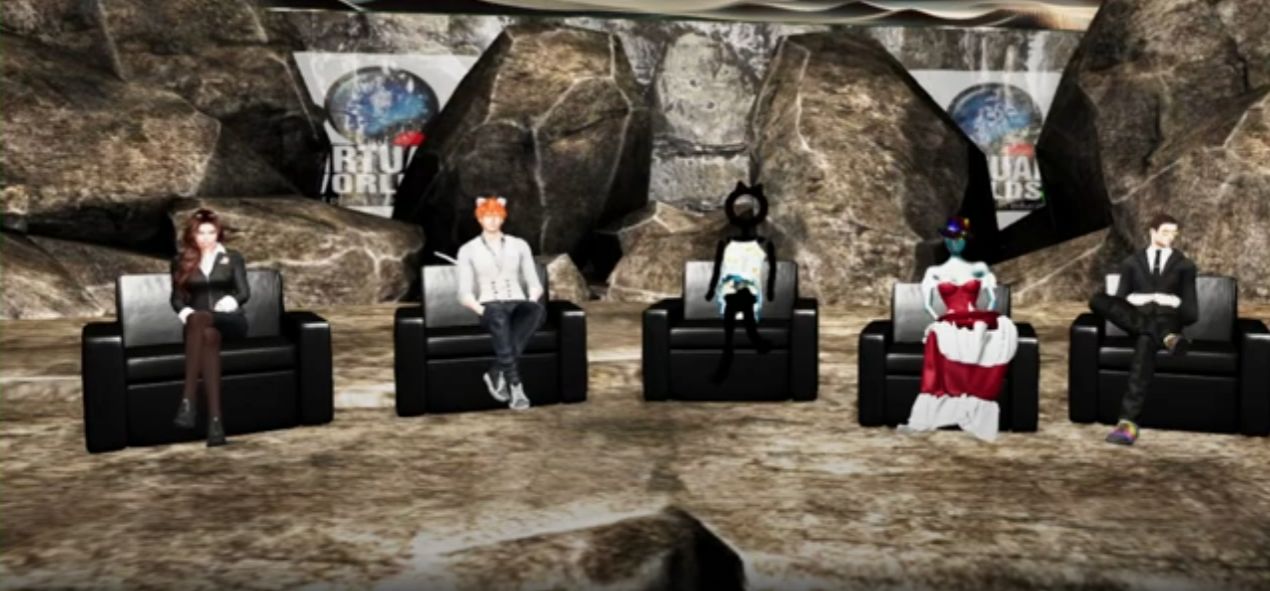
| On Friday, April 4th, 2025 the Virtual Worlds Best Practices in Education (VWBPE) conference held another of in their sessions featuring representatives from Linden Lab and various called over the years Above the Book, What’s Up at the Lab and now Catching Up With the Lindens. |
Table of Contents |
The following is a summary of the session covering the core topics raised. Notes are based on the official video of the session, which is embedded at the end of this article. Time stamps are also provided to the relevant points in the video for those who wish to listen to specific comments.
On hand for the session, hosted by Elli Pinion, were:
- Grumpity Linden, Senior Vice President of Product and Engineering.
- Patch Linden, Senior Vice President of Product Operations.
- Kali Linden, Director of Engineering Web & Platform
- Kyle Linden, Product Manager (viewer).
Notes:
- This is a summary, not a full transcript, and items have been grouped by topic, so may not be presented chronologically when compared to the video.
- Timestamps are included to allow a direct jump to a subject.
- Given these sessions are part of the VWBPE annual conference, there is obviously a lean towards matters of education and learning.
SL Mobile and Project Zero
SL Mobile
Resources:
- SL mobile web page – with links to the Google and Apple stores.
- SL Mobile User Group details – SL Wiki.
- Mobile User Group summaries in this blog.
- SL Mobile Beta Announcements – Feedback Portal.
- A re-cap on work to date on SL Mobile, from the baseline starting point: could an app be built that could render avatars much as they appear within the viewer?
- All the work tends to be iterative in nature – so, for example, avatar appearance and fixes form a tranche of on-going work as they are refined and improved.
- Features are being added in terms of “journeys” – what would people like to do in SL when using a mobile app + what is practical to be able to to on a mobile device, and then building-out a specific “journey”.
- The first such “journey” was called “going to a club” (although it can be applied to other in-world activities), and which incorporated capabilities such as logging-in, seeing Friends on-line, finding an event / location, going to it, being able to chat / IM, listen to music, interact with objects, etc.
- As the project has been opened out through the on-going Beta:
- Development has been adjusted to try to take into account feedback and feature requests from users. developed and more and more feedback has been supplied by users (e.g. feature requests), and all of this is reviewed and considered in building-out the development roadmap.
- One aspect of the Beta has been the need to better support incoming new users – hence the integration of the new user sign-up process with Mobile, the provision of an arrival / “welcome” area specifically for new users coming into SL via Mobile, etc.
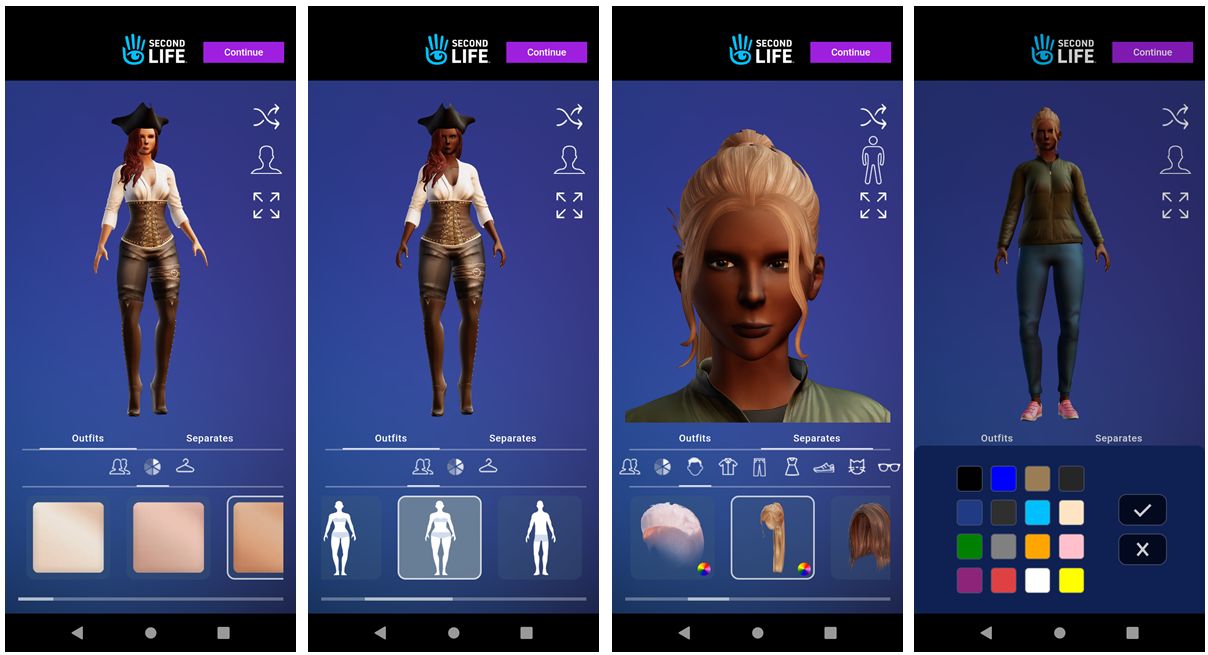
- The goal with the Mobile app is to have it as a companion means of accessing Second Life alongside of the desktop experience, with the eventual aim of having it stand on its own as a window into SL – but there is a lot of work / functionality to add before that point is reached.
- However, some functionality will not be fully developed – such as the ability to build content from within Mobile; screen size and other limitations do not allow for this, but users can expect the ability to interact / move content around on Mobile to customise spaces.
Project Zero
Resources:
- Official Announcement – Linden Lab.
- Announcements and Updates – this blog.
- Multi-faceted project:
- Providing easier on-boarding for incoming / returning users by offering a direct path from sign-up to using the official viewer within a browser (Project Zero).
- Providing a suitable new UI to with with the viewer when offered through a browser (React / HTML) (Project Zero).
- Providing ability for existing users to access Second Life using a third-party viewer.
- The payments aspect is in flux; streaming has costs associated with it, which LL need to cover (at the time of writing, around US $1.75 an hour per session – see: here and here for more), but at the same time those costs are gradually decreasing.
- Firestorm Zero (see: Project Zero Update: Firestorm in your browser as well) has been a “first pass” at trying to offer access to a third-party viewer via a browser. This has been:
- A limited-availability (in terms of available passes) offer.
- A experiment in charging a nominal fee for access (L$250 for 5 hours) to see how that was received by existing users.
- Testing the ability to have viewer settings persist across multiple log-ins using a browser-based version of the viewer.
- LL are aware of the appetite among users to have browser-based access to SL, and more will be “coming, but not immediately coming.”
- In terms of pay-to-use: LL are looking at various ways to reduce the cost to users (e.g. bundling so many hours of access per month to the SL subscription tiers before users on those tiers would have to start paying) – but this is all very much still in discussion.
WebRTC
- Project recap: replacing Vivox Voice service and plug-in with the WebRTC communications protocol (RTC=”real-time communication”). Key benefits:
- WebRTC supports a wide range of real-time communications tools in common use (e.g. Google Meet), supporting audio, video and data communications, and is thus something of a “standard” approach.
- Offers a good range of features: automatic echo cancellation, better noise cancellation and automatic gain control, much improved audio sampling rates for improved audio quality.
- Opens the door to features and capabilities to voice services which could not be implemented whilst using Vivox (e.g. text-to-speech / speech-to-text).
- Currently, the majority of up-to-date viewer support both Vivox and WebRTC, and regions are running either WebRTC or Vivox on the back end.
- The intention remains to turn off Vivox altogether on the back-end at some point, leaving only WebRTC.
- This has been delayed due to the (now decreasing) number of users still using older versions of viewer which do not have the WebRTC updates, and so are reliant on Vivox.
- It is hoped that, all things being equal, the switch-over can be made before the end of the second quarter of 2025 (e.g. by the end of June 2025).
- In the meantime, region / estate holders wishing to try WebRTC on their regions can submit a support ticket to have their region moved from Vivox to WebRTC, with the understanding that (at the time of writing) WebRTC is still under development and might be a little unpredictable.
Combat 2.0
Resources:
- Original proposal document – Rider Linden.
- Combat 2.0 SL Wiki page – SL Wiki.
- Combat 2.0 showcase regions:
- Combat User Group summaries (currently suspended)- this blog.
- Recap: a project (currently on hiatus) to overhaul the Second life Combat System (SLCS) and update it to support better combat capabilities and options, and make user engagement in combat simulations easier and more enjoyable.
- Key additions to SLCS thus far include:
- Damage Limit, Regeneration Speed, consequence of death (e.g. teleport victim home as per current SLCS or to a telehub / landing point or take no action).
- An on_damage event to account for intervening elements which may result in less severe damage being caused (e.g. when riding inside an armoured vehicle).
- A new Region Combat Event Log (aka “Brigadier Linden”).
- More work to come, with discussions often taking place during the weekly Simulator User Group meetings.
AI Integration
- Recap:
- LL originally launched the AI Character Generator utilising Convai, a platform for developers and creators proving an intuitive approach to designing AI characters, and with limited access in December 2024.
- There was a lot of negative feedback, prompting the alpha test to be suspended, prior to re-opening in March 2025, with increased access, as a part of the March Membership Madness promotions.
- LL is looking to work with various groups to make the capability more accessible / usable.
- Due to the negativity from many towards AI (and some of the issues the wider use of generative AI has genuinely caused), the the Lab is looking to follow-up on Philip Rosedale’s promise to have a dedicated Town Hall / Community Round Table on the subject of AI, and get such a meeting scheduled.
- There is acknowledgement that AI characters have a use within SL (e.g. the AI helper for new users that can answer questions, provide assistance, etc), and such use-cases could be widespread.
- In developing AI capabilities for use with / in SL, LL is trying to be as thoughtful as possible, and respective of people’s views.
- Concerns have been raised about people being able to know whether the character in front of them is an AI-driven agent rather than an avatar operated by a human.
- Traditionally, the requirement has been for any scripted agent used in-world to be noted as so by the creator.
- However, LL acknowledges that AI agents have a more nuanced capability over that of scripted agents (“bots”), and so a more granular distinction is likely required so that people do understand the nature of the avatar which whom they are interacting.
In Brief
From approx. 42 mins to end.
- Mention of the SL server-side implementation of Luau scripting – referenced as “SLua”, currently in alpha testing on Aditi (the Beta grid).
- Please refer to the official blog post for more.
- SLua is generally discussed at the weekly Simulator User Group meetings.
- SL22B: general notes that the birthday event will run from Friday, June 20th, 2025 through until Sunday, July 20th, and that (at the time of writing) performer and exhibitor applications are open.
- Mention of the first cut of the glTF mesh model import to run alongside COLLADA – see my Content Creation User Group summaries for more.
- Mention – without specifics – of two Linden Home releases that are on the horizon.
- A reminder that SL users are welcome to attend all user group meetings.





 Inara Pey: Living in a Modemworld