
On Tuesday, October 9th, Linden Lab issues the October release for Sansar (R26). Called the thumbs-up release, it includes some significant updates and additions, not all of which I can review in-depth, simply because they are VR-oriented. However, the VR such is not perhaps the most significant element within the release – although it is impressive.
This article is designed to provide an illustrative summary of the release, but do note the lack of an VR headset and controller on my part means that any features described in detail here are looked at from the Desktop Mode.
The full release notes for R26 are available here.
Permissions / Licensing System
This is perhaps the most anticipated element within the release. With it, content creators can now set permissions against their goods, allowing them to be sold and re-sold via the Sansar Store.
Resale Price and Buyer’s Permissions
Sansar’s permissions system is built around the concept of the supply chain: creators can sell complete items “as is”, or they can create items – such as components as well as complete objects like a house or a suite of furniture, etc.,), expressly for other creators to use in their own creations which can also be sold on to consumers, with both the maker of the object and the creator of the original item receive payment.
This means, for example, a creator might make the engine and gearbox for use in cars and place them for sale / resale in the store for use in vehicle products built by others. When one of those vehicles is subsequently sold, the creator of the engine / gearbox receives a commission from the sale. To achieve this, the permissions / licensing system has two key elements:
- The Resale Price: set by the original creator, it defines the price at which the item must be resold and is their commission on any re-sales of that item / any objects in which it is used. So using the car engine / gearbox example, if the resale price for these is set at S$400, then anyone building a car using them must factor this amount into their car price, as the engine / gearbox creator will receive S$400 from the sale of each car using the engine / gearbox.
- The Buyers Permissions: set by the creator of an object sold via the Store, these define what purchasers can change with the object when they have bought it.
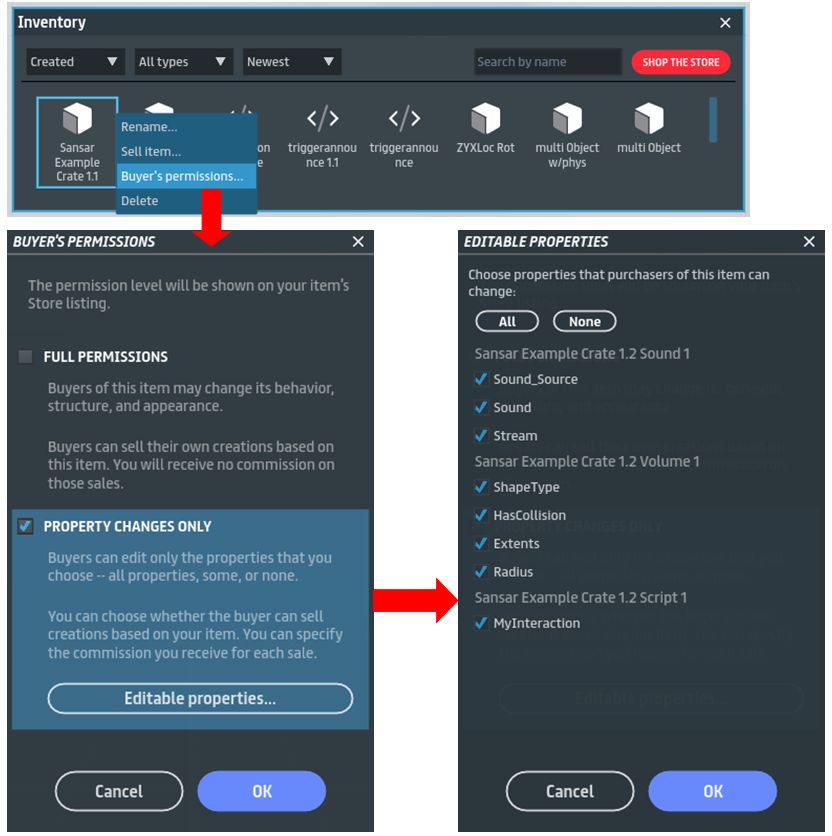
There are some important concepts around resale prices and buyer’s permissions, so please read the official documents linked to above – particularly the small print.
Additional Notes On Permissions
- Save to Inventory: Objects with edited properties or with additional components can now be saved from a scene in Edit mode back to inventory.
- With this release, it is still not possible to join two objects together.
- Note: Legacy items created by other store sellers cannot be saved back to the inventory.
- Licensing: Any item uploaded to Sansar or saved back to inventory will not contain a basic license with information of the avatar uploading / saving it. This is part of the mechanism to allow items to be resold and commissions paid.
- Disable materials editing: it is no longer possible to change the materials of legacy items purchased prior to this release. For new items, materials editing can be enabled by giving full editing permissions or limit it by setting it to property changes only.
Store Integration
With the September 2018 R25 release, Linden Lab took the first step towards integrating the Sansar Store into the client. At that time, users could browse the store from within the client, but when wishing to purchase an item would be transferred to the web version of the Store in their browser to complete their purchase.
With this release, purchases can now be completed within the client.





 Inara Pey: Living in a Modemworld