Sansar: Anu by AnuAmun, one of the destinations in the January edition of Sansar’s Top 5
Sansar Top 5 is a new monthly live stream event put together by the Lab to help highlight experiences within Sansar the Lab feel are worthy of note. The first episode took place on December 21st, 2017 – which I completely missed – and the second is due to be streamed via the Lab’s Sansar YouTube channel from 5:00pm PST (SLT) on Thursday, January 4th.
There is already a weekly Sansar-focused live stream event, hosted by Strawberry Singh and Draxtor Despres, which can be seen on their respectively YouTube channels – here for Berry, and here for Drax, which include an archive of past travels as well). Currently, the Lab’s events don’t appear to be archived.
Sam Distaso, Manager, Strategic Business Development and a Sansar’s Top 5 co-host
Sansar Top 5 is hosted by Boden Linden, a member of Sansar’s Product Team, and Sam Linden, otherwise known as Sam Distaso, who joined the Lab in September 2017 from AltspaceVR, where he worked as the Virtual Reality Business Manager. His function at the Lab is that of Manager, Strategic Business Development for Sansar.
If I’m honest, I find Sam’s role somewhat more interesting than the live stream event, as it seems to point towards the Lab following through on their aim of directly engaging with businesses and organisations that have a use for VR, and who may wish to leverage Sansar, something I hope to follow-up on at some point in the near future. Sam is also no stranger to VR media events and shows, having co-hosted the VR Sports Show for AltspaceVR and is also known as TheGuyInVR with IG.
Sansar users are invited to join Boden and Sam on their journey, with the initial meet-up taking place at Skye Naturae Virtualis. Those who cannot make it into Sansar, or are curious about seeing Sansar and don’t have an account, can follow the live stream via the Sansar YouTube channel, as noted above.
Skye Naturae Virtualis by Alex Bader, launch point for the January edition of Sansar’s Top 5
As it is the holidays and a time for fun and games, I thought I’d blog about two quirky experiences in Sansar which are easy to hop into and enjoy.
The first is the Violin Tree, by Mikki Miles, which offers a fun little trip into the world of music in an abstract kind of way – and one easily missed if not careful. The setting is simple enough: a square, hilly island rising from open waters, a circular lake at its centre. To one side, a down the slope from the spawn point, a wooden jetty points towards a raft floating on the water. A walk out along the jetty will reveal several things: the first is that half of it is a xylophone, which is playing randomly. The second is that a voice is singing over on the raft – but don’t try to walk to it over the water! The singing comes from a megaphone sitting on the raft alongside a wooden frame containing Sandro Botticelli’s Venus from The Birth of Venus (circa 1480-1490), with a granite sculpture sitting on the other side of the frame (if you want to get close use F4 + the movement keys to freecam over the water).
Atop the island, each flanking a central body of water, sit a tree – the titular violin tree – and the 40,000 year-old bone flute of the experience description. On the lake, a little rubber duck scoots around, attracting attention; walk towards it and as you reach the edge of the lake, the duck vanishes as a gigantic piano rises from the water, the fall board and main lid opening before the piano starts to play Handel’s Water Music – albeit it slightly tinny. Similarly, approach the tree and / or bone flute, and they will also impart a music excerpt, while the brass “piping” rising from the outer slopes of the island are revealed to be the tubing of trumpet, horn or trombone.
But that’s not all. To one side of the island there sits what appears to be the entrance to a mine. Visitors can enter it and follow the tunnel down into the island, where a little more musical fun is to be had, including a nice tip-of-the-hat to the Rolling Stones.
The Violin Tree isn’t a hugely ambitious experience – but it is one cleverly considered, which makes good use of ambient sounds and trigger volumes to offer an eclectic little musical / art / historical visit.
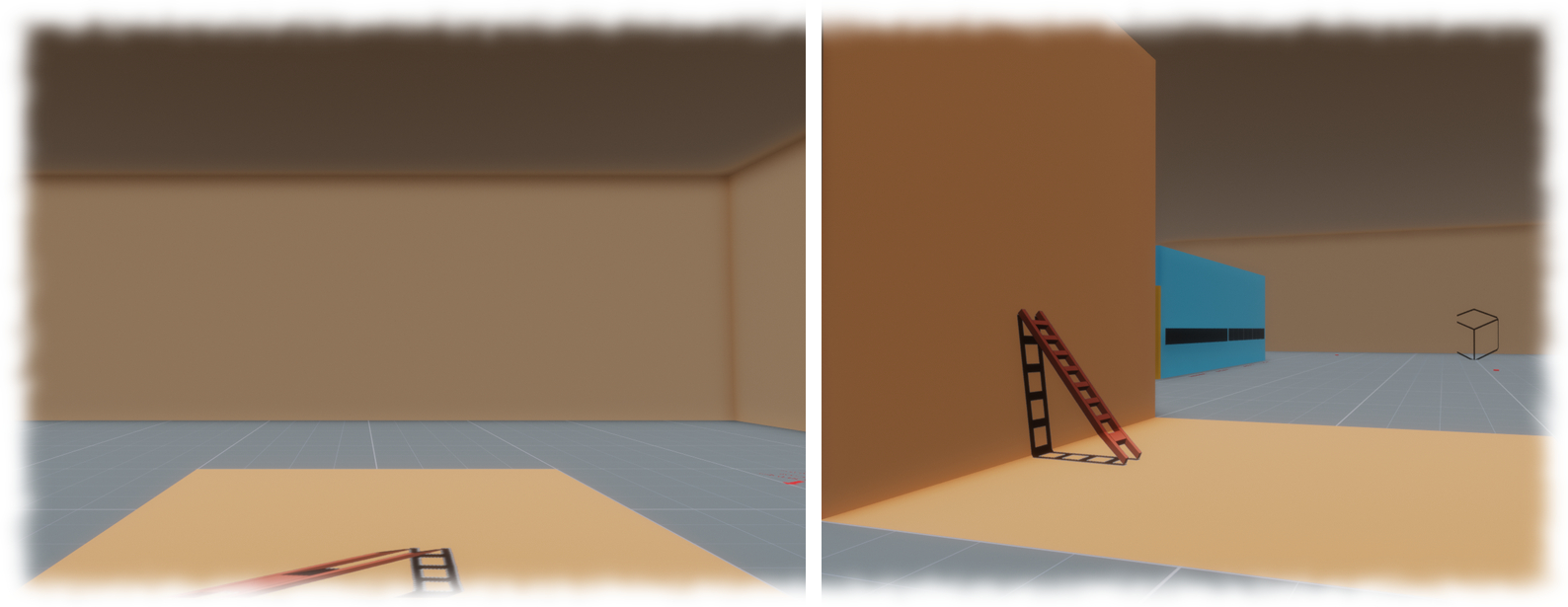
Back in September I visited the Reverse Perspective Art gallery by JackTheRipper, which offers a fascinating tour into the world of reverspective art, as conceived by Patrick Hughes (see here for more). This is actually one of two art / optical illusion focused experiences created by JackTheRipper, and I for my second little recommendation, I offer the second: his Optical Illusions Arena.
Exceedingly simple in presentation – to the point where it might initially seem to be just a random space where someone has been playing – the Optical Illusions Arena again has more to it than may at first appear to be the case. As the name suggests, it is a space containing images and items designed to trick the eye through the use of set observation points, forced perspective and so on. What’s more, it works in either VR or Desktop mode.
Sansar: Optical Illusions Arena – from one vantages point, an odd painting on the floor (l); from another, a ladder against a wall (r)
Scattered around the single-room arena are a number of elements, some in 3D – such as what at first appears to be a collection of sticks hanging in the air – through to seemingly random paintings on the floor. Also appearing on the floor are a series of red dots with arrows indicating a direction in which to look. When standing on one of these and looking in the direction indicated either in VR mode or first-person (F3) view in Desktop mode, will reveal the secret of one of these random collections or paintings. Thus, the group of coloured sticks becomes as set of painted wooden chairs, the odd splodge of white-and-grey on the ground becomes an opening in the floor, and so on.
If visiting with a couple of friends, the reproduction of an Ames room can offer the most interesting effect. When viewed from the observation point outside of the room, two avatars entering it through the doors on either side will appear to be very differently sized, one to the other, and interesting effects – from the observer’s perspective – can then be had as they move around the room.
Sansar: Optical illusions Arena – the Ames room will make two avatars appear to be different sizes when they are apparently the same distance from the observer (note: the disjointed element of the image is due to my attempt to demonstrate the effect with one avatar and two photos, not a reflection of the build)
Neither the Violin Tree nor Optical Illusions Arena are going to set the world on fire in terms of being major attractions – but that’s not the intend of either. They’re about having a little bit of fun while experimenting in 3D and with Sansar’s tools. As such, if you find yourself with ten or fifteen minutes on your hands, why pay them both a visit?
Jay Salton is an Australian digital artist with a remarkable eye for creating stunning images which encompass fantasy, surreal and abstract elements and which are rich in colour and depth. He’s long held a desire to see his art evolve into a virtual space which people can explore and experience with their own senses. As Renegade Rabbit, he has taken a step along the road towards this evolution within Sansar, where he presents the Jay Salton Art Gallery.
Set within a walled meadow, the gallery building is fronted by a small garden with a lean towards Japanese influences. The spawn point is at the end of a footpath that leads beneath a Torii gate and over a water feature from which rise two small islands, each topped by a tree – one of which has something of a Bonsai-like topiary around it. A young lady sits on a rock before the water feature, while Jay’s love of the surreal is catered for by the presence of two gigantic mushrooms flanking the gallery building in the meadow.
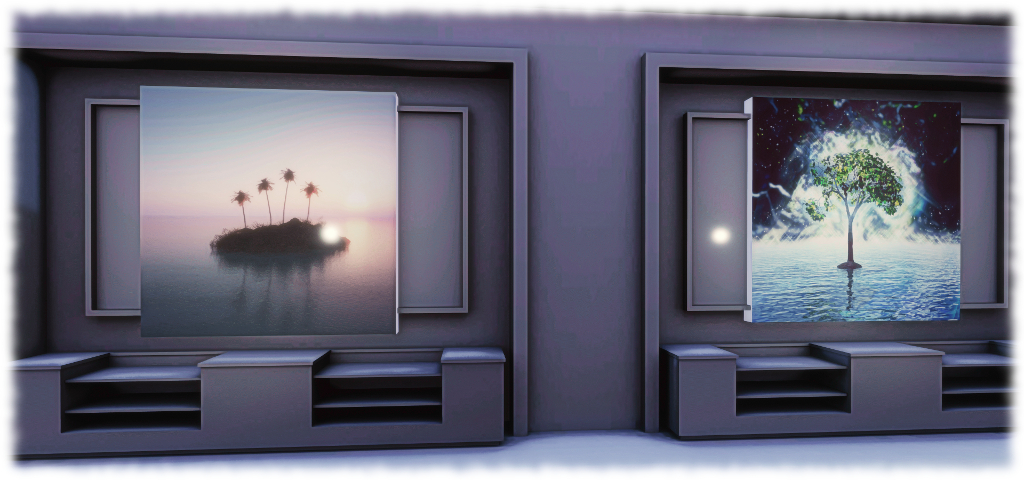
The gallery, wrapped in the greenery of young birch-like trees, is of modern design, with clean lines with the interior finished in soft tones – an ideal backdrop for Jay’s stunning art. At the time of my visit, fourteen pieces of Jay’s work were on display, eight in individual alcoves or mounted on their own on walls, the remaining four grouped together along the rearmost of the gallery’s walls.
These are all visually stunning pieces, presenting marvellous scenes that range from might Saturn (at least I assume it is Saturn) rising over one of Titan’s hydrocarbon lakes, to images of fabulous islands one can easily picture in the South Seas, to studies of fantasy settings and images hinting at mysticism and magic. All are fabulously evocative, carrying rich narratives that speak to us as we look at them – and which perhaps reveal something of the artist himself, and his love of the digital medium.
“My artistic pursuit started at a young age when I dreamed of creating worlds and realities of my own,” Jay notes, before going on to reveal his life took a darker road. Drugs, a diagnosis of schizophrenia at 18, and a decent into hopelessness from which he escaped through glass blowing after his uncle stepped in and gave him a job at his glass studio. And thus his delight in creativity and art was renewed.
He goes on to note, “When I discovered digital art I was given the tools to turn my childhood dreams into a reality.” With a gift for working with Photoshop, 3Ds Max and Bryce, Jay now offers his worlds and his imagination for all of us to enjoy – and having visited his work in Sansar, I’m looking forward to see how else he might use the platform where he might further realise his dream of evolving his art as a virtual space.
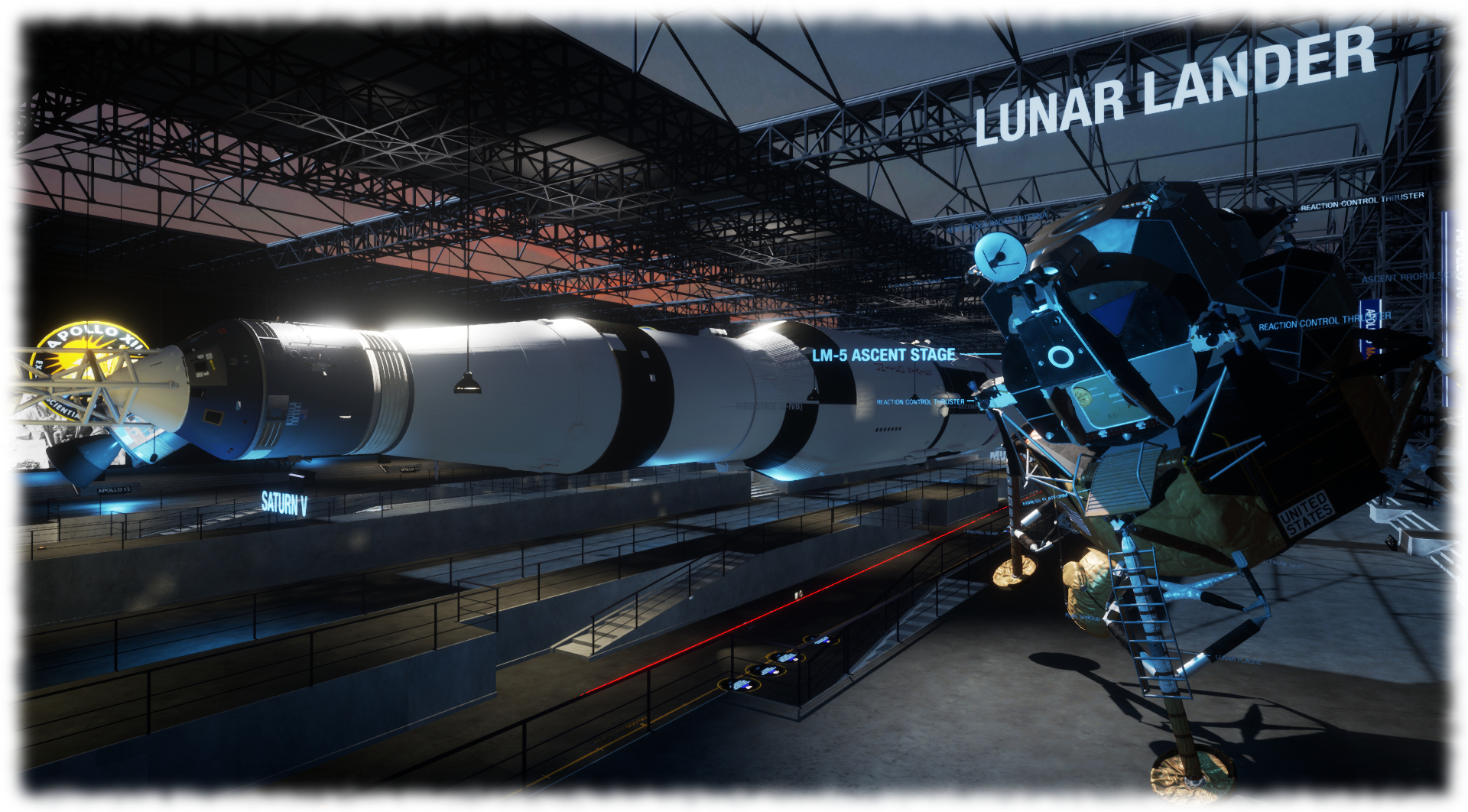
Linden Lab published a new Sansar Creator Profile video on Thursday, December 21st. It’s one I had heard about some time agao, and hard started to wonder what had happened to it. Regular readers will understand why my interest had been piqued when I say that the subject of the video is LOOT Interactive, the makers of the NASA Apollo Museum experience, based on the Apollo Saturn Centre at the Kennedy Space Centre Visitor Centre, and the Sea of Tranquillity experience, commemorating the Apollo 11 Moon landing.
These were two of the first experiences I visited in Sansar, given my interest in space flight and space exploration. As such, I was hoping the video, once available, would delve into the creation of these two experiences and examine the collaborations between LOOT Interactive and NASA and with Linden Lab’s Sansar team which brought the experiences to fruition. Sadly, this isn’t the case. Instead, what is presented is more of a promo reel, in keeping with the other Creator Profile films released in the run-up to Sansar’s Public Beta commencing at the end of July 2017. As such, this video in some ways feels a little out-of-place.
Which should not be taken to mean the video isn’t worth watching; that promo reel bias notwithstanding, the video does a very good job in underscoring the potential of VR in markets such as education, learning and even – although not directly discussed – virtual tourism. Certainly, it explores the power of something like the NASA Apollo Museum to engage and inspire – and educate – simply by allowing people to experience an environment as personally as if they were there.
Take the Saturn 5 centre-piece for example. Being able to stand under its flank whilst in VR and look along its length brings home not only its gargantuan nature – but the sheer size of the technical and human endeavour that went into it and the entire Apollo-Saturn programme. For adults and students alike, it, and the entire experience, deeply ingrains the entire voyage of Apollo 11 to and from the Moon in a deeply personal way; one not easily matched by watching archive video footage alone or without actually visiting NASA’s Visitor Centre complex. As the LOOT team note, there is a powerful way in which this immersive engagement translates into retained understanding and knowledge one which could apply to many areas of education and learning, formal and informal.
If you’ve not visited the NASA Apollo Museum experience in Sansar – with or without VR – it is a location I recommend as being a good leaping off point to discover what can be achieved within the place even at this stage of its development. Yes, there are niggles, but these are not enough to detract from the sheer scale and depth of the experience. And if you’re not sure, perhaps this video will also help to persuade you a visit could be worthwhile.
The Sansar Fashion release, with Marvelous Designer integration. Credit: Marvelous Designer
On Monday, December 18th, Linden Lab announced the Sansar Fashion release, the last major release to the platform for 2017. The title of the release is reflects the fact that the major aspect of the release is focused on clothing and fashion design in Sansar. However, the release covers a lot more than this, with improvements to the uploader, the UI, audio and media, and a host of over changes. I’ve had a quick run through the update, and release notes and the following is offered as an overview of the principle updates.
Avatar Update
The first thing users will notice with this update is that their avatars will need to be re-created – this is as a consequence of the fashion update, and the separating off of the clothing layers. This means facial sliders have to be re-set, but it also means users can experiment with removing /adding clothing.
Within in the Avatar App – now called LookBook rather than My Looks -, locate an article of clothing already work and click on it to remove it. Click another item of clothing to wear it.
Clothing is split between upper and lower body, and are limited to two layers apiece.
Note that the avatar’s underwear is still baked in place, and cannot be removed.
Hair can also be removed as well as styles changed.
Once your avatar is set to your satisfaction, save the changes via Done.
Fashion Updates
Clothing
The core of the Fashion updates can be summarised as new clothing support for Sansar. Designers can create their own rigged clothing for use in Sansar / sale through the Sansar Store.
In addition, Sansar offers integrations with Marvelous Designer. This is software that allows designers to create virtual clothing “from basic shirts to intricately pleated dresses and rugged uniforms”. It is able to replicate fabric textures and physical properties, drape garments on physical forms as well as providing the creator with a range of editing tools. It is used by games manufacturers such as EA Games and film effects studios such as Weta Digital.
A new exporter capability in Marvelous Designer allows creators to export their designs directly from the software into Sansar with ease. One in Sansar, clothing can be adjusted on the avatar within the Avatar App (LookBook). You can learn more here, and via the video below. Note: cloth physics for clothing are not currently available in Sansar’s runtime mode.
Sansar creator resources for Marvelous Designer can be found here.
Avatar Meshes
.FBX files for the Fashion update should have been made available, but none are referenced in the release notes, and I was unable to find any reference in the knowledge base outside of the .FBX files for accessories – which may or may not be suitable for clothing (male .fbx; female .fbx).
Hair
Creators and stylists can now create and sell hair styles for avatars. As noted above, avatars can also be bald.
Wearable Accessories
With the Fashion release, wearable accessories are no longer limited to a 1m x 1m x 1m size, instead, they must be within the Axis Aligned Bounding Box (AABB). with the knowledge base article on accessories noting that for import:
Avatar accessories must be close to the avatar. The entire accessory must be within the Axis Aligned Bounding Box (AABB) of the avatar. The AABB’s area is as follows: 0.8m left and right, 0.6m front and back, and 2.2m tall from the feet of the avatar, and 0.05m below the avatar (to account for shoes)**
Note: **Minimum (-0.8m, -0.6m, -0.05m) and Maximum (0.8m, 0.6m, 2.2m).
Atlas Update
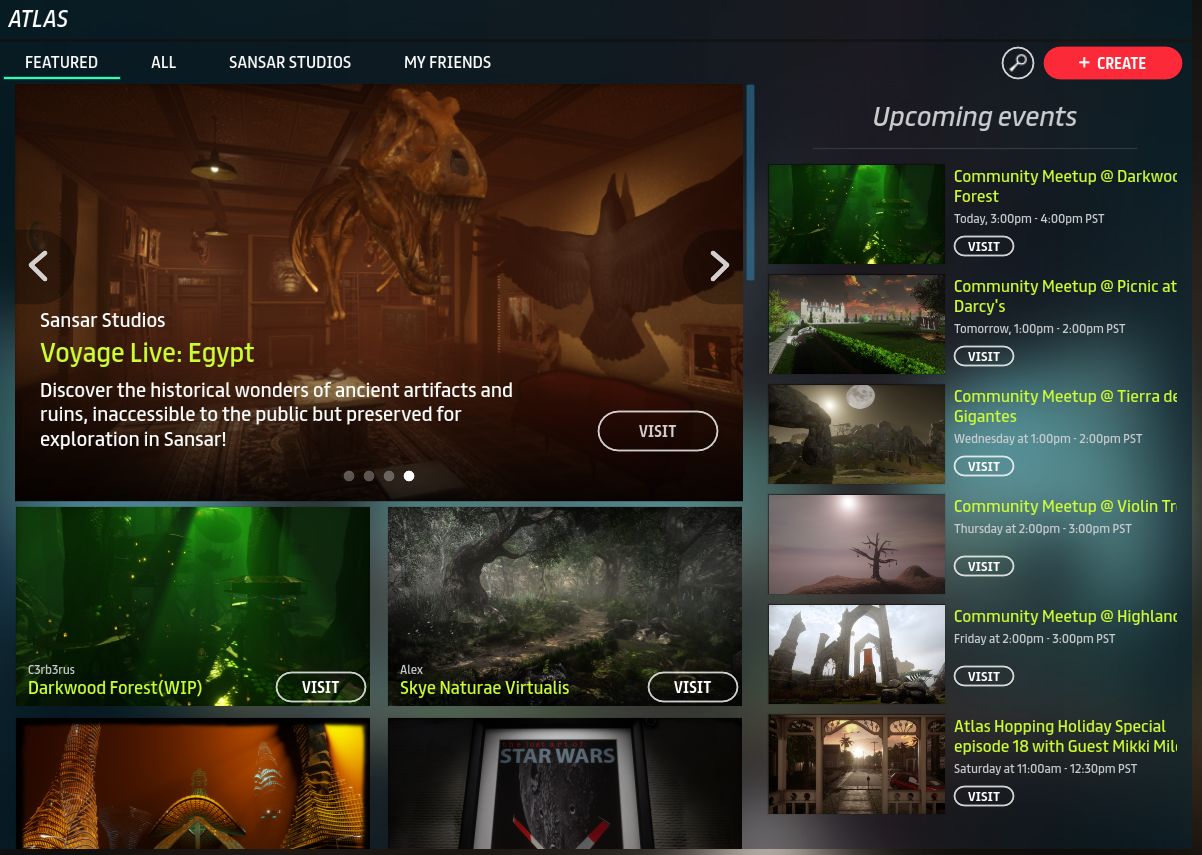
The client atlas has been updated to include submitted events – which are now displayed on the right side, if there are any in the calendar. Each has a Visit button, which will load the experience.
The events section (right) in the updated client Atlas
The Web client now has a new Friends tab. This displays all experiences created by people on your Friends list. If they have created an experience exclusive for access by their friends, this is also where it will appear – it will not appear in the public (Home or All) listings of the Atlas.
Editing Updates
There are a range of editing updates with the Fashion release – for details, please refer to the release notes. These include:
A range of audio updates and improvements.
A revised upload tool for 3D models and has been relocated to the Scene tool bar – see Importing items to Sansar for more.
It is now possible to enable memory limits for scripts which is now capped at 32MB per scene. See Sansar.Script.Memory for more information.
Keyboard commands for scripts – subscribe to client “commands” with default keyboard bindings. See AgentPrivate.Client.SubscribeToCommand and the Command Example script in the client folder.
The following notes are taken from the Sansar Product Meetings held on Friday, December 15th. These meetings are usually held every Friday at 9:30am PST and 4:00pm PST, and are open to all. There is currently no set agenda, and the meetings are a mix of voice and text. The official meeting notes are published in the week following each pair of meetings, while venues change each week, and are listed in the Meet-up Announcements. and the Sansar Atlas events section.
Nyx Linden attended the morning session; a former member of the engineering team for Second Life, Nyx is perhaps best known for his appearances in-world as the Tiny Robot, and leading the “old” Content Creation User Group meetings which used to take place in-world on Mondays. Nowadays, Nyx is a member of the Sansar product team, working on the planning / road mapping side of the platform’s development and coordinating the various development teams.
Fashion Release
Again, please refer to my week #49 and week #48 updates for notes on known elements in the upcoming release.
The Fashion release should be deployed during the week commencing Monday, December 18th.
This initial release will not include cloth physics within the run-time mode (although they may be available in the Avatar App). Instead the baking service will continue to handle clothing as is currently the case.
The avatar mesh models will be provided via the Knowledge base when the release is deployed. These will most likely be supplied as .FBX files, rather than a blend file – but this is still TBC.
It will be possible to upload hair attachments, but the recommendation appears to be for creators to initially keep to shorter hair styles to avoid hair cutting into the avatar bodies at this point in time
On the non-Fashion side, the release will include a number of script updates including keyboard commands for scripts and updates to object APIs.
Modifying Materials on In-World Objects
There is still considerable upset over the decision to allow experience creators to modify / change the materials of in-scene items. This change is due to be deployed with the Fashion update, but does not extend to avatar clothing or attachments and any changes made to an object last only as long as the object is within a scene – they cannot be saved back to inventory when the object is removed.
Some creators see this as a reason not to upload their items until such time as the permissions / licensing system is deployed.
Some want to see a guarantee from the Lab that the change will not be extending to include accessories / clothing in a future release, ahead of the licensing / permissions system deployment. This is to be escalated to senior management for feedback.
Character Creation Flow
A point to note with the Fashion release is that users logging-in to Sansar the first time after the release has been deployed will have to go through the character creation flow.
This is because existing clothing will no longer work with the update.
It will mean that any custom work done to the avatar’s face will have to be re-done as well.
Sansar Store: Product Updates: Nyx indicated that there are still complexities around licensing / pricing which need to be resolved. As such, the Lab is considering possibly going with a basic system to allow for updates through the store, and then enhancing it as other elements of work fall into place. However, there is no time line as yet on when something might appear, but it is on the road map.
Permissions / Licensing System: the Lab is actively working on a permissions / licensing system, however, there is still no time frame as to when it might start to be deployed.
Dynamic mirrors and using in-scene cameras to record and project the scenes onto a surface: neither are on the road map as present. Dynamic mirrors can be rendering-heavy, and are not something the Lab is currently looking at.








 Inara Pey: Living in a Modemworld