Space update: Pluto, Mars, and Earth’s big cousin

A composite image of Pluto an Charon, show to scale with one another and in true colour, as they were images by New Horizons on July 15th, 2015 (image courtesy of  NASA/ APL / JHU)
A composite image of Pluto and Charon, show to scale with one another and in true colour, as they were imaged by New Horizons on July 14th, 2015

New Horizons is continuing outbound from the Pluto-Charon system, its primary mission  complete. A new phase of the mission has now begun: returning all the data gathered safely to Earth; a process that is going to take an estimated 16 months to complete. Even so, and as indicated in my last report, what has already been received has been enough to turn much of planetary science on its head.

During a mission briefing on July 24th, 2015, Alan Stern, the New Horizons principal investigator and members of the science team provided a further update on the mission, and revealed some of the more stunning images captured by the spacecraft during the close approach phase of the mission. One of the most striking of these was a picture snapped by New Horizons just seven hours after close approach, when it was already 2 million kilometres (1.2 million miles) from Pluto.

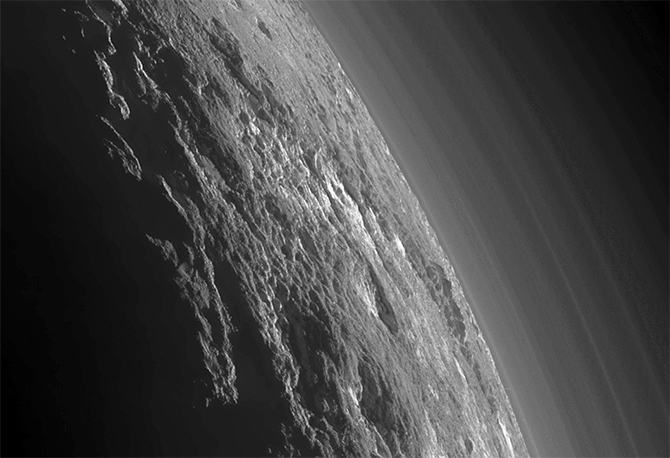
The image shows the dark disc of Pluto’s night side (which will not see the light of the Sun for another 20 years), surrounded by a halo of atmosphere, 130 kilometres (80 miles) thick, backlit by the distant Sun. Within the atmosphere sit two bands of thick haze, one around 50 kilometres (30 miles) altitude and the second at around 80 kilometres (50 miles) altitude.

Taken from a distance of 2 million kilometres (1.25 million million) beyond Pluto, this black-and-white LORRI images, captured 24 hours after closest approach, reveals the haze of Pluto's atmosphere as sunlight is filtered through it
Taken from 2 million kilometres (1.25 million miles) beyond Pluto, this black-and-white LORRI images, captured just 7 hours after closest approach, reveals the haze of Pluto’s atmosphere as sunlight is filtered through it

These bands of haze are believed to be the result of ultraviolet sunlight striking the upper reaches of Pluto’s atmosphere, breaking apart the methane gas there, giving rise to more complex hydrocarbon gases such as ethylene and acetylene. These heavier gases then descend into the colder regions of Pluto’s atmosphere, condensing as ice particles, which are seen by New Horizon’s instruments as the bands of haze.

The ice particles are further acted upon by ultraviolet sunlight so that tholins are formed. Tholins are large complex organic aerosols thought to contain some of the chemical precursors of life. These gradually fall out of the atmosphere to mix with hydrocarbons on Pluto’s surface, giving it the distinctive colouring we see in images like those given below.

Pluto by day: this image of Pluto, captured on July 14th, is the clearest true-colour image of the dwarf planet so far returned by New Horizons and shows deails down to 2.2 kilometres across
Pluto by day: this image of Pluto, captured on July 14th, is the clearest true-colour image of the dwarf planet so far returned by New Horizons, and shows details down to 2.2 kilometres across

The July 24th briefing also revealed some of the most detailed images of Pluto’s sunlit side yet published, starting with the true colour image shown above. This shows Pluto in twice the level of detail as the July 13th image published by NASA, revealing surface features as small as two kilometres across (the ultra-high resolution images LORRI has captured will eventually reveal surface features as small as 50 metres across). Featured prominently and unmistakably in the image is Pluto’s light-coloured “heart”, informally named the “Tombaugh Regio” in honour of Pluto’s discoverer, Clyde Tombaugh.

This huge region is divided into two parts, defined by the two “lobes” of the heart. On the left (west side) is the relatively smooth expanse of the “Sputnik Planum”, roughly the size of Texas.The is largely composed of a thick layer of nitrogen, methane and carbon monoxide ice. That it is almost completely without craters suggests it is much younger than the rest of Pluto’s visible surface; but how it formed has yet to be determined.

An increased magnification image of “Tombaugh Regio” and its surroundings. On the left of the “heart” (the western side of the planet) lies the smooth form of “Sputnik Planum”; to the right, is the eastern “lobe” of the “heart”, which shows similar bright material to that found on “Sputnik Planum”, but spread within more chaotic terrain

The right side of the “heart” is also brightly-coloured, indicating the presence of ices similar in nature to those in “Sputnik Planum”, but it also shows a much rougher terrain as well. Further bright, icy material also extends from the “point” of the “heart” into the southern polar regions of Pluto, again mixing with rougher terrain.

While it is not clear what actually gave rise to the icy expanse of “Sputnik Planum”, it is not believed the same mechanism is responsible for the ice in either eastern lobe or which extends southwards from the “heart”. These are believed to be the result of material from “Sputnik Planum” being carried into these areas, where it is gradually “painting over” surface features there.

An enlarged view of the southern area “Sputnik Planum” bordering the Lovecraft-inspired “Cthulhu Region” showing how the chaotic terrain around the “Hillary Montes” and “Norgay Montes” has been invaded by icy deposits, possibly carried into them as snow by wind action, or even the result of glacial activity

Continue reading “Space update: Pluto, Mars, and Earth’s big cousin”

Space Sunday: perfectly Pluto

New Horizons (travelling approximately left-to-right) passes Pluto on July 14th, 2015, with Charon beyond, in NASA's Eyes on Pluto simulation
New Horizons (travelling approximately top left to bottom right) passes Pluto on July 14th, 2015, with Charon beyond, in NASA’s Eyes on Pluto simulation

It’s a mission that cost $650 million to mount, took 5 years of planning and building prior to spending 9.5 years in space as one of the fastest man-made objects yet built (and the fastest ever at launch); it has travelled some 4.76 billion kilometres to reach its destination, swinging by and studying Jupiter  (the first time we’ve done so close-up in over decade) in the process. All this for a close encounter which, due to the speed of the vehicle, could be measured in a mere hours.

But what an encounter!

I’m of course referring to NASA’s New Horizons mission which, on July 14th, 2015, after all of the above, flashed by the Pluto-Charon system precisely on target and just 72 seconds ahead of it’s  predicted arrival time of 11:49:59 UTC at its closest point to Pluto.

Encounter trajectory: New Horizons' flight path is shown is red, running right-to-left in 10 minute time increments. The times for the vehicle's closest encounters with Pluto and Charon on July 14th, 2015, are given, together with the times of occultation - when both worldlets would be directly between the spacecraft and Earth
Encounter trajectory: New Horizons’ flight path is shown is red, running right-to-left in 10 minute time increments. The times for the vehicle’s closest encounters with Pluto and Charon on July 14th, 2015, are given, together with the times of occultation – when both worldlets would be directly between the spacecraft and Earth – click for full size

Obviously, the overall encounter has been going on for some time now, as I previewed in my  Space Sunday report of July 12th: what NASA called the “distant encounter phase” started in January 2015, and even now, as New Horizons heads away from Pluto and Charon, observations are still being made. But the mission has always been about the hours immediately either side of that point of closest approach, when New Horizons flashed by Pluto at a speed relative to the planet of 13.77 km/s (8.56 miles per second).

The close approach wasn’t something that could be followed in real-time, the time delay in transmissions from the probe to Earth being some 4.5 hours. This being the case, NASA kept people informed with images and information recorded in the hours leading-up to the period of closest approach, such as a stunning image of Pluto captured by New Horizon’s LORRI and Ralph instruments on July 13th. Since then, they’ve been releasing a steady stream of the initial images that have been returned by the probe.

July 13th: two views of Pluto. On the left is an approximate true-colour image of the surface of Pluto, captured by the LORRI imaging system on New Horizons, and colour-enhanced by data obtained by the Ralph suite of instruments. On the right, a false-colour image indicating the compositional differences comprising Pluto's surface
July 13th: two views of Pluto. On the left is an approximate true-colour image of the surface of Pluto, captured by the LORRI imaging system on New Horizons, and colour-enhanced by data obtained by the Ralph suite of instruments. On the right, a false-colour image indicating the compositional differences comprising Pluto’s surface.

Pluto also appears to be an active planet – more so than had been imagined – with distinct compositional difference across its surface, making understanding of some of its characteristics difficult, so it is going to be some time before a range of questions relating to Pluto’s formation, development, etc., are liable to be answered, as many of them are going to have to wait for the arrival of very high-resolution lossless images from the probe, some of may now be received until well into next year (transmission of all the data recorded by New Horizons will take some 16 months).

In particular, New Horizons focused on a bright region positioned towards the centre of the of Pluto’s sunlit side and initially dubbed “Pluto’s Heart” due to its shape (seen  most clearly in the image above left). Now informally christened “Tombaugh Regio”, after Pluto’s discoverer, Clyde Tombaugh,  the region has been of interest to the science team due to its apparent “youthful” appearance: it is relatively crater-free, suggesting the surface has undergone significant re-working compared to the surface features around it, which are far more heavily cratered.

The region is home to a series of intriguing features, including the “Norgay Montes”, named after Tenzing Norgay, Edmund Hillary’s companion on the 1953 ascent of Mount Everest. This is a range of mountains rising some 3,300 metres (10,000 feet) above the surrounding plains, and which are estimated to be around 100 million years old, making them one of the youngest surface features seen in the solar system (younger than the Appalachian Mountains in North America, for example). There are believed to be a exposed region of Pluto’s bedrock, itself likely to be heavily comprised of water ice.

Continue reading “Space Sunday: perfectly Pluto”

Space Sunday: Pluto – the history of a brief encounter

Pluto (right) and Charon, as captured by the LORRI instrument aboard NASA's New Horizon's probe on July 8th, 2015. The colour of Pluto has been obtained by combining the image with data gathered by another instrument on the spacecraft, called Ralph
Pluto (right) and Charon, as captured by the LORRI instrument aboard NASA’s New Horizon’s probe on July 8th, 2015. The colour of Pluto has been obtained by combining the image with data gathered by another instrument on the spacecraft, called Ralph

Tuesday, July 14th promises to be a major day in the annals of space exploration, as the deep space probe New Horizons hurls through the Pluto-Charon system, making its closest approach to both, allowing us to gain our best views yet of this binary pairing of dwarf worlds and their little nest of moonlets.

The mission is already fast approaching the 10th anniversary of its launch (January 19th, 2006),  with the overall mission (from inception to the present day) already  almost 15 years old – although the planning for a Pluto mission goes back a lot further than that. Getting to the Pluto-Charon system has been a remarkable feat.

Originally, Voyager 1 had been provisionally scheduled to make a Pluto flyby as a part of its half of the “grand tour” of the solar system, using its encounter with Saturn to swing the probe on to a rendezvous with Pluto in 1986. In the end, Saturn’s Mighty moon Titan was considered a more valuable target for study, and the laws of celestial mechanics meant that a study of Titan and a swing-by of Saturn suitable to send the mission on to Pluto were mutually exclusive.

In the 1990s various missions to Pluto were proposed, ranging in size from the huge Mariner II mission, utilising an update on NASA’s veritable Mariner class probes, weighing two tonnes, down to the tiny Pluto 350, a comparatively tiny vehicle massing just 350 kilogrammes (772 pounds). These evolved, through short-lived programmes such as the Pluto Fast Flyby mission and the Pluto-Kuiper Express mission to eventually become New Horizons in 2001, a mission conceived and operated by the Applied Physics Laboratory, which often operates in partnership with NASA’s Jet Propulsion Laboratory.

At launch, New Horizons became the fastest spacecraft ever launched, using an Atlas V booster with no fewer than five strap-on solid rocket boosters. In addition, a high-powered third stage was used to boost it directly onto a solar escape trajectory – something which required the vehicle to achieve a velocity of over 16 kilometres per second (56,000 km/h or 37,000 mph) following launch. To put that in perspective, such was New Horizons’ velocity that it had passed beyond the orbit of the Moon (an average of 384,400 km / 238,900 miles from Earth) less than nine hours after launch.

The nuclear-powered (RTG) New Horizons - one of the fastest man-made craft ever made to date, now closing on the Pluto-Charon system
The nuclear-powered New Horizons – one of the fastest man-made craft ever made to date, now closing on the Pluto-Charon system The RTG system which provides electrical power through the radioactive decay of plutonium, can be see in the upper right of the vehicle in the main image, alongside the inset image of New Horizons under construction

Just under 3 months after launch, and travelling at over 21 kilometres a second, (76,000 km/h; 47,000 mph), New Horizons passed beyond the orbit of Mars, heading onwards for Jupiter, and a manoeuvre referred to a gravity assist.

Reaching the Jovian system in September, 2006, New Horizons was able to stretch its scientific legs, when it started observing Jupiter and its moons from a distance of 291 million kilometres (181 million miles). Over the next 6 months, the craft continued to close on Jupiter, gathering a huge amount of data along the way to add to our understanding of the biggest planet in the solar system, its complex weather systems and atmospheric composition, and its ever-growing system of smaller moons, many of which perform a vital role is “shepherding” Jupiter’s thin ring system.

Jupiter

This was the first real opportunity to observe Jupiter and its moons since the end of the Galileo mission in 2003, and New Horizons did so spectacularly well, passing within 2.3 million kilometres of the planet and using its gravity to further increase its speed by 14,000 km/h (9,000 mph), shortening the journey time to Pluto by some 3 years.

Following the Jupiter mission, the vehicle went into a hibernation mode, allowing it to reduce the power drain on its nuclear “battery”, the radioisotope thermoelectric generator (RTG) which provides the vehicle with all its electrical power (and which itself was the back-up unit for the Cassini mission which is still in operation around Saturn, 18 years after its launch).

During the vehicle’s hibernation, things were changing with regards to Pluto. Until the 1990s, it had always been classified as a planet – albeit one with an unusual orbit, which is both sharply inclined to the plane of the ecliptic in which the other planets of the solar system orbit, and highly elliptical, bringing it closer to the Sun than Neptune during certain periods.

Eris and Dysnomia (bright spot, lower left) imaged by the Hubble Space Telescope in 2007.

Both of these factors, coupled with Pluto’s relatively small size, suggested that it was more of a “captured” object from the Scattered Disc, a region of the Solar System between Neptune and the Kuiper Belt  that is sparsely populated by icy minor planets (Pluto’s orbit around the Sun actually sits within the Scattered Disc).

In 2005, while New Horizons was sleeping,  astronomers at Mount Palomar Observatory imaged Eris, a Scattered Disc object, complete with a moon of its own (Dysnomia), which is some 27% more massive than Pluto. This discovery, coupled with the fact that the Scattered Disc may be the home of other objects of similar size, caused the International Astronomical Union to officially define the term “dwarf planet” in 2006, and downgrade Pluto’s status to match – although not without a certain amount of controversy and protest.

Continue reading “Space Sunday: Pluto – the history of a brief encounter”

Space Sunday: Mars rocks, Ceres glitters, Pluto beckons

CuriosityOperations on and around Mars are resuming following the June 2015 conjunction, which saw Mars and Earth on opposite sides of the Sun, a time which makes reliable two-way communications hard-to-impossible due to the Sun’s interference, so vehicles operating on and around the Red Planet are placed in autonomous modes of relatively safe operations.

For the NASA rovers, Opportunity and Curiosity, this meant parking and waiting for reliable communications to be restored. However, now that Mars has once again emerged from “behind” the Sun, Curiosity is preparing to study the confluence of at least two different types of rock formation on the slopes of “Mount Sharp”.

As noted in my recent Curiosity updates, the Mars Science Laboratory (MSL) had been attempting to reach such a confluence, dubbed “Logan Pass”, but the terrain leading to that location proved more difficult from had been hoped. As a result, the rover was redirected towards another point leading up to higher elevations dubbed “Marias Pass”, and a small valley where the rock formations meet.

A mosaic showing the contact layers near the location dubbed “Marias Pass” on “Mount Sharp”. In the foreground is pale mudstome, similar to that studied by Curiosity at “Pahrump Hills” in 2014. Overlaying this stratigraphically is sandstone that the rover team calls the “Stimson unit.” The images used in this mosaic were captured by Curiosity’s left Mastcam on May 25th, 2015 (Sol 995 of the rover’s surface mission). The colour has been approximately white-balanced to resemble how the scene would appear under daytime lighting conditions on Earth.

The two types of rock are a pale mudstone, similar in appearance to the bedrock studied at “Pahump Hills”; the other is a darker, finely bedded sandstone sitting above the Pahrump-like mudstone, which has been dubbed the “Stimson unit”. In addition, the valley also has a sandstone with grains of differing shapes and colour which the science team wish to examine in more detail as well, having already identified a potential target within it they’ve named “Big Arm”.

“On Mars as on Earth, each layer of a sedimentary rock tells a story about the environment in which it was formed and modified,” NASA spokesman Guy Webster said during a status update on the mission which explained the science team’s interest in the area. “Contacts between adjacent layers hold particular interest as sites where changes in environmental conditions may be studied. Some contacts show smooth transitions; others are abrupt.”

Curiosity is expected to spend the next few weeks examining the rock formations before resuming its trek up the side of “Mount Sharp”.

Dawn Over Ceres

Dawn mission patch (NASA / JPL)

On Monday, June 30th, The joint ESA / NASA Dawn deep space mission completed the second of its orbital mapping phases of Ceres, which it has been carrying out since May at a distance of some 4,400 kilometres (2,700 miles).

During July, the spacecraft will engage in a series of gentle manoeuvres that will allow it to reduce its orbit to 1,450 kilometres (900 miles), ready to start a further surface mapping and investigation mission in early August.

Ceres has revealed it has a much more varied landscape that Vesta, its slightly smaller “sister” protoplanet, which the Dawn spacecraft studied over a prior if 14 months in 2011/12, prior to reaching Ceres in March 2015. One particular point of interest on the latter is a grouping of bright surface features located within a crater some 90 kilometres (55 miles) across.

The most recent images returned be Dawn of these spots reveals they are more numerous than had first been thought, with the largest approximately 9 km (6 miles) across.  It is believed these bright spots are the result of ice or salt, although other causes may be possible; spectra of the region should reveal far more as the spacecraft reduces its orbit.

A closer view of the bright areas inside a crater on Ceres, captured by the European imaging systems aboard the Dawn mission on June 9th, 2015 (credit: NASA/JPL-Caltech/UCLA/MPS/DLR/IDA)

In addition to the bright spots, the latest images also show a pyramid-like mountain with steep slopes rising to a height of about 5 km (3 miles) from a relatively flat area on Ceres, which has also provoked scientific interest. Ceres is also richly cratered, like Vesta; however, unlike Vesta, many more of the craters on Ceres have central peaks associated with them, evidence of their formation being the result of surface impacts. Images have also revealed evidence of other activities on the rocky, barren surface: slumps, landslides and lava-like flows, all indicative of Ceres perhaps having been somewhat more active in its formative years than Vesta.

Continue reading “Space Sunday: Mars rocks, Ceres glitters, Pluto beckons”

Space Sunday: metal rain and glass on Mars, HoloLens into orbit

Comet Siding Spring's passage through the solar system 2013-2014
Comet Siding Spring’s passage through the solar system 2014

In October 2014, I wrote about comet Sliding Spring and it’s close approach to Mars as it swung through the solar system.

The comet had been identified as coming from the Oort cloud (or the Öpik–Oort cloud, to give proper recognition both astronomers who initially and independently postulated its existence), a spherical cloud of debris left-over from the creation of the solar system, occupying a huge area starting some 2,000-5,000 AU (2,000 to 5,000 times the distance from the Earth to the Sun) and extending out to around 50-100,000 AU – or about one light year away.

There is nothing odd about comets from the Oort cloud per se, but Sliding Spring appeared to be making its very first journey into the inner solar system, and so astronomers were keen to try to study it as best they could. Given the close pass at Mars, the vehicles on and orbiting that planet stood to have something of a grandstand view of things – providing certain precautions were taken, as I noted at the time.

An artist's impression of MAVEN in orbit around Mars (NASA / JPL)
An artist’s impression of MAVEN in orbit around Mars

Now data released by NASA shows that the comet’s flight past Mars did result in something very unusual: the comet’s tail, which brushed the Martian atmosphere, resulted in a “rain of metal” over the planet.

The data was obtained by NASA’s Mars Atmosphere and Volatile EvolutioN Mission (MAVEN), which at the time of the comet’s passage was so recent an arrival at Mars, that all its instruments hadn’t been fully commissioned. Hence, in part, the delay in releasing the data – NASA wanted to be sure MAVEN was recording things accurately.

According to MAVEN, the direct detection of sodium, magnesium, aluminium, chromium, nickel, copper, zinc, iron and other metals high in the Martian atmosphere can be linked directly to material sloughing off of the comet as it passed.

“This must have been a mind-blowing meteor shower,” said Nick Schneider of the Laboratory of Atmospheric and Space Physics at the University of Colorado, commenting on the data returned by the orbiter. Such is the strength of the signal of magnesium and iron measurements, the hourly meteor rate overhead on Mars must have been tens of thousands of “shooting stars” per hour over a period of many hours.

An artist's impression of meteors resulting from comet Siding Spring in the sky over NASA's MSL Curiosity rover
An artist’s impression of meteors resulting from comet Siding Spring in the sky over NASA’s MSL Curiosity rover

“I’m not sure anyone alive has ever seen that,” Schneider added, “and the closest thing in human history might the the 1833 Leonids shower.” The metal ions were the remains of pebbles and other pieces shed from the comet that burned up, or “ablated” into individual atoms as they struck the Martian atmosphere at 56 kilometres per second (125,000 miles per hour).

What is particularly important about the event is that as scientists know the source of the dust particles, it’s speed, and key information about Mars’ upper atmosphere, it is possible to learn more about Mars’ ionosphere, the comet’s composition, and even the workings of Earth’s ionosphere when it is hit by comet or asteroid debris.

Impact Glass

There is glass on Mars, and it might just be the ideal place in which to find any evidence of past microbial life.

The type of glass in question is referred to as “impact glass”, and is formed as a result of the heat generated by the impact of a meteorite melts the surrounding rock into glass. when a meteorite strikes the surface of a planet or moon, melting the surrounding rock into glass, preserving and organic matter that existed on or in the rock prior to the meteorite impact occurring.

In 2014, a research team examining impact glass formed millions of years ago as a result of meteorite strikes in Antarctica form found organic molecules and plant matter within the glass. Their work spurred a group of planetary science graduates at Brown University, Rhode Island, to simulate the spectral composition of possible Martian impact glass by using chemicals, compounds and powders matching those known to compose the surface material on Mars, and then melting the mix at high temperatures to form glass, which they then subjected to spectrographic analysis.

The team then compared the results of their analysis with spectral analyses of the surface of Mars carried out by the Imaging Spectrometer aboard NASA’s Mars Reconnaissance Orbiter (MRO) – and found a very similar spectral signature in areas where such impact glass would be expected to form, such as around the central peaks of craters caused by meteorite impacts.

A spectrographic image of the central peak of the Alga Crater impact zone, taken by MRO. The green colours indicate the presence of impact glass

Continue reading “Space Sunday: metal rain and glass on Mars, HoloLens into orbit”

Space Sunday: Philae, Titan and Pluto, oh my!

November 12th, 2015: Philae departs Rosetta en route for the surface of comet 67P/C-G
November 12th, 2015: Philae departs Rosetta en route for the surface of comet 67P/C-G  (image courtesy of ESA)

ESA’s Philae lander, which as I reported a week ago, resumed contact with Earth via its “Parent”, Rosetta, after seven months in hibernation, continues to return data to Earth from comet 67P/Churyumov–Gerasimenko (67P/C-G) as it continues towards the Sun.

Friday, June 19th, marked the latest transmission from Philae, which is about the size of a domestic washing machine, bringing the total of communications with mission control in Germany to 3 since the lander managed to re-establish its link with Rosetta.

Communications are sporadic because it is still not entirely clear where Philae is sitting on the comet, having bounced across the surface following its initial touch-down in November 2014. This, and Rosetta’s science-focused orbit around the comet means that there can be extended periods of several days between the times when both spacecraft and lander are suitably aligned to allow communications to take place.

The Friday communication lasted 19 minutes, and allowed the lander to return a further 185 packets of data to Earth. The data gave additional confirmation that Philae is in good health and in an environment which means it should be quite comfortable for a good while – thus increasing the chances of it resuming its science activities.

“Among other things, we have received updated status information,” Michael Maibaum, a systems engineer at the DLR Lander Control Centre in Cologne, reported following the Friday contact. “At present, the lander is operating at a temperature of zero degrees Celsius, which means that the battery is now warm enough to store energy. This means that Philae will also be able to work during the comet’s night, regardless of solar illumination.”

The three communications so far received mean that the mission team now have sufficient data to be able to more accurately position Rosetta so that it can continue with its primary science mission while being better placed to improve radio visibility between it and the lander’s estimated location. The first set of commands for the spacecraft to start adjusting its orbit were uploaded on Wednesday, June 17th, and and further set of instructions were uploaded on Saturday, June 20th. The aim is to close the distance between Rosetta and the comet to 177 kilometres within an orbit that will allow the orbiter to be above Philae’s horizon more regularly than is currently the case.

Pluto’s Gentle Fade In

NASA’s New Horizons mission to the Pluto-Charon system is now less than a month from its point of closest approach, which will occur on July 14th, 2015. As the fast-moving spacecraft closes on the two planetoids, the images it is returning to Earth of Pluto are starting to show tantalising splotches of dark across the planetoid’s surface, the first hints of landforms.

Pluto slowly starts to unmask itself as New horizons approaches
Pluto slowly starts to unmask itself as New horizons approaches (image: NASA / APL)

The pictures are still nowhere near being as clear as they should be in the days immediately prior to and following the point of closest approach, but they are still nevertheless interesting; in April 2015, New Horizons images what appears to be a polar ice cap on Pluto, so scientists are curious to what else might be revealed.

At the time of closest approach, New Horizons should be within 10,000 kilometres (6,200 miles) of Pluto and around 27,000 kilometres (17,000 miles) of Charon. The fly-by of Pluto should allow the main telescope camera system on the vehicle to take selected high-resolution images of Pluto at a scale of 50 metres / pixel. It is hoped that the average resolution of daylight images captured of Pluto will be around 1.6 km (1 mile) resolution, and will allow the composition of 4-colour maps of the surface.

From around 3.2 days before closest approach, long-range imaging will be used to map both worlds to a resolution of around 40 kilometres (25 miles).  New Horizons will also attempt to gather data on the nature of any atmosphere present on Pluto and seek evidence of any cryovolcanism which might be occurring or surface feature changes which might be attributable to snowfall or similar.

Titan: Even More In Common

An infographic released by NASA in June 2014 to mark Cassni's ten years in operation around Saturn
An infographic released by NASA in June 2014 to mark Cassni’s ten years in operation around Saturn – click for full size (NASA)

There are only two places in our solar system known of have rainfall, rivers and oceans, as well as a thick atmosphere, rocky ground and plate tectonics. They are Earth and Saturn’s huge moon, Titan. Now the joint ESA / NASA Cassini mission has revealed Titan shares something else with Earth: polar “winds” that suck gasses out of its atmosphere and into space.

Titan’s atmosphere has around a 50% higher surface pressure than Earth’s, and is comprised mainly of nitrogen and methane, and is rich in hydrocarbons, which also exist in lakes, reivers and seas on the surface of the planet.

Several years ago Cassini, which has been orbiting in orbit around Saturn for over a decade, revealed that around seven tonnes of hydrocarbons and nitriles were being lost every day from the upper layers of Titan’s atmosphere, but the mechanism causing the loss remained unknown until CAPS, the instrument which first recorded the loss recorded the “wind” in action.

Essentially, sunlight striking the upper layers of Titan’s atmosphere ejects negatively charged electrons out of the hydrocarbon and nitrile molecules resting there. These electrons are then drawn away along Saturn’s magnetic field, generating their own electrical field strong enough to “pull” the positively charged particles left behind by the formation of the original electrons out of the atmosphere along with them.

On Earth, this process charges particles in the atmosphere and draws them up along the planet’s magnetic field, where they can escape at the poles, and the same thing is happening on Titan. The discovery has lead to speculation that similar processes might be at work on Mars and Venus.

In this false-colour image, lakes and
In this false-colour image, lakes and “sea” of hydrocarbons can be seen scattered across the north polar region of Titan (the white areas indicate parts of the moon’s surface which had not been imaged at the time this mosaic was constructed (image: NASA)

Continue reading “Space Sunday: Philae, Titan and Pluto, oh my!”