Space Sunday: launches, storms, simulations, and space walks

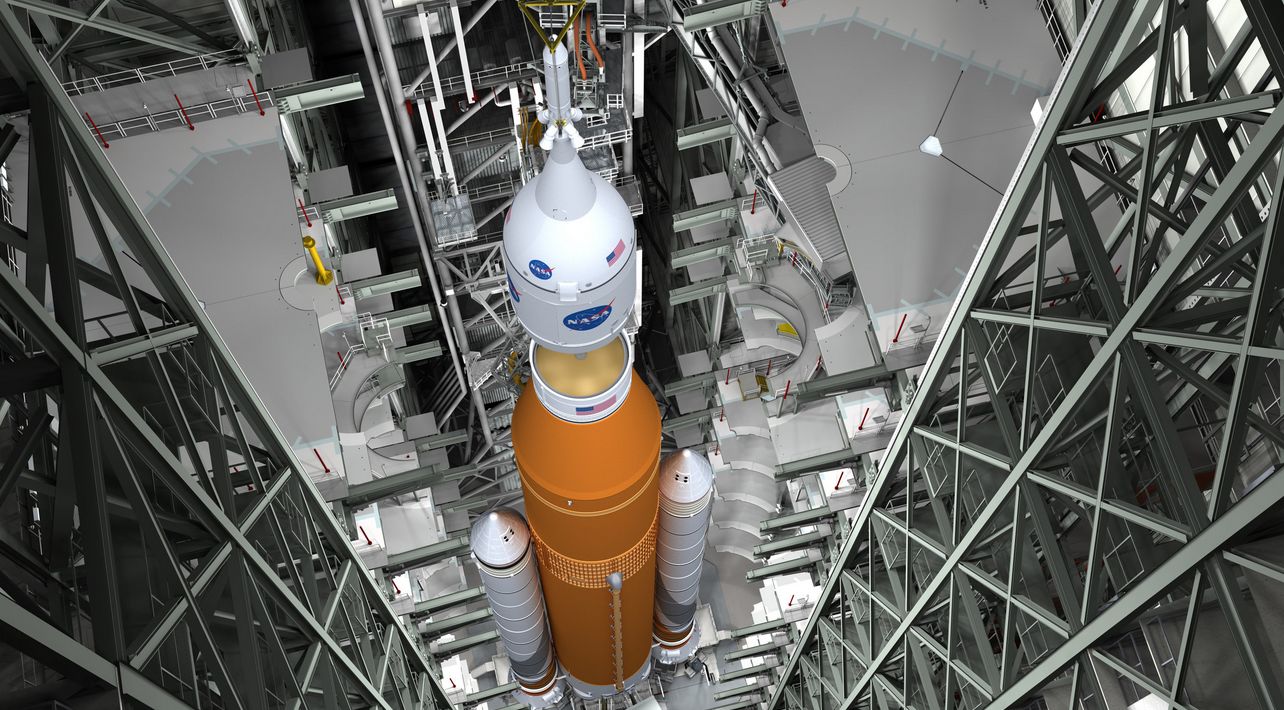
An artist’s impression of the Orion vehicle, in its launch shroud and with attached launch abort system, being attached to is SLS launch vehicle in NASA’s Vehicle Assembly Building. Credit NASA

NASA has confirmed the first flight of the Orion / Space Launch System (SLS) will not include a crew. As I recently reported, the US space agency had been considering shifting gear with with the new combination of launch vehicle and the Orion Multi-Purpose Crew Vehicle to include a crew on the maiden flight, referred to as Exploration Mission 1 (EM-1). The change in direction was prompted by a request from the Trump administration to acting NASA Administrator Richard Lightfoot, in an attempt to accelerate the human space flight programme.

On Friday, May 12th, Lightfoot indicated that while it would be technically feasible to make EM-1 a crewed mission, the agency would not do so on the grounds of costs. For an uncrewed flight, the Orion vehicle does not need to be equipped the life support, flight control and other additional systems a crew would need. would require. Doing so would require an additional expenditure of between US $600 and $900 million  – costs which would otherwise be deferred across several years in the run-up to the originally planned crewed launch for Orion / SLS – called EM-2, slated for 2021. However, EM-1 will still be delayed until mid-2019.

Orion’s first deep space mission, EM-1 will remain an extended uncrewed flight to cislunar space, and will take place around mid-2019. Credit: NASA

The reasons for the EM-1 delay are due to unrelated issues with various parts of the Orion / SLS programme. Again, as covered in recent Space Sunday updates, the European-built Service Module, which will provide the Orion capsule with power, consumables and propulsion, is running behind schedule. In addition, the programme is also experiencing delays in developing key software.

These issues mean that pushing back the EM-1 launch was fairly inevitable. Had NASA been able to comfortably combine equipping the Orion vehicle for a crewed launch in 2019, then it would have roughly coincided with the 50th anniversary the first human lunar landing by NASA astronauts Neil Armstrong and Buzz Aldrin during the Apollo 11 mission in July 1969.  Instead, NASA will continue implementing the current baseline plan, with the second Orion / SLS flight carrying a crew into space. However, this mission may also be pushed back beyond 2021.

Saturn’s Hexagon to Star in Cassini’s Finale

As I’ve been covering, the joint NASA-ESA Cassini mission to Saturn is now in its last phase, as the spacecraft makes a final series of 22 orbits around the planet, diving between Saturn’s cloud tops and its rings in the process.

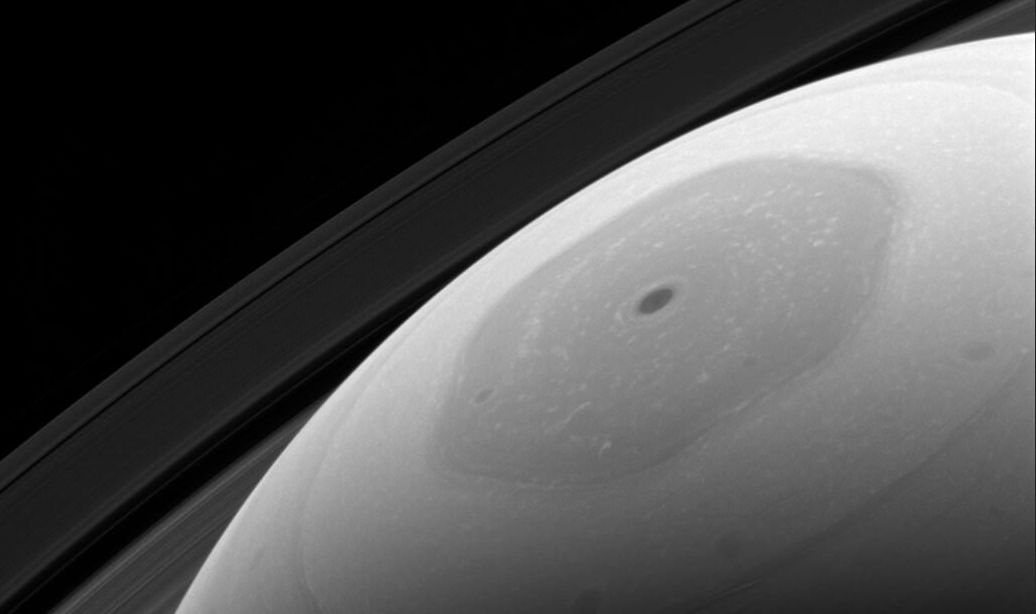
Saturn’s enormous north polar hexagonal storm, as imaged by Cassini on January. 22nd, 2017. Credit: NASA/JPL

However, in addition to exploring a region of space no other mission has properly examined, Cassini’s final series of orbits around Saturn provide an unprecedented opportunity to study the massive hexagonal storm occupying the atmosphere of the planet’s northern polar region.

First seen by the Voyager missions which flew by Saturn in 1980 and 1981 respectively, the storm is of a massive size – each side of the hexagon measures around 13,800km (8,600 mi), greater than the diameter of Earth.; it rotates at what is thought to be the speed of the planet’s interior: once every 10 hours 39 minutes. However, due to Saturn’s distance from the Sun (an average of 9.5549 AU) and its axial tilt (26.73°), the northern polar region only gets about 1% as much sunlight as Earth does; making steady observations of the storm difficult. Cassini’s final series of orbits, passing as they do over Saturn’s north pole offers a unique opportunity to examine the storm in some detail.

During the first passage between Saturn and its rings on April 26th, Cassini captured a string of black-and-white images of the region, include the vortex at the centre of the storm, which were subsequently stitched together into a short movie (above).

The passes over Saturn during these final orbits should allow Cassini to use its wide-angle camera to gather detailed images of the storm whenever possible, which may in turn help scientists probe its secrets – including what is powering it, and why it has such a clearly defined boundary between itself and Saturn’s atmosphere at lower latitudes.

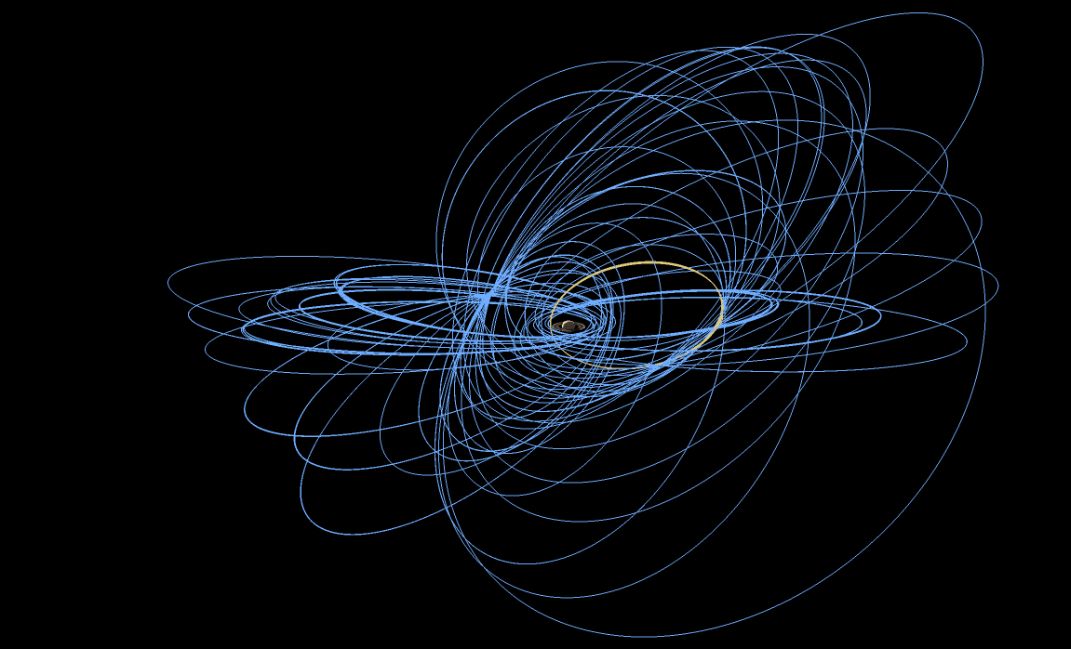
Graphic of some of Cassini’s many orbits around Saturn, which over the years have been designed to allow study of some of Saturn’s moons as well as the planet. Credit: NASA

Cassini has already completed two “ring dives”, with the third scheduled pass occurring on Monday, May 15th. The mission as a whole will end on September 15th, when the vehicle will enter the upper reaches of Saturn’s atmosphere and burn-up.

Continue reading “Space Sunday: launches, storms, simulations, and space walks”

Space Sunday: solar systems, flying telescopes, and spaceplanes

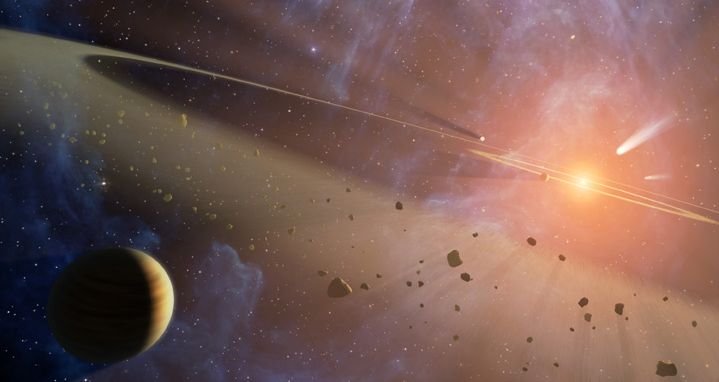
An artist’s impression of the Epsilon Eridani system, which might be very similar to our own. Credit: NASA/JPL

To Babylon 5 fans, Epsilon Eridani is (will be?) the home to our “last, best hope for peace”. To some loosely versed in Star Trek lore, it is credited as being the star orbited by the planet Vulcan (although somewhat more officially, Vulcan is placed in the 40 Eridani star system). To astronomers, it is a very Sun-like star some 10.5 light years away, which may be the home of two (or more) planets. And now it appears it is something of a younger version of our own solar system.

The star has long been of interest to astronomers as  the possible location of exoplanets, and in 1987, it appeared as if a Jupiter-sized planet had been discovered orbiting Epsilon Eridani at roughly seven times the distance of the Earth from the Sun, and with an orbital period of some 7 terrestrial years. Initially called Epsilon Eridani b, the planet has been strongly contested over the decades for assorted reasons – even though in 2016 it was granted a formal name: AEgir (sic).

Observations of the system also revealed that the star appears to be surrounded by a cometary ring, somewhat akin to out own Kuiper Belt, and in 2008, the Spitzer Space Telescope revealed that the Epsilon Eridani system may have two major asteroid belts. the first of which correlates to the position of the asteroid belt in our own system, and the second, much broader and denser belt lying roughly at the same distance from the star as orbit of Uranus around the Sun.

The Epsilon Eridani system compared to our own. Credit: NASA/JPL

Like Epsilon Eridani’s planets, the existence of the debris material surrounding the star as two distinct asteroid belts has been contested.Because the Spitzer data failed to indicate a clearly defined band of “warm material” of gas and dust within each of the rings, it has been hypothesised that rather than being two individual belts, they might actually mark the inner and outer boundaries of a single accretion disk.

The difference here is important. If the debris exists as to separate rings of material, it raises the prospect that there are planetary bodies orbiting Epsilon Eridani which may have both helped order the rings and remove debris from the space between them. If there is only one extended accretion disk around the star, it reduces the potential for planets having formed. Now the results of a 2-year study, published in the April edition of Astronomical Journal, sheds new light not only on the asteroid belts, but on the Epislon Eridani system as a whole.

The study, led by Kate Su, an Associate Astronomer with the Steward Observatory at the University of Arizona, used data gathered during a 2015 observation of Epsilon Eridani by the remarkable Stratospheric Observatory For Infrared Astronomy (SOFIA) observation platform developed by NASA and the German Aerospace Centre, DLR. This is a specially modified 747 jet aircraft designed to carry out extended studies of celestial targets.

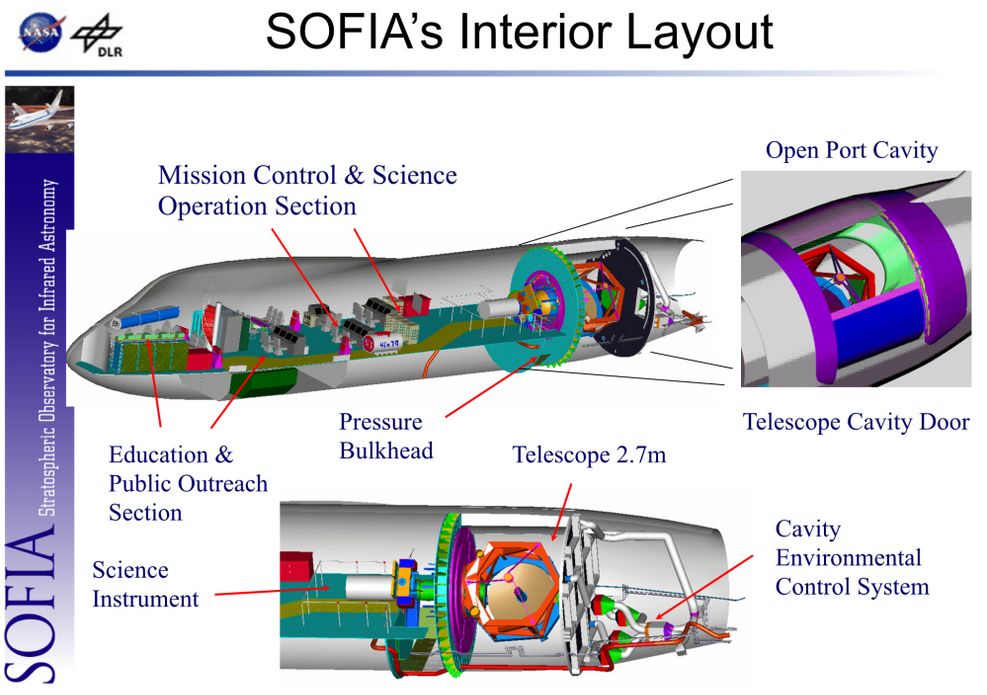
The Stratospheric Observatory for Infrared Astronomy (SOFIA) observation platform developed by NASA and the German Aerospace Centre, showing the open observation bay at the 2.5 optical telescope. Credit: NASA

Operating at almost 14 kilometres (45,000 ft) altitude, SOFIA flies well above the major distorting effects of Earth’s atmosphere, allowing it to use a 2.5 metre optical telescope with 3 times the resolution power of Spitzer, together with an ultra-sensitive infra-red imaging system called FORCAST, the Faint Object infraRed CAmera for the SOFIA Telescope, to observe targets.

Su and her team used the data gathered by SOFIA’s 2015 observations of Epsilon Eridani, coupled with the Spitzer data and the results of other ground-based observations of the star to build a series of computer models of the system. The results of the models tend to very much confirm that Epsilon Eridani does have two asteroid belts, each with its own distinct “warm band”, and that there could be at least three Jupiter-sized planets within the system helping to organise the rings.

Inside SOFIA. Credit: USRA / NASA / DLR

Not only that, but the study suggest that the Epsilon Eiridani system might be directly comparable to our own as it was not long after the inner planets formed.  If this is the case, the study of Epsilon Eridani could help astronomers gain greater insights into the history of our own Solar System.

Continue reading “Space Sunday: solar systems, flying telescopes, and spaceplanes”

Space Sunday: Saturn, spacesuits and printing a base on the Moon

An artist’s impression of NASA’s Cassini passing Titan, Saturn’s largest moon, on its way to the first of its Grand Finale dives between the planet and its ring system

NASA’s Cassini mission has completed the first of its final 22 “dives” through the gap between  Saturn its ring system. In the process, the craft came to its closest past so far over the planet’s cloud tops.

As I noted in my previous Space Sunday update, after 20 years in service and with manoeuvring fuel running out, the mission is set to end on September 15th, 2017, when the veteran spacecraft will enter the upper reaches of Saturn’s atmosphere and burn up, preventing any risk of the vehicle colliding with one of Saturn’s moons and risk contaminating it with the radiation from its plutonium power cells.

Two images of a vast hurricane-like vortex at Saturn’s north pole. Left: the raw image captured by Cassini as it passed over the planet on April 27th, 2017 (UT). Right; a colour enhanced image (from a slightly different angle) showing the complex mechanics of the atmosphere around the vortex. Credit: NASA/JPL / Jason Major. Click for full size

This first pass between planet and rings was a complete dive into the unknown – so much so, that the spacecraft was out of contact for 20 hours during the critical part of the pass. This was because prior to making the pass, the vehicle had to be oriented so that its 4-metre (13 ft) diameter communications dish was facing away from Earth and into the direction of flight, so it could act as a shield to prevent any dust particles within gap impacting more sensitive parts of the vehicle.

NASA’s Deep Space Communications network lost contact with the vehicle at 09:00 UT, on April 26th, as Cassini cross Saturn’s ring plane. The signal was successfully re-acquired at 06:56 UT on April 27th, after the vehicle had cleared the gap and could re-orient itself and point its communications dish back towards Earth. The transfer of data gathered during the pass commenced a few minutes later.

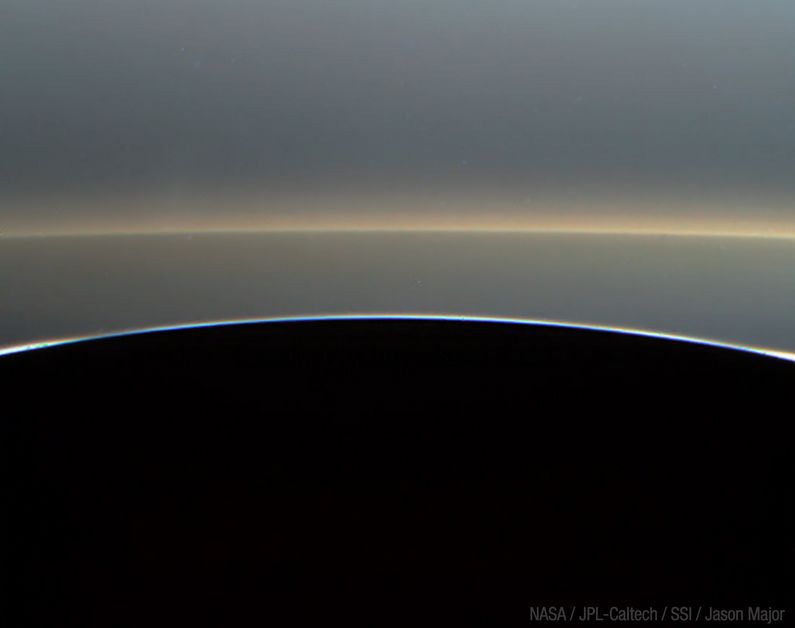
A dramatic image from April 27th (UT) showing the darkened limb of Saturn with a thin band of the upper atmosphere catching the sunlight. Above the planet are the hazy, sunlight reflecting major rings of the planet with the bright wedding ring of the G-ring brightly catching the Sun’s light. Credit: NASA/JPL / Jason Major

“No spacecraft has ever been this close to Saturn before. We could only rely on predictions, based on our experience with Saturn’s other rings, of what we thought this gap between the rings and Saturn would be like,” said Cassini Project Manager Earl Maize at NASA’s Jet Propulsion Laboratory, California, as the data from the spacecraft started flowing. “I am delighted to report that Cassini shot through the gap just as we planned and has come out the other side in excellent shape.”

The gap between the rings and the top of Saturn’s atmosphere is about 2,000 km (1500 mi) wide, and Cassini came within 3,000 km (1900 mi) of Saturn’s cloud tops, in an area where there was a risk of smoke particle sized motes of dust being encountered. Small as they might be, the fact that the probe was travelling at some 124,000 km/h (77,000 mph) relative to Saturn meant that any dust striking an unprotected part of the vehicle could have been catastrophic, hence using the communications antenna (which could suffer some damage without serve loss of capability) as a shield.

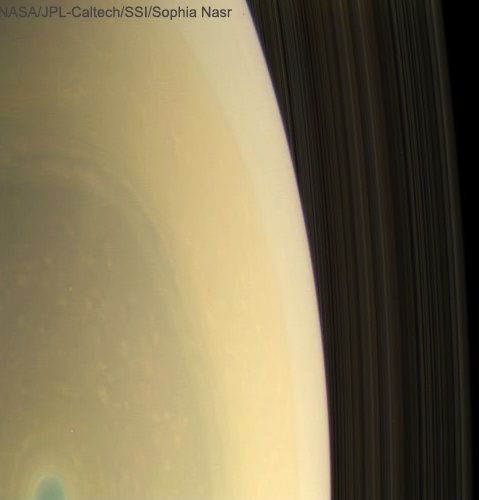
Tipped on its side, this true colour image of Saturn shows the planet’s north polar region and vortex (just visible, bottom right), caught in sunlight, together with the planet’s ring system. Credit: NASA/JPL / Sophia Nasr

“In the grandest tradition of exploration, NASA’s Cassini spacecraft has once again blazed a trail, showing us new wonders and demonstrating where our curiosity can take us if we dare,” said Jim Green, director of the Planetary Science Division at NASA Headquarters.

The data from Cassini is already being analysed and revealing more about Saturn and it’s atmosphere, but it has been the images that were released following the pass which have stunned observers on Social media – although some needed to have their perspective adjusted as the first of the raw images appeared.

“Hey, it’s a GIF of something you think’s gonna be cool, but it’s Cassini proving it’s no better at camera s*** than somebody getting shot at,” one commentator chose to Tweet. This prompted a quick response from fellow space enthusiast, Jason Major (whose images are used in this article); “Cute. Now realise Cassini is taking these pics w/a camera built in 1996 while travelling 65,000 mph where sunlight is 100x dimmer than here.”

Cassini’s second ring-dive will occur on Tuesday, May 2nd.

Continue reading “Space Sunday: Saturn, spacesuits and printing a base on the Moon”

Space Sunday: Cassini’s Grand Finale begins; Voyager’s Grand Tour remembered

An artist’s impression of NASA’s Cassini passing Titan, Saturn’s largest moon. Credit: NASA

NASA’s Cassini spacecraft performed what is effectively its last close flyby of Titan, Saturn’s largest moon on Saturday, April 22nd, 2017, marking a final opportunity for the mission to make up-close observations of the lakes and seas of liquid hydrocarbons that spread across the moon’s northern polar region and for the probe to use its radar imager pierce the haze enveloping the moon and map its surface. The next time the spacecraft passes Titan, it will be on its way to its destruction.

It is twenty years since the mission was launched from Earth, a combined NASA / ESA attempt to explore Saturnian system and probe the mysteries of Titan. It took seven years for the vehicle, carrying the European Huygens Titan Lander to is own rendezvous with the surface of Titan. Over the last thirteen years, the Cassini vehicle, roughly the size of a small truck and massing (at launch), 5 tonnes, has revolutionised our understanding of Titan and the potentially habitable moon of Enceladus.

July 22nd, 1997, the Cassini probe, with the Huygen’s lander attached (left side, in the gold aeroshell), is hoisted aloft in the spacecraft’s assembly clean room at NASA’s Jet Propulsion Laboratory, California, ready to be mated to is launch vehicle adapter (seen under it). Credit: NASA/JPL

However, all good things must eventually come to an end. The Cassini vehicle now has limited manoeuvring fuel left in its tanks, and while its three plutonium radioisotope thermoelectric generators (RTGs) are still capable of producing around 600 watts of electrical power, a decision was made some time ago to ensure the probe ended its mission before its tanks were dry and it was left to tumble around Saturn, where it might one day collide with one of the moons and contaminate it.

Instead, it was decided to direct the probe to into a series of orbits which would eventually see it enter the upper regions of Saturn’s atmosphere to burn up. This might seem an ignominious end for such a grand mission, but it is not without purpose.

This final plunge will not occur until September 15th, 2017, and the flyby of Titan – Cassini’s 127th –  was the first step in that final journey, turning as it did, Cassini’s path in towards Saturn as it loops around the planet from pole-to-pole. But before that fiery end comes, the vehicle will complete 22 more orbits of Saturn which will see it repeatedly  dive between the gas giant and its series of concentric rings, giving it an unprecedented science opportunity – a dive into the unknown.

“No spacecraft has ever gone through the unique region that we’ll attempt to boldly cross 22 times,” Thomas Zurbuchen, associate administrator for the Science Mission Directorate at NASA Headquarters in Washington said. “What we learn from Cassini’s daring final orbits will further our understanding of how giant planets, and planetary systems everywhere, form and evolve. This is truly discovery in action to the very end.”

“Based on our best models, we expect the gap to be clear of particles large enough to damage the spacecraft,” Earl Maize, Cassini project manager at JPL added. “But we’re also being cautious by using our large antenna as a shield on the first pass, as we determine whether it’s safe to expose the science instruments to that environment on future passes. Certainly there are some unknowns, but that’s one of the reasons we’re doing this kind of daring exploration at the end of the mission.”

In mid-September, Cassini will make a final, distant pass by Titan. Distant, but still close enough for the moon’s gravity to turn the craft into its rendezvous with Saturn’s cloud-tops. And when Cassini makes that final plunge on September 15th, it will send data from several instruments  until its signal is lost.

Ahead of the April 22nd Titan flyby, Cassini captured an image of Earth as seen through the ring of Saturn. Taken on April 13th, the probe was 1.4 billion kilometres (870 million miles) from Earth. when the image was taken.

April 13th, 2017: the “evening star” of Earth, as seen through Saturn’s rings by Cassini. Credit: NASA/JPL

Visible in the picture are, on the right, the A ring and the Keeler and Encke gaps, with the F ring over to the left. Earth is plainly visible in the gap between the rings. During this observation, Cassini was looking toward the backlit rings with the sun blocked by the disk of Saturn. The part of Earth facing toward Cassini at the time was the southern Atlantic Ocean.

Seen from Saturn, Earth and the other inner solar system planets always appear close to the sun much like Venus and Mercury do from Earth. All orbit interior to Saturn; even at maximum elongation, they never get far from the Sun. Early this month, as viewed from Saturn, Earth was near maximum elongation east of the sun, thus an “evening star,” making it an ideal time to take a picture.

A cropped and rotated version of the Cassini image, showing the Earth and, a short distance away, below and to the left of Earth, the Moon. Credit: NASA/JPL

Continue reading “Space Sunday: Cassini’s Grand Finale begins; Voyager’s Grand Tour remembered”

Space Sunday: hydrogen, imaging a black hole, and exoplanet hunting

A dramatic plume sprays water ice and vapor from the south polar region of Saturn’s moon Enceladus. Cassini’s first hint of this plume came during the spacecraft’s first close flyby of the icy moon on February 17, 2005. Credit: NASA/JPL / Space Science Institute

I’ve written a lot of late about Saturn’s icy moon, Enceladus. Covered by an icy crust, there is a good chance this distant moon harbours a liquid water ocean beneath that ice. NASA’s Cassini mission has imaged geyser plumes erupting through the ice, and the speculation is that if Enceladus does have an ocean beneath its crust.  Now that speculation has been given a sizeable boost.

As a result of a long-term study, on April 13th, 2017 NASA announced the icy plumes of Enceladus contain hydrogen. This is a huge finding; not only does this main the plumes are water vapour, it directly points to a geo-chemical / geo-thermal interaction taking place deep within Enceladus between warm water and rocks which could provide an energy source of microbes.

Current thinking is that life requires three things to get started:  water, energy, and the right chemicals. As we know from Earth’s deep oceans, sunlight doesn’t actually enter into the equation; hydrothermal vents provide the energy to support – albeit on a fragile basis – an entire ecosystem from bacteria at the base of the food chain, through tube worms, shrimp, crabs and more. This could well be the case with Enceladus.

As the hydrogen is vented, it is possible that any microbes present in the water of Enceladus could use hydrogen and dissolved carbon dioxide in the water to produce methane in a process called biomethanation (or methanogenesis), one of the foundation processes of life on Earth.

The hydrogen was measured using Cassini’s Ion and Neutral Mass Spectrometer (INMS) instrument. Designed to sample the upper atmosphere of Saturn’s moon Titan, INMS was turned towards Enceladus to follow-up on several discoveries of plumes emanating from the moon’s southern regions dating back as far as 2005.

“This is the closest we’ve come, so far, to identifying a place with some of the ingredients needed for a habitable environment,” Thomas Zurbuchen, associate administrator for NASA’s Science Mission Directorate stated in reference to the report.

Linda Spilker, Cassini project scientist at NASA’s Jet Propulsion Laboratory added,  “Confirmation that the chemical energy for life exists within the ocean of a small moon of Saturn is an important milestone in our search for habitable worlds beyond Earth.”

NASA’s Orion / SLS Ambitions Face Delays

In February I wrote about NASA possibly re-scheduling the first flights of their new Space Launch  (SLS) rocket system so that the maiden flight could include a crew aboard the Orion Multiple-Purpose Crew Vehicle due to fly as a part of the mission, rather than flying it as an uncrewed mission, and then flying a crew on a second later mission.

Such a move would mean the initial flight of SLS, referred to as Exploration Mission 1 (EM-1), would need to be put back from 2018 to 2019 (at the earliest), to allow time for the Orion vehicle to be correctly outfitted and tested for a crewed mission. However, a new report from NASA indicates that Orion itself may not be ready in time to meet and EM-1 launch in either 2018 or 2019.

The Orion MPCV with its European Service Module (the section with the four solar panels), attached to a propulsion stage in Earth orbit. The Service Module is one part of the system facing delays, according to a NASA report. Credit: NASA

The report, published on April 14th, 2017, highlights three significant areas of concern for the programme. The first is that design changes made to Orion’s heat shield now raise technical risks which need to be eliminated. The second is that the Service Module for Orion, which is being developed by the European Space Agency, is facing delays. The third – which is particularly underlined in the report, is that critical software required by both the SLS / SLS systems and need for ground systems at the Kennedy Space Centre in Florida, will not be ready in time.

As a result of the report, NASA is now weighing pushing back the SLS / Orion launch schedule. Nor do the programme’s woes end there; the report also questions NASA’s ability to achieve its longer-term goals with regards to SLS, Orion and Mars, citing the fact that there is no clear roadmap for developing systems (such as a deep-space habitat module, lander / ascent vehicles, etc.) vital for Mars missions.

Without such a roadmap being put in place within the next few years, the report indicates it will be impossible to tell if planned Orion / SLS project expenditure – which is slated to rise to US $23 billion in 2018 and to US $33 billion (including Mars systems expenditure) by 2030 – will be sufficient for the space agency to meet its goals.

Continue reading “Space Sunday: hydrogen, imaging a black hole, and exoplanet hunting”

Space Sunday: of atmospheres, reusable rockets and Trojans

Artist’s concept showing what each of the TRAPPIST-1 planets may look like, based on available data about their sizes, masses and orbital distances. Credit: NASA

Back in February 2017, I covered the news about seven Earth-sized planets found in orbit around the super-cool red dwarf star TRAPPIST-1, roughly 40 light years away (see here and here for more).

While three of the planets lie within their parent star’s “habitable zone”, and so might have both an atmosphere and liquid water on their surfaces, I mentioned in both of those articles that the planets may still not be particularly habitable for life for a number of reasons, one of which is TRAPPIST-1 itself. As I noted in a previous article:

The nature of their parent star, a super cool red dwarf with all internal action entirely convective in nature, means that all seven planets are likely subject to sufficient irradiation in the X-ray and extreme ultraviolet wavelengths to significantly alter their atmospheres, potentially rendering them unsuitable for life.

A new study of TRAPPIST-1 now appears to show that it is a particularly active and violent little star.

Utilising data gathered on it by the Kepler Space Telescope, a team at the Konkoly Observatory, Hungary, lead by astronomer Krisztián Vida, have identified 42 strong solar flares occurring with TRAPPIST-1 over a period of just 80 days. Five of these events were multi-peaked, and the average time between flares was only 28 hours.

The most violent of the outbursts correlated to the most powerful flare observed on our Sun: the Carrington Event of 1859.

This was an enormously powerful solar storm, in which a coronal mass ejection struck Earth’s magnetosphere, causing auroras as far south as the Caribbean, and which resulted in chaos in telegraph systems around the world, with some operators receiving electric shocks through their handsets and telegraph pylons throwing sparks. Such was the power of the event, telegraph messages could be sent and received even with the power supplies to telegraphic equipment turned off.

The TRAPPIST-1 planets are far closer to their parent than the Earth is to the Sun, so events on an equivalent scale to the Carrington Event would hit the seven planets with a force hundreds or even thousands of times greater than Earth experienced in 1859. This, coupled with the general frequency of TRAPPIST-1 flares would most likely destroy any stability in a planet’s  atmosphere, making it extremely difficult for life to develop. And that’s assuming any of the planets orbiting TRAPPIST-1 have atmospheres.

Repeated strikes from solar flares can, over time, strip away a planet’s atmosphere. Again, given the proximity of the TRAPPIST planets to their parent, and the frequency of the stellar outburst exhibited by the star, it would seem likely that rather than being unstable, any atmosphere which may have once formed around any one of the seven planets has long since been stripped away, leaving the as barren, exposed lumps of rock.

SpaceX Successfully Flies Refurnish Falcon 9 First Stage & Announces Falcon Heavy Hopes

In April 2016 SpaceX made the first successful recovery of the first stage of a Falcon 9 launch system. Used to lift the SpaceX Dragon CRS-8 resupply mission capsule from the launchpad up towards orbit and a rendezvous with the International Space Station (ISS), the first stage of the rocket successfully touched-down vertically on the autonomous spaceport drone ship Of Course I Still Love You, 300 km (190 mi) from the Florida coastline just nine minutes after lift-off. In doing so, it achieved a long-sought-after milestone for the SpaceX reusable launch system development programme.

The world’s first reflown rocket booster, a SpaceX Falcon 9 first stage, is towed back into Port Canaveral, serving the Kennedy Space Centre, just before sunrise on securely mounted on the autonomous landing barge Of Course I Still Love You, on which it landed less than 10 minutes after a successful launch on March 30th, 2017. Credit: Ken Kremer/Kenkremer.com

On March 30th, 2017 that booster made its second successful launch and recovery, boosting the SES-10 telecommunications satellite  on its way towards orbit, before completing a successful boost-back to Earth, where it again landed on the waiting  Of Course I Still Love You.

“This is a huge revolution in spaceflight,” billionaire SpaceX CEO and Chief Designer Elon Musk told reporters at the post launch briefing at the Kennedy Space Centre press site, barely an hour after lift-off.The ability to re-use booster in this way could dramatically cut the cost of launch operations, removing the need for a brand-new rocket to be built and then disposed of with each launch – and lowering the cost of operations will not only make SpaceX vastly more competitive on pricing compared to rivals, it is also key to the company’s longer-term goals such as human missions to Mars.

The first flight of the SpaceX Falcon Heavy, may see the company attempt to recover the three first stage boosters and the upper stage of the vehicle, marking it as fully reuseable

Following the re-launch and recovery of the “used” Falcon 9 booster, Musk provided further details on the upcoming launch of his new super-booster, the Falcon 9 Heavy.

This vehicle comprises 3 Falcon 9 First stages  – one acting as the “core” to the rocket and two as “strap-on” boosters. It’s long been known that SpaceX plans to recover all three boosters following each Falcon Heavy launch. However, given the complexities involved in the first flight of a launch system, it hadn’t been entirely clear if attempts would be made to recover the boosters when Falcon Heavy flies for the first time in summer 2017.

But speaking at the SES-10 post-launch press conference, Musk confirmed that SpaceX would indeed try to recover all three boosters used be the vehicle, two of which will be refurbished Falcon 9s used on previous missions.

Landing three boosters requires considerable planning: SpaceX only has two landing options at Florida right now: the drone ship Of Course I Still Love You (the other, Just Read The Instructions, is currently based in California to support SpaceX operations out of Vandenberg Air Force Base), and their landing facility at Cape Canaveral Air Force Station. Thus, the launch will involve some aerial ballet, as Musk explained:

It will be exciting mission, one way or another. Hopefully in a good direction. The two side boosters will come back and do sort of a synchronized aerial ballet and land … That’ll be pretty exciting to see two come in simultaneously, and the centre core will land downrange on the drone ship.

A few days after this, he upped the ante further, announcing the flight will also attempt something never tried before – the recovery of the rocket’s upper stage as well. If successful – although even Musk believes the odds of recovering the upper stage on the first attempt to do so are slim – it will signal that his  dream of a fully reusable launch vehicle: first stage, payload fairings, and second stage, has come to fruition.

Continue reading “Space Sunday: of atmospheres, reusable rockets and Trojans”