Space Sunday: ninja space stations, Falcons, Dragons and ET

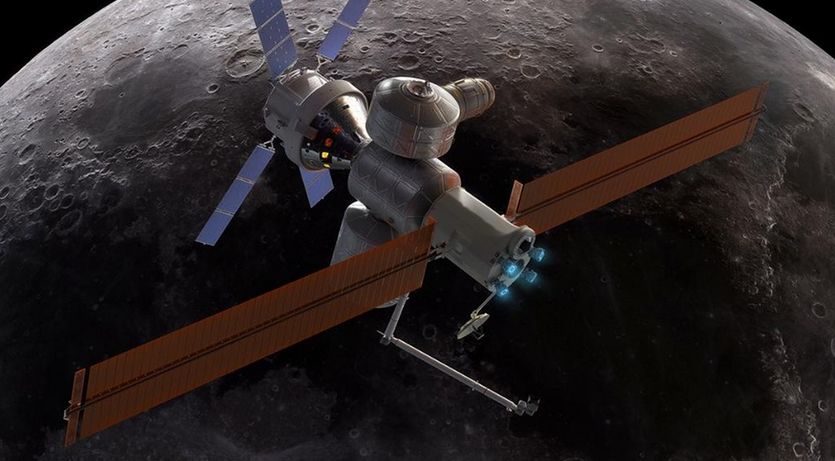
The cislunar Deep Space Gateway with an Orion Multi-Purpose Crew Module approaching it. Credit: NASA

Lockheed Martin has announced it will build a full-scale prototype of NASA’s proposed Deep Space Gateway (DSG), a space habitat occupying cislunar space. The facility, which if built, will be both autonomous and crew-tended, and is intended to be used as a staging point for the proposed Deep Space Transport NASA is considering for missions to Mars, as well as for robotic and crewed lunar surface missions.

DSG is part of a public-private partnership involving NASA in developing technologies for carrying humans beyond low Earth orbit called Next Space Technologies for Exploration Partnerships (NextSTEP). A Phase I study for the facility has already been completed, and the full-scale prototype will be constructed as a part of the Phase II NextSTEP habitat programme, which will examine the practical issues of living and working on a facility removed from the relative proximity of low Earth orbit, outside of the relative protection of the Earth’s magnetic field and subject to delays of up to 3 seconds in two-way communications.

“It is easy to take things for granted when you are living at home, but the recently selected astronauts will face unique challenges,” said Bill Pratt, Lockheed Martin NextSTEP program manager.

“Something as simple as calling your family is completely different when you are outside of low Earth orbit. While building this habitat, we have to operate in a different mindset that’s more akin to long trips to Mars to ensure we keep them safe, healthy and productive.”

The proposed Gateway, which if built would likely enter service in 2027/2028, will be designed to make full use of the Orion Multi-Purpose Crew Module as its command and control centre, and will also use avionics and control systems designed for the likes of NASA’s MAVEN mission in order around Mars and the Juno mission at Jupiter, which will allow the facility to operate in an uncrewed automated flight mode around the Moon for up to seven months at a time.

NASA’s MPLM mission logo. Credit: NASA / Marshall Space Flight Centre

The core of the prototype will be the Donatello Multi-Purpose Logistics Module (MPLM), originally designed and built for flights aboard the space shuttle and capable of delivering up to nine metric tonnes of supplies to the International Space Station (ISS). Two of these units, Leonardo and Raffaello flew a total of 12 missions to the ISS between 2001 and 2011, with Leonardo becoming a permanent addition to the space station in early 2011. And if film and comic fans are wondering, yes, the modules were all named after a certain band of mutant ninja turtles – hence the MPLM mission logo (right).

Donatello was a more capable module than its two siblings, as it was designed to carry payloads that required continuous power from construction through to installation on the ISS. However, it was never actually flown in space, and some of its parts were cannibalised to convert Leonardo into a permanent extension to the space station. In its new role, Donatello will form the core habitat space for the DSG prototype, and will be used as a testbed for developing the living and working space in the station, which will also have its own power module and multi-purpose docking adapter / airlock unit.

The Phase II development of the DSG is expected to occur over 18 months. Mixed Reality (augmented reality and virtual reality) will be used throughout the prototyping process to reduced wastage, shorten the development time frame and allow for rapid prototyping of actual interior designs and systems. The results of the work and its associated studies will be provided to NASA to help further the understanding of the systems, standards and common interfaces needed to make living in deep space possible.

The DSG is one of two concepts NASA is considering in it attempts to send humans to Mars. The second is the so-called Deep Space Transport (DSH). This is intended to be a large vehicle using a combination of electric and chemical propulsion to carry a crew of six to Mars. It would be assembled at the Deep Space Gateway.

While having a facility in lunar orbit does make sense for supporting operations on the Moon’s surface, when it comes to human missions to Mars, the use of the DSG as an assembly  / staging post for the DST actually makes very little practical sense. Exactly the same results could be achieved from low Earth orbit and without all the added complications of lunar orbit rendezvous. The latter simply adds an unnecessary layer of complexity to Mars missions whilst providing almost no practical (or cost) benefits, and perhaps again demonstrates NASA’s inability to separate the Moon and Mars as separate destinations – something which has hindered their plans in the past.

Musk Walks Back SpaceX Aspirations

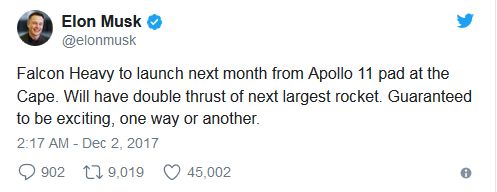
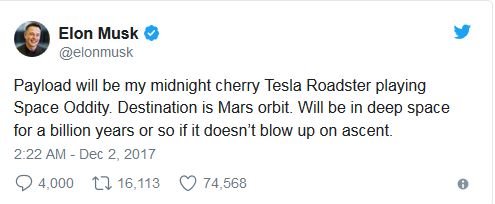
SpaceX CEO and chief designer, Elon Musk has walked back on expectations for the initial lunch of the Falcon Heavy booster and on longer-terms aspirations for the Dragon 2 crew capsule.

Musk: a successful maiden flight of the Falcon Heavy “unlikely”. Credit: Associated Press

Speaking at the International Space Station Research and Development Conference held in Washington DC in mid-July 2017, Musk indicated that a successful maiden flight of the Falcon Heavy rocket is extremely unlikely. He also indicated that the company is abandoning plans to develop propulsive landing techniques for the Dragon 2 when returning crews to Earth from the ISS – and to achieve a soft landing on Mars.

Falcon Heavy is slated to be the world’s most powerful rocket currently in operation when it enters service in 2018, capable of lifting a massive 54 tonnes to low Earth orbit – or boosting around 14 tonnes on its way to Mars. Designed to be reusable, the rocket uses three core stages of the veritable Falcon 9 rocket – one as the centre stage, two as “strap on boosters” either side of it.

But computer modelling has revealed that firing all 27 motors on the stages (nine engines apiece) at launch has dramatically increased vibrations throughout the vehicle stack, making it impossible to gauge by simulation whether or not the rocket will shake itself apart without actually flying it. Hence Musk’s statement that the maiden flight of the Falcon Heavy  – slated for later in 2017 – is unlikely to achieve a successful orbit. However, telemetry gathered during the flight – should the worse happen – will help the company more readily identify stresses and issues created by any excessive vibration, allowing them to be properly countered in future launches.

Once Falcon Heavy is fully operational, all three of the core stages are intended to return to Earth and achieve a soft landing just as they do when used as the first stage of a Falcon 9 launch vehicle, and SpaceX is also working to make the upper stage of the Falcon 9 / Falcon Heavy  recoverable as well.

Also at the conference, Musk announced SpaceX will no longer be using propulsive landings for the crewed version of their Dragon 2 space capsule, due to enter operations in 2019 ferrying crews two and from the ISS, operating alongside Boeing’s CST-100 Starliner capsule. Initial flights of the Dragon 2 were intended to see the vehicle make a “traditional” parachute descent through Earth’s atmosphere followed by an ocean splashdown – the technique currently used by the uncrewed Dragon I ISS resupply vehicle.

However, SpaceX had planned to shift Dragon 2 landings from the sea to land – using parachutes for the majority of the descent back through the atmosphere, before cutting the vehicle free and using the built-in Super Draco engines (otherwise used as the crew escape system to blast the capsule free of a Falcon launch vehicle if the latter suffers any form of pre- or post-launch failure). The engines would fire during the last few metres of decent, placing the capsule into a hover before setting it down on four landing legs.

Extensively tested in tethered “hover” flights, propulsive landings would in theory made the recovery and refurbishment of Dragon capsules for future launches a lot easier, lowering the overall operating costs for the capsule. In announcing the decision to scrap the propulsive landing approach, Musk indicated it would have unnecessarily further drawn out the vehicle’s development as SpaceX sought to satisfy NASA’s requirements for crewed vehicle operations.

The decision also affects Musk’s hope of placing a robotic mission on the surface of Mars in 2020. Under that mission, a special cargo version of Dragon 2 – called Red Dragon- would fly a NASA science payload to Mars and use supersonic propulsive landing to slow itself through the tenuous Martian atmosphere and achieve a successful soft landing. This approach was seen as ideal, because using parachutes on Mars is extremely difficult with heavy payloads – NASAs studies suggest parachute on Mars have an upper limit of payloads around 1.5-2 tonnes. A Red Dragon capsule is liable to mass around 8-10 tonnes.

SpaceX have dropped plans to use propulsive landings on both their crewed Dragon 2 vehicles returning from the ISS and on their Red Dragon automated Mars lander (above). Credit: SpaceX

However, Musk no longer believes the use of a propulsive landing mechanism is “optimal” for Red Dragon, and the company has a better way of realising their goal – although he declined to indicate what this might be. Instead, propulsive landing systems would seem to be something the company will return to in the future – particularly given their hopes of placing vehicles massing as much as 100 tonnes on the surface of Mars.

No, ET Isn’t Calling Us

The Internet was agog recently after it was announced some very “peculiar signals” had been noticed coming from Ross 128, a red dwarf star just 11 light-years away. While not known to have any planets in orbit around it, and despite the best attempts of astronomers – including the team picking up the signals at the Arecibo radio telescope, Puerto Rico – news of the signals led to widespread speculation that “alien signals” had been picked up.

The usual signals – officially dubbed the “Weird!” signal, due to the comment made in highlighting the signals in an image – were first picked up on May 12th/13th, 2017. However, it was not until two weeks later that the signals were identified and analysed, the PHL team concluding that they were not “local” radio frequency interference, but were in fact odd signals coming from the direction of Ross 128 – sparking the claims of alien signals, even though the director at PHL and the survey team leader -Abel Mendez – was one of the first to pour water on the heat of the speculation. “In case you are wondering, he stated in response to the rumours, “the recurrent aliens hypothesis is at the bottom of many other better explanations.”

The Weird! signal. Credit: UPR Aricebo

Without drawing any conclusions on what might be behind the signals, PHL liaised with  astronomers from the Search for Extra-Terrestrial Intelligence (SETI) Institute to conduct a follow-up study of the star. This was performed on Sunday, July 16th, using SETI’s Allen Telescope Array and the National Radio Astronomy Observatory‘s (NRAO) Green Bank Telescope. The fact that SETI was involved probably also helped fan the flames of “alien signal” theories. However, initial analysis of the signal and the portion of the sky where it was observed have suggested a far more mundane explanation:  geostationary satellites.

“The best explanation is that the signals are transmissions from one or more geostationary satellites,”  Mendez stated in an announcement issued on July 21st. “This explains why the signals were within the satellite’s frequencies and only appeared and persisted in Ross 128; the star is close to the celestial equator, where many geostationary satellites are placed.”

While certain this explanation is correct, Mendez does note it doesn’t account for the strong dispersion-like features of the signals (diagonal lines in the figure). His theory for this is that it is possible multiple reflections caused the distortions, but the astronomers will need more time to evaluate this idea and other possibilities.

So sorry, no ETs calling out into the night – yet.

Space Sunday: anniversaries, storms and hidden worlds

July 16th, 1969. A Saturn V rocket lifted the crew of Apollo 11 – Neil A. Armstrong, Edwin Eugene “Buzz” Aldrin Jr and Michael Collins –  on their way to the Moon, and the first manned landing there. Credit: NASA

July is a celebratory month for the US space programme. I’ve already written about July 4th marking the 20th anniversary of America – and the world – having had a continuous robotic presence on or around Mars for 20 years. This week, July 16th and July 20th mark the anniversaries of perhaps the two most momentous days in human space flight – the Lift-off of the Apollo 11 mission to land men on the lunar surface and, on July 20th, the actual landing of the Lunar Excursion Module Eagle on the Sea of Tranquillity. Neil A. Armstrong and Edwin “Buzz” Aldrin  spent 21.5 hours there, while their colleague Michael Collins (the “forgotten third man” of Apollo 11) orbited the Moon aboard the Command and Service Module Columbia, carrying out a range of science work as he awaited his compatriots’ ascent back to orbit.

The Apollo programme, although ultimately dedicated to meeting John F. Kennedy’s 1961 goal of “putting a man on the Moon and returning him safely to the Earth”, actually had its roots in President Dwight D. Eisenhower’s administration, when it was seen as a logical progression from America’s single-seat Mercury programme to a vehicle capable of carrying a crew of three on a range of mission types, including ferrying crews to a space station, performing circumlunar flights, and eventually forming part of manned lunar landings.

Apollo was a bold venture, particularly when you consider Kennedy’s directive that America commit itself to achieving a manned landing on the Moon before the end of the 1960s, given in a stirring address before Congress on May 25, 1961 came just twenty days after NASA had finally managed to pump a man  – Alan Shephard – into space on a sub-orbital flight, while their first orbital success with John Glenn was still nine months in the future. It was a programme which was politically motivated to be sure, but which nevertheless yielded scientific and technological results which helped shape both our understanding of the solar system and helped improve ours lives on many levels. It raised the potential of human space exploration high in the public consciousness, and was illuminated by tremendous successes whilst also and shadowed by moments of tragedy and near-tragedy.

A sketch of the Apollo lunar landing mission profile produced as a part of NASA’s post Apollo 8 mission report of February 1969 annotating how the mission would be undertaken

As well as the missions themselves and the hardware required to carry them out – the Command and Service Module, the Lunar Excursion Module, the Saturn family of rockets (including the mighty Saturn V), Apollo perhaps did more than any over programme to shape NASA. It gave rise to the massive launch infrastructure at Merritt Island, Florida – now known as the Kennedy Space Centre – including the historic launch pads of Launch Complex 39, used by both Apollo and the shuttle, and now used by SpaceX and (soon) by NASA’s massive Space Launch System rockets; the Vehicle Assembly Building (then called the Vertical Assembly Building), where the Saturn rockets were assembled ready for launch, the still-used Launch Control Complex, and more. At the same time, Apollo gave NASA its operational heart for human space missions – the Manned Spaceflight Centre (now called the Johnston Spaceflight Centre) on land just outside Houston, Texas, donated to NASA by Rice University.

The entire history of the programme is a fascinating read – the politics, both in Washington (Kennedy’s own s science advisor, Jerome Wiesner, was quite vociferous in opposing the idea of sending men to the Moon) and in NASA (where a fierce difference of opinion was apparent in how the mission should be carried out. It’s a story I may some day plumb in a Space Sunday “special”, but for now I’ll simply say that all things considered, Apollo was a success, albeit one very self-contained. Six missions to the surface of the Moon, nine missions to and around the Moon, and the opportunity to increase our understanding of Earth’s natural satellite both by a human presence there and afterwards, thanks to the equipment left behind.

Armstrong, Collins and Aldrin pose for an official Apollo 11 crew shot, May 1st, 1969

New Horizons Pluto Flyby

July 14th marked the second anniversary of the New Horizons spacecraft’s flyby of Pluto and Charon – a high-speed dash between the two lasting mere hours, after a nine-and-a-half year flight simply to reach them. Brief though the encounter might have been, the spacecraft returned such a wealth of data and images that our view of Pluto and its companion has been forever changed, with Pluto in particular – as I’ve often referenced in these Space Sunday pieces –  revealing itself to be an enigma wrapped in a puzzle, determined to shatter our understanding of small planetary bodies in the solar system.

Such is the wealth of data gathered by the probe, coupled with the distances involved and the rate at which it could transmit data back to Earth, it took 16 months of all of the information stored aboard New Horizons to be returned to scientists here on Earth.

The July 14th mosaic of Pluto. The heart-shaped region is informally called “Tombaugh Regio” in honour of Pluto’s finder, Clyde Tombaugh. The left lobe of the “heart” is a vast icy plain. Credit: NASA/JHUAPL/SwRI.

To mark the second anniversary of New Horizons’ flyby, NASA released a new video using actual New Horizons data and digital elevation models of Pluto and Charon, to offer a unique flight across Pluto.

The movie starts over the highlands to the south-west of “Sputnik Planum’s” great nitrogen ice sheet (visible to the right as the movie progresses), with the track of the film passing directly over the chaotic cratered and mountain terrain of “Cthulhu Macula”. moving northwards, the flight passes over the fractured highlands of “Voyager Terra” then back southwards over Pioneer Terra, distinguished by pitting, before concluding over the bladed terrain of Tartarus Dorsa in the far east of the encounter hemisphere.

Continue reading “Space Sunday: anniversaries, storms and hidden worlds”

Space Sunday: imaging a star and x-rays from a planet

The M-2 red super giant Betelgeuse, 650 light-years from Earth, as seen by the Atacama Large Millimetre Array (ALMA). Credit: ALMA / ESO / NRAO

Some call it Betelgeuse others call it Beetlejuice. It is the second brightest star in the constellation of Orion and officially designated Alpha Orionis, the ninth brightest star in the night skies over Earth.

A red super giant of spectral type M1-2, Betelgeuse is around 12 times the mass of our own Sun, and is one of the largest and most luminous stars visible to the naked eye. It is also destined to be – in cosmic terms –  very short-lived. At just eight million years of age, it is already approaching the end of its life and will likely go supernova some time in the next few thousand years.

But it is the star’s sheer size which makes it stunning: it’s an estimated 2.6 AU in diameter. To put this in perspective, were it to be dropped into our solar system to replace the Sun, it would extend out towards the orbit of Jupiter.  Such is its size, it is one of the few stars we can observe via telescope large enough to be resolved as anything more than a point of light.

This was brought home at the end of June 2017, when the Atacama Large Millimetre Array (ALMA) captured the star in a series of images taken at the sub-millimetre wavelength range. The images reveal the star’s chromosphere looking somewhat asymmetrical, the result of the star  generating a massive bow-shock as it moves through the interstellar medium. In short, as Betelgeuse travels through the gas clouds at a rate of around 30 kilometres per second, it own equivalent of the solar wind (much denser than anything the Sun generates) which is thrown off of the star at 17 kilometres / second, slams into this gas in the direction of travel at47 km/ sec, generating a massive shock wave about 3 light-years across in front of the star, which curls around it, influencing its chromosphere.

The bow shock preceding Betelgeuse, as seen by the Japanese Akari orbital observatory. Credit: JAXA/Akari

When Betelgeuse goes supernova, it will be in a blink of an eye – although we’ll only know about it 650 years after it has actually happened. When it does so, it will create an unmistakable light in the night sky – and this bow shock of matter will play a role in the supernova process, as it reacts to the sudden influx of matter slamming into it from the exploding star at a large fraction of the speed of light.

As violent as it will be, the Betelgeuse supernova will not threaten life on Earth, as it’s beyond the “harmful” range. And in case you think that’s a bit of a reach, scientists have shown that the Earth has in fact been influenced by supernovae in the past. This evidence comes from the presence of Iron 60 in the deep oceans, an isotope formed within stars, and which has an exceptionally short half-life: 2.6 million years – so the fact we can detect it suggests it originated in other stars that went supernova.

In fact, for the last 5-10 million years, the solar system has been travelling through a region of space called the “local bubble”, an expanding region of gases some 300 light years across, created by a series of supernova explosions which occurred over a relatively short period  of time about 20 million years ago. Within this bubble, the magnetic field is weak and disordered, which could greatly magnify the impact a large supernova occurring within 100 light years from Earth could have on life here.

At the upper end of this distance, research suggests a supernova could lead to climate changes similar to those which caused a rise in glaciation seen in the Pleistocene period, 2.5 million years ago. At the nearer end of this distance – say, 25-30 light years – a supernova could actually be an extinction level event for much of life here due to the radiation levels striking the Earth, altering the climate, impacting the Earth’s biomass, and giving raise to increases in cancers.

The stars of the IK Pegasi system compared to our own Sun (r). IK Pegasi is the large white star on the left, and IK Pegasi B – a potential supernova progenitor – is the white dot below and between the other two stars. Credit: R.J. Hall

Fortunately, the nearest known star to us which is likely to go supernova is IK Pegasi B, a massive white dwarf star which forms part of the binary star system IK Pegasi in the constellation of Pegasus, and 150 light years away. As a massive white dwarf, IK Pegasi is no longer generating energy through nuclear fusion. However, when its companion star, IK Pegasi A, a main sequence star slightly larger than our own Sun and itself a variable star, reaches the latter stages of its life, it will swell up to a red giant, allowing IK Pegasi B to star accrete matter from it, causing it to swell to as much a 1.4 solar masses – at which point it will explode as a supernova.

China’s Launch Failures

China’s space efforts have been in the news for the wrong reasons of late. In mid-June a Long March 3B rocket – the workhorse of the Chinese fleet – designed to carry a communications satellite to geostationary transfer orbit was declared a “partial failure” when the rocket’s upper stage failed, initially leaving the satellite stranded in a much lower orbit. Since then, mission controller have been using satellite’s manoeuvring motors gradually nudge it up to an operational orbit, although this will drastically shorten its active lifespan.

A slight fuzzy TV image of the Long March 5 launch on July 2nd, 2017. The vehicle suffered “an anomaly” shortly after lift-off and eventually crashed into the Pacific Ocean. Credit: CCTV

Then, on July 2nd, 2017, the second launch of China’s powerful Long March 5, capable of launching 8.4 tonnes of payload to the Moon or placing 25 tonnes in low Earth orbit, suffered a major failure shortly after clearing the launch pad at 11:23 GMT. This booster is key to China’s longer-term ambitions in space, as it is crucial to the development of their own space station, as well as vital for a number of deep space missions.

Continue reading “Space Sunday: imaging a star and x-rays from a planet”

Space Sunday: 20 years on Mars, 24/7

On July 4th, 2017, we will have had a robotic presence at Mars 24/7 for twenty years. Here’s a look at those missions, and more. Credit: NASA/JPL

July 4th is a special date in American history, and this year it will, for space exploration enthusiasts be doubly meaningful, as it will mark the point at which we have been examining and exploring Mars continuously for 20 years without a single break.

Of course, attempts to explore and understand Mars began much earlier than that. We first started launching missions to the Red Planet far back in the 1960s. The first successful mission  – the United States’ Mariner 4 probe – shot past Mars in July 1965, returning just 22 fuzzy images as it did so, travelling too fast and without any fuel to achieve orbit. In 1969, and total overshadowed by the Apollo 11 mission to the Moon, Mariner 6 also flew by Mars in July, and was followed in August by its twin, Mariner 7, becoming the first dual mission to visit another world in the solar system.

Mariner 4’s route past Mars in July 1965, and the 22 images returned to Earth. Ironically, the vehicle flight path took it over some of the more “uninteresting” parts of Mars, leading some to dismiss it as being much the same as the Moon in looks. Credit: NASA

The first American mission to orbit Mars was Mariner 9, which arrived in orbit in November 1971, the exact time Mars was wreathed in a series of globe-spanning dust storms. Fortunately, the space vehicle had a planned orbital life of around 18 months, and successfully waited out the storms before returning the most spectacular images of Mars yet seen – including the mighty Tharsis volcanoes and the great gash of the Vallis Marineris, named in honour of the probe.

Russia also finally successfully reach Mars orbit in 1971 with the dual Mars 2 and Mars 3 missions. The former arrived just days after Mariner 9, and the latter became the first mission to successfully deploy a lander to the surface of Mars – although the craft ceased transmitting just 15 seconds after a safe landing had been confirmed, probably due to the dust storms. Unlike Mariner 9, the Russian orbiters had a shorter operational lifespan, and both ceased operations before the dust had fully cleared, resulting in them being classified as “partially successful” missions.

Then, in 1976 came the twin Viking Missions, comprising two pairs of orbiter and lander vehicles. Even now it remains one of the most ambitious robotic missions ever undertaken.  The Viking 1 orbiter and lander combination launched on August 20th, 1975 and arrived in Mars orbit on June 19th, 1976. Viking 2 departed Earth on September 9th, 1975 and arrived in Mars orbit on August 7th, 1976.

Viking returned the first colour still images of the surface of Mars, including this one, taken by Viking Lander 2, 1100 Sols into its mission and showing frost scattered over the ground before it. Credit: NASA/JPL

Viking Lander 1 had been scheduled to depart its orbiter and attempt a landing on Mars on July 4th, 1976 – the 200th anniversary of America’s independence. However, images of the landing site taken by the orbiter revealed it to be far rougher terrain than had been thought, so the landing was delayed while an alternative site was surveyed. The lander eventually touched-down on July 20th, 1976, marking the seventh anniversary of the first mission to land on the surface of the Moon. Viking lander 2 touched down half a world away on September 3rd, 1976.

Viking really was a landmark – and controversial – mission. Landmark, because they utterly changed our understand over Mars during years both orbiters and landers operated. Controversial because it is still argued to this day by some that two of the five life-seeking experiments carried by each of the landers did find evidence of Martian microbes living in the planet’s regolith, although it seems more likely that the positive results – in both cases, from the same two experiments – were the result of inorganic chemical reactions between mineral in the Martian soil samples and elements within the experiments.

After Viking the came a pause. While missions continued to be launched to Mars by the USA and Russia in the 1980s and early 1990s, none of them were successful. It was not until 1997 that the current trend of having vehicles continuously operating around and on Mars began – and which NASA has been celebrating, having been the stalwart of the 20-year effort of these 24/7 operations.

This run technically started in early November 1996, with the launch of NASA’s Mars Global Surveyor (MGS) mission. It was followed a month later by the NASA Pathfinder Mission. By a quirk of orbital mechanics, the Pathfinder Mission – designed to test the feasibility of placing a lander and small rover on Mars – arrived at Mars first, performing a successful aerobraking and landing on July 4th, 1996.

Mars Pathfinder being prepared in a clean room at NASA’s Jet Propulsion Laboratory. The lander’s base station in the centre of the vehicle and during flight would be surrounded by the three solar panel “petals”, one of which houses the Sojourner mini-rover, in its stored configuration. Credit: NASA/JPL

The Pathfinder lander arrived in Ares Vallis on Mars, an ancient flood plain in the northern hemisphere in an innovative way. A conventional aerodynamic heat shield protected the craft through initial entry into, and deceleration through, the upper reaches of Mars’ tenuous atmosphere. Having slowed from a velocity of several thousand kilometres an hour to just over 1300 km/h, allowing a supersonic parachute to be deployed. This slowed the vehicle’s descent to around 256 km/h and lowering the vehicle to just 355 metres above the surface of Mars, where several things happened.

Firstly, a tetrahedron cocoon of protective airbags was inflated all around the vehicle in less than a second. A set of rocket motors in the back shell beneath which the airbags and lander were suspended, then fired. These slowed the vehicle almost to a hover about 15-20 metres above the ground, at which point the tether connecting the cocooned lander was cut, and the lander fell to the ground, bouncing several times before coming to rest and the airbags were deflated and drawn back underneath the lander. The triangular lander was designed to right itself while unfolding its three solar power “petals”, however, this was not required as the lander came to a stop the right way up, allowing the petals to be deployed, and – after check-out tests – the little Sojourner rover was command to drive down off of the lander and onto the surface of Mars. The same system would later be used for the MER rover missions.

The Sojourner mini-rover on Mars during Sol 22 of its mission

As a proof of concept mission, Pathfinder was not intended to be a long duration mission. Just 65 cm (25.6 in) long and 48 cm (19 in) wide, the 10.5 kg (23 lb) Sojourner rover had a top speed of 1 cm a second, so it could never roam far from its base station;  in fact it never went further than about 12 metres (39 ft) from the base station, which acted as a communications relay as well as studying the Martian atmosphere and imaging Sojourner in action. Nevertheless, the mission exceeded expectations, lasting some 3 months, with the little rover examining 16 points of interest with its humble 0.3 megapixel cameras and its on-board spectrometer.

Continue reading “Space Sunday: 20 years on Mars, 24/7”

Space Sunday: other worlds, near and far

Curiosity on “Mount Sharp” as seen by the Mars Reconnaissance Orbiter. Credit: NASA/JPL / MSSS  (click for full size)

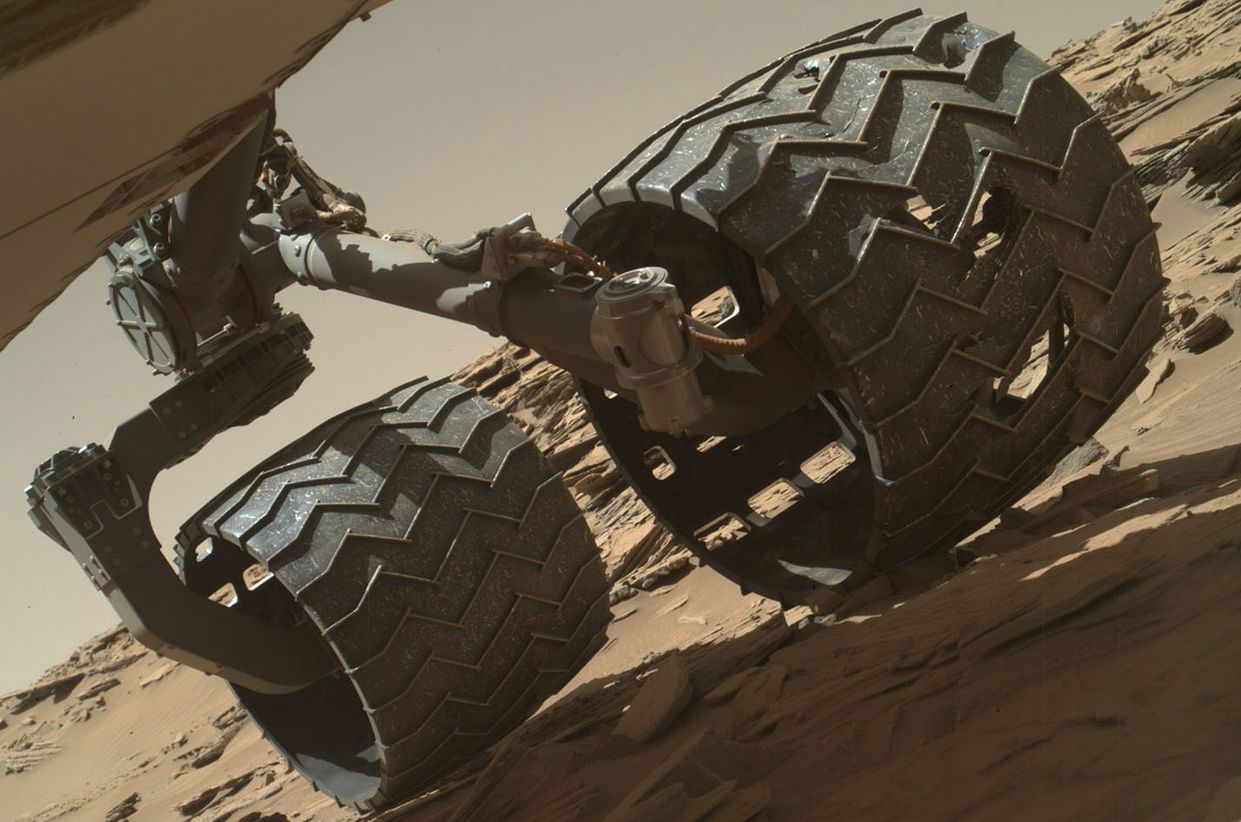
NASA’s Mars Science Laboratory rover, Curiosity continues to climb Aeolis Mons (“Mount Sharp”), and in doing so, it has been once again imaged from orbit by the HiRISE camera system on NASA’s Mars Reconnaissance Orbiter (MRO). The image was captured on June 5th, 2017 (Curiosity’s 1717th Martian Sol), at the same time the rover was engaged in taking colour images of its surrounding using its mast-mounted Navcam system.

MRO has actually been imaging Curiosity roughly once every three months, as the orbiter’s track around Mars carries it over “Mount Sharp” and the rover’s route up the mound’s flank. However, these aren’t simply happy snaps of the rover’s progress: MRO is actively monitoring the terrain around the rover to allow scientists to check for changes – such as movement among sand dunes – and to help plan the rover’s route up the slopes.

The June 5th image, released by NASA on June 20th, has been colour enhanced to better reveal Curiosity as a bright blue feature. To give an idea of scale and resolution, the rover is some 3 metres (10ft) in length and 2.8 metres (9 ft) wide.

A mosaic of images captured by Curiosity using the Navcam system, looking back along the rover’ route up “Mount Sharp” towards the distant rim of Gale Crater. The images making up the view were all captured on June 5th, 2017 (Sol 1717 for the rover), the same day as MRO imaged the rover from orbit. Credit: see image

Curiosity is currently traversing ground between two points of scientific interest: the “Bagnold Dunes”, an area of sand dunes which are slowly progressing down the side of “Mount Sharp” as a result of both wind action and gravity; and a high-standing ridge which runs parallel to the eastward side of the dune field. Dubbed the “Vera Rubin Ridge” after the American astronomer who pioneered work on galaxy rotation rates, this ridge line is of interest to scientists because it has been shown to exhibit signatures of hematite, an oxidized iron mineral which can provide clues to the environmental conditions on this region of “Mount Sharp” when it formed.

The route to the ridge is slightly circuitous. At the moment the rover is heading east-north-east around a small set of dunes. Once clear of them it will turn south-east and drive to where a potential safe route up onto the ridge has been identified. The drive is further slowed as Curiosity periodically pauses to capture images of the feature to help scientists characterize any observed layers, fractures, or geologic contacts and better understand determine how the ridge formed, and its relationship to the other geologic units found within Gale Crater.

The route ahead: a June 14th (Sol 1726) mosaic captured by Curiosity, showing “Vera Rubin Ridge”, which was roughly 370 metres (114 ft) away from the rover at the time the images were captured. Credit: NASA/JPL / MSSS / Ken Kremer / Marco DiLorenzo

At the same time NASA released the image of Curiosity seen from orbit, half a world away, attempts to correct a wheel problem the solar-powered Opportunity Mars Exploration Rover (MER) had been experiencing appeared to end in partial success.

“Oppy” had suffered a failure with its left-front wheel steering actuator on June 4th, leaving the wheel angled and unable to straighten. After numerous attempts to correct the issue, a new approach tested on June 20th resulted in the wheel turning correctly and resuming its proper alignment with the other wheels. However, what originally caused the actuator to fail remains unknown, and there is concern that it might recur.

To limit the risk of this happening and possibly stranding “Oppy”, the rover will avoid all use of its front wheel steering, and will only use its rear wheel steering when absolutely necessary. To maintain manoeuvrability, it will instead rely on “tank steering” – effectively running the drive motors for the wheels on one side of the rover in opposition to those on the other, allowing Opportunity to turn left or right more-or-less on the spot, a technique the rover is designed to use. This should allow the rover to continue its current survey of “Perseverance Valley” in preparation for a descent into Endeavour Crater.

“Planet Nine” Set to Become “Planet Ten”?

I’ve written extensively in these pages about the hunt for “Planet Nine” (or “Planet X” or “George”, “Jehoshaphat” or “Planet of the Apes” as some would have it): the Neptune-sized world believed to be orbiting the sun at a distance of at least 200 astronomical units (AUs – one AU being the average distance of the Earth from the Sun) in a highly eccentric orbit.  The search for that world is still continuing, but if a new study is confirmed, that mystery world may well have to give up its “Planet Nine” title for another.

A planetary mass object the size of Mars would be sufficient to produce the observed perturbations in the distant Kuiper Belt. Credit: Heather Roper/LPL

Kat Volk and Renu Malhotra of the University of Arizona’s Lunar and Planetary Laboratory, offer compelling evidence of a yet-to-be-discovered planetary body with a mass somewhere between that of Mars and Earth, orbiting the Sun much closer than the mysterious “Planet Nine”, at around 50 AU distance.

Whilst carrying out a detailed studying of Kuiper Belt Objects (KBOs) – the disk of rocky asteroids and comets surrounding the Sun from a distance of around 30 AU to about 50-60 AU, Volk and Malhotra discovered a consistent anomaly. Whilst most KBOs surround the sun with orbital inclinations that average out to what planetary scientists call the “invariable plane of the solar system”, they discovered that the more distance KBOs – those around 50 AU or over from the Sun are tilted away from the invariable plane by about eight degrees.

The pair surveyed around 600 of the 2,000 observed KBOs, and found all of those on the outer reaches of the Kuiper Belt to be inclined from the invariable plane by roughly the same amount and in numbers that tend to preclude a statistical fluke. In modelling possible causes for this, they discovered that an object with a mass of Mars, orbiting about 50-60 AU would cause just such a disruption, as would a Earth-sized body slightly further away.

However, Volk and Malhotra carefully avoid any suggestion there is a Mars- or Earth-sized body is awaiting discovery, noting that the disruption might also be the result of several large (but not planet-sized) masses lying within the outer fringes of the Kuiper belt. Even so, a single body would seem more likely, and given it is effectively sitting within the galactic plane – an area so densely packed with stars that solar system surveys tend to avoid it – could explain why it has been able to remain undetected.

An artist’s rendering of the LSST atop Cerro Pachón mountain, Chile. When LSST starts taking images of the entire visible southern sky in 2022, it will produce the widest, deepest and fastest views of the night sky ever observed. Over a 10-year time frame, LSST will image several tens of billions of objects and create movies of the sky with unprecedented detail – and might reveal whatever is causing the odd perturbations among the KBOs studied by Volk and Malhotra. Credit: Large Synoptic Survey Telescope Project Office

But it might not remain hidden for much longer. 2020 should see the Large Synoptic Survey Telescope (LSST) come on-line. This 8.4 metre (27.6 ft) primary mirror telescope is due to commence a 10-year sky survey in 2022. Among other things, it is expected to increase the number of KBOs so far observed from 2000 – to over 40,000 as it carries out real-time surveys of the sky, night after night. In doing so, it could well find any planet-sized body lurking near them.

Continue reading “Space Sunday: other worlds, near and far”

Space Sunday: Jupiter, exoplanets, Opportunity, and Wow! again

The planets – actual size. Jupiter is the biggest – and most likely the oldest – of our solar system’s family of gas and solid body planets. Credit: NASA

Jupiter is the most massive planet of the solar system and its presence had an immense effect on the dynamics of the solar accretion disk (the disk of dust and stellar material which surrounded and formed the Sun). Knowing the age of Jupiter is key for understanding how the solar system evolved toward its present-day architecture. Although models predict that Jupiter formed relatively early in the solar system’s history, until now, its formation has never been dated. Now, an international study suggests it was the very first planet to form.

The team, comprising scientists from the US Lawrence Livermore National Laboratory and Germany’s Institut für Planetologie at the University of Münster, believe that Jupiter’s core started forming within the first million years of the solar system’s existence. By looking at tungsten and molybdenum isotopes on iron meteorites, the team found that meteorites are made up from two genetically distinct nebular reservoirs that coexisted but remained separated between 1 million and 3-4 million years after the solar system formed.

“The most plausible mechanism for this efficient separation is the formation of Jupiter, opening a gap in the accretion disk, preventing the exchange of material between the two reservoirs,” said Thomas Kruijer, lead author of team’s paper, published in the June 12th Proceedings of the National Academy of Sciences.

“We do not have any samples from Jupiter (in contrast to other bodies like the Earth, Mars, the moon and asteroids),” he continued, when discussing the paper. “In our study, we use isotope signatures of meteorites (which are derived from asteroids) to infer Jupiter’s age. Jupiter is the oldest planet of the solar system, and its solid core formed well before the solar nebula gas dissipated, consistent with the core accretion model for giant planet formation.”

Even now, Jupiter sucks up material falling towards the Sun from further out in the solar system. This August 2009 image shows the result of an object striking the upper reaches of Jupiter’s southern hemisphere (south is at the top in the photo). The object was most likely a comet or asteroid a few hundred metres across. Credit: NASA

The team showed through isotope analyses of meteorites that Jupiter’s solid core formed within only about 1 million years after the start of the solar system history, rapidly growing to a mass of around 20 times that of Earth, then expanding more gradually to around 50 Earth masses over the next 2-3 million years. This rapid formation meant Jupiter acted as a barrier against inward transport of material from the outer reservoir of nebula material to the inner one, potentially explaining why our solar system lacks any super-Earths (a solid planet with a mass and size greater than Earth’s) orbiting the sun – Jupiter effectively vacuumed up the material.

The common belief among planetary scientists has leaned towards the gas giants of the outer solar system having formed relatively early in the solar system’s history, before the complete dissipation of the solar nebula—the gaseous circumstellar disk surrounding the young Sun – which occurred around 10 million years after the solar system formed. These finding fully support that belief, but has been able to far more precisely pin-down Jupiter’s birth date.

“Our measurements show that the growth of Jupiter can be dated using the distinct genetic heritage and formation times of meteorites,” Kruijer said.

Chinese Resupply Vehicle Competes 2nd Lab Refuelling

China’s automated Tianzhou-1 re-supply vehicle has carried out a successful second rendezvous with the currently uncrewed  Tiangong-2 space laboratory, and completed out a further refuelling operation of the orbital facility.

An artist’s impression of Tianzhou-1 (left) docked with the slightly larger Tiangong-2 orbital laboratory. Credit: CMSE

Launched in April 2017, Tianzhou-1 (“Heavenly Ship 1”) is the first of a series of resupply vehicles based on China’s first orbital module, Tiangong-1, designed to deliver up to 6.5 tonnes of equipment, supplies and fuel to orbital facilities – most notably China’s space station, construction of which is due to commence in 2018.

The 10.6m (34ft) long, 13 tonne Tianzhou-1 being prepared for installation into its launch shroud, April 2017. Image: CCTV

Tianzhou-1 is currently on an extended mission with the Tiangong-2 (“Heavenly Palace 2”) orbital facility, during which automated dockings at each of the laboratory’s two airlock systems are being practised, as is the transfer of fuel to the laboratory. The latter is a complicated, 29-step process, but one vital to the success of an orbital facility, where fuel is used in very small motor systems to help it maintain the correct orientation whilst in orbit and – potentially – help periodically boost the facility orbit to counter the microscopic (but cumulative) effect of atmospheric drag encountered whilst orbiting the Earth.

However, as such “boosts” to a space station’s orbit are more normally provided by an attached vehicle (the space shuttle used to do it for the International Space Station, for example, and the role has been taken over by the resupply craft which periodically visit the ISS). To this end, part of the Tianzhou-1 mission has also been to practice manoeuvring both the vehicle and  Tiangong-2 when the two have been docked. In addition, Tianzhou-1 has been carrying out its own free flight mission when not docked with the laboratory.

Like the European Automated Transfer Vehicle (ATV), Japanese H-II Transfer Vehicle (HTV) and American Cygnus resupply craft used in support of ISS operations, Tianzhou-1 is not designed to return to Earth. Instead, the vehicle will be allowed to burn-up as it re-enters the denser part of the Earth’s atmosphere at the end of its mission.

Following the Tianzhou-1 mission, a further crew of Chinese tiakonauts is expected to visit Tiangong-2 laboratory.

Kepler’s Latest Findings

NASA will announce the latest crop of planet discoveries from the Kepler Space Telescope on Monday, June 19th.

An artistic concept demonstrating gravitational microlensing. As an exoplanet passes in front of a more distant star, its gravity causes the trajectory of the starlight to bend, and in some cases results in a brief brightening of the background star as seen by a telescope, enabling scientists to search for exoplanets that are too distant and dark to be detected any other way (Credit: NASA / JPL / T. Pyle)

Kepler has been hunting for extrasolar planets since its launch in 2009, although the programme was almost cut short in 2013, following the failure of two of the reaction wheels (essentially gyroscope systems) used to stabilise the platform and allow it to gather data.

However, in November 2013, a new mission for the platform, dubbed “Second Light” and more generally referred to as the K2 mission,  was proposed and, after a successful period of test in early 2014, officially got under way on May 26th, 2014.

Most recently, Kepler has been using gravitational microlensing in an attempt to locate planets  orbiting stars so far away, the dimming of the star’s light by a transiting planet cannot easily be detected.

Kepler was the first mission capable of seeing planets the size of Earth around other stars in the “habitable zone” — the region at a distance from a star where liquid water could exist without freezing or boiling away immediately.

Thus far Kepler has found 4,496 exoplanet candidates. Some 2,335 have been confirmed and 21 are Earth-size planets in the habitable zone. Further, 520 of these exoplanet candidates have been found during the K2 mission, with 148 confirmed as having planets.

Continue reading “Space Sunday: Jupiter, exoplanets, Opportunity, and Wow! again”