Space Sunday: water, water everywhere

NASA’s Mars Curiosity rover celebrated its two-thousandth Martian day, or Sol, on the Red Planet on March 22nd, 2018. In celebration, NASA issued a new photo-mosaic of images captured by the rover in January 2018, which have been processed to provide a offers a preview of what comes next.

Looming over the image is Mount Sharp, the mound Curiosity has been climbing since September 2014. In the centre of the image is the rover’s next big, scientific target: an area scientists have studied from orbit and have determined contains clay minerals.

Clay minerals requires water to form. Curiosity has already revealed that the lower layers of Mount Sharp formed within lakes that once spanned Gale Crater’s floor. The area the rover is about to survey could offer additional insight into the presence of water in the region, how long it may have persisted, and whether the ancient environment may have been suitable for life.

Key to examining the area will be the rover’s drill mechanism, which the science team hope will be able to draw samples pulled from the clay-bearing rocks so their composition can be determined. As I recently reported, a new process for obtaining samples via the drill and getting them to the rover’s on-board science suite was recently tested to overcome a long-term issue with the drill feed mechanism, and the approach is being refined on Earth in preparation for the excursion into the clay region.

The 2,000 Sol celebration mosaic, published on March 22nd. It is made up of dozens of images captured by the rover’s Mastcam on Sol 1931 back in January. The mount of “Mount Sharp” (Aeolis Mons) dominates the mosaic, while the area outlined in white marks the region of clay minerals the rover is going to explore in the weeks and months ahead. The image has been white-balanced to match Earth normal lighting. Credit: NASA/JPL / MSSS

In the meantime, a new study seeking to explain how Mars’ putative oceans came and went over the last 4 billion years implies that the oceans formed several hundred million years earlier than previously thought, and were not as deep as had been assumed. In particular, it links the existence of oceans early in Mars history to the rise of the massive Tharsis volcanoes on Mars and highlights the key role they may have played in the ancient oceans of the Red Planet.

A common objection to Mars ever having oceans of liquid water is that estimates of the size of the oceans doesn’t marry-up with estimates of how much water is retained within the planet’s polar caps, how much could be hidden today as permafrost underground, and how much could have escaped into space. In the new study, from the University of California, Berkeley, it is proposed that Mars’ oceans first formed before, or at the same time as, the massive volcanoes of the Tharsis bulge, 3.7 billion years ago, rather than after them.

“The assumption was that Tharsis formed quickly and early, rather than gradually, and that the oceans came later,” Michael Manga, professor of earth and planetary science and senior author of the study, said. “We’re saying that the oceans pre-date and accompany the lava outpourings that made Tharsis.”

This would mean that the plains that cover most of the northern hemisphere, which are the presumed to be an ancient seabed, would have extended into the area later deformed as the Tharsis Ridge expanded, and lava flows cut into the plains. Thus, the initial oceans on the planet would have been more widespread – but shallower – than originally thought, providing a smaller overall volume of water.

The early ocean known as Arabia (left, blue) would have looked like this when it formed 4 billion years ago on Mars, while the Deuteronilus ocean, about 3.6 billion years old, had a smaller shoreline. Both coexisted with the massive volcanic province Tharsis, located on the unseen side of the planet, which may have helped support the existence of liquid water. The water is now gone, perhaps frozen underground and partially lost to space, while the ancient seabed is known as the northern plains. Credit: Robert Citron images, UC Berkeley

The model also counters another argument against oceans: that the proposed shorelines are very irregular, varying in height by as much as a kilometre, when they should be level, like shorelines on Earth. However, this irregularity could be explained if the first ocean, called Arabia, started forming about 4 billion years ago and existed, if intermittently, during as much as the first 20% of Tharsis’s growth. The growing volcanoes would have depressed the land and deformed the shoreline over time, leading to the irregular heights seen today. This would also apply to the subsequent ocean, called Deuteronilus, if it formed during the last 17% of Tharsis’s growth, about 3.6 billion years ago.

Tharsis, now a 5,000-km-wide eruptive complex, contains some of the biggest volcanoes in the solar system and dominates the topography of Mars. Its bulk creates a bulge on the opposite side of the planet (the Elysium volcanic complex), and the canyon system of Valles Marineris in between. This explains why estimates of the volume of water the northern plains could hold based on today’s topography are twice what the new study estimates based on the topography 4 billion years ago.

This new theory has two further points in its favour. Firstly, it can account for the valley networks (cut by flowing water) that appeared around the same time.Secondly, both Arabia and Deuteronilus would have existed at a time when the Tharsis volcanoes and those of Elysium would have been active, throwing greenhouse gases into the Martian atmosphere, warming it and increasing its density.

The authors of the study admit it is just a hypothesis at this point in time, and Manga invites others to follow-up on it. “Scientists can do more precise dating of Tharsis and the shorelines to see if it holds up.”

Too Much Water To Be Habitable?

The latest study to be published concerning TRAPPIST-1, the 7-exoplanet star system 39 light-years from our Sun, suggests the exoplanets may be too wet to have ever supported life – which might sound a little surprising. It also suggests the planets have migrated closer to their planet red dwarf star since their formation.

The study was led by Cayman T. Unterborn, a geologist with the School of Earth and Space Exploration (SESE), and used data from prior surveys that attempted to place constraints on the mass and diameter of the TRAPPIST-1 planets in order to calculate their densities, one of which I mentioned in January 2018.

Artist’s concept showing what each of the TRAPPIST-1 planets may look like. Credit: NASA

Using this data as a starting point, the team constructed mass-radius-composition models to determine the volatile contents of each of the TRAPPIST-1 planets. They found the 7 planets are light for rocky bodies, suggesting a high content of volatile elements. On similar low-density worlds, this volatile component is usually thought to be atmospheric gases. However the TRAPPIST-1 planets are too small in mass to hold onto enough gas to make up the density deficit.

Because of this, Unterborn and his teams determined that the low-density component of the seven planets was most likely water. To determine just how much water, the team used ExoPlex, software for calculating interior structure and mineralogy and mass-radius relationships for exoplanets. This allowed the researchers to combine all of the available information about the TRAPPIST-1 system.

The results revealed that all of the TRAPPIST-1 planets have high percentages of water by mass: 15% for the two inner worlds, b and c, rising to more than 50% for the outer planets, f and g. To put this into context, Earth has just 0.02% water by mass. Thus, the TRAPPIST-1 planets have the equivalent of hundreds of Earth-sized oceans trapped within their volumes. Had this water been liquid at any point in the past, or simply frozen ice enveloping the surfaces of them, it would likely to have been far too much to support life, as Natalie R. Hinkel, an astrophysicists from Vanderbilt University, Nashville, explained:

We typically think having liquid water on a planet as a way to start life, since life, as we know it on Earth, is composed mostly of water and requires it to live. However, a planet that is a water world, or one that doesn’t have any surface above the water, does not have the important geochemical or elemental cycles that are absolutely necessary for life.

In addition, the study also suggests that all seven planets in the system most likely formed father away from their star and migrated inward over time – something which has been noted with other exoplanet systems. In the case of TRAPPIST-1, the planets are distributed either close to, or within, the star’s “ice line”. This is a boundary where, within which, ice on planets tends to melt and either form oceans (if sufficient atmosphere is present) or vaporise. Beyond this line, water will take the form of ice and can be accreted to form planets.

An artist’s impression of the sky from the outermost of the three TRAPPIST exoplanets in the star’s habitable zone.

Given the relative positions of the outer planets to their star’s ice line, the research team determined all seven of TRAPPIST-1’s planets must have formed beyond the ice line, but over the aeons migrated inwards, with the inner planets losing much of their water content through their surface ice vaporising – but leaving a high volume of water still being retained within their rocky crusts.

Working out how far – and when – the planets might have formed is made more complicated by the fact that M-type red dwarf stars like TRAPPIST-1 burn brighter and hotter early in their lives before cooling and dimming – so its “ice line” would have contracted inwards as well.  Based on how long it takes for rocky planets to form, the team estimated that the planets must have originally been twice as far from their star as they are now.

Overall, the study leans weight to the view that TRAPPIST-1 worlds are unlikely to be habitable. Early on, as Natalie Hinkel noted above, they may well have been ice or water covered, but lacking the geochemical and elemental cycles essential for life. Any period in which surface conditions might have been more favourable for life on the inner planets as their ice melted would likely have been comparatively short as a result of the star’s solar activity stripping most of their atmospheres away.

Kepler Observatory Nears End of Life

To date, around 3,743 exoplanets have been discovered in our galaxy – 2,649 of them by the Kepler Space Observatory, but we’re now approaching the end of life for this veritable planet hunter.

Launched in 2009, Kepler occupies an Earth-trailing heliocentric orbit, from which it has sought out exoplanets using the transit method – monitoring a star over a period of time for periodic dips in brightness caused by a planet transiting (passing in front of) the star.

In 2012 and 2013, the observatory suffered failures and issues with two of the observatory’s four reaction wheels used to hold it steady while observing distant stars. As a result, a new mission profile, K2 Second Light, was developed in order to compensate for the issues. Unfortunately this required the observatory to use small amounts of its propellant reserves to help hold it steady during operations – and those fuel reserves are almost expended.

Mission engineers are uncertain as to precisely when the observatory’s fuel will run out, other than it will likely happen in the next several months.  The hope is that there is still enough time to gather as much data a possible from the current observation campaign.

For the first four years of its primary mission, the space telescope observed a set star field located in the constellation Cygnus Since 2014, Kepler has been collecting data on its second mission, observing fields on the plane of the ecliptic of our galaxy. Credit: NASA / Wendy Stenzel

“Without a gas gauge, we have been monitoring the spacecraft for warning signs of low fuel— such as a drop in the fuel tank’s pressure and changes in the performance of the thrusters,” Charlie Sobeck, a system engineer for the Kepler space telescope mission, explained. “But in the end, we only have an estimate – not precise knowledge.”

The end of Kepler’s mission does not mark the end of the search for Exoplanets from space. April 2018 will see the launch of  the Transiting Exoplanet Survey Satellite (TESS), will conduct transit surveys on a large scale, and in 2019 the James Webb Space Telescope (JWST) will also have part of its mission devoted to the hunt for exoplanets. Both will help build on Kepler’s legacy.

Space Sunday: Stephen Hawking

Stephen Hawking, circa 1970

He was the galaxy’s most unlikely celebrity; a man almost every human with a passing interest in space, news or current affairs had likely heard of, even if they didn’t understand his work. For 55 years he “beat the odds”, so to speak, in living with a terminal illness, a rare form of early onset of motor neurone disease (also known as amyotrophic lateral sclerosis (ALS), or Lou Gehrig‘s disease).

Most of all, he forever altered or perception of the cosmos around us. He was able to take the obscure, fringe-like science of cosmology and make it possible the most compelling of space sciences through his insights into gravity, space and time which easily match those of Einstein.

I’m of course speaking about Professor Stephen Hawking, CH CBE FRS FRSA, who passed away on March 14th, 2018 (coincidentally anniversary of the birth of Albert Einstein).

Born on January 8th 1942 (coincidentally, the anniversary of the death of Galileo Galilei) in Oxford, England, Stephen Hawking had a modest  – oft described as “frugal” – upbringing. School for the young Stephen was not initially filled with academic prowess – he would later blame the “progressive methods” used at his first school in London, for his failure to learn to read while he attended it.

Things improved after a move to St. Albans, Hertfordshire, where he took his eleven plus examination a year early while attending the independent  St Albans School. His parents hoped he would be able to attend the well-regarded Westminster School, London from the age of 13. However, illness prevented him from taking the entrance examination which would have earned him a scholarship to the school, and without it, his parents could not afford the fees.

Instead, Hawking remained at St Albans, spending his time among a close group of friends, gaining an interest in making model aeroplanes, boats, and also fireworks. Most notably at this time, Hawking entered the influence of Dikran Tahta, his mathematics teacher.

Tahta encouraged Hawking’s interest in mathematics and physics, and urged him to pursue one or the other at University. Hawking’s father, however, wanted his son to follow his footsteps and attend his old Alma Mater, University College, Oxford to study medicine. Unwilling to disappoint his father in his choice of college, but heeding Tahta’s urgings, Hawking enrolled at the college, selecting physics as his subject, mathematics not being a part of the college’s curriculum at the time. He would later declare that Tahta was one of greatest influences on his life, alongside Dennis Sciama and Roger Penrose.

Three major influences on Hawking life: mathematics teacher Dikran Tahta (l), cosmologist Dennis William Sciama (c) and Professor Sir Roger Penrose (r), with whom Hawking collaborated on several of his early papers

Hawking started his university education in 1959 at the age of 17. For his first year-and-a-half he was “bored”, and found his studies “ridiculously easy”. His physics tutor, Robert Berman, would later comment, “It was only necessary for him to know that something could be done, and he could do it without looking to see how other people did it.”

During his second year, Hawking became more outgoing – and as a result, more interested in non-academic pursuits. In particular, he joined the college boat club as a coxswain, quickly becoming popular and fiercely competitive, gaining a reputation as a “daredevil”, often picking risky courses for his crew – sometimes leading to the boat being damaged in his thirst for victory.

The result of this was that his studies suffered, and he admitted that by the time his final examinations came around, he was woefully ill-prepared to take them. As a result, he opted only to answer the theoretical physics questions on his paper, knowing he had insufficient knowledge to answer the factual questions. He gambled doing so would  be enough to get him the first-class honours degree he needed if he were to attend Cambridge University for  his post-graduate studies in cosmology.

Hawking (r) coxing an eight at the University College Boat Club at the University College, Oxford, circa 1960

The gamble almost paid off: his results put him on the borderline between first- and second-class honours, requiring he complete an oral exam. As it turned out, his examiners realised they were facing someone far brighter than they on hearing him, and the first-class honours was duly awarded.

Hawking began his graduate work at Trinity Hall, Cambridge, in October 1962 and once again found things difficult. He had hoped to study under Sir Fred Hoyle, but instead found Dennis William Sciama, one of the founders of modern cosmology, was his supervisor. It was at this time that Hawking was diagnosed with motor neurone disease, and given just two years to live.

Understandably, this caused him to almost give up on his studies – only his relationship with his sisters friend, Jane Wilde, whom he met not long before his diagnosis, held interest. The two  became engaged in October 1964 and married in July 1965, Hawking commenting that Jane “gave him something to live for”. However, Sciama was not done with Hawking; throughout this period, he gradually persuaded Hawking to resume his studies.

Hawking met Jane Wilde, his first wife, shortly before he was diagnosed with motor neurone disease. They married in 1965, and together had three children – Lucy, Robert and Tim. They divorced in 1995.

Continue reading “Space Sunday: Stephen Hawking”

Space Sunday: reborn stars, icy worlds and air propulsion

A symbiotic X-ray binary of an ageing red giant (l) and relatively young neutron star (r – not to scale). Interaction between the two may have helped the neutron star to be “come back to life”. 

Astronomers have witnessed an extraordinary stellar event – a star “coming back to life” thanks to its nearby neighbour.

The two stars are from different points in the stellar evolutionary process. The “dead” star is a neutron star, all that remains of a massive star  – possibly with 30 times the mass of the Sun – which ended its life in a violent explosion, leaving whatever matter was left so densely packed, a sphere of the material just 10 km (6.25 mi) in diameter could have a mass 1.5 times that of the Sun.

The “donor” star is a red giant. This is a star similar to the Sun which has reached the latter stages of its life. With the hydrogen in its core exhausted, the star has swollen in size as a result of heat overcoming gravity, and has begun thermonuclear fusion of hydrogen in a shell surrounding the core. When this happens, the star sheds stellar material from its outer layers in a solar wind that travels several hundreds of km/sec.

In this particular case, the two stars – red giant and neutron – form what’s called a symbiotic X-ray binary system – one of one 10 such binaries of this kid so far discovered. There are also some oddities about this particular pairing which makes it somewhat unique. For one thing, while most neutron stars spin at several rotations per second, the neutron star in this pairing takes around 2 hours to complete one rotation. In addition, this star has a much stronger magnetic field than is usual for neutron stars, suggesting it is relatively young.

The ESA INTEGRAL observatory was the first to spot the “re-animation” of the neutron star. Credit; ESA

The “re-animation” of the neutron star occurred in late 2017, and is the subject of a paper published in the Journal of Astronomy and Astrophysics. It was spotted by the European Space Agency’s  INTEGRAL mission on August 13th 2017, which detected high-energy emission from the dead stellar core of the neutron star. These emissions were quickly picked-up by other observatories, such as ESA’s  XMM Newton observatory and NASA’s NuSTAR and Swift space telescopes, and a number of ground-based telescopes, confirming the event.

Its discovery has prompted two main questions: what exactly happened, and how long will this process go on? In answering the first question, astronomers believe that as the neutron star is relatively young, it rate of rotation may have been held in check by the solar wind from the red giant. Over time, the interaction between the red giant’s solar wind and the neutron star’s magnetic field resulted in ongoing high-energy emissions from the dead stellar core.

As to whether this it a short-lived phenomenon or the beginning of a long-term relationship, Erik Kuulkers, ESA’s INTEGRAL project scientist, notes:

We haven’t seen this object before in the past 15 years of our observations with INTEGRAL, so we believe we saw the X-rays turning on for the first time. We’ll continue to watch how it behaves in case it is just a long ‘burp’ of winds, but so far we haven’t seen any significant changes.

So for now, we’ll just have to wait and see.

Air-Breathing Electric Thruster Tested

While it is true the that densest part of the Earth’s atmosphere extends to the edge of the mesopause, just 85 km (53 mi), and the Kármán line –  representing the boundary between Earth’s atmosphere and “outer space” sits at 100 km (62 mi) altitude above the surface of the planet – the fact is that Earth’s atmosphere extends much further from Earth – out as far as 10,000 km (6,200 mi) from the planet’s surface.

This means, for example, that the space station, which operates at an altitude of 400-410 km  (250-256 mi) is operating within the thermosphere, and despite the tenuous nature of the atmosphere at that altitude it is subject to drag which requires it periodically boosts its orbit. This atmospheric drag also extends to low-Earth orbit satellites (which operate up to 2,000 km (1,200 mi), requiring they also periodically need to adjust their orbits. The problem here is that while the ISS can be refuelled – satellites in low-Earth orbit have finite supplies of fuel they can use, which can limit their operating lives.

Now – in a world’s first – the European Space Agency has tested an electric thruster was can ingest scarce air molecules from the thermosphere as fuel, potentially allowing satellites in very low orbits around Earth to have greatly extended operating lives.

Ram-Electric Propulsion is a potential means of providing propulsion for low-orbiting satellites uses extremely rare air molecules in the upper reaches of the Earth’s atmosphere as a means to generate electric thrust. Credit: ESA

A test version of the air-breathing thruster (technically referred as Ram-Electric Propulsion) was recently tested in a vacuum chamber simulating the environment at 200 km altitude. In the test, the thruster was initial fired using xenon gas – a common fuel supply for electric thruster systems – generating a distinctive blue-green plume. A “particle flow generator” was then used to simulate the influx of rarefied air molecules into the thruster system as if it were moving in orbit around Earth, causing the exhaust plume to turn a milky-grey – a clear sign the thruster was burning air as propellant, rather than xenon.

Once the initial thruster burn was completed, the thruster was shut down, purged and than restarted a number of times only using the air molecules provided by the “particle flow generator”, proving the engine can be successful fired – and fuel – by upper atmosphere trace gases.

Placed in a vacuum chamber simulating the mix of atmospheric gases at 200 km altitude, the thruster was initially fired using xenon gas as a fuel, causing a distinctive blue-green exhaust plume (l). It was then fired – with the aid of a “particle flow generator” to simulate its movement through the upper atmosphere – purely using the available air molecules as a fuel supply (r). Credit: ESA

The test firing is the culmination of almost a decade’s worth of research into electric thruster systems. While there is still a way to go before it is ready for practical use, the approach has the potential to benefit more than just low-Earth orbit satellites.

With minimal adjustment the system could in theory be adapted for use on satellites intended to operate in orbit around Mars or even Titan, both reducing the amounts of on-board propellants such a vehicle would require and increasing the mass allowance for science systems.

Continue reading “Space Sunday: reborn stars, icy worlds and air propulsion”

Space Sunday: drills, flares and monster ‘planes

NASA’s Mars Science Laboratory (MSL) rover Curiosity has taken a further step along the way to retrieving and analysing samples gathered by its drill mechanism, which hasn’t been actively used since December 2016, after problems were encountered with the drill feed mechanism.

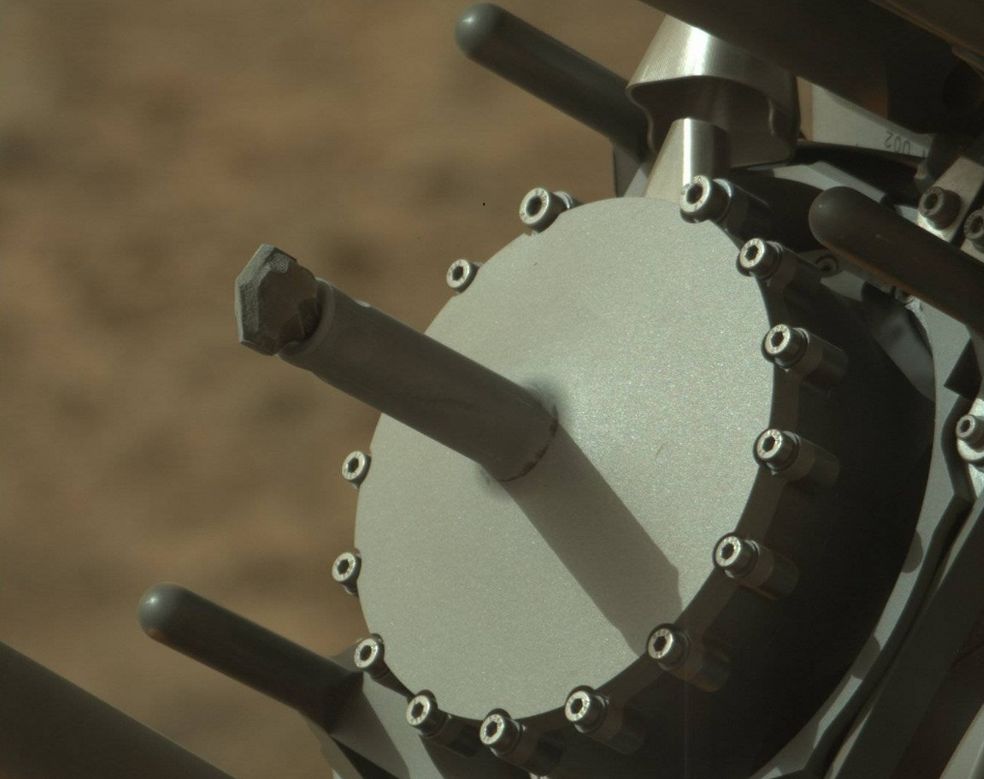
Essentially, the drill system is mounted on Curiosity’s robot arm and uses two “contact posts”, one either side of the drill bit, to steady it against the target rock. A motor – the drill feed mechanism – is then used to advance the drill head between the contact posts, bringing the drill bit into contact with the rock to be drilled, and then provide the force required to drive the drill bit into the rock. However, issues were noted with this feed mechanism, during drilling operations in late 2016, leading to fears that it could fail at some point, leaving Curiosity without the means to extend the drill head, and thus unable to gather samples.

To overcome this, MSL engineers have been looking at ways in which the feed mechanism need not be used – such as by keeping the drill head in an extended position. This is actually harder than it sounds, because the drill mechanism – and the rover as a whole – isn’t designed to work that way. Without the contact posts, there was no guarantee the drill bit would remain in steady, straight contact with a target rock, raising fears it could become stuck or even break. Further, without the forward force of the drill feed mechanism, there was no way to provide any measured force to gently push the drill bit into a rock – the rover’s arm simply isn’t designed for such delicate work.

Curiosity’s drill mechanism, showing the two contact posts (arrowed) used the steady the rover’s robot arm against a target rock, and the circular drill head and bit between them – which until December 2016, had been driven forward between the two contact posts by the drill feed mechanism, which also provided the force necessary to drive the drill bit into a rock target. Credit: NASA/JPL / MSSS

So, for the larger part of 2017, engineers worked on Curiosity’s Earth-based twin, re-writing the drill software, carrying out tests and working their way to a point where the drill could be operated by the test rover on a “freehand” basis. At the same time, code was written and tested to allow force sensors within the rover’s robot arm – designed to detect heavy jolts, rather than provide delicate feedback data – to ensure gentle and uniform pressure could be applied during a drilling operation and also monitor vibration and other feedback which might indicate the drill bit might be in difficulty, and thus stop drilling operations before damage occurs.

At the end of February 2018, the new technique was put to the test on Mars. Curiosity is currently exploring a part of “Mount Sharp” dubbed “Vera Rubin Ridge”, and within the area being studied, the science team identified a relatively flat area of rock they dubbed “Lake Orcadie”, and which was deemed a suitable location for an initial “freehand” drilling test. The rover’s arm was extended over the rock and rotated to gently bring the extended drill head in contact with the target, before a hole roughly one centimetre deep was cut into the rock. This was not enough to gather any samples, but it was sufficient to gauge how well robot arm and drill functioned.

“We’re now drilling on Mars more like the way you do at home,” said Steven Lee, a Curiosity deputy project manager on seeing the results of the test. “Humans are pretty good at re-centring the drill, almost without thinking about it. Programming Curiosity to do this by itself was challenging — especially when it wasn’t designed to do that.”

The test drill site of “Lake Orcadie”, “Vera Rubin Ridge”, imaged by Curiosity’s Mastcam on February 28th, 2018, following the initial “freehand” drilling test. Credit: MASA/JPL / MSSS

The test is only the first step to restoring Curiosity’s ability to gather pristine samples of Martian rocks, however. The next test will be to drive the drill bit much deeper – possibly deep enough (around 5 cm / 2 inches) to gather a sample. If this is successful, then the step after that will be to test a new technique for delivering a gathered sample to its on-board science suite.

Prior to the drill feed mechanism issue, samples were initially graded and sorted within the drill mechanism using a series of sieves called CHIMRA – Collection and Handling for In-Situ Martian Rock Analysis, prior to the graded material between deposited in the rover’s science suite using its sample scoop. This “sieving” of a sample was done by upending the drill and then rapidly “shaking” it using the feed mechanism, forcing the sample into CHIMRA. However, as engineers can no longer rely on the drill feed mechanism, another method to transfer samples to the rover’s science suite has had to be developed.

This involves placing the drill bit directly over the science suite sample ports, then gently tapping it against the sides of the ports to encourage the gathered sample to slide back down the drill bit and into the ports. This tapping has been successfully tested on Earth – but as the Curiosity team note, Earth’s atmosphere and gravity are very different from that of Mars. So whether rock powder will behave there as it has here on Earth remains a further critical test for Curiosity’s sample-gathering abilities.

More Evidence Proxima b Unlikely To Be Habitable

Since the confirmation of its discovery in August 2016, there has been much speculation on the nature of conditions which may exist on Proxima b, the Earth-sized world orbiting our nearest stellar neighbour, Proxima Centauri, 4.25 light years away from the Sun.

Although the planet – roughly 1.3 times the mass of Earth – orbits its parent star at a distance of roughly 7.5 million km (4.7 million miles), placing it within the so-called “goldilocks zone” in which conditions might be “just right” for life to gain a foothold on a world, evidence has been mounting that Proxima b is unlikely to support life.

Comparing Proxima b with Earth. Credit: Space.com

The major cause for this conclusion is that Proxima Centauri is a M-type red dwarf star, roughly one-seventh the diameter of our Sun, or just 1.5 times bigger than Jupiter. Such stars are volatile in nature and prone stellar flares. Given the proximity of Proxima-B its parent, it is entirely possible such flares could at least heavily irradiate the planet’s surface, if not rip away its atmosphere completely.

This was the conclusion drawn in 2017 study by a team from NASA’s Goodard Space Centre (see here for more). Now another study adds further weight to the idea that Proxima b is most likely a barren world.

In Detection of a Millimeter Flare from Proxima Centauri, a team of astronomers using the ALMA Observatory report that a review of data gathered by ALMA whilst observing Proxima Centauri between January 21st to April 25th, 2017, reveals the star experienced a massive flare event. At its peak, the event of March 24th, 2017, was 1000 times brighter than the “normal” levels of emissions for the star, for a period of ten seconds. To put that in perspective, that’s a flare ten times larger than our Sun’s brightest flares at similar wavelengths.

An artist’s impression of Proxima b with Proxima Centauri low on the horizon. The double star above and to the right of it is Alpha Centauri A and B. The ALMA study suggests that it is very unlikely that Proxima b retains any kind of atmosphere, as suggested by this image. Credit: ESO

While the ALMA team acknowledge such ferocious outbursts from Proxima Centauri might be rare, they also point out that such outbursts could still occur with a frequency that, when combined with smaller flare events by the star, could be sufficient enough to have stripped the planet’s atmosphere away over the aeons.

“It’s likely that Proxima b was blasted by high energy radiation during this flare,” Meredith A. MacGregor, a co-author of the study stated as the report was published. “Over the billions of years since Proxima b formed, flares like this one could have evaporated any atmosphere or ocean and sterilised the surface, suggesting that habitability may involve more than just being the right distance from the host star to have liquid water.”

Which is a bit of a downer for those hoping some form of extra-solar life, however basic, might be sitting in what is effectively our stellar back yard – but exoplanets are still continuing to surprise us, both with their frequency and the many ways in which they suggest evolutionary paths very different to that taken by the solar system.

Continue reading “Space Sunday: drills, flares and monster ‘planes”

Space Sunday: budgets and splashdowns

NASA Acting Administrator Robert Lightfoot believes the Lunar Orbit platform-Gateway (LOP-G, formerly the Deep Space Gateway) could be build and operating by 2024 at a cost of around US $3 billion. Really? Credit; NASA

NASA’s fiscal year 2019 budget has had its first public airing, and while not anywhere near finalised, it does first set-out the agency’s table under the Trump administration, and further cement some of the foundations on which that table will be built.

The top line is that for FY 2019 (starting October 2018), NASA should be allocated US $19.9 billion; roughly $370 million above the Obama 2017 budget (which is actually still being used under emergency measures, the FY 2018 budget still yet to be approved), and could be as high as $800 million more than the allocated FY 2018 budget. Some have taken this as a sign that the Trump Administration intends to back-up its noise making around US space activities with some hard spending. However, it’s important to note the FY 2019 request is seen as being the last real-term increase in NASA budget until at least 2024; from 2020 through 2023, it is expected that the agency’s budget will be locked at US $19.6 billion per year.

NASA FY 2019 budget request and forecast 2020-2023. Credit: NASA

Bullet-points from the budget include:

  • Low-Earth Orbit and ISS: confirmation that the Administration wants to phase-out the International Space Station by 2025, in favour of developing a sustained commercial presence in low-Earth orbit. NASA is expected to provide some $900 million through to 2023 to help companies develop their own orbital facilities – or possibly transition the ISS to commercial use (how this would be done, given the international nature of a number of the ISS modules, is unclear).
  • Lunar Aspirations: confirmation of the re-direct for NASA to aim for a return to the Moon and drop human Mars missions from its plans, with a specific emphasis on the agency establishing the Lunar Orbital Platform-Gateway (as the Deep Space Gateway is now being called). Although a NASA project, this is now likely to be driven forward on something of a public / private partnership basis.
  • Earth Sciences: a renewed attempt to end the Deep Space Climate Observatory (DSCOVR) mission, the Climate Absolute Radiance and Refractivity Observatory (CLARREO), the Orbiting Carbon Observatory (OCO) and the Plankton, Aerosol, Cloud, ocean Ecosystem (PACE) satellite. All four were cut from NASA’s 2018 budget by the Trump Administration, but currently continue to receive funding as a result of the failure thus far to get that budget approved.
  • Planetary Sciences: this gets a boost of some US $400 million over 2017, but its unclear where the money is to be allocated; little mention is made of new missions, and the budget language suggests most of the additional $400 million will be allocated to  lunar precursor missions, and thus limited in effective scope.
    • Mars science is effectively frozen at the current level of missions, up to and including the InSight Lander due for launch in May, and the Mars 2020 rover. Only the potential sample return mission to follow Mars 2020 gets seed money.
    • Missions like Europa Clipper gain a lot of words, but no clearer idea on how they are to be achieved.
  • Astrophysics: contains the biggest shock item – cancellation of WFIRST, the Wide Field Infra-Red Survey Telescope (which I previewed here). This has already caused consternation in the science community, is liable to be one of the more strongly fought against recommendations. The White House rationale for the cancellation is that WFIRST “overlaps” the James Webb Space Telescope (JWST), and that “good” science can be conducted with “cheaper” missions. This latter point is particularly ironic given WFIRST, despite a small increase in projected cost, is still one of the most cost-effective NASA deep space missions thanks to its use of available elements.
  • Education: the axing of NASA’s Office of Education, again a repeat of a cut from the FY2018 budget – and one rejected by Congress. OOE accounts for less than 0.5% of NASA’s budget, but plays a significant role in generating interest among US school and college students in pursuing careers in science, technology and engineering.

Initial response to the budget has been mixed. Many are applauding the idea of shifting human activities in low-Earth orbit to a commercial footing – something the Trump administration would like to accelerated through a “streamlining” of policy and regulatory requirements. Advocates of the ISS are less pleased however.

While not approved, it had been expected that ISS operations would be extended through to 2028; a new Russian-built power module, NEM-1, due for launch in 2019/2020 would certainly help with this – and a unilateral decision by the United Station on the ISS might cause some international upset, as well as the domestic kick-back already being heard. Even before the ISS cut was confirmed, Republican law makers were lining up in support of the station. They’ve been joined by Democrats as well.

“The proposal would end support for the International Space Station in 2025 and make deep cuts to popular education and science programmes,” U.S. Senator. Bill Nelson (D-Fla) said. “Turning off the lights and walking away from our sole outpost in space at a time when we’re pushing the frontiers of exploration makes no sense.”

With opinions sharply split of the matter of the future of the ISS, LOP-G offering potentially limited benefit in terms of human operations on the Moon, upset over NASA’s science efforts having to effectively foot the bill for LOP-G, NASA’s FY 2019 budget could be in for as bumpy a ride through Congress as the FY 2018 budget…

SpaceX +1 For Certification; almost +1 for Recovery Attempt

The NASA budget proposal published on February 14th also revealed that the current variant of the SpaceX Falcon 9 rocket has gained “Category 2” launch certification from NASA, clearing the way for the vehicle to start launching science missions on behalf of the agency. The first of these is scheduled to be the Transiting Exoplanet Survey Satellite (TESS), currently slated for launch in April 2018.

On February 22nd, the latest Falcon 9 mission lifted-off from California’s Vandenberg Air Force Base at 14:17 UT, carrying the Spanish Earth-observing Paz satellite and two prototype SpaceX microsats, referred to as Tintin A and Tintin B. Paz will observe Earth in radar wavelengths from a 514 km (319 mi) perch in quasi-polar orbit, gathering data for the Spanish government and other customers over the course of a 5.5 year mission. It will be able to generate images with up to 25 cm (10 in) resolution, day and night and regardless of the meteorological conditions.

The two SpaceX satellite-internet prototypes, originally dubbed Microsat-2a and Microsat-2b, are meant to gather data in advance of deploying and operating a satellite constellation designed to provide a global, low-cost internet service. Called Starlink, the system was first announced by SpaceX chief Elon Musk in 2015, and will eventually comprise thousands of the little satellites when it opens for business in 2020.

The first stage of the launch vehicle had first flown in August 2017, when it helped deliver Taiwan’s Formosat-5 satellite to low-Earth orbit. However, no attempt was made to recover the stage this time around – the ninth such stage to make a second journey into space. Instead, SpaceX’s efforts were focused on trying to recover one of the vehicle’s two payload fairings.

A Falcon 9 / Falcon Heavy payload fairing rolls of the SpaceX production line at a cost of US $3 million. Two such fairings are used per launch. Credit: SpaceX

As I’ve previously noted, the payload fairings enclose the rocket’s cargo during its ascent through the atmosphere. Normally, they are simply jettisoned on reaching low-Earth orbit, and allowed to burn-up in the upper atmosphere.   However, they are actually extremely expensive and complex vehicle elements. The SpaceX units, used by both the Falcon 9 and Falcon Heavy, measure 13.1 m in length and 5.2 m in diameter (43 ft by 17ft), weigh just under a tonne each, and are made of carbon composite material at a cost of US $3 million each – so that’s effectively $6 million per launch being thrown away. If they could be recovered and refurbished, it could allow SpaceX to knock an estimated $5 million off the cost of a launch.

After separating from the Falcon’s upper stage, one of the two payload fairings – which had been equipped with small gas thrusters – re-oriented itself for a slow re-entry into the upper atmosphere, which also gradually slowed it to around eight times the speed of sound (roughly 10,000 km/h). At this point, a parafoil was deployed, effectively turning the fairing into a monster hang glider and further slowing its descent over the Pacific Ocean.

Sea trials: the 62 m (205 ft) long Mr. Steven, leased by SpaceX and converted to “catch” payload fairings in the huge net suspended over the stern deck. Credit: Teslarati / SpaceX / Sea Tran

Waiting for it on that Ocean was Mr. Steven, a “high-speed passenger boat” launched in 2015, and capable of a sustained top speed of 32 knots (37 mph / 59 km/h). The theory is that at this speed, the vessel should be able to sprint along beneath the fairing’s descent trajectory, matching its course and velocity during the final part of the decent, and then “catch” it is a huge net strung between four ungainly arms added to the vessel’s large, flat stern deck.

As it turned out, things didn’t quite come together as hoped. Mr. Steven was unable to maintain position relative to the returning fairing, which actually splashed down in the ocean a couple of hundred metres from the ship. However, it did so so gently, it exhibited little initial visual signs of damage, and Mr. Steven was able to come alongside and recover it.

The payload fairing as seen from Mr. Steven, February 22nd, 2018, a few minutes after the unexpected splashdown. Credit: Teslarati / SpaceX.

“Missed by a few hundred meters, but fairing landed intact in water. Should be able catch it with slightly bigger chutes to slow down descent,” Musk tweeted shortly afterwards.

The next attempt at a fairing recovery could come at the end of March, 2018, with the launch of the next batch of 10 Iridium communications satellites from Vandenberg.

Mr Steven brings the recovered Falcon 9 payload fairing back to port, February 22nd, 2018. Credit: Teslarati / SpaceX

Space Sunday: Mars rover round-up

Curiosity, NASA’s Mars Science Laboratory (MSL) continues its exploration and examination of “Vera Rubin Ridge” on the slopes of “Mount Sharp”.

Most recently, star- and swallowtail-shaped tiny, dark bumps in fine-layered bright bedrock have been drawing the attention of the rover’s science team due to their similarity to gypsum crystals formed in drying lakes on Earth – although multiple possibilities for the features are being considered alongside their potential for being formed as a result of water action.

The features pose a number of puzzles: where they formed at the same time as the layers of sediment in which they sit, or were formed later as a result of some action? Might they have been formed inside the rock sediments of “Mount Sharp” and exposed over time as a result of wind erosion? Do they contain the mineral that originally crystallised in them, or was it dissolved away to be replaced by another? Answering these questions may point to evidence of a drying lake within Gale Crater, or to groundwater that flowed through the sediment after it became cemented into rock.

“Vera Rubin Ridge” stands out as an erosion-resistant band on the north slope of lower Mount Sharp inside Gale Crater. It was a planned destination for Curiosity even before the rover’s 2012 landing on the crater floor near the mountain. The rover began climbing the ridge about five months ago, and has now reached the uphill, southern edge. Some features here might be related to a transition to the next destination area uphill, which is called the “Clay Unit” because of clay minerals detected from orbit.

In addition to the deposits, the rover team also is investigating other clues on the same area to learn more about the Red Planet’s history. These include stick-shaped features the size of rice grains, mineral veins with both bright and dark zones, colour variations in the bedrock, smoothly horizontal laminations that vary more than tenfold in thickness of individual layers, and more than fourfold variation in the iron content of local rock targets examined by the rover.

A mineral vein with bright and dark portions distinguishes this Martian rock target, called “Rona,” near the upper edge of “Vera Rubin Ridge” on Mount Sharp. The MAHLI camera on NASA’s Curiosity Mars rover took the image after the rover brushed dust off the grey area, roughly 5cm by 7.5 inches. Click for full size. Credit: NASA/JPL / MSSS

The deposits are about the size of a sesame seed. Some are single elongated crystals. Commonly, two or more coalesce into V-shaped “swallowtails” or more complex “lark’s foot” or star configurations. They are characteristic of gypsum crystals, a form of calcium sulphate which can form when salts become concentrated in water, such as in an evaporating lake.

“These tiny ‘V’ shapes really caught our attention, but they were not at all the reason we went to that rock,” said Curiosity science team member Abigail Fraeman of NASA’s Jet Propulsion Laboratory. “We were looking at the colour change from one area to another. We were lucky to see the crystals. They’re so tiny, you don’t see them until you’re right on them.”

“There’s just a treasure trove of interesting targets concentrated in this one area,” Curiosity Project Scientist Ashwin Vasavada of NASA’s Jet Propulsion Laboratory, adds. “Each is a clue, and the more clues, the better. It’s going to be fun figuring out what it all means.”

In January, Curiosity examined a finely laminated bedrock area dubbed “Jura”, thought to result from lake bed sedimentation, as has been true in several lower, older geological layers Curiosity has examined. This tends to suggest the crystals formed as a lake in the crater evaporated. However, an alternate theory is that they formed much later, as a result of salty fluids moving through the rock during periodic “wet” bouts in the planet’s early history. This would again be consistent with features previous witnessed by Curiosity in its past examination of geological layers, where subsurface fluids deposited features such as mineral veins.

The surface of the Martian rock target in this stereo, close-up image from the Curiosity rover’s MAHLI camera includes small hollows with a “swallowtail” shape characteristic of gypsum crystals. The view appears three-dimensional when seen through blue-red glasses with the red lens on the left. Click for full size. Credit: NASA/JPL / MSSS

That the deposits may have formed as a result of fluids moving down the slopes of “Mount Sharp” is pointed to by some of them being two-toned – the darker portions containing more iron, and the brighter portions more calcium sulphate. These suggest the minerals which originally formed the features have been replaced or removed by water. The presence of calcium sulphate suggests salts were suspended in any water which may have once been present in the crater. If this is the case, it could reveal more about the past history of Mars.

“So far on this mission, most of the evidence we’ve seen about ancient lakes in Gale Crater has been for relatively fresh, non-salty water,” Vasavada said. “If we start seeing lakes becoming saltier with time, that would help us understand how the environment changed in Gale Crater, and it’s consistent with an overall pattern that water on Mars became more scarce over time.”

Even if the deposits formed inside the sediments of “Mount Sharp” and were exposed over time as a result of wind erosion, it would reveal a lot about the region, providing evidence that as water became more and more scarce, so it moved underground, taking any minerals which may have been suspended within it along as well.

“In either scenario – surface or underground formation –  these crystals are a new type of evidence that builds the story of persistent water and a long-lived habitable environment on Mars,” Vasavada notes.

As well as offering further evidence of Gale Crater having once being the home of multiple wet environments, the presence of iron content in the veins and features might provide clues about whether the wet conditions in the area were favourable for microbial life. Iron oxides vary in their solubility in water, with more-oxidized types generally less likely to be dissolved and transported. An environment with a range of oxidation states can provide a battery-like energy gradient exploitable by some types of microbes.

Opportunity’s Mystery

As Curiosity explores “Vera Rubin Ridge”, half a world away, NASA’s Mars Exploration Rover (MER) Opportunity has reached 5,000 Sols (Martian days) of operations on Mars in what was originally seen as a 90-day surface mission.

A view from the front Hazard Avoidance Camera on NASA’s Mars Exploration Rover Opportunity shows a pattern of rock stripes on the ground, a surprise to scientists on the rover team. It was taken in January 2018, as the rover neared Sol 5000 of what was planned as a 90-Sol mission. Credit: NASA/JPL

Currently, Opportunity is investigating a mystery of its own: a strange  ground texture resembling stone striping seen on some mountain slopes on Earth that result from repeated cycles of freezing and thawing of wet soil. The texture has been found within a channel dubbed “Perseverance Valley” the rover is exploring in an attempt to reach the floor of Endeavour crater. This 22 km (14 mi) diameter impact crater has been the focus of Opportunity’s studies since it reached the edge of the crater in October 2011.

The striping takes the form of soil and gravel particles appearing to be organised into narrow rows or corrugations, parallel to the slope, alternating between rows with more gravel and rows with less. One possible explanation for their formation is that on a scale of hundreds of thousands of years, Mars goes through cycles when the tilt, or obliquity, of its axis increases so much that some of the water now frozen at the poles vaporises into the atmosphere and then becomes snow or frost accumulating nearer the equator and around the rims of craters like Endeavour.

Continue reading “Space Sunday: Mars rover round-up”