Space Sunday: moles, rovers, and spacewalks

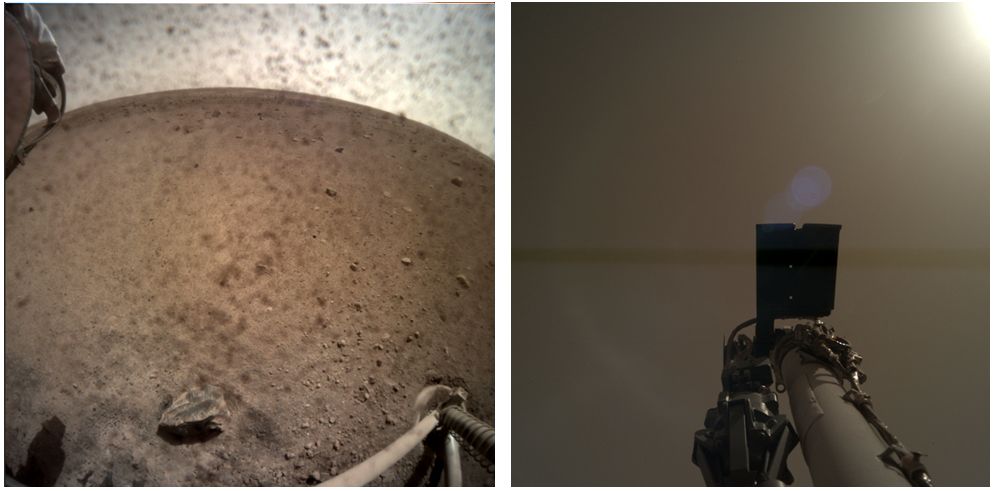
The arm-mounted camera on NASA’s InSight lander captures an image of the scoop at the end of the arm pushing gently against the HP³ “mole” in an attempt to get it burrowing once more. The data cable trailing from the “mole” is packed with sensors designed to measure sub-surface heat flow, and so reveal more about the interior of Mars. Credit: NASA/JPL

NASA’s attempts to free the heat-sensing “mole”, deployed onto the surface of Mars by the InSight lander mission at the end of 2018 have met with some success.

As I reported at the start of October, the “mole”, a special probe that forms a key part of the Heat Flow and Physical Properties Package (HP³), is designed to propel itself up to 5 metres (16 ft) beneath the surface of Mars in order to record the amount of heat escaping from the planet’s interior, helping scientists determine more about the planet. However, Since February of 2019, it has been stuck, having travelled just 30 cm and leaving it partially sticking out of the ground. Numerous attempts to get it moving again have been tried, none of which, up until this most recent attempt, had managed to get the “mole” moving again.

The problem was believed to be down to the self-propelled probe being unable to generate sufficient friction against whatever material it had burrowed into in more to gain downward traction. At that time, I noted that the mission team where hoping to use the lander’s robot arm to apply direct pressure against the exposed portion of the probe in the hope of pushing it against the side of the hole it has so far created, giving it sufficient traction to resume burrowing.

On October 14th, 2019, the German team responsible for the “mole” confirmed the attempt had worked: the probe had resumed progress during the initial test, burrowing a further 3 cm (just over an inch). That may not sound much, and it certainly doesn’t mean the “mole” is in the clear; however, it does tend remove the other lurking fear: that the probe had in fact hit a solid mass such as a boulder or rock that was impeding its downward progress.

In this image, the “mole” can be see canted to one side, giving rise to fears it may have struck a large rock or boulder beneath the surface and was being pushed sideways each time it tried to propel its way forward. Given it has now moved downwards once more, the risk of a rock being in the way now seems unlikely. Credit: NASA/JPL

The mole still has a way to go, but we’re all thrilled to see it digging again. When we first encountered this problem, it was crushing. But I thought, ‘Maybe there’s a chance; let’s keep pressing on.’ And right now, I’m feeling giddy.

– Troy Hudson, JPL engineer-scientist leading the US side of
efforts to get the “mole” moving again

This doesn’t mean the “mole” is free and clear however; the extent of the loose material it appears to have burrowed into is unknown, and as the data cable connected to it cannot be used to simply haul it back out of the initial hole, the decision has been made to keep the scoop of InSight’s robot arm pressed against the exposed portion of the probe until such time as it can no longer provide support. The hope is that by the time this has happened, the mole will have moved beyond the looser material that seems to be hampering downward movement. However, in case if it has not, the team are now looking at other options to try to assist the probe – such as filling-in the hole behind it in the hope that sufficient material falls around it to provide it with the traction it needs.

Throughout its time on Mars, InSight has been under observation by NASA’s Mars Reconnaissance Orbiter, which routinely passes over the Elysium Planitia region where InSight landed. As such, it has been able to image the lander on several occasions, but on September 23rd, 2019, MRO directly overflew InSight’s landing site at an altitude of 272 km (169 mi), and the orbiter’s HiRISE imaging system captured what is regarded as the best image yet of InSight (blow).

The HiRISE camera on NASA’s Mars Reconnaissance Orbiter got its best view yet of the InSight lander on September 23rd, 2019. Image credit: NASA/JPL / University of Arizona

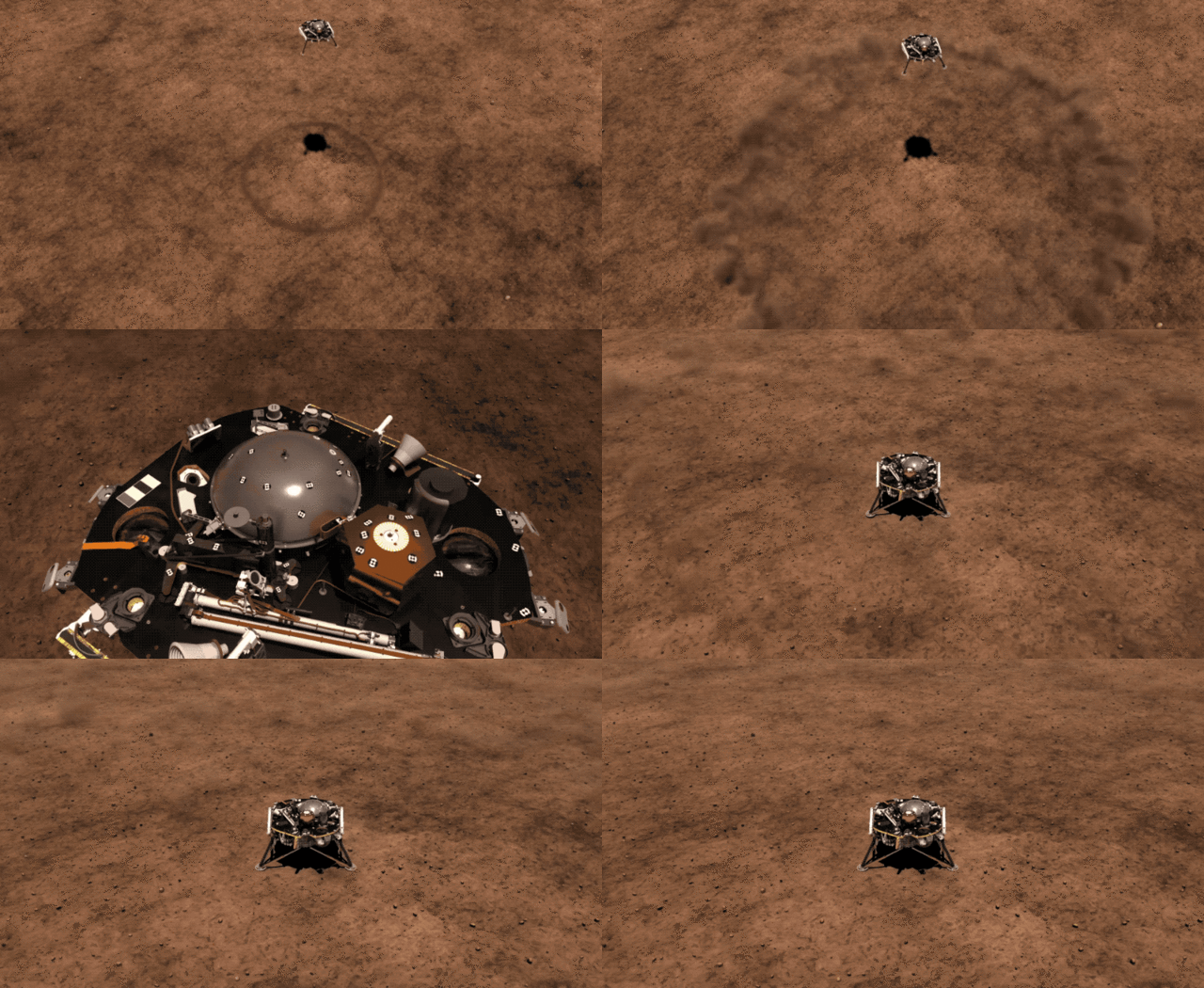
The main image above shows the lander on the surface of Mars surrounded by the blast circle left by its landing motors. The inset image shows the lander in greater detail, revealing its two circular solar panels, each just over 2 m (7 ft) across (in green), with the body of the lander between them (brighter green). The bright dot just below the lander is the protective dome covering the seismometer deployed to the surface of Mars along with the HP³ mentioned above. Also visible in the main image is a series of diagonal streaks on the Martian surface. These are the tracks left by dust devils that have passing through the area.

As well as issuing the image of InSight on October 16th, NASA also released an animated GIF showing the Mars Science Laboratory’s progress up the slopes of “Mount Sharp” (Aeolis Mons). The GIF switches between two shots of “Mount Sharp” taken at the same overhead angle and roughly two months apart. Between them, they show Curiosity’s progress across 337 m (1,106 ft) of what was dubbed the “clay bearing unit”. The first image, which has Curiosity circled near the top, was captured on May 31st, 2019 as the rover was sitting within “Woodland Bay”. The second image shows Curiosity on July 20th, 2019, as it sat on a part of the unit called “Sandside Harbour” further up the slopes of “Mount Sharp”.

Curiosity, as seen by MRO on May 31st, 2019 (top) and July 20th, 2019 (centre), as the rover traversed the “clay bearing unit” on the slopes of “Mount Sharp”. Credit: NASA/JPL / University of Arizona

UK and Japan Plan to Send Rovers to the Moon

Both the United Kingdom and Japan are planning to become part of a select community (thus far!) of countries that have operated rover vehicles on the surface of the Moon.

To date, only three nations have operated rover vehicles on the lunar surface: Russia, with its Lunokhod 1 and Lunokhod 2 rovers, China with its Yutu rovers (all of which were automated vehicles) and America with the Apollo lunar roving vehicle famously driven by the astronauts of Apollo 15 through 17. The Japanese and British rovers will be very small, as carried to the Moon as part of a robotic lander called Peregrine being developed by US commercial organisation, Astrobotic, one of the former contenders for the Google Lunar X Prize.

The Japanese rover, called Yaoki, is a single axle vehicle designed by Dymon Co., Ltd, based in Tokyo and specialising in robotic systems development. The company has been working on the design for eight years, with the overall technology design having been finalised in 2018, and the development cycle including several hundred hours of field testing, causing Dymon to dub it, “the smallest but most effective wheeled rover ever produced.” A video of the little rover undergoing field testing has been released by one of the engineers working on the project that – while a little dramatic in places – highlights Yaoki’s capabilities.

The British rover weighs-in at just 1 kg (2.2 Lb) and is solar-powered with a range of some 10 m (33 ft). However, unlike traditional rovers, it will not have wheels or even tracks – it will get around by walking on four spider-like jointed legs. Like the Japanese rover, it will be equipped with high-definition video and camera systems.

Developed by a London-based company called Spacebit, the rover is more of a proof-of-concept unit than outright science instrument; if Successful, Spacebit hope that the little rovers will become a feature of multiple missions, exploring both the surface and sub-surface regions of the lunar surface – they are specifically designed to scuttle into small lava tubes and explore them.

A model of the Spacebit rover. Credit: Spacebit

The Peregrine lander is designed to deliver payloads to the Moon at a cost of US 1.2 million per kilogramme in support of NASA’s Artemis lunar exploration programme. Its payload limit is some 264 kg (584 lb), although the mission carrying the two rovers  – which will be the first flight for the lander will only carry 90 kg of payload. It is currently scheduled for a July 2021 launch using a United Launch Alliance Vulcan rocket – the first certification launch for that vehicle.

The cost of the mission – US $79.5 million – is being met by NASA, with the agency supply providing 14 of the lander’s total of 21 payloads, which between them will mass 90 kg and will include at least one other, larger rover vehicle. The proposed landing site is Lacus Mortis, a relatively flat northern latitude plateau. Once there, the lander and its rovers are expected to operate for 8 terrestrial days.

An artist’s impression of the Peregrine lunar lander. Credit: Astrobotic

Continue reading “Space Sunday: moles, rovers, and spacewalks”

Space Sunday: the man who first walked in space

Alexei Leonov’s self portrait of his (and the world’s) first space walk, 1965.

On Friday, October 11th came the news that Alexei Arkhipovich Leonov, the first man to complete a space walk, and later the commander of the Russian side of the historic Apollo-Soyuz mission, had sadly passed away at the age of 85.

Leonov was born on May 30th, 1934, in the remote Siberian village of Listvyanka, Siberia, to which his father’s family had been exiled as a result of his grandfather’s involvement in the 1905 Russian Revolution. In 1936, his railway worker / miner father was falsely accused of “improper” political views during Stalin’s purges, and was imprisoned for several years, leaving Alexei’s mother to raise her children on her own.

Leonov was known as a quick leaner with a keen sense of fun and light-heartedness, as this 1960s shot – taken before his first space flight – with his cap jauntily cocked to one side shows. Credit: RIA Novosti

Creative from an early age, Alexei developed a talent for painting and drawing, going so far as being able to sell some of his pieces for extra money. However, he was determined to be a military aviator, and when his reunited family relocated to Kaliningrad in 1948, he was able to pursue more technical studies that enabled him to be accepted into flight training in the 1950s. Posted to the the Chuguev military pilots’ academy, he graduated in 1957 as both a qualified fighter pilot and parachute training instructor, and served three tours of duty in both roles, gaining 278 hours flight time in front-line fighters and completing 115 parachute jumps while training others.

His skills as a parachutist saw him accepted into the new cosmonaut training programme in 1960 – it had been decided that for early flights, rather than landing in their capsule, cosmonauts would be jettisoned from their Vostok craft using an ejector seat similar to jet fighters, allowing them to complete the last part of their return to Earth via parachute.

Alexei Leonov (back row, left), with some of his cosmonaut comrades, including Yuri Gagarin (first man in space), 2nd from the left, front row; Valentina Tereshkova (first woman in space), Gherman Titov (second cosmonaut in space, next to Leonov) and Pavel Belyayev (mission commander, Voskhod 2), right side, front row. This images was taken some time between April 1965 and March 1968 Credit: RIA Novosti archive

As a part of the original intake of 20 cosmonaut recruits, Leonov trained alongside Yuri Gagarin, the first human to fly in space and orbit the Earth, and Gherman Titov, the second Cosmonaut and third human in space. Like them, he was initially selected for Vostok flights, serving as back-up pilot to the 1963 Vostok 5 mission. However, before he could be rotated to a “prime” Vostok seat, he was one of five cosmonauts selected to fly the more ambitious Voskhod missions.

Voskhod was really a Vostok system but with the ejection seat and mechanism removed to make way for up to three crew seats, and with additional retro rockets attached to the descent stage to cushion the crew on landing instead of them being ejected. It was really an “interim” designed to bridge Vostok and the much more capable Soyuz (which wouldn’t fly until 1967), allowing Russia to match the America Gemini system in launching more than one man at a time. In particular, Leonov was selected with Pavel Belyayev (as mission commander) to fly the Voskhod 2 mission in which he would undertake the world’s first space walk.

This one-day mission was launched on March 18th, 1965 with the call-sign Almaz (“Diamond”). The design of the Vostok / Voskhod vehicle meant that the cabin could not be depressurised in order for a cosmonaut to egress the vehicle. Instead, a complicated airlock had to be fitted to the vehicle’s exterior. This comprised a metal mount surrounding the crew hatch, and to which was fitted an inflatable tube with a further hatch built on to it.

Alexei Leonov and avel Belyayev (r), pictured after their historic Voskhod 2 mission. Credit: unknown

Once in orbit, Belyayev helped Leonov add a backpack to his basic spacesuit that would supply him with 45 minutes of oxygen for breathing and cooling, pumped to him through an umbilical cord / pipe, and which included a second pipe and adjustable valve designed to vent small amounts of oxygen into space to carry away heat, moisture, and exhaled carbon dioxide. The airlock mechanism was then inflated and pressurised using air from the Voskhod’s supplies, extending it some 3 metres (9 ft) outward from the vehicle. After checking the integrity of the airlock tube, Belyayev opened the inward hinged crew hatch so Leonov could pull himself into the tube and the hatch re-secured behind him. Controls both inside the tube and the Voskhod allowed the airlock to be depressurised, allowing Leonov to open the inward-hinged “top” hatch.

Before exiting the tube, Leonov attached a video camera to a boom he then connected to the airlock rim, allowing live television pictures of his egress from the Voskhod to be captured and relayed to Earth. The sight of him exiting the vehicle reportedly caused consternation among some his family who didn’t understand the purpose of his mission!

When my four-year-old daughter, Vika, saw me take my first steps in space, I later learned, she hid her face in her hands and cried. “What is he doing? What is he doing?” she wailed. “Please tell Daddy to get back inside!”

My elderly father, too, was upset. Not understanding that the purpose of my mission was to show that man could survive in open space, he expressed his distress to journalists who had gathered at my parents’ home. “Why is he acting like a juvenile delinquent?” he shouted in frustration. “Everyone else can complete their mission properly, inside the spacecraft. What is he doing clambering about outside? Somebody must tell him to get back inside immediately. He must be punished for this!”

– Alexei Leonov, Two Sides of the Moon, written with U.S. Apollo astronaut David Scott.

Once clear of the airlock, Leonov encountered some difficulties. Not actually designed for the vacuum of space, his suit inflated and became semi-rigid, limiting his range of movements. He found he couldn’t reach a stills camera mounted on the front of his suit and intended to allow him to take photographs while outside the vehicle, for example. But worst was to come.

In training, Leonov had rehearsed sliding back into the airlock feet first, enabling him to easily swing the outer hatch back up into place to be secured and allow the interior of the tube to be re-pressurised so that Belyayev could then open the Voskhod’s hatch and guide him back into the spacecraft. However, he now realised he had a real problem.

With some reluctance I acknowledged that it was time to re-enter the spacecraft. Our orbit would soon take us away from the sun and into darkness. It was then I realized how deformed my stiff spacesuit had become, owing to the lack of atmospheric pressure [outside of it]. My feet had pulled away from my boots and my fingers from the gloves attached to my sleeves, making it impossible to re-enter the airlock feet first.

– Alexei Leonov, Two Sides of the Moon, written with U.S. Apollo astronaut David Scott,
describing his spacesuit issues

His only option was to enter the tube head-first and then work out how to turn himself around to close the hatch – except his suit had inflated such that it was too big to fit through the outer hatch ring. His only option was to use the oxygen relief valve to gently release pressure from the suit and deflate it. The problem? if he let out too much oxygen, he’d risk hypoxia and suffocation and if he let it out too quickly, he risked decompression sickness (or “the bends” as sea divers call it).

The first public indication that Leonov was in trouble came when the live video feed and radio broadcast were both cut and Russian state broadcasters switched to playing  Mozart’s Requiem in D Minor on repeat. Meanwhile, he cautiously went about releasing the pressure in his suit until he could wriggle his way into the airlock tube and, in a feat of contortion, turned himself around so he could secure the outer hatch. This effort proved almost too much for the suit’s primitive cooling system, and by the time Belyayev opened the Voskhod’s hatch and helped Leonov back into the capsule, he was in grave danger of passing out from heatstroke. However, their problems were far from over.

How it might have looked: a still from the 2017 Russian film Spacewalk, recreating Leonov’s historic 1965 space walk

Re-entry for the Voskhod was a three stage affair: eject the airlock, jettison the equipment module, then fire the retro-rockets on the descent module to drop the vehicle back into the denser part of Earth’s atmosphere. All of this was meant to be largely automated, but the guidance system failed due to an electrical fault taking out a number of systems, leaving Belyayev and an exhausted Leonov scrambling to handle things manually, literally clambering over one another to perform their assigned duties. As a result, the re-entry motors were fired 46 second late, enough to mean they would overshoot their planned landing site by over 380 km (241 mi).

However, this proved to be the least of their worries. No sooner had the rockets fired than the Voskhod went into a 10G spin, pinning the two men into their seats and rupturing blood vessels in their eyes. Through the observation port on his side of the vehicle, Leonov saw that the equipment module hadn’t fully separated from the descent module and lay connected to it via a communications cable. When the retro rockets fired to slow the decent capsule, the equipment module had shot past, causing the cable to snap taut and start the two modules tumbling around one another.

Continue reading “Space Sunday: the man who first walked in space”

Space Sunday: life’s building blocks, black holes and moles

A dramatic plume sprays water ice and vapour from the south polar region of Saturn’s moon Enceladus. It’s known that these plumes contain organic material, and now have been shown to contain the possible precursors to the building block of life. Credit: NASA/JPL / Space Science Institute

Saturn’s moon Enceladus is one of several icy worlds within the solar system that likely harbour a vast ocean beneath its icy crust. We know this because the Cassini mission spotted geysers of vapour bursting out from its south polar region. Following daring passes through these plumes, rising hundreds of kilometres from Enceladus, the spacecraft was able to obtain samples that confirmed they comprised water vapour.

As I’ve noted in past Space Sunday articles, it is believed the vapour originates from a vast ocean under the moon’s ice, and that this ocean is kept liquid as a result of Enceladus being constantly “flexed” by the gravities of Saturn and its other moons, flexing that both causes the ridges and fractures seen on Enceladus’s surface and generates frictional heat deep within the Moon’s core. These heat could both keep the subsurface ocean liquid and also cause hydrothermal vents on the ocean floor. Such vents on Earth are sources of chemical energy and elements such as carbon, nitrogen, hydrogen and oxygen – the essential building blocks of life, and it has been suggested this could be the same on Enceladus.

An artist’s impression of the interior of Enceladus, showing the rocky core, ocean and icy crust. The geysers imaged by Cassini in the moon’s southern hemisphere are also show. Credit: NASA/JPL

2018, an international team based in Germany studying the data gathered by Cassini found the geyser plumes contained a range of organics. Now, as revealed in the October issue of The Monthly Notices of the Royal Astronomical Society. that same team have taken their studies further, finding evidence of organic compounds that could be the precursors to the actual building blocks of life. What’s more, these compounds are condensed within icy grains containing oxygen and nitrogen that are ejected any the geysers. On Earth, similar combinations of these compounds take part in the chemical reactions that form amino acids, core essential building blocks for life as we know it.

More excitingly, these reactions could be driven by the heat generated by hydrothermal vents, and on Earth, the oldest fossilised lifeforms have been found around such vents on the ocean floor, leading to the theory that they are the places where life first emerged on the planet.

If the conditions are right, these molecules coming from the deep ocean of Enceladus could be on the same reaction pathway as we see here on Earth. We don’t yet know if amino acids are needed for life beyond Earth, but finding the molecules that form amino acids is an important piece of the puzzle.

– Nozair Khawaja,  study, lead Free University of Berlin

In this illustration, you can see the organic compounds combining with the icy grains in the plumes emitted by Enceladus. Credit: NASA/JPL

Here we are finding smaller and soluble organic building blocks — potential precursors for amino acids and other ingredients required for life on Earth.

– Jon Hillier, study co-author.

That these basic compounds have been found in material released by Enceladus does not automatically mean that life is forming in its deep ocean, but their discovery does point to the potential of amino acids being formed beyond Earth, which could have significant import with regard to the search for life in the universe.

Currently – and as I’ve again reported – both NASA and ESA are planning mission to Jupiter’s moon Europa, another moon with the potential of having a warm, liquid water ocean under its mantle of ice. These discoveries with Enceladus point to it also being worthy of further and detailed study. NASA has mulled such a mission in 2015 and 2017 – the Enceladus Life Finder (ELF) – but it has yet to receive funding.

ELF is designed to orbit Saturn and make repeated passes through the geyser plumes of Enceladus in order to locate any biosignatures and biomolecules that might be present in the vapours. It is also intended to measure amino acids, and analyse fatty acids or methane (CH4) that may be within the plumes found in the plumes and that might be produced by living organisms.  These latest result may cause NASA to give the mission further consideration.

Could “Planet Nine” Actually be a Black Hole?

Planet Nine, the mysterious, yet-to-be-discovered world thought to be orbiting far out in the hinterlands of the solar system, and potentially responsible for the odd orbits of a number of bodies in the Kuiper Belt, is something I’ve written about numerous times in this column.

In my last piece on the subject, I noted a paper that suggested that gravity created by a large disc of dust and icy material orbiting well beyond the Sun might be largely responsible for the odd orbits of these trans-Neptunian Objects (TNOs). Now another paper suggests that if it is gravity responsible, it could actually be due to a black hole lurking on the fringes of the solar system.

Computer modelling showing how a possible large planetary body (“Planet Nine”, also “Planet X” and other names) could account for the eccentric orbits of several TNOs. Now a new paper suggests an ancient black hole might be responsible.  Credit: Caltech / R Hurt

The black hole in question is a primordial black hole (PBH), a hypothetical class of small black holes thought to have emerged soon after the Big Bang as a result of density fluctuations in the very early universe. It is believed that most PBHs have likely evaporated, but some with sufficient mass could still exist, wandering the galaxy, although none have thus far been directly observed.

In their paper, astronomers Jakub Scholtz and James Unwin suggest that a wandering PBH might have strayed close enough to our solar system to have been caught by the Sun’s gravity to orbit it at a distance between 300 and 1,000 AU. They note that there are certain similarities between the estimated mass of the object responsible for giving rise to the eccentric TNO orbits and that found in an excess in microlensing events.

Their hypothesis is that a PBH of around five Earth masses may have been captured by the Sun’s gravity – that’s well within the mass range hypothesised for Planet Nine. But finding it if it exists, will be problematic: a PBH of around 5 Earth masses would likely have a diameter of 5 cm (2 in), and have a Hawking temperature of approximately 0.004 K – making it colder than the cosmic microwave background (CMB) and thus exceptionally hard to detect.

The hypothesis is controversial, as Scholtz and Unwin note. However, they also suggest a way in which the idea could be proven or eliminated from consideration. PBHs are They propose a search for annihilation signals from the dark matter halo of the PBH. If it is annihilating, the halo would provide a powerful and localised signal offering a mix of X-rays, gamma-rays and other high-energy cosmic rays. If such a source were to be detected and found to be moving, it could be indicative of a local PBH.

Continue reading “Space Sunday: life’s building blocks, black holes and moles”

Space Sunday: SpaceX Starship update

A Starship / Super Heavy pairing lifts-off from a dedicated launch facility in this still from an animated video produced by SpaceX for the September 28th, 2019 update. Credit: SpaceX

On the occasion of the eleventh anniversary of SpaceX achieving orbit for the first time with their Falcon 1 rocket on September 28th, 2008, CEO Elon Musk presented an update on the company’s progress developing its massive Super Heavy booster and interplanetary class vehicle, Starship.

It has been some 12 months since the last update on the development of the two vehicles – the last update really being overshadowed by the announcement SpaceX planned to fly a Japanese billionaire and his entourage around the Moon and back (see Moon trips, Mr Spock’s “home” and roving an asteroid for more), and the programme has moved on significantly since then, as indicated by the fact that the 2019 update took place at the SpaceX facilities in Boca Chica and against the backdrop of the first of the Starship prototype vehicle.

Starship Mk1 under construction at the SpaceX facilities near Boca Chica, Texas. Credit: unknown

Since its first public unveiling in 2016, the Starship / Super Heavy combination has been through a number of iterations and name changes. However, it is fair to say that things have now settled down on the design front, and what was presented at Boca Chica is liable to remain largely unchanged, assuming everything proceeds as SpaceX hopes.

In this, the flight capable prototype Starship at Boca Chica is the first in a series of such vehicles. A second is  under construction at the SpaceX facilities in Cocoa, Florida, and three more are planned, one of which will be used to make the first orbital flight within the next 6 months, and Musk suggesting another could be used in a crewed orbital flight within the next 12 months – which sounds exceptionally ambitious. Construction of the two initial Starship prototypes has not exactly been secret: both have been literally assembled in the open. So even ahead of the September 28th event, some were already developing renderings of the new Starship design compared to the last known iteration.

A rendering by Kimi Talvitie comparing the 2018 design for Starship (l) with the prototype (r). The rendering of the 2019 prototype was based on direct feedback from Elon Musk

The new design sees some significant changes in Starship – notably with the fins, canards and landing legs. The 2018 variant was marked by three large fins, two of which would be actuated (hinged for up / down motion relative to the hull) for atmospheric flight, with all three fins containing the vehicle’s landing legs. At the time of that design, I commented that this approach appeared risky: a heavy landing on the Moon or Mars might conceivably damage one of the actuated fins, affecting the vehicle’s ability to undertake atmospheric flight on its return to Earth.

With the new design, the fins are reduced to two and reshaped, both of which are actuated to hinge “up” and “down”. In addition, the landing system is now independent of the fins, removing the greater part of the risk of damaging them on landing. The number of landing legs is also increased to six. At the forward end of the vehicle, the canards are enlarged and hinged in a similar manner to the fins.

Starship’s basic specification. Note the “dry” mass of 85 tonnes is incorrectly stated in the slide: it is expected the production version of Starship will mass around 120 tonnes (the prototype masses around 200 tonnes. Credit: SpaceX

The remaining aspects of the design are more-or-less unchanged as far as the body of the ship is concerned: it will be some 50 metres (162.5ft) in length and have a diameter of 9m (29ft). The forward end of the vehicle will be given over to crew and passengers or cargo (or a mix of the two), although Musk now estimates the vehicle will – with the aid of the Super Heavy booster – be lifting up to 150 tonnes to low Earth orbit – an increase of roughly a third – and return up to 50 tonnes to Earth.

To help achieve this, the motor system has been slight revised. While six engines will still be used, three will now be optimised for vacuum thrust, ideal for orbital flight and pushing the vehicle out to the Moon or Mars, and the remaining three optimised for sea level thrust and capable of being gimballed for use during a descent through an atmosphere and landing.

Starship’s motor arrangement: three central Raptor engines optimised for sea level thrust and capable of gimballing and three outer vacuum optimised motors with fixed, large diameter exhaust bells for maximum efficiency. The “boxes” visible in the rendering are potentially additional cargo bins. Credit: SpaceX

During the presentation, Musk explained the rationale behind the use of 301 cold rolled stainless steel in the design, noting a number of reasons. Firstly, the cold rolling process results in a stronger, light finished product, and this becomes even stronger when exposed to the very low temperatures of cryogenic fuels. Thus, Starship and Super Heavy in theory have a structural strength equitable to that of carbon composites – but at a much lower overall mass.

Secondly, the cold rolled steel has very high melt temperatures, reducing the amount of direct heat shielding required, again reducing the vehicle’s overall mass. It is also both highly corrosion-resistant and easy to work with. This means that basic repairs to a vehicle on the surface of the Moon or Mars could be effected, or even that a Starship could even be dismantled and the steel from the hull re-purposed. Finally, there’s the fact that all these advantages are gained in a product costing around 2% that of an equivalent mass of carbon composite.

Starship Mk 1 filmed during the September 28th livestream event. Credit: SpaceX

In terms of heat shielding, the “windward” side of Starship (the side facing the fictional heat of entry into an atmosphere) will be coated with lightweight ceramic tiles. Somewhat similar in nature to those used within the space shuttle, they will be of a hardier material and less prone to damage. The re-entry profile was also discussed, with Musk comparing Starship to a sky diver.

To explain: the vehicle will approach the atmosphere at a relatively high 60-degree incidence, using the heat generated by contact with the upper atmosphere to slow its velocity from Mach 25 to a point where, once within the denser atmosphere, the vehicle is literally falling more-or-less horizontally. The fins and canards can then be used to maintain the vehicles orientation in a similar manner to that of a sky diver using his arms and legs. in addition, the lift generated by fins and canards will further help slow its descent until, roughly 2 km above the ground, the vehicle will rotate to a vertical position and use the three gimballed Raptor motors to make a propulsive, tail-first landing.

SpaceX plan to offer Starship in support of lunar operations – but the company’s goal is to establish a permanent human presence on Mars. Credit: SpaceX

Starship Mk 1 is equipped with the same sea level optimised Raptor motors as intended for the production vehicles.  SpaceX hope to see it make at least one flight before the end of the year – although the company has yet to secure a permit from the US Federal Aviation Authority to commence flights. This first attempt will be to an altitude of around 20 km (12.5 mi) before a descent and landing. If successful, the test programme involving the various prototype vehicles will unfold from there.

Continue reading “Space Sunday: SpaceX Starship update”

Space Sunday: Venus and getting to the Moon

A new study suggests that less that one billion years ago, Venus had liquid water on its surface and atmospheric conditions similar to Earth’s. Credit: NASA

We’re familiar with the idea that Venus is a very hostile place: it has a thick, carbon-dioxide atmosphere mixed with other deadly gases that is so dense, it would instantly crush you were you to step onto the planet’s surface unprotected, and hot enough to boil you in the same moment as well as burn your skin away due to the presence of sulphuric acid. But for a long time, due to its enveloping clouds, it was believed that Venus could be a tropical paradise – a place of warm seas, lakes and rain forests, kept warm by the Sun whilst also protected from the worst of the heat by those thick clouds.

Now, according to a new study presented on September 20th, 2019 at the Joint Meeting of the European Planetary Science Congress (EPSC-DPS),that view of Venus as a warm, wet – and potentially habitable world. What’s more, but for a potentially massive cataclysmic event / chain of events, Venus might have remained that way through to modern times. The study comes from a team at the NASA Goddard Institute for Space Science (GISS), led by Michael Way and Anthony Del Genio.

The studies uses data gathered by two key NASA missions to Venus: the Pioneer Venus orbiter mission (1978-1992), and the Pioneer Venus Multiprobe mission (1978). The latter delivered four probes into the Venusian atmosphere, none of which were expected to survive impact with the planet’s surface, but instead sought to send their findings to Earth as they descended – although as it turned out, one did survive impact and continued to transmit data on surface conditions for more than an hour.

As oceans on Venus might have appeared. Credit: ittiz

That data was coupled with a 3-D general solar circulation model that accounts for the increase in radiation as the Sun has warmed up over its lifetime and models used to define Earth’s early conditions, enabling the GISS time to develop five simulations to try to determine how surface Venus may have developed happened over time – and all five models produced very similar outcomes.

In essence, the models suggest that around 4 billion years ago, and following a period of rapid cooling after its formation, Venus likely had a primordial atmosphere rich in carbon dioxide, and with liquid water present on the surface. Over a period of around 2 billion years, much of the carbon dioxide settled in a similar manner seen on Earth, becoming subsurface carbonate looked in the planet’s crust. In the process, a nitrogen-rich atmosphere would have been left behind, again potentially not that different to Earth’s.

By about 715 million years ago – and allowing for the planet having a sufficient rotation period (16 Earth days or slower) – conditions would have reached a point where a stable temperature regime ranging between 20°C (68 °F) and 50°C (122 °F) could be maintained, with the models indicating that the planet could have oceans and / or seas and / or lakes varying in depth from about  10 m (30 ft) to a maximum of about 310 m (1000 ft), generating sufficient cloud coverage combined with the planet’s rotation to deflect enough sunlight and prevent the atmosphere from overheating. Further, had nothing further happened, these conditions could have more-or-less survived through to current times.

So what happened? That has yet to be fully determined, but the suggestion is that a series of connected global events came together in what might be regarded as a single cataclysmic re-surfacing of the planet. This is somewhat supported by data gathered by the Magellan probe (1988-1994). The GISS team suggest that this caused a massive outflow of the CO2 previously trapped in the subsurface rock that in turn caused a runaway greenhouse effect that resulted in the hothouse we know today,  where the average surface temperature is 462°C (864°F).

The surface of Venus called Phoebe Regio, as imaged by the Soviet era Venera 13, 1981-1983
Something happened on Venus where a huge amount of gas was released into the atmosphere and couldn’t be re-absorbed by the rocks. On Earth we have some examples of large-scale outgassing, for instance the creation of the Siberian Traps 500 million years ago which is linked to a mass extinction, but nothing on this scale. It completely transformed Venus.

– Michael Way – GISS Venus study joint lead

There are questions that still need to be answered before the models can be shown to be correct, which the GISS team acknowledge by stating further orbital study of Venus is needed. However, if the study’s findings can be shown to be reasonably correct, it could have relevance in the study of exoplanets.

Until now, it has been believed that planets with an atmosphere occupying a similar orbit around their host star would, like Venus, be subject to tremendous atmospheric heating, preventing liquid water or habitable conditions to exist on their surfaces. However, the GISS models now suggest that subject to certain boxes  being ticked, such planets occupying the so-called “Venus zone” around their parent stars could have liquid water present – and might actually be amenable to life.

Artemis and the Moon: Political Football

America is trying to return humans to the Moon by 2024 via a programme called Artemis. It’s an effort that requires funding, clear thinking, co-ordination and agreement. Right now, it would appear as if few of these are proving to be the case.

On the one hand, things do appear to be moving forward. According to a presentation on September 11th, the Lunar Orbital Gateway Platform (LOP-G) is on track. Both the Power and Propulsion Element (PPE -due for launch in 2022) and the Habitation and Logistics Outpost (HALO – due for launched in 2023), as the two core elements of the initial Gateway – remain on track. Even so, doubts have been sewn concerning its relevance, as I’ll come back to in a moment.

An artist’s impression of an unpiloted commercial lander leaving a scaled-back LOP-G for a descent to the surface of the Moon ahead of a 2024 human return to the lunar surface. The LOP-G is the unit on the right, comprising a habitation module and docking ports unit, an on the far right, a power and propulsion unit. In the left foreground is an Orion crewed vehicle. Credit: NASA

Elsewhere, the programme is far from smooth in its progress. On September 11th, the US House of Representative issued a draft  continuing resolution (CR) on the 2020 federal budget that provides no additional funding for NASA’s lunar ambitions – a result NASA Administrator Jim Bridenstine stated would be “devastating” to the development of the Artemis lunar lander.

Then at a hearing of the space subcommittee of the U.S. House of Representatives’ Science, Space and Technology Committee on September 18th, NASA’s acting associate administrator for human exploration and operations, Ken Bowersox (himself an ex-astronaut) came under heavy questioning on whether NASA really could achieve a successful human return to the Moon by 2024. His reply wasn’t entirely reassuring, “I wouldn’t bet my oldest child’s upcoming birthday present or anything like that.” He went on:

We’re going to do our best to make it. But, like I said, what’s important is that we launch when we’re ready, that we have a successful mission when it launches.
I’m not going to sit here and tell you that, just arbitrarily, we’re going to make. We have to have a lot of things come together to make it happen. We have to get our funding, we have to balance our resources with our requirements, and then we’ve got to execute it really well. And so, there’s a lot of risk to making the date, but we want to try to do it.

 – NASA acting associate administrator for human exploration, Ken Bowersox, September 18th, 2019

In particular, there are concerns surrounding NASA’s new Space Launch System rocket – vital to the effort. This is been plagued by issues to the point where Bridenstine suggested a critical test for the vehicle’s core stage and rocket engines, called the “green run” could be skipped in favour of “other means” of testing – an idea ultimately dropped after considerable push-back from within NASA and safety bodies. As it is, SLS will not be in a position to undertake all of the missions required to return humans to the surface of the Moon – such as delivering hardware to the halo orbit around the Moon that will be used by LOP-G, and so NASA has indicated it would be willing to use commercial vehicles such as the SpaceX Falcon Heavy for a number of cargo flights.

Continue reading “Space Sunday: Venus and getting to the Moon”

Space Sunday: exoplanets, exocomets and Titan’s craters

K2-18b as it might appear in orbit around its red dwarf parent star and with the other known planet in the system – K2-18c – also visible. Credit: ESA/Hubble, M. Kornmesser

I first wrote about K2-18, a red dwarf star some 11 light-years from Earth, and its two companion planets in December 2017. At that time, the outermost of the two planets, called K2-18b or EPIC 201912552 b and discovered in 2015, was the subject of a study to determine its mass in an attempt to better understand the planet’s possible atmospheric properties and bulk composition. This was of particular interest to scientists as K2-18b lay within its parent star’s habitable zone – where liquid water might exist on the planet’s surface.

That study ultimately revealed K2-18b has a mass of around 8 times that of Earth, putting it in the “super-Earth” category of rocky worlds, with a diameter roughly 2.3 times greater than Earth’s (see: Space Sunday: Exoplanets Update). Since then, K2-18b has continued to be the subject of study – and it has now become the first exoplanet thus far discovered confirmed to have water vapour, mostly likely liquid water clouds, within its atmosphere.

The news came via two independent studies that have been carried out using the data gathered by the Hubble Space Telescope (HST). The first study, written by the team who originally gathered the data, appeared on September 10th, 2019 on arXiv.org, but has not been peer-reviewed. The second study – which has been peer-reviewed – appeared in the September 11th edition of Nature Astronomy.

The team responsible for gathering the data – led by Björn Benneke, a professor at the Institute for Research on Exoplanets,  Université de Montréal – did so after applying to use Hubble to observe K2-18b shortly after its discovery. They were ultimately granted telescope time in in 2016 and 2017, using Hubble to gather data in the light from the red dwarf star, and how that light changed under the influence of any atmosphere surrounding K2-18b as it transited in front of the star. Spectrographic analysis of the data confirmed the planet has a fairly dense atmosphere rich in hydrogen and helium – and which also contains the molecular signature of water.

Researchers gathered data on K2-18b’s atmosphere by using the Hubble Space Telescope to observe changes in the light from its parent star as it passed through the planet’s atmosphere during transits. Credit: NASA / ESA simulation

After gathering the data, Benneke’s team wanted time to carry out further observations to both confirm what they had found and make additional discoveries. In the meantime, their findings were available for others to study – which is exactly what a team led by Dr. Angelos Tsiaras based at the University College London (UCL), UK did.

Using independent means of analysing the data, both teams reached the same overall conclusions concerning the major finds within K2-18b’s atmosphere – although they come to different conclusions as to the planet’s likely form. The UCL specify K2-18b as a rocky planet with a dense atmosphere, between 0.01% and 50% of which is water vapour. By comparison, the amount of water vapour in our atmosphere is put at between 0.1% and 4% – so, K2-18b could have anything from a comparable amount of water vapour in its atmosphere to Earth through to being a completely flooded world.

By contrast, Benneke’s team believe the planet is more of a “mini-Neptune”: a planet with a small, solid core surrounded with a thick atmosphere that is predominantly hydrogen / helium in nature, with only trace amounts of water vapour – albeit enough to create liquid water clouds, and possibly even rain. However, the idea that the planet is a mini-Neptune is somewhat at odds with other findings about the planet – such as the December 2017 study.

There is also some tension between the two teams. While Benneke acknowledges his team’s research was open to others to use, he is somewhat aggrieved the UCL team did not bother to contact him or his team concerning their work or their intentions. However, he also sees the results of the UCL’s work as positive in respect to understanding the nature of K2-18b.

The presence of liquid water in the planet’s atmosphere doesn’t automatically mean it is home to life. There are some significant issues around this. For one thing, while the plant is within the habitable zone, the precise surface temperature has yet to be determined, and could range from -73ºC  to +47ºC (-100ºF and +116ºF), meaning it could be colder or hotter than the coldest / hottest places on Earth.

There’s also the fact that the planet is so close to its parent, orbiting once every 33 days, that it is likely tidally-locked with its star. This means one side of the planet will be in perpetual sunlight, and the other in perpetual darkness – something that could well give rise to extreme weather conditions. Finally, there’s the fact that K2-18 is a red dwarf star. These, as I’ve noted before, can be exceptionally violent, and flares and coronal mass ejections from the star are likely to both expose the planet to high levels of radiation and could strip away its atmosphere over time, although it is possible K2-18b’s atmosphere might be dense enough to help it withstand at least some of this stripping away.

Finding water on a potentially habitable world other than Earth is incredibly exciting. K2-18b is not ‘Earth 2.0’ as it is significantly heavier and has a different atmospheric composition. However, it brings us closer to answering the fundamental question: Is the Earth unique?

– Dr. Angelos Tsiaras (UCL Centre for Space Exochemistry Data)
co-author of the UCL study on K2-18b

The next phases in studying K2-18b will likely come in the mid-to-late 2020s. Benneke and his team are already planning to continue their work using NASA’s James Webb telescope, due to be launched in 2021, while Giovanna Tinetti, a member of the UCL team studying K2-18b also happens to be the Principal Investigator for Europe’s Atmospheric Remote-sensing Infra-red Exoplanet Large-survey (ARIEL). She has already indicated the planet will be target for study by that mission when it launches in 2028.

Continue reading “Space Sunday: exoplanets, exocomets and Titan’s craters”