Space Sunday: exoplanets, helicopters and telescopes

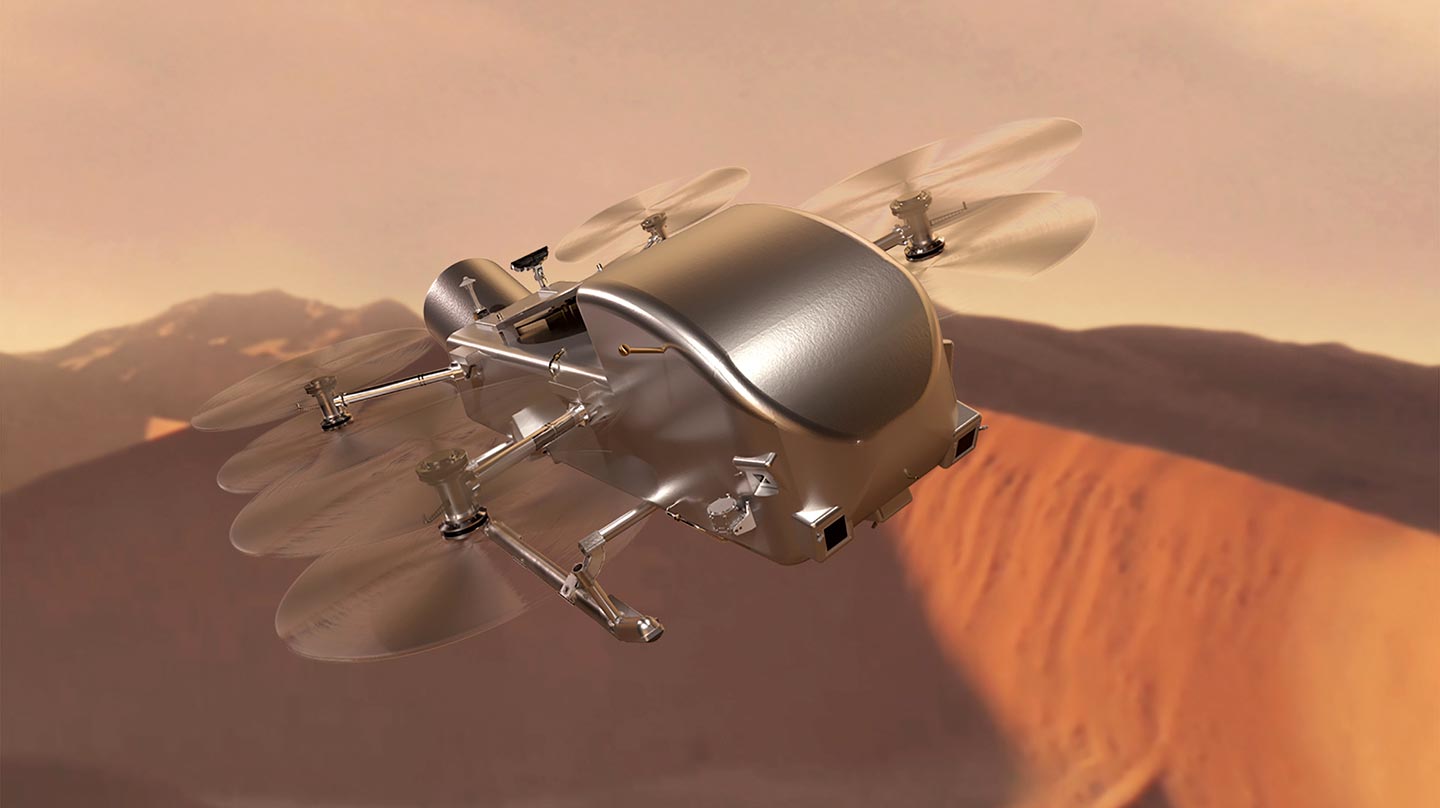
An artist’s impression of the Skyfall concept mission about to deploy its helicopters over Mars. Credit: AeroVironment – see below for details

Multi-planet star systems are of considerable interest to astronomers, as they offer opportunities for comparative study which might answer questions about the formation and development of solar systems like our own. They can also help astronomers better understand star system architectures in general, help us gain more understanding of the nature of other planetary systems and the potential for life elsewhere in the galaxy, and so on.

This is why the discovery of the seven planet TRAPPIST-1 system caused such interest in 2016 onwards (see here for more), together with the Kepler-90 system (see: Space update special: the 8-exoplanet system and AI). Now there is confirmation of a further candidate for intriguing study, the rather boringly-called L 98-59.

Located in the southern hemisphere sky, within the constellation of Volans, L 98-59 is some 34.6 light-years from our Sun. An M3 red dwarf star with around 0.3 solar masses, it measures approximately 0.31 solar radii. This week it was confirmed as being the home to a family of at least five planets. Three of these – L 98-59 b, c, and d were located by NASA’s Transiting Exoplanet Survey Satellite (TESS); then in 2021 a fourth non-transiting planet (i.e. one orbiting a star but which does not cross directly between the star and our solar system was located, with hints of a second potentially orbiting the star.

An artist’s impression of the five planets of L 98-59, seen from over the top of the outermost planet in the system. Credit: Benoit Gougeon, Université de Montréal

The fourth planet, labelled L 98-59 e was confirmed using the transit timings method and the ESO ESPRESSO system, with the fifth planet –L 98-59 f was finally confirmed this year, using the ESO HARPS system and the radical velocity method – which also suggested a sixth planet might be lurking in the system.

Given the size of their parent star, all of the planets occupy orbits very close to it. L 98-59 b orbits its parent every 2.25 terrestrial days and has an Earth-like density; but is only about 84% Earth’s mass and half its size. L 98-59 c is slightly larger than Earth, its radius being around 1.3 that of Earth, with approximately twice the mass; it orbits its star every 3.7 terrestrial days. The fourth planet, L 98-59 e is roughly the same size as L 98-59 c, but with 2.8 Earth masses and takes 12.8 terrestrial days to complete an orbit. All three of these worlds suggest they are rocky and potentially volcanic in nature, although they do not appear to have significant atmospheres.

Sitting between L 98-59 c and e, and orbiting its parent every 7.4 days, is L98-59 d, which is believed to be a hycean (water) world with around 30% of its total mass made up of water. Reports on its atmosphere vary, and it is around 1.6 Earth radii in size and has 1.6 Earth masses. The newly-confirmed planet, L 98-59 f, is in the optimistic habitable zone of the star. It has a minimum mass of about 2.80 Earth masses, about 1.4 Earth radii, and follows a 28 day orbit.

An artist’s impression of the sizes of the three planets located by NASA’s TESS orbiting L 98-59, compared to Mars and Earth.  Credit: NASA’s Goddard Space Flight Centre

One of the most interesting things about this system is that all the planets follow near circular orbits. This means they’re amenable to atmospheric spectroscopic studies by the JWST or other telescopes. Their comparative sizes also offer an opportunity to answer some key question, such as: what are super-Earths and sub-Neptunes made of? Do planets form differently around small stars? Can rocky planets around red dwarfs retain atmospheres over time? The fact that there appears to be both a hycean world and a world located within the star’s nominal habitable zone presents opportunities for studying potentially habitable worlds orbiting low-mass stars.

This latter aspect is of significance, as habitable environments within planets orbits low-mass stars like L 98-59 (and indeed, those around the likes of TRAPPIST-1) is highly contentious. Firstly, while they are long-lived and can enter into a stable maturity, red dwarf stars can also be subject to massive solar flares which, given how closely their planets orbit them, could easily rip away atmospheres make it that much harder for life to gain a toe-hold.

Additionally, because of their close proximity to their parent star, these planets are liable to be tidally locked, always keeping the same side pointing towards the star. This could play havoc with any atmosphere such a planet might have, the star super-heating the side facing it whilst the planet’s far side remains frigid and dark, potentially limited any habitable zone on the planet to the pole-to-pole terminator between the two sides of the world.

Joining a select group of relatively nearby planetary systems, L 98-59 is to become the focus of some intense study through the likes of the James Webb Space Telescope.

Skyfall: Dropping Helicopters on Mars?

Building on the success of the Ingenuity  helicopter delivered to Mars as a part of NASA’s Mars 2020 exploration programme (and covered extensively in these pages), Skyfall is a new mission concept being proposed by NASA’s Jet Propulsion Laboratory and their principal partner with Ingenuity, AeroVironment.

Were it to develop into a mission, Skyfall would see a total of six Ingenuity-class helicopter drones delivered to Mars and deployed in a manner indirectly drawing on the Skycrane system used to deliver the Mars Science Laboratory rover Curiosity and the Mars 2020 rover Perseverance to the surface of Mars.

An artist’s impression of one of Skyfall’s Ingenuity-class helicopter drones falling free of the aeroshell which help protect them on the trip to Mars and entry into the Martian atmosphere. Credit: AeroVironment

Skyfall would see the six helicopters carried to Mars within a protective aeroshell and heat shield. Once within the Martian atmosphere and descending under a parachute, the heat shield will be jettisoned and a “launch tower” extended below the aeroshell, allowing the helicopters to start their motors and fly clear of the aeroshell to start six individual but parallel missions.

By releasing the helicopters in the air, the mission avoids the need for a complex landing and deployment system, in theory reducing both mission complexity and cost – although there are obvious challenges involved in making aerial launches from under a descending platform.

The six drones would be enhanced versions of Ingenuity, charged with a variety of tasks including recording and transmitting high-resolution surface images back to Earth, using ground-penetrating radar to investigating what lies under the surface they overfly – such as potential pockets of water ice that could greatly assist future surface operations -, and identifying possible landing sites for future human missions to the Red Planet.

Like Ingenuity, the six drones would be capable of landing in order to use solar arrays to recharge their battery systems. However, exactly how far each vehicle will be able to fly between landings has not been defined, nor has their total mass, or the portion of that mass given over to science instruments and battery packs. If the concept progresses, these details will doubtless be defined and made public. As it is, AeroVironment has begun internal investments and coordination with NASA’s Jet Propulsion Laboratory to facilitate a potential 2028 launch of Skyfall.

NASA to Lose 3,900 Personnel and Gains a new Acting Administrator

For the last couple of weeks, rumours have been circulating that a large number of NASA personnel has applied to take the Trump administration’s “deferred resignation” offer, by which staff can go on paid administrative leave until such time as an actual departure date can be agreed.

The numbers had been put at somewhere between 3,500 and 4,000 personnel – many from senior management and leadership roles. Some of the rumours had been played down by the current temporary NASA senior administrator, but on July 25th, the date the offer of “deferred resignation” closed, NASA News Chief Cheryl Warner confirmed a total of around 3,900 personnel – 20% of the total workforce – have, or will be departing.

The figure might yet be subject to adjustment (up or down) as a post-offer analysis is carried out to ensure that those applying for deferred resignation do not impact the agency’s focus on safety and the Trump-demanded focus on sending humans to the Moon and Mars.

Sean Duffy, official portrait, 2025, via Wikipedia

At the same time as the rumours of the workforce cuts started circulating earlier in July, the Trump Administration further caught NASA off-guard by announcing that secretary of transportation Sean Duffy will be taking over as interim NASA Administrator until a permanent appointment can be made. The announcement came just days after Trump abruptly withdrew nominee Jared Isaacman from the running just ahead of his expected confirmation, allegedly as a result of Trump’s public spat with Elon Musk.

No-one at NASA headquarters was informed of the decision ahead of Trump’s social media announcement. It had been expected that existing acting administrator, Janet Petro, would remain in place until a suitable nominee was put forward in Isaacman’s stead. Whilst not a part of the Trump administration, Petro has tended to move in the direction the administration wants with regards to NASA – such as encouraging workforce reduction through early retirements, etc., – and had been regarded within the agency as a safe pair of hands.

A television presenter turned prosecutor turned politician, Duffy is primarily known as a vocal supporter of Donald Trump and his various policies, notably in the areas of decrying climate change, and diversity and equality in employment.

Some have attempted to paint his appointment positively, stating he could bring NASA the kind of direct access to the White House Petro lacks. However, others seen his appointment as a means of forcing through changes at NASA that are in line with Trump’s goals of reducing spending on science and R&D, and focusing only on human missions to the Moon and Mars.

Spain to the Rescue?

The Thirty Metre Telescope (TMT) has been in development since the early 2000s – and if it ever gets built, it will be the second largest optical / infrared telescope in the world, with an effective primary mirror diameter of 30 metres. Only the European-led Extremely Large Telescope – ELT – will be larger, with a primary mirror effectively 39 metres across.

A computer rendering of the Thirty Metre Telescope complex on Mauna Kea. Credit: TMT Corporation

Primarily a US-led project but with strong international involvement from Europe, Canada, Japan, India and even China, the TMT has been beset by problems. Most notably, these have involved protests over the proposed location for the observatory – on Mauna Kea, Hawaii, within the area designated the Mauna Kea Observatories Grounds, and home to 13 other astronomical facilities. However, Mauna Kea is also a sacred site and largely conservation land, and the telescope, coupled with all the environmental impact that it would bring, was seen as a step too far by many, and a battle has been waged back and forth for some 16 years, preventing any construction from proceeding.

In 2019, a proposal was made to have the TMT built in Las Palma in the Canary Islands. This was initially approved by the Spanish authorities, but has also been subject to objections. Some of these again relate to the environmental impact of such a massive construction project, but there are also astronomical objections as well; in particular, La Palma does not have the same elevation as Mauna Kea, meaning that high atmosphere water vapour could limit much of the telescope’s infrared operations (water vapour tends to absorb light in the mid-infrared spectrum).

Most recently, TMT has been under threat due to the Trump Administration’s cuts to the National Science Foundation’s budget (the NSF having the remit of oversee the construction and operation of the TMT), with the telescope directly singled-out for cancellation – and this despite the fact that China and India have agreed to meet the lion’s share of the estimated US $1 billion construction cost, and Canada offering to contribute US $24.3 million a year over ten years for the telescope’s operation.

Several observatories already located at La Palma’s Roque de los Muchachos Observatory. From left: Carlsberg Meridian Telescope; William Herschel Telescope (domed); Dutch Open Telescope; Mercator Telescope (silver dome, just visible); Swedish Solar Telescope (solid tower); Isaac Newton Telescope (domed, second from right); Jacobus Kapteyn Telescope (far right). Credit: Bob Tubbs

Now the government of Spain has stepped in, offering to commit US $471 million (400 million Euros) towards the telescope’s operating costs – if the US agrees to have the facility located on La Palma. It’s not clear how the US will respond to the offer – or what can be done over the possible limitations of TMT’s infrared mission. However, TMT is also seen as critical to providing very large optical telescope coverage of the whole sky, with the TMT covering northern skies and the Giant Magellan Telescope (GMT), based in Chile to cover the southern skies, with the two intended to work in collaboration and with Europe’s ELT (also in the southern hemisphere).

GMT has a significant advantage over TMT in that its location is not controversial, allowing construction to go ahead to a point where the National Science Foundation has given the Trump administration a guarantee the project can be completed to reach operational status without the need for additional funding in 2026. Thus there have been no calls for its cancellation.

Space Sunday: interstellar visitors and updates

Interstellar comet 3I/ATLAS seen moving against a backdrop of stars in a series of images captured by the 8.2-metre Very Large Telescope at Cerro Paranal on the night of July 4th, 2025. Credit: ESO Science Archive.

The solar system is welcoming its third (known at least – we have no idea how many may have passed through the solar system undetected down the ages) interstellar visitor. 3I/ATLAS, also known as C/2025 N1 (ATLAS), was identified on July 1st, 2025 as an interstellar comet. It is the third such object positively identified as having interstellar origins to pass through the solar system in the last eight years, the others being 1I/ʻOumuamua (discovered in October 2017) and 2I/Borisov (discovered in August 2019).

At the time of its discovery, 3I/ATLAS was some 4.5 AU (670 million km) from the Sun and moving at a relative speed of 61 km/s (38 m/s). It’s exact size is unknown, as it is behaving as an active comet and so is surrounded by a cloud of reflective gas and vapour. However, estimates put it to be somewhere between around 1 km and 24 km across – with its size likely to be at the lower end of this scale.

The object was located by the NASA-funded ATLAS survey telescope at Río Hurtado, Chile, and will reach perihelion in October 2025, when it will pass around the Sun at a distance of 1.3 AU. Following its initial discovery as a object moving through the inner solar system, there were concerns it would come close to Earth – and it was even designated a Near-Earth Object (NEO). However, checks back through the records of other observatories which may have spotted the object – such as the Zwicky Transient Facility – indicated 3I/ATLAS had been observed in mid-June 2025. These observations and those made by ATLAS confirmed the object to be of interstellar origin and on a hyperbolic path through the solar system that would not bring it close to Earth.

An animation of the hyperbolic trajectory of 3I/ATLAS (blue) through the Solar System, with orbits of planets shown. Credit: Catalina Sky Survey.

More recently, studies of the object’s track suggest that Comet 3I/ATLAS may pre-date the formation of our solar system by over three billion years, and that it appears to hail from the outer thick disk of the Milky Way, rather than the inner disk where stars like our Sun typically reside. The thick disk is where the majority of the Milky Way’s oldest stars tend to reside, and it is likely 3I/ATLAS originate in one of these ancient star systems.

Given spectrographic analysis of the object is rich in water ice, making it the oldest and most unique of our three known interstellar visitors to date. This water ice means that the comet is likely to become more active and reveal more about itself as it approaches and passes around the Sun and becomes more active. Observations will be curtailed as it passes around the Sun relative to Earth, but then resume as 3I/ATLAS starts its long journey back out of the solar system and back to interstellar space.

New Glenn to Launch EscaPADE on Second Flight

Blue Origin has confirmed that the second flight of its massive New Glenn launch vehicle will be to launch NASA’s Escape and Plasma Acceleration and Dynamics Explorer (EscaPADE) mission to Mars and the launch is scheduled for mid-to-late August 2025.

This mission had actually be scheduled to fly aboard New Glenn’s inaugural launch in late 2024; however, NASA withdrew it from the launch manifest in September 2024 when it became clear Blue Origin would be unlikely to meet the necessary launch window for the mission, so as to avoid the expense (and complications) of loading the necessary propellants aboard the EscaPADE vehicles and then having to off-load them again.

Since then, it has been unclear when the EscaPADE mission would launch – or on what vehicle. Speculation had been that the second launch of New Glenn – originally (and provisionally) scheduled for spring 2025 – could be used to send the mission on its way; However, this was not confirmed by either NASA or Blue Origin until the latter issued as formal confirmation on July 17th announcement.

The twin EscaPADE spacecraft in a clean room at Rocket Lab, the company responsible for building them on behalf of NASA, prior to being shipped to Kennedy Space Centre. Credit: Rocket Lab

EscaPADE is a pair of small satellites called Blue and Gold led by UC Berkeley’s Space Sciences Laboratory, with the two craft built by Rocket Lab Inc., and financed under NASA’s Small Innovative Missions for Planetary Exploration (SIMPLEx) programme. The mission has three primary mission goals:

  • Understand the processes controlling the structure of Mars’ hybrid magnetosphere and how it guides ion flows
  • Understand how energy and momentum are transported from the solar wind through Mars’ magnetosphere
  • Understand the processes controlling the flow of energy and matter into and out of the collisional atmosphere.

Each of the two satellites carries the same three science experiments to achieve these goals. Due to the relative positions of Earth and Mars at the time of launch, the craft will not be able to enter into a direct transfer orbit. Instead, they will initially target the Earth-Sun Lagrange 2 position (located on the opposite side of Earth’s orbit around the Sun relative to the latter), where they will loiter for several months carrying out solar weather observations. As a suitable transfer orbit from the L2 position opens, so the satellites will continue their journey, with a total transit time from Earth to Mars of around 24 months.

Annotated illustration of an EscaPADE satellite. Credit: NASA Scientific Visualization Studio

On initial arrival around Mars, Blue and Gold will enter a highly elliptical orbit that will be gradually lowered and circularised over a 6-month period, after which the science mission proper will begin. Both vehicles will then occupy the same nominal orbit whilst maintaining a good separation. After this, Blue will lower its apoapsis to 7,000 km and Gold will increase its own to 10,000 km, allowing simultaneous measurements of distant parts of the Mars magnetosphere for a period of some 5 months, after which the primary mission is due to end.

As well as EscaPADE, the New Glenn NG-2 launch will also fly a technology demonstration for commercial satellite company Viasat in support of NASA Space Operations Mission Directorate’s Communications Services Project, with the mission serving as the formal second certification flight to clear New Glenn to fly US national security missions. As with the first flight of the vehicle, Blue Origin will attempt to have the first stage of the booster for landing on the company’s floating landing platform Jacklyn.

AX-4 Crew Return to Earth

In my previous Space Sunday, I wrote about the Axiom Ax-4 private mission to the International Space Station (ISS). Well, two weeks have passed and the 4-person crew is back on Earth. The mission had been scheduled for a minimum of 14 days and – as I’ve reported – the mission was subjected to a series of delays prior to launch.

As such, it was perhaps somewhat fitting the crew’s return was slightly delayed, with Grace, their SpaceX Crew Dragon, departing the space station at 11:15 UTC on July 14th, to commence a gentle return to Earth over a period of almost 24 hours, splashing down off the coast of California on July 15th.

The slow return was in part to allow a Pacific splash-down, avoiding the need for the Crew Dragon to re-enter the atmosphere over the US mainland, as would be required were the vehicle to make a splash-down in the Atlantic, as has been the case with the majority of past Crew Dragon missions. The reason for this is that there have been several occasions where pieces of a Dragon “Trunk”- the service module – surviving re-entry into the atmosphere to come down close to – or within – populated areas.

An infra-red image made from video provided by SpaceX, showing the bright white dot of Crew Dragon Grace dissipating the heat of re-entry and suspended below four good main parachutes, shortly before splash-down off of the coast of California by the Axiom Ax-4 mission very early in the morning (PST) on Tuesday, July 15th, 2025. Credit: SpaceX

In all the international crew spent two and a half weeks on the ISS carrying out some 60 experiments and technology demonstrations which involving 31 different nations, and also carried out a series of public outreach events. The mission went a long way towards increasing Axiom’s experience in on-orbit operations ahead of plans for the company to start operating its own station as the ISS reaches its end-of-life.

This mission marked the first time in space for the three male members of the crew – Shubhanshu “Shux” Shukla from India; Tibor Kapu, a member of HUNOR, Hungary’s orbital astronaut programme which operates independently of Hungary’s involvement with the European Space Agency (ESA); and Sławosz “Suave” Uznański-Wiśniewski, from Poland, who is an ESA astronaut. It also marked mission Commander Peggy Whitson, a former NASA astronaut and now Axiom’s director of human spaceflight, extending her record for cumulative days spent by an American in space to 69 days across five missions.

Starliner Flight: 2026, and No Crew

As Boeing and NASA continue to work on the problems affecting the former’s CST-100 Starliner crew vehicle, the US space agency has indicated that, despites hope to slot a possible re-flight for Starliner into 2025, the next mission will almost certainly not come before 2026 – and is likely to be uncrewed.

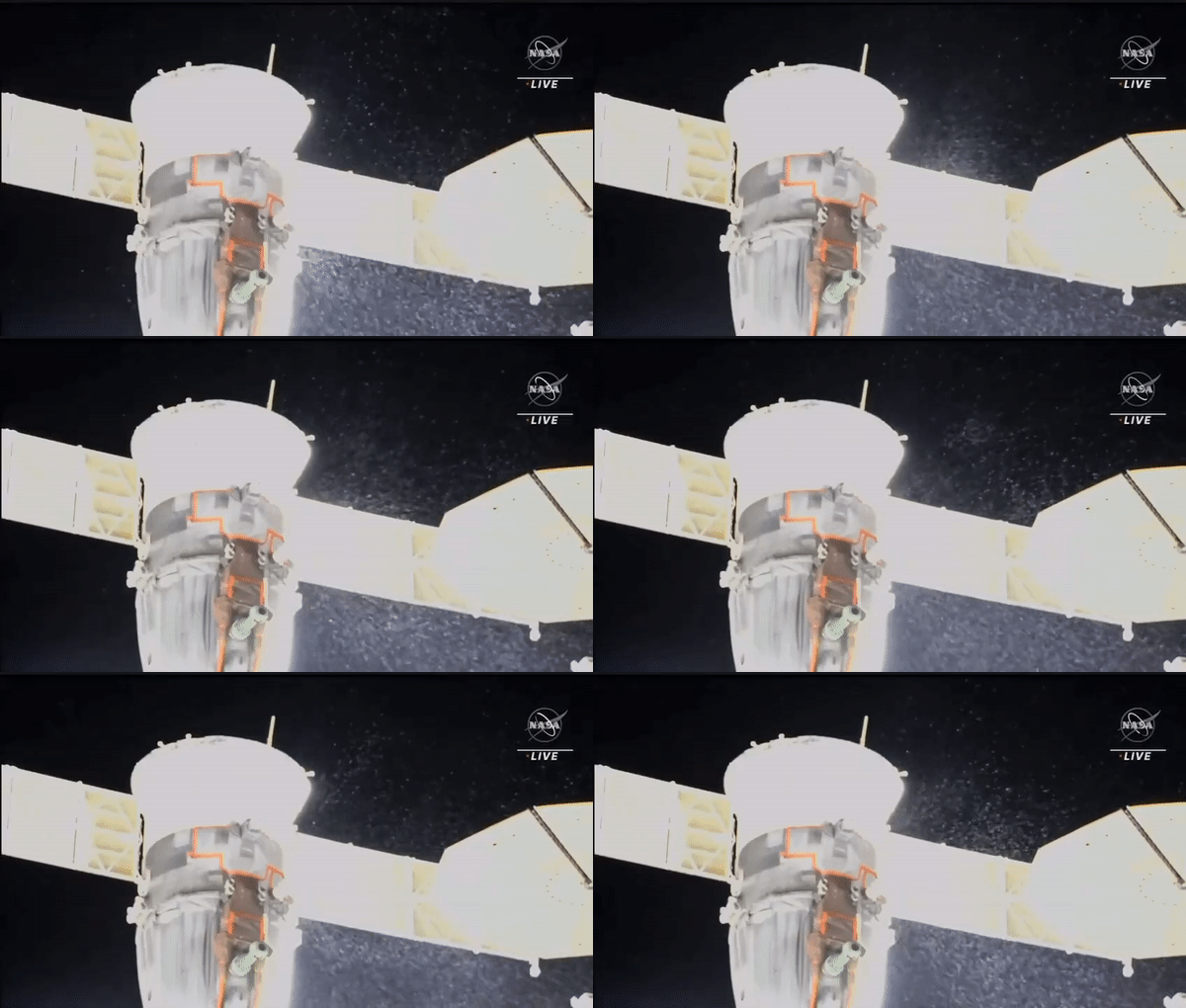
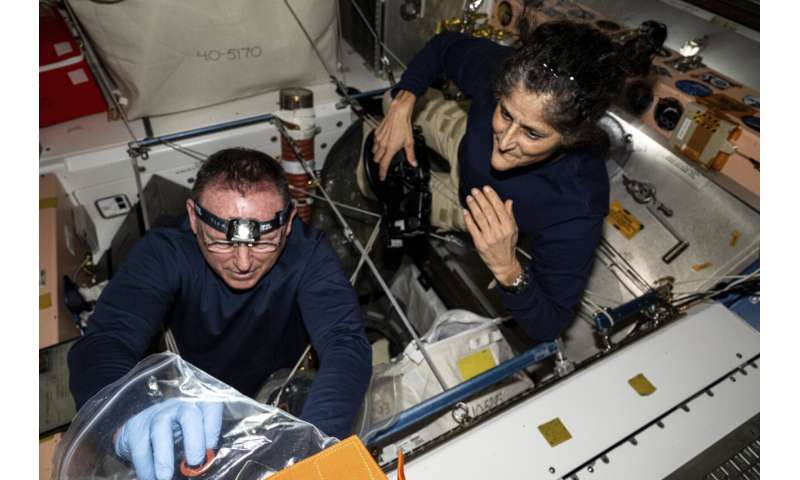
Starliner’s last mission was the first to fly with a crew aboard, after two previous uncrewed test flights. However, despite the overall success of that first crewed flight, the Starliner vehicle had a series of issues with its thrusters systems which, whilst not critical, caused NASA to opt to instruct Boeing to return the vehicle – comprising the capsule Calypso and its service module (which mounted the problematic thrusters systems) – under automated means; leading to the inevitable (and largely inaccurate) claims that the crew – Barry “Butch” Wilmore and Sunita “Suni” Williams – were “stranded” in space and in need of “rescue”.
The core issue with the vehicle’s thrusters has been identified as a design flaw with seals within the vehicle’s fuel lines and helium purge systems, which NASA and Boeing are now working to resolve. Part of the problem here is related to the fact that the vehicle’s multiple thrusters are grouped into four close-knit sets set equidistantly around the circumference of the vehicle’s service module, in what are called “doghouses”. These units experienced unexpected temperature spikes during the 2024 Crewed Flight Test, exacerbating the issues with the seals on the thrusters failing / causing valves to stick.

A CST-100 Starliner service module showing one of the four problematic thruster assembles (bordered by blue stripes) without its “doghouse” cover. Credit: Boeing.

The doghouse system has already seen a number of improvements since the Crew Flight Test, and the focus is now on developing seals in the thruster system valves so they can better hand the stresses and remaining heat issues. This work means that no Starliner vehicle will be ready for a 2025 launch. Further, such is the schedule for 2026 ISS missions that slotting a crewed test of Starliner in that year is liable to be difficult. NASA are therefore looking to conduct a further uncrewed flight – but rather than it be merely a flight test, the plan is to have the vehicle fly cargo to the ISS, making it an “operational” mission.

Space Sunday: Axiom Ax-4 and Vera C. Rubin

The SpaceX Dragon Grace, carrying the Axiom Mission 4 (Ax-4) crew, approaches the International Space Station with it nose cone open to expose the docking mechanism within. At the time of this shot, both spacecraft were orbiting 421 km above the coast of southern Madagascar. Credit: NASA

After delays and concerns over pressure leaks within the Russian section of the International Space Station (ISS) – see Space Sunday: frustrations and extensions and Space Sunday: Rockets, updates and Planet Nine – the Axiom Ax-4 private mission to the station finally lifted-off from Kennedy Space Centre on June 25th, carrying an international crew of four to the station.

The SpaceX Falcon Nine booster lifted-off from Launch Complex 39A at 06:31:52 UTC, carrying mission commander Peggy Whitson, a highly-experienced former NASA astronaut and now Axiom’s Director of Human Space Flight; India Space Research Organisation’s (ISRO) astronaut Shubhanshu Shukla, filling the role of mission pilot; and mission specialists Sławosz Uznański-Wiśniewski, a European Space Agency project astronaut from Poland, and Tibor Kapu representing the Hungarian Space Office.

The fifth (and final) Crew Dragon vehicle – to be named Grace by the Ax-4 crew – atop its flacon 9 booster as both are raised to a vertical position at Launch complex 39-A, Kennedy Space Centre. Credit: SpaceX

The four were flying aboard the newest Crew Dragon vehicle built by SpaceX, which the crew christened Grace following a flawless launch and ascent to orbit.

We had an incredible ride uphill and now we’d like to set our course for the International Space Station aboard the newest member of the Dragon fleet, our spacecraft named ‘Grace’.
“Grace” is more than a name. It reflects the elegance with which we move through space against the backdrop of Earth. It speaks to the refinement of our mission, the harmony of science and spirit and the unmerited favour we carry with humility. Grace reminds us that spaceflight is not just a seed of engineering, but an act of good work for the benefit of every human everywhere.

– Peggy Whitson, AX-4 Crew commander

Following launch and separation from the Falcon 9 upper stage, Grace preceded on a “slow” orbital trajectory to “chase” the ISS, rendezvousing with the station some 24 hours after launch. This allowed the crew to check-out the vehicle and perform the first of their broadcasts to Earth. Docking with the ISS took place on June 26th, at 10:31 UTC, to mark the start of a say that is designed to last at least 14 days, but could extend to up to 21 days.

The Axiom Mission 4 (Ax-4) crew (in the blue jumpsuits) and the ISS Expedition 73 in a group portrait within the Harmony module of the ISS. Form left to right: back row – cosmonauts Alexey Zubritskiy, Kirill Peskov, Sergey Ryzhikov and NASA astronauts Jonny Kim and Nichole Ayers; front row: Ax-4 crew Tibor Kapu, Peggy Whitson, Shubhanshu Shukla, and Sławosz Uznański-Wiśniewski, with Anne McClain (NASA) and Takuya Onishi (JAXA). Credit: NASA

Also aboard the flight are a number of science experiments, notably from Poland and India, further emphasising the international focus of the mission. The flight is especially significant for Shukla; he is the first Indian to fly into space as a part of India’s newly-instigated astronaut corps (although not the first Indian national to fly in space), and has already been selected to fly in the first crewed mission aboard India’s home-grown Gaganyaan space capsule. His time aboard Ax-4 is very much seen as preparing him for that mission. For Axiom and NASA, Ax-4, is intended to signify a desire to maintain on-orbit operations aboard space stations as an international endeavour as the ISS researches its end-of-life in 2030, and facilities such as Axiom’s own space station take over from it.

Ax-4 also carries aboard it some special treats for everyone on the ISS: Shukla and Kapu have taken along specifically-developed national dishes and treats such as moong dal halwa, carrot halwa and mango nectar, together with a specially-formulated version of Hungarian chocolate and a range of Hungarian spices to help pep-up the taste of food on the ISS. Uznański-Wiśniewski, meanwhile worked with ESA, NASA and Polish chef and restaurateur Mateusz Gessler to develop an entire menu for the Ax-4 crew which includes pierogi, tomato soup with noodles, Polish ‘leczo’ stew with buckwheat, and apple crumble for dessert.

Nor is carrying such foods simply a matter of catering to personal whims; food can have a positive psychological impact – particularly comfort foods that bring with them memories of home and which offer a departure from the more usual offerings. As such, experiments like this can help nutritionists and psychologists bring more and better varieties of meals and foods to crews on long-duration missions, bolstering their sense of well-being and comfort.

Vera C. Rubin Opens its Eyes

Located on the El Peñón peak of Cerro Pachón, a 2,682-meter-high mountain in northern Chile is the world’s biggest digital camera, a 3.2 gigapixel charge-coupled device. It sits at the heart of the Vera C. Rubin Observatory, a major new astronomy facility capable of imaging the entire southern sky every few nights.

Originally called the Large Synoptic Survey Telescope (LSST), where synoptic describes observations that give a broad view of a subject, the observatory was first proposed in 2001, with work on the 8.4-metre primary mirror starting on 2007 with the aid of private funding.

The Vera C. Rubin Observatory imaged in 2022 during the final construction phase, seen against the backdrop of the Milky Way galaxy. The latter appears to be split in two by a dark path called the Great Rift. This is actually a shroud of dust sitting between Earth and out view of the centre of our galaxy, preventing the light of the stars beyond it breaking through as it scatters visible light. Credit: Rubin Observatory/NSF/AURA/B. Quint

In 2010, the observatory became the top-rated large ground-based project in the 2010 Astrophysics Decadal Survey, moving to be funded through and overseen by the US National Science Foundation (NSF), with the actual funding provided by the US Department of Energy and the non-profit international LSST Discovery Alliance.

Overall construction of the physical observatory commenced in 2015, with initial testing of the on-sky observational capabilities taking place in late 2024 utilising an engineering test camera, with the First Light images captured with the observatory’s Simonyi Survey Telescope and the 3.2 gigapixel camera taken on June 23rd, 2025.

The primary aim of the observatory is designed to build a continuous survey of the southern sky over 10-years in an attempt to answer a number of questions, including:

  • How did the Milky Way galaxy form?
  • What is 95% of the Universe made of?
  • What will a full inventory of Solar System objects reveal?
  • What will we learn from watching millions of changes in the night sky over 10 years?
Combining 678 separate images taken by the Vera C. Rubin Observatory in just over seven hours during its First Light test, this mosaic shows a region of space in the southern skies in which two nebula – the Lagoon Nebula (Messier 8), 4000 light-years away and shown in a vibrant pink colour, and the Trifid Nebula (Messier 10), some 5,000 light years away and also pink-looking – can be seen. Labelled are various stars and galaxies which lie in, before or beyond the Nebulae. The Lagoon Nebula is a stellar nursery, and is brightly illuminated by a cluster of young, massive stars within it, their illumination allowing it to be just visible with even a modest telescope. Click for full size. Credit: Rubin Observatory/NSF/AURA

To answer these questions the observatory will carry out science in four principal areas:

  1. Understanding the nature of dark matter and dark energy.
  2. Creating an inventory of the Solar System.
  3. Mapping the Milky Way.
  4. Exploring objects that change position or brightness over time.

The telescope’s wide field of view is extraordinary – 3.5 degrees in diameter, or 9.6 square degrees. Combined with the telescope’s large aperture (light-collecting ability), the telescope’s optics have an imaging capability three times that of the largest-view telescopes currently in use. This means the observatory can “see” literally everything – from the smallest sources of reflected light in our own solar system to remote deep-space objects.

A rendering of Vera C. Rubin’s Simonyi Survey Telescope (in the centre of the ring structure) and its mounting frame. Credit: Rubin Observatory project office.

To achieve this, the Simonyi Survey Telescope’s 8.4 metre diameter primary mirror is supported by a 3.2-metre diameter secondary mirror, and a tertiary 5-metre mirror, the world’s largest convex mirror. Both the primary and tertiary mirrors were designed to be placed together to make the telescope very compact and easier to re-orient, which it must do quickly and efficiently each night.

Further, it allows the placement of three additional corrective mirrors to reduce image aberrations without over-complicating the optical train. This in turn allows the telescope to avoid the usual adjustable optical mechanisms required to counter atmospheric image dispersion as a telescope is repointed and encounters different atmospheric conditions. This is particularly important as the Vera Rubin must be able to bet re-point and be ready to take an image within 5 seconds after the previous image capture has been confirmed – leaving no time for the usual atmospheric adjustments.

First light with a telescope refers to the first time a telescope and its instruments capture one of more astronomical images after its construction. This moment is significant for astronomers and engineers as it is an important step towards fully calibrating a telescope and correcting potential issues within the optics so that it is ready to start formal operations.

Made from over 1100 images captured by the Vera C. Rubin Observatory during its 10-hour First Light test, this mosaic contains an immense variety of objects, including some 10 million other galaxies, demonstrating the broad range of science Rubin will transform with its 10-year Legacy Survey of Space and Time. Annotated within it are a number of galaxies and brighter stars. Click the image for full size. Credit: Rubin Observatory/NSF/AURA

For the Vera C. Rubin observatory, First Light tests produced images revealing over 10 million galaxies and led to the discovery over 2,000 new asteroids. Once operational, the observatory will be capable to capture more information about the universe than all the optical telescopes used throughout history thus far, combined. Its image gathering capability means it will be generate 20 terabytes of image data per night. This data will be collected and transmitted to a series of “data brokers” around the world, ensuring that the data is not only secured across multiple redundant sites, but allows the brokers to serve the information and alerts to astronomers and research centres globally.

To assist in making sure astronomers and institutions can access the data and images they are interested in, the cloud-based data brokers are supported by a dedicated system called Data Butler. This holds all the relevant metadata for every image captured by the observatory, allowing astronomers with access to it to query it using astronomical terms – object type, time scale of observations, object co-ordinates, etc., and receive the images they need.

Vera Florence Cooper Rubin, 1828-2016. Credit: Mark Godfrey

The alert system allows the system to identify “transients”, unexpected events which could require an immediate response by astronomers: things like supernovas, kilonovas that produce gravitational waves, novas, flare stars, eclipsing binaries, magnetar outbursts, asteroids and comets moving across the sky, quasars, and so on.

Once operational it is expected that the observatory will issue up to 10 million such alerts per night, all of which will be parsed through the Data Brokers, allowing the system to analyse them and determine what should be immediately passed on to astronomers for further / detailed investigation.

In all, the Vera C. Rubin Observatory – named for Vera Florence Cooper Rubin, the American astronomer who pioneered research into galaxy rotation rates which is seen as evidence for the existence of dark matter – is set to revolutionise our visual understanding of the universe, our galaxy and our own solar system. However, there is a cloud on the horizon.

As it moves towards entering service, the observatory’s major source of funding, the National Science Foundation, is facing significant budget cuts and uncertainty about its future operation allocation.

Under the Trump Administration’s budget, NSF is set to have its budget cut by 56%, from US$8.83 billion under the Biden Administration to just US $3.9 billion. Already, the Trump administration has frozen or terminated 1,600 NSF grants. While on the day following Vera C. Rubin’s First Light test, 1,800 NSF staff were informed the administration intends to remove them from their current headquarters building as a part of “government efficiency”. Ironically, NSF only moved into the building under the first Trump administration. Worse, no word has been given as to where NSF staff are to be relocated. As a result, the attempt to displace the NSF is meeting strong resistance from both Capitol Hill and the American Federation of Government Employees (AFGE).

The particular concern for the Vera C. Rubin observatory is that if the Trump budget passes as is, the NSF’s Mathematical and Physical Sciences Directorate, which is responsible for funding astronomical activities under the NSF’s remit, will only have an operation budget of US $500 million. This means that optical and radio centres  such as Kitt Peak, and Cerro Tololo Inter-American Observatory some 10 km from Vera C. Rubin, are to be “phased out” of the NSF’s budget, with the hope their operations can be transferred to “other organisations”. Similarly, the Nobel Physics Prize winning Laser Interferometer Gravitational Wave Observatory (LIGO), is to have its budget reduced by 40%, resulting in the closure of one of its two facilities, reducing its effectiveness enormously.

In response to concerns the Trump Administration emphasises “support” for the observatory, noting its 2025/26 budget allocation is increased from US $17.7 million to US $32 million over 2024/25. However, the former budget amount was for the final development phase of the project, not operations, and the US$32 million promised to the observatory is some 20% less than had been requested in order for it to start observational operations.

These concerns aside, the First Light images from Vera C. Rubin are astonishing – and one hopes the observatory will be funded to a point where it can complete its initial 10-year mission.

Space Sunday: Rockets, updates and Planet Nine

Honda’s 6.3 m tall experimental reusable rocket stage, with legs deployed, readies to land after an ascent to just under 300 metres in its first flight. Credit: Honda R&D Co., Ltd

Honda is known for many things: cars, motorcycles, engines, power tools robots, bicycles, aircraft, rocket motors – and now reusable rockets.

The company only formally announced its interest in entering the world of reusable launch systems in 2021, and since then things have been a little quiet. Well, up until this past week, that is; on Tuesday 17 June 2025, Honda’s research and development arm, Honda R&D Co., Ltd., announced the successful launch and landing of its first experimental reusable rocket.

The announcement appeared to come out of left-field for many in the space media – with the success, inevitably, being contrasted to that of SpaceX, a company with more than 20 years in the business, and not to Honda’s advantage; something that’s a little unfair given the head-start SpaceX has – and possibly unwise, given Honda’s abilities.

Honda’s experimental reusable rocket stage being prepped for launch. Credit:Honda R&D Co., Ltd

The vehicle, measuring 6.3m tall and 85 cm in diameter and with an all-up launch mass of 1.3 tonnes, was launched out of Honda’s facility in Taiki, Hokkaido. It rose to an altitude of 271.4 metres, before making a controlled descent to land just 37 centimetres from its target. It is the first step towards a stated goal for Honda to make a full sub-orbital launch by 2029. The launch was intended to carry out a range of aerodynamic tests and gather data, and Honda defined it as being a complete success.

Honda’s involvement in developing a launch vehicle is part of the overall goal of the Japanese government to double its space industry’s turnover to US $55.20 billion per annum by 2030.This will be through a combination of government-driven space activities managed by JAXA, the Japan Aerospace Exploration Agency, and subsidising private endeavours, including launch and satellite systems. However, while its is a goal Honda seemingly intends to support, the company is the first to admit that at this point in time, it has no clear goals for commercialising its reusable launch system once fully developed.

Even so, the company has the size and power to achieve a lot, and potentially become a major player in the commercial launch business.

The Search for Planet Nine – New Evidence?

I’ve written about the search of “Planet Nine” on numerous occasions as evidence for and against its existence have bounced back and forth down the years, but now a new study has identified possible candidates which might prove its existence.

As a quick recap: were it to exist, Planet Nine would be roughly 5–10 times the mass of Earth, orbiting somewhere between 400–800 times farther from the Sun. The problem here is that whilst it may well be big, it is so far away from the Sun that it will reflect very little sunlight, making it hard to detect via conventional means.

Because of this, theories as to the planet’s possible orbit and location have to a large part depended on mathematical models and some degree of assumption based on the orbits of clusters of large Kuiper Belt Objects.

An artist’s impression of Planet Nine with the Milky Way as a backdrop, as the planet orbits the distant Sun. The oval around the Sun represents the orbit of Neptune. Credit: Tom Ruen, background from ESO

Now, a team led by Amos Chen from the National Tsing Hua University, Taiwan, have taken a step in a different direction in and attempt to locate a potential Planet Nine – one that perhaps seems so obvious, it might seem surprising no-one has tried it before: looking for the thermal footprint of the planet, rather than any optical evidence.

To explain: all objects in space tend to give off heat – particularly planets. But here’s the thing: when you double the distance from the sun, reflected light becomes 16 times fainter (following what scientists call an inverse fourth-power relationship); however, its thermal radiation signature only diminishes by a factor of four. Thus, whilst still faint, the thermal signature of a planet a long way away should be easier to detect then by searching for it visually.

With this in mind, Chen and his team took the most common computer models that suggest where Planet Nine might reside in the night sky and then turned to the data gathered on that portion of the sky by the Japanese ASTRO-F AKARI space telescope during its operational period to see if they could find something unusual.

Launched in 2006 into an Earth-Sun synchronous orbit, AKARI (“Light”) carried out one of the most sensitive whole sky surveys in the mid- and far-infrared. As such it generated a wealth of data much of which was recorded multiple times for the same areas of the sky.

An artist’s illustration of JAXA’s infrared astronomy satellite ASTRO-F AKARI. Credit: JAXA

This is important because Planet Nine is so very far from the Sun, it will not appear to move over spans of days, making it exceptionally hard to differentiate from the background of stars and galaxies and gas and dust clouds. However, over a course of months, it will be seen to move, so by comparing images gathered by AKARI at different times of the year, the team were able to examine the specific area of sky the models suggest Planet Nine might be found, longing for signs of something moving in a manner predicted by the computer models, and with the kind of thermal signature something the size of Planet Nine would most likely have.

They discovered two possible candidates which met the criteria. This doesn’t mean that one of them might turn out to be Planet Nine; as the team notes, there is potential  for Planet Nine to be there in the form of one of the candidates, but much more work in observing both to determine what they might actually be.

There is a further complication in this: the computer modelling used by the team is based on the orbits of a number of Kuiper Belt objects which are both extreme, but also quite closely packed. This has led to the hypothesis that they have been “shepherded” into their close-knit groups by the influence of Planet Nine’s own gravity, and therefore, they can be used to define the likely arc of the planet’s orbit.

The problem here is, again as I’ve recently written about, there is a growing number of other Kuiper Belt objects which exist within their own extreme orbits well apart of the clusters. If there was a large body out beyond them, then realistically, it should have affected and shaped their orbits as well, coaxing them into similar orbits to the identified groups. Thus, there is a lot more work to be done before it can be definitively started that the solar system once more has nine planets orbiting the Sun.

In Brief

Axiom Ax-4 Mission

As noted in my previous Space Sunday, the planned fourth mission by Axiom Space to send 4 people to the International Space Station has been plagued by problems in actually getting off the ground. None of the issues have been Axiom’s fault, but a combination of weather than technical issues.

In that piece, I noted that the most recent technical issue was that of pressure leaks within the “vestibule” tunnel at the aft end of the Zvevzda module. Whilst not a new problem for the module, the losses had until recently been relatively under control before spiking again ahead of the launch.

The Axiom AX-4 crew: From left to right: mission specialist Sławosz Uznański-Wiśniewski; commander Peggy Whitson; pilot Shubhanshu Shukla, and mission specialist Tibor Kapu. Credit: Axiom

As a result, NASA held the launch, pending further checks and remedial action by the cosmonauts on the ISS (who, under the management of Roscosmos, are entirely responsible for the status of the Russian section of the ISS). The hold meant the launch would not take place before June 19th, 2025.

However, this target was then moved to June 22nd, as the pressure leaks continued, despite assurances from Roscosmos. Therefore, the decision was taken on June 19th, to scrub the June 22nd launch attempt. At the time of writing, a new target launch date had not been released.

Starship Explodes on the Test Stand

On 04:00 UTC on Thursday, June 19th, a SpaceX Starship exploded whilst on the test stand at the company’s Boca Chica, Texas facilities.

The 52-metre tall vehicle, intended to form the upper stage of the company’s massive heavy-lift launch system, was being prepared for the next attempt to complete a test flight from end-to-end with all objectives successful met.

Part of these tests involve static fire tests of the motors on both the booster and the Starship upper stage. The vehicle in question had already completed a test of one of its motors and the explosion occurred during preparation for a test of all six engines. These tests take place at a sub-facility within the SpaceX Starbase facilities referred to as Massey’s Test Facility, well removed from the main launch / recovery facilities.

No-one was injured in the explosion, although the vehicle was utterly destroyed. Early indications from SpaceX are that the fault lay with one of the vehicle’s composite overwrapped pressure vessels (COPV). These are pressure-containing units typically used in spaceflight due to their high strength and low weight.

The explosion of the Starship at the Massey Test Facility, Starbase City, Boca Chica, June 19th, UTC

The COPV in question was holding pressurised nitrogen in its gaseous state, when it ruptured. There are multiple COPVs within the Starship payload bay, and significantly, they are located close together and have propellant feed lines running between them to serve the vehicle’s header tanks up in its nose – the tanks that are intended to provide propellants to the vehicle’s motors during atmospheric descent and capture manoeuvres.

The running theory is that the rupture of one COPV may have over-pressured the vehicle hull and compromised others COPV units and the header tanks propellant feeds, and compromised the main propellants tanks, bringing the 10% load of liquid methane the vehicle had aboard at the time of the explosion and the almost full load of liquid oxygen the vehicle had into contract with a source of ignition.

Interestingly, a whistleblower had in May raised concerns about a lack of professionalism at the Starbase site relating to how crews charged with assembling vehicles there treated the COPVs with a lack of respect, although it is far too earlier to say if his statements reflect ate actual state-of-play and if so, whether such poor handling was a factor in the explosion.

 What is clear is that there was significant damage done to the Massey Test Facility itself, notably to the infrastructure required to feed propellants to Starship vehicles undergoing testing there – the facility now being the only facility where such pre-flight testing of Starship vehicles can occur. As such it is likely to be some time before there are any further attempts to launch Starship / Super Heavy test articles.

China Completes Anticipated On-Orbit Rendezvous

As previewed in my previous Space Sunday update, China has completed an on-orbit rendezvous between two remote vehicles operating in geostationary orbit.

As noted in that article, China is developing the means to carry out high-orbit rendezvous capabilities, with the intention of developing a means of extending the operational life of their various satellites. Both Shijian-21, launched in 2021, and Shijian-25, launches earlier this year, have been moving towards you another since the start of the month. Initially, Shijian-25 manoeuvred towards Shijian-21, the latter having been in a parking orbit for a number of years after a busy early life, which included hauling a defunct communications satellite to a graveyard orbit.

An initial rendezvous between the two had been expected sometime after June 12th, but at the time of my last article, it wasn’t clear if it had actually taken place. However, it appears that both vehicles made contact on both June 13th and June 14th, or at least came very close to making contact. The aim of Shijian-25 is to provide a refuelling capability for satellites, which Shijian-21 is liable to require given its very active early on-orbit career. Success, if not already achieved, would and put China on an even footing with the United States in terms of on-orbit capabilities.

Space Sunday: frustrations and extensions

The (currently unnamed) Crew Dragon vehicle – the latest in the fleet – sitting atop its Falcon 9 booster awaiting an opportunity to launch to the ISS with the Axiom Ax-4 crew, a full Moon rising behind it. Credit: SpaceX

Axiom Space, one of the leading contenders to take over low-Earth orbit space station operations for the United States once the International Space Station (ISS) ends its career, has been encountering frustrations as it tries to get its fourth crew to the ISS.

Axiom Mission 4 (Ax‑4), comprising a four-person crew, had originally been scheduled to lift-off on a 2-3 week mission to the ISS in early spring, using the Crew Dragon Endurance. That launch target was pushed back when SpaceX admitted they would not have their newest Crew Dragon ready for the planned launch of the Crew 10/Expedition 72  mission to the ISS – the so-called “rescue” mission (which it wasn’t) for astronauts Barry Wilmore and Sunita Williams.

Because of this, result Endurance had to be swapped into the Crew 10 mission to avoid the latter slipping (ironic, given the SpaceX CEO was at the time screaming that President Biden was responsible for no “rescue” having been launched). With the two Crew Dragon vehicles swapped, May was targeted for Ax-4, utilising the new Crew Dragon vehicle. That date was pushed back to June 8th, when it was realised final check-outs of the new vehicle weren’t going to be completed on time – only for the weather to intervene, it being too poor over the recovery area on the 8th to enable a safe recovery of the capsule in the event of an ascent abort.

June 11th was finally targeted as the launch date, only for NASA to cancel it after it came to light that SpaceX had been playing down a propellant leak identified during a June 8th static fire test of the booster’s Merlin engines (such pre-launch tests are standard feature of Falcon 9 launches). After revealing the leak after the test, SpaceX insisted it would not impede any launch – only to then state on June 10th that they needed a launch delay in order to correct the issue.

The crew of Axiom Space’s Ax-4 mission to the International Space Station. From left to right: mission specialist Tibor Kapu; pilot Shubhanshu Shukla, commander Peggy Whitson, and mission specialist Sławosz Uznański-Wiśniewski. Credit: SpaceX / Axiom

The leak – within the booster’s liquid oxygen feeds – had been noted during the booster’s previous flight in April 2025, but had not been properly resolved during the rocket’s refurbishment following that flight. As a result, Ax-4’s launch was pushed back to June 12th.

Then, if all the above weren’t enough, a long-running issue of pressure leaks within the Russian modules of the space station reared its head once more, initially causing NASA to inform Axiom that it was postponing any launch clearance for the mission “indefinitely”.

As I’ve previously noted numerous times in these pages, all of the major elements of the Russian portion of the ISS are “out of warranty”; that is: they are now exceeding their planned operational life span. Even the Nauka (“Science”) module, which arrived at the ISS in 2021, was originally laid down in the early 1990, and 70% complete by the end of that decade – meaning much of it is now exceeding its 30-year life span.

A 2021 rendering of the ISS showing the vehicles docked at that time. Note the Russian segment of the station – particularly the large Zarya, Zvezda and Nauka modules, note of which are less than 30 years old. The problematic PrK “vestibule” is contained within the tan area of Zvezda, directly where the arrow is pointing. Credit: NASA

Nauka is mated with the Zvezda module, the core segment of the Russian portion of the ISS, and this has a history going back to the 1980s. At one end of Zvezda is a small transfer tunnel, or “vestibule”, which connects directly to the module’s aft docking port. This port is generally used by Russian Progress resupply vehicles when delivering materiel to the ISS, and so sees a lot of use. Since 2019, the vestibule – referred to as PrK in Russian parlance – has suffered ongoing pressure leaks. By April 2024 the leaks had in NASA’s eyes reached a critical threshold: 1.7 kg per day of atmospheric loss. Whilst Roscosmos disagreed with NASA’s assessment that the leaks pointed to a potential catastrophic failure with PrK, it was agreed to keep the inner (Zvezda-side) hatch on the tunnel shut at all times other than when in active use.

Although this reduced the overall amount of daily pressure loss, the leaks within PrK have remained a concern. This was heightened recently when the pressure loss started to rise again, suggesting the seals on the hatch between Zvezda proper and PrK might be failing, and this is what caused NASA to place the AX-4 mission on “indefinite” hold while Roscosmos acted to fix the issue.

A cutaway of the Zvezda module. The Prk “vestibule” is the brown / grey internal element between the labelled treadmill and the after docking port. Credit: NASA

On June 13th, Roscosmos indicated the further micro-cracks within PrK’s inner walls had been sealed, and the cosmonauts on the station would be carrying out regular pressure checks. They made no mention of NASA’s concerns over the state of the seals on the hatch itself. After two days of monitoring, NASA agreed the leaks had once again been stabilised, and on that basis provisionally cleared the AX-4 mission for a potential launch as soon as June 19th, providing the leaks in the PrK did not resume.

When it does eventually launch, Ax-4 is set to spend up to three weeks at the ISS, with the crew carrying out a range of science experiments and research. The crew is commanded by former NASA astronaut Peggy Whitson, one of the most experienced people to have flown is space, clocking up a total of 675 days in orbit and an impressive 60 hours and 21 minutes of EVA time. She also served as NASA’s Chief of the Astronaut Office for three years between active duty stints as an astronaut. In 2018 she retired from NASA to join Axiom as Director of Human Spaceflight.

ISRO’s official image of Shubhanshu Shukla, taken at the Vikram Sarabhai Space centre (VSSC), during the announcement of India’s first astronauts selected to fly in their domestic human spaceflight programme. Credit: ISRO

Joining Whitson are Shubhanshu Shukla of the Indian Space Research organisation, Sławosz Uznański-Wiśniewski, an ESA astronaut hailing from Poland and Tibor Kapu of the Hungarian Space Organisation, all of whom are making their first trips to orbit. The international mix of the crew is intended to underscore Axiom’s (and NASA’s) desire to maintain the levels of international co-operation in orbital activities beyond the ISS.

In this, Shukla’s presence is seen as particularly important: an Indian Air Force test pilot, he was selected in 2024 as one of the first four astronauts to fly the first crewed mission aboard India’s Gaganyaan crew-capable spacecraft. This flight is currently targeting a 2027 launch (allowing for three uncrewed test flights in 2025/2026). Flying AX-4 as mission Pilot will give Shukla invaluable experience ahead of the Gaganyaan-4 mission.

It is not currently clear if his back-up, Prasanth Nair – who has already been named the Commander of Gaganyaan-4 – will have a similar opportunity to experience spaceflight ahead of that flight; The Ax-5 mission is due to fly to the ISS in May/June 2026, but the crew for that mission has yet to be announced as appears to be subject to some degree of competition between nations.

China Prepares for On-Orbit Satellite Replenishment

If it hasn’t already happened, China could be about to undertake its first automated satellite refuelling test in geostationary Earth orbit (GEO), roughly 35,786 km above the surface of Earth. The mission is part of a broader programme as China develops capabilities to dispose of defunct satellites and refuel / service others to extend their lifespan.

The project was initiated in 2016, with the launch of Shijian-17 (SJ-17). “Shijian” is a name China uses to describe various satellites intended to test capabilities and technologies that may be used in future space activities; as such it can be translated as “practice”. Since the 1970s, Shijian vehicles have been used to test systems and capabilities related to Earth observation, signals intelligence, communications, space environment monitoring, space-based agriculture, optical imaging, ICBM launch monitoring, etc.

The launch of a Long March 3B from Xichang, carrying the Shijian-25 vehicle on its way to orbit, January. 6th, 2025 (see below). Credit: CCTV

At the time of its launch, SJ-17 caused concern in some quarters as it carried a robotic arm, which some in the west suggested could be used to grapple satellites belonging to other nations and drag them off-orbit – or worse, be used as a kinetic force to physically damage them. China’s eventual statement that the vehicle was intended for “space debris remediation” at geostationary orbit altitudes did little to quell the rumours; nor did SJ-17 behaviour following launch. Over multiple months, the vehicle moved between widely varying orbits, often coming to with 55 km of other satellites – not all of them Chinese – and spending multiple days “shadowing” them. Eventually it settled into a parking orbit, where it remains, still operational.

In October 2021, China followed-up SJ-17 with Shijian-21. This again caused concerns in the West as its launch was far more secretive than most, and about a month after it entered orbit, a secondary vehicle appeared to separate from it, and the two proceeded to orbit in very close proximity to one another, with China saying nothing, other than SJ-21 was designed to remove defunct satellites from orbit. They demonstrated this in 2022, when SJ-21 left its unidentified companion to rendezvous and dock with the expended Beidou G2 (Compass G2) navigation satellite, before hauling it to a much higher “graveyard” orbit, leaving room for another satellite to take its place. After depositing Beidou G2, SJ-21 returned a geostationary orbit where it has remained up until earlier this year.

In January 2025, China launched SJ-25, defined as a satellite refuelling and life extension vehicle. After SJ-25 entered its own geosync orbit, it was noticed that SJ-21 had apparently woken up and had commenced manoeuvring. Over several months, SJ-21 altered its trajectory and track to bring it into a more-or-less similar orbit to SJ-25.

At the start of June 2025, SJ-25 commenced refining its position, slowly closing on SJ-21. By June 9th, the vehicles were in absolute lockstep, SJ-25 trailing SJ-21 by some 1,500 km, and closing its orbit by some 1.5° per day. Given SJ-25’s slightly faster velocity, it was anticipated that the two could be in a position to rendezvous and dock any time after June 12th, allowing time for SJ-25 to slow itself sufficiently and gently to achieve such a goal.

As of writing this piece, there have been no reports to confirm any such rendezvous. However, if they do, and the intent is to transfer propellants from SJ-25 to SJ-21, it would be a major achievement for China in developing the ability to extended the lifespan of many of their more expensive and complex satellites.

Just how beneficial this could be has already been demonstrated by the American-built Mission Extension Vehicle-1 (MEV-1), which coincidentally saw the end of its first mission in April 2025.

Northrop Grumman’s MEV-1 in its launch configuration prior to shipping to the launch site. Credit: Northrop Grumman

Initiated as a start-up private venture in 2010, the Mission Extension Vehicle programme is now owned and managed by Northrop Grumman, with MEV-1 the programme’s first demonstrator / operational vehicle, launched in 2019 (MEV-2 was launched in August 2020). Following its arrival in geostationary orbit, MEV-1 gradually adjusted its orbital track and altitude to rendezvous with communications satellite Intelsat 901 (or IS-901).

Originally launched in 2001, with a planned operational life of 13 years, IS-901 was still fully functional in 2019. However, its orbital slot was required by the newer and more capable Intelsat 37e satellite. To this end, and some 5 years over its planned lifespan, IS-901 had been commanded to move itself out of its slot and into a higher “graveyard” orbit. However, rather than being decommissioned, it was placed in hibernation.

Left: a view of IS-901 as seen by MEV-1 during its final approach in February 2020.  The vehicles are some 20 metres apart, with the Earth forming a partial backdrop. Note the central engine bell on IS-901, intended to be MEV-1’s first point of contact. Right: an image of MEV-1’s retractable capture arm extended into IS-901’s engine bell, allowing MEV-1 to draw them together and achieve a hard dock. Credit: Northrop Grumman

This allowed MEV-1 to reach it in February 2020 and make a successful docking. Mev-1 was then used to carry out remote checks on the communications satellite to ensure it was still functional despite its hibernating status. With a confirmation IS-901 could be fully revived, MEV-1 towed it to a new geostationary orbit, where it remained mated to the satellite to provide orbital correctional capabilities and additional power. This allowed Intelsat to bring IS-901 fully back on-line and operate it for an agreed further five years from April 2020 to April 2025.

In April, IS-901 was moved back to its “graveyard” orbit where it was decommissioned. Separating from it MEV-1 commence manoeuvring to rendezvous with its next target, the Australian GEO communications satellite Optus D3, launched in 2009. Once mated, MEV-1 is expected to allow Optus D3 to remain operational for a further 5-7 years.

Space Sunday: lunar and Mars missions

The Hakuto-R lander Resilience with micro-rover TENACIOUS visible, undergoing final preparations at a JAXA facility in Tsukuba, Japan prior to being shipped to Kennedy Space Centre. Credit: ispace/JAXA

Japan’s ispace Inc., made its second attempt to place an automated lander on the surface of the Moon in the early hours (UTC) of June 6th, but unfortunately, things did not go well.

The Hakuto-R Mission 2, for which the lander was given the name Resilience, was a follow-up to the company’s first attempt to become the first Japanese private company to place a lander on the Moon in April 2023. That mission came to an abrupt end when the on-board flight computer disagreed with the vehicle’s radar altimeter and kept the vehicle in a hover some 5 km above the lunar surface until propellants were exhausted, and the vehicle made a final uncontrolled descent and impact.

Working with US partners, ipsace has been developing the Hakuto-R programme as a payload delivery service for customers involved in the lunar exploration industry, and also NASA’s Commercial Lunar Payload Services (CLPS) designed to allow commercial organisations engage with the US space agency primarily in support of Project Artemis. In this respect, both the Mission-1 vehicle lost in 2023 together with this latest lander, were regarded as technology demonstrators, although both carried meaningful payloads.

Resilience was launched atop a SpaceX Falcon 9 rocket on January 15th, 2025, and followed a similar low-energy 5-month passage to the Moon as it forbear, gradually increasing its orbit around Earth before translating over to a lunar trajectory and entering orbit around the Moon on May 6th. On May 28th, the lander performed a final orbital control manoeuvre to enter a 100 km circular orbit above the Moon, targeting its intended landing site in the middle of Mare Frigoris (Sea of Cold), in the far north of the Moon, selected as it provides direct line-of-sight communications with Earth.

The aim of the mission was to successfully land and carry out several studies, including an in-situ resource utilisation (ISRU) demonstration. It was also hoped the lander would deploy TENACIOUS, a European-built, small-scale rover weighing just 5 kg onto the surface of the Moon, which in turn carried a tiny model of a “Moonhouse”, a piece of art by Swedish artist Mikeal Genberg, as the culmination of a 25-year inspirational art project.

Mikael Genberg’s Moonhouse mounted on the front of the micro-rover Tenacious. Credit: ispace / JAXA

The initial descent of the 2.3m by 2.3m lander from lunar orbit appeared to go well. However, telemetry from the lander stopped one minute and 45 seconds before the scheduled touchdown, apparently due to an equipment malfunction.

A preliminary review of the flight data received on Earth suggests that the lander’s laser rangefinder experienced delays IN measuring the probe’s distance to the lunar surface. As a result, the lander’s descent motor failed to operate in sufficient time to decelerate to the required velocity for a safe landing, and the craft impacted the lunar surface in what ipsace refers to as a “hard landing”, meaning it is unlikely to have survived the event in any condition to proceed with its planned mission.

A simulation of ispace’s Resilience lander during its lunar landing attempt on June 5, 2025. Credit: ispace

The loss of the vehicle is a double disappointment for ispace. Not only is it their second failure to land on the Moon, Resilience shared its launch ride with US-based Firefly Aerospace’s Blue Ghost Mission 1. That craft took a similar but faster route to the Moon, allowing it to make a successful landing on March 2nd, 2025, becoming the first commercial lunar lander to do so and commence operations (see: Space Sunday: A landing, a topple, a return and another failure).

ispace are scheduled to deliver a much larger lander vehicle to the Moon in 2027, the APEX 1.0 lander, massing some 2 tonnes. This, with a follow-on mission the same year, is intended to establish ispace’s ability lander as a cost-effective, high lunch frequency craft capable of delivering multiple payloads to the Moon.

Blue Origin Reveals More on Lunar Landers and Transporter

In late May, Blue Origin provided an update on its hardware plans for supporting a human presence on the Moon, going into more detail about its Mark 1 and Mark 2 landers, and its all-important Transporter.

Contracted to develop and supply a crew-capable lunar lander as a part of NASA’s Sustaining Lunar Development (SLD) contract within Project Artemis, Blue Origin is already well advanced with that vehicle (when compare to that of the SpaceX Starship-derived lander vehicle, which is supposed to be ready to fly next year), which is due to be used in the Artemis 5 mission, currently slated for 2030. Standing 16.3 metres tall and with a diameter of 3.8 metres with the ability to support up to 4 astronauts on the Moon for up to 30 days, that vehicle is called Blue Moon Mk 2, and much of its nature is already a matter of public record.

The Blue Moon Mk 2 crewed lander. Credit: Blue Moon

What is new to the mix, as revealed by John Couluris, Senior VP of Lunar Permanence at Blue Origin, speaking at a lunar symposium, is the confirmation that the company is going ahead with a cargo version of the Mk 2 lander.

This vehicle, which will replace the crew habitat facilities with payload space, is to have the ability to deliver up to 22 tonnes to the lunar surface if reused, or 30 tonnes if flown one-way – enough to deliver habitat modules to the Moon. It will join the company’s Blue Moon Mk 1 cargo vehicle to offer a flexible approach to delivering payloads to the Moon, the 8 metre tall Mk 1 having a payload capability of 3 tonnes.

The Mk 1 lander has also been in development for some time, and the first vehicle is currently due to fly to the Moon before the end of 2025. If successful, it will become the largest vehicle to land on the Moon to date with a mass of 21 tonnes, and the first lander to do so using cryogenic propulsion. A second Mk 1 lander is also under construction.

Blue Origin’s lunar lander family — the Mark 1 and Mark 2 vehicles. Credit: Blue Origin

Transporter is now the name formally given to the Cislunar Transporter Blue Origin originally indicated they would be developing with Lockheed Martin. This would have been a two-stage vehicle, comprising a propulsion unit and a cryogenic fuel storage tank, each launched separately into low-Earth orbit (LEO) by Blue Origin’s New Glenn launcher, prior to them mating and the tank being filled with cryogenics delivered by further New Glenn Launches. The propulsion unit would then deliver the tank to cislunar space, allowing it to refuel landers operating between there and the lunar surface.

Under the new design, Blue Origin will be progressing Transporter on their own, and the vehicle will now be a combined propulsion unit and cryogenic propellant store capable of being launched atop a single New Glenn rocket. Once in orbit, the tanks would again be filled by propellants delivered by the upper stages of other New Glenn rockets. Just how many additional launches to do this will be required has not been made clear, but the intent is to have Transporter capable of delivering 100 tonnes of cryogenic propellants to cislunar space – and 30 tonnes to Mars.

A rendering of Blue Origin’s Transporter in low-Earth orbit. Credit: Blue Origin

However, one of the complications in using cryogenic propellants in lunar (and Mars) missions is that that of boil-off. Propellants like liquid oxygen, liquid hydrogen and liquid methane need to be kept extremely cold to avoid them turning to gas, thus increasing their volume and necessitating them being vented to avoid over-pressurising their containers. This is bad enough on Earth where the ambient temperatures aren’t that high; in space and direct sunlight, the problem is dramatically multiplied. One way of slowing the process is to slowly rotate the vehicle so that the same side is not always towards the Sun – a so-called barbeque roll – but it is limited in effect. Another is to add masses of insulation, but at the cost of payload capabilities.

Blue Origin is attempting to solve the issue by working with NASA to develop “zero-boiloff” technology capable of keeping both liquid hydrogen and liquid hydrogen – their preferred propellants – below their boiling points (−250.2 °C and −183 °C respectively). The company is currently testing this hardware within a thermal vacuum chamber, and Couluris indicated the company plan to start flight-testing the capability towards the end of 2025. If it works, and can maintain the required temperatures within large volumes of cryogenic propellants, it could be a major step in lunar operations.

Cruz to the Rescue?

On Friday, June 5th, Senator Ted Cruz (R-Texas), chairman of the Senate Committee on Commerce, Science, and Transportation, on Friday (June 5) unveiled the Committee’s legislative directives for Senate Republicans’ budget reconciliation bill, with the aim of bolstering NASA’s budget in the face of massive cuts by the White House.

Well, at least the human spaceflight programme. The science programme gets barely a nod.

Geared as “beating China to the Moon and Mars” and ensuring “America dominates space”, the Committee calls for almost US $10 billion in supplemental funding for NASA, which would target:

  • Continued funding of the Space Launch System (SLS) through to Artemis 5, without impacting the “on-ramping” of commercial crew launch alternatives (US $4.1 billion).
  • Continued support for the development of Moon-orbiting Gateway station (US $2.6 billion).
  • US $700 million for the procurement of a Mars Telecommunications Orbiter to take over primary Earth-Mars communications.
  • US $20 million to complete the fourth of the planned Orion Multi-Purpose Crew Vehicles (MPCV)
  • US $1.25 billion over five years to fully and properly fund International Space Station (ISS) operations through until its decommissioning.
  • Procurement of an ISS De-orbit Vehicle from SpaceX (US $325 million).
  • US $1 billion for infrastructure improvements at the following NASA facilities: Johnson Space Centre – $300 million; Kennedy Space Centre – $250 million; Stennis Space Centre – $120 million; Marshall Space Flight Centre – $100 million; Michoud Assembly Facility – $30 million; $100 million for “infrastructure needed to beat China to Mars and the Moon”

The US $1 billion in infrastructure spending is around one-fifth of the estimated cost of clearing the backlog of improvements required at all of NASA’s centres, and (again) completely ignores the Earth and Space Science centres. Further, all of the above would be phased-in over a 3-year period, commencing in 2026 and running through 2029.

EscaPADE Mission Gets Launch Opportunity

NASA’s Escape and Plasma Acceleration and Dynamics Explorers (EscaPADE) mission, a pair of smallsats destined for Mars should have been launched in October 2024 as part of the payload for the maiden flight of Blue Origin’s New Glenn booster. However, NASA opted to remove the mission from that launch in September 2024, when it became apparent the New Glenn wouldn’t be ready to launch within the window required for the mission to reach Mars.

Since then, the mission has been awaiting a launch opportunity, with NASA looking at options for in 2025 and 2026 using complex trajectories that would enable the smallsats to reach Mars in 2027. One such potential launch opportunity is summer 2025, the period Blue Origin are looking towards for the next New Glenn launch.

The twin EscaPADE spacecraft in a clean room at Rocket Lab, the company responsible for building them on behalf of NASA, prior to being shipped to Kennedy Space Centre. Credit: Rocket Lab

These plans were stated as being aspirational at the start of May 2025, but a line NASA fiscal Year 2026 budget released by the White House on May 30th, provided the first confirmation that NASA is very much looking at an opportunity to launch this year.

Due to delays in the development schedule of the Blue Origin New Glenn launch vehicle, NASA is in the process of establishing an updated schedule and cost profile to enable this mission to ride on the second launch of New Glenn. The ESCAPADE launch readiness date is expected in Q4 FY 2025

– NASA Budget document, May 30th, 2025

Thus far, beyond saying it is hope to make the second flight with New Glenn in summer and are open to payload options (or flying a payload simulator), Blue Origin has said nothing about the overall status for the vehicle to be used in the flight.  However, documents filed with the Federal Communications Commission requesting the use of certain ground frequencies from July 1st, indicate that the company intend to commence ground testing of the booster that month.