Space Sunday: cat videos from space and images of a cold world

Credit: NASA/JPL via Associated Press

For 60 years, NASA’s Deep Space Network (DSN) has been the means by which the agency has maintained contact with every mission it has sent beyond Earth’s orbit. As missions have become more and more sophisticated, so has the amount of data flowing to and from the DSN’s three major ground stations – one in California, one in Spain, and one in Australia, and so positioned so that between them they provide a full 360O coverage of space around Earth – has increased.

While the DSN does work in cooperation with similar facilities operated by other nations – notably the Japanese Deep Space Network and EASTRACK , the European Space Agency’s network – NASA has been facing practical limits on how much data the DSN can send and receive – even allowing for past moves to higher bandwidth radio transmissions to increase data flow volumes – without increasing the number, size and power of the radio dishes the network has at its disposal; something which would be a long and costly process to put in place.

So instead, the agency is now moving to laser-based optical communications. some of these have been trialled with communications between Earth and orbiting satellites and the International Space Station, but a new system currently in development called DSOC (“dee-sock”), for Deep Space Optical Communications, now promises to revolutionise NASA’s deep space communications.

I first mentioned DSOC back in October 2023 when covering the launch of the Psyche mission to send a robotic vehicle to study the asteroid 16 Psyche (see: Space Sunday: Psyche and an eclipse). As I noted in that piece, the mission spacecraft – also called Psyche, carries a proof-of-concept DSOC system for communicating with Earth, and that system would be tested during – and possibly well beyond – the first twelve month’s of the vehicle’s outward flight from Earth.

Optical communications are of extreme importance for deep space missions for a number of reasons. First and foremost, that allow for the use of much greater bandwidths, allowing a greater volume of data to be transmitted in the same time as used for conventional radio transmissions. Secondly, the tight focus of optical transmissions removes a lot of the signal attenuation experienced by radio frequency transmissions, whilst also increasing overall signal strength and security. Finally, optical systems don’t require large receiving dishes, etc., and so can be far more compact and lighter than radio systems, allowing spacecraft mass to be reduced.

The Psyche mission’s route to asteroid 16-Psyche, going by way of a Mars gravity assist (2026). The dotted lines show the two main periods for testing DSOC. Credit: NASA

Testing of the Pysche mission’s DSOC proof-of-concept system recently started, and on December 22nd, 2023, it achieved a significant milestone by transmitting a pre-recorded 15-second high-definition video from the spacecraft to the Hale Telescope operated by the Palomar Observatory. On receipt, Palomar transmitted the video to to NASA’s Jet Propulsion Laboratory, Pasadena, where it was played in real time on the Internet. Transmitted across a distance of 31 million kilometres, the video was sent at a rate of 267 Mbps and took 101 seconds to reach Earth in its entirety.

And of course, being a video destined to be seen on the Internet, its subject was that of a cat; specifically a tabby called Taters, who was being entertained with a laser pointer toy.

Despite the light-hearted nature of the test, it underscores the potential for DSOC capabilities in future space missions. It shows that not only does the laser-based system transmit and receive far more data than can be achieved through conventional radio link in the same time period, it has the potential to bring “real time” (allowing for the  inevitable lag on transmission times) video to things like rover missions on Mars, allowing mission planners and vehicle drivers to see terrain, etc., with greater continuity and clarity and faster than can be achieved through the recording, transmission, receipt and stitching together of multiple still images.

When it comes to human missions into deep space, capabilities like DSOC could become invaluable in helping crews on Mars (for example) maintain a sense of grater connection to family and friends on Earth simply because of the ability to see and record personal messages in high-definition video. To both these ends, the DSOC tests using the Psyche spacecraft could be extended all the way out to its rendezvous with Mars, allowing engineers to gather precise data on the capabilities and options for enhancing optical communications systems for use with robotic and crewed missions.

JWST Reveals a Dynamic Uranus

Learning aside the prepubescent titters mention of its name tends to give rise two in some quarters, Uranus is one of the most enigmatic planets within our solar system. A gas giant, Uranus is smaller than Saturn, but slightly larger than Neptune. It has mean diameter four times that of Earth, with a mass some 14.5 time greater than that of Earth.

Orbiting the Sun at an average distance of 20AU – 20 times that of the Earth’s average distance from the Sun – Uranus takes 84 terrestrial years to complete a single circuit around our star. To put this in context, it has not even completed three orbits since William Herschel first observed it in 1781 and was able to determine it to be a planet (or possibly – as he originally thought – a comet) rather than dismissing it as just another star, as those before him all the way back as far as Hipparchus had done.

Earth and Uranus to scale. Credit: NASA

But what makes Uranus curious is the fact that it is the only major planet (that is, excluding Pluto and the other dwarf planets) to have an extreme axial tilt – some 82.23º. The exact cause for this isn’t known for certain, but the most common theory is that very early in its history, Uranus was dealt a blow from a body of rock larger than Earth, knocking it over whilst causing the impacting body to break apart.

The upshot of this is a very – by our standards at least – unusual set of circumstances for the planet. These include the fact that in each 84-Earth-year orbit around the Sun, each of Uranus’ poles receives around 42 years of continuous sunlight, followed by 42 years of continuous darkness, and it is during the dozen(ish) terrestrial years of the equinoxes, when the Sun is facing the equator of Uranus, that the planet’s mid-latitudes experience  a period of day–night cycles similar to those seen on most of the other planets. However, despite this – and because of a still-to-be-understand mechanism, the planet’s equatorial regions experience higher temperatures than are seen at its poles.

This mystery is deepened by the fact that Uranus is markedly colder than the other gas giants, but it has a low thermal flux, radiating little to no excess heat. Again, why this should by is unknown. One theory is that that force of the impact – if it was an impact – which tipped the planet over may have cause Uranus’ core to shed all of its primordial heat; another theory is that there may by one or more compositionally different layers within the planet’s mantle which cause convection flows which carry heat so far up towards the outer mantel and its boundary with the atmosphere before pushing the heat back down towards the core before it can be properly expelled.

The most widely-accepted view of the interior of Uranus. Credit: Frederik Beuk

Uranus, with its ring system and 27 known moons, all tilted in the same manner as the planet, has only ever been visited once by a vehicle from Earth, and that was Voyager 2, which came to within 81,500 km of the upper reaches of the planet’s atmosphere on January 24th, 1986 as it swung by the planet en-route to Neptune. At that time, Uranus appeared surprising bland and uninteresting, despite the fact is rotates around its axis once every 17 hours; in fact, the spacecraft only noted 10 features visible in the planet’s atmosphere as it passed, a marked contrast with the likes of Neptune, Saturn and Jupiter.

Since then, Uranus has been observed by the Hubble Space Telescope (HST), which allowed astronomers their first close-up glimpse of the planet’s north polar latitudes. HST’s imaging, largely in the visible and ultra-violet wavelengths did help to reveal a more dynamic thrust to Uranus’ atmospheric mechanisms, whilst further observations in the infra-red suggested that Uranus is every bit as dynamic as its gas giant siblings.

These latter findings have now been added to by the James Webb Space Telescope (JWST), which earlier in 2023 was commanded to turn its huge eye towards Uranus and have a good look. In doing so, JWST was able to image the planet’s slender series of rings – so dark they are hard to discern in the visible spectrum when images by telescopes – and several of the tiny moons which orbit Uranus and help shepherd those rings.

An enlarged image in the infra-red spectrum, as taken by the James Webb Space Telescope, shown the northern hemisphere of Uranus, complete with its ring system and several of its 27 moons (the blue-white dots around the planet and its rings), some of which help “shepherd” the rings and keep them in their position around the planet. These nine moons are (starting upper right, in the 2 o’clock position and progressing clockwise): Rosalind, Puck, Belinda, Desdemona, Cressida, Bianca, Portia, Juliet, and Perdita. Credit: NASA / ESA / CSA / STSci

In particular, Webb was able to capture the elusive Zeta Ring, the closest to the planet and so diffuse it has proven hard to image with any clarity. In addition, JWST caught multiple atmospheric formations, including the planet’s “polar cap”.

This cap – a collection of high-altitude weather formations rather than any ice cap of the type with which we’re familiar – tends to form during the solstices, when one or other the Uranus’ poles is pointing more-or-less directly towards the Sun – in this case, the summer solstice, which reaches its peak in 2028. Observing the development of this cap, as JWST has and will continue to do over the next few years, may help unlock some of the mysteries surrounding the dynamics of the planet’s atmosphere and weather. Beyond the bright disc of the polar region, JWST also imaged cloud formations suggesting both developing and on-going storms, the understanding of which might inform astronomers as to the planet’s heat flow mechanisms.

A wider-field view of Uranus, as captured by JWST in September 2023, with more of the planet’s moons annotated, and several galaxies far beyond our own also visible. Credit: NASA / ESA / CSA / STSci

Gaining a clearer view of the planet’s ring system is important for those who want to send a mission to study the planet and its moons at some point in the future. Interest in doing this is actually fairly high in some quarters, with no fewer than five orbital missions being proposed in just the last 15 years alone. However, having a clearer understanding of the composition and disposition of the Urainian ring system, particularly the inner rings like the Zeta Ring, is seen as vital to the success of any orbital mission.

Thus, Webb’s unparalleled infrared resolution and sensitivity is allowing astronomers to see Uranus its system with unparalleled clarity, helping them to better understand the planet, the challenges any future missions their might face and – perhaps most intriguingly of all – helping them understand how exoplanets which show similarities with Uranus and Neptune may have formed and how they work.

Space Sunday: 1,000 sols and counting

NASA’s Perseverance Mars rover using the WATSON camera mounted on its robot arm to take this “selfie” showing the rover’s camera mast looking at WATSON and the Ingenuity helicopter sitting on the surface of Mars after being dropped there by the rover. This image was r=taken on the 46th sol of the mission (April 6th, 2021). Credit: NASA/JPL/ASU/MSSS

1,000 Martian sols ago, two further ambassadors from Earth arrived on the Red Planet, winched safely down onto the floor of Jezero Crater by a hovering “skycrane”. Since then, both have performed their work near-flawlessly over a period of almost 3 terrestrial years – one doing do for far, far longer than its designers and operators had ever hoped. They are, of course, the Mars 2020 mission rover Perseverance and its companion “Mars Helicopter” Ingenuity.

The mission actually arrived on Mars on February 18th 2021, but the passing of 1,000 sols (as the local Martian day is called) is an excellent opportunity to review the Mars 2020 mission as a whole, and look to the future.

Ingenuity had a planned mission duration of 90 terrestrial days during which it was expected to be able to make up to five flights; no-one really knew how well the craft’s batteries, electronics and mechanical systems would stand up to the hostile conditions on Mars once operations got underway. But as of December 2nd, 2023, the 1.8 kg drone has complete 64 flight and clocked up just over 2 hours of airborne time. In doing so, it has proven that entirely automated flight on other planets without direct human control is possible, and that a small, camera-equipped aerial vehicle can work in tandem with ground units to help reconnoitre potential routes of exploration and identify potential points of scientific interest.

Perseverance, meanwhile, has spent the intervening time studying an ancient river delta within the crater, believed to have formed as water poured down from the plains above early in Mars’ history, depositing clays and other minerals as they gradually flowed outwards and eventually gave rise to a lake within Jezero. The primary mission for the rover has thus far been to explore the delta and seek both evidence of past habitability and search for actual biosignatures indicative of past life. In doing so, Perseverance has gathered 23 air and soil samples, some of which may be returned to Earth in a future (if controversial, in terms of NASA funding) sample-return mission.

In this false-colour image of Jezero Crater, the river that once broached the crater walls and carried water into its basin to form a shallow lake can be seen on the left, with the river’s delta clearly visible on the crater floor. The colours are intended to highlight different mineral deposits within the delta, with green representing the widespread carbonates. Most recently, Perseverance has been exploring the green-tinted area above the main river channel. Credit: NASA/JPL/ASU/MSSS

The data gathered by the rover confirms that Jezero Crater – originally formed some 4 billion years ago via an asteroid impact – was subject to multiple periods of flooding which took place over an extended period commencing several hundred million years after the crater was formed. These periods of flooding initially gave rise to the deposition of sandstone and mudstone in the crater, suggesting a modest lake was created. Later, this lake underwent a more sustained period of cyclic flooding and evaporation, giving rise to the deposition of salt-rich mudstones as the waters expanded and contracted.

At its peak, it is believed the lake was perhaps 35 kilometres in diameter and 30 metres deep. Later, as Mars’ climate became more erratic, the crater was subjected to sudden, violent bursts of flooding from above, with large rocks and boulders from outside of the crater being deposited within it by repeated flash floods before the lake – and all surface water on Mars – slowly vanished, being lost to space through evaporation as the atmosphere was lost, or ras a result of it retreating underground, where it froze.

Of the samples gathered and studies by the rover’s on-board science lab, many carried tantalising markers which might be associated with the formation of basic forms of life. These include carbonates, minerals that form in watery environments often favourable to the development of organic molecules (although the molecules themselves could be the result of either organic or inorganic reactions within the water). The rover has also found quantities of fine-grained silica and deposits of phosphate, both of which have been rich in carbonates, and which are respectively known to both preserve fossilised microbes and help microbes kick-start their life processes here on Earth – although evidence of them doing the same on Mars remains elusive.  Some of the carbonate-carrying phosphates have been found to contain iron, something again associated with life here on Earth.

December 2023 is a key month for Perseverance, as it brings to a close the rover’s fourth science campaign within Jezero Crater and the start of a new endeavour. Commencing in 2024, Perseverance will follow the course of the river bed back towards the crater wall – a distance of around 4 km – to where mission personnel believe they have located an “easy” climb up the crater walls and which intersects the river’s channel at its lower end.

This image of Jezero Crater, captured by NASA’s Perseverance rover, shows the potential route (yellow line) that the robot may take to the crater’s rim. Credit: NASA/JPL/ASU/MSSS

Climbing the crater up to the plains above will expose Perseverance’s science instruments to bedrock and material even older then the outflow plain it has thus far studied, allowing it to reach back to the time the crater was formed. Along the way it will be able to both study the changing rocks and any atmospheric changes as it climbs upwards. As well as analysing the rock samples it gathers, the rover will also store some in the remaining 13 sample tubes contained in its belly, allowing them to be cached together with some of the remaining tubes of material gathered from the crater floor so that an alternate collection of samples can await the arrival of the still-to-be-fully-defined sample return mission, should landing within Jezero itself prove too difficult for the proposed lander part of the mission, and the samples cached there are abandoned.

 Video Promotes Rosalind Franklin

If fortune favours the unfortunate, the next rover to trundle across the surface of Mars will be Europe’s long-awaited Rosalind Franklin. Originally called the ExoMars rover, this vehicle has suffered a number of setbacks during its 20 years in development and pre-flight hell. However, (and touching large amounts of wood, given I have something of a loose association with the mission), things are currently on course for an October 2028 launch, that the European Space Agency felt confident enough to release a new promotional video showcasing the mission.

Some 60% heavier and slightly larger than NASA’s Mars Exploration Rovers Opportunity and Spirit, the European rover is, like them, solar-powered. It also shares a similar mission arc as both of the MER rovers and the nuclear-powered Curiosity and Perseverance: to locate evidence for water on Mars and seek out evidence for past signs of life. However, in one respect its mission does differ, as Rosalind Franklin will also focus seeking evidence for current microbial life on Mars.

To assist with the latter, the rover will be equipped with a drilling mechanism capable of reaching up to two metres beneath the planet’s surface – far beyond depths so far plumbed in the search for evidence of Martian microbial life – with the samples gathered then put through extensive study and analysis by the rover’s multiple science systems.

The landing site for the mission is Oxia Planum, a region located between two outflow channel systems: Mawrth Vallis to the northeast and Ares Vallis to the southwest. Scientists believe this region will contain remnants of the planet’s wetter past, increasing the potential for finding evidence for past or even current microbial life on the planet. Once there – the flight to Mars will take almost exactly 2 years, courtesy of the capabilities of its launch vehicle – Rosalind Franklin will travel up to 70 metres a day when on the move, with an overall primary mission expected to last some 7 months.

Voyager 1 Hits Problems

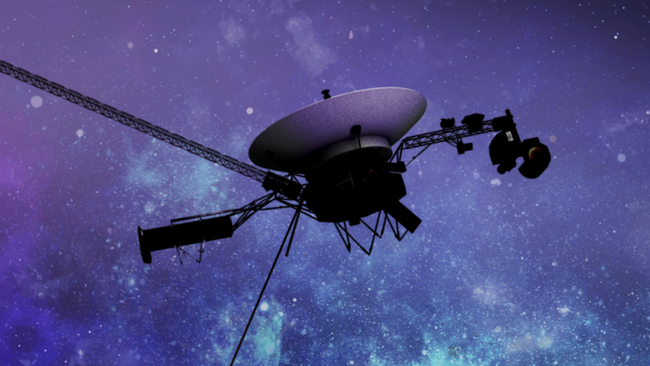
Humanity’s first interstellar ambassador, Voyager 1, is now just over 47 years into its voyage and more than 162 AU (or 24 billion kilometres) from Earth – and like all of us as we grow older, it is increasingly showing signs of its age. Already, the more energy-intensive science instruments on the lonely spacecraft have been shut down, and engineers have had to repeatedly work their way gingerly around assorted problems the craft has encountered; such is the distance separating vehicle and home planet that even the tiniest errors risks breaking all communications.

An artist’s impression of a voyager probe in deep space. Credit: NASA

Most recently, Voyager 1 has started having issues with two key systems: the Flight Data System (FDS) and the Telemetry Modulation Unit (TMU). The latter is responsible for transmitting to Earth data on the spacecraft’s condition, orientation, etc., together with information from its operational science instruments, and receiving and managing communications from Earth. The data it sends is gathered by the three computers of the FDS, which combine everything obtained from the other instruments and sub-systems into a single package for the TMU to send. Except recently, all the TMU has been sending is a repeating pattern of meaningless binary, although it has continued to act on messages from Earth.

It had been thought the problem lies with the TMU itself, but after careful and painfully slow diagnoses (round-trip communications between Voyager 1 and Earth are on the order of 45 hours); the problem was found to be within the FDS. Over the weekend of December 9th/10th, mission engineers ordered the FDS to perform a sequential restart, which it was hoped would kick-start the system into once again passing meaningful data to the TMU. It didn’t.

Created using NASA’s Eyes on the Solar System, this image shows what it might be like to look back at our solar system from 162 AU

So currently, Voyager 1 remains capable of receiving commands from Earth, but it cannot provide any understandable feedback on whether anything succeeded, or what systems are trying to report back through the FDS. As such, the Voyager mission team have indicated it will take several weeks to formulate a new plan of action in order to try to resolve the problem.

Spaceplanes, Spaceplanes

Both the United States and China were due to launch their highly secretive, automated “spaceplanes” this past week – although as it turned out, only one of them actually did so.

The United States X-37B programme had been due to commence its seventh mission – and the fourth flight of the 2nd of the two X-37B craft the US Space Force and US Air Force jointly operate – on December 14th. It was to be the first flight of the craft atop a SpaceX Falcon Heavy, seen as offering the craft the ability to fly missions at much higher orbits than can be achieved using its over launch vehicles – the ULA Atlas V 501and the Falcon 9 Block 4 -, potentially allowing for more flexible and even longer-duration on-orbit operations.

The USSF / USAF X-37B (vehicle 1), shortly after its return to Earth on November 22nd, 2022, following a 908-day orbital mission. Credit: US DoD

The cause of the delay has not been stated, but appears to have been called by SpaceX rather than the US DoD, and following the postponement, the Falcon Heavy was removed from Pad 39A at Kennedy Space Centre. At the time of writing, no revised launch target has been announced.

China, however, so no such delays in the third flight of its Shenlong “Divine Dragon” spaceplane, which lifted-off from the Jiuquan Satellite Launch Centre on December 14th, as planned, using a Long March 2F booster.

Little is actually known about the Chinese vehicle – although there is an emerging consensus that it is potentially similar in overall size and form to the US X-37B. The craft first flew the craft in September 2020 and then was launched a second time in August 2022 – this mission lasting for 276 days, which is still a small fraction of the time the US craft tends to spend in orbit (908 days on its last mission). That said, the second Shenlong mission did cause surprise and concern in the west when it apparently launch / placed / jettisoned something into space  – China has remained tight-lipped as to what it was.

An artist’s rendering of what the Chinese automated space plane might look like. Credit: Erik Simonsen / Getty

No information on the flight or its potential duration has been given by the Chinese authorities, with the official statement post-launch something of a laconic repetition of the announcements which followed the first two flights of the vehicle.

The test spacecraft will be in orbit for a period of time before returning to the domestic scheduled landing site. During this period, it will carry out reusable technology verification as planned to provide technical support for the peaceful use of space.

– Official and bland Chinese statement following the latest Shenlong launch

That both vehicles were originally intended to launch so close together is not a coincidence. The USSC/USAF has been very open in its desire to learn more about the Chinese vehicle’s purpose and capabilities – and the China probably likewise want to know more about the American vehicle. Thus, having them in space at the same time allows the two nations to observe one another’s craft via Earth-based means and – perhaps – mimic the manoeuvrings of one another’s vehicles.

Space Sunday: ISS reaches 25; HST resumes mission

Image of the ISS taken by SpaceX Crew-2 mission on November 8th, 2021 after it successfully undocked from the ISS Harmony module. Credit: NASA

The International Space Station celebrated its 25th anniversary on December 6th, 2023 – the date marking the orbital mating of the first two modules forming the station in 1998.

This operation was undertaken by the US space shuttle Endeavour, commanded by astronaut Robert Cabana. Launched on December 4th, 1998 from Launch Complex 39A at Kennedy Space Centre on STS-88, Endeavour carried the US- built Unity module in its cargo bay. Once in orbit, it started a series of manoeuvres to rendezvous with the 19.3 tonne Zarya Functional Cargo Block (referred to as the FGB, this being the Russian funktsionalno-gruzovoy blok), which had been launched out of Baikonur Cosmodrome Site 81 in Kazakhstan on November 20th, 1998.

As Endeavour approached the Russian module, the shuttle’s robot arm lifted the 11.6 tonne Unity node from its cavernous cargo bay and rotating it so that one of the module’s two Pressurized Mating Adapters (PMA) could be attached to the Orbiter Docking System also located in the shuttle’s cargo bay and connected to the shuttle’s airlock.

On reaching Zarya, Cabana then slowly eased Endeavour so it was paralleling Zarya’s orbital track whilst “below” the Russian module. He then gently manoeuvred the shuttle to within 10 metres of Zarya – close enough for Mission specialist Nancy J. Currie, who had mated Unity to the shuttle’s Docking System, to use the shuttle’s robot arm to “grab” the Russian module and gently mate it with the second PMA on the far end of Unity.

December 6th, 1998. Operated by NASA astronaut Nancy Currie uses the robot arm on the space shuttle Endeavour to gently position the Russian Zarya module over the USS Unity module, anchored against the Shuttle Docking System, in readiness to mate the two. Credit: NASA

EVAs were then conducted by Mission Specialists Jerry Ross and James Newman to connect power and data services between the two modules, and on December 10th, 1998 Cabana and Russian Cosmonaut Sergei Krikalev opened the hatch between the shuttle and the Unity module and entered the latter together as a symbol of US-Russian cooperation, after which members of the shuttle’s crew completed bringing the station’s power and communications systems on-line.

Whilst this marked the first time humans entered the nascent space station, it would not be until November 2001 that the first official crew – Expedition 1 – arrived at the ISS that the station’s “operational” phase would begin, the period between STS-88 and Expedition 1 being regarded as a “construction” period. However, given the latter actually continued well beyond the arrival of Expedition 1, the mating of Unity and Zarya has come to be regarded as the official anniversary of the ISS.

Excluding the astronauts who visited the ISS as a part of STS-88 and those missions ahead of Expedition 1, the space station ISS has hosted 273 individuals from 21 countries around the world. Together they have conducted over 2,500 short- and long-term science experiments and studies involving researchers from 108 countries and multiple disciplines including Earth and space science, educational activities, human research and healthcare, physical science, and technology.

To mark the 25th anniversary, NASA held a special event with the current ISS crew of Expedition 70 – who themselves represent the international nature of the project, as shown below – and special guest Robert Cabana, commander of STS-88.

The official Expedition 70 crew portrait with (top row from left) Roscosmos cosmonauts Nikolai Chub, Konstantin Borisov, and Oleg Kononenko; JAXA (Japan Aerospace Exploration Agency) astronaut Satoshi Furukawa; and NASA astronaut Loral O’Hara. In the front row are, ESA (European Space Agency) astronaut and Expedition 70 Commander Andreas Mogensen and NASA astronaut Jasmin Moghbeli. Credit: NASA

For Cabana, the event was something of a triple celebration. Not only did it mark space station’s anniversary, but also the 25th anniversary of his 4th and final space mission with STS-88, and the fact that at the age of 74, he is now retiring from NASA. Throughout his later career at the agency, he remained close to the ISS project, joining the Operations team in 1999 to head-up its international aspect, working with other national space agencies. From here he went to work in Russia, heading up NASA’s ISS team there, before becoming the deputy head of the entire ISS project in the US for a two-year period through to 2004. After this he served as the Director of Flight Crew Operations, all the while maintaining his “active” flight status as an astronaut. In May 2021, after stints managing various NASA facilities – including Kennedy Space Centre -, Cabana was promoted to NASA Deputy Administrator, one of 16 former US astronauts holding senior management roles in the agency, the post from which he will now be retiring.

The event itself was a little dry, but also fascinating in the way to shone a light on the astronauts themselves in terms of their thoughts on living and working in space and what captivates them.

The celebration of the space station’s 25th anniversary came alongside the news that NASA is revising contract options and timings for the station’s “retirement”. This is due to come in late 2030 or early 2031, when the ISS will be de-orbited in a controlled manner so that it will break-up on entering the upper atmosphere, with any large elements falling into the South Pacific.

Originally, it had been planned to announce the contract for building the de-orbit vehicle at the end of 2023. However, this has now been pushed back until February 2024, the additional time to allow prospective bidders for the contract to review its updated options, which have been altered from a fixed-price basis to something a little more flexible.

This new contract calls for the de-orbit vehicle to be ready for launch no later than mid-2029, so that it can be launched to dock with the ISS where it will remain until called upon to de-orbit the station. Whilst planned for the end of 2030 / start of 2031, the new contract requires the vehicle must have “dwell in place” capability, allowing it to remain docked at the station but capable of performing its task for a period beyond 2031 so as to provide increased flexibility in the time frame for the decommissioning and de-orbit of the station.

Blue Origin to Purchase ULA?

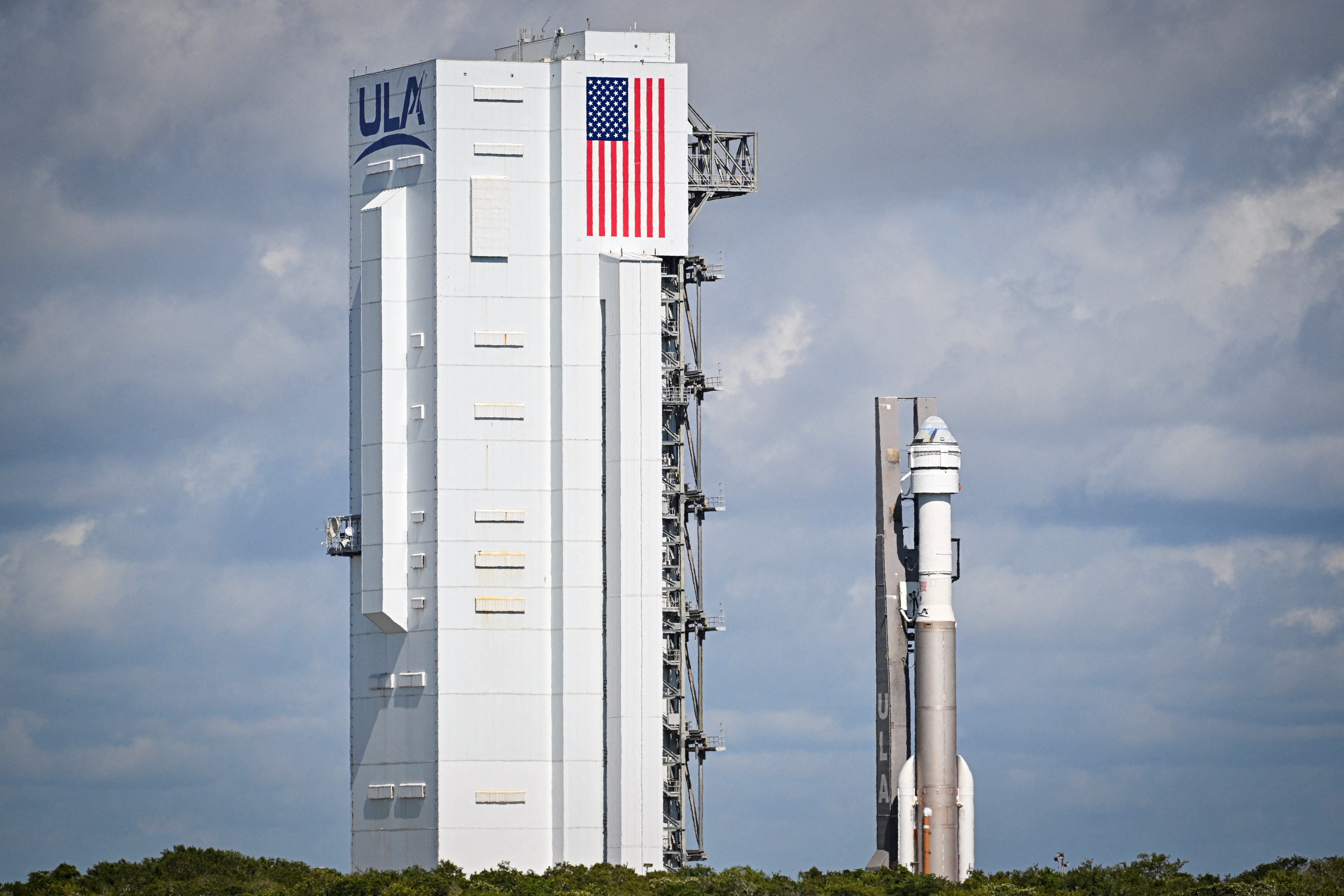
United Launch Alliance (ULA) is something of the “granddaddy” of US government launch system providers. A joint venture between Lockheed Martin Space and Boeing Defense, Space & Security, it was formed in 2006 with its primary customers being the US Department of Defense (DoD) and NASA, proving them with the expendable Delta IV Heavy and Atlas V boosters and which will soon be replaced by ULA’s new Vulcan Centaur rocket.

However, at the end of October 2023, ULA’s current CEO Tory Bruno indicated the entire company could available for purchase by anyone willing to obtain it as a going concern, rather than breaking it up, stating the overall structure of the company – answerable in equal portions to the two parent companies – has prevented the company from flourishing as well as it could if under single ownership.

Prior to Bruno’s announcement it had been rumoured that either Boeing or Lockheed would buy the other out, but neither appeared willing to do so, each pursuing its own space contracts. As a result, and at the end of November 29th, 2023, it appeared that three bidders had expressed an interest in taking over ULA – although one has yet to be confirmed.

Th “possible” bidder has been referred to as a “well-capitalized aerospace firm that is interested in increasing its space portfolio” but which “does not have a large amount of space business presently”. Meanwhile the two “known” organisations interested in ULA are said to be a private equity fund – and Blue Origin, the privately-owned company founded (and largely funded) by billionaire Jeff Bezos.

The idea of Blue Origin gobbling up ULA might seem inconceivable, but there is actually a lot of synergy between the two already: Blue Origin has worked closely with ULA in the development of the company’s BE-4 engine which will be used to power ULA’s Vulcan Centaur and upgraded Atlas V (as well as Blue Origin’s own New Glenn).

An artist’s impression of the Vulcan Centaur rocket – designed by ULA and with a core stage powered by the Blue Origin BE-4 engine. Credit: ULA

Further, Vulcan Centaur’s capabilities overlap nicely with those of New Glenn, offering Blue Origin with a broad range of launch capabilities. ULA has also sought to eventually make Vulcan Centaur semi-reusable, the engine module being detached from the rocket’s first stage and recovered after splashdown, allowing it to be refurbished and re-used. Such a capability would both dramatically reduce operating costs with Vulcan Centaur – and also match Blue Origin’s desire to develop semi-reusable launch systems, as with its New Glenn. So again, there is a synergy here.

Perhaps most beneficial to Blue Origin is that an acquisition of ULA is the fact that the latter is already an establish provider of launch vehicles to the lucrative US defence market, which Blue Origin could then capitalise upon. In addition, ULA’s Atlas V and the Vulcan Centaur launches are designed to carry humans into space via the Boeing CST-100 Starliner capsule. Thus, Blue Origin gain the means to fly crews into space in partnership with Boeing – potentially vital to its space station plans.

An artist’s concept of the Orbital Reef facility proposed by Blue Origin and Sierra Space, showing the core modules (to be built by Blue Origin) with a Sierra Space Dream Chaser (l) and Boeing CST-100 (r) docked against them, with smaller inflatable and rigid modules mated to either side, with another CST-100 approaching. Credit: Blue Origin / Sierra Space

In 2021, Blue Origin and Sierra Space announced plans for an orbital facility called Orbital Reef, designed to provide facilities for up to 10 people at a time. Under current plans, Blue Origin would provide the station’s large-diameter modules and the launch vehicle (New Glenn), Sierra Space the smaller modules and cargo support via their Dream Chaser vehicle, and Boeing / ULA crew launch capabilities via Starliner / ULA launchers. If Blue Origin obtained ULA, it would further streamline Orbital Reef development / operations.  Plus, being able to fly the CST-100 via the Atlas and Vulcan Centaur allows Blue Origin to access a share of NASA’s crewed launch requirements to service the ISS, again through Boeing.

Thus far, neither Boeing nor Lockheed have either confirmed or denied whether ULA is in fact up for sale – but industry insiders believe an announcement on the state of play with ULA – including any winning bid – will be made in early 2024. However, exactly how long any acquisition might take to complete is also unclear, requiring as it would the approval via the US Federal Trade Commission.

Continue reading “Space Sunday: ISS reaches 25; HST resumes mission”

Space Sunday: lunar delays and planetary dances

The Peregrine Mission One lander on the surface of the Moon, as imaged by Astrobotic Technology, the company responsible for the lander’s design and construction. Credit: Astrobotic Technology

America’s return to the surface Moon as a part of government-funded activities will start in earnest over Christmas 2023, with the launch of the NASA-supported Peregrine Mission One and the Peregrine lander, built by Astrobotic Technology, which will take to the sky on December 24th, 2023 atop a Vulcan Centaur rocket out of Cape Canaveral Space Force Base, Florida.

Originally a private mission, Mission One qualified for NASA funding under the agency’s Commercial Lunar Payload Services (CLPS) in 2018, effectively making it the first lander programme funded by NASA under the broader umbrella of the Artemis programme. In this capacity, the mission will fly 14 NASA-funded science payloads in addition to the original 14 private payloads planned for the mission.

The mission will be the inaugural payload carrying flight for the Vulcan Centaur, with the lander arriving in lunar orbit after just a few days flight – but will not land until January 25th, 2024, the delay due to the need to await the having to wait for the right lighting conditions at the landing site.

I’ll have more on this mission closer to the launch date, but in the meantime, as the Peregrine Mission One launch date is getting closer, the date for America’s return to the Moon with a crewed mission is slipping further away.

The Peregrine Lander (r) will mark the first flight of United Launch Alliance’s (ULA) new Vulcan Centaur launch vehicle (l). Credits: ULA and Astrobotic Technology

In terms of the Artemis crewed programmed, there have been a number of flags raised around the stated time-frame for Artemis 3, the mission slated to deliver the first such crew to the surface of the Moon in 2025, over the past few years. These have notably come from NASA’s own Office of Inspector General (OIG), but similar concerns have also started to be more openly voiced from within NASA.

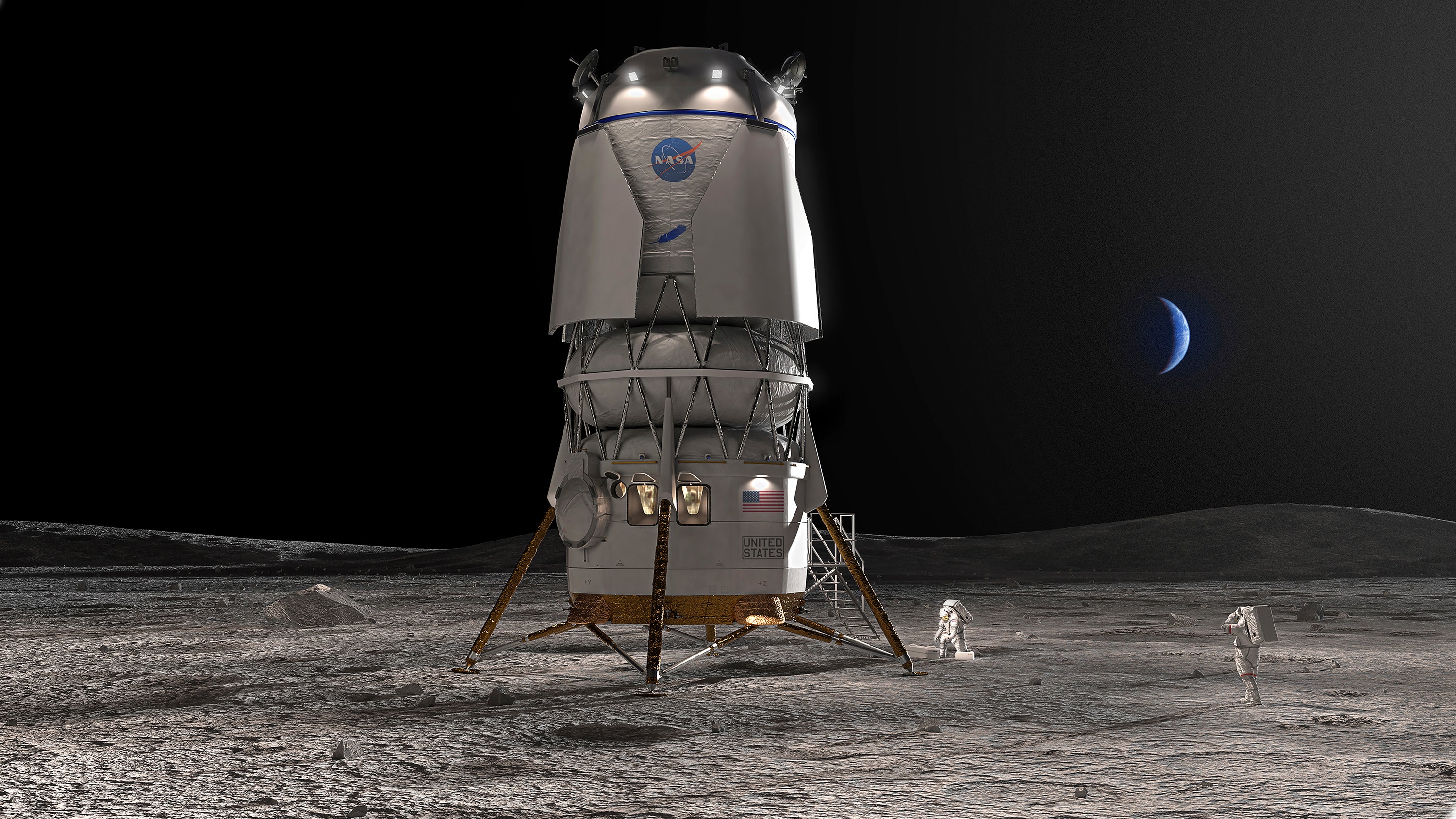
These concerns largely focus on whether or not SpaceX can provide NASA with its promised lunar lander and its supporting infrastructure in anything like a timely manner, given that SpaceX has yet to actually successfully fly a Starship vehicle. In this, the awarding of the lander vehicle – called the Human Landing System (HLS) in NASA parlance – to SpaceX, who propose using a specialised version of the Starship vehicle, was always controversial. For one thing, Starship HLS will be incapable of being launched directly to lunar orbit. Instead, it will have to initially go to low Earth orbit and reload itself with propellants – which will also have to be carried to orbit by other Starship vehicles.

Infographic produced by Blue Origin highlighting the likely launch requirements for a Starship HLS. Credit: Blue Origin

At the time the contract for HLS was awarded (2021), competing bidders Blue Origin noted that according to SpaceX’s own data for Starship, a HLS variant of the vehicle would require the launch of fifteen other starship vehicles just to get it to the Moon. The first of these would be another modified Starship designed to be an “orbiting fuel depot”. It would then be followed by 14 further “tanker” Starship flights, which would transfer up to 100 tonnes of propellant per flight for transfer to the “fuel depot”. Only after these flights had been performed, would the Starship HLS be launched – and it would have to rendezvous with the “fuel depot” and transfer the majority of propellants (approx. 1,200 tonnes) from the depot to its own tanks in order to be able to boost itself to the Moon and then brake itself into lunar orbit.

Despite such claims being made on the basis of SpaceX’s own figures, SpaceX CEO Elon Musk pooh-poohed  them, claiming all such refuelling could be done in around 4-8 flights, not 16. Despite their own OIG and the US Government Accountability Office (GOA) agreeing with the 16-flight estimation, NASA nevertheless opted to accept Musk’s claim of 4-8 launches, going so far is to use it in their own mission graphics.

A NASA infographic showing the Artemis 3 mission infrastructure. Note the (optimistic)  6 Starship launches required to get the SpaceX Starship HLS to lunar orbit. Credit: NASA/SpaceX

However, the agency appeared to step back from this on November 17th, 2023, when Lakiesha Hawkins, assistant deputy associate administrator in NASA’s Moon to Mars Programme Office, confirmed that SpaceX will need “almost 20” Starship launches in order to get their HLS vehicle to the Moon, with launches at a relatively high cadence to avoid issues of boil-off occurring when storing propellant in orbit.

Now the US Government Accountability Office (GOA) has re-joined the debate, underlining the belief that SpaceX is far from being in any position to make good on its promises regarding the available of HLS. In particular the report highlights SpaceX is still a good way from demonstrating it can successfully orbit (and re-fly) a Starship vehicle, and it has not even started to demonstrate it has the means to store upwards of 1,000 tonnes of propellants in orbit, or the means by which volumes of propellants well above what has thus far been achieved can be safely and efficiently be transferred between space vehicles, and it has yet to produce a even a prototype design for the vehicle.

Nor does the report end there; it is also highly critical of the manner in which NASA has managed the equally important element of space suit design, firstly in awarding the initial contract for the Artemis lunar space suits to Axiom Space – a company with no practical experience in spacesuit design and development –  rather than a company like ILC Dover, which has produced all of NASA’s space suits since Apollo; then secondly in failing to provide Axiom with all the criteria for the suits, necessitating Axiom redesigning various elements of their suit to meet safety / emergency life support needs.

As a result, the GAO concludes that it is likely Artemis 3 will be in a position to go ahead much before 2027; there is just too much to do and too much to successfully develop for the mission to go ahead any sooner. In this, there is a certain irony. When Artemis was originally roadmapped, it was for a first crewed landing in 2028; however, the entire programme was unduly accelerated in 2019 by the Trump Administration, which wanted the first crewed mission to take place no later than December 2024, so as to fall within what they believed would be their second term in office. Had NASA been able to stick with the original plan of 2028, there is a good chance that right now, it would be considered as being “on target”, rather than being seen as “failing” to meet time frames.

Hubble Hits Further Gyro Issues

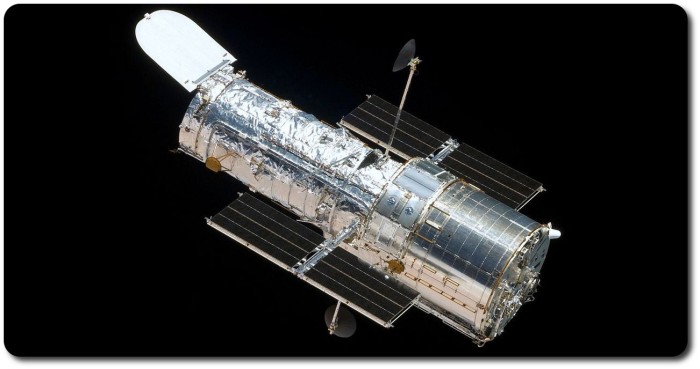
On November 29th, 2023, NASA announced that the ageing Hubble Space Telescope (HST) had entered a “safe” mode for an indefinite period due to further troubles with the system of gyroscopes used to point the observatory and hold it steady during imaging.

In all, HST has six gyroscopes (comprising 3 pairs – a primary and a back-up),with one of each pair required for normal operations. To help increase the telescope’s operational life, all three pairs of gyros were replaced in the last shuttle mission to service Hubble in 2009, and software was uploaded to the observatory to allow it to function on two gyros – or even one (with greatly reduced science capacity)  should it become necessary.

Today, only 3 of those gyros remain operational, the other three having simply worn out, and on November 19th, one of those remaining 3 started producing incorrect data, causing the telescope to enter a safe mode, stopping all science operations. Engineers investigating the issue were able to get the gyro operating correctly in short order, allowing Hubble to resume operations – only for the gyro to glitch again on November 21st and again on November 23rd, leading to the decision to leave the telescope in its safe mode until the issue can be more fully assessed.

The Hubble Space Telescope. Credit: NASA

The news of the problems immediately led to renewed calls for either a crewed servicing mission to Hubble or some form of automated servicing mission – either of which might also be used to boost HST’s declining orbit. However, such missions are far more easily said than done: currently, there isn’t any robotic craft capable of servicing Hubble (not the hardware or software to make one possible). When it comes to crewed missions, it needs to be remembered that Hubble was designed to be serviced by the space shuttle, which could carry a special adaptor in its cargo bay to which Hubble could be attached, providing a stable platform from which work could be conducted, with the shuttle’s robot arm also making a range of tasks possible, whilst the bulk of the shuttle itself made raising Hubble’s orbit much more straightforward.

Currently, the only US crewed vehicle capable of servicing HST is the SpaceX Crew Dragon – and it is far from ideal, having none of the advantages or capabilities offered by the space shuttle, despite the gung-ho attitude of many Space X supporters. In fact, it is not unfair to say that having such a vehicle free-flying in such close proximity to Hubble, together with astronauts floating around on tethers could do more harm than good.

A further issue with any servicing mission is that of financing. Right now, the money isn’t in the pot in terms of any funding NASA might make available for a servicing mission – and its science budget is liable to get a lot tighter in 2024, which could see Hubble’s overall budget cut.

Continue reading “Space Sunday: lunar delays and planetary dances”

Space Sunday: Message in A bottle – Send Your Name to Europa

An artist’s impression of NASA’s Europa Clipper passing over Europa. Credit: NASA/JPL

NASA has a tradition of inviting people to have their names added to various robot missions – I’ve mentioned some in this column, and have had both my birth name and my avatar name included on various missions, including both the 2012 Mars Science Laboratory mission and Mars 2020, so they are currently trundling around Mars on the Curiosity and Perseverance rovers, for example.

Europa Clipper mission patch

In just under a year from this article’s publication, NASA is set to launch Europa Clipper, a mission to Jupiter with a focus on studying the icy, potentially watery world of Europa, the second innermost of Jupiter’s Galilean moons.

On entering Jupiter’s orbit in April 2030, the mission will use multiple fly-bys of Europa to study its ice crust and probe the mysteries of what lies beneath it so we might better understand what kind of ocean might exist under its protective shell. In addition, the mission will look for places where a future lander mission might safely touch-down for in situ studies of Europa.

As a part of the Europa Clipper mission, and through until the end of 2023, the public have once again been invited to have their names engraved on a microchip and flown to the Jovian system.

This project, which has been appropriately called (given the mission’s links to water) Message in a Bottle, also sees NASA link up with the current US Poet Laureate Ada Limón. Limón has penned a poem highlighting the watery link between Earth and Europa, together with humanity’s insatiable quest for knowledge. Entitled In Praise of Mystery: a Poem for Europa, it is also being flown on the mission.

Water connects Earth and Europa, the two ocean worlds NASA’s Europa Clipper spacecraft travels between on its journey. The existence of a vast ocean on a moon of Jupiter – which the Europa Clipper mission is equipped to decisively confirm and characterize – is what makes Europa such a promising place to better understand the astrobiological potential for habitable worlds beyond Earth.

– NASA Message in a Bottle

To participate in the project and have your name flown out into the depths of our solar system as a part of the Europa Clipper mission, visit the NASA website Message in a Bottle, and enter your name and requested details. Whilst there, you can also learn more about the mission and also take an interactive tour of Europa Clipper itself, discovering its instruments and their purpose along the way.

If you’d like to know just how names get to be flown on these missions, then the video below should reveal all:

US and European Launch Systems Update

2024 is looking to be a busy year as new US and European launch systems are set to finally (and in some cases, finally finally) debut operationally. Here’s a quick summary of some of the key craft.

Boeing’s CST-100 Starliner, this is the craft intended to join with SpaceX’s Crew Dragon in delivering personnel to the International Space Station (ISS) and returning them to US soil, and which had originally been set to start crewed flights to the ISS in 2018. However, the programme has been beset by numerous (and at times embarrassing for Boeing) issues, coupled with COVID-2 related shutdowns, which have repeatedly pushed the flight back.

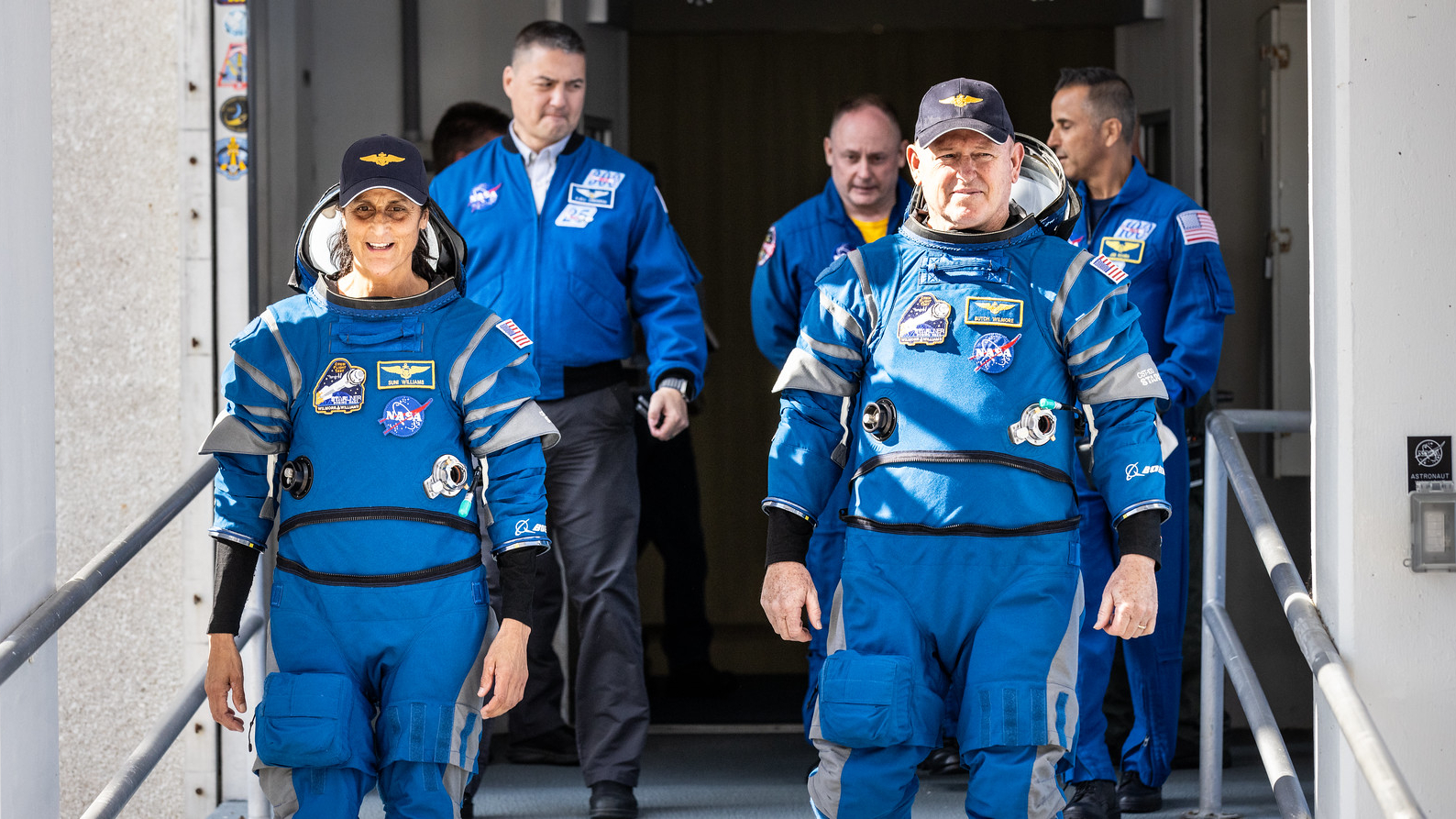
Currently, the first crewed launch – which is still technically a test flight – is scheduled for April / May 2024, and the latest report issued by NASA and Boeing indicate that the vehicle performing that mission and carry NASA astronauts Butch Wilmore and Suni Williams to the ISS for around an 8-day stay, is now 98% certified as being able to perform the mission.

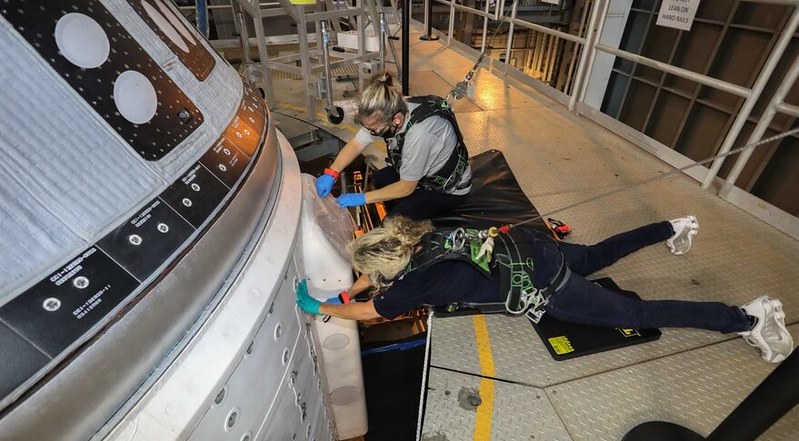
The Boeing CST-100 Starliner crew capsule being prepared for the Crew Flight Test mission. Credit: Boeing/John Grant

When the flight does take place – the exact date will be confirmed in the new year – it will chalk up one or perhaps two historical milestones. It will certainly be first crewed U.S. capsule to make a land-based soft landing, rather than splashing down in the ocean. In addition, it might be the first launch of a US crewed space vehicle from Cape Canaveral rather than the Kennedy Space Centre, since Apollo 7 in 1968.

However, the second of these two honours might yet go to SpaceX and Axiom Space. The former is currently converting their Falcon 9 launch facilities at Canaveral’s SLC-40 pad to support crewed launches. If it certified for such use before April 2024, it will likely be used to launch Axiom Space’s third private mission to the ISS, Ax-3, allowing SpaceX to use the fast-fuelling facilities at Kennedy Space Centre’s Pad 39A for the launch of a robotic mission to the Moon.

Blue Origin’s New Glenn heavy lift launch vehicle remains on target for a maiden flight in November 2024, which will see it not only lift-off for the first time, but then head to Mars carrying NASA’s Escape and Plasma Acceleration and Dynamic Explorers (ESCAPADES) mission, a pair of smallsats that will study the interaction of the solar wind with the magnetosphere of Mars.

A semi-reusable vehicle capable of hauling up to 45 tonnes to low Earth orbit (LEO) or up to 13.6 tonnes to geostationary transfer orbit (GTO), New Glenn’s first stage is designed to be flown up to 25 times, and the system has a planned cadence of 8 launches per year once operations commence – and Blue Origin have an initial batch of contracts to meet this target.

An artist’s impression of a New Glenn rocket on the pad. Credit: Blue Origin

Unlike SpaceX, which has (despite claims to the contrary) relied exclusively on a mix of private investment rounds and both NASA and US DoD contracts for the majority of its development funding, New Glenn has – barring a US $500 million US DoD contract that enables it to met the requirements for flying classified payloads – been funded entirely out of company founder Jeff Bezo’s own pocket (to the tune of US $2.5 billion by the end of 2017 alone).

Dream Chaser Cargo, the lifting body space plane designed by Sierra Space to carry up to 5.5 tonnes of payload and supplies to the ISS has passed its latest milestone towards meeting a first planned launch in April 2024. The first operational vehicle – named Tenacity – has been completed, and construction is underway with the second “100 series” craft, built to the same specification as Tenacity. The Tenacity, meanwhile, is now to be transferred to NASA’s Armstrong Test Facility in Ohio for environmental tests, after which it will likely be transferred to Cape Canaveral Space Force Station where it will be readied for its demonstration flight to the ISS.

DC-101 Tenacity, the first orbit-capable Dream Chaser vehicle approaching completion, with its wings folded up to fit within a booster payload fairing. Credit: Sierra Space

Sierra Space has itself been in the news this week after laying-off 165 personnel from the project. However, many of the reports failed to mention that the company had “surge hired” contractors over an 8-month period specifically to see Tenacity completed in order to transition company focus to the second vehicle and a “200 series” version of the craft the company indicated in January 2023 it would be developing – although to date, no further information on this vehicle has been supplied.

Some reports on the layoffs also failed to note that the company was also absorbing 150 personnel from parent company Sierra Nevada Corporation (SNC), as projects requiring staff with requisite security clearances transferred from SNC to Sierra Space.

Continue reading “Space Sunday: Message in A bottle – Send Your Name to Europa”

Space Sunday: Starship Integrated flight Test 2

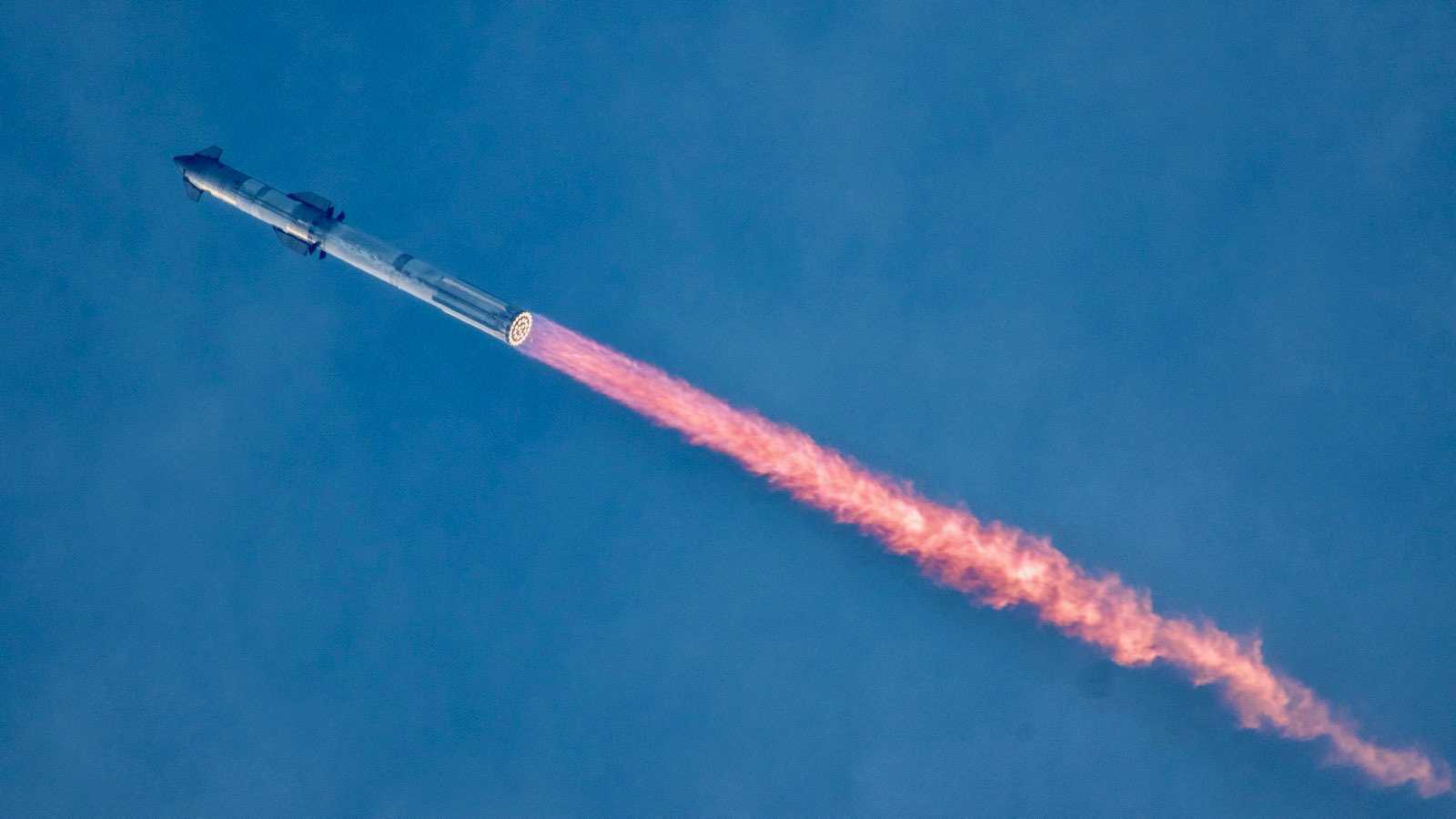
Lift off: 5 seconds after the ignition of its 33 Raptor engines, the SpaceX Integrated Flight Test (IFT-2) of a Starship / Super Heavy gets underway, December 18th, 2023. Credit: SpaceX

Saturday, November 18th, 2023 saw SpaceX attempt the second flight test of the Starship / Super Heavy behemoth out of their Starbase Boca Chica facility near Brownsville, Texas, in what is called the Integrated Flight Test 2 (IFT-2), featuring Booster 9 and Ship 25.

Regulars to the column will likely remember that the first such test of this launch combination on April 20th (and then called Orbital Flight Test 1), didn’t go that well; the launch stack was totally lost four minutes into the ascent, whilst the 31 operating engines on the booster spent the 5+ seconds between ignition and launch excavating the ground under the launch stand (see: Space Sunday: Starship orbital flight test).

The failure of that flight came as no surprise: the vehicle wasn’t fit for purpose (by Elon Musk’s own admission), and the launch infrastructure, as many (myself included) was not fit for purposes as long as it lacked a sound suppression system / water deluge system. In this regard, the April 20th attempt – which was more about boosting Musk’s ego on the so-called “Elon Musk Day” than anything practical – proved us right, the booster’s engines excavating the ground under the launch stand and throwing enough debris into themselves as to cripple the flight before it even left the launch stand.

So, how did the second flight go? Well – spoiler alert – both vehicles were again lost; the booster within the first 3.5 minutes of flight and the Starship around 4.5 minutes later. However, even this allows the flight to be recorded as a qualified success in that it will have yielded a fair amount of usable data and it did potentially succeed in meeting its two critical milestones.

Booter 9 / Ship 25 around a minute into the flight. Credit: Future / Josh Dinner

In all the flight might be summarised as:

  • T -02:00:00 hours: fast sequence propellant loading commenced, pumping around 4,536 tonnes into the tanks of both vehicles, less than the 4,800 tonnes full load required for an orbital flight.
  • T -00:00:05 seconds: the newly-installed and novel sound suppression system below the launch pad starts up, delivering a “cushion” of water under the launch stand in its first active launch test and the first critical milestone for the launch.
  • T-00:00:00: ignition of Booster 9’s 33 Raptor engines.
  • T +00:00:5 (approx 13:02:53 UTC): lift-off.
  • T +00:00:10 the vehicle stack clears the tower.
  • T +00:01:12 at 15km altitude and travelling at 1,500 km /h, the stack passes through Max Q, the period when it is exposed to the maximum dynamic pressure as it punches through the denser atmosphere.
  • T +00:02:40 main engine cut-off (MECO) commences, with the raptors on Booster 9 shutting down sequentially from the outer ring of 20 and progressing inwards to leave just three running.
A series of images showing the sequential shut-down of Booster 9’s engines, progressing from all 33 firing (l) through incremental shut-downs starting with the outer ring of 20 and commencing inwards, to leave just three firing (r). Credit: screen caps via the SpaceX live feed.
  • T + 00:02:48: Ship 25 ignites its engines in a “hot staging” process – second critical milestone for the flight.
  • T +00:02:49: Ship 25 separates from Booster 7, which fires upper and mid-point thrusters to tip itself away from Ship 25’s line of flight, using the thrust from its 3 remaining Raptor motors to increase its separation. Livestream graphic incorrectly shows 12 Raptors on the booster firing.
  • T +00:02:57: Booster 9 uses its small thrusters to flip itself over (so the top of the booster is pointing back towards the launch facility) ready to commence a “boost back” burn. Graphic continues to show incorrect number of engines firing.
  • T + 00:03:11: attempt to re-start the 10 motors of the inner ring to join the core 3 in firing for the “boost back” burn.
  • T +00:03:15: one or two engines flare briefly, following by attitude thrusters firing to correct, or some form of propellant venting.
  • T+00:03:17: further attempt at engine start-up, graphic now shows all 13 inner engines have shut down. Vehicle appears to be venting heavily from one side of the engine skirt.
  • T +00:03:20: one or more engines appear to explode. A fraction of a second late, the midsection explodes and vehicle is destroyed.
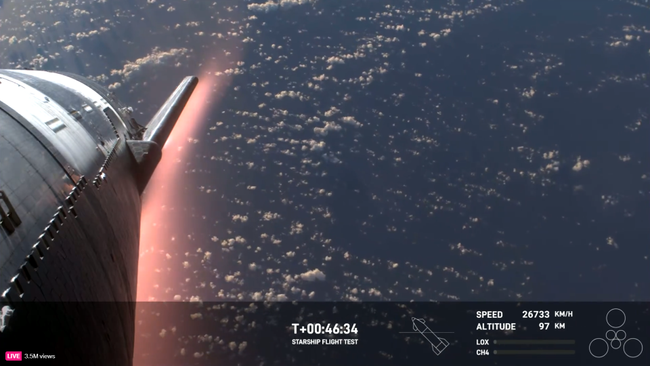
  • T +00:07:57: at an altitude between 140 and 148 km, and travelling at 23,350 km/h, Ship 25 appears to suffer an engine anomaly.
  • T +00:08:04: all flight telemetry seizes, showing the vehicle travelling at a flat trajectory at 149 km altitude.
  • T +00:08:08: Ship 25 is destroyed, – although mission control appear to be under the impression engine cut-off (scheduled for 8m 33s into the flight) had occurred prematurely and that the vehicle was still coasting in flight, publicly acknowledging it loss at 11m 23s after launch.
This image, taken within the first 90 seconds of launch, clearly shows the Starship vehicle to have lost numerous tiles from its thermal protection system (the white lines and dots on the black), making its ability to survive re-entry into the atmosphere – if it got that far – unlikely. Credit: SpaceX

Many were quick to hail the test as a huge win for SpaceX; others were equally quick to call it a further failure. The truth actually lies somewhere in between, as I noted earlier.

On the one hand, the flight was a success in that it clearly demonstrated the hot staging concept works, and the new sound suppression system may well protect vehicle and launch facilities at lift-off; the flight was also sufficiently long enough for a lot of data to be gathered.

On the other, the ways in which Booster 9 and Ship 25 were lost indicating there is a lot still to be done. Those claiming this flight to have failed also point to the fact that Ship 25 never got to coast on a sub-orbital hop to re-enter the atmosphere over the Pacific Ocean to splash-down near Hawaii.

However, while this was the supposed primary goal of April’s flight, for IFT-2, it was very much a tertiary objective; one a good distance behind hot staging and proving the sound suppression system. As such to call IFT-2 a failure based on this criteria is not entirely fair.

Of the two cited objectives, it is not unfair to say the jury is still out on the overall effectiveness of the sound suppression system. This is because – at the time of writing – we do not know its overall condition, as SpaceX has not released any post-launch images.

While there are various amateur videos of the launch stand and facilities post-flight, they are shot from a distance where it is impossible to judge the condition of the actual sound suppression system; therefore – and despite claims to the contrary made on their basis – we cannot tell how well it stood up to the blast from Booster 9’s engines.

All that can be positively determine from these videos is that the concrete on the launch stand withstood the blast considerably better than it did in April 2023, which show them to be in very good condition compared to the April 20th attempt, which might be indicative of the effectiveness of the sound suppression system – but that doesn’t mean it survived unscathed itself.

A further point here is that even if images do reveal the system to be relatively undamaged, that does not automatically mean it is fit for purpose; for one thing, this was an atypical launch: the stack was some 360 tonne lighter than it would be fully fuelled and with a payload – which likely reduced the degree of exposure the sound suppression system had to the fury of 33 Raptors operating at maximum thrust. Thus, it’s going to take a few more launches to really find out if the system is up to snuff or not.

Meanwhile, hot staging refers to igniting the motors of one stage of a rocket while it is still attached to a lower stage, rather than separating them first and then igniting the engine. When done right, it imparts an extra kick of velocity into the ascending stage which can be translated into a larger payload capability. Russia has been using hot staging in vehicles like Soyuz for decades, so the idea is not new; however, their rockets are built with it in mind; Super Heavy is effectively being retro-fitted with the capability, so there was a lot riding on this flight.

A diagram of the Soyuz FG variant, showing the hot staging structure between the core stage (called “Stage II” as the Russians refer to the strap-on boosters as “Stage I”) and the vehicle’s Stage III, allowing the motor on Stage III to fire before it separates from the core stage. Credit: as per the image

Continue reading “Space Sunday: Starship Integrated flight Test 2”