In its final mission, the United Launch Alliance Delta II launch vehicle lifted NASA’s ICESat-2 (Ice, Cloud, and land Elevation Satellite 2) up into orbit. Designed to measure ice sheet elevation and sea ice freeboard, as well as land topography and vegetation characteristics, the mission is a follow-on to the ICESat mission of 2003 to 2010.
The launch vehicle lifted-off from Space Launch Complex 2 at Vandenberg Air Force Base in California at 06:02 local time (9:02 EDT; 14:02 BST). The satellite separated from the second stage about 53 minutes after lift-off, followed by four cubesat secondary payloads some 20 minutes later.
The half-tonne satellite, about the size of a small car, carries a single instrument: a laser altimeter called the Advanced Topographic Laser Altimeter System (ATLAS). It is designed to fire 10,000 laser pulses a second to obtain elevation data with an accuracy of half a centimetre, and will primarily be used to measure the elevation of ice sheets and changes in their size, but will also measure the height of vegetation on land.
The last ever Delta II lifts-off carrying the ICESat-2 mission to orbit, September 15th, 2018. Credit: NASA/Bill Ingalls
Originally, ICESat-2 had been due to launch in 2015 as a follow-up to the original mission. However, the complexity of ATLAS meant that the mission hit delays and overran its original budget, both of which left NASA facing an either / or situation: either divert funds from other Earth resources missions (such as the Pre-Aerosol, Clouds, and Ocean Ecosystem (PACE) satellite) and cancel them, or cancel ICESat-2.
The first ICESat revealed that sea ice was thinning, and ice cover was disappearing from coastal areas in Greenland and Antarctica. Due to the delays in developing and launching ICESat-2, NASA has relied on an aircraft mission, Operation IceBridge, to monitor ice elevation and gathering other data on ice changes in both the Arctic and Antarctic.
While there are those who like to believe human-made global warming doesn’t exist, and that the unprecedented increases in temperature Earth has experienced in the last 100 or so years is simply a matter of solar cycles (a view that actually does not stand up to objective scrutiny), global average temperatures are climbing year after year (four of the hottest years in modern times all taking place from 2014-2017), largely as a result of humanity’s constant reliance on fossil fuels for energy. This warming is contributing to the shrinking ice cover in the Arctic and Greenland and adding to sea level rises that threaten hundreds of millions of people living in coastal regions around the world, as well as contributing to further weather and climate changes.
An artist’s impression of ICESat-2’s ATLAS laser in operation. ATLAS is capable of firing 10,000 per second and will take measurements every 0.7 m (2.3 ft) along the satellite’s path. It will gather enough data to estimate the annual elevation change in the Greenland and Antarctic ice sheets even if it’s as slight as four millimetres. Credit: NASA
ICESat-2 should help scientists understand just how much melting the ice sheets are contributing to this sea level rise, with ATLAS being fired-up for the first time in orbit in around a week’s time.
The launch was the 155th and final flight of the Delta II, which first entered service in 1989. Once a mainstay of both government and commercial customers, the vehicle has seen decreasing use in favour of vehicles like the Delta IV and Atlas launchers and, more recently, SpaceX. In 2007, it was announced ULA would phase out the Delta II – although it has enough parts to build around half-a-dozen complete versions of the rocket. With NASA the only user for the vehicle, it has taken time to use these remaining vehicles, and the final vehicle will be used as a museum piece.
The Delta II occupies a unique place in history: it is the only rocket ever to recorded to have debris strike a human. In 1996, the US Ballistic Missile Defense Organisation (BMDO) launched the Midcourse Space Experiment (MSX) atop a Delta II. Ten months later, on January 22nd, 1997, the upper stage of the launcher re-entered the atmosphere and broke apart, the greater part of it burning up in a fireball over the mid-west United States.
Lottie Williams hold the debris from a Delta II upper stage, which struck her on the shoulder in January 1997. Credit: unknown
Witnessing the fireball while exercising in a park in Tulsa, Oklahoma, was Lottie Williams. Thirty minutes later, she was struck on the shoulder by a charred piece of metal about 15 cm (6 in) across and weighing about the same as an empty soda can. She was uninjured by the strike, and analysis of the object confirmed it originated from the Delta’s upper stage.
An artist’s concept of a “carrier” – the “elevator car” of a space elevator – climbing the elevator cable. Credit: unknown
The space elevator is perhaps one of the most intriguing ideas for reaching space. It was first conceived as a thought experiment in 1895 by the grandfather of astronautics, Konstantin Tsiolkovsky. In it, he considered the building of a massive tower reaching up to geostationary orbit at 35,756 km (23,000 mi) above the surface of the Earth, and which at the top would have sufficient horizontal velocity to launch vehicles into orbit. The vehicles themselves would be carried aloft by elevators like the ones climbing the Eiffel Tower.
Tsoilkovsky knew the construction of such a tower would be next to impossible, there simply were no materials capable of withstanding the compressional pressures exerted the mass of such a tower as it was built upwards – nor are there today. However, in 1960, another Russian, Yuri N. Artsutanov suggested that rather than building the elevator up from the ground, it could be built both down and out from geostationary orbit, using tension along the cable from its lower end and through the “counterweight” of the outward extent of its length to maintain is tautness and balance. Referring to the design as a “heavenly funicular”, Artsutanov estimated it would be capable of delivering up to 12,000 tonnes of payload to geostationary orbit per day.
An artist’s impression of a solar-powered car ascending the “Sky Hook”. Credit: unknown
Six years later, working entirely independently of Artsutanov, four American oceanographers – John Isaacs, Hugh Bradner, George Bachus and Allyn Vine (after whom the deep-ocean research submersible Alvin was named) – published their idea for a “sky hook” that essentially used the same approach: build a cable both “down” and “out” from a geostationary starting point. Their idea became the inspiration for Arthur C. Clarke’s 1979 novel The Fountains of Paradise, which did much to promote the idea of space elevators in the public mind.
Since then, the idea has received many re-visits, and has also given birth to a number of experiments and ideas for the use of tensile cables – referred to as “tethers” for doing things like “lowering” experiments into the upper atmosphere for research (such ideas being tested during the space shuttle era) and for creating “artificial gravity” in spinning space vehicles travelling to Mars. A space elevator even appeared in Kim Stanley Robinson’s Mars trilogy as the means to get from orbit down to the surface of the planet. Today, the space elevator is the subject of study by the International Space Elevator Consortium (ISEC), which holds annual conferences on the subject and supports research programmes into space elevator concepts.
The appeal of space elevators – if they can be built – is that they could deliver huge amounts of payload and manpower to orbit around Earth for a relatively low-cost when compared to using traditional rocket launches. And deliver them not just to geostationary orbit, but to other points above the surface of Earth, referred to as “way stations”.
For example, a “way-station” at around 420-450 km (262-281 mi) altitude would impart a horizontal velocity for vehicles “launched” from it to keep them in a low Earth orbit. similarly, a way station placed above the geostationary orbit point, at say 57,000 km (36,625 mi) would impart enough horizontal velocity to a vehicle “launched” from it that it could escape Earth on a flight to Mars.
The space elevator concept, show an ocean anchor point, and the various “way stations” along its length, capable of supporting operations a low Earth orbit (LEO), geostationary orbit (GEO) and high earth orbit (HEO) altitudes, the latter of which could support missions to Mars and further out into the solar system. Credit: ISEC
But before this can happen, there are some significant issues to overcome. The “simplest” of these is that of finding a suitable anchor point on Earth.
To work at geostationary orbit, the primary station on an elevator would have to be positioned over the equator. The problem here is, an awful lot of the equator is ocean (78.7%), making the construction of such an anchor-point at best difficult. While the remainder of the equatorial region is over land, it brings with it the overheads of political haggling and leveraging to gain an anchor-point.
In The Fountains of Paradise, Arthur C. Clarke solved this problem by conveniently moving Sri Lanka (which he called by its ancient Greek name of Taprobane (Tap-ro-ban-EE) 1,000 km (625 mi) south of its current position to straddle the equator. Unfortunately, we can’t do that in the physical world.
The more significant issues, however, are exactly how to build the elevator tether and how to gradually and safely lower it through the denser part of Earth’s atmosphere, and without its “downward” mass simply ripping it apart before it can be anchored.
The most promising material for the tether construction is carbon nanotubes (CNTs). These are artificially “grown” structures with a number of unusual properties, one of which it their sheer strength: up to 10 times that of an equivalent steel cable, which comes at a fraction of a cable’s mass. CNTs have been known about for around 20 years and are seen as having a range of potential applications: construction, electronics, optics, nanotechnology, etc. However, there is one slight issue with their use in large-scale projects. So far, no-one has successfully “grown” a nanotube longer than 1.5 metres.
Even so, experimental cables have been lifted to altitudes of around 1 km (0.6 mi) using weather balloons and had scale “carriers” run up and down them to test how an elevator tether and its payload would react to the influence of wind and weather. Now, researchers at the Shizuoka University Faculty of Engineering are taking the practical research a step further, by deploying an experimental “space elevator” in space.
On Monday, September 7th, 2018, the Kounotori-7 H-II Transfer Vehicle (HTV) resupply vehicle is due to be launched to the International Space Station (ISS). As a part of the six tonnes of supplies the vehicle will be carrying will be two small “cubesats” – satellites that are each just 10 cm (4 inches) on a side.
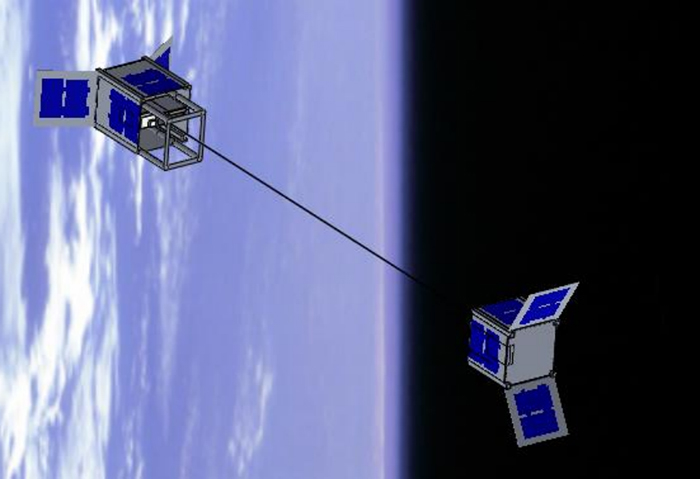
Computer model of the cubesats and their (not to scale) tether deployed in Earth orbit. Credit: Shizuoka University
These will be deployed in space, connected by a 10 metre (33 ft) tether. Once the tether is under stable tension, a little electrically powered “car” will traverse it, marking the first time a vehicle has travelled along a tether in space. The test is intended to see how a space elevator tether might react to payloads moving along it in whilst in the “vacuum” of space, together with the stresses placed on it and its “anchor points”, etc.
It’s a small step along the way to establishing a space elevator, but the test will be watched with interest by Japan’s massive construction firm, Obayashi Corporation. In 2012, they announced they would have the world’s first space elevator operating by 2050. They are actively sponsoring research into CNT development, and believe the issues of growing long strands of CNTs and “knitting” them together into a tether will have been resolved by 2030.
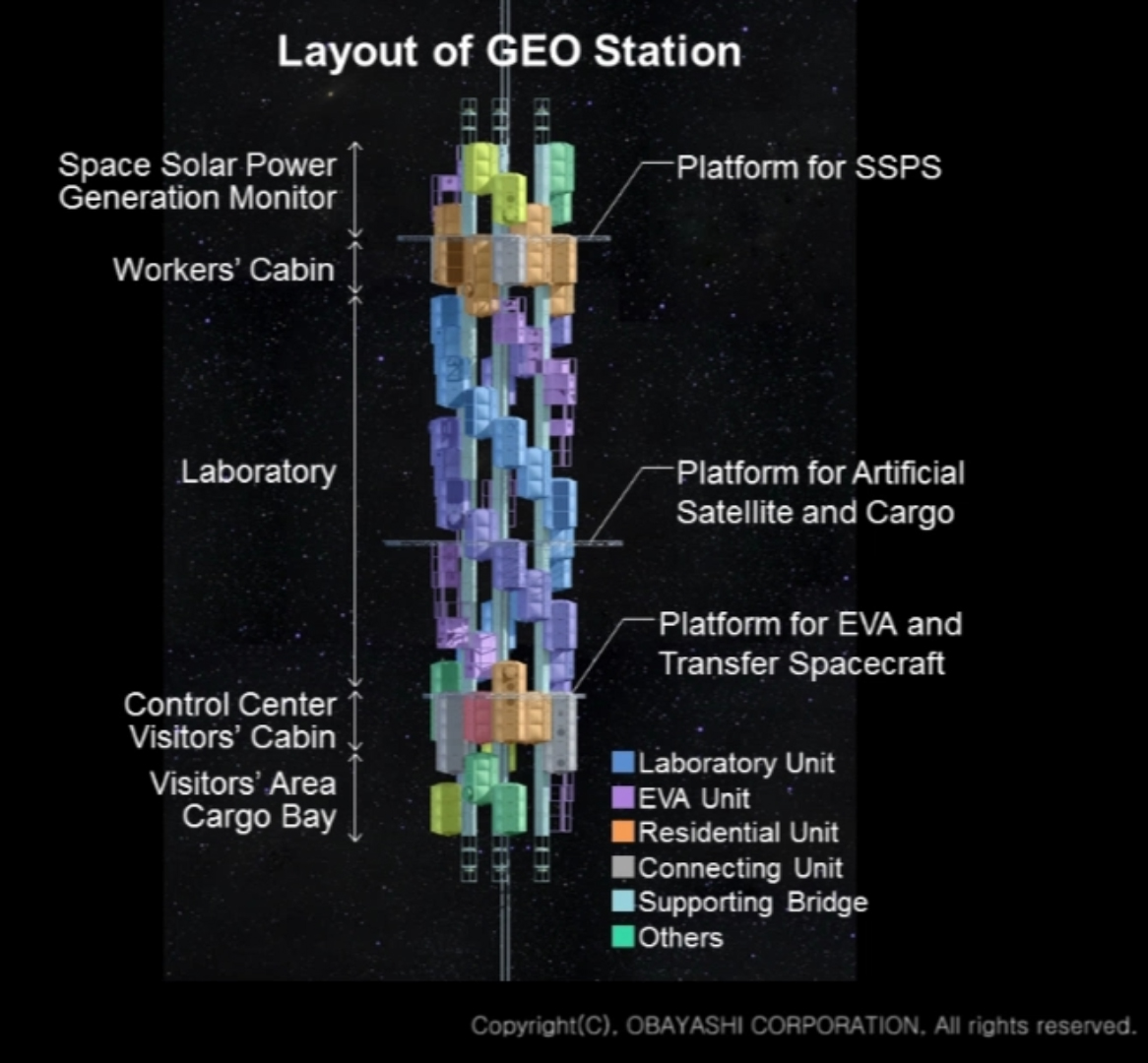
Obaysahi Corporation’s design for their GEO station on the space elevator, which the company says will use “inflatable” modules to reduce mass. Credit: Obayashi Corp.
Yesterday I gave slightly late (my bad, it slipped my mind!) notice of the September 7th 2018 High Fidelity avatar concurrency load test.
The aim of these events is to enough as many people as possible to sign-up / join-in with an event held in a single contiguous space within High Fidelity (no instancing or sharding) and see how the system stands up to the load. The programme is part of what High Fidelity refer to getting “one billion in VR”, and it was hoped that the September 7th event would break the company’s previous record of 256 avatars, set during the August load test.
As it turned out, the record wasn’t just broken – it was shattered.
From 256 to 262 – before the September 7th 2018 load test had officially started
People had been encouraged to register and turn up ahead of the official start of the event at 13:30 PDT on September 7th, and a few minutes before the official kick-off, High Fidelity were able to announce the August record had been superseded with 262 avatars in The Spot.
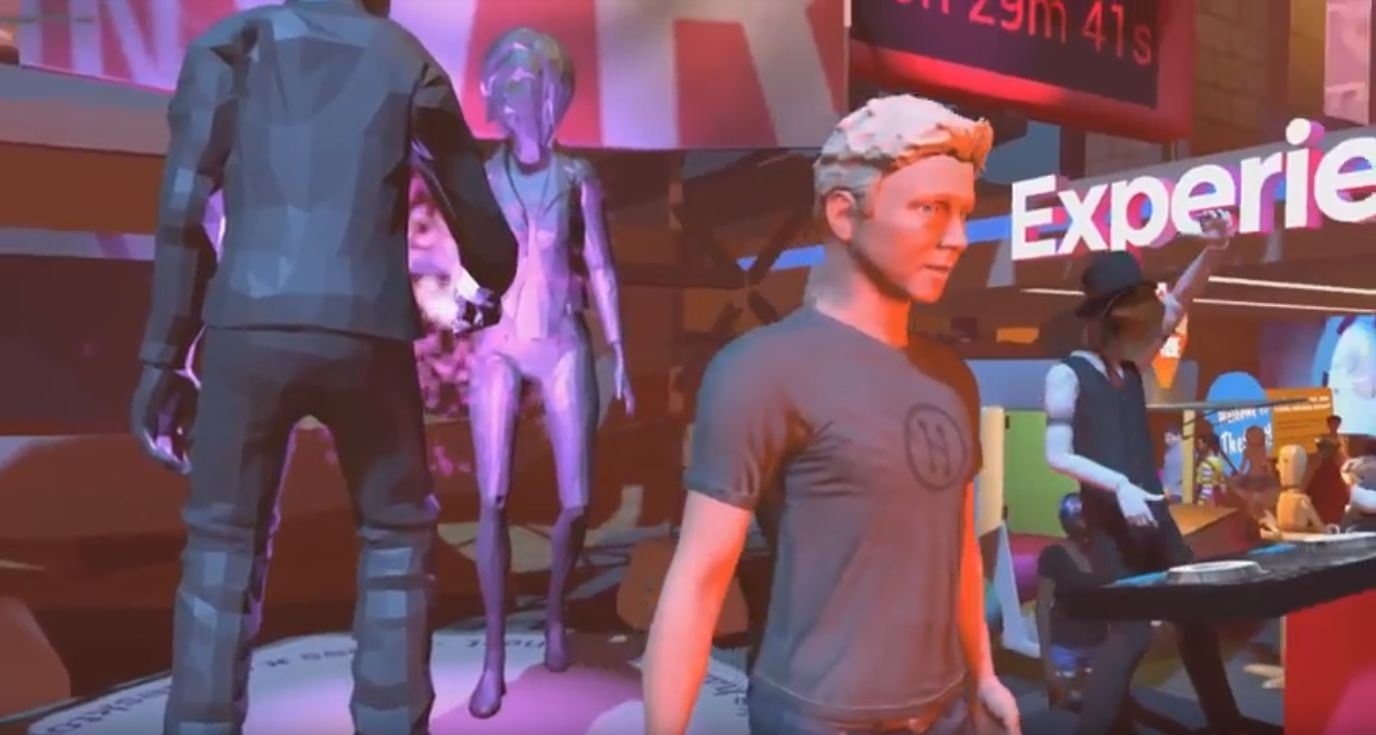
That wasn’t all, by the end of the event, some 356 avatars were in the event region, raising the August record by 100 – not bad for a Friday afternoon when large swathes of the USA are liable to be at work, and many in places like Europe might be out and about at the start of their weekends.
Goal achieved; time to level up at the next event!
Must of those attending had a good time; however, the event wasn’t all plain sailing.
Some people reported arriving and being unable to see any avatars at all. Philip Rosedale acknowledged the problem was at High Fidelity’s end of things, and they are working to address the issue.
Oopsie to be fixed!
The One Billion in VR road tests are a monthly event with High Fidelity, and gift card / HFC rewards on offer to those attending. To help boost numbers, events from October onwards will be held on the first Saturday of the month.
This means the next load test will be on Saturday, October 6th, 2018 at 11:00 PDT, and those wishing to participate can find the details and register via Eventbrite.
Updated September 8th: the record was broken, with a total of 356 avatars in the same contiguous space, as tweeted via the High Fidelity Twitter account. Read more here.
On Friday, September 7th, 2018 at 13:30 PDT, High Fidelity will be attempting to break their avatar concurrency record – which currently stands at 256 avatars in the same virtual space. The load test is part of the company’s drive towards seeing “One Billion in VR”.
These tests are handled on a monthly basis, with the September event offering a couple of enticements for those wishing to join in: the chance to earn gift cards (or an Amazon credit), or have the equivalent USD amount donated to the American Civil Liberties Union (ACLU).
People wishing to participate in the event will (obviously) have a High Fidelity account, and be in a position to log-in to the platform during the test period (commencing at 13:300 PDT, as noted). Registration is required, which is offered free-of-charge via Eventbrite. Registration, together with requirements for entry can be found on the Eventbrite website, with the nature of the US dollar rewards specified as:
Every registered attendee who checks-in at the event will receive at least $10 in Visa or Mastercard prepaid gift card, or Amazon credit, or you can redeem High Fidelity Coin (HFC) donate your rewards value to the ACLU.
The “at least” aspect of the reward value is due to the fact that High Fidelity is offering it on a sliding scale:
Up to 100 people // $10
100+ people // $15
200+ people // $20
1000+ people // $25
As well as the gift card / credit / donation options, those who prefer can take their reward in High Fidelity Coins (HFCs).
On top of all this, all registered participants have the chance to win a custom avatar created by Doob3D, and quoted as having a value of US $550.
Philip Rosedale at the August 2018 Road to One Billion load test event in High Fidelity
Registrations will remain open to the start of the event, and new users are advised to go through the High Fidelity tutorial once logged-in, as this has a portal that will take users to the load test location, referred to as The Spot.
The event itself offers various activities and well as the means to meet other High Fidelity users, and is designed to be a fun activity with a serious edge. Following the August load test, High Fidelity published a short video of the event, which I’ve embedded below – note that it opens with a brief look at people checking-in to the event, which is required in order to gain the USD reward.
NASA’s MER rover, Opportunity (MER-B) arrived on Mars in January 2004. It has been in a “sleep” mode since the start of June 2018, as a result of a globe-spanning dust storm on Mars. Credit: NASA/JPL
NASA has announced it will undertake a 45-day campaign to try to re-establish contact with its long-lived Mars Exploration Rover (MER) Opportunity. in the wake of contact being lost was a globe-spanning dust storm started to grip Mars in June 2018.
After running its course for almost three months, the storm is now abating, and whilst not the biggest storm seen on Mars since “Oppy” arrived there it the start of 2004, it is one of the most intense in terms of the amount of dust thrown up into the Martian atmosphere.
Contact with the rover was lost in early June 2018. With sunlight barely able to penetrate the dust in the air, it is thought the rover went into hibernation to conserve battery power – terminating contact with Earth in the process.
The attempt to re-establish communications will commence once the tau in the region where “Oppy” is located has dropped below 1.5. Tau is the term used to measure the opaqueness of the dust in the Martian atmosphere, and it is usually around 0.5. Opportunity requires a tau of below 2.0 to avoid triggering its sleep mode, and by early June the value had reached 10.8 – making this dust storm the densest the rover has ever encountered during its fourteen years on Mars.
As a solar-powered vehicle, there are a number of risks Opportunity faces during a long duration dust storm. The first is that as the batteries cannot be charged, they could run out of sufficient power required to keep the rover’s sensitive electronics warm – although this is partially mitigated by the fact that during a storm like this, the heat normally radiated away by the planet gets trapped in the dusty atmosphere, raising the ambient temperature and thus offsetting the amount of power the rover needs to use to keep itself warm.
How the dust storm progressed. Taken 15 days apart through the same telescope and viewing the same face of Mars. On the left, taken on June 8th and the storm started to rise, features such as Syrtis Major ( the dark India-shaped marking below centre) are visible. On the right, taken on June 23rd, they are almost totally obscured by dust. Note that south is top the top of both images. Credits: Damian Peach (left) / Christopher Go (right)
To other points of concern with the rover are the potential for a clock failure, or what is called an “uploss” recovery being triggered. Opportunity’s on-board clock allows the rover to track when an orbiting satellite – vital for relaying signals from the rover to Earth – is above the local horizon, allowing Opportunity to make contact with Mission Control. If it has failed or now has an incorrect reading as a result of power fluctuations, “Oppy” might not be easily able to establish contact with Earth by itself. An “uploss” recovery is triggered when the rover has failed to establish contact with Earth for an extended period. There is a concern that if the rover didn’t enter its hibernation state correctly, the lack of any communications might have triggered this mode, forcing the rover to continuously re-try different methods to receive a signal from Earth, using up its power reserves.
The 45-day campaign will be a pro-active attempt to re-establish contact with “Oppy” from Earth by sending commands out to it. However, if there is no response from the rover, a grim warning was given in the announcement:
If we do not hear back after 45 days, the team will be forced to conclude that the Sun-blocking dust and the Martian cold have conspired to cause some type of fault from which the rover will more than likely not recover. At that point, our active phase of reaching out to Opportunity will be at an end.
– John Callas, Opportunity project manager, NASA Jet Propulsion Laboratory
This has drawn some sharp criticism from former members of the MER team, particularly those who worked with Opportunity. They point out that when communications were lost with the other MER vehicle, Spirit, in 2010, NASA spent 10 months trying to re-establish contact. In response to the criticism, NASA state that the 45-day period has been dictated by the decreasing amount of sunlight the rover is receiving as winter approaches, requiring the rover to start conserving power once more, but they will continue to listen for any attempts by the rover to re-establish communications after 45 day campaign has come to an end – they just won’t continue to try to make the connection pro-actively.
Even if communications are re-established, it doesn’t necessarily mean “Oppy” is out of danger; there is a chance that the storm has caused the rover to use its batteries for so long without charge, then may not longer have the capacity to charge correctly or to efficiently retaining their charge – either of which could severely impact further operations for the rover, and require careful assessment.
Soyuz Pressure Leak at the ISS
A Soyuz vehicle suffered a minor loss of cabin pressure whilst docked at the International Space Station (ISS), causing a bit of a fuss in some sectors of the media.
At around 19:00 Eastern Standard Time on August 29th, 2018, ground controllers noted a loss of atmospheric pressure in the orbital module of a Soyuz MS-08 docked to the station. While some media outlets reported the ISS crew “scrambled” to locate and patch the source of the pressure loss, the drop was so slight mission controllers decided to allow the 6-man crew to continue their sleep period aboard the station, and did not inform them of the issue until they were woken up at their scheduled time.
A Soyuz vehicle docked with the ISS (a second Soyuz is just visible, top reight of this image). The pressure leak occurred in the spherical orbital module directly attached to the space station. Behind this is the earth return module (and primary compartment for cosmonauts and astronauts when flying Soyuz) with the white section at the rear, with the solar panels, is the vehicle’s propulsion and power module. Credit: NASA / Roscosmos.
The leak was ultimately traced to a 2mm hole through the skin of the Soyuz module. A temporary fix was made using tape while the crew awaited instructions from Earth on how best to affect a more permanent repair. This actually highlighted a difference in approach between American astronauts and engineers and their Russian counterparts in handling situations.
The Americans – including Expedition 56 Commander Drew Feustel – were keen to explore and test options on Earth before determining on a curse of action out of concern that if options were not tested, then a repair could result in additional damage to the Soyuz. Russian engineers, however, proposed just the one approach to making the repair, and ordered the two Russian cosmonauts on the ISS – Oleg Artemyev and Sergei Prokopyev – to make the repair without any Earth-based testing, handling the situation entirely in Russian and using an interpreter to keep NASA personnel appraised of progress.
After completing the work, Artemyev and Prokopyev reported bubbles forming in the patch, but were instructed to leave it in place to harden over 24 hours. At the time of writing, the path appears to be holding, with no further leaks reported. The damaged Soyuz had been scheduled to make a return to Earth in December 2018 (each vehicle generally spending around 6 months berthed at the ISS alongside another Soyuz so they can be used as “lifeboats” by a station crew should they have to abandon the station for any reason), but as a result of the incident, mission controllers are contemplating using the vehicle in October, when three of the current ISS crew are due to return to Earth.
As the leak occurred in the Soyuz orbital module, it does not pose a threat to a crew: the module is only used during the time a Soyuz is en route to the ISS to give the crew a little more space. On a flight back to Earth the module is jettisoned along with the power and propulsion module, leaving the crew to return in the “mid-ships” Earth return capsule.
The cause of the leak is still being investigated, but suggestions are that it may have been a MMOD – a MicroMeteoroid (tiny piece of orbiting rock weighing less than a gramme but travelling at high-speed) or a piece of Orbital Debris (tiny fragment of debris from a space mission). Such strikes have occurred with the ISS in the past, but if this is the cause of the Soyuz leak, it will be the first time such a strike has directly resulted in a loss of atmospheric pressure either aboard the station or a vehicle docked with it, something that will add to concerns as to the amount of natural and human-made debris circling Earth.
On August 23rd, Philip Rosedale announced High Fidelity users can now convert High Fidelity Coin (HFC) into U.S. dollars.
This is a major step for the blockchain based crypto-currency used by the platform, and for High Fidelity users. In the latter regard, Rosedale notes:
This opens the possibility for people to earn real money creating and selling virtual goods and services within High Fidelity. We see this as a vital step in the emergence of a thriving High Fidelity economy: the flywheel of innovation and creativity in any marketplace starts when creators have positive incentives to contribute to the growing body of content for sale. In time, we hope creators will be able to support themselves by selling items in the Marketplace, charging for the experiences they create, and offering useful in-world services to other creators and performers.
– Philip Rosedale, High Fidelity CEO
The move is one of three contained within the blog post, and represents the latest stage in High Fidelity’s development of a blockchain-based economy.
In late 2017, the company provided a roadmap for the development of the company’s currency and for IP protection within High Fidelity. Since then, the company has been building steadily towards presenting an infrastructure to allow comprehensive economic activities to take place within High Fidelity, including a comprehensive means to track and protect original IP on content. As such, the ability for users to convert HFCs to fiat money (US dollars) is part of this wider programme.
The HFC / USD exchange rate is fixed by High Fidelity at 100 HFC to the US dollar. The cashing-out process is currently a manual activity undertaken by High Fidelity in response to user requests made via a BankofHighFidelity appointment, as is explained in a FAQ included with the blog post. This FAQ also indicates:
It is not currently possible to purchase HFCs – but they can be obtained through the BankofHighFidelity once a user has set-up their Wallet, the focal-point for economic actions.
Those wishing to convert HFCs to USD can only do so for a minimum of 5000 HFCs per transaction, and must have a PayPal account.
HFCs cannot currently be converted into other crypto-currencies or tokens – although this (like the ability to directly purchase HFCs) is intended to be a part of the system in the future, again governed through the BankofHighFidelity.
The second part of the blog post is an announcement designed to encourage creators to get involved in wider content creation for High Fidelity:
Creators who have assets already developed, or who prefer to use go-to applications like SketchUp or Google Poly, can now import them into High Fidelity. We’re officially launching support for these applications and others alongside our trading services now that the entire workflow from creation to monetization is in place.
– Philip Rosedale, High Fidelity CEO
The high Fidelity website includes details on how to how to add content to the Marketplace. Supported file formats comprise: models – .FBX and .OBJ; images and textures – .JPG, .PNG, and .TGA; audio – .WAV (mono or stereo or ambisonic, 16-bit at 24 or 48 Khz).
The third announcement in the blog post is aimed at spurring the development of the platform as a whole through the launch the High Fidelity Development Fund. Initially comprising 1 million HFC, this Development Fund will be used to pay developers willing to help develop features and capabilities High Fidelity have defined for the platform.
Projects for these features are (and will be) listed in a public group on the cross-platform Telegram service. Developers interested in taking on a project can then indicate their interest via public chat with a proposed price and time-line for completion. Bids are reviewed by the High Fidelity team, and those gaining approval will receive a public notification of their acceptance. HFCs earned through the fund are eligible for cashing-out if the developer so wishes. Again, refer to the official blog post and FAQ for further details.
Taken together, these three moves represent further significant – and logical – steps in High Fidelity’s growing maturity as a platform, and which could see creators take renewed / further interest in developing for them platform. At the same time, the High Fidelity Development Fund further underlines the open approach the company is taking towards building-out the platform – which is itself becoming something of a signature element in Rosedale’s approach to developing tools and platforms.






 Inara Pey: Living in a Modemworld