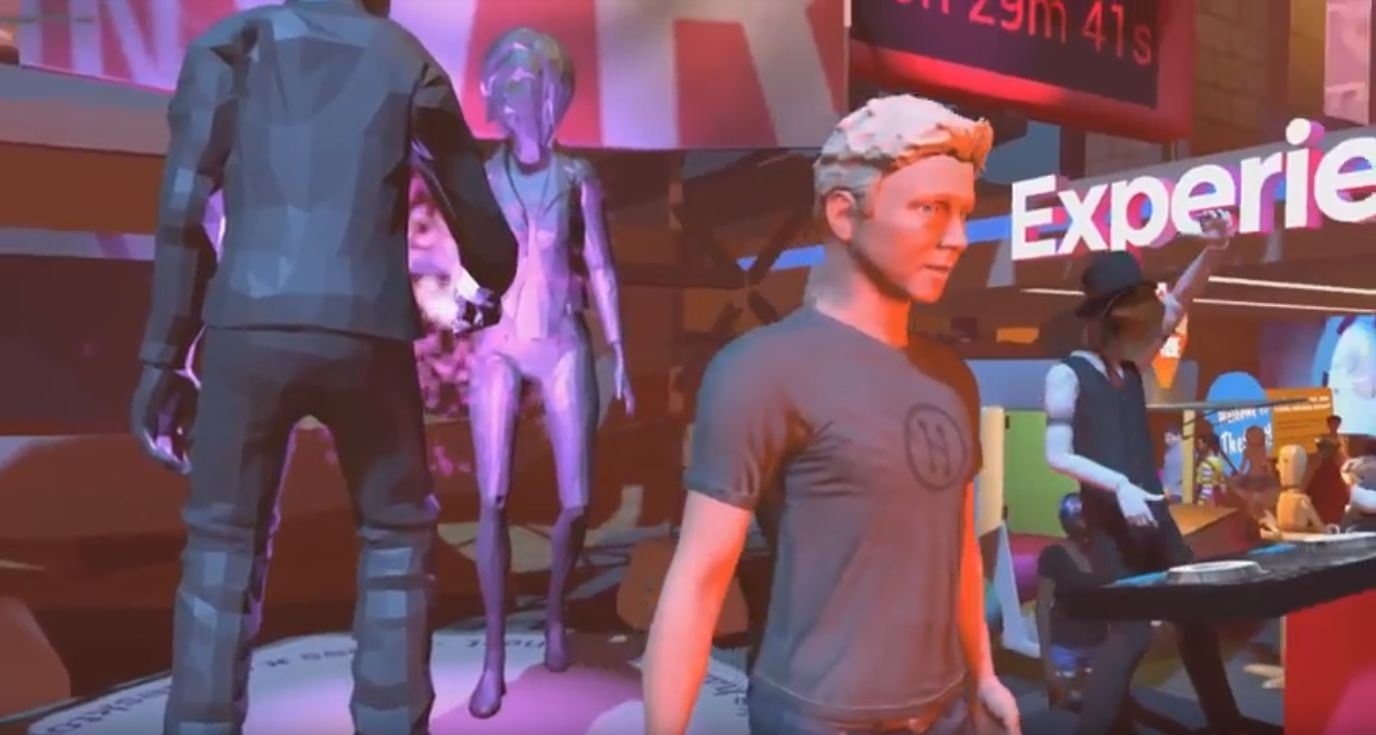
OSCC 2018: call for proposals and volunteers

Via OSCC

The 2018 OpenSimulator Community Conference (OSCC) will take place on Saturday 8th and Sunday 9th December 2018.

An annual conference that focuses on the developer and user community creating the OpenSimulator software.  Organised as a joint production by Core Developers of OpenSimulator and AvaCon, Inc., with major sponsors including  the University of California, Irvine, Institute for Virtual Environments and Computer Games and the Rockcliffe University Consortium.

Call for Proposals

The Conference for 2018 will feature a series of dynamic short presentations and panels that spotlight the best of the OpenSimulator platform and community, and a Call for Proposals has been issued to individuals or groups who are shaping the Metaverse.

The speaker sessions offer 20-minute presentations to engage the mind while the community-sponsored tours, and on the Expo regions, content give-aways and Hypergrid explorations take attendees to faraway places. We are particularly interested in speakers who dramatically tell the story of their work and employ great 3D examples as props and graphics. In particular, the organisers encourage presentations that span current innovations and activities, performance artistry, educational simulations, innovative business cases or  have a publication or track record of real world use.

Those wishing o submit a proposal, please complete the proposal application form. If you have questions or need more information, please contact the conference organisers.

Key Dates & Deadlines

  • October 22nd, 2018 – Proposals are due by 11:59 PM PST (Pacific Standard Time).
  • October 29th, 2018 – Proposal  acceptance emails and with conference information.
  • November 3rd, 2018 – Accepted speakers must register for the conference to create an entry in the conference schedule and the program.
  • November 10th, 2018 – Speaker Orientation & Training sessions and Presenter Booth Setup to prepare speakers for the conference.
  • November 17th, 2018 – Deadline for stage props and audio-visuals (beyond textures) for conference program.
  • December 8-9th, 2018 – OSCC18 Conference dates.
Image courtesy of the OpenSimulator Community Conference

Volunteers

The conference needs volunteers to help in a range of activities:

  • Greeters / audience assistances
  • Moderators
  • Builders
  • Scripters
  • Social Media / Communications
  • Streaming and Technical Support

Those interested in volunteering can do so via the Volunteer Sign-up form,  Depending upon interests, volunteers can select more than one role if they wish.

Image courtesy of the OpenSimulator Community Conference

About the Conference

The OpenSimulator Community Conference is an annual conference that focuses on the developer and user community creating the OpenSimulator software. The conference is a joint production by Core Developers of OpenSimulator and AvaCon, Inc., a 501(c)(3) non-profit organization dedicated to promoting the growth, enhancement, and development of the metaverse, virtual worlds, augmented reality, and 3D immersive and virtual spaces.  The conference features a day of presentations, panels, keynote sessions, and social events across diverse sectors of the OpenSimulator user base.

Space Sunday: exomoons, dwarf planets and spaceflight plans

Artist’s impression of the exoplanet Kepler-1625b, transiting the star, with the candidate exomoon in tow. Credit: Dan Durda

A pair of Columbia University astronomers using NASA’s Hubble Space Telescope and Kepler Space Telescope have assembled compelling evidence for the existence of a Neptune-size moon orbiting a gas-giant planet 8,000 light-years away. If their findings are correct, it will be the first moon found orbiting a planet beyond our solar system.

The planet, Kepler 1625b, is between 5.9 and 11.67 times the size of Jupiter. It orbits a G-class main sequence star with around 8% more mass than our own in the constellation of Cygnus, every 287.4 days. The planet has been known about for some time, but whilst re-examining the data gathered by the Kepler space observatory that led to its discovery, Alex Teachey and David Kipping from the University of Columbia noticed anomalies in the way the planet dimmed the star’s light as it transited between the star and Kepler – anomalies that in ordinary circumstances should not have been there, but which were enough to get the astronomers 40 hours observing time using the Hubble Space Telescope.

Able to study the star with four times greater precision than Kepler, HST was used to observe Kepler 1625 both before and during one of the planet’s 19.5 hour transits across the star. In doing so, it recorded not only the anticipated dip in the star’s brightness, but also a second dimming along the same orbital path, starting some 3.5 hours after the first had started. The Hubble data also revealed that Kepler 1625b started its transit across the star 1.25 hours earlier than it should have.

When put together, the most likely explanation for both the “premature” transit and the extra dimming of light from Kepler 1625 is that a vary large, somewhat distance moon is orbiting the Jupiter-like Kepler 1625b. The presence of such a body in orbit would set a common barycentre (centre of gravity) between the planet and the moon that would cause the planet to “wobble” from its predicted location in its orbit, leading to variations in the start times for transits. Similarly, the presence of a large moon orbiting it would cause the additional dimming in the star’s brightness during a transit.

Diagram of the sequence of HST photometric observations. The purple object represents the planet Kepler 1625b, and the smaller green object is that exomoon, showing how the latter transits the star about 3.5 hours after the planet. Credit: NASA / ESA / D. Kipping (Columbia University), and A. Field (STScI)

Before the exomoon’s existence can be confirmed, further observations by Hubble are required. However, the preliminary data gathered suggests it could be around 1.5 percent the mass of its parent star – which is a very close mass-ratio between the Earth and its moon. However, given both the massive planet and its moon appear to both be gaseous in nature, should the moon’s existence be confirmed, it raises intriguing questions as to how it was formed.

In the case of solid satellites like the Moon, their creation is likely due to a collision between Earth and another planetary body that left debris that coalesced into the Moon. Such a path of formation for a gaseous body, however, is exceptionally unlikely: anything impacting with Kepler 1625b, for example, would likely be absorbed into it, rather than throwing off matter to form a separate orbiting body.

One of the most intriguing theories for the moon’s possible existence is that it may have started life as a separate planet orbiting Kepler 1625, but over time it came under the gravitational influence of the massive Kepler 1625b, and over time was drawn into orbit around it. If this should prove to be the case, it could have interesting implications for future exoplanets and the moons that may be found orbiting them.

NASA Delays Commercial Crew Launches and Tensions with Russia Increase

NASA has confirmed that the first uncrewed test flights of the SpaceX Crew Dragon and Boeing CST 100 Starliner commercial crew transports intended to fly astronauts to the International Space Station (ISS) have been delayed.

SpaceX Crew Dragon (l) and the Boeing CST-100 Starliner: initial flights delayed. Credit: SpaceX / Boeing

Under the original schedule, the uncrewed flight test for Crew Dragon had been scheduled for November 2018 and would have been followed by a 2-week crewed flight with NASA astronauts Bob Behnken and Doug Hurley in April 2019.  Under the new schedule, these flights will now  occur in January and June 2019 respectively.

Similarly, the first uncrewed flight for the CST-100 Starliner is now planned for March 2019 with the crewed test previously scheduled for mid-2019 now set for August 2019.

If SpaceX and Boeing maintain the new schedule, NASA believe the first operational commercial crew mission could take place in August 2019 – which would suggest a Crew Dragon would be the vehicle used, given the CST-100 would just have completed its crewed test flight, requiring some post-mission analysis. The second operational will then follow in December 2019. Both of these dates straddle the end to the US government’s extended contract to use seats on Russia’s Soyuz vehicle to send US astronauts to and from the ISS.

While unrelated, the news of the delays came as US / Russia tensions concerning the hole found in a Soyuz capsule became strained once more.

As I’ve previously noted (see here and here), at the end of August a slow leak was detected in a Soyuz MS-08 docked at the ISS. Initially, it was thought the hole causing the leak was the result of debris puncturing the Soyuz hull. However, it emerged the hole appears to have been drilled. Core thinking around it was that a mistake had been made during the vehicle’s fabrication or in preparing it for flight at the Baikonur cosmodrome, and then hastily covered up. In either case, it is believed a substance unfit for purpose was used in the repair, which gradually degraded in space prior to failing completely, causing the pressure loss.

Continue reading “Space Sunday: exomoons, dwarf planets and spaceflight plans”

Space Sunday: roadmaps, space stations, rovers and storms

A dramatic illustration from the latest NASA report on reaching the Moon and Mars with human space flights. Credit: NASA

On September 28th, 2018, NASA issued its latest report on how it hopes to return humans to the Moon and then travel onwards to Mars. Entitled the National Space Exploration Campaign Report, it’s a bit of a curate’s egg of things; just 21 pages in length, it offers a lot of aspiration, not always with underlying detail; avoids hard decisions while offering open-ended time lines; presents time lines as a road map,  but avoids mention of precisely how to reach the destination(s) or the cost of the journey(s).

In all, the report lays out three broad aims:  expanding low Earth orbit activities to include commercial operators, operating their own orbital facilities – and possibly the International Space Station; moving outwards to lunar orbit and from there to the surface of the Moon; then moving onwards to Mars. All are painted with very broad brush strokes and leave much unsaid.

LOP-G is now seen as a “foundational gateway” system for reaching both the Moon and Mars – click for full size, if required. Credit: NASA

The lunar aspects of the report, for example, cover the incremental development of the Lunar Orbital Platform-Gateway (LOP-G) and how it could theoretically help develop capabilities that can be used in vehicles intended to carry humans to Mars. It also outlines how NASA can build towards human operations on the Moon through an incremental development of automated capabilities that both increase our understanding of the Moon, the resources it offers, etc., to a point where the first crew-carrying lander vehicle could be ready “in the late 2020s”. But when it comes to detailed ideas for the architecture of a human presence on the Moon, things are left vague.

In terms of Earth orbit operations, the report points to NASA transitioning away from operating the International Space Station to leasing facilities from the private sector; but precisely how these commercial orbital platforms are to be built is unclear, other than referencing the US $150 million of NASA’s that will be used to encourage commercial development of such platforms from 2019. $150 million is a very small amount when you consider the $100 billion construction cost of the ISS; without some very clear-cut, real-time ROI being evidenced for the private sector, it’s hard to see the ISS being supported by multiple commercial platforms of equatable capabilities in just six years.

NASA’s “swoosh” chart outlining the agency’s plans for lunar exploration, and a common element is recent presentations and a part of the new report. Credit: NASA

To be fair, some of the lack of detail within the report is understandable on a number of levels. In 1989, for example, NASA produced the Space Exploration Initiative (SEI), a report outlining how it would take humans to Earth orbit, thence to the Moon and thence to Mars. The report offered a massive vision: 30 years of development and exploration lading up to humans landing on Mars – as a suitable price tag to go with it: US $430 billion. That’s the kind of figure that would have had Congress dropping the report into the bottom of a very deep draw (possibly in a locked filing cabinet stuck in a disused lavatory with a sign on the door saying Beware of the Leopard, somewhere in the basement of Capitol Hill, if I might re-purpose a quote).

There’s also the fact that it’s hard to get any politico to sign up to something that has end results they’re unlikely to be in office long enough to see. This was certainly the case with SEI, and it was something John F. Kennedy understood when he set NASA the goal of “landing a man on the Moon and returning him safely to the Earth” within a decade. Thus, it is perhaps understandable why this report doesn’t stray that far beyond 2024, preferring to leave matters after that date pretty much as “TBD”.

However, in the course of the last few years, NASA has been repeatedly criticised by the US Congress for refusing to present  specifics when outlining its intentions. In this respect, the pendulum seems to have swung too far: from a gung-ho attitude of “gives us the money and we’ll deliver – although it could take longer than you’ll be around” evidenced with SEI, to an almost timid, “We’d like to do this, but we’ll sort out how later, so you don’t have to worry about the price”, which is perhaps as equally as dangerous when trying to set out where you’d like to go and how you’d like to get there.

The View from an Asteroid

In my previous Space Sunday update, I covered the arrival of two small Japanese landers on the surface of asteroid 162173 Ryugu. Since then, both of these little vehicles have been returning images and data as they sit on the asteroid’s surface and / or hop around it.

While the rovers – MINERVA-II1 A and B – have both revealed the surface of Ryugu to be rocky, the images are still stunning, especially those stitched together to form a time-lapse video showing the Sun passing across the sky above rover 1 B as the asteroid tumbles along its orbit.

The rovers are two of four vehicles that will be delivered to the surface of Ryugu by Japan’s Hayabusha 2 satellite, currently orbiting the asteroid. Together the rovers and orbiter will probe and study Ryugu in detail, with the orbiter also gathering samples from both the surface and sub-surface, which it will return to Earth for analysis at the end of 2020.

Continue reading “Space Sunday: roadmaps, space stations, rovers and storms”

Oculus Quest: the new Oculus standalone headset system

The Oculus Quest (centre) with the Go and Rift flanking it. Credit: Facebook.

Update, Thursday September 27th, 2018: hands-on reviews, such as this one from Techcrunch, report the Quest is powered by a Snapdragon 835 chipset.

On Wednesday, September 26th, Facebook announced the Oculus Quest, billed as their “first all-in-one VR gaming system”. The new headset is due to start shipping in Spring 2019 with a price point of US $399 and 64 GB of on-board storage.

The Quest isn’t actually the first Oculus standalone headset unit – that honour went to the Oculus Go, launched in May 2018. It provides an experience similar to the Gear VR system offered by Samsung (and using Oculus optical hardware), and sells for US $199 with 32 GB, or US $249 with US $64 GB of storage. The unit was seen as easy to use, albeit with limitations.

Oculus Quest is intended to sit between the Rift and Go, and “first” used with it is in relation to the “VR gaming system”, as Facebook see this new headset being specifically about gaming. It offers capabilities far above those of Go, and even exceeding the Rift. These capabilities include:

  • 1600 x 1440 per eye resolution.
  • Two Oculus Touch style controllers.
  • 6DoF (6 degrees of freedom).
  • Built-in 360 degree audio.
  • Adjustable spacing for its lenses.
  • Four ultra wide-angle sensors for motion tracking / positioning, with “arena sized” tracking capabilities.
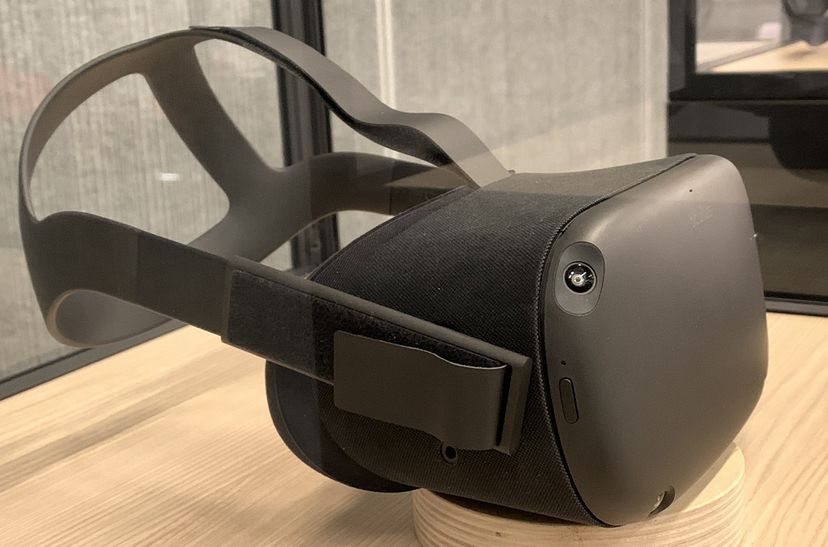
The Oculus Quest on display at Connect 5. Everything – battery, CPU, GPU, etc., is contained within the headset. No separate battery case processing unit. Credit: Windows Central

As a standalone unit, the headset uses a dedicated operating system, based on Android (as does the Go), so it will not natively run existing Rift VR titles, although it is anticipated that Rift-focused games will be ported to Quest alongside Quest’s own list of titles – there will be a portfolio of at least 50 titles available when the Quest starts shipping. Interestingly Facebook have indicated that they plan to have a Single button” process to allow Quest centric games to be converted for use on the Rift “with no code changes”.

The key differentiator between Quest and the Rift – other than the standalone nature of Quest – is, as mentioned above, that Quest is being touted as a games-centric headset, while the Rift is seen as more “video” oriented. However, and allowing for development of titles and applications, it’s hard to see such an artificial division between the two remaining in place over time.

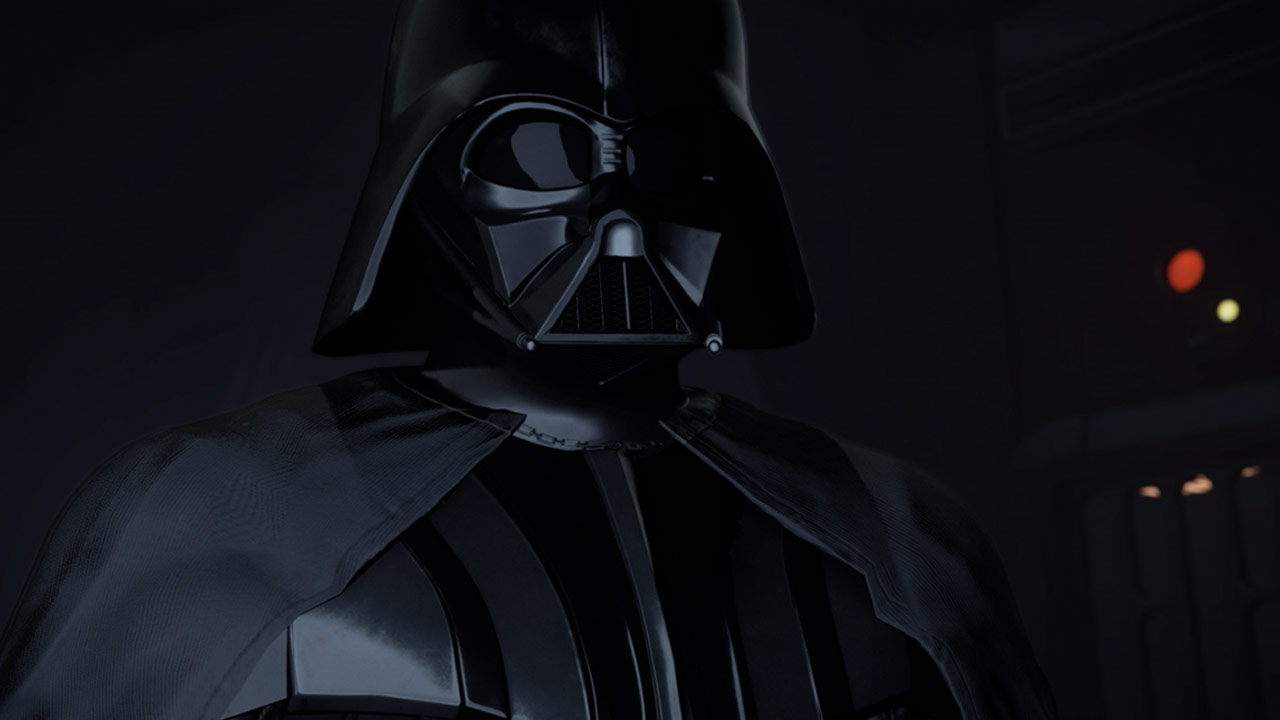
In keeping with this, the 50-title line-up for when Oculus Quest starts shipping is games centric, and will include a three-part cinematic Star Wars “6DOF” experience, centred on Darth Vader. Called Vader Immortal, players using it will, to quote, “Be able to step inside the world of Star Wars in the comfort of your living room and, for the first time, truly feel free.” Also as a part of the games element, Facebook note that Quest headsets can be used in multi-player scenarios right out of the box.

An image said to be from Vader Immortal, the new Lucasfilm 3-part VR experience set to launch when the Oculus Quest starts shipping in 2019. Credit: Starwars.com

The sensor system on Quest, now officially called Oculus Insight, sounds particularly impressive. The four ultra-wide-angle sensors coupled with “advanced computer vision algorithms”, allow for full position tracking in real-time. the sensors look for edges, corners, walls and furniture to build up a 3D map of the wearer’s surroundings, while input from the headset’s gyroscope and accelerometer allows an estimate of the wearer’s head position to be calculated every millisecond. Quest also includes a capability called “multi-room guardian”, allowing multiple environments where the headset may be used to be mapped and saved, removing the need for constant recalibration when using Quest in different locations.

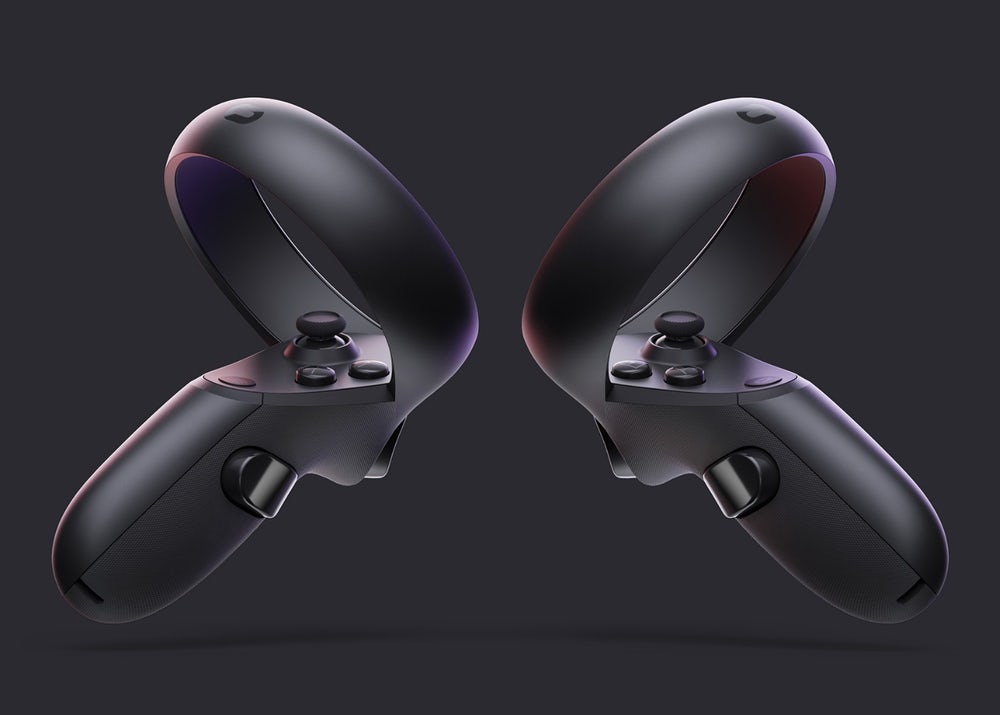
The new Quest controllers (seen below) are very similar in nature to the Touch controllers, offering joysticks, menu buttons, a pair of trigger buttons for each hand, and an AB/XY array. The major difference is a new halo that goes around the hand. It is thought this may link with another element of the Oculus Quest ecosystem: an RGB sensor, which may be used to translate controller location in virtual space, and which can double as a “camera” a Quest wearer can toggle in order to see a (greyscale?) view of their real-life surroundings.

The Oculus Quest controllers, similar in nature to the Oculus Touch. Credit: Facebook

No detailed specifications have been given in terms of CPU / GPU for Quest – although it is believed a  high-end Qualcomm Snapdragon is providing the necessary processing. In introducing the headset, Facebook refer to it as rounding out their “first generation” of VR systems:

With the introduction of Oculus Quest, we’ve completed our first generation of best-in-class VR headsets. Oculus Go remains the easiest and most affordable way to get into VR, while Oculus Rift leverages the power of your PC to push the limits of what’s possible. Thanks to Oculus Quest, we’re now able to combine the best of both worlds and welcome even more people into the VR community.

Oculus VR, Introducing the Oculus Quest, September 26th, 2018

With HTC recently having launched a US $300 wireless adaptor for the HTC Vive and Vive Pro – both of which require a high-end gaming rig, Oculus VR may just, with this announcement of the Quest priced at the same level as the Rift, stolen a march on their competition. That said, it’s likely still not enough to get me to invest in a VR headset just yet. I’ll see what the next generation of hardware brings. But for those who are interested in the Oculus Quest, hands-on reviews should be appearing on the web, “real soon now”, to coin a phrase.

Space Sunday: Moon trips, Mr Spock’s “home” and roving an asteroid

The updated BFR / BFS combination, as revealed on September 17th, 2018. Credit: SpaceX

On Monday, September 17th, SpaceX CEO, Elon Musk, provided an update on the company’s massive Big Falcon Rocket (BFR) and Big Falcon Ship (BFS –  previously referred to simply as “the ship” or “the spaceship”), and revealed the first fare-paying passenger who will supposedly fly around the Moon aboard a BFS some time in the 2020s.

BFR has been in development since 2012/13. Designed to be fully reusable, it was initially referred to as the Mars Colonial Transport (MCT) – reflecting the company’s intention to use it to send humans to Mars. In 2016, SpaceX revealed the first formal design for the vehicle, which had been renamed the Interplanetary Transport System (ITS) to reflect the fact it could fulfil a number of roles. At that time, the vehicle  – comprising a first stage booster and upper stage starship – was to be a 12 metre (39 ft) diameter, 122 m (400 ft) tall monster. By 2017, it had been renamed the BFR (for “Big Falcon Rocket”), and redesigned to be 9 m (29.5 ft) in diameter and 106 m (347 ft) tall.

With the 2018 presentation, Musk revealed further design changes to the system, most notably with the upper stage spaceship, the BFS, some of which give it very retro rocket ship look.

 
Left: The evolution of the BFR from 2016 (as the ITS) to 2018; renderings via the Everyday Astronaut. Right: an animated comparison between the 2017 BFS and the 3-finned 2018 variant (from an idea by Overlook Horizon).

In particular, the BFS now sports three large fins at its rear end. All three are intended to be landing legs – the BFS being designed to land vertically – with two of them actuated to move up and down as flight control surfaces during atmospheric decent. These are matched by two forward actuated canards, also designed to provide aerodynamic control during a descent through an atmosphere.

Two less obvious changes are an increase forward payload section and the design of the nose area of the vehicle, which includes a much larger forward “canopy” design than previous iterations, and an update to the BFS’s motors. Originally designed to be powered by 7 of the new SpaceX Raptor engine optimised for vacuum operations, the BFS will now initially be powered by seven of the same Raptor motors that will be used on the vehicle’s first stage (which uses a total of 31), optimised for thrust in an atmosphere.

The redesigned BFS includes new fore and aft actuated control surfaces for atmospheric entry, and an enlarged crew / cargo space. Credit: SpaceX

Elements of the first BFR system have been under construction for the last 12-18 months. These include one of the fuel tanks, and the initial hull rings, and Musk claims that the company hope to have the first BFS prototype ready for initial “hopper flights” – lifting itself off the ground under thrust and then landing again – by the end of 2019. SpaceX then plan to run high altitude testing of BFS in 2020, together with initial flights of the core stage as well.

Overall, the goal is to have the first BFR / BFS combination ready for orbital flight tests in 2021, building towards the flight around the Moon, which the company has earmarked for 2023.

The first completed cylinder section of the prototype BFR. just visible to the left is a part of one of the tanks that will eventually go inside the vehicle. Credit: SpaceX via The Independent

This is an incredibly ambitious time frame, one most unlikely to be achieved. SpaceX would appear to have some significant engineering challenges to overcome. For example, by combining the landing legs with control surfaces, how are they going to ensure the craft can land sufficiently gently on another surface without damaging the mechanisms designed to move the fins, which will be required when the vehicle returns to earth.

While there was always a risk that landing struts (as were originally going to be used with BFS) might suffer damage as a result of a “hard” landing on the Moon or Mars, integrating landing systems into surfaces vital to the vehicle’s (and a crew’s)  safe return to Earth as planned by SpaceX, would appear to add further complexity to the vehicle – or call for contingencies to be able to transfer a returning crew to another vehicle on their return to Earth orbit should one of systems use to actuate the fins suffer damage when landing on the Moon or Mars.

Another view of BFS showing the seven Raptor engines and the additional cargo bays at the rear of the vehicle. This configuration assumes the Raptor engines are the same as those used on the core stage, although the new design means BFS can be equipped with vacuum optimised motors, with larger exhaust bells (with the removal of the ring of cargo bays) to offer better performance in space. Credit: SpaceX

Another of the questions from where is BFR is likely to be launched. When initially revealed with a 12-metre diameter, it required a purpose-built launch facility. But with the core now reduced to a 9 metre diameter, BFR could in theory be launched from the SpaceX facilities at Launch Complex 39A, Kennedy Space Centre (KSC), Florida.

More particularly is the entire question of whether or not such a behemoth is really commercially viable. Payloads are getting progressively smaller, lighter and more capable;  SpaceX itself is transitioning its Flacon 9 flights to a mix of dedicated launches and “transporter” (more usually called “rideshare”) launch, combining several customers into one launch, thus lowering the cost per customer.

That’s fine for a vehicle with an all-up semi-useable payload capacity of around 15-16 tonnes, it only takes perhaps a third of that capacity to reach the point where the launch is revenue-earning and the lead time for customers seeing their satellites in space is relatively short. But multiply that out to the scale of Starship, ad the lead-time in getting sufficient customers to fill the a vehicle even one-third full in order to lift income sufficiently over launch costs (assuming the new vehicle is as low-cost as Falcon 9) could be a real problem.

In discussing plans, Musk revealed a final decision on BFR launch facilities has yet to be made, and hinted it might even initially fly from a floating platform. This was an idea first put forward in one of the company’s promotional videos for the system, suggesting it could fly up to 100 people between New York City harbour and Shanghai harbour in 40 minutes. This, simply put, will not happen – because the idea doesn’t work either economically or practically.

Continue reading “Space Sunday: Moon trips, Mr Spock’s “home” and roving an asteroid”

Be a High Fidelity helper and earn HFCs

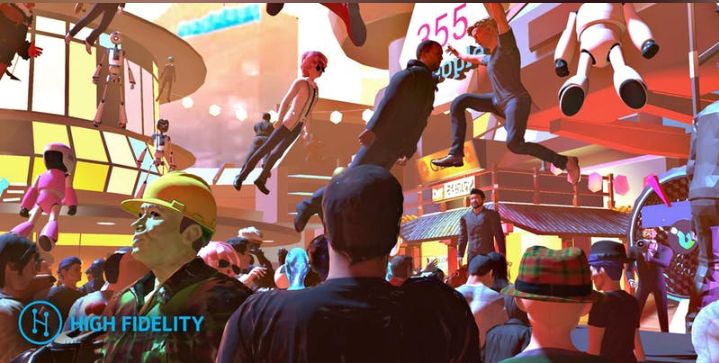
A High Fidelity Load Test. Credit: High Fidelity

High Fidelity’s next concurrency load test is due to take place on Saturday, October 6th, 2018. These monthly events are designed to drive avatar load testing within in a single continuous space within High Fidelity, providing the platform with a rigorous test as avatars meet, mingle, play games and generally have fun. The load tests are also a small part of High Fidelity’s The Road to One Billion in VR programme – seeing 1 billion people in VR environments (not just HiFi).

As I’ve previously reported, the events offer participants rewards in the form of High Fidelity Coins (HFCs) or a gift card or an Amazon credit – or, as with the September test, even have their rewards donated to the American Civil Liberties Union (ACLU) as a fiat money contribution.

Rewards are offered on a sliding scale, based on the number of participants, with the minimum value being equivalent to US $10. However, with the Saturday October 6th, 2018 load test, High Fidelity are offering some 15 volunteers to earn up to 30,000 HFCs (equivalent to Us $30) if they are willing to offer a maximum of 2 hours of their time in helping manage the event, by ensuring people participating are properly checked-in, and the company explains:

High Fidelity needs help checking-in all the people who signed up for the Road to a Billion event on Oct 6th.

Your job will be to roam the crowd and ask people if they signed up for the event and if so, check to see that they have automatically been checked in.

If they have not been checked in, your job will be to give them instructions on how to retrieve their Eventbrite ticket number so that you can manually check them in. We will provide you with the app to do all of this. Also, you will be given an avatar or shirt that will designate you as an official helper so that you are easy to spot and easy for us to tell people to find you.

This job pays 1500HFC an hour, and we need you to work for two hours. We advise you use Desktop mode to make this job easier.

Applicants need a good network connection, confidence using the High Fidelity client and a great attitude as you will be meeting lots of people!

If you’re an experience High Fidelity user, you can volunteer to help with checking-in participants by completing this volunteer form.

Philip Rosedale at the August 2018 load test in High Fidelity

In the load tests thus far, High Fidelity have gone from 197 to 356 avatars all active within a single space, and the company is hoping to have more than 500 on-board on the October 6th, 2018. To encourage this, the event will include new games, plus a Best Avatar contest with a 30,000 HFC first prize.

Those wishing to join the fun can register via Eventbrite (separate registering to the check-in volunteers noted above), with the event officially kicking-off at 11:00 PDT (although people generally turn up earlier than that).

To find out more about these tests, read  High Fidelity CEO Philip Rosedale’s blog post on them.