Space Sunday: A landing, a topple, a return and another failure

The Earth, brightly reflecting sunlight, sits above the horizon over Mare Crisium, the shadow of Firefly Aerospace’s Blue Ghost capturing the fact the lander was on the Moon. Credit: Firefly Aerospace

I’ve covered the US-led Project Artemis quite a lot in recent Space Sunday pieces, largely as a result of all the speculation about NASA’s Space Launch System (SLS) and Orion vehicle facing potential cancellation (for the tl;dr folk, whilst SLS is perceived as being “too expensive” the practicalities are that, like it or not, there is no launch capability available which could be easily “slotted-in” to Artemis to replace it any time soon). However, another reason for doing so, is the support work and missions related to Artemis are busily ramping up.

Back in January, Firefly Aerospace saw the launch of their Blue Ghost lunar lander on a shared ride to the Moon atop a SpaceX Falcon 9 rocket, its companion being the Japanese private-venture Hakuto-R Mission 2 lander Resilience. Whilst built and operated by Firefly Aerospace, Blue Ghost Mission 1 – which also has the mission title Ghost Riders in the Sky, named for the 1948 song of the same name – has been developed under NASA’s Commercial Lunar Payload Services (CLPS) programme, and thus has the official NASA designation (just to confuse things further) of CLPS TO 19D.

After a gentle cruise out to the Moon by steadily increasing its orbit distance from Earth until it could transfer to a distant lunar orbit and then slowly close on the Moon from there – thus requiring minimal propellant payload – the Blue Ghost vehicle touched-down on the Moon on March 2nd, 2025, becoming the first commercial lunar lander to reach the surface of the Moon and commence operations.

Another image from the Blue Ghose Lander, again showing the Earth above the horizon and reflected in the surface of one of the lander’s solar arrays. Credit: Blue Ghost

The vehicle is intended to have an operational lifespan of 14 days (one lunar day), and carries 10 experiments which utilise the lander’s solar power generation system. Roughly the size of a small car, the vehicle landed not in the southern polar regions of the Moon – the target area for Artemis missions – but within Mare Crisium, a 556 km basin to the north-east of Mare Tranquillitatis, the region in which Apollo 11 landed in 1969.

Despite this more northerly landing location, the mission’s objectives remain in line with Artemis, being intended to gather additional data on the properties of lunar regolith, together with its geophysical characteristics, as well as measuring the interactions between Earth magnetic field and the solar wind – all of which will help in the preparations for the long-term human exploration of the Moon and “routine” travel between Earth and cislunar space.

The location of Mare Crisium on the Moon, to the north-east of Mare Tranquillitatis where Apollo 11 landed in 1969. Credit: NASA

And if you’re wondering about Blue Ghost’s companion during the launch for Earth, Japan’s Resilience, which also carries a lunar rover, is taking the “scenic” route to the Moon, arriving there in early June 2025, at which point I’ll hopefully have an update on that mission.

However, Blue Ghost was not intended to be the only US lander reaching the Moon in early 2025. Also a part of NASA’s CLPS programme, the Athena lander, built and operated by Intuitive Machines, had been slated to arrive on the Moon and commence operations on March 6th, having also been launched on its way to the Moon atop a SpaceX Falcon 9 on February 27th, 2025.

Officially designated IM-2 / CLPS-3, the lander – christened Athena and classified by the company as a Nova-C lander – was the second lunar lander mission undertaken within the CLPS programme by Intuitive Machines, their first having been launched to, and reaching, the Moon in February 2024. However, that lander, called Odysseus, toppled over on landing (see: Space Sunday: Lunar topples, space drugs and wooden satellites), effectively ending that mission.

A artist’s impression of the MAPP rover driving away from the Athena lander. Credit: Intuitive Machines / Lunar Outpost

Like Odysseus, the IM-2 mission was targeting the Lunar South Polar Region for a landing, in this case the tallest mountain on the Moon to be given its own name (in 2022): Mons Mouton, named for Melba Roy Mouton, a pioneering African-American mathematician at NASA during the 1960s, the peak having previously been regarded as part of the broader Leibnitz plateau. In addition to its own science mission, the lander also carried a trio on small-scale landers – Grace, a hopper-style mini-rover also made by Intuitive Machines and massing just 1 kg; the Mobile Autonomous Prospecting Platform (MAPP), a 5-10 kg rover with a 15 kg payload built and operated by a consortium; and AstroAnt, a matchbox-size micro rover from MIT, which would have trundled around the back of MAPP using magnetic wheels taking measurements on the amount of heat absorption and heat radiation to help determine the thermal regulation requirements on future rovers operating within the temperature regimes of the lunar South Polar Region.

Both Athena and Odysseus share the same overall design, being very tall, slim vehicles with elevated centres of mass.  With Odysseus, this appeared to combine with a horizontal drift of the vehicle during its landing attempt (the vehicle’s telemetry indicated it was crabbing sideways at around 3.2 km/h at touch-down, rather than descending vertically), to cause it to topple over.

An AstroAnt “swarm rover” as developed by MIT. Credit: MIT

On March 6th, 2025, Athena appeared to suffer a similar fate: as the vehicle neared the surface of Mons Mouton, its motors kicked-up a plume of dust which prevented the vehicle’s lasers and rangefinders from guiding the spacecraft. While data was received to indicate Athena had landed, it also indicated the loss of one of the lander’s two communications antennas and that power was being generated by the vehicle’s solar arrays well below nominal levels.

Subsequent to the landing, the mission team placed Athena into a “safe” mode to conserve power. However, images taken by both the lander and from NASA’s Lunar Reconnaissance Orbiter (LRO) as it passed over the landing site confirmed Athena had toppled over on touch-down and to be laying in a small, shallow crater, either as a result of sideways drift in the final phase of landing or as a result of one of more landing legs overhanging the edge of the crater at touch-down.

An image returned by Intuitive Machine’s Athena lander, showing it lying on its side on the Moon following its March 6th, 2025 attempted landing. Credit: Intuitive Machines

Despite the fall, Intuitive Machines regard the mission as a “success” inasmuch as the vehicle returned data all the way up to the point of landing, and was able to briefly power-up some of the on-board instruments despite falling into the crater. However, given this is the second incident wherein a tall, slim lander with a high centre of mass has toppled over when landing in what is acknowledged to be one of the toughest and mostly unknown regions of the Moon to reach, it could  call into question the suitability of the SpaceX 50-metre tall human landing system (HLS) to successfully make similar landings within the environment.

X-37B Returns Home

Released in February 2025, this image from the USSF’s X-37B spaceplane was captured in October 2024, during the 7th mission of the OTV programme. Credit: United States Space Force

The US Space Force’s highly-secretive X-37B space plane returned to Earth on Friday, March 7th (UTC), marking the end of a 434-day mission in orbit. The 9-metre long automated vehicle – one of two currently operated by the USSF – originally lifted-off from Kennedy Space Centre’s Lunch Complex 39A (LC-39A) atop a SpaceX Falcon Heavy booster in December 2023, on the seventh overall flight of the Orbital Test Vehicle mission (OTV-7).

As with the previous six missions in the programme, much of OTV-7 was completed in a blanket of secrecy; however, unlike them, the mission did not continue to push the envelope of flight duration. Whereas the 2nd through 6th OTV flights repeatedly increased the number of days one of the vehicles could spend in orbit (from 224 days in the case of the first mission to just under 3 hours shy of 909 days in the case of OTV-6), this seventh flight was the second shortest to date.

Which is not so say it was without precedent; whilst the previous missions had been confined to the sphere of low-Earth orbit operations, OTV-7 saw the spacecraft placed into a highly elliptical orbit (HEO0, with a perigee of just 323 km, and an apogee of 38,838 km. This orbit not only illustrated the vehicle’s ability to operate at significant distances from Earth, but also allowed it to demonstrate its ability to using aerobraking – dipping into the upper reaches of Earth’s denser atmosphere as a means to both decelerate a space vehicle and / or to alter its orbit. Whilst often used by robotic missions to Mars and Venus, the aerobraking by OTV-7 marked a first for a US winged space vehicle, giving the X-37B an additional operational capability, such as detection avoidance by altering both orbital inclination and altitude during such a manoeuvre, a capability which could be extended to future generations of US military satellites.

In another departure from previous missions, in February 2025, the US Department of Defense (DoD) released images taken from the X-37B while in space – the first time any such pictures of the vehicle on-orbit have entered the public domain.

Following a de-orbit burn of its main propulsion system, the X-37B vehicle successfully re-entered the Earth’s atmosphere and glided to a landing on Vandenberg Runway 12, wheels touching down at 07:22 UTVC on Friday, March 7th, 2025. There is obviously no word on when one of the vehicles might next be placed into orbit.

Starship Blows It – Again

On March 6th, 2025, and less than two months after their previous attempt, SpaceX tried to deliver one of their Starship vehicles onto a sub-orbital flight. Called Integrated Flight Test 8 (IFT-8), the flight was intended to be something of a repeat of January’s IFT-7 – and it turned to be almost a direct carbon copy of that flight in more ways than intended.

The primary goals of the mission were to:

  • Launch the combined vehicle and recover the booster at the launch site.
  • Deliver a Starship “block 2” vehicle incorporating numerous design changes into a sub-orbital track and deploy a series of dummy Starlink satellites & carry out an on-orbit re-light of some of the vehicle’s engines to simulate a de-orbit burn.
  • Starship re-entry and possible splashdown, testing new thermal projection system tiles and the function of the redesigned forward aerodynamic flaps.

What was not on the cards was an almost to-the-minute loss of the Starship vehicle in what appears to have been very similar circumstances to the last flight – and with an initially similar aftermath.

The catcher is ready: the Super Heavy booster used in IFT-8 decelerates on three engines as it closes on the launch tower at Boca Chica in readiness for a perfect “catch”. Credit: SpaceX

The first goal of the mission was carried out successfully: the 123-metre tall stack of Super Heavy vehicle and Starship vehicle departed the launch facility at Boca Chica, Texas, at 23:30 UTC, with the booster pushing the Starship up to the assigned “hot staging” altitude. At this point, the vehicles separated, and the booster completed the necessary “boost back” operations to return to the launch site and be “caught” by the “chopstick” arms on the launch tower 7 minutes and one second after its initial departure.

However, and echoing the events of January’s IFT-7, the Starship vehicle encountered what appear to again be engine / engine bay related issues. At 7 minutes 45 seconds into the flight, images from inside the vehicle’s engine skirt showed both clouds of propellant gases streaming around the exhaust bells of the inner three sea-level Raptor engines, together with signs of some form of burn-through on the engine bell of one of the outer large vacuum Raptor engines (referred to as “Rvacs”). The images were followed at 8:04 into the flight by the premature shut-down of an Rvac motor, followed in rapid succession by all three sea-level engines.

First indications: on the left, signs of a fire burning through part of an Rvac exhaust bell can be seen circled, while right-of centre, a plume of propellant gas can be seen passing over one of the three sea-level engine bells prior to entering the exhaust flow. Credit: SpaceX

With just two fixed Rvac motors running, the vehicle entered an uncontrolled tumble and likely started to break-up somewhere between 9:19 and 9:30 into the flight. Shortly after this, observers in parts of the Caribbean, from the Dominican Republic to the Bahamas, and as far north as Florida’s Space Coast, reported seeing the vehicle explode and debris falling. As a result, and as with IFT-7, the FAA implemented a number of debris response areas along the vehicle’s flight path over the Greater Antilles, closing off airspace. This resulted in some flights either being placed in holding patterns outside the threat areas, or being diverted to other airports or being held on the ground.

Following the loss of the vehicle, the FAA once again suspended the Starship launch license and announced a mishap investigation to be led by SpaceX. This is common practice – the operator leading the investigation into the loss of their vehicle, with FAA having oversight and a final say in allowing the resumption of flights. However, what is far from usual is that the launch operator takes it upon itself to unilaterally declare the issues surrounding the vehicle loss had been investigated and resolved, and launches would therefore be resuming. However, this is precisely what happened in the case of IFT-7 on February 24th, 2025, with the FAA (now very much under the thumb of the SpaceX CEO in his “special appointment” role within the Trump administration) releasing the license to allow Starship operations to resume whilst leaving their investigation open.

As such, there are significant question to be asked in relation to both what actually happened following IFT-7 in terms of issue rectification, whether the loss of IFT-8 might indicate a significant design flaw in the Starship “block 2” vehicle, and whether or not the FAA’s ability to properly manage oversight of commercial space companies – or at least SpaceX – may have been compromised given the SpaceX CEO’s new position of authority within the Trump administration (although getting an answer to this question is highly unlikely).

Space Sunday: debris and the Kessler syndrome; more Artemis

Space debris: defunct satellites, rocket stages, launch vehicle elements like payload fairings, complete or fragmented, has increasingly cluttered the space around Earth since the birth of the space age and now poses multiple threats. Credit: ESA

I’ve written about the issues of orbital space debris several times in these pages. It is estimated that there are 150 million pieces of space junk surrounding Earth. The vast majority of this debris is too small to be readily detected – minute pieces smaller than a centimetre; still large enough to do mischief to a satellite or other orbital vehicle, particularly if a cloud of them happen to strike – but of no significant threat to those of us on Earth or flying through the sky.

However, there are between 25,857 and 56,450 large object orbiting the Earth; of these, between 10,000 and 12,500 are operational satellites (the numbers vary based on the collective orbital regions studied), and the rest defunct satellites, rocket stages, payload fairing and other debris large enough to pose a range of issues. These present a range of problems, some of which are obvious, others perhaps less so.

For example, satellites and rocket stages in low-Earth orbit (LEO) can be directed to re-enter the atmosphere so that any parts surviving re-entry “safely” fall into the Pacific Ocean at “Point Nemo” (officially called the oceanic pole of inaccessibility), the furthest point from land in any ocean or sea, and a place 400 km from the nearest air or marine route. However, as “safe” as this is, as I recently noted – they result in an increase in high-altitude pollutants such as aluminium oxides that is on the increase (as I noted in that article, SpaceX’s Starlink is now responsible for some 40% of debris burning-up in the upper atmosphere and creating up to 5 tonnes of (mostly) aluminium oxide dumped in the mesosphere and stratosphere per day).

The Japanese ispace Hakuto-R 2 lunar lander mission, launched on January 15th, 2025, captured this image of Earth on January 31st, 2025. It is looking directly down on Point Nemo – the “spacecraft graveyard”. Credit: ispace

There are others who are less considerate in what happens to their satellites and the expended stages of their rockets. Russia, for example, has a habit of taking pot-shots at its own satellites, blowing them up (and thus increasing the amount of fast-moving debris and adding to the general confusion, whilst China just tends to leave rocket stages to make an uncontrolled re-entry which, whilst pointing in the general direction of Point Nemo, could equally result in debris striking populated areas.

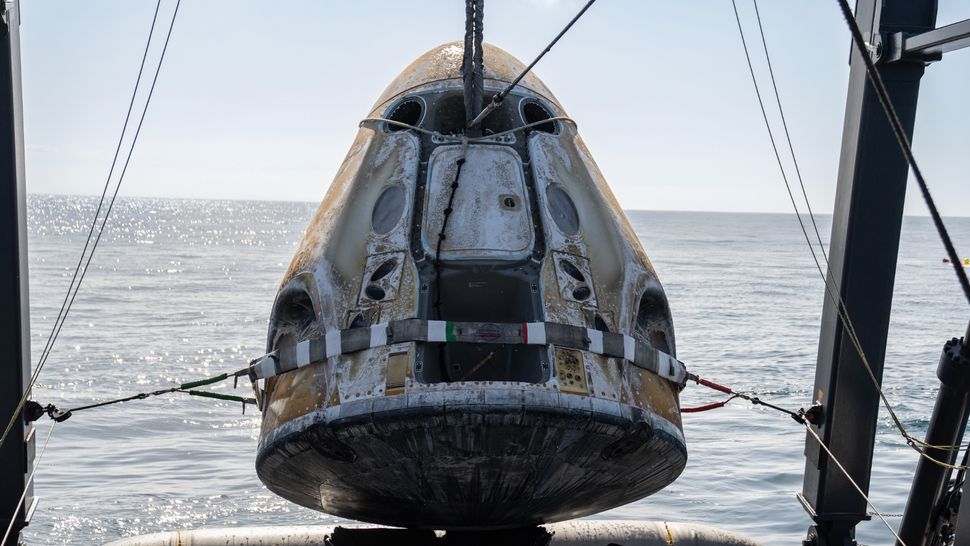
Even SpaceX has been a little cavalier; three of their service modules – or “Trunks” – from Crew Dragon missions have survived re-entry to come down near populated areas. The first was largely glossed over (it fell on Australia); the next two came down in America – one within a glamping centre, the other actually striking a house in Florida (fortunately without loss of life or injury). These two were enough to persuade NASA and SpaceX to move Crew Dragon splashdowns from the Atlantic to the Pacific Ocean, so the vehicles would not be re-entering the atmosphere over the continental United States.

A piece of debris linked to the Crew-7 Dragon trunk that landed within a glamping site in North Carolina in May 2024. Credit: Future/Brett Tingley

However, this is just the tip of the iceberg. Not only is there a vast amount of debris occupying the various orbital planes – low Earth orbit (LEO), medium Earth orbit (MEO), Geostationary orbit (GEO), Sun synchronous orbit  (SSO) – over the years all of the smaller debris previously mentioned has come to be spread more broadly around the Earth and across different altitudes. And the amount of potential junk we’re casually lobbing up in the form of smallsats viewed as “no bother” as even in an uncontrolled re-entry at the end of their useful life, they will completely burn up, together with the rocket stages used to get them there, is now accelerating. In 2024, for example, there were 263 launches world-wide, most of them delivering multiple satellites to various orbits and leaving upper stages in what are called “superspreader orbits” – orbit beyond those occupied by satellites, so as to minimise collision risks between them. Taken together, all of this increases the risk of collisions – and not just between a couple of objects; there is a very real risk of one or more collisions leading to an event referenced under the term Kessler syndrome.

Also called collisional cascading, the Kessler syndrome envisages a  single collision between two fast-moving orbital objects generating debris which goes on to strike other orbital objects, shattering them, causing more debris, and so on through a cascading set of collisions that could destroy entire networks of satellites – and orbital facilities like space stations together with orbiting crewed space vehicles.  If you’ve seen the 2013 film Gravity starring and Sandra Bullock and George Clooney, you’ll have seen a visualisation of a Kessler syndrome event.

Kessler syndrome is particularly relevant to the crowded domain of low Earth orbit which is currently getting packed out thanks to the arrival of megaconstellations such as Starlink (currently 7,000 active and inactive, with a plan for 12,000 potentially rising to 40,000 in both LEO and MEO, together with China’s planned 14,000 strong Qianfan (“Thousand Sails”). Because of these and the overall increase of commercial activities in LEO, the risk of a Kessler syndrome event occurring is seen as being on the rise – as is its potential range of impact (no pun intended).

A 2023 axonometric view of Earth showing the space debris situation in different kinds of orbits around Earth. Credit: Pablo Carlos Budassi

In particular, a study conducted by a team from the University of British Columbia (UBC) and published in Scientific Reports noted that a widespread collisional cascade could result in multiple large-scale debris elements entering the atmosphere to rain down fragments across wides areas, not only putting lives on the ground at risk but also causing potential disruptions to air travel and airspace closures, even when there is no direct threat to people on the ground.

In this latter regard, the report additionally notes that even without a Kessler syndrome event, particularly busy concentrations of air routes – like southern Europe, the Mediterranean Sea and Middle East; the Caribbean and Central America; south-east Asia through the Philippines and around the South China Sea – now have a 1 in 4 risk of suffering significant disruption as a result of orbital debris falling through them, and this could rise to 1 in 3 in the next few years (although the chances of an individual aircraft actually being struck by debris will remain around 1 in 430,000).

The report also notes that this potential for disruption is not limited to just space debris re-entering the atmosphere; the increasing number of launches around the world could see something of an increase in vehicle losses at high altitudes during ascent, also causing short-term airspace restrictions and aircraft diversions. In this, the report references the loss of the Starship vehicle during the January 16th, 2025 IFT-7 sub-orbital flight by SpaceX.  The vehicle in question exploded at an attitude of 124 km, with wreckage falling over the airspace of the Caribbean and Greater Antilles, resulting in aircraft being diverted and airspace being temporary restricted to avoid the risk of aircraft passing through clouds of small debris which could be ingested by their engines with unwanted results. Also, and as a by-the-by, this mishap resulted in 85.5 tonnes of pollutants in the form of metal oxides and nitrogen oxides oxides dumped into the upper atmosphere – that’s 1/3 of the annual levels of such pollutants dumped on us from meteorites burning up in the atmosphere.


A video captured from an airliner flying over the Greater Antilles showing the break-up of the SpaceX Starship on January 16th, 2025

All of which underlines the fact that whilst space companies point towards their use of more environmentally-friendly propellants for the launch vehicles – notably with the move away from using kerosene – this is actually a very small step in tackling increasingly complex problems resulting from spaceflight.

Boeing Warn of SLS Layoffs

Following my last piece concerning NASA Project Artemis and – particularly – the Space Launch System (SLS) and Orion crew vehicle – Boeing has formally notified employees working on the SLS programme that there could be lay-offs coming.

To align with revisions to the Artemis program and cost expectations, today we informed our Space Launch Systems team of the potential for approximately 400 fewer positions by April 2025. This will require 60-day notices of involuntary layoff be issued to impacted employees in coming weeks, in accordance with the Worker Adjustment and Retraining Notification Act.

– Boeing Statement in the possible layoffs notification

SLS Core stage engine sections, 2022. Artemis 3 (l) being fitted with its four RS-25 motors; Artemis 4 (r) awaiting the same. Credit: NASA

The notification is seen as evidence that the Trump administration is moving towards an immediate cancellation of SLS – and possibly Orion. However, the wording of the Boeing statement might indicate otherwise. The company and its partners in Artemis, Lockheed-Martin and ULA have been under pressure from NASA to reduce costs, and have agreed to do so. With the SLS production line maturing the notification might by in line with that goal, Boeing having the confidence they can reduce the SLS workforce without impacting the programme. As it is, the vehicles  – both SLS and Orion – due to be used in the next three Artemis missions (2 through 4) are already well advanced: 

  • The Artemis 2 SLS is being stacked at Kennedy Space Centre, and the Orion vehicle for that mission is awaiting final testing.
  • Construction of the core stages for the SLS vehicles to be used with Artemis 3 and Artemis 4 have been under construction in parallel by Boeing at NASA’s Michoud Assembly Facility, and work has commenced on the Artemis 5 rocket’s core stage.
  • The Orion vehicles for Artemis 3 and Artemis 4 are at Kennedy space centre, undergoing assembly and integration.
  • The European Service Module (ESM) for Artemis 3 was shipped to Kennedy Space Centre from Germany in August / September 2024 while the ESM for Artemis 4 is currently under construction in Bremen, Germany.

However, if the Boeing notice has been issued over concerns about cancellation, then as I pointed out last time out, it would likely only serve to severely delay Artemis, because there just isn’t anything available to readily replace SLS or SLS + Orion. Also, there is an argument to be made that whilst Artemis in its current form with the fully expendable SLS is unsustainable, continuing with it for the time being might actually help move the programme towards any SLS replacement without the need to completely disrupt the entire Artemis programme.

Right now, only Artemis mission 2 through 5 are funded to any degree; 6 through 10 have yet to receive serious budget allocations – although this will have to start soon. As such, it would seem to make more sense to continue with Artemis 2 preparations and the development of the Artemis 3-5 flight hardware whilst redirecting funds that would otherwise go into the vehicles required for Artemis 6 onwards into the development of a more cost-effective architecture, such as modifications to New Glenn and the Orion launch Abort System to allow the one to launch the other, and the development of a means for Orion to dock with ULA’s Centaur upper stage whilst on-orbit (required to get Orion to cislunar space, New Glenn being unable to do so on its own).

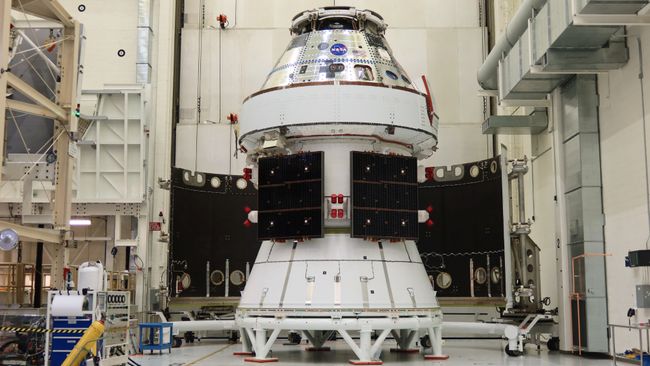
February 2023: Artemis 2 Orion (r) during system integration work; Artemis 3 Orion (l) on a work stand and Artemis 4 Orion pressure module (c). Credit: NASA

Such an approach would both allow Artemis to meet current goals – and even provide a buffer if mission dates have to again slip – whilst the alternate hardware is modified, tested, rated, and called for flight. Thus, by the time Artemis 6 rolls around, the new architecture could be ready to make its debut in place of SLS, and no significant ground has been lost in moving Artemis forward. Additionally, the specific use of New Glenn / Centaur would both fit with the current Lunar Gateway architecture (possibly the one thing NASA really should abandon but likely won’t) and avoid the need to cancel and squander Orion.

However, this is pure conjecture. Whether the Boeing notification was issued in expectation of SLS cancellation or not, is something that is likely to become clear within the next month or two.

Space Sunday: of Artemis and Asteroids

NASA’s SLS, Blue Origin’s New Glenn and SpaceX’s Starship / Super Heavy. Credit: NASA, Blue Origin and SpaceX

NASA’s Project Artemis, which plans to return humans to the Moon, is being increasingly strained under the weight of multiple opinions and as a result of on-going delays.

In December, NASA confirmed it is pushing back the next mission in the programme, Artemis 2 – intended to fly a crew of 4 around the Moon and back to Earth – back to April 2026, with the first lunar landing now not occurring until at least mid-2027 (see:  Space Sunday: of Artemis and Administrators). More recently, the agency has attempted to walk back on the Artemis 2 mission date by saying April 2026 is the “at the latest” target, but efforts are focused on trying to offer a “work to” date which could be somewhat sooner.

In the interim, here have been calls from several different points on the compass calling for the abandonment of the current technology route for Artemis – the Space Launch System and Orion – and replace them with “something better”. Others are calling for “alternatives” to be used in place of the Space Launch System, which is regarded as the most crippling element of the Artemis programme on the basis of costs – critics citing its US $4 billion per launch cost and thus pointing to “cheaper” alternatives.

For example, claims have been made that Artemis 2 could still go ahead “simply” by substituting Blue Origin’s New Glenn as the Orion launch vehicle, and having Orion rendezvous and mate with a ULA Centaur upper stage placed in orbit by that company’s Vulcan launch vehicle (Centaur being the Vulcan upper stage), and using the Centaur to boost Orion on its way to the Moon. However, such a claim simply does not stand up to any reasonable examination due to the number and extend of changes that would be required, including:

  • Significant alterations to New Glenn’s upper stage to handle Orion’s larger diameter, including an entirely new vehicle mount and new fairings to enclose Orion’s European Service Module (ESM).
  • Alterations to the vehicles aerodynamics as a result of the above modifications in order to maintain stability during launch and ascent.
  • A complete re-working of the Orion launch abort system (LAS), which has been designed specifically to work with SLS.
  • Significant upgrades and alterations to the New Glenn launch facilities at Space Launch Complex 36, Canaveral Space Force Station, in order to support Orion and its systems while on the pad.
  • As New Glenn is designed to have its payload integrated horizontally, and Orion is designed to be integrated into SLS vertically, it is likely significant changes would have to be made to either Blue Origin’s payload integration workflow / systems and / or Orion to accommodate mating both on a horizontal basis.
Among other things, Blue Origin’s New Glenn is designed for horizontal vehicle integration and transport to the launch pad; NASA’s Orion is designed for vertical integration / transport to the launch pad. Credit: Blue Origin

None of these issues are insurmountable, but the idea that they could be implemented in a manner that would allow Artemis 2 to go ahead in anything like the current time scales NASA is looking at, or without delaying Artemis as a whole, is frankly ludicrous. Nor do the problems end there.

With a combined mass of 26.5 tonnes, Orion and its ESM are too heavy for New Glenn to boost directly to the Moon – hence the suggested use of the Vulcan Centaur upper stage. However, this would require on-orbit rendezvous and docking between Orion and Centaur, something for which neither is designed – so the idea simply added another level of complexity to missions, which in turn will require even more expenditure (with NASA undoubtedly footing the bill) and additional delays while the vehicles are modified and tested.

Finally, and in the case of Artemis 2, the fact remains that the delay to that mission doesn’t lie with SLS – it is because of concerns over Orion’s heat shield, with NASA wanting to delay the mission so that additional studies can be carried out around optimising the capsule’s re-entry profile to minimise the kind of excessive ablation (aka “char loss”) seen in the initial SLS / Orion flight.

As to “replacing” the entire hardware roster – something the SpaceX CEO has called for – the answer has to be – with what? People will point to that company’s Starship / Super Heavy, but the fact is, that system has yet to achieve a single orbit of Earth – and is a very long way for being certified for (or capable of) carrying humans. A more viable solution might be to utilise Dragon XL and Falcon Heavy; NASA already see this combination as viable for resupply missions to the proposed Lunar Gateway station. But Dragon XL isn’t designed to carry humans and Falcon Heavy isn’t certified for crewed launches; so again, a switch could lead to protracted delays to Artemis and even more expenditure – which might well benefit SpaceX financially, but on its own will do little to move Artemis forward.

Dragon XL: an uncrewed cargo vehicle NASA has requested from SpaceX to deliver cargo to to the Lunar Gateway station. Credit: SpaceX

Hence why the Companies involved in the current Artemis lunar exploration campaign are urging the new administration and their prospective new NASA Administrator not to rock the boat, arguing the current architecture still offers the fastest way of getting humans back to the Moon from the United States. The simple fact is, that while there is nothing wrong with developing alternatives to SLS / Orion for future use; if NASA (and more importantly, the US government) want to reach the Moon without becoming serious stalled for years beyond the current delays, SLS / Orion remains, at this point in time, the most practical path to doing so.

2024 YR4Sparks Planetary Defence Response – But There’s No Need to Panic

Estimated to be somewhere in the region of 50-60 metres across, 2024 YR4 is an Earth-crossing Apollo-type asteroid discovered on December 27th, 2024 and which – as of February 2nd, 2025 has a 1 in 71 (1.4%) chance of entering Earth’ atmosphere in December 2032.

A stony S-type or L-type asteroid was spotted just two days after it has passed just 828,000 km from Earth. It is now moving away from Earth and will make its next close approach in June 2028. The overall threat of the asteroid striking Earth is subject to further refinement. However, on January 29th, 2025, the International Asteroid Warning Network (IAWN) issued a warning that if the asteroid does impact Earth, possible impact sites include over the eastern Pacific Ocean, northern South America, the Atlantic Ocean, Africa, the Arabian Sea, and South Asia.

Asteroid 2024 YR4 imaged by an Earth-based observatory on January 27th, 2025, illustrating the difficulty in observing it – even with a large telescope, the asteroid is almost indistinguishable from far more distant star unless its motion on successive observations is recorded. Credit: NASA

However, it is highly likely that as more observations are made utilising both ground- and space-based observatories and capabilities, the risk of impact will decline, not increase: hence the IAWN issuing a “first step” planetary defence response; they want as many eyes on the asteroid as it retreats from Earth so that the asteroid’s orbit around the Sun and how it might be influenced over time can be more precisely calculated.  In this it is also estimated that rather than impacting in 2032, the asteroid will come to within approx. 277,000 km of Earth – which is still closer than the orbit of the Moon.

Were the asteroid to impact, it would do so at a 17.32 kilometres per second. Given its size and composition (both similar to the asteroid which likely caused the Tunguska event of 1908), any such impact would most likely result in an air burst of between 7 and 8 megatons rather than the asteroid actually striking the surface of the planet, likely resulting in a radius of destruction of some 50 km.

The project corridor of impact were asteroid 2024 YR4 to impact Earth in 2032 

With the asteroid retreating from Earth, opportunities for gathering detailed data are limited, but will improve once more during the 2028 close approach, when the risk of impact in 2032 can be more accurately refined. Should the risk of impact then or in a further close approach remain, then a DART-style mission could be sent to prevent the impact.

“Life Here Began Out There”

Battlestar Galactica fans may well recognise the above quote, but the question as to whether life on Earth may have had a kick-start from beyond the planet has long been a tantalising one. In 2016, NASA launched OSIRIS-REx, a mission to recover samples from the asteroid 101955 Bennu.  As I’ve previously covered, those samples were returned to Earth in September 2023 and have been undergoing study.

Two teams studying the samples have found that not only do the pristine building blocks for life, they also contain the salty remains of an ancient water world. In particular the sodium-rich minerals contain amino acids, nitrogen in the form of ammonia and even parts of the genetic code. Meanwhile, the salts found within the examined samples are very similar to those found within the ancient lakebeds of the Mojave and Sahara deserts.

This image provided by NASA shows a top-down view of the OSIRIS-REx Touch-and-Go-Sample-Acquisition-Mechanism (TAGSAM) head with the lid removed, revealing the remainder of the asteroid sample inside. Credit: NASA

Combining the ingredients of life – the minerals with their amino acids, etc., – with and environment of sodium-rich water, as suggested by the salty deposits in the sample, is regarded as “the pathway to life”, and the organic materials also found within the sample appear to support this. They further lend credence to the idea that Bennu was once a part of a much larger body which contained liquid water within it, but which was shattered through impacts, evaporating the liquids and leaving remnants like Bennu containing evidence of the basic building blocks of life. If this happened with Bennu’s parent object, it potentially happened with other bodies in the early solar system, and it is possible that fragments from those incidents found their way to Earth to help kick-start life.

Most of the Bennu sample is being preserved for comparison with samples with future missions, but the published result from these studies have led to a renewal of calls for a mission to collect samples from the icy dwarf planet of Ceres, visited by NASA’s Dawn mission, entering orbit there in March 2015, and where it remains, inoperative, to this day. During its study of Ceres, the mission’s spacecraft revealed the dwarf has a surface of hydrated minerals on its surface and likely has channels of brine flowing through its mantle which could hold further clues on the origins of life.

Starliner Update

NASA’s Aerospace Safety Advisory Panel (ASAP) provided something of an update on the status of investigations into the reported issues affecting Boeing’s CST-100 Starliner vehicle, following the problems experience with the propulsion units on the vehicle’s service module during the Crew Flight Test in mid-2024.

Although largely successful, the latter left significant question marks over the reliability of the vehicle’s thruster systems, and saw NASA exercise significant caution in not allowing the test crew of Barry Wilmore and Sunita Williams to return to Earth aboard the vehicle, although the Calypso capsule did ultimately return to Earth safely in September 2024.

The Boeing Starliner, comprising capsule Calypso and an expendable service module (the propulsion units of which lead to problems) docked at the ISS during the Crew Flight Test, June, 2024

Most notably, the ASAP update indicated that the capsule has been cleared, and a number of issues reports relating to the service module have now been closed. However, it also indicated the issues related to the service module’s thrusters – the primary cause of problems during the crew test flight – remain open and subject to both further testing campaigns. In this, the update was frustrating, in that beyond general statements of progress, specifics were not provided, and both NASA and Boeing have remained tight-lipped on the subject of the propulsion system since the Crew Flight Test.

As a result – whilst positive for the Starliner capsule units, the update does little to update on how or when the system will next fly; in October 2024, NASA indicated it was keeping the door open to a possible Starliner launch in 2025 – although whether or not this will be another test flight (either crewed or uncrewed) or an all-up 6-month crew rotation flight has yet to be finalised, and following the ASAP update, NASA indicated a possible flight was still on the cards, although it is not clear how any such flight would slot into the current ISS launch manifest.

Space Sunday: NG-1 and IFT-7

New Glenn NG-1 rises from SLC-36, Canaveral Space Force Station, Florida, on the morning of January 16th, marking the start of the vehicle’s maiden flight. Credit: Blue Origin

This past week marked several space launch events and announcements, including India’s first successful on-orbit rendezvous and docking between two of its satellites, However, for this edition of Space Sunday, I’m focusing on the two “biggies” of the week.

New Glenn NG-1: Primary Goal Met, even with Booster Lost

On Thursday, January 16th, 2025, Blue Origin’s New Glenn rocket finally lifted off on its maiden flight after multiple delays over a 4-year period.

Originally targeting 2020/21 for a first launch, New Glenn was delayed numerous times both as a result of changes to the vehicle’s overall design (some coming as late at 2018), technical issues in development, external forces such as the COVID-2 pandemic, and as one Blue Origin executive put it in 2018, “we study a little too much and do too little.”

Such was the delay that the company lost the chance to debut New Glenn with a high-profile launch – that of NASA’s EscaPADE mission to Mars. In late summer of 2024, the US space agency became concerned enough over Blue Origin’s ability to meet the required November 2024 launch window for the mission, the decision was made to push back EscaPADE to a spring 2025 launch date. Instead, the first New Glenn flight – NG-1 – took place with a prototype / demonstrator payload of another of the company’s vehicles, Blue Ring. This is a spacecraft platform designed to support spacecraft operation, under development by Blue Origin. The platform is to be capable of refuelling, transporting, and hosting satellites.

An artist’s impression of a Blue Ring vehicle in Earth orbit with its pair of 22-metre solar arrays deployed to provide electrical power and propulsion. Credit: Blue Origin

With a payload capacity of up to three tonnes and fully able to be refuelled itself, Blue Ring is capable of performing the role of a space tug, moving payload between orbits and itself capable operating in geostationary orbit, lunar orbit, cislunar space and within the Earth-Moon Lagrange points. This makes it a highly flexible vehicle, something added to by its mix of electric and chemical propulsion systems and its ability to be carried by a range of launch vehicles as well as New Glenn.

This first flight on Blue Ring did not see the vehicle detach from the rocket’s upper stage; instead, the launch was to test of whether New Glenn could accurately deliver it to an assigned orbit with a high level of accuracy and whether the vehicle’s own flight and data-gathering systems operated correctly. Both of these are key to both New Glenn and Blue Ring gaining certification to carry out US National Security Space Launch (NSSL) operations.

New Glenn on the launch stand at SLC-36, as seen from the just off the Florida coast. Note the large black object alongside the rocket is the Launch Table, a platform used to hold the rocket in both its horizontal orientation when being rolled-out from the integration building to the pad, and provide launch-tower like support when the vehicle is upright. Credit: Blue Origin

Lift-off for NG-1 came at 07:03 UTC on January 16th, the 98 metre tall two-stage vehicle rising from Space Launch Complex 36 at Canaveral Space Force Station. All seven BE-4 liquid oxygen / liquid methane engines on the first stage worked flawlessly, successfully pushing the vehicle up to a stage separation some 21 km above the Earth. The upper stage then lifted the Blue Ring pathfinder into an elliptical medium Earth orbit (MEO) with an apogee of 19,300 km and a perigee of 2,400 km at a 30-degree inclination (and not a “low Earth orbit” as some outlets reported) some 13 minutes after launch.

While the payload did not separate from the New Glenn upper stage, its on-board systems did power-up, allowing it to provide detailed telemetry as to its position and orbit – confirming it had deviated less than 1% from its optimal orbital track. Over a 6-hour period the pathfinder vehicle completed all assigned tasks, and the New Glenn was “safed” (all remaining propellants and any potentially hazardous elements such as batteries, vented / jettisoned).

All of this marked a highly successful maiden flight for New Glenn – which already has a fairly full launch manifest. However, there was one hiccup: Like SpaceX’s Falcon family, New Glenn’s first stage is designed to be recovered and re-used; and while ambitious, Blue Origin hoped to achieve what it admitted was “secondary goal” on the flight, and one unlikely to happen, a successful recovery of the NG-1 first stage aboard the Landing Platform Vessel Jacklyn, station-keeping some 1,000 km off the Florida coast.

However, following second stage separation, the first stage of the booster entered into a re-entry burn using three of its main engines, and at T+ 7:55, telemetry froze at the planned end of that burn, indicating the stage had been lost at an attitude of approximately 26.5 km while travelling at some 6,900 km/h.

Exactly what happened is unclear – the stage loss is now subject to a Federal Aviation Administration (FAA) Mishap Investigation which, following standard FAA practice, will be led by Blue Origin as the launch vehicle operator, and subject to FAA oversight. It is not clear at present in this investigation will impact on upcoming New Glenn launches; that will depend on what is identified as the cause of the loss.

Starship IFT-7: Booster Caught, but Exposed the Risks

Almost on January 16th, 2025, SpaceX attempted the seventh integrated flight teat (IFT) of their Starship / Super Heavy (S/SH) launch system. The launch featured Booster 14 (a Block 1 – i.e. “original version”- vehicle) and a Ship 33, a Block 2 craft said to feature multiple updates and improvements to increase “reliability, capability and safety”.

Chief among the changes to the Block 2 series of Starship vehicles and their predecessors are:

  • An increase in hull length by 3.1 metres.
  • Redesigned forward aeroflaps, which are smaller and thinner than Block 1, thinner, and positioned both further forward and more leeward (further “up” the hull relative to the heat shield in an attempt to reduce their exposure to plasma flow heating during re-entry).
  • A 25% increase in overall propellant load.
  • Redesigned flight avionics, improvements to the interstage venting.

Additionally, Block 2 vehicles are specifically designed to fly with the upcoming Raptor 3 engine, which is an even lighter variant of the motor (1.525 tonnes), wither greater maximum thrust (280-300 tonne-force (tf) at sea level compared to Raptor 2’s 230 tf). However, Ship 33 flew with Raptor 2 motors. The Block 2 vehicle is also the first variant of Starship reportedly designed to lift 100 tonnes of payload to LEO.

IFT-7 was to be a further proving flight for S/SH, with a number of core milestones:

  • Vehicle launch with booster recovery.
  • Starship sub-orbital insertion & on-orbit re-light of engines.
  • Starship deployment of a dummy Starlink payload via a “pez dispenser” hatch.
  • Starship re-entry test and possible splashdown.

It’s important to note that whether or not Ship 33 survived re-entry was to be questionable. Ship 33 had a reduction in the area of its hull covered by thermal protection system tiles in an attempt to reduce vehicle mass and complexity, and intentionally had a number of tiles removed from various points to test the ability of the steel used in the vehicle to withstand heating (the areas devoid of tiles will eventually mount the “catch pins” required during launch tower recovery operations.). Therefore, the loss of this vehicle during re-entry was considered likely, even if everything else went smoothly.

Ship 33 and Booster 14 lift-off from Boca Chica, Texas at the start of IFT-7, January 16th, 2025

IFT-7 launched from the SpaceX facilities at Boca Chica, Texas, at 22:37 UTC, and the initial ascent proceeded smoothly. At 2:32 into the flight and at around 60 km altitude, the booster shut down all but its central three directional motors ready for “hot staging” – the ignition of Ship 33’s six motors and its separation from the booster. This took place at T+ 2:46, the booster immediately re-lighting all but one of its inner ring of 10 fixed motors at the start of the boost-back manoeuvre designed to stop its ascent and push it back towards the launch point.

Boost-back lasted some 42 seconds before the inner ring of motors on the booster shut down again, immediately followed by the jettisoning of the hot stage (the ring mounted between the booster and the starship and used to deflect the latter’s exhaust flames away from the former during the hot staging sequence. At this point the booster was in an aerodynamic fall / glide back towards Boca Chica, the fall becoming increasingly vertical as it closed on the launch point.

Just over 3 minutes after shutting-down from boost-back, all 10 motors on the booster’s inner ring re-lit at approximately 1.2 km altitude, slowing its decent, before shutting down a final time 8 seconds later, allowing the three directional motors to both continue to slow the boosters descent to a hover and guide it between the “chopstick” arms of the launch tower’s “Mechazilla” mechanism for a successful “catch”, marking a successful conclusion to the initial two milestones for the flight.

Meanwhile, Ship 33 continued its ascent towards a sub-orbital trajectory. Then, at 7:39 into the flight and at an altitude of 141 km, telemetry indicated one of Ship 33’s inner three inner sea-level Raptor motors prematurely shut down. Fourteen seconds later, livestream camera footage appeared to show flames from an internal fire passing over the exposed hinge mechanism of an aft flap. This is followed by telemetry indicating the loss of a second sea-level Raptor, together with one of the outer three vacuum-optimised Raptors, likely resulting in an off-centre thrust from the three remaining motors (only one of which – the central sea-level motor – could be gimballed to provide directional thrust to counter the thrust bias from the two fixed outer motors.

At 8:19 into the flight, and at altitude of 145 km, telemetry indicates the last of the remaining central motors and one of the two outer motors were no longer functioning. Seven seconds later, telemetry freezes, suggesting at this point the vehicle was breaking up. As has been seen from numerous videos released over social media, it appears the vehicle exploded (euphemistically called “a rapid unscheduled disassembly” by SpaceX, a term making light of the potential harm such an event can cause).

A close-up of a still from the IFT-1 livestream showing one of the hinge mechanisms on a aft flap of Ship 33 – flames are just visible passing through the aperture. Credit: SpaceX

SpaceX founder Elon Musk made light of the event, stating SpaceX had already likely identified the cause – a propellant leak resulting in a fire within the aft section of Ship 33 – and the next flight, planned for February will not be affected.

Whether this is the case or not remains to be seen; like it or not, the FAA have called for a mishap investigation; there’s also the fact the break-up of Ship 33 highlights the potential risk of flights out of Boca Chica. These carry ascending vehicles directly over over the Caribbean and close to many of the islands and archipelagos forming the Greater Antilles (including the Bahamas, Cuba, the Turks and Caicos, Hispaniola, Puerto Rico and the Virgin islands) – thus presenting a high risk of debris falling on populated areas.

As it is, debris from this flight has been reported as striking the Turks and Caicos Islands (fortunately without injury), and the spread of debris required the delay and diversion of numerous flights from and into the region (whilst passengers in some already in the area witness the aftermath of the vehicle’s destruction). These points alone warrant a review of the risks involved in launches out of Boca Chica.

Space Sunday: samples from Mars

Artist’s concept of the Rocket Lab Mars Ascent Vehicle lifting-off from its lander vehicle, carrying samples collected by the NASA Perseverance rover. Credit: Rocket Lab

Returning samples from Mars is proving difficult for NASA to get sorted – which, considering plans of various forms have been under consideration since before Apollo 11 landing on the Moon, might sound confusing. However, early proposals for such a mission were hampered by the fact that the density of Mars’ atmosphere was unknown, making the analysis of preferable vehicle masses and trajectory options to achieve a successful atmospheric entry somewhat difficult.

Things became easier in this regard following the successful Viking mission landings in the mid-1970s, but there were still significant technical issues to overcome – such as the number and type of vehicles required to reach Mars, land safely, obtain samples get them safely back to orbit and from there back to Earth.

A 1993 concept for a Mars Sample Return mission using ISU – the use of the Martian atmosphere to produce the propellant the sample capsule (top of the vehicle) required to achieve orbit – in order to try to reduce mission complexity and mass. Credit: NASA

Such were the complications involved that even as relatively recently as 2002, some at NASA felt that skimming a vehicle through the upper reaches of the Martian atmosphere and which used an aerogel to collect samples that would include high-altitude dust would be a easier proposition than trying to gather samples from the planet’s surface.

Also since the early 2000s, efforts have focused on the potential for international / joint efforts to recover samples from Mars, perhaps the most notable being the proposal NASA-ESA sample recovery mission, intended to recover sample tubes deposited on Mars by NASA’s Mars 2020 Perseverance mission.

However, even this has suffered from spiralling costs – in part due to an increasing reliance on complex technologies. By 2022, the mission required no fewer than five vehicles (not including Perseverance): a sample retriever lander + ascent vehicle (NASA); a sample return vehicle (ESA); and a sample collection lander and rover combination (ESA) – later replaced by two Ingenuity-class helicopters to – gather sample tubes deposited by Perseverance. This complexity and cleverness resulted in the cost estimates for the mission surpassing US $11 billion by April 2024, with the return of any samples collected by the Mars 2020 mission unlikely to occur before 2040.

A concept rendering of the original NASA/ESA Mars Sample Return mission showing the ESA Mars return vehicle (top right), the ESA sample recovery rover (centre) and the NASA sample lander / MAV combination (right). The Perseverance rover is show on the left as the collector of the samples. Note that Earth is shown for reference only, and is not to scale. Credit: NASA
As a result, NASA sought alternate architectures to complete such a sample return mission possible, turning to external expertise as well as looking to its own capabilities. The idea here would be to reduce costs and return samples gathered by Perseverance in a more reasonable time frame than 2040.

On January 7th, 2025, NASA announced it intended to spend a further 18 months studying two alternate architectures by which to recover sample caches created on Mars by Perseverance. One leverages technologies developed by NASA, whilst the other involved commercially-developed technologies, with both utilising the existing proposal for the European-built Earth Return Orbiter (ERO) from the mission architecture outlined above to return the gathered samples to Earth.

The principle difference between the two options is that the NASA option proposes using the “skcrane” system sued to which both the Curiosity and Perseverance rovers to deliver the same recovery lander / ascent vehicle onto the surface of Mars, whilst the second would utilise a commercial “heavy lander”. Exactly what form this would take is unclear from the NASA statement – however, both Blue Origin and SpaceX have tried to muscle-in on the mission, suggesting the use of variants of their Blue Moon and Starship lunar landers. In both mission outlines, Perseverance would be used to deliver sample tubes to the sample return craft.

A comparison of the size of the existing design for the MSR lander (right) with a smaller concept proposed by JPL that can use the proven “sky crane” landing system. Credit: NASA/JPL

Exactly how much of an improvement / cost reduction these two methodologies will bring over current plans is very debatable; NASA’s own estimates put the two options at a cost of between US $7 and $8 billion – which is about the same as original estimates for the NASA-ESA proposal at the time when it was already causing concerns, having risen to US $7 billion from an intended cost of US $4 billion. Further, NASA suggests that while either approach might achieve a sample return by 2035 – a more likely timeframe is 2035-2039; hardly any improvement at all over the current 2040 timeframe.

Hence why, perhaps, Peter Beck’s Rocket Lab has placed a formal request with the incoming Trump administration to re-examine sample return mission options rather than green-lighting the updated NASA approach. This is because Rocket Lab – at NASA’s request – has developed a completely alternate sample-return architecture designed to fit NASA’s requested mission cap of US $4 billion, whilst potentially returning the sample to Earth by 2031/32.

The Rocket Lab Mars Sample Return mission concept. Credit: Rocket Lab

Whilst on the surface as complex as NASA’s joint approach with ESA, the Rocket Lab mission is actually far more direct and lightweight, comprising a total of three launches from Earth, and six vehicle elements. These comprise:

  • The Mars Telecommunications Orbiter (MRO): this would offer an orbital communications relay for the rest of the mission – and other Mars surface missions.
  • The Mars Entry and Descent System (EDS): an aeroshell vehicle carrying within it the Mars Lander and the Mars Ascent Vehicle (MAV).
  • The Earth Return Orbiter (ERO), which includes the Earth Entry System (EES).

Rocket Lab’s mission would proceed as follows:  a Rocket Lab Neutron launcher is used to send the MRO to Mars. This is followed by to further Neutron launches, one for the EDS and one for the ERO. On arrival at Mars, the MRO arrives first, entering an orbit where it can act as communications relay. The EDS then makes a direct atmosphere entry, protecting the lander / MAV through the heat of atmospheric entry prior to the lander making a parachute descent and propulsive landing.

A photo montage of ten sample tubes set on the surface of Mars by the Mars 2020 rover Perseverance as a cache for possible return to Earth by a sample return mission. Credit: NASA

The latter will be made close to one of the sample caches created by Perseverance, allowing it to collect up to 20 sample tubes (depending on the size of the cache) – although how this will be done is not fully defined in the rocket Lab proposal. The sample tubes are delivered to the MAV on the top of the lander, the MAV using the lander as its launch pad to return to orbit.

Once in orbit, the MAV rendezvous with the ERO, transferring the sample container to the ERO, which sterilises it using onboard systems as it returns the container to Earth and uses the EES to deliver the sample container back to Earth’s surface.

While Rocket Lab might seem an unlikely candidate for a Mars Sample Return mission when compared to the likes of SpaceX, the company arguably has a lot more experience with the technologies required for such a mission. The company has supplied elements used within several Mars missions from the Mars Science Laboratory onwards – including developing solar arrays for power, support systems to maintain vehicles while en-route to Mars, and build the EscaPADE Mars orbiters and their support bus, and re-entry technologies being utilised by other companies.

The six vehicle elements of the Rocket Lab MSR proposal, forming three distinct launch vehicle payloads. Credit: Rocket Lab

It’s not clear how the incoming NASA Administrator (whether it be Jared Isaacman or someone else)  will respond to Rocket Lab’s request; a lot, in this regard, might be dependent upon how much influence Elon Musk  – whose SpaceX, like it or not, still very much depends upon NASA and government contracts for its survival – welds over NASA’s decision-making in the coming months.

Big Birds Set to Fly

Two significant launches are due to take place in the coming week, one of which could mark the entry of a significant new player in the space launch market.

Blue Origin’s massive New Glenn vehicle, of carrying up to 45 tonnes of payload to orbit – although for the most part it will likely carry far less than that – is due to lift off from Space Launch Complex 36 at Canaveral Space Force Station at 06:00 on Monday, January 13th. It’s a mission I’ve written about extensively already, but there is a lot riding on the broad success of the mission in delivering its upper stage and payload to orbit.

New Glenn on the SLC-36 launch pad at Cape Canaveral Space Force Station in Florida, in December 2024. The flight is now targeting a January 13th launch. Credit: Blue Origin

New Glenn has, from the outset, been designed to fulfil a wide variety of roles, from delivering individual and multiple satellite payloads to orbit and to places like the Moon, through to playing a crucial role in helping Blue Origin and its partners establish their planned Orbital Reef space station, to even carrying out human-rated launches. As a payload launcher, it will – subject to a second qualifying flight after this one – be used for US government launches as well carrying out commercial launch operations.

This first flight will carry a prototype of Blue Origin’s Blue Ring orbital vehicle as the payload – although it will not separate from the vehicle’s upper stage – and will attempt a recovery of the core booster on the landing recovery ship Jacklyn, some 1,000 km off the Florida coast.

Some will likely point to Wednesday, January 15th as being more important, as it is on that day at 22:00 SpaceX is due to carry out the seventh integrated flight test of their Starship / Super Heavy behemoth,  featuring the first flight of their Block 2 version of the Starship vehicle.  This features revised forward aerodynamic flaps (used to control the vehicle during its fall through the atmosphere), a 25% increase in propellant load, a 3.1 metres increase in length and an updated thermal protection system.

SpaceX Starship 33 stacked on top of Booster 14, ahead of the seventh orbital flight test, currently targeting a January 15th launch. Credit: SpaceX

Overall, the flight should follow a similar format to Flight 6 – attempting a recovery of the booster at the launch site and the Starship vehicle splashing down in the Indian Ocean. However, a test of the thermal protection system and the deliberate exposure of parts of the vehicle to the heat of re-entry might result in its complete loss. This flight will also see the first attempt to deploy Starlink communication satellite “simulators” from the payload bay.

Starship, with its stated payload capability of up to 100 tonnes far outclasses New Glenn in lifting capabilities – but contrary to SpaceX fans, this actually does not guarantee the vehicle is destined for commercial success once it reaches any form of operational status beyond being a Starlink delivery mechanism. A lot in this regard depends on the price-point for launches with the system, and the continuing downwards trend in the size and mass of many classes of satellite which make smaller, low-cost launchers potentially far more attractive for such launches (I’m deliberately ignoring the claims that Starship is about opening Mars to colonisation, as that had a world of issues in its own right).

I’ve have a report on the flights – assuming they go ahead – in the next Space Sunday.

Space Sunday: selected spaceflight previews for 2025

Blue Origin’s New Glenn performs a full 7-engine statis fire test at Space launch Complex 36, Cape Canaveral Space Force Station, December 27th, 2024. Credit: Blue Origin

As we’re at the end of 2024, rather than looking back over the year, I thought I’d look ahead to some of the spaceflight events hopefully coming our way in 2025. Note this list intentionally does not include schedule missions to the ISS, SpaceX Starlink launches or test programmes, or similar.

New Glenn Maiden Flight

While Blue Origin didn’t meet their target to fly their new heavy lift launcher, New Glenn, before the end of 2024, the flight now looks set to go ahead in early January 2025. Specifically:

  • On December 27th, 2024, and after some delay, the company finally received a license from the FAA to conduct New Glenn launches out of Canaveral Space Force Station for five years.
  • That same day, the rocket, which has been on the pad for final testing, completely a full static fire test of its core stages engines. The test saw all seven core stage engines run for a total of 24 seconds, over half of which saw them throttle up to 100%.
  • While a launch date has not been disclosed by Blue Origin, an airspace advisory has been released referencing NG-1, the name of the flight, and warning of airspace restrictions around and over Florida’s Space Coast for the period 06:00 through 09:45 UTC on January 6th, 2025, with the option for a second airspace restriction being enforced at the same time on January 7th, 2025.

As I’ve previously noted, the flight will be carrying a prototype Blue Ring satellite platform capable of delivering up to 3 tonnes of payload to different orbits, as well as being able to carry out on-orbit satellite refuelling (as well as being refuelled in orbit itself) and transporting payloads between orbits. However, Blue Ring will not physically detach from the launch vehicle’s upper stage for the flight. Additionally, the flight is seen as the first of two flights required to certify New Glenn to fly United States Space Force national security and related payloads, and will hopefully see the first stage make a safe return to Earth and landing on the company’s Landing Platform Vessel 1, Jacklyn.

Japan Goes Lunar Roving

January is also the target month for Japan’s second attempt at a private lunar landing, in the form of the Hakuto-R Mission 2, developed by ispace. It is a follow-up to the Hakuto-R Mission 1, a technology demonstrator mission also launched by ispace, which took the “long way” to the Moon, covering a total of 1.4 million kilometres in a 5-month journey.

However, the lander and its payloads were lost during it landing attempt on April 23rd, 2023, after a disagreement between the main flight computer and the vehicle’s altimeter resulted in it entering a sustained hover some 5 km above the lunar surface, expending its propellants so it fell uncontrolled to the Moon’s surface.

The Hakuto-R lander Resilience with micro-rover Tenacious visible, undergoing final preparations at a JAXA facility in Tsukuba, Japan prior to being shipped to Kennedy Space Centre. Credit: ispace/JAXA

Like its predecessor, Hakuto-R Mission 2 comprises a lander vehicle some 2.5 metres tall and 2.3 metres wide intended to demonstrate a reliable small-scale lander capability with data transmission and relay capabilities for use as a part of the US-led Project Artemis. The lander will launch atop a SpaceX Falcon 9, but unlike it predecessor will head directly to the Moon, where it will land in Mare Frigoris, the Sea of Cold.

Once there, the lander – called Resilience – will deploy a micro-rover called Tenacious. Weighing just 5 kg, this has been built as a multi-role vehicle by a team in Luxembourg. Once deployed, it will demonstrate autonomous driving capabilities as it explores the area around the lander, and will also partner with the lander in an ISRU (in-situ resource utilisation) demonstration, attempting to extract water from the lunar surface, heating it and splitting the resultant steam into oxygen and hydrogen.

One of the team responsible for Tenacious checks the little rover before the cover is closed on the payload bay containing it. Credit: ispace

The mission will carry a number of additional payloads, perhaps the most unusual of which is Moonhouse, by Swedish artist Mikeal Genberg.

For 25 years, Genberg has had a dream about a little red house (“all house in Sweden are red!” he states) on the Moon; throughout that time he’s visualised it through art installations here on Earth, and has even seen one of his models flown aboard the space shuttle, courtesy of Swedish astronaut Christer Fuglesang. Now, Tenacious will carry one of Genberg’s little houses to the surface of the Moon. It is secured to a platform on the front of the rover, and represents the culmination of Genberg’s 25-year-long dream.

Mikael Genberg’s Moonhouse mounted on the front of the micro-rover Tenacious. Credit: ispace / JAXA

As to its meaning – Genberg notes that it could be many things, depending on who you are. A symbol of life; for the potential for future life; a beacon of hope that anything is possible if we put our minds to it; a commentary on humanity and our treatment of the one home we have; as art, it has the ability to speak to each of us, and to do so differently with each of us.

Fram2 Private Polar Mission

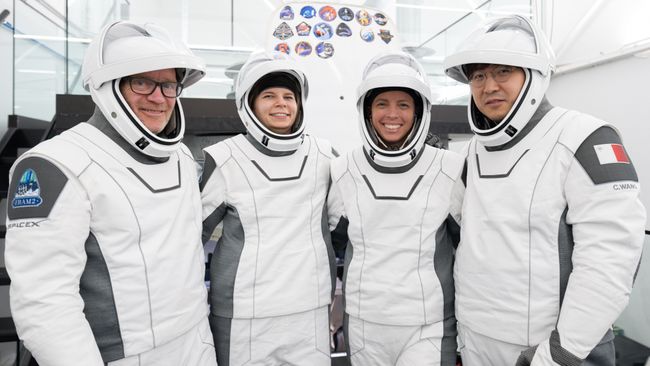
Due to launch in around March 2025, Fram2 is another “all-private” space mission in the mould of Jared Isaacman’s Inspiration4 (2021) and Polaris Dawn (2024) flights. Also utilising SpaceX Crew Dragon Resilience, Fram2 will fly a crew of 4 on a mission of up to 5 days duration in a 90º inclination orbit between 425 and 450 km altitude. It aims to observe and study aurora-like phenomena such as STEVE and green fragments and conduct experiments on the human body, including the first X-ray of a human in space.

The Fram2 mission will utilise SpaceX Crew Dragon Resilience, which will once again be fitted with the panoramic cupola in the vehicle’s nose section, replacing the ISS docking mechanism. Credit: SpaceX

The crew for the mission comprise:

  • Chung Wang, the mission commander and co-bankroller, a Chinese-born Maltese crypto currency entrepreneur who founded f2pool , one of the largest Bitcoin mining pools in the world, and Stakefish, one of the largest Ethereum staking providers.
  • Jannicke Mikkelsen, the vehicle commander, and co-bankroller for the mission, a Scottish-born Norwegian cinematographer and a pioneer of VR cinematography, 3D animation and augmented reality. A skilled speed skater, she will become the first Norwegian astronaut and the first European to command a space vehicle.
  • Eric Philips, a 62-year-old noted Australian polar explorer, who will serve as the vehicle pilot as will be the first Australian national to fly in space (while both Paul Scully-Power and Andy Thomas were born in Australia and flew on space shuttle missions (Thomas flying multiple times), they only did so after becoming US citizens).
  • Rabea Rogge, a German electrical engineer and robotic expert, who will fill the role of Mission Specialist and will become the first German woman to fly in space, beating-out those selected as a part of the privately-funded programme Die Astronautin, specifically set-up to fly a German woman in space by 2023.
The Fram2 crew (l to r): Chun Wang, Jannicke Mikkelsen, Eric Philips and Rabea Rogge

Fram2 is named for the Norwegian polar exploration vessel Fram, a veteran of multiple expeditions to both poles between 1883 and 1912, including Roald Amundsen’s historic 1910-1912 southern polar expedition, is planned to launch in March 2025.

Tianwen-2: Asteroid Sample Return Mission

China will continue its deep-space exploration ambitions with the planned May 2025 launch of Tianwen-2 (“’Heavenly Questions-2”) robotic vehicle. Whilst bearing the same name as the highly-successfully mission to place an orbiter around Mars and a lander and rover on the surface of that planet in 2021 (and covered within past Space Sunday articles), Tianwen-2 is a very different mission: that of rendezvousing with, and landing on, a near-Earth object (NEO) asteroid and gathering up to 100 grams of material for a return to Earth.

A screen cap of the Tianwen-2 vehicle arriving at 469219 Kamoʻoalewa. Credit: CCTV

The target for the mission is a quasi-moon 469219 Kamoʻoalewa, thought to be around 40-100 metres along its longest axis. It orbits the Sun at distance of between 0.9 and 1.0 (the average distance of the Earth from the Sun) and with an orbital period of 365-366 days. This makes it appear as if it moving around the Earth, although it is in fact oscillating around the L1 and L2 and L4 and L5 positions, and not actually gravitationally bound to Earth, never coming closer than some 14 million kilometres.

What is particularly interesting about 469219 Kamoʻoalewa, first identified in 2016, is that spectral analysis suggests it is likely silicate in origin; combined with its orbit, this points to it possibly being a lump of rock ejected from our Moon as a result of an asteroid impact. However, it could equally be an S-type asteroid (which account for around 17% of all known asteroids) or possibly an L-type, which are exceptionally uncommon.

Thus, given the mix of potential heritage, 469219 Kamoʻoalewa has been seen as an intriguing subject for up-close study ever since its identification, and a number of proposals have been put forward up-close study, as well as being the target for observation by numerous Earth-based telescopes. Following launch, Tianwen-2 is expected to intercept the asteroid in 2026, and conduct remote sensing activities which will include identifying locations for sample acquisition. It will also deploy both a nano-orbiter and a nano-lander for independent study of the asteroid.

To collect samples, Tianwen-2 will send down a sample gathering unit which will conduct both touch-and-go operations similar to those used by Japan’s Hayabusa2 probe sent to obtain samples from the near-Earth asteroid 162173 Ryugu (2014-2020), and NASA’s OSIRIS-REx (2016-2023) mission to gather samples from asteroid Bennu, and also anchor-and-attach – the first time such a technique will be attempted.

The two approaches to gathering samples: in touch and go, the sample gathering vehicle will briefly touch the surface of the asteroid to gather a sample, the  spring-loaded arm of the sample gatherer absorbing the vehicle’s downward momentum before pushing it back away from the asteroid. With Anchor-and-attach, the sample vehicle will attempt to use four legs with penetrators to grip the asteroid’s surface, prior to the sample arm being deployed to collect material. Credit: CCTV

After gathering samples, Tianwen-2 will depart 469219 Kamoʻoalewa and make a fly-by of Earth in 2027, which it will use to both drop-off its sample capsule and also complete a gravity assist manoeuvre in order to travel on to rendezvous with active asteroid 311P/PanSTARRS, which orbits the Sun every 3.24 years and exhibits the characteristics of both an asteroid and a comet, including having up to six comet-like tails.

Estimated to be around 240 metres across and always orbiting the Sun beyond the orbit of Mars, 311P/PanSTARRs was first identified in 2013, and observations in 2018 suggested it might have a companion orbiting it. Tianwen-2 is expected to reach it in 2034.

Two images of 311P/PanSTARRS captured by the Hubble Space Telescope and showing its tail formations. Credit: NASA, ESA, D. Jewitt

Dream Chaser Rises

May is the month that will hopefully see the launch of the newest addition to the fleet of vehicles that help keep the International Space Station (ISS) well-stocked with supplies and operational, when a ULA Vulcan Centaur VC4L lifts-off from Space Launch complex 41 at Canaveral Space Force Station, carrying Tenacity, the first Dream Chaser Cargo vehicle from Sierra Space.

Referred to SSC Demo-1, the mission will see Tenacity and its Shooting Star power and cargo module carry out a check-out mission of up to 45 days duration which will see the combined vehicle rendezvous and dock with the ISS, undergoing check-out by ISS crew and eventually undocking, after which the Shooting Star module will be jettisoned and Tenacity will return to Earth for an aircraft-style landing at the former Space Shuttle Landing Facility, Kennedy Space Centre.

Dream Chaser Tenacity and its cargo module undergoing testing at NASA’s Neil Armstrong Test Facility, Kennedy Space Centre, Florida. Credit: NASA

When operational, Dream Chaser with Shooting Star will have the largest all-up payload capacity of any ISS resupply vehicle: 5.5 tonnes; 5 tonnes of which can be pressurised. However, missions will likely be flown with lesser payload amounts. In addition, Dream Chaser can return to Earth with payloads of up to 1.75 tonnes, comprising equipment, experiments and general waste.

Six Dream Chaser resupply missions to the ISS have been contracted, using at least two Dream Chaser vehicles, Tenacity and Reverence (although construction on the latter is currently suspended). The date of the first operational flight (CRS SSC-1) has yet to be given, but is unlikely to be before 2026.

Space RIDER Flies

The European Space Agency (ESA) is expected to debut its entry into the reusable spaceplane market in the latter half of 2025 with the maiden flight of Space RIDER (Space Reusable Integrated Demonstrator for Europe Return), a two-stage vehicle designed to provide routine and relatively low-cost capabilities to delivery payloads of up to 620 kg to low-Earth orbit.

I’ve covered Space RIDER in the past, but briefly, it is a small-scale reusable lifting body supported by an expendable service module which supplies it with main propulsion and electrical power when in orbit, prior to being jettisoned before the main vehicle re-enters the atmosphere. Payloads are intended to be experiments and science instruments, which the vehicle returns to Earth at the end of a mission, although it will have the ability to deploy smallsats in space as well.

An artist’s impression of ESA’s Space RIDER in orbit. The black module with solar panels to the rear is the vehicle’s expendable service module. Credit: ESA

Massing 4.9 tonnes at launch (including the service module), the lifting body – referred to as the Re-entry module (RM) – masses 2.8 tonnes on landing. The combined craft has a length of just over 8 metres, of which 4.6 metres is that of RM, which includes a payload volume of 1.2 m³.

Designed to be launched atop ESA’s Vega-C rocket, Space RIDER can remain in orbit for up to 2 months at a time conducting experiments. Following re-entry, the RM will use its lifting body shape to drop its speed from Mach 25 to Mach 0.8 (roughly the speed of an commercial airliner) as it descends, prior to deploying a drogue parachute at between 12-15 km altitude, which will slow it to around Mach 0.22. After this, a parafoil is deployed, which allows the vehicle to glide under control to a horizontal landing. It is designed to make up to six flights into space, and has a turnaround time of “less then 6 months”.

The Year of Fly-bys

2025 is going to be a year of fly-bys for several deep space missions, including:

  • January: The ESA / JAXA BepiColumbo mission to Mercury will complete its sixth and final fly-by of the planet as it uses Mercury’s relatively weak gravity to both decelerate and swing it on to a trajectory from which it can establish itself in orbit around the planet. The manoeuvre will mark the end of 9 fly-bys of three planets – Earth (1); Venus (2) and Mercury (6); the next time the probe reaches Mercury (after another passage around the Sun) in November 2026, it will fire its motor and enter orbit ready to commence its primary science mission, over 8 years after its launch.
  • March: ESA’s Hera mission, launched in October 2024, will perform a fly-by of Mars en route to its final destination, the Didymos binary asteroid system, where it will carry out a detailed study of the aftermath of the NASA Double Asteroid Redirection Test (DART) which impacted the asteroid Dimorphos in an attempt to deflect it in its orbit around the larger Didymos.
An artist’s impression of ESA’s Hera mission, complete with its payload of two cubesats as they observe the asteroid Didymos. Credit: ESA
  • March: NASA’s Europa Clipper mission will also fly-by Mars as it makes its way towards Jupiter in order to study the icy world of Europa. The second of two such mission to be launched – the other being ESA’s Juice mission (see below), The NASA mission will make better progress to Jupiter by virtue of being launched atop a more powerful rocket – the SpaceX Falcon Heavy.
  • April: NASA’s Lucy mission will complete its fourth fly-by of a celestial body, and the second of a main belt asteroid – 52246 Donaldjohanson, named for the paleoanthropologist who discovered the famous “Lucy” fossil. This vehicle is on a complex mission to examine eight separate asteroids (2 within the main belt between the orbits of Mars and Jupiter; four more in the L4 Trojan cloud occupying the same orbit a Jupiter, but 60º, which it will reach in 2027; and a pair within the Trojan cloud trailing Jupiter in its orbit by 60º, which it will reach in 2034 after a further fly-by of Earth at the end of 2030.
  • August: ESA’s Jupiter Icy Moons Explorer (Juice) will make a fly-by of Venus as it gathers the momentum it needs to reach Jupiter and start its studies of Europa, Ganymede and Callisto. The fly-by of Venus will be the second of four such manoeuvres, the other three (August 2024, September 2026, January 2029) being around Earth.