Space Sunday: supergiants on camera and more to Mars

Are they stars? No, they’re a pair of exoplanets 310 light years away. Credit: ESO/Bohn et al, 2020

The above picture may not look that spectacular, just a couple of stars against the backdrop of space – exception the two disks it shows are not stars, they are planets – exoplanets, in fact, orbiting a star 310 light years away. As such, it is the first visible light photograph of multiple planets orbiting a Sun-like star taken from Earth.

Called TYC 8998-760-1, the star in question is of the G2V spectral class, and the closest Sun-like star to the solar system. However, whereas the Sun is some 4.6 billion years old, TYC 8998-760-1 is a mere stripling – just 17 million years old. It lies within the southern hemisphere constellation of Musca – a constellation which though small, contains a number of notable stars including Alpha, Beta, Gamma and Zeta Muscae, part of a group of hot blue-white stars that seem to share a common point of origin and motion within the galaxy, HD 100546, a blue-white Herbig Ae/Be star that is surrounded by a complex debris disk containing a large planet or brown dwarf and possible protoplanet, and  Theta Muscae, a triple star system, the brightest member of which is a Wolf–Rayet star.

The image was taken by the European Southern Observatory’s (ESO) Very Large Telescope (VLT) using the Spectro-Polarimetric High-contrast Exoplanet REsearch instrument (SPHERE). This instrument utilises a coronagraph to block out much of the light from a star, allowing the light reflected by any planetary bodies to be visible.

TYC 8998-760-1 is an interesting planetary system for a number of reasons. Given the relative youth of the parent star, it might be said that the system represents a glimpse of the early formation of the solar system. However, it is on a scale far vaster than our own. Both of the planets are gas supergiants, the innermost, called TYC 8998-760-1 b, being some 14 times the mass of Jupiter, whilst the outermost, TYC 8998-760-1 c, is around 6 times Jupiter’s mass. Both also orbit their parent at incredible distances in comparison to the planets of our own system:  TYC 8998-760-1 b averages 162 AU (1 AU being the average distance the Earth is from the Sun), and TYC 8998-760-1 c averages some 320 AU. By comparison, Neptune, the most distant of our major planets, averages a “mere” 30 AU from the Sun.
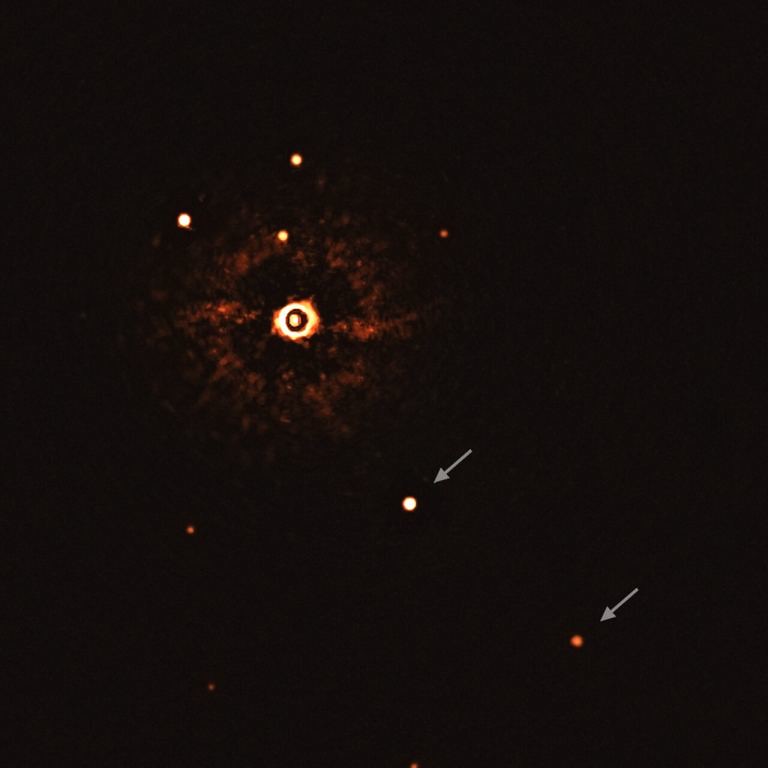
The complete image captured by the SPHERE instrument on ESO’s Very Large Telescope, showing the star TYC 8998-760-1 above centre, left, with three additional stars above it and its two supergiant planets below (arrowed). This image marks the first time astronomers have directly observed more than one planet orbiting a star similar to the Sun. Image Credit: ESO/Bohn et al, 2020.

These vast distances make both planets curiosities: exoplanets that are large and orbiting far from their host stars are very difficult to fit into the protoplanetary and accretion disk model(s ) that are generally used to explain planetary formation. Further, both planets appear to occupy relatively stable, circular orbits. Astronomers believe this could indicate that the two planets formed more-or-less where they are now and their near-circular orbits may indicate the presence of a still-to-be discovered third large body orbiting even further from the star (and TYC 8998-760-1 c was unknown prior to SPHERE capturing it) – or that their orbits might indicate their are the result of very specific ejections from an unseen stellar companion to  TYC 8998-760-1.

Further study is required to determine exactly how the planets may have formed, but their presence does raise the questions on whether smaller, rocky planets might orbit closer to the star – possibly within its habitable zone. As it is, SPHERE’s ability to gather data on planets has yielded a lot of information on the two gas giants that will keep astronomers busy. And while this is only the third image of exoplanets currently on record, with the upcoming generation of high-powered Earth and space-based telescopes, that number will increase over the coming decades.

Heavenly Questions En-route to Mars

The Long March 5 carrying China’s Tianwen-1 mission to Mars lifts-off on July 23rd. Credit: CCTV / China National Space Agency

In my previous Space Sunday update I covered the launch of the UAE’s Hope mission to Mars, launched as that article was being written, and the (then) forthcoming launch of China’s ambitious Tianwen-1 (“Quest for Heavenly Truth” or “Questions for Heaven”) orbiter / lander / rover mission.

At that time, it wasn’t clear just when China’s mission would lift-off, but going on past launches of the Long March 5 booster that would be hefting the mission away from Earth have generally been within 6 days of the rocket being delivered to the launch pad, speculation was that the Tianwen-1 launch would come in he week of July 20th through 24th, given its launcher arrived on the pad on July 17th.

A view of the Long March 5 booster ascending to orbit, showing the dual exhaust configuration of its first stage boosters. Credit: CCTV / China National Space Agency

Those speculations proved to be correct, because Long March 5 launch Y4 took to the skies from the Wenchang Satellite Launch Centre on Hainan Island in the South China Sea, at 04:41 UTC on the Morning of July 23rd (11:41 local time).

Continue reading “Space Sunday: supergiants on camera and more to Mars”

Space Sunday: a Martian Hope and Heavenly Questions

An artist’s impression of the UAESA Hope satellite in orbit around Mars. Credit: Mohammed bin Rashid Space Centre

late July and early August mark the period of the 2020 Mars opposition launch window, once again offering opportunities to send missions to the Red Planet. This period occurs once every 26 months, when the orbits of Earth and Mars are both on the same side of the Sun (so Mars and the Sun are on “opposite sides” of Earth, hence the name “opposition”) and positioned relative to one another (with Earth “catching up” with Mars as they both move around the Sun) such that the flight time from Earth to Mars is at its shortest – around 6-7 months.

Because of this, these periods tend to be fairly busy, and 2020 is particularly so, with three missions heading for Mars. The most prominent of this missions in terms of publicity is NASA’s Mars 2020 Perseverance rover, scheduled for a July 30th 2020 launch. The second is China’s ground-breaking orbiter / lander / rover mission (of which more below), whilst the third  – and first to launch – is possibly the most overlooked of the three: the Hope, or Al-Amal, orbiter mission developed by the United Arab Emirates.

Hope under assembly at the Mohammed bin Rashid Space Centre (MBRSC). Credit: MBRSC

Hope is a remarkable mission for the UAE; the mission was announced in 2014, literally as the country formed its fledgling space agency, employing just 75 people – a number that has since grown to 150. At that time the UAE had developed and flown – in partnership with other nations – a total of 5 communications satellites and two Earth observation platforms, so the idea for the country’s new space agency setting its sights on Mars was seen as incredibly ambitious.

However, over the course of the last six years the United Arab Emirates Space Agency (UAESA) has worked steadily on the the project, and has drawn on space development expertise in France, Japan, the UK and USA both for its own development and for the Hope spacecraft, moving the project forward and at minimum cost – just US $200 million.

The Mohammed bin Rashid Space Centre, Dubai, UAE, headquarters for the Hope mission and the UAE’s space efforts, on the night of the Hope mission launch. Credit: UAE television

Roughly cubic in shape, Hope measures 2.37m wide and 2.90m in length and has a mass of just under 1.4 tonnes (including its propellant fuel load). Solar-powered, it is billed as the “first true weather satellite for Mars” and is intended to develop a complete picture of the Martian atmosphere.

To do this, the satellite has a primary mission period of a full Martian year (approx. two terrestrial years), with the option for mission extensions through to 2025. During this time, the spacecraft will study the Martian climate and weather on a daily basis from a 55-hour equatorial orbit around the planet that will vary between 20,000 and 43,000 km from the planet’s surface. This high orbit will afford it the best view of weather patterns in both the northern and southern hemispheres, and observe how weather patterns interact along the equatorial regions of the planet. In particular, Hope will be able to study seasonal weather  / climate cycles and record weather events in the lower atmosphere such as dust storms, and the weather at different geographic areas of Mars.

To achieve this, the mission carries a relatively modest number of science packages compared to other missions, comprising:

  • The Emirates eXploration Imager (EXI): developed with assistance from two US research facilities, this is a multi-band camera capable of taking high resolution images with a spatial resolution of better than 8 km. Equipped with a set of 6 filters, it can image in both RGB colour wavelengths and in the ultraviolet bands, and measure properties such as water, ice, dust, aerosols and abundance of ozone in the Martian atmosphere.
  • Emirates Mars Infra-red Spectrometer: developed with the assistance of the Arizona State University, this is an interferometric thermal infra-red spectrometer. It is designed to examine temperature profiles in the Martian atmosphere and record ice, water vapour and dust in the lower to mid-level of the atmosphere.
  • Emirates Mars Ultraviolet Spectrometer (EMUS): is a far-ultraviolet imaging spectrograph for measuring global characteristics and variability of the Martian thermosphere.

As well as carrying out a genuine science mission that will produce data that will be of significant use for future missions up to and including eventually sending human to Mars, Hope is also seen as an inspirational programme intended to “send a message of optimism to millions of young Arabs” and encourage them to consider careers in science, technology, engineering and maths (STEM).

Nor, given the traditional conservative nature of Arab nations, is this inspirational element of the mission directed solely at young men: the deputy project manager and lead science investigator for the mission is Sarah Amiri, who is also is the Chair of the United Arab Emirates Council of Scientists. She has managed the mission’s objectives and overseen the development and integration of the mission’s science packages, and and will continue in that role throughout the mission. Her role is seen as pivotal to encouraging other Arab nations in allowing women greater access to leadership roles and in encouraging young Arab women to consider STEM-based studies and careers.

Left: the H-IIA launch vehicle on the pad at T -25 minutes before launch on Sunday, July 19th. Right Top: Hope mission managers watch the launch preparations from the main control centre at the Mohammed bin Rashid Space Centre while (right lower), engineers monitor data being received from the satellite.

Continue reading “Space Sunday: a Martian Hope and Heavenly Questions”

Space Sunday: Comet NEOWISE, Starship and Starliner

Comet C/2020 F3 seen in the eastern horizon above Earth shortly before sunrise, as seen from the ISS, July 5th, 2020. Credit; NASA / Bob Behnken

Those in the northern hemisphere wishing to see a comet in the night sky currently have an excellent opportunity to do so. Comet NEOWISE (officially C/2020 F3 (NEOWISE)) is currently approaching Earth and will reach its closest point of approach on July 23rd, 2020, before starting its trip back out to the depths of the solar system.

Having passed around the Sun (reaching perihelion on July 3rd, 2020), NEOWISE has been an early morning, pre-dawn object in clear northern hemisphere skies. however, in the coming week it switches to being twilight object, potentially making opportunities to view it much better for many people.

Comet C/2020 F3 seen early in the morning of July 9th, from the grand view lookout at the Colorado National Monument, Grand Junction, Colorado. Credit: Conrad Earnest

The comet is a relatively “new” object in terms of its first observation – it was initially spotted on March 27th, 2020 by NASA’s Wide-field Infra-red Survey Explorer (WISE), a polar-orbiting space telescope. Launched in December 2009, WISE has been responsible for the discovery of thousands of minor planets within the solar system, and star clusters beyond. It is also a telescope with an interesting history.

Originally given a primary mission of just 10 months – the amount of time required to deplete the hydrogen coolant reserves the telescope needed to successfully operate two of its primary instruments – WISE was afterwards given a 4-month mission extension dubbed NEOWISE. For this mission it was tasked with looking for asteroids and comets that can come close to Earth (and are therefore known as Near Earth Objects, the “NEO” in the mission’s name). That mission drew to a close in February 2011, the telescope having completed an “all sky” survey, and it was ordered to place itself into hibernation, powering-off everything bar its communications link with Earth.

An artist’s impression of the WISE telescope in Earth orbit. Credit: NASA

Then in August 2013, NASA decided to give the telescope a formal wake-up call, tasking it to resume its NEOWISE mission, this time with the emphasis on locating asteroids that may pose a risk of impacting Earth in the wake of the 2013 Chelyabinsk meteor incident. After a period of naturally cooling the vehicle and re-calibrating its instruments, WISE officially resumed NEOWISE operations at the end of 2013, and has gone on to observe more than 26,000 previously known objects, and has additionally identified more than 400 that had not been previously recorded, 25% of which have been classified NEOs.

C/2020 F3 (NEOWISE) is one of those 400+ “new” objects. After it’s initial identification, it was confirmed as a retrograde comet (i.e. it is travelling around the Sun in opposition to the Sun’s rotation), with a near-parabolic orbit. Its nucleus is believed to be about 5 km across, and covered with sooty material dating back to the origin of our solar system, 4.6 billion years ago. At the time of its closest approach to the Sun, the comet was just 43 million km from our star – causing speculation that it might not survive the encounter in one piece.

However, as it once again came into view from Earth, the comet had brightened considerably  – to magnitude +1, while the out-gassing of material saw it develop two tails (although only one or the other tends to be visible in many photographs taken of it so far). The first is blueish in colour, and largely comprises gas and ion; the second is a more yellow-gold in colour, and thought to be largely made of dust.

At its closest approach to Earth, on July 23rd, the comet will be just 103 million km away, potentially offering the best time to see it – although binoculars will be required for the best view. However, it is not clear just how active the comet will remain as it moves away from the Sun, so there is a chance that the currently spectacular tail(s) extending from it may fade before then. As such, astronomers are recommending that the upcoming week should offers the “guaranteed best” opportunities to see the comet (local sky conditions allowing!).

How to see Comet NEOWISE, July 14th-23rd, 2020 from moderate northern latitudes. For those further north, it will appear higher above the horizon. As the month progresses, the comet will move more westward. Credit: Earthsky.org

Having been an early-morning object up until now, C/2020 F3 should switch to being an evening object from July 14th onwards, roughly 80 minutes after local sunset (during the nautical twilight period), and appear up to 20º above the local horizon, depending on your line of latitude in the north-eastern sky.

Beyond July 19th, the comet will remain visible increasing in altitude up to around 30º above the horizon for northern latitudes, and in the same part of the sky – but may see some reduction in brightness if the tail(s) do show a rapid fall-off due to cooling.  After July 23rd, the comet will remain visible, but will fade more rapidly as it moves away from both the Sun and Earth. By August, it will likely only be visible via telescope.

Such was the comet’s close approach to the Sun, its its orbit was altered as a result of acceleration, increasing its orbital period from around 4,500 years to 6,800. So if you want to see it, this is the time to do so.

Continue reading “Space Sunday: Comet NEOWISE, Starship and Starliner”

Space Sunday: helicopters, craters and a sunny ISS

A perspective view of Korolev Crater, Mars. Measuring 82 kilometres across and located in the northern lowlands, this image of the crater was digitally created from pictures taken by the European Space Agency’s Mars Express orbiter. Story below. Credit: ESA / DLR / FU Berlin

Later this month an Atlas V launch vehicle should depart Canaveral Air Force Station at the start of what will be a 6+ month cruise to Mars for its payload, the Mars 2020 rover Perseverance. A twin to the Mars Science Laboratory (MSL) rover Curiosity that has been operating on the red planet since 2012, the Mars 2020 vehicle carries a range of updated systems and a science package designed, among other things, to investigate the possibility of past life on Mars, and the potential for preservation of biosignatures within accessible geological materials.

I’ll have a lot more to say about the rover – already nicknamed “Percy” in some circles – but here I’d like to focus on the rover’s travelling companion, Ingenuity, the perfectly named Mars helicopter.

Weighing just 1.8 kilogrammes, Ingenuity will make the trip to Mars mounted on the underside of Perseverance, where it will sit until such time in the rover’s surface mission – probably around the 60-day mark – will hopefully be in a position to deploy the helicopter ready to undertake up to five flights under its own power.

Mars Helicopter Ingenuity. Credit: NASA/JPL

The helicopter is very much a proof-of-concept vehicle, but if it proves successful, it will pave the way for future helicopter drones to assist in Mars surface missions. Such drones could, for example, be used to provide better terrain images and mapping when planning routes for future rovers to take, scout locations that may be suitable for more detailed study by rovers, and even undertake the recovery of samples obtained by other missions and left for collection, and return them to the craft that will carry them back to Earth for analysis.

Such future helicopter systems would likely be larger and heavier than Ingenuity, and capable of carrying their own science packages for use for studying things like the atmosphere around them. Further, their use is neither restricted to automated missions or to Mars. There is no reason why, if successful, Ingenuity shouldn’t pave the way for helicopter drones that could be used in conjunction with human missions on Mars, or in automated missions to Titan.

First, however, Ingenuity has to safely get to the surface of Mars – and that means experiencing the same “seven minutes of terror” of the entry, decent and landing (EDL) phase of the rover’s. mission. After that, it has to survive 60 days slung under the rover’s belly, with just 13 centimetres clearance between its protective shield and whatever is under the rover before it is liable to be a a location where it can be deployed. And then the fun begins.

Ingenuity stowed under Perseverance. The blue arrow shows the rotor mechanism, the red the helicopter’s body, as it sits on its side under the rover. Credit: NASA/JPL

Ingenuity has to be placed on ground that is relatively flat and free from significant obstacles – an area roughly 10 metres on a side. The shield protecting the helicopter will then be dropped by the rover at the edge of the location, and checks will be made to confirm the shield has fallen clear of both helicopter and rover and that the helicopter’s systems are in working order, a process that will take several days. After this, the rover will be commanded to roll forward several metres in readiness for actual helicopter deployment.

After this, the actual deployment process can commence. Due to its shape, the helicopter is stowed on its side under the rover, relative to the ground. This means the locking system that holds it in place must be released to allow the helicopter to drop through 90º, bringing two of its landing legs parallel to the ground. The remaining two legs will then be released to drop and lock into position, a the helicopter itself released from its restraining clips and literally drops down to the ground, and the rover drives clear, leaving Ingenuity to go through final checks head of its first flight.

The reason the helicopter is carried horizontally under the rover is because its rotor system makes it taller than it is wide, and the engineering team didn’t want to complicate the design by making it such that rotors would have to be unpacked / unfolded / deployed; they are instead ready for use once the helicopter is upright.

Ingenuity has two contra-rotating main rotors, one above the other. These not only provide lift and motion; the fact that they are contra-rotating means they each cancel the torque they would each induce in the helicopter’s body, something that would otherwise require a tail rotor to prevent it from also spinning when flying.

Once ready to go, Ingenuity is expected to fly up to five times, as noted, reaching heights of between 3 and 10 metres and potentially covering 300 metres per flight. Data from each flight will be shared from the helicopter and the rover using the Zigbee wi-fi low-power communications protocol, with Perseverance acting as the helicopter’s communications relay with Earth. Cameras on the helicopter should also provide the first ever bird’s eye view of low-level flying above Mars.

An artist’s impression of Ingenuity flying free of Perseverance, seen in the background. Credit: NASA/JPL

Continue reading “Space Sunday: helicopters, craters and a sunny ISS”

Space Sunday: SpaceX and a rapid round-up

Starship SN7 rises briefly through a cloud of super-cold nitrogen gas after the base of the tank ruptured during a deliberate over-pressurisation teat, June 23rd. Credit: LabPadre

SpaceX has had a busy week. Following the loss of the Starship prototype SN4, the company has been pushing ahead with the construction of prototypes SN5 and SN6 – one of which is likely to complete the first flight tests for the vehicle.

These prototypes look a little odd to some, resembling little more than steel cylinders. This is because SpaceX is currently focused purely on the vertical ascent / decent capabilities of the vehicle, and for this they only need the section of the hull that contains the fuel tanks and the raptor motors. Experience in flying the smaller Starhopper vehicle demonstrated there is no need to include the vehicle’s upper sections or the dynamic flight surfaces – although these will be added as the test flights become more ambitious and broader in scope.

Starships SN5 and SN6 under construction at the SpaceX Boca Chica Midbay building: Credit: SpaceX

Also following the destruction of the SN4 prototype, the company started work on the SN7 vehicle. This caused some speculation as to where it might fit in the test vehicle series. Might it be the start of a prototype that does go on to include the said upper sections and flight surfaces? Was it being built in case SN5 or SN6 went the way of SN4 and SN3?

As it turned out, SN7 was constructed specifically for further tests on tank pressurisation. On June 15th, 2020 the tank, mounted on a test stand was filled with liquid nitrogen (used in testing because it mimics the super-cold temperatures of the propellants the tanks will eventually contain, and so exposes the tank to the same temperature stresses, but if the tank ruptures, it will not explode) to its maximum pressure. It resulted in a slight leak developing, which was repaired. Then, on June 23rd, the tank was once more filled with liquid nitrogen – but this time to a pressure well beyond it would have to face when in use during a launch.

With nitrogen gas still roiling on the ground, Zeus, the robot dog (arrowed) goes in to check the area around the wrecked SN7 tank. Credit: LabPadre

The results were spectacular: an initial rupture occurs in the lower half of the tank, instantly expand into a tear along its base seam that released the liquid nitrogen in such bulk and pressure that it instantly vaporised en masse, venting with a force that lifted tank and test stand sideways off the ground. Immediately after the incident, SpaceX deployed their newest team member, Zeus.

A robot “dog” developed by Boston Dynamics (which they generically call “Spot”), Zeus is being used by SpaceX to assess potentially hazardous situations around the Boca Chica test site – in this case, the ground conditions following exposure to so much liquid nitrogen that took time to completely boil off. In typical SpaceX humour, the company has even erected a large Snoopy-style dog house on the grounds that’s allegedly the robot dog’s home.

And aerial view: the remnants of SN7 can be seen on their side, the test stand attached. The grey area “below” it is the concrete base on which it stood. A second test stand sits “above” the wreck. Credit: RGV Aerial Photography

One of the reasons for taking the test beyond limits was to check the steel used in SN7’s construction. Earlier versions of the Starship prototypes had been built with 301 stainless steel, but the company has opted to switch to the stronger 304L, and the degree to which the tank stood up to the test is being seen as indicative that the 304L is structurally a better choice.

Also during the week, NASA announced that the Crew Dragon currently docked with the International Space Station will likely return to Earth at the start of August 2020, with its crew of Robert Behnken and Douglas Hurley. Its return will pave the way for the first “operational” crew Dragon launch, which will carry astronauts Michael Hopkins, Victor Glover, Shannon Walker (commander) and Soichi Noguchi to the ISS at the end of August or early September.

Starship prototype SN5 being raised on to its test stand. In the foreground is the Spacehopper. Credit: BocaChicaGal

In a separate announcement, the agency further indicated that in a change to their requirements, they will in future allow SpaceX to make use of re-used Falcon 9 first stages in Crew Dragon launches. Previously, the agency had specified that each crewed mission must take place using a new Crew Dragon and new Falcon 9 launcher. The change came after a second Falcon 9 first stage successfully completed its fifth launch and landing.

Continue reading “Space Sunday: SpaceX and a rapid round-up”

Space Sunday: a ring of fire, 6 billion Earths and an FRB

The “ring of fire” of the June 21st annular eclipse as seen from Taiwan. Credit: unknown, distributed via Twitter.

For parts of East Africa, the Middle East and Asia, the 2020 summer solstice of June 21st was marked by an annular eclipse of the Sun.

Solar eclipses – when the Moon passes between the Earth and the Sun – take a number of forms, of which the most spectacular is, of course, a total eclipse. These occur when the distance between the Earth and the Moon is such that entire disk of the Sun is covered by the Moon, and the Moon’s shadow – called the umbra – falls directly onto the Earth’s surface, reducing the landscape directly below it to a state of dusk-like darkness called Totality. And just before that period of Totality, that can last several minutes, the solar corona is displayed as a beautiful halo of pearly white light.

A combination of pictures showing the June 21st eclipse as seen from (top l to r) Kurukshetra, Allahabad, Bangalore; (bottom l to r) Kolkata, New Delhi, Bangalore. Credits: Jewel Samad, Manjunath Kiran, Sanjay Kanojia, Dibyangshu Sarkar, Sajjad Hussain/AFP via Getty Images

However, as the Moon’s orbit around the Earth is elliptical rather than circular, for a total eclipse to occur, the Moon needs to be around 379,100 km from Earth. At this distance, the conical shadow of the Moon (the umbra) is sufficient for us to witness Totality. When the Moon is further away from Earth – say at the 381,500 km of the June 21st, 2020 event – , we have an annular eclipse, in which the Moon’s umbra “falls short” of reaching the Earth’s surface. This means that only around 99-99.5% of the Sun’s disk is covered by the Moon when observed along the path of the umbra, leaving the Sun and Moon appearing as a “ring of fire” hanging in the sky. It is this “ring of fire” that makes an annular eclipse the second most spectacular type of solar eclipse.

The needle of the Burj Khalifa, Dubai, magnificently set against the backdrop of the June 21st 2020 eclipse. Credit: unknown, distributed via Twitter

This particular event began at 03:45 UTC on June 21st, 2020, with the Moon “cutting in” to the disk of the Sun, and ended at 10:34 UTC as the Moon moved clear of the Sun. However, the period of maximum eclipse – the time at which the “ring of fire” might be seen – occurred at 06:54 UTC and was visible along a narrow track of the eclipse path just 21 km wide for around 35-60 seconds. Even so, it was still spectacular for those who witnessed it.

For people north and south of this narrow band of passage, the eclipse varied in nature from a partial ring of fire (where the disk of the Moon is jut off-centre enough relative to the Sun for the ring not to be completed) to a partial eclipse (where the disk of the Moon partially sits between the Earth and the Sun, but leaves a fair amount of the latter visible.

As direct viewing of the Sun is dangerous, ahead of the event, Astronomers Without Borders – a global group based out of the United States – worked with regional governments and astronomical groups and societies in Africa to get 16,000 pairs of solar glasses distributed to help people view the eclipse safely. For those well outside the path of the event who wished to witness it, the eclipse was streamed through You Tube and other platforms by a number of organisations such as SLOOH.

The track of the June 21st 2020 eclipse. The central orange band marks the track  along with the “ring of fire” could be seen. Credit: timeanddate.com

Eclipses are seasonal in nature, and generally occur in pairs: one lunar – when the Earth is between the Sun and the Moon, so that the later moves within the Earth’s shadow. This annular solar eclipse was preceded by a penumbral lunar eclipse on June 5th. However, and somewhat unusually, it will be followed by a further penumbral lunar eclipse on July 4th / 5th. A penumbral eclipse is one where the Moon is only within the outermost extent of the cone of Earth’s shadow, dimming it as it reflects the Sun’s light, rather than blocking sunlight falling on it entirely.

The next pair of eclipses will take place in November / December 2020, with a penumbral lunar eclipse on November 30th and a total solar eclipse visible from Chile and Argentina occurring on December 14th. For now, here’s a video of the June 21st event.

Six Billion Earths?

A new study from the University of British Columbia estimates that there could be as many as six billion Earth-type planets in the Milky Way galaxy orbiting within the habitable zone of stars with the same G_Type spectral class as our own Sun.

This may seem a surprisingly high number, but it requires context. In this case, it is estimated our galaxy has 400 billion stars of which some seven percent are G-Type. This means that if the study’s findings are correct, Earth-type planets orbiting in the habitable zone of G-Type stars averages out as just 0.18 per star.

Could Earth have as many as 6 billion “cousins” orbiting G-Type stars? Credit: NASA

The study findings are based on extrapolations from the data on 200,000 stars in the Kepler Space Telescope catalogue, with some adjustments to calculations.

The adjustments were required because Kepler used the transit method of exoplanet detection: watching for regular dips in a star’s brightness. However, given that a large planet will cause a correspondingly greater dip in a star’s brightness than one the size of Earth, the Kepler data is naturally biased towards finding larger planets. Further, it is possible that the dips caused by Earth-sized worlds could be mistaken for transient data rather than actual planets. So to handle things, Michelle Kunimoto, one of the researchers in the study used a technique called forward modelling.

I started by simulating the full population of exoplanets around the stars Kepler searched. I marked each planet as ‘detected’ or ‘missed’ depending on how likely it was my planet search algorithm would have found them. Then, I compared the detected planets to my actual catalogue of planets. If the simulation produced a close match, then the initial population was likely a good representation of the actual population of planets orbiting those stars.

– Michelle Kunimoto, University of British Columbia

Continue reading “Space Sunday: a ring of fire, 6 billion Earths and an FRB”