In an article by Maria, Melanie Thielker of Avination (and who also heads-up OpenSim hosting company 3D Hosting) confirms that her company has entered into negotiations with Havok over the potential deployment of the company’s physics engine on the Avination grid.
As those actively engaged in Second Life know, the Havok engine is used to provide physics capabilities on Second Life; if the negotiations between Avination and Havok are successful, then it could see Avination becoming the first OpenSim grid to deploy physics of a standard comparable to Second Life – something that could give the company a strategic edge in gaining user-take up, especially in the areas of combat and role-play, which Aviation is geared towards already.
This is not the first time Avination has taken the path trod by Linden Lab; as Maria points out, in March of this year, Avination became the first OpenSim grid to offer Vivox voice capabilities. Again, given the widespread use of Vivox (Eve Online, EverQuest and others online games use the system as well), Avination opted for a product with a solid track record that is an excellent fit for their product. And they did so without having to pass on costs to their users.
Obviously, there are alternatives to both Voice and physics. In the case of Voice, there is Freeswitch and Whisper/Mumble, for example, although these have disadvantages in terms of reliability and usability. Physics-wise, there are open-source alternatives, as currently used by Avination and others. However, both Vivox and Havok are widely regarded as the “gold standard” in their respective fields.
Given this, Avination have demonstrated a shrewd approach to developing their platform and adding to its overall appeal both with Vivox in March, and now with Havok. It’ll be interesting to see how these latter negotiations pan out.
Just last week, I reviewed SpotON3D’s approach to accessing grid-based virtual worlds – presenting the Viewer through your web browser and, for those that use it, Facebook.
The presentation of the browser in this way is not new: as Kitely’s co-founder Ilan Tochner pointed out, a UK start-up company, Pelican Crossing (now defunct) did something similar back in 2007. How far that attempt might have gone is now a matter of conjecture. But Pelican Crossing were not alone: others have taken stabs at this approach – and as such, SpotON3D are hardly the first.
inDuality, circa 2007: Viewer-in-a-web page (image from Pelican Crossing)
But they are the first to apply for a patent on the capability to run the Viewer through a web browser / Facebook page with the intention of then licencing the technology to other grids wishing to use it on (quote) “a sliding scale to those grid owners that show an interest”.
This intention to patient the technology around the wrapper-side of things has led to something of a row in the Open Sim community, with many leading lights (Mr. Tochner among them) taking issue with SpotON3D’s position – and not without cause, it would seem.
Essentially, the matter boils down to two core issues:
Whether the code used to present the Viewer through a web browser / Facebook page is actually patentable
Issues of open source licensing that involve the Viewer code as supplied to the open source community by Linden Lab under GPL
Patent pending
SpotON3D are focused on the patent issue, as this is obviously where the money is, longer-term, arguing that the software that enabled the Viewer is unique and therefore patentable. in this, they cite an essay on patents and open source software by Lawrence Rosen, an attorney-at-law and general counsel for the Open Source Initiative, which would appear to support their position.
The flip side to this is the issue of prior art (and, one would assume, the first to invent rule that is applied in the USA). This could be used to encourage the US Patents Office to re-examine SpotON3D’s patent application. However, in order to do so, those concerned at SpotON3D’s actions need to have the Patent Application Number for the plugin – and so far, SpotON3D have refused to release it. While they are under no legal obligation to do so, this is being taken as a sign of bad faith in the wider community.
Licence revoked?
The licensing issue is somewhat separate, but could call into question the benefits of patenting the wrapper technology.
The Viewer software in its native form is not well-suited to being presented through the an intermediary form of presentation such as a Facebook page or web browser. This raises questions as to what has been done to the Viewer code in order to make it more amenable for this kind of use, and while SpotON3D insist they remain in compliance with GPL requirements, but others argue this is not the case.
“How do you integrate your plugin with the viewer without modifying the viewer?” Gareth Nelson, himself a plugin creator asked SpotON3D. “You can’t just alter the render target. There are changes to the input handling needed to make it work inside a browser plugin applet, so you patched the viewer too.”
The crux of this point is that if the modified Viewer-side code can be shown to work closely with the plugin that presents it to a web browser / FB page, then it could be strongly argued that the plugin is in fact derivative work, and therefore itself subject to open source distribution in accordance with the GPL.
The potential pot of gold
To many, this all may sound like a lot of fluff; after all, it doesn’t impact on our ability to access the likes of SL and OpenSim directly through the many and varied standalone Viewer offerings that we have. But, while the Viewer-as-a-browser-plugin may seem questionable in reaching a larger audience, the same is not necessarily true with the ability to “access” grid environments through Facebook.
Say what you will about Facebook, but the fact remains that a huge number of people play games in it. Many of these people probably won’t touch OpenSim environments simply because a) they exist outside of Facebook and b) (more importantly), it all adds up to a lot of hassle – going to different websites, registering your details, selecting an avatar, downloading software, installing said software…
But – present Joe Facebook-User with the option of doing all this with the minimum of effort, and with software that self-installs in the background; and all from his Facebook page – and you have a potential winner. Doesn’t matter to him as to whether the Viewer ends up somewhere on his computer – as long as Facebook offers him the ability to remove it, should he become bored and move on to other things.
Linden Lab have been trying to court Facebook users for over a year – and largely tripping over their own feet in the process. Here is an approach that might just work; and those who hold the patent on it stand to potentially make a small fortune if others want to get in on the act – or at the very least, stands to funnel the flow of potential FB users into their own grid (with the financial rewards that also offers).
This is an issue that is likely to run for a time, with the debate now spreading to SpotON3D’s own statement on the matter of patents, which has added fuel to the flames that are already burning.
SpotON3D is an OSGrid that has implemented a novel means of accessing a grid: by making the Viewer a browser plug-in that works with IE, Firefox and Chrome – although currently only on the Windows platform (Mac and Linux to follow). For those with a Facebook account, you can also apparently access the Viewer from FB, but as I’m not registered with FB, I canot tell you how!
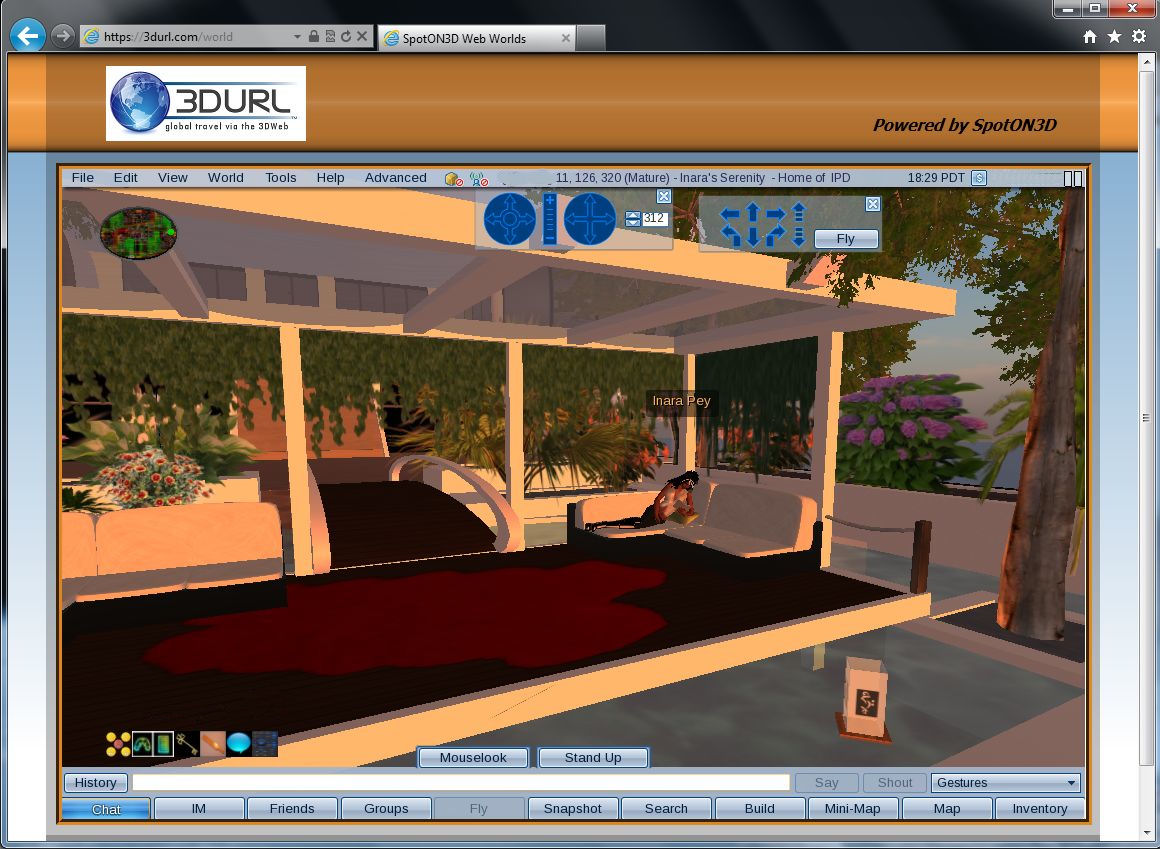
At home in SL – in a browser
While intended primarily for the SpotON (and VeeSome) grid(s), the Viewer is based on Snowglobe code (with the addition of some of Henri Beachamp’s extras), and so works with SL and other OS Grids.
Setting-up
Go to http://3durl.com/world. You’ll be asked to download and install the SpotON plug-in.
The installation of the plug-in will require you to close your browser.
The installation process will also create a application icon in your Programs list, allowing you to run the browser as a standalone item, as well as via the web.
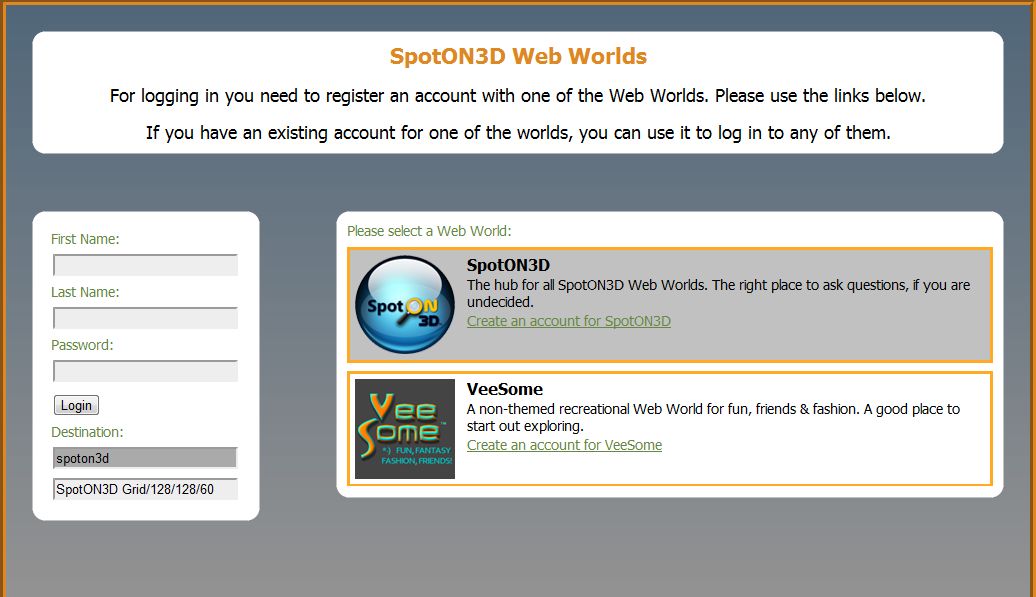
Once installation has completed, return to 3durl.com/world, where you will need to register with one of the offered grids (shown below).
Log-in / Registration page
Registration comprises:
Selecting one of the two grid options
Choosing your default avatar
Providing a name and password for the avatar
Providing an E-mail address for your Master Account (you can register up to five avatars against the Account)
Replying to the Account activation e-mail that will be sent to you.
Once you’ve activated your account, return to the SpotON log-in / Registration page and use the panel on the left to log-in. This will automatically log you into whichever grid you registered with – which you are free to explore, obviously.
Getting to Second Life and Elsewhere
To get to SL or another grid, go to FILE -> LOGOUT. You will be logged out of the current Grid and a splash screen will be displayed, complete with both a GRIDS button and a QUICK GRID SELECT button. You can use the latter to access Second Life as one of the pre-defined Grids in the Viewers, or the former to bring-up the Grid Selection window and add an additional grid.
Grid selection options
Any grids added using the Grid Manager will automatically appear in the Quick Select button as well, making switching between grids very easy; just remember that the Viewer is optimised for SpotON.
In InWroldz In my Browser
Quick Tip
By default, you can only log-in to either the SpotON or the VeeSome grid from the 3durl.com log-in page (depending on which one you chose when signing-up). However, if you want to be able to get to SL or another grid without having to log-in and out with SpotON or VeeSome, you can:
At the 3durl.com log-in page, enter an incorrect user name / password
The plugin will attempt to log you in, but when authentication fails, the Viewer splash screen will be displayed
You can now select your preferred grid from the QUICK SELECT button & supply the required log-in information
Occasionally the splash screen may refresh and default back to either SpotON or VeeSome as the logging-in grid, should this happen, simply click on the GRID button and select your grid from the Grid Manager window and APPLY and OK.
Some things to bear in mind:
SpotON isn’t listed on the SL Third Party Viewer Directory as yet, so there is a risk it is not register for use with SL (not that registered Viewer *have* to be listed in the Directory)
It is based on the SL Viewer 1.23 so no multi-attach options as yet or vertical IM tabs and only minimal skin support (although it does have Mu poses (use “:” for “/me”) OOC auto-complete and RLV/a)
Test Systems and Performance
I tested the Viewer-as-a plugin on three systems, using the same versions of Firefox, IE and Chrome on each. The three test systems comprised:
Acer Eee PC 1201N Netbook: Intel Atom 330 quad core 1.6GHz 2Gb; Windows 7 32-bit + SP1; nVidia Ion2 graphics 256Mb
Sony Vaio UMPC: Intel Core Solo U1500 1.33GHz 1Gb; Windows Vista + Service Packs; Intel 945 graphics chipset, shared memory
Overall, the performance on each was pretty similar to running the Viewer in a standalone mode, other than the fact that visually and fps-wise the Viewer fell somewhat behind the latest offerings from LL and others – but then the code base is significantly older as well, so this is not surprising.
Why Do This?
Given there is little performance-wise to be gained in using the Viewer in this way, coupled with the fact that you are still effectively downloading a Viewer to your PC for grid access, it is tempting to ask why bother? After all, if a computer can run a Viewer in this manner, it is probably going to be able to run a standalone Viewer. So where are the advantages in this approach? I put this question to SpotON3D Manager Victor Hua.
“The biggest advantage is ease of access. Giving people the ability to log in with a minimum amount of effort,” he replied. “Many businesses and educators would like to see the client run as a web based plugin, most likely for those same reasons. Also, having it as a Facebook app opens up the venue for a much larger audience and helps spread and improve adoption.”
The ease-of-access approach is an interesting one (if not entirely new), as it is something grid-based worlds are often critiqued about. However, the real issue with getting to grips with any grid-based world is not so much downloading and installing the Viewer as it is in using it; and here this approach offers no real advantage. But that said, it cannot be denied that many people are more comfortable downloading and using browser plug-ins than perhaps they are downloading and installing dedicated applications. This being the case, presenting the Viewer as a browser plugin, regardless of the fact it is full capable of standalone us, may well persuade people to dip a toe or two into the virtual waters.
It’ll be interesting to see where this idea goes, and whether anyone else will pick-up on it. For my part, I found it a fascinating experience to dabble around in a number of grids from my browser, and actually found this solution somewhat more preferable and convenient to use on the UMPC than using Radegast & its 3D scene rendering capability. That said, until someone comes up with a genuine solution that enables people to access grid-based virtual worlds from within a browser, as Tipodean are attempting to do, and which allows lower-end systems to access the virtual environment, then it is probable this solution will have limited appeal.
Updates
Aug 3rd:The issue of patients on the plugin aspect of this technology, coupled with issues around Viewer and GPL licensing, which are referred to by Kitely CEO Ilan Tochner in the comments below, are covered in-depth today by Maria Korolov at Hypergrid Business.
Aug 20th: As I’ve reported here, SpotON3D has now closed the ability to use the Viewer when presented through the browser with any other grid but their own.
InWorldz LLC, operators of the fast-growing InWorldz grid have today announced a significant joint venture with CariNet Inc. a quality-oriented service provider in the USA, to build a redundant 3D virtual world grid.
The Press Release from InWorldz reads in full:
InWorldz, LLC and CariNet Inc. To Power Virtual World Technology and Hosting Through Joint Venture
Venture to focus on quality of service, scalability, and core software to promote growth and technical innovation
NY and SAN DIEGO, CA , July 30, 2011 – InWorldz, LLC a leading provider of virtual world services and CariNet Inc. a quality-oriented provider of dedicated servers, server clusters, and cloud computing announce plans to form a joint venture to build a redundant 3D virtual world grid capable of high performance and fast growth.
The venture builds around the original vision of the InWorldz founders. Known to their customers mainly by their pseudonyms, Elenia Llewellyn (real name Beth Reischl), Legion Hienrichs (real name John Arnolde), and Tranquillity Dexler (real name David Daeschler) have supported the continuing vision that everyone should be able to experience virtual world technologies and services in a way that enhances their lives and their own vision. Since it’s inception in February of 2009,InWorldz, LLC has listened to customer feedback and demand to provide it’s residents with the software, hardware, and tools they need to create dramatic simulations ranging from vast and mystical oceans, to artistic depictions of real world cities. Building on a strong customer community and a solid technical background, the InWorldz grid has grown to over 800 customer owned regions on word of mouth alone.
CariNet Inc. has been a hosting leader since 1997, offering a wide variety of hosting options including dedicated servers, server clusters, public and private cloud offerings as well as server virtualization hypervisors. CariNet Inc. builds, owns and operates all of their datacenters and are capable of handling customers and demands of any size. CariNet Inc. currently services 7500+ customers around the globe.
CariNet Inc. provides a strong background and expertise in all things hosting. The CariNet team consists of a dedicated group of individuals willing to go the extra mile to make sure they have a quality product their customers can rely on. From power, to network, to hardware and software, CariNet Inc. has created a strong backbone for any business to tether their dreams to and let them run.
Enablement is the shared theme that has brought CariNet Inc. and InWorldz, LLC together. The joint venture will provide InWorldz with access to the latest in hardware and software technology available to support efficiency and scalability. Powered by this venture, InWorldz will have access to systems and expertise that will increase the effectiveness of their business processes, free up development resources, and increase profitability. The joint venture will provide both companies with the opportunity to continue to explore the growing virtual world market and provide the services and support that enable the individual as well as organizations who will use virtual world technologies in the future.
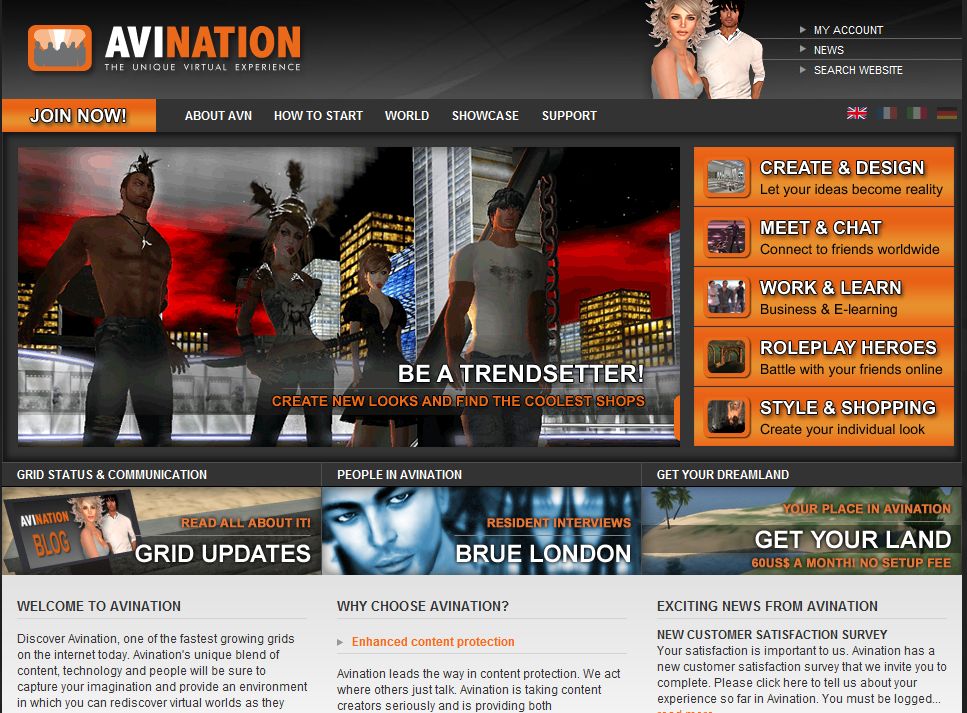
Avination have launched a “try a sim” promotion. you can pick-up a 15K prim simulator for $40USD for the first three months, rising to their standard $60USD a month thereafter.
The offer starts today and runs for an indefinite period. Builds from one discounted sim cannot be transferred to another discounted sim (so no $40-a-month sim hopping!).
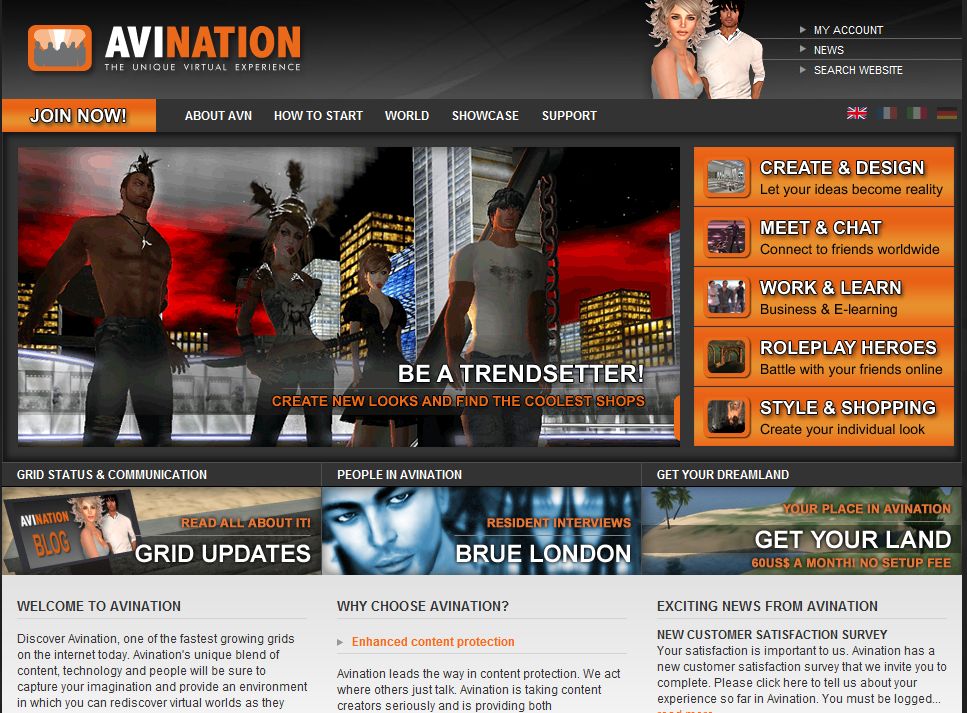 While people were focused on the announcement last week concerning InWorldz joint venture with CariNet, many of us missed an interesting snippet coming out of Avination by way of Maria Korolov’s excellent Hypergrid Business.


 Inara Pey: Living in a Modemworld