Creatorverse: Android arrival and playing on my S2

As Daniel Voyager reports, Creatorverse today makes its debut on Android, and is available via Google Play at a (UK) cost of  £3.14 (US: $4.99, approx), and requires Android 2.3.3+. There is yet more to come, with Creatorverse due to debut on the iPhone shortly, and possibly go elsewhere as well.

Creatorverse on my Galaxy S2

Given I have a Samsung Galaxy S2 and time on my hands today, I opted to download Creatorverse and have an initial look. Doubtless there are some out there who would like the short form of my thoughts on the app, so here they are:

Creatorverse is baffling, frustrating, teeth-grinding, innovative, engrossing, and potentially highly addictive.

To be fair, the first three of these issues are as much down to trying to use Creatorverse on the S2’s relative small screen as much as anything else. Simply put, the UI is so small, it’s hard to see the various button icons easily. Well, at least for me; I freely admit, I’m getting older and my eyes aren’t what they used to be (and as I write that, Spike Milligan’s immortal addition to the comment echoes through my head: “they used to be my ears!”). Even so, and despite the relative intuitiveness of the drag-and-drop shape creation options, it is as well that Linden Lab have produced a range of tutorial videos to help people get more to grips with Creatorverse; in today’s “satisfaction in 5 minutes or forget it” society, there is a risk that some might otherwise chuck Creatorverse over their shoulders all to easily. This is a Settings option (device MENU button > Settings) for “Restart Tutorials”, but I’ve yet to find out what this actually does…

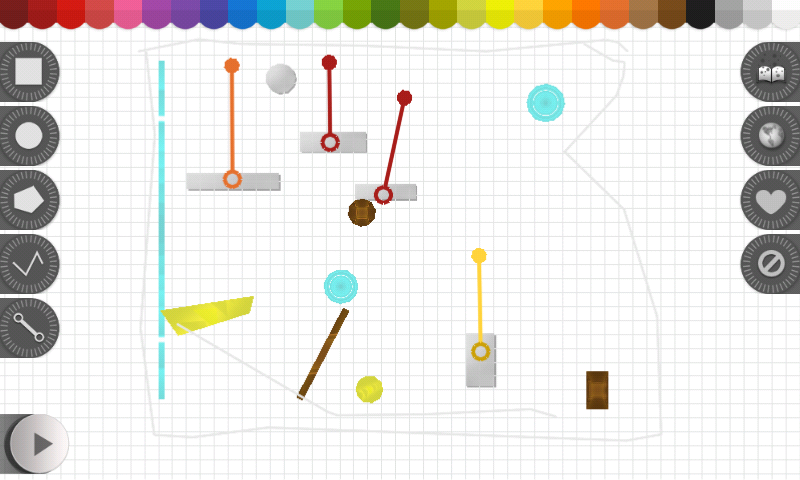
Which would actually be a shame – because, as with the latter part of my summary above, Creatorverse is engrossing – and potentially addictive. The basic screen display is easy enough to grasp, comprising a white grid workspace area when shapes can be dragged and dropped, and can be drawn freehand. Anchor points are present in both objects and lines, which can be use to drag / stretch corners, sections of a line or shape, and so on.

The Creatorverse basic workspace

The workspace is also somewhat context-sensitive. Add an object to it, for example, and additional buttons will appear to the left of the screen, such as the PLAY button, which allows you to switch to another screen, wherein anything you’ve created, together with any forces applied to it, will play and allow you to interact with it. Touch an object in the workspace, and a further series of buttons appear along the bottom of the screen, allowing you to do various things with objects your created.

Here’s where the first grumble arises: the buttons all use icons, some of which aren’t terribly clear, such as a sphere with a line either above or below it. Tapping a button does bring up a prompt as to what the button will do, but I’d tend to suggest the prompts themselves aren’t overly intuitive. Or maybe that is just me; I was certainly struggling to make sense between what I was seeing on the screen and what the prompts were attempting to explain….
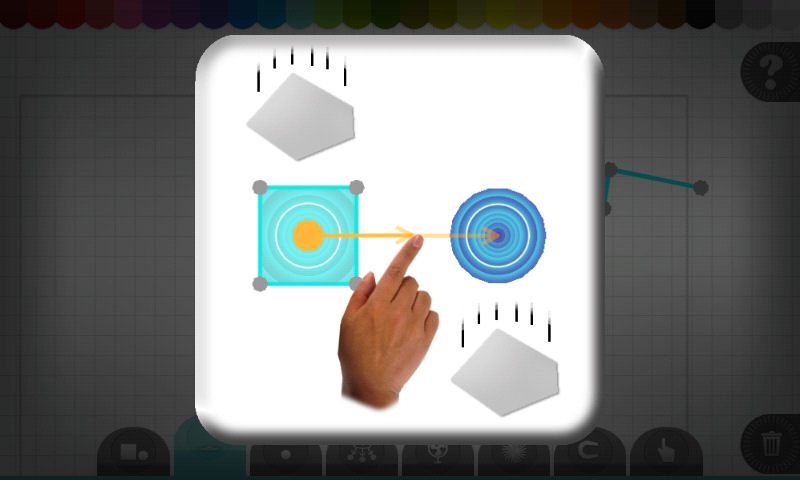
Say whut? On-screen prompts aren’t always clear to the uninitiated

Continue reading “Creatorverse: Android arrival and playing on my S2”

Rod Humble reveals some of his thinking behind LL’s new products

Kill Screen carries an interesting article on Second Life and Linden Lab’s direction under the leadership of Rod Humble. Provocatively entitled, Can Rod Humble resurrect Second Life? the piece examines Humble’s role as LL’s CEO and in particular his strategy in driving the company towards diversification.

A relaxed Humble with a memory of the past…

The latter has tended to divide people engaged in or observing SL, with some seeing it as a sign that LL have somehow “given up” on Second Life or are using it simply as a financial lever with which to churn out new products, and others taking a more moderate view of things. I’ve argued myself on a couple of occasions that diversification could actually be both beneficial towards SL in the longer term, and really doesn’t measure up in any way to LL having “given up” on SL. However, Humble’s view adds an interesting dimension to the discussion, as it is clear his thoughts possibly reach far beyond matters of “direct” user retention. The article notes in particular that:

One initial challenge, however, is its own core product. Building an object in Second Life isn’t easy. There are tutorials and message boards, but for someone who wants to pop in and simply make something quickly, Second Life is intimidating. In fact, that was part of the barrier to the community’s growth. Despite all its fanfare and media coverage, actually getting started was a hindrance to casual users. “Second Life is a highly complex 3D space. It’s a high learning curve,” Humble notes. “A steep climb but rewarding and deep.”

As we’re aware, bridging that gap is hard. There have been numerous attempts to help new users across it, from in-depth solutions such as the old Orientation, Discovery and Help Islands, through to the infamous “first hour” experience of Mark Kingdon’s day (which grew to encompass the “first five hours” when it wasn’t working out as planned) to the highly minimalistic (and questionable) Destination Islands seen more recently. Efforts have also included privately run welcome areas through to experimental orientation areas to something of a return to the more traditional approach.

Part of the problem here is that everyone tends to have an opinion on how it should be done. Many focus on the technical aspects, some on the social aspects, and well may have common foundations, then often build out in various different directions. This makes drawing a consensus as to what works actually quite difficult – as the Lab has learned.

However, in launching the new apps – particularly Creatorverse and Patterns – Humble sees things differently; that by breaking down the creative process into easily understandable concepts and ideas that allow the user to develop a more intuitive understanding of the creative process – and perhaps then move on to more involved creative environments. As the Kill Screen article also comments:

The Linden apps strategy hopes to bridge the gap between the tactile joys of painting and the more guided pleasures of digital makers. More importantly, Humble’s ultimate goal is digital literacy. As he struggled as an amateur, he found that his appreciation of the masters was heightened. The jazzy rhythms of Kandinsky took on new life as he was able to speak the painter’s language. Humble hopes that games like Creatorverse will foster a greater appreciation of the creative process behind designing digital goods. “The hope is that the more people make things, the more they have a richer language to express criticism.”

Rod Humble: Creatorverse and Patterns – opening doors to greater user creativity

Whether this will lead people from the likes of Creatorverse to Second Life is questionable; but where Patterns is concerned, there is something of a path where this may happen; both it and Second Life are somewhat grounded in similar concepts, something a number of commentators – myself included – have noted. Obviously for it to be effective, there needs to be some pointing of the finger towards the doorway from either Patterns to Second Life, which is currently far from being evidenced; but then Patterns is also a long way from prime-time as well.

Perhaps more telling from an SL standpoint is a direct quote from Humble:

“I like rebelling against the tyranny of structured forms,” Humble says. Sims creator Will Wright’s approach to “software as toys” was an inspiration to Humble while the latter was at EA. The constraints that game designers typically place on their players are anathema to the more open-ended creative process that Humble sees as the future of play. “Instead of being told you need to do these tasks to proceed to the next air lock of fun, why not open those doors and give you the ability to fly around?”

This not only encapsulates the broader aims of the likes of Creatorverse and Patterns in reaching new audiences and (maybe) enticing them towards Second Life, it more particularly seems to point to why Linden Lab has, on the one hand, been pushing out new tools and capabilities on their users while on the other, seeming to step back from “direct” involvement within SL. That is, the company is simply trying to present users new and old with as wide a palette of tools and capabilities as possible (mesh, pathfinding, the still-to-be-completed advanced creation tools, the upcoming materials processing capabilities, etc.) they can use create and explore the 3D spaces offered by SL without feeling constrained by the constant presence of the company looking over their shoulder.

The Garden – a subtle use of Teleport Agent, an element of the advanced creation capabilities in SL, which is used ion the puzzle HUD

Doubtless there will be disagreements with this view and with Humble’s comments in general; however they do make interesting reading. For me, and despite all the problems which are looming on the horizon where SL is concerned, I can’t help but come away from it with a feeling that (again) neither Humble nor LL have given up on their core platform.

With thanks to Daniel Voyager for the Twitter pointer.

Creatorverse now on Kindle Fire and Kindle Fire HD

Update February 19th, 2014: As linden Lab have discontinued Creatorverse, links to the application have been removed from this post.

On Wednesday the 14th November, Linden Lab slipped out the news that Creatorverse, their 2D creation / sharing application recently released for the Apple iPad is now available for the Amazon Kindle Fire and Kindle Fire HD.

The apparently low-key announcement was made via a press release, which appears on the Company’s website, and which reads:

SAN FRANCISCO – November  , 2012 – Linden Lab®, the makers of shared creative spaces including Second Life® and PatternsTM, today announced that CreatorverseTM is now available on Amazon for Kindle Fire and Kindle Fire HD.

Creatorverse is a two-dimensional shared creative space, a digital canvas on which you can build unique creations, set them in motion, and share them with the world to enjoy and remix. You become an inventor as you draw, stretch, shape, and color your creations, and then add joints, forces, motors, teleporters, and inputs that change how your inventions come to life on the screen. You can save your inventions locally or share them to the cloud for other users to enjoy and remix into their own unique creations.

“It’s been gratifying to see the positive response to Creatorverse since we first launched it, like Kotaku calling it one of the coolest things you can do with an iPad,” said Rod Humble, CEO of Linden Lab. “Already, iPad users have made and shared some incredible and fun things with Creatorverse, from games to interactive art, and we’re excited to now bring the app to the Kindle Fire and Kindle Fire HD. Very soon, we’ll also be releasing Creatorverse for the iPhone and Android so that even more people can enjoy this shared creative space.”

Creatorverse for Kindle Fire and Kindle Fire HD is available now for $4.99 on Amazon at  http://www.amazon.com/Linden-Lab-Creatorverse/dp/B00A439RGG/ref=sr_1_1?ie=UTF8&qid=1352913683&sr=8-1&keywords=creatorverse

Creatorverse is also available for iPad and is available from the App Store at https://itunes.apple.com/us/app/creatorverse/id563088306?mt=8 .

Creatorverse – now available for the Kindle tablets from Amazon

Versions of the application for the iPhone and Android platform are reported as “coming soon”.

Creatorverse: one week on, going strong?

Update, February 19th, 2014: Creatorverse was discontinued by Linden Lab on February 19th, 2014. Links to the Creatorverse website have therefore been removed from this article.

They say a week is a long time in politics. While the same cannot be said of business in any way, shape size or form, Creatorverse has now been out on the market for a week, and so I thought it worthwhile to take a look at reaction so far.

And it all seems very positive.

Screenshot_2012-11-20-16-31-53
Creatorverse

Creatorverse is One Of the Coolest Things You Can Do With an iPad was the opinion of Kotaku.com on the day Creatorverse was launched. “With its simple bare-bones interface, Creatorverse requires a little fumbling about to get one’s bearings. So far I’ve managed to build a simple machine that keeps a ball spinning endlessly, achieving mastery over virtual perpetual motion,” the article goes on. “Thankfully I don’t have to rely on my own creations to amuse me. The game allows players to share their creations with the Creatorverse community, allowing others to download and tweak their designs to their hearts’ content. It’s an incredibly cool little toy …”

148apps.com were impressed with the app’s ease-of-use, “The interface is what stands out the most. It’s clean and crisp and the white canvas just invites users to start creating. Shape and line tools may be selected on the left. Once an object is placed, users can then drag the points to make different shapes or drag a color down from the top to fill it.”

They go on, “The simple drag and drop controls allow users to make animations with ease. While Creatorverse‘s unique sandbox style may mean it’s more fun for kids (or kids at heart), it’s the creative possibility that makes it so engaging. Whether uses wish to make a simple pinball-style game or a short animation, it’s a neat concept that lets users explore their artistic side.”

Continue reading “Creatorverse: one week on, going strong?”

Lab launches Creatorverse

Update, February 19th, 2014: Linden Lab have discontinued Creatorverse. Therefore, links in this article have been removed.

Thursday November 1st, 2012 Linden Research Inc has officially announced the launch of Creatorverse for the Apple iPad. Announcing the launch, the Press Release reads in part:

Creatorverse is a two-dimensional shared creative space, a digital canvas on which you can build unique creations, set them in motion, and share them with the world to enjoy and remix. You become an inventor as you draw, stretch, shape, and color your creations, and then add joints, forces, motors, teleporters, and inputs that change how your inventions come to life on the screen. You can save your inventions locally or share them to the cloud for other users to enjoy and remix into their own unique creations. From the simplest bouncing ball to a car, a rocket, a pinball game or a beautiful piece of interactive art, the possibilities for creativity are endless with Creatorverse.

Sharing your creations – seen as one of the attentions for Creatorverse (image: Linden Research Inc.)

Interestingly, and prehaps learning from their experience with Patterns, Linden Lab have also launched a series of YouTube tutorial videos for Creatorverse in their own dedicated channel, some of which are also displayed on the Creatorverse website.

Given that Patterns did give some people initial issues with getting started, this may not be a bad idea, depending upon how complicated and capable the tools within Creatorverse are. As it stands, topics for the videos cover input to the screen, how to make various joints – distance, wheel, weld, etc., – howe to apply forces to objects, and so on; a total of 14 videos in total at the moment.

As Patterns users are being encouraged to upload videos of their activities within the Patterns universe, it’ll be interesting to see if / how users of Creatorverse may do likewise – and whether they will be encouraged to do so.

As with Patterns, the Creatorverse website is focused on community, with a community / forums area where topics can be raised, ideas exchanged, suggestions made and questions asked / answered. With Patterns, the forum area has been well received and quite well used; one assumes the same will happen with Creatorverse should it prove popular.

The ability to share creations is a major part of Creatorverse, and it is interesting to note that currently, there appears to be no dedicated area on the website for viewing other people’s creations. As the SHARE button is part and parcel of the Creatorverse application, one assumes that sharing and browsing creations must be handled purely from within the application itself. If so, it will again be interesting to see if a preview capability will be added to the website should there prove to be a demand for it.

Creatorverse is available at $4.99 in the Apple App Store. Unlike Patterns, this is a full release of the product, not an alpha or Genesis release, and so technically marks the first “full” release of a product by the company outside of Second Life – the Lab has stated that Patterns will not be released as a “full” version until late 2013.

Currently, Creatorverse runs only on the iPad, but it may well be made available on other platforms in the future – at least one recent interview with Linden Lab CEO Rod Humble has hinted at Creatorverse also being made available for the PC and Mac, and one assumes that if this is the case, an Android version may also be made available at some point.

Sadly, no reviews of Creatorverse are likely to appear on these pages, as I am not an Apple user.

Update: read one of the first reviews of Creatorverse from 148app.

Slightly Mad Avians: Humble talks Creatorverse, Versu and Dio

Update, February 19th, 2014: Creatorverse, Versu and dio were discontinued by Linden Lab on February 19th, 2014. Links to their websites, etc, have therefore been removed from this article.

Looking through the pingbacks on my blog comments, I was curious to see one show up on the 23rd October 2012 linking to an article I wrote back at the start of the year. Curious at to why someone would be linking to an old article, I went to have a look.

Turns out the article linking to me is from Kotaku, a games-related blog run by Gawker News – and the article itself is an interview with Rod Humble. (which came to me via Kotaku’s Australian site) Needless to say, I was more than a tad surprised to have someone interviewing our own Rodvik linking to my blog (oh, be still, beating ego!), so I decided to have a read through.

The piece itself is obviously about the Lab’s new and upcoming products, and it gives some interesting insights into the thinking behind them.

“Just about everybody I know who isn’t in the games business or programming business comes to me with a game idea or a website, and the truth of the matter is, quite often, they can’t make it.”

the article quotes Humble as saying. He then goes on:

“There’s this big barrier. They look at something like C++ [programming] code and, frankly, it looks like a big equation. It just looks like gibberish.

“The more we can make tools that are just fun to use—all of a sudden you are making something you wanted—you can focus on the creativity than mastering this arcane set of symbols. We can hopefully bring more people into that fold of ‘hey, you made something!'”

Thus is the broad thinking behind Patterns, Creatorverse and the still-to-be-seen Dio and Versu, which are apparently going to be appearing something in the next month – if not before the end of this one, depending on how you read quotes from elsewhere.

Creatorverse itself comes in for some attention in the piece – Humble describes it as being his five-year-old daughter’s favourite game at the moment, and it is referred to as coming out “later this year”. Whether that is a result of the interviewer misunderstanding Humble (the interview was via ‘phone), or whether it is because the release date may have shifted while the wheels at Apple (or elsewhere) turn slowly, isn’t clear.

What is clear, however, is the novel way Creatorverse is pitched in the interview:

In the near future, his company will put out a program for iPad called Creatorverse, which will let people use shapes and physics to create basic 3D systems and, yes, games, then share them for anyone else to download and play. Think of making a game that lets you fling shapes into other shapes—your own “Slightly Mad Avians”, he offers as an example, if you get what he means.

Creatorverse

While Slightly Mad Avians could stand as a title in its own right (along with Perturbed Pigeons, a name Darien Caldwell suggested to me the other evening in an entirely unrelated conversation…), it’s nevertheless a curious hook on which to hang a description of Creatorverse – but an interesting one in terms of mental images….!

What is of greater potential interest, however, is the comments about the upcoming Dio and Versu.

Dio is described as: “A website that lets people create rooms out of their personal images and videos, connects them to other people’s rooms and lets people share the space.”

While it has previously been described as “A room creator, in which players can do everything from construct a choose-your-own adventure to develop an interactive wedding album,” and Linden Lab managed to accidentally give people something of a quick peek at an early iteration of a website connected to Dio back at the start of the year, the comment in the Kotaku piece implies that the website appears to be the product, rather than in support of it. It’ll be interesting to see how people react to this.

Versu, meanwhile, gains a little more flesh on the bones given in an interview with Giant Bomb, with Humble describing it as, “A platform that lets you make real interactive drama” by giving you “the ability to create characters within a story and then, thanks to the AI, see that “those characters will have emergent properties as you play through the story.” He goes on to admit that this is pretty ambitious and admits to an element of “Tilting at windmills” in order to bring it to a wide audience.

The article goes on to talk in more detail about Patterns, which many of us – and many more in the gaming community – are enjoying even in its nascent (or as Humble puts it, “not even pre-baked”) form. It also talks about Humble himself and his arrival at Linden Lab, which leads to a good mention of Second Life:

It makes perfect sense that Humble would wind up at Linden Lab, the company best known for the virtual world Second Life. It’s as successful a canvas for the communal creation of a virtual world as there’s been. It’s been a viable digital canvas for about a decade now has been populated by users who make their own buildings and vehicles, who design contraptions, contort physics, stage elaborate events, form societies, and pioneer the art of inhabiting elaborate second skins that express inner or otherwise impossible creativity and desires.

It’s a positive read, and well worth taking a few minutes out to read through.

Related Links