The following notes were taken from the Tuesday, October 15th, 2024 Simulator User Group (SUG) meeting. They form a summary of the items discussed, and are not intended to be a full transcript, and were taken from my chat log and Pantera’s video of the meeting, which is embedded at the end – my thanks to her for providing it.
Meeting Overview
The Simulator User Group (also referred to by its older name of Server User Group) exists to provide an opportunity for discussion about simulator technology, bugs, and feature ideas.
Meetings are open to anyone with a concern / interest in the above topics, and form one of a series of regular / semi-regular User Group meetings conducted by Linden Lab.
Dates and times of all current meetings can be found on the Second Life Public Calendar, and descriptions of meetings are defined on the SL wiki.
Simulator Deployments
Quoting Rider Linden:
Two weeks ago we had a bit of a rough roll, so some of the main grid was left on Summer Fun. Last week the entire engineering team was at an offsite and we decided it was probably not a good idea to do anything while we were all distracted. We believe that we have a fix for the issue and are going to be making a final decision later today about doing an off schedule roll on the SLS regions that are still causing problems. Once we have that out of the way we’ll be able to get back to the regular schedule. I believe that that the next in line is WebRTC, but we need to make sure that enough people have upgraded to an RTC capable client.
SL Viewer Updates
No changes at the start of the week:
Release viewer: version 7.1.10.10800445603, (formerly the DeltaFPS RC), dated September 11th, was promoted to de facto release status on September 19th. This includes:
Performance boosts. Memory management has been optimized and users will experience a higher FPS across various systems. A comprehensive range of bug fixes are also provided. This includes better PBR material handling and resolving frequent crashes. See the release notes for more.
UI for scheduling region restarts now available via a new button located in the Region/Estate floater. (Note: there is currently an issue with scheduled region restarts working correctly and a fix is due to come in the next server release).
Release Candidate: ExtraFPS RC, version 7.1.11.11074622243, issued September 30th.
Aesthetics improvements: new Antialiasing setting – SMAA; Contrast Adaptive Sharpening; Khronos Neutral Tone Mapping (can be changed to ACES via the RenderTonemapType Debug setting).
In Brief
Please refer to the video below for the following:
Leviathan Linden requested a “top five” (or so) features / options people would like to see added to the official viewer. Responses at the meeting included:
RLV – currently, RLV/a code is being submitted to LL by its author, Kitty Barnett, for inclusion in the Official viewer and (I believe) RLV author Marine Kelley may have also provided information on RLV functionality to LL.
Client- side animation override (AO) capability.
Object derender.
Contact Sets (Firestorm).
Autrespond outside of Do Not Disturb mode.
Automatically rezzing under land Group.
ADD instead of WEAR as the default behaviour for attachments.
Adjustable toolbar button sizes.
Leviathan also dropped the following question into the meeting:
Suppose SL added a VR mode that allowed for seeing SL content in stereo vision a-la VR goggles. NOT the ability to be in the avatar body and move the limbs with trackers but just the ability to view SL content as a fly-cam in VR mode… would that be useful to anyone? Would anyone here use it? What would you use it for?
Responses were broadly positive, if the capability could be tired to the likes of using a vehicle in world.
Concerns were raised over the viewer’s ability to maintain a smooth, high enough frame rate consistently through a VR session.
The above does nor mean LL is about to implement and kind of VR / partial VR element within the viewer; Leviathan made it clear he was just looking at feed back in relation to the general idea of a partial VR experience with SL.
A further discussion on the issue of attachments failing (being dropped / lost / ghosted issues (see: Attachment loss on RC channel 2024-08-29.10619830788) which can be experienced during region crossing (TP or physical) & the fact the LL are working on a fix. is being
A discussion on making Media on Prim (MOAP) safer, and which threaded throughout much of the meeting.
The above drifted into discussions general media handling and also on rendering, colour maps, support for look-up tables for rendering / colour grading in the viewer (e.g. to give post-processed effects).
A further discussion on editing tools, scripting options, etc.
† The header images included in these summaries are not intended to represent anything discussed at the meetings; they are simply here to avoid a repeated image of a rooftop of people every week. They are taken from my list of region visits, with a link to the post for those interested.
Soulstone, October 2024 – click any image for full size
Valayra Asher (Valayra) has once again redressed her Full region of Soulstone, a region I’ve covered a number of times, and I’m always drawn back to it because Valayra tends to offer something very removed from the previous iteration, making any visit a entry into a new world and vision. This iteration is no exception, touching on Halloween to bring a theme of general horror and mystery mixed with a little post-apocalyptic or dystopian and flavoured with a very faint hint of Dark Knight stories.
Before getting into things, I will note that this is a location best viewed using a PBR-capable viewer or, if you’re still on an older viewer, then with Advanced Lighting Model (ALM: Preferences → Graphics) enabled.
Soulstone, October 2024
If your system can handle them, then proceeding with shadows enabled is recommended; if your system cannot handle this whilst exploring the region as a whole, give it a go whilst inside the asylum, where you can also potentially reduce Draw Distance to help lighten the load the viewer is handling. Do also make sure you’re using the Shared Environment and, finally, please note that the south-west quarter of the region appears to be given over to a private residence, and is separated from the rest via a mix of hills and building shells, so avoid trespass there.
Located on the north side of the region, the Landing Point gives the first hint of the post-apocalyptic / dystopian feel to the setting as it lies on a partially destroyed road bridge. It’s not clear what caused the literal downfall of the bridge, but the local flooding to be found suggests it may have been the result of a natural disaster such as an earthquake. At the foot of the bridge the mystery of the setting continues: it appears the road once linked with one running from the east side of the region – but where they presumably once met has been turned into a caged basketball court with the appearance of having been placed there after the roads had been largely destroyed.
Soulstone, October 2024
This basketball court with its razor wire, closed-circuit security cameras and the guard tower sitting next to it all give the setting a penitentiary feel; however, standing above them along the top of an eastern rise in the land is the foreboding bulk of an asylum. For me, it immediately brought to mind thoughts of the Elizabeth Arkham Asylum for the Criminally Insane. Whether this is intended or not, I’ve no idea, but a hospital for the criminally insane might account for the use of a guard tower, spotlights and the like.
The asylum sits as a the major focal point of the setting. The way to it is along the east-pointing section of road, littered as it is with the well-rusted wrecks of cars as they sit as the detritus of disaster. The asylum itself appears at first glance to be deserted – the main doors are wide open (as are other leading outside) and the windows smashed and broken, with further signs of chaos inside. Exploration here is best done with shadows enabled, so as to fully absorb the environment and the sense of stumbling around in the dark and coming across the unexpected.
Soulstone, October 2024
While it is fair to say the asylum dominates the landscape, its multiple broken eyes staring out over the devastation below the brow on which it sits; it is not alone; others sit on the flat plain it overlooks, some of which, like the asylum, have managed to retain some vestiges of electrical power despite whatever has befallen them.
Broken and empty, a forlorn and empty swimming pool sitting before one block, these high-rises bear silent, shattered witness to whatever anger was unleashed upon this land; not even the glimmering neon of an advertising hoarding can disguise the fact that civilisation here has passed, living behind only animals, birds, and the shuffling shells of those asylum inmates somehow left behind in whatever evacuation may have taken place.
Soulstone, October 2024
Yet amidst the ruin a little tram station sits, ostensibly in one piece, also sheltering under the dormant protection of the guard tower. Where the trams arriving and departing this station might have come from or run to makes no difference now. Indeed, going on the signs hung from the pole of a working streetlight alongside the station, it would appear whoever survived whatever happened recognises this fact, given the destinations the signs list…
And speaking of signs / signage / graffiti, attention should be paid through any explorations, as there is a certain dark humour to be found throughout in the signage and scrawl, posters and adverts. Places to sit can be found scatters around, mostly in makeshift shelters out on the broken roads or alongside the fractured walls of buildings. They offer a chance for those who want to absorb the setting’s ambience and / or allow it to conjure stories of how it has come to be so devastated to do so in a measure of small comfort. Also to be found, large and small, are touches that might bring to mind a particular film about the aftermath of one calamitous event in human history – at least to me -, and others echoing the shuffling threat of horror from assorted films and televisions series (“Braiiins….”).
Soulstone, October 2024 (“You maniacs! You blew it up! Ahh! Damn you! God damn you all to hell!”)
Finished with a soundscape well suited to both its devastation and mystery, this iteration of Soulstone is, as with previous builds, well worth visiting.
Logos representative only and should not be seen as an endorsement / preference / recommendation
Updates from the week through to Sunday, October 13th, 2024
This summary is generally published every Monday, and is a list of SL viewer / client releases (official and TPV) made during the previous week. When reading it, please note:
It is based on my Current Viewer Releases Page, a list of all Second Life viewers and clients that are in popular use (and of which I am aware), and which are recognised as adhering to the TPV Policy. This page includes comprehensive links to download pages, blog notes, release notes, etc., as well as links to any / all reviews of specific viewers / clients made within this blog.
By its nature, this summary presented here will always be in arrears, please refer to the Current Viewer Release Page for more up-to-date information.
Note that for purposes of length, TPV test viewers, preview / beta viewers / nightly builds are generally not recorded in these summaries.
Official LL Viewers
Release viewer: version 7.1.10.10800445603, formerly the DeltaFPS RC, dated September 11, promoted September 17 – NO CHANGE.
Cica Ghost is back for October with another whimsical installation with White, which opened its doors on October 14th, 2024. The setting uses a quote from the American portrait and genre artist, Charles Webster Hawthorne (1872-1930), who is perhaps most famous for for his lushly painted portraits and landscapes and for founding the Cape Cod School of Art (1899):
Put variety in white.
To be honest, I’ve no idea of the context in which the quote was originally given, but Cica has taken it to heart ahead of the coming of winter in the northern hemisphere to give us a symphony of white from the ground on which we walk when visiting to the sky overhead. Has it snowed? Is the world frosted? Are we perhaps in another realm entirely? You decide.
Cica Ghost, October 2024 – White
Certainly, the creatures scattered through the landscape are somewhat otherworldly; some appear slug-like (but friendly – for the most part!) as they sit upon the pockmarked white of the ground; others appear to be partially extruded from that very ground, as if squeezed up from below – or perhaps they are simply lying partially buried for some reason; still other looks like alien mice, small (compared to their companions!) and potentially huggable. Some even look like hills within the landscape – at least until their maws open in a long, slow yawn-like motion.
The structures here are equally strange, carrying with them the feeling that they’ve also been extruded from the ground – or some giant little boy or girl has been building the more extraordinary sandcastle-like creations as they raise trumpet-like appendages to the sky.
Cica Ghost, October 2024 – White
But then, also, there are the tall flowers, snowdrop-like in their white innocence and the monochrome butterflies flittering overhead (and under at least one of which people can ride); these look so natural, so familiar, it’s hard to place this strange place as being anywhere else than on Earth. And perhaps it is; perhaps it is a dreamscape, and we are invited to be travellers crossing it. The choice is yours.
And that’s the beauty of Cica’s installations: they allow us a moment of escape, a chance to relax and inhale the air of whimsy. so – enjoy!
Cica Ghost, October 2024 – White
SLurl Details
White by Cica Ghost (Mysterious Isle, rated Moderate)
Simurg – Halloween + Autumn, October 2024 – click any image for full size
In June 2024, I dropped into Simurg, an engaging 4096 sq metre parcel seated within a Full region leveraging the Land Capacity bonus and designed by Lintu (KorppiLintu). Presented as a photogenic location, it offered an engaging mix of ancient history and a touch of fantasy mythology (see: Simurg’s mythical beauty in Second Life). Since then, Lintu has been busy expanding that build (of which more later), and is also presenting another setting specifically for the Halloween season.
Also located on a Full region (but entirely separate to Simurg), this is Simurg + Halloween in Autumn. Occupying a parcel roughly twice the size of Simurg, it offers an equally engaging location for photography in which there is more to be found than might meet the eye on first arrival.
The landing point sits on the east side of the setting, which is itself located in the south-east corner of the region, allowing it to to have, in keeping with Simrug, open water on two sides. Indeed, the landing point sits with its back to the sea as it sits in the shadow of two of the buildings within the setting. One of the latter is the Simurg Gothic Cottage, designed by Kwoone Oui (Kwoone), Lintu’s Second Life companion, and it is the first in a series of scenes suitable for the season that are awaiting discovery as one explores.
Simurg – Halloween + Autumn, October 2024
Spreading itself out before the landing point is something of a stone-flagged village square or street, the local chapel and graveyard to one side showing more signs of ghostly goings-on, edged with touches of humour via some of the tombstones, along with plenty of indications the dead are not entirely content to rest. A large house looms up over the back of the chapel, and while it is unfurnished within, its nature is such that it draws the eyes to it. More to the point, a walk up the steps leading to it will provide arched access to a back terrace where fortunes might be read, together with a bridge spanning the gap to another rocky plateau.
This second plateau is home to The Ruined Retreat by Marcus Inkpen, and here offered as what I take – from the cauldron bubbling away in the remnant’s of one of the building’s rooms – is potentially the home of one or more witches. This house overlooks the northern end of the village, where a street runs west from the cliffs, passing assorted places of business and residence (façades), with two of the former being the local apothecary’s abode, where potions and other magical items might be found, and the local music hall where the bare bones of entertainment might be enjoyed (in a manner of speaking 😀 ).
Simurg – Halloween + Autumn, October 2024
The western end of this street takes the form of the open maw of a cave which at first appears to be a rocky tunnel passing under the witches’ house. In fact a wander into it will bring one to the three witches gathered around their cauldron as if awaiting a certain Macbeth to come to them in much the same way as he found the three weyward Sisters (to use the description from Shakespeare’s First Folio) as he crossed the “blasted heath”. Beyond an encounter with the three, the cave will bring those walking through it to a ribbon-like meadow beyond, where horses peacefully graze and water tumbles down rock to fill a pond on which a leaf boat awaits those looking for a place to rest. More on this anon.
However, a look to the left as one reaches the three crones when entering this subterranean walk (or to the right, if coming from the meadow) will reveal a second passage downwards, lit by what first might seem like the flames of hell, given the denizens found along its length. However, allowing for the spider and the webs she has woven, it leads to a quite unexpected and hauntingly attractive setting sitting is a large cavern. With access also provided by steps descending the cliff-face to the south of the Gothic Cottage mentioned above, the cavern also provides access to another little sitting area well away from the rest of the village for those who seek it on the water.
Simurg – Halloween + Autumn, October 2024
Now, to return the to meadow, which can also be reached by walking through the village and passing under the bridge leading to the witches’ house. Follow the path meandering through it and past the pond, and you’ll come to both a further little seating area, and open against the rock wall a teleport portal that will carry you to Simurg, delivering you to one side of that setting. Here, a further portal directly behind you will take you up to the gardens, or a walk through one of the arches under the stone curtain and then across the stepping stones beyond, will bring you to the ruins.
Neither the gardens nor the ruins have significantly changed since my last visit (although some details have been added / removed), although they do now sit under a most dramatic sky. Two enormous craft hang in the sky above, their form perhaps vaguely reminiscent with Stargate SG-1’s ships of the Ori for those familiar with that show (a not entirely out-of-place line of thinking, given the show’s dives into mythologies and an ancient history, etc.).
Simurg – Ancient and Underwater City, October 2024
However, the most significant change is to be found by using a further teleport portal located within raised garden to carry you below the flagstoned and partially-flooded floor of the main structure. Here you will find the aquatic element of the setting that gives it its extended name: Ancient & Underwater City. It is a place of flooded ruins where a trio of Roman deities – Venus, Mars and Saturn – are joined by the Romano-Hellenistic goddess Diana in poses of battle, as kraken-like tentacles rise from even greater depths below the submerged ruins, while sea plants and fish calmly go about their business.
I did not find a teleport portal linking Simurg back the the Halloween setting – which might be simply a case of lack of seeing on my part – so I’ll add the Simug link below as well, as if you’ve not visited either, both are more than worth the time, offering as they do compact settings with plenty to explore and appreciate. I assume Simurg Halloween + Autumn will vanish some time after October 31st – so be sure to visit on or before then!
Simurg – Ancient and Underwater City, October 2024
Seconds from capture: Super Heavy Booster 12 descends between the “chopsticks” of the Mechazilla lifting system of the tower from which it and Ship 30 launched less than 8 minutes previously, as the arms close around it in readiness for a safe capture during the fifth integrated flight test of SpaceX’s starship / super heavy launch system. Story below. Credit: SpaceX via the NSF.com livestream.
Hera: Return to Didymos
On November 24th, 2021, NASA launched the Double Asteroid Redirection Test (DART) mission, a vehicle aimed at testing a method of planetary defence against near-Earth objects (NEOs) that pose a real risk of impact, by smashing an object into them and using kinetic energy to deflect them from their existing trajectory.
To achieve this, the spacecraft was both a science probe and impact device, and it was launched to rendezvous with the binary asteroid 65803 Didymos (Greek for “twin”), comprising a primary asteroid approximately 780 metres across, and a smaller companion called Dimorphos (Greek: “two forms”). These sit within a heliocentric orbit which periodically cross that of Earth whilst also reaching out beyond Mars , which occupy a heliocentric orbit that periodically crosses that of Earth. On reaching the pair, DART smashed into Dimorphos, successfully altering its orbit around Didymos.
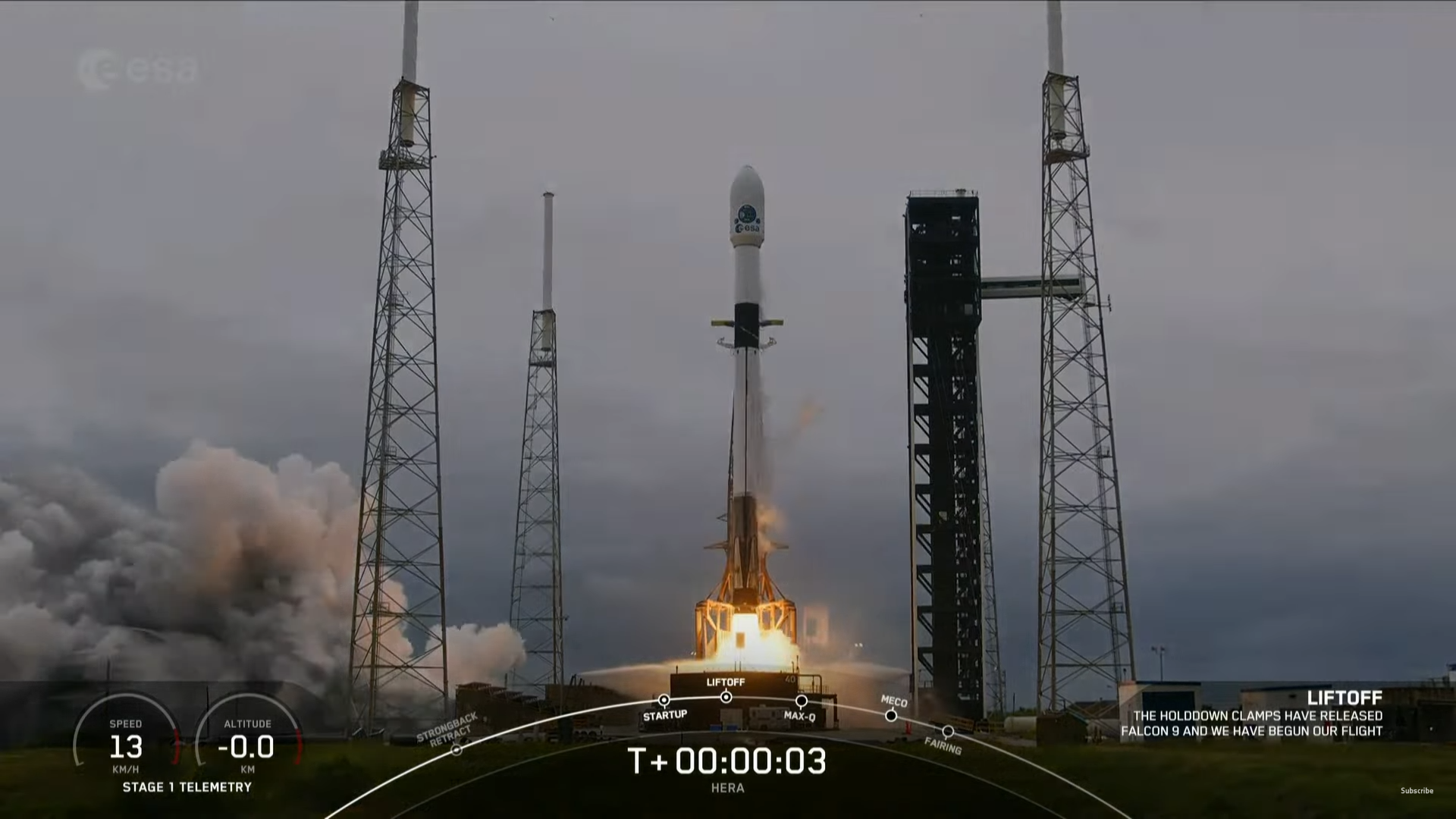
A SpaceX Falcon 9 lifts-off from Cape Canaveral Space force station’s SLC-41 on Monday, October 7th, 2024, carrying the European Space Agency’s Hera asteroid mission to the binary asteroids Didymos and Dimorphos. Credit: ESA/SpaceX
I covered the launch of the mission in Space Sunday: a DART plus JWST and TRAPPIST-1 updates, and the aftermath of the impact two years ago in Space Sunday: collisions, gamma bursts and rockets. Since then there has been much reported on what has happened to Dimorphos in the wake of the impact, but scientists have been awaiting a planned follow-up mission to the Didymos pairing which could survey the outcome up close. And that mission is now underway, courtesy of the European Space Agency (ESA).
Launched at 14:52:11 UTC on Monday, October 7th from Canaveral Space Force Station, Florida atop a SpaceX Falcon 9 rocket, ESA’s Hera mission made it away from Earth just ahead of the arrival of Hurricane Milton. Lift-off marked the start of a two-year journey for the 1.1 tonne solar-powered spacecraft – also called Hera, after the mythological Greek goddess, rather than the name being an acronym –, as it heads first for Mars, which it will pass in March 2025 at a distance of between 5,000 and 8,000km. Taking the opportunity to test its science instruments in studying the tiny outermost Martian moon, Deimos as it does so, Hera will use the Martian gravity well to swing itself onto a trajectory so it can rendezvous with Didymos in December 2026.
Hera spacecraft design. The locations of the different payload elements are indicated (AFC = Asteroid Framing Cameras; TIRI = Thermal InfraRed Imager; PALT = Planetary ALTimeter; SMC = Small Monitoring Cameras. Credit: Michael, Kuppers, et al, ESA
The cube-shaped vehicle will have a primary mission of six months orbiting the Didymos pair, split into 5 phases:
Initial characterisation (6 weeks): determine the global shape and mass/gravity together with the thermal and dynamical properties of both asteroids.
Payload deployment (4 weeks): release two small cubesats, Juventas and Milani. The former will attempt to land on Didymos to conduct direct surface and sub-surface science, the latter will gather spectral data on the two asteroids and the surrounding dust cloud resulting from the DART impact.
Detailed characterisation (6 weeks): metre-scale mapping of the asteroids and determination of thermal, spectral, and interior properties.
Dimorphos observations (6 weeks): High-resolution investigations of a large fraction of the surface area of Dimorphos, including the DART impact crater.
Experimental (6 weeks): study the morphological, spectral, and thermal properties of Dimorphos.
Overall, the mission is designed to accuracy access the overall success of the DART mission if deflecting Dimorphos in its orbit around Didymos (and thus the effectiveness of using kinetic impact to deflect NEOs threatening Earth with an impact) and to characterise both asteroids to help us better understand the composition, etc., of typical NEOs, so that the data obtained might help further refine plans for potential future asteroid redirect missions.
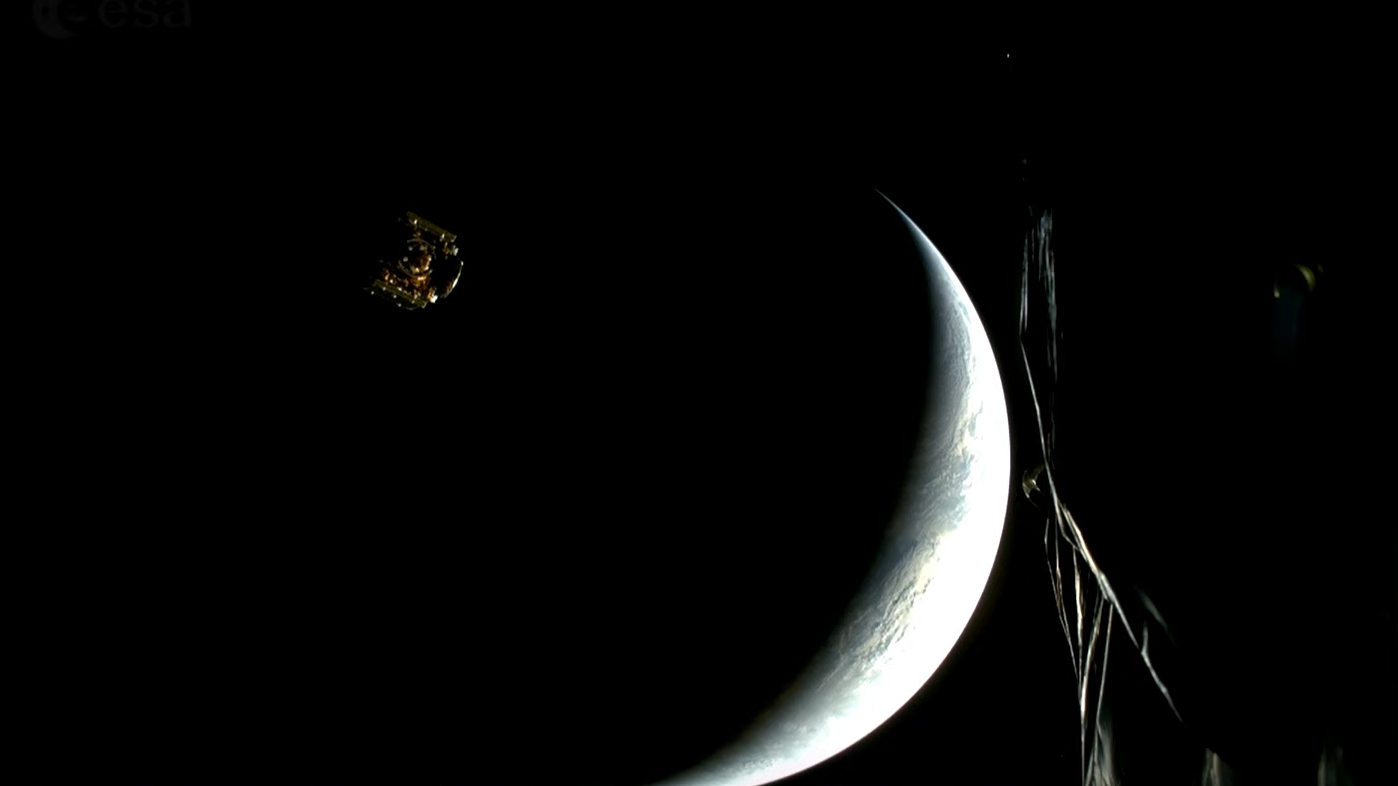
Hera, with the crescent Earth to one side, seen from the SpaceX Falcon 9 upper stage following vehicle separation and prior to solar array deployment. October 7th, 2024. Credit: SpaceX/ESA
One of the major elements of the mission has been the development of sophisticated guidance and mapping software which will allow Hera, using a series of compact sensor systems, to autonomously construct a map of the Didymos system and the space around it. It will then use this map to determine for itself the safest orbital trajectories around the asteroids to avoid impacts with any remaining rock and dust debris remaining in orbit around both bodies from the DART impact, and of a sufficient size to damage it in a collision.
Following launch, Hera successfully separated from the upper stage of the Falcon 9 launch vehicle and called ESA’s mission control to confirm it was operating correctly and ready to start crucial operations such as deploying its solar panels. In November 2024, the vehicle will perform a “mid-flight” adjustment to better align its trajectory to Mars.
Starship Flight 5
October 13th saw the launch of the fifth Starship / Super Heavy combination from the SpaceX facilities at Boca Chica – and the first attempt to bring a booster back to the launch pad and catch it using the “chopsticks” of the Mechazilla mechanism on the launch tower.
A lot of people – myself included – severely doubt(ed) the ability of both the long-term viability of the idea of catching boosters and launch vehicles out of the air, or whether this flight could prove the concept. Credit falls where due, and for this flight we were proven wrong.
A drones-eye via of the starship / super heavy launch facility, Boca Chica, Texas as IFT-5 propellant loading is underway. Note the clouds of liquid oxygen forming as a result of venting from the propellant feeds and vehicle tank vents. Credit: SpaceX livestream
The launch came at 13:25 UTC, with the ignition of the 33 Raptor 2 motors lifting the roughly 5,000 tonne mass of the combined Ship 30 and Booster 12 into the morning skies above south Texas. All 33 motors had a good clean burn, and the stack quickly gained altitude. At 2m 40s after launch, and approximately 50km altitude, the majority of the engines on the booster shut down and the six motors on Ship 30 ignited in the “hot staging” burn ahead of separation. Following separation, the booster immediately commenced a manoeuvre to steer away from the starship, in readiness to commence a flight back towards the launch pad.
This started the critical phase of Booster 12’s flight. Initially it continued to gain height ballistically, reaching an altitude of approximately 100 km whilst performing a “boost back” engine burn to slow its ascent and then start a fall back towards the launch site. The manoeuvre was completed with a level of accuracy such that SpaceX confirmed they would proceed with the “return to base” and attempted booster capture. Had the boost-back been off, the capture phase would have been abandoned and the booster allow to make a controlled splashdown in the Gulf of Mexico.
Boost back: with the hot staging ring a bright dot at the bottom of the image, Booster 12 fall back towards Earth heading towards the launch site. Credit: SpaceX livestream
There followed a series of visible pulses from the booster as it purged excess vapour from this primary propellant tanks while the three central motors gimballed to direct their thrust and steer it away from the jettisoned hot staging ring falling below it. Canting over to being close to horizontal, the booster descended to some 10 km altitude, racing back towards the launch facilities with a speed of 2,860 km/h, before the inner ring of 10 motors fired committing it to an initial braking manoeuvre.
At this point, and abort and splashdown was still possible, but the guidance system on the launch tower was working perfectly, allowing the booster to home into it. At 5km and still travelling at over 1750 km/h the 13 motors that have been firing all shut down, the booster gradually righting itself and decelerating through 1200 km/h before all thirteen re-fired in a final deceleration move before the inner ring of ten engines shut down and the three centre engines took over at at 1 km altitude to steer the booster in for capture.
With propellant vapours also burning form the mid-point vents, Booster 12 approaches the launch tower in readiness for capture. Credit: SpaceX livestream
The final part of the descent witnessed flames rising along two sides of the booster. The first, and larger of the two appeared to originate at the Quick Disconnect ports at the bottom of the booster (the connectors for loading propellants into the booster). The second appears part-way up the booster, possibly at vent ports for the main propellant tanks. This may have been ignited by flames from the lower fire reaching around the vehicle and setting vapours from the vents alight. Neither fire affected the vehicle’s performance as it slowed rapidly and descend precisely between the Mechazilla “chopsticks”, although it did actually come quite close to striking the tower in the process.
At precisely the same time, the “chopsticks” started to close on either side of the booster such that once it was vertical, the arms were close enough for it to gently lower itself onto them using four hard points around its hull (called “pins”, and specifically designed to allow the “chopsticks” take the booster’s unladen weight when raising / lowering it), which came to rest precisely on “shock absorbers” running along the length of the arms, designed to dissipate the weight of the booster as it dropped onto them. At this point, the Raptor engines shut down, and because of the fire, the onboard fire suppression system appeared to activate.
Even so, the fire rocket continued for several minutes, giving rise to fears of a possible post-capture explosion, but vent valves at the top of the booster were opened, allowing any remaining propellant vapours in the header tanks (smaller propellant tanks used for the final decent and capture) to be released away from the vehicle, greatly reducing the rick of explosion, and the vehicle remained intact on the launch tower.
In all, a remarkable achievement for a first attempt. Kudos to SpaceX.
However, the booster’s successful capture just under 8 minutes after launch wasn’t the end of the flight. As Booster was making its return, Ship 30 continued on its way to orbit, reaching a peak altitude of some 211 km as it cruised half-way around the world.
As it passed across Africa, the vehicle started a slow decent back into the atmosphere, passing over the tip of southern Madagascar as it gently dropped from 119 km to 115km. At around 100m altitude, it started to show the first indications of plasma built-up due the frictions created as it pushed the air molecules around it against their neighbours in the increasing atmospheric density, signs which quickly grew in intensity.
Plasma flow around the side of the starship as it passes through the re-entry interface and enters into the period of maximum dynamic stress during descent. Thanks to Starlink, transmissions from the vehicle were largely uninterrupted during the re-entry phase. Credit: SpaceX livestream
At around 75 km altitude, the vehicle entered the period of peak heating – the roughly 10 minute period when the plasma generated around the vehicle reaches its highest temperatures. It was during the period during IFT-4 in June 24, that the starship started to suffer significant burn-through issues and structure loss with one it its aft aerodynamic flaps, and which continued through its decent, destroying pretty much all of the flap in the process. Not of this was evident at this point with Ship 30.
As re-entry progressed, propellant from the header tanks in the vehicle started to be pumped through the three motors that would be used during the final phase of the flight in a “chill down” process to get them down to the desired temperature for full ignition.
At 47 km altitude, and slightly lower than the previous flight, one of the aft flaps on Ship 30 (top left) shows evidence of burn-through along the hinge mechanism. Whilst showing there is is still an issue with the hinges, this time the burn-through did not result in the partial loss of the entire flap. Credit: SpaceX livestream
It was after the period of peak re-entry heating, as the vehicle entered the period of maximum dynamic stress on its structure that the first hints of plasma burn-through began to make their presence visible on one of the two aft flaps (at roughly 48 km altitude), although there was no visible sign of large pieces of the flaps disintegrating, as had been the case in June. Transmissions did break up at this point, resuming as the vehicle entered aerodynamic fee-fall (the “bellyflop”), which showed all four flaps functioning despite the burn-through damage to one.
With less than a kilometre to fall, the three Raptors ignited, and the vehicle tipped upright, and 1 hour 5 minutes after launch, it splashed-down at night, precisely on target in the Indian Ocean. There was around a 20-second period where the vehicle appeared to settle in the water prior to it exploding, the event caught via a remote camera on a buoy positioned a short distance from the target splashdown zone.
20 seconds after splashing down in the Indian Ocean and precisely on target, Ship 30 exploded, the moment caught by a remote camera mounted on a buoy anchored close the the landing zone. Even so, IFT-5 can be counted as nothing short of a successful flight. Credit: SpaceX livestream
The cause of the explosion has yet to be determined – but given that Starship isn’t actually designed to land on water, and the mix of super-heated engine elements and cold sea water isn’t a particularly good one, the explosion shouldn’t be surprising, and doesn’t negate the overall success of the flight.
There is still much more to do in testing this system – such as demonstrating these kinds of “return to base” flights and captures can be achieved consistently. There is also much that is questionable about the starship / super heavy launch system as a whole, particularly in terms of crewed missions to Mars and even in supporting NASA’s Project Artemis lunar aspirations. However, none of this negates what is a remarkable first time achievement for SpaceX with IFT-5.
And here’s another view of the Booster 12 capture – from a camera mounted on the launch tower:
Europa Clipper Update
Previewed in my previous Space Sunday update (see: Space Sunday: Europa Clipper, Vulcan Centaur and Voyager 2), Europa Clipper, NASA’s mission to study the Jovian moon Europa, which had been due to lift-off on Thursday, October 10th, suffered a launch postponement courtesy of Hurricane Milton. The launch is now targeted for 16:06 UTC on Monday, October 14th for launch from Launch Complex 39A at Kennedy Space Centre, Florida.








 Inara Pey: Living in a Modemworld