Second Life: looking at the new Linden Homes Stilt theme

The new linden Stilt Homes (r-l) Tortuga, Havana and 2-storey Lauderdale

On Tuesday, June 23rd, while speaking at the SL17B Meet the Lindens event, Patch Linden announced the next theme of Linden Home that is being lined up for release: Stilt Homes, designed to be placed in coastal setting, their stilts allowing them to sit on land, over water or between the two.

Once available – the new houses are currently only available for preview at SL17B – will again come in four styles, and will occupy 1024 sq m parcels. When they are released, they will become the sixth type of new Linden Homes to be made available over the last 18 months, with two further themes already in preparation.

The new theme is … stilt homes. They take their inspiration from south-eastern US geographical areas that basically are Floridian shore-side stilt home communities that tend to pop-in in low-lying and potentially even hurricane prone areas. Generally, they’re fairly brightly coloured; they have fairly good-sized open concept floor designs, and we’re going to offer them in three different variants. There will be an over water variant of the home, a partial version of the home that could rest over land and water. and there will be an inland version of the home, all on stilts no matter what because – you know – when the hurricane comes though you certainly don’t want to be on the ground when the flooding happens!

– Patch Linden, SL17B, describing the new Linden Home theme

This slideshow requires JavaScript.

The new theme comprises the following styles of home:

The Lauderdale: a two-floor unit with two large down stairs rooms, open with front door opening to a full length front porch with roof over, and sliding doors to the rear opening to a rear deck-come-dock. Central stairs lead up to an enclosed landing area with bedrooms either side, one with views to the front and rear, and the other with views to the front and side and sliding doors to a large verandah with roof over at the rear of the house.

The Havana: is single-storey 3-roomed, cross-shaped house with central front-to-back room providing access to front covered porch and rear covered deck. One side room also offers access to the deck-come-dock, and with windows to front and side aspect. Remaining room has windows to front, rear and side aspects.

The Santiago: a two-storey house with ½-porch with verandah over to the front, and an open-plan ground floor presenting space for two rooms, the larger of which has a bay window to the front and sliding doors to the rear opening onto full length deck, sans dock. A dog-leg staircase leads up to a central landing with sliding doors to the front verandah, and two bedrooms. The first bedroom is a full front-to back room with windows to the front and rear. The second bedroom has windows to the front bay and side aspect, and sliding doors serving a rear private verandah.

The Tortuga: a single-storey house with offset main room to one side with front door to a small covered front porch and sliding doors to the rear deck-come-dock. A second room, also with access to the deck / dock opens off of this, together with windows to the rear / side aspect. A small room sits to the front of the house with windows to the front aspect.

This slideshow requires JavaScript.

The theme itself has been a lot of fun to design and develop. We took a lot of plant life from that area and created it to be true to that geographical zone of the United States as well as varying out transportation capabilities between road and dock as well as waterway and such. And the thing I’m particularly excited about is that the home that are over water will marry up to and against regions that are also specific to houseboats. So this is going to give us a new ability to segue from area to area between the stilt homes portions of the continents to also adding on more houseboat regions out and around these continent sections that we’re planning on putting out. 

– Patch Linden, SL17B

A view of an “inland” group of Stilt Homes – Santiago to the left, Lauderdale centre

All four styles of home look like they can be used over land or water; those over land appear to have steps down to the ground from the front porch, with perhaps room to squeeze a car under them. As Patch notes the landscaping is tropical coastal and modelled on that of Florida. The houses with water parcels are either connected by sun washed board walks back to dry land and which can also provide social spaces, or – at least in the demo region – sit entirely surrounded by water, which is an interesting approach.

There is something of the Traditional Homes look to these stilt homes, so much so, that with a casual initial glance, you might be forgiven for thinking that they are “traditional homes on legs”. However, once examined, it becomes clear this similarity is more passing than anything else; something that gives these houses something of a hook into past Linden Homes designs whilst also  – thanks to the large deck spaces and mix of land / water locations – being something completely unique.
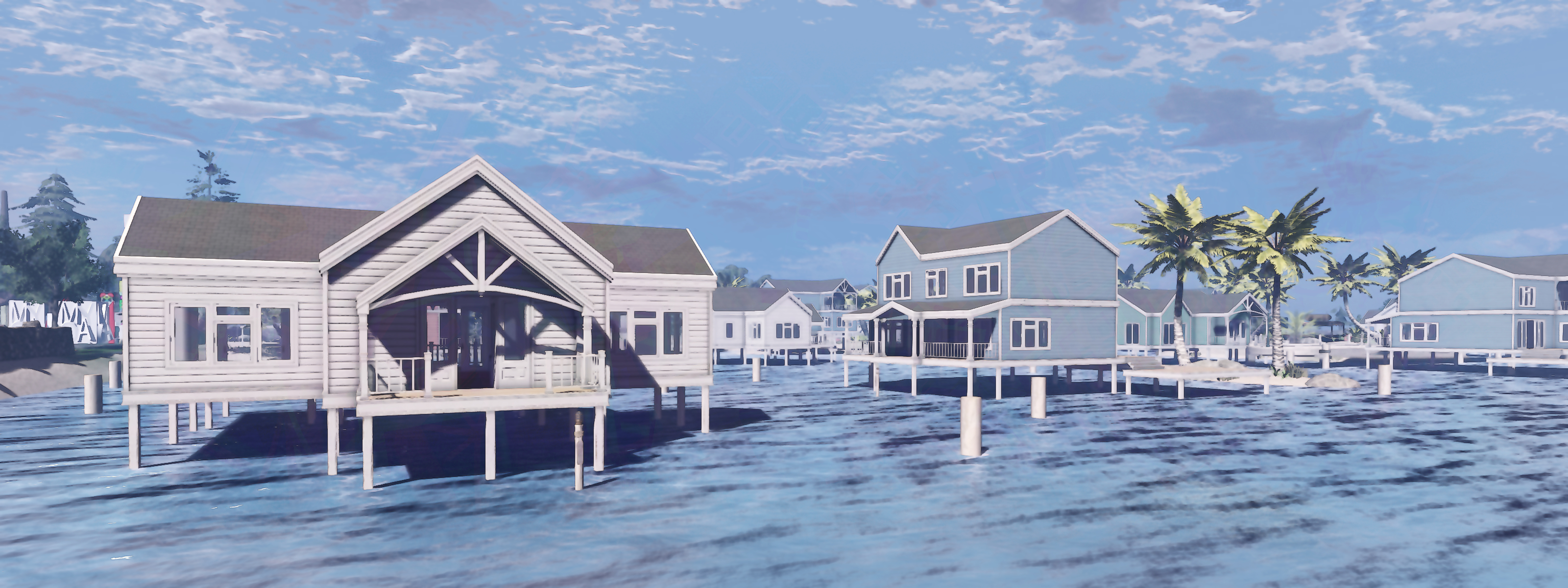
The “offshore” Stilt Homes at the SL17B preview region – Havana in the foreground, and Lauderdale towards the centre

Given there desk and docks, the theme also appears to have the largest general footprint of the Linden Home released to date, which might cause problems for those wishing to moor a large type of boat alongside one. Even so, I have to admit that this is the first theme that – once available – might tempt me into giving up my houseboat and trying to snag one that sits in its own “offshore” parcel. Although that said, it would be nice to see a theme that isn’t another aspect of Americana – the rest of the world has house styles to offer, after all!

SLurl to Preview Region

(only available while the SL17B regions are live)

2020 Simulator User Group week #26 summary

Kintsugi: Spirited Beyond – blog post

The following notes were taken at the Simulator User Group meeting held on Tuesday, June 23rd. Not much to report as it as another live music event.

Simulator Deployments

Please refer to the server deployment thread for news and updates:

  • On Tuesday, June 23rd, the min channel was updated to server release 543526, comprising further infrastructure updates to support Group chat improvements / support of the cloud uplift work.
  • There is no planned RC deployment or restart planned for Wednesday, June 24th, also leaving regions running on release 543526.

SL Viewer

There have been no updates to the official viewers to mark the start of the week, leaving the current viewers as follows:

  • Current Release viewer version 6.4.3.542964, dated May 29th, promoted June 2nd, formerly the FMOD Studio RC viewer – No Change.
  • Release channel cohorts:
    • CEF RC viewer, version 6.4.3.543157, June 11.
    • Tools Update RC viewer, version 6.4.4.543148, June 5 – this viewer is built using VS 2017 / a recent version of Xcode, and Boost.Fiber. It contains no user-facing changes.
    • Love Me Render RC viewer, version 6.4.4.543142, June 3.
  • Project viewers:
    • Mesh uploader project viewer, version 6.4.4.543141, June 11.
    • Copy / Paste viewer, version 6.3.5.533365, December 9, 2019.
    • Project Muscadine (Animesh follow-on) project viewer, version 6.4.0.532999, November 22, 2019.
    • Legacy Profiles viewer, version 6.3.2.530836, September 17, 2019. Covers the re-integration of Viewer Profiles.
    • 360 Snapshot project viewer, version 6.2.4.529111, July 16, 2019.

SL17B Meet Ebbe Altberg- a summary with video and audio

via Linden Lab
On Monday, June 22nd, 2020 at the SL17B celebrations, the first of five Meet the Lindens sessions was held, featuring the Lab’s CEO, Ebbe Altberg, aka Ebbe Linden.

The following is a summary of the session covering the core topics raised, with  audio extracts where relevant. The notes provided have been taken directly from the official video of the session, which is embedded at the end of the article. Time stamps to the video are also provided for ease of reference. In addition, audio extracts are provided in places that may be of particular interest to readers.

Table of Contents

When reading this article, please note:

  • It is not a full transcript:
    • Discussion points have been grouped by topic, and not necessarily in the order raised during the session.
    • I have focused on those topics liable to be of the most interest to readers / generated the most informative answers, so this is not a summary of all comments, feedback, etc.
    • Topics are given as bullet-point highlights for ease of reference.
  • In places, information that is supplementary to Ebbe’s comments is provided, and square braces (.i.e. [ and ]) are used in the body text below to indicate where this is the case.
  • Audio extracts have been cleaned-up to remove repetition or pauses, etc.

About Ebbe

[Video: 3:44-6:21]

Note: the following is taken from both Ebbe’s comments and my own research into his background, carried out when he joined Linden Lab in 2014, and which also included input from Ebbe.

  • Swedish by birth and still by nationality – he is still working in the US on a green card.
  • Graduated from Tärnaby Skidhem in 1983. He had hoped to be a ski racer – with eyes on the Swedish national team and the world cup – but was prevented from pursuing this career due to a back injury.
  • Instead went to the USA to study at Middlebury College, Vermont, USA, where he spent a lot of time in the art studio and the computer lab in an extreme left brain / right brain type of education”, before graduating with a degree in Fine Arts and a concentration in Computer Applications.
Ebbe Linden, aka Ebbe Altberg. Credit: Strawberry Linden
    • He  “slipped into Microsoft on a random banana peel”, where he spent twelve years. He was particularly involved with the Office products (Word, Mac Office, etc.), and although he wasn’t directly responsible for Clippy! – he did oversee it being ported to Mac Office 98.
  • In 2000, he joined Ingenio, a company that created marketplaces for people to buy and sell information over the phone. As well as managing the engineering, program management, operations, and quality teams, he also served as both the company’s interim CEO its Chief Product Officer. He also “racked up quite a few patents there.”
  • Joined Yahoo! in 2008, filling out a number of senior roles, working in both Europe and the US.As the Senior Vice President for Media Engineering based in the USA, but with global responsibly for Media Engineering, managing  an organisation of more than 600 engineers, architects, program managers and quality engineering staff, and with dotted-line oversight of some 150 product managers and designers.
Linden Lab’s chairman of the Board, Jed Smith, is a long-time friend of Ebbe Altberg, and had previously tried to get Ebbe to join the company prior to his appointment as CEO in 2014. (image: Owl Ventures)
  • Moved from Yahoo! to San Francisco based BranchOut, a small company that had, prior to his joining built a 25 million user base for its professional networking app before seeing that number shrink to just 3 million. He was specifically responsible for pivoting the company to a new workplace messaging application called Talk.co, launched in October 2013.
  • Has had a long exposure with SL indirectly through his son Aleks, who initially joined the Teen Grid before moving to establish his own in-world business.
  • Has also been long-term friends with LL board Chair, Jed Smith, through whom he met Philip Rosedale. Smith had asked Ebbe to consider the LL CEO position previously to 2013/14, but “things “didn’t line up” .
  • Is immensely proud of the all that the company has achieved and continues to be drawn by both the rewards and challenges involved in running a platform that is so technically and socially diverse.


Back to top

Working at the Lab

Rewards and Challenges Working with SL

[Video: 6:23-10:20]

  • Loves the technical / product aspects of the platform and the diversity of potential use cases it can meet. Also loves the rich diversity of ways users make use of SL creatively, socially, etc., that mean the platform constantly offers unique opportunities and challenges.
  • Enjoys the fact that SL makes it possible to meet people from around the world and from all walks of life who find value in the platform for so many different reasons.
  • These aspects also, for him, present the challenges of working with SL: putting all the different technologies that make SL work together such that they can form a virtual world where people can create, socialise, earn income, etc.
  • There’s also the challenge of talking to a customer base that is not of a single mind in using the platform, but rather is a range of user communities, each of which has nuanced needs and requirements that need to be met.
  • Also likes the challenge of trying to extend and build a product set that no-one else has managed to develop to the same degree – such as with SL’s economic model and the development of Tilia Pay.
  • The strength with SL that he loves is the sheer diversity within the technology required or SL and the people that use is – which is also the platform’s most engaging challenge.

SARS-Cov-2 Impact

[10:22-12:04; 12:30-18:53]

  • Is appreciative of the power that SL has in bringing people together during the SARS-CoV-2 pandemic and providing a safe space for continued interaction, and that it can continue to help furnish those using it to generate an income to continue to do so.
  • From a business perspective, SL has seen significant increases in demand. However, this has been somewhat impacted by the “land shortage” [see The Cloud Uplift, below for more on this].
  • This increase is not just from “social” users; here has been “a lot” of demand from businesses wanting to host meetings through the platform, education institutions wanting to hold lessons, etc.
  • Company has been very fortunate in its operations because, while it does have offices in San Francisco, Seattle, Boston and Atlanta, many of the staff have always worked from home, so there has always been the assumption of remote working [even the Operations Team works remotely from LL’s co-location data centre in Arizona]. So, moving to that model of operations was less stressful than it might have been.
  • The real hamper in the move has been more the “knock-on” effect caused by the isolation – having children at home whilst trying to work, seeing to their needs, etc.
  • Overall is very pleased with how the company has been able to continue to manage SL and move ahead in plans and development.
  • Pandemic has also caused the media to re-examine SL, and Marketing has been via busy dealing the increased interest in how the platform and how it can be of use to people / organisations during the pandemic.
  • What has been particularly pleasing is the more positive view the media has of the platform, and the recognition of its maturity as a platform.
  • Like to point out to reporters that Second Life isn’t “old”, it is “mature”, which is not necessary a bad thing when talking about a platform.

Back to top

The Cloud Uplift

[Note: Cloud uplift is the term used for the project to transition all of the Second Life services from hosting in a single co-location data centre used by Linden Lab and using their own hardware, to provision it all via Amazon AWS cloud services.]

[Video: 19:51-23:25]

  • Likely to be around 3-4 months before new regions are once again available, although it is understandably hard to put a definite date on things.
  • The shortfall is due to LL wanting to cease any expenditure in hardware and supporting infrastructure for SL during the cloud transition, believing they had sufficient reserves to offer during the uplift period – but the SARS-CoV-2 pandemic resulted in an unexpected burn through of that reserve.
  • Provisioning and testing new hardware and infrastructure is being avoided, as this would effectively be “lost” capital expenditure.
  • The uplift work is the primary focus of the product, engineering and operations teams at the Lab, with many services have actually already been transitioned to AWS.
  • Details of which systems these might be are not generally given out by LL due to the fact users often make false assumptions on things like issues when aware of such information.
  • Region servers [aka simhosts] make up the majority of the Lab’s hardware, and the Lab now has a test region server successfully running within AWS, but there is still “quiet a bit more work to do” in terms of security and other elements before the Lab will be in a position to offer a region product running in AWS.

Back to top

Continue reading “SL17B Meet Ebbe Altberg- a summary with video and audio”

2020 viewer release summaries week #25

Logos representative only and should not be seen as an endorsement / preference / recommendation

Updates for the week ending Sunday, June 21st

This summary is generally published every Monday, and is a list of SL viewer / client releases (official and TPV) made during the previous week. When reading it, please note:

  • It is based on my Current Viewer Releases Page, a list of all Second Life viewers and clients that are in popular use (and of which I am aware), and which are recognised as adhering to the TPV Policy. This page includes comprehensive links to download pages, blog notes, release notes, etc., as well as links to any / all reviews of specific viewers / clients made within this blog.
  • By its nature, this summary presented here will always be in arrears, please refer to the Current Viewer Release Page for more up-to-date information.
  • Note that for purposes of length, TPV test viewers, preview / beta viewers / nightly builds are generally not recorded in these summaries.

Official LL Viewers

  • Current Release viewer version 6.4.3.542964,, dated May 29th, promoted June 2nd, formerly the FMOD Studio RC viewer – No Change.
  • Release channel cohorts:
    • No updates.
  • Project viewers:
    • No updates.

LL Viewer Resources

Third-party Viewers

V6-style

  • No updates.

V1-style

  • Cool VL viewer stable branch updated to 1.26.24.23 and Experimental branch to 1.27.0.3, both  on June 20th – release notes.

Mobile / Other Clients

  • No updates.

Additional TPV Resources

Related Links

A corner of Cascadia in Second Life

Cascadia, June 2020 – click any image for full size

Zakk Lusch recently invited us to pay a visit to Cascadia, a Homestead region he has designed with the assistance of Lilly Noel and Jimmeh Obolensky. The name appears to be taken from the Cascadia bioregion, a theoretical region / country that, were it to come into existence, would extend down through British Columbia, Washington state and Oregon, and inland potentially as far as Utah, although more modest proposals limit it to the the Cascade Mountains.

In particular, this means the bioregion follows the line of the US / Canadian Pacific Northwest coastline, and it is in the spirit of this coastline that the region has been modelled. It offers the suggestion of a coastal headland backed by high mountains, a place where the local highway briefly winds between the two maws of tunnels to offer an expansive view of the northern Pacific.

Cascadia, June 2020

One of the first things to note in general about the region is that it is in part residential, with three private homes located on it. However – and I assume this is a genuine comment – the note card that is delivered to visitors at the landing point states, “While all of the homes on the sim are indeed occupied by Residents, we strongly encourage you to enter these homes and disturb the occupants!”

That said, given the three homes do not intrude into the public areas of of the region, it is possible to enjoy explorations without having to worry about trespassing into people’s homes.

Cascadia, June 2020

Like the coast on which it is modelled, this is a ruggedly beautiful setting, if the drop from high mountain peaks to foothills is perhaps a little abrupt. The landing point sits to the north-east on a deck build over a cove that cuts its way into the landscape. The deck is part of a cosy roadside area just across the highway from the local motel and gas station. The highway appears to be El Camino Real (The Royal Road) – otherwise known as Route 101, suggesting the setting is towards the northern end of the American stretch of the Cascades.

Running out from one of the two tunnels mentioned above, the road points south to pass between the landing point and the motel before making a hard turn to point westwards, passing over a bridge that spans the mouth of the landing point’s cove. In this, the highway offers the best route of initial exploration, although once across it, further paths of exploration open up.

Cascadia, June 2020

One of these routes is a gravel track that offers a way along the south-eastern headland to one of the private homes. The latter might easily be mistaken for a café given the OPEN sign hanging alongside the door, but the furnishing and washing hanging on the line outside confirm it is a residence, a small and rough beach bordering it on two sides. Just before the path along the headland reaches it, it passes steps that descend down to a ribbon of beach that points westward, under a line of low cliffs that also see the continuance of a branch of the gravel path above which in turn sits the second of the region’s homes.

This second house sits on a square of rock between gravel and highway, trailing a tail behind it that narrows to a point where stone steps connect path and highway, a wooden bridge alongside crossing the waters to where the third house sits on its own island, offering an impressive view back across the region.

Cascadia, June 2020

Cascadia is a photogenic, natural region that is given added life by the inclusion of static figures, each of which has been perfectly placed: the tourists pausing in their journey to take in the view, the cyclist taking a break from a ride along the coast, shoppers and storekeepers in the little roadside area, and so on.

There are also touches of humour to be found within the region – the advert for a shady lawyer, for example – together with numerous places to sit, some more obvious that others. For the latter, be sure to follow the signs for the woodland walks; one might lead you to a camp site being watched over by an unexpected visitor!

Cascadia, June 2020

An engaging and considered design well worth the time needed to explore and appreciate it. Our thanks to Zakk for the invitation, an apologies for taking a while to accept it.

SLurl Details

  • Cascadia (whisperwoods, rated Moderate)

Landscapes and open spaces in Second Life

Michiel Bechir Gallery: Hazel Foxtrot

Currently open at the Michiel Bechir Gallery, curated by Michiel Bechir, are three exhibitions of art indirectly linked by themes, making for an interesting excursion for patrons of art in Second Life. On the ground floor, and in the north and south halls respectively, are selections from the portfolios of Hazel Foxtrot and Pavel Stransky, each of whom offer pieces largely focused on landscape images.

Hazel’s work appears to be largely without post-processing, a fact that leaves them with a raw and  – in an age where every image of Second Life is expected to be subject to PhotoShop and GIMP – refreshing naturalness to them. This is not to imply I have anything against the post-processing of Second Life images – such treatment can be used to add significant depth to an image or even transform it. However, it is refreshing to see images that have not been so treated, as they capture the places Hazel has visited as they might be seen  on a first visit.

Michiel Bechir Gallery: Pavel Stransky

Across the gallery, Pavel Stransky also presents works also largely focused on landscapes, although in difference to Hazel, he does use post-processing. This allows Pavel to present his work in a variety of styles: oil painting, water colour, photograph – all of which are highly effective in their presentation and in given that depth mentioned above, to each and every piece in the selection.

On the upper floor of the gallery is Balance, a join exhibition by Jessamine2108 and Zoe Ocelot. Offering a mix of words and images, it is a reflection on the current SARS-CoV-2 pandemic and its impact around the globe – but perhaps not in the manner you might expect. As has been noted in the news, the lock-down that has impacted the majority of the world has served to have a significant impact impact on pollution, leading to cleaner air within and beyond cities, and also cleaner water that can benefit humans and animals alike.

Michiel Bechir Gallery: Balance

Thus, through images taken and selected by Jessamine2108, and the words presented by Zoe, the two artists to offer their own view of how the pandemic is affecting humans and Nature alike, with an emphasis on the idea that – as one of the natural brakes on human activity – the pandemic is helping to bring the Earth back into balance.

While that balance may be – in the scheme of things – short-lived overall, Balance serves as a reminder than Nature actually doesn’t require human kind; that – as the artists note – the rest of world moves on as humans huddle and hide in their corners.

Michiel Bechir Gallery: Balance

And the link between the lower level exhibitions and Balance? All of them remind us of how important open spaces and the freedom to travel are to us and – hopefully – how much better we should be as caretakers of beauty present in the worlds around us.

SLurl Details