Logos representative only and should not be seen as an endorsement / preference / recommendation
Updates for the week ending Sunday, September 20th
This summary is generally published every Monday, and is a list of SL viewer / client releases (official and TPV) made during the previous week. When reading it, please note:
It is based on my Current Viewer Releases Page, a list of all Second Life viewers and clients that are in popular use (and of which I am aware), and which are recognised as adhering to the TPV Policy. This page includes comprehensive links to download pages, blog notes, release notes, etc., as well as links to any / all reviews of specific viewers / clients made within this blog.
By its nature, this summary presented here will always be in arrears, please refer to the Current Viewer Release Page for more up-to-date information.
Note that for purposes of length, TPV test viewers, preview / beta viewers / nightly builds are generally not recorded in these summaries.
Official LL Viewers
Current release viewer version 6.4.7.546539, dated August 11, promoted August 17, formerly the Arrack Maintenance RC viewer – No Change.
Release channel cohorts:
Bormotukha Maintenance RC viewer updated to version 6.4.8.548890 on September 18th.
Recently opened at Niccoli Sweetwater’s Basilique region is a joint exhibition of art organised by the Focus team, and featuring the work of Looker Lumet and Sophie Marie Sinclair (Perpetua1010), both of whom are artists new to my eyes. This is something of a “split level” exhibition of work, the core being located at Basilique’s skyborne exhibition and event space, Palazzo di Basilique, with some of Looker’s work also appearing at the ground level Galleria rotunda.
Located on the Lago di Garda terrace at the rear of Palazzo di Basilique, Sophie Marie Sinclair presents Yellow Expressions, a portfolio of her physical world art with – as might be expected from the title – something of a yellow theme running through them.
Basilique: Sophie Marie Sinclair (Perpetua1010)
Sophie’s background is perhaps as fascinating as her art. A graduate of the Academy of fine Arts Vienna, she is also by turn a cartoonist, having had a particular focus on political satire, an author and a ghost writer for certain well-known comedians. As a painter, she is an experimentalist in terms of materials she uses, but has a leaning towards plaster, glue, terracotta, stones, bones, ash, charcoal, and the use of natural pigments.
Sophie describes her artistic focus as being on the nude body and also abstract art, and the former is certainly demonstrated in Yellow Expressions, which features 10 studies of the male and female form, most of which appear to be pen or charcoal drawing finished in a water or ink wash to provide the natural yellow tone within them, with one piece (Mind N) offering the suggestion of a more oil-like and textured / layered finish that also involves richer hues.
All ten pieces are superbly rendered, their finish highly suggestive of being produced on porous plaster rather than canvas, something that gives them a highly tactile sense, whilst their neo-classical styling presents them as pieces that would fit any home environment admirably.
Basilique: Looker Lumet
Straddling the upper terrace at the front of Palazzo di Basilique and the ground-level Galleria rotunda, Looker Lumet offers a selection of his Second Life landscape photography (although he also produces avatar studies and portraits as well), with 12 pieces on the terrace, eight of which are also offered within the Galleria. I’m not entirely sure of the reason for this, although I assume it is to allow visitors to Basilique itself to view an art display without them necessarily being aware of the exhibitions up at Palazzo di Basilique.
Either way, Looker’s landscape work is rich in atmosphere, with the pieces offered in this selection perhaps leaning more towards darker tones and hues, some of which are fitting, given the theme (such as with The Graveyard in the Forest), whilst with others it offers a genuine and fitting depth of broodiness that emphasises Nature’s changing moods or the overall tone of the piece in question (see Abandoned and Seasight).
Which is not to say this is a “heavy” exhibition in terms of colour and tone: there are several brighter pieces that stand as memories of happy times on the beach or the splendour of a day’s sailing, all of which stands as an engaging exhibition.
Basilique: Looker Lumet
I gather both Sophie’s and looker’s work will remain at Basilique through until mid-October.
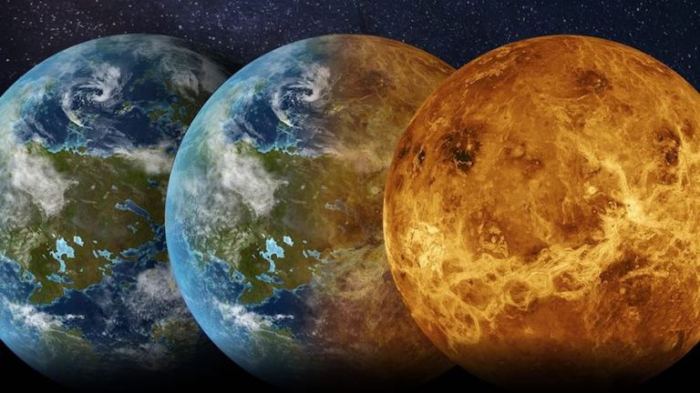
Venus, the second planet out from the Sun and roughly the same size of Earth, is well known for being the prime example of a runaway greenhouse effect. Shrouded in dense, toxic clouds that hide its barren surface from view, the planet has an average surface temperature 464°C, its dense, carbon-dioxide dominant (96%) atmosphere places an average pressure on that surface around 92 times the mean pressure at sea level here on Earth – or roughly the same pressure as exerted by the sea at a depth of 900 metres (3,000 ft).
Yet, as I’ve recently reported (see: Space Sunday: Venus’ transformation, SLS and an asteroid), there is evidence to suggest that Venus started life as a warm, wet planet with liquid water seas of its own, only to be started on the road to becoming the hothouse we know today thanks to Jupiter’s wandering influence.
However, if this theory is correct, and Venus was once warm and wet, the question of whether it was sufficiently so to give rise to the earliest forms of basic life becomes a very real one – as does what might have happened to that life as the planet started its long transformation in the superheated, super pressurised world we see today.
Did the changing conditions simply wipe out any microbes that may have arisen there, or did those microbes themselves have been transformed, moving to the upper reaches of the Venusian atmosphere where they could survive on the heat from both the Sun and rising from through the planet’s atmosphere without necessarily being dry roasted, while drawing on the minerals and chemicals also floating within the high-altitude clouds?
The idea of entirely atmosphere-borne forms of life on planets like Venus and Jupiter is not new, but this past week, the potential for some form of organic activity on Venus became a lot more real with the detection of a compound this is usually the off-shoot of organic processes within the mid-levels of the Venusian cloud layers.
Phosphine is a colourless, flammable, very toxic gas compound made up of one phosphorus and three hydrogen atoms (PH₃). It is most commonly produced by organic life forms, thus its presence within the atmosphere of Venus raises the tantalizing possibility that something is alive in that atmosphere – although it should be noted, it can also be created artificially.
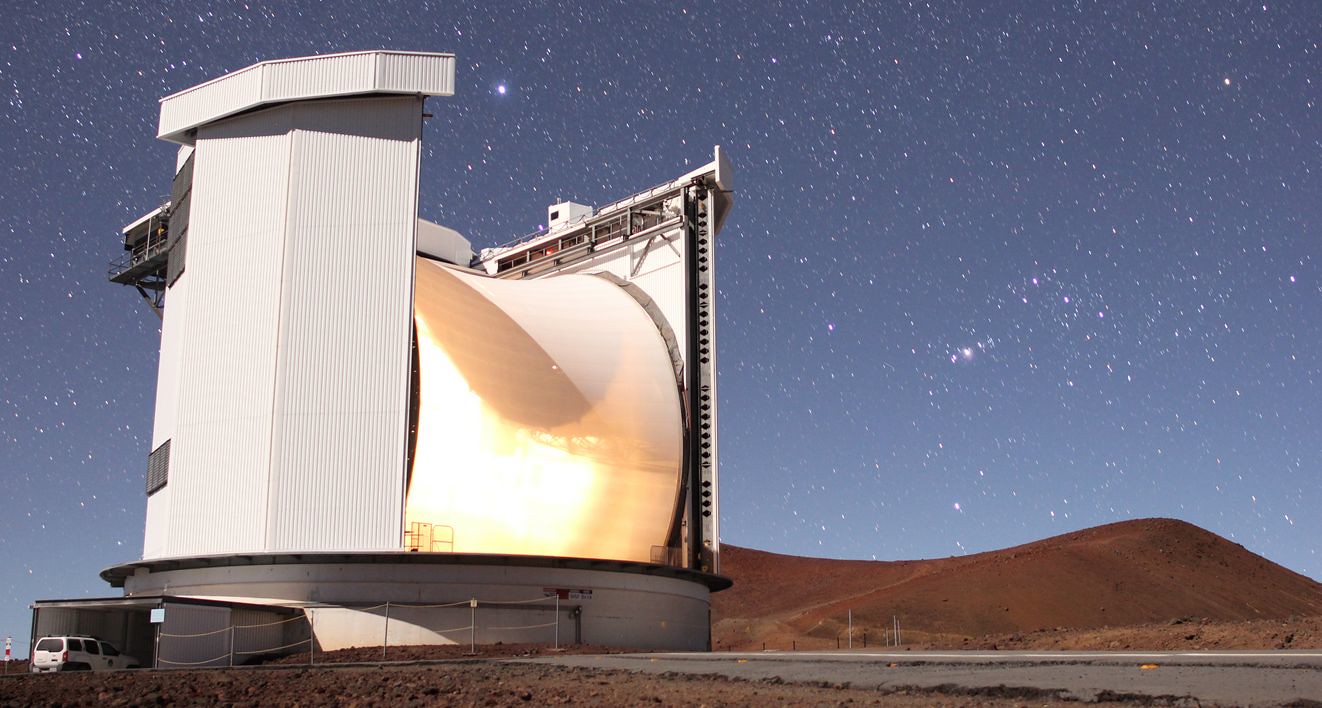
The detection of phosphine in Venus’ atmosphere was made by an international team using two different telescopes in different parts of the world. The team, led by astronomers working out of Cardiff University in the UK, first identified the compound using the James Clark Maxwell Telescope (JMCT), located in Hawaii. They then turned to the Atacama Large Millimetre/sub millimetre Array (ALMA) in Chile, equipped with more sensitive detectors than JCMT, to confirm their findings.
The James Clark Maxwell telescope, Hawaii. Credit: Will Montgomerie/EAO/JCMT
It’s important to note that while the phosphine has been identified, the team responsible for identifying it are not jumping to the conclusion it means there is life within the Venusian atmosphere. While – in our experience – it is generally the result of organic interactions, it can be produced in the laboratory, as noted, through chemical interactions – and Venus is a veritable chemical hothouse.
What is surprising is the amount of phosphine calculated to be in the cloud layer: roughly 20 parts per billion. While a comparatively tiny amount, it is astonishing to planetary astronomers because it’s long been assumed that if any phosphorus existed in Venus’ atmosphere, it would long ago have bonded with oxygen atoms, of which there are a lot around Venus, albeit the majority being bound within the dominant carbon dioxide.
Following their discovery the team, led by Jane Greaves of Cardiff University and ideo Sagawa at Kyoto Sangyo University, Japan, sought potentially natural means for the formation of phosphine around Venus. These included things such as chemical reactions in the atmosphere driven by strong sunlight or lightning, or the interaction of chemicals coming from volcanic activity, or delivered by meteorites. However, none of these mechanisms could account for the volume of phosphine Venus appears to have.
Even so, this doesn’t necessarily mean that the phosphine is the result of tiny Venuisan organisms; as the team note, it could be the result of as yet unknown photochemistry or geochemistry mechanisms within the planet’s atmosphere or the planet itself.
Although we concluded that known chemical processes cannot produce enough phosphine, there remains the possibility that some hitherto unknown abiotic process exists on Venus. We have a lot of homework to do before reaching an exotic conclusion, including re-observation of Venus to verify the present result itself.
– Study member Ideo Sagawa
Obviously, to determine whether or not biotic or abiotic processes are responsible for the phosphine, further study – preferably close-up – of Venus’ atmosphere is required. Although further Earth-based observations from Earth can help confirm the volume of phosphine within the planet’s atmosphere, satellites orbiting Venus will offer a far more complete picture, simply because they can study the planet in detail over the course of years, building up a complete picture of its composition using spectrographic analysis.
Two Venus missions – VERITAS, the Venus Emissivity, Radio Science, InSAR, Topography, And Spectroscopy orbit and DAVINCI+, an atmospheric penetrator, are already being considered by NASA as planetary missions among missions to other destinations, with one of this group of proposals due to be selected in April 2021. Either could help sniff out the phosphine and potentially help identify its cause. Japan’s Akatsuki orbiter may also help in further studies of phosphine around Venus.
The private company Rocket Lab has been developing plans to mount its own mission to Venus for some time, using their Electron rocket, which has been operating since 2018, and their new Photon upper stage, which made its début in august 2020. Rocket Lab founder and CEO Peter Beck believes that Venus has been undervalued as a place for stud (although there have been some 30 fly, orbital and lander missions since 1962).
Poughkeepsie, September 2020 – click any image for full size
Poughkeepsie is a parcel covering just under a quarter of a Full region which has the bonus LI capacity applied, that was recently highlighted in the Destination Guide, prompting me to hop over and take a look.
Held and in part designed by Peresphone Kore (LeriaDraven) – Loly Hallison performed a lot of the general landscaping -, the parcel has an interesting description and greeting, reading in turn (via About Land and a sign post at the landing point):
An amazingly whimsical photography sim with plenty to see and do. From date night, chilling by the fire, relaxing in the library, or taking on a game in the arcade (yes the games really work!) This is all my own creation and I’m super excited for this!
Warning. You are about to enter someone else’s dream.
Poughkeepsie, September 2020
Both the description and the sign present a huge promise, and visually, the parcel does deliver on this promise. Located in the north-west of the region, it offers a north-facing beach cupped between a curtain wall of rock that runs diagonally across the back of the parcel from east to south-west, and an upland area. The curtain of cliffs neatly separates Poughkeepsie, with the western table plateau overlooking the north beach and the lowlands running back from it to the feet of the cliffs.
Topped to a large house, the rocky plateau falls directly to the sea to the west, but also hides a low-lying corner of the parcel in which sits a second house complete with a west-facing beach of its own, both screened by giant oaks. This house, and the one top the plateau appear open to the public, with the latter reached by curving stone steps rising from the landing point, the former by following a winding path that curls around the base of the rocky table. This second house, sitting within its screen of giant oaks has something of a Halloween feel in the grounds on its landward side, whilst the shingle beach on its waterside offers the opportunity for a game of chess.
Poughkeepsie, September 2020
Each of the houses is fully furnished, offering multiple rooms to explore, while the house on the plateau additionally offers a rock-and-wood terrace / deck for outdoor seating and an outbuilding that looks like a greenhouse converted for use as a little café. A barn and field, home to cattle and sheep may at first give the impression this is a working farm. However, given the expansive nature of the house, and the small number of animals, it’s hard not to wonder if the latter are more a hobby for the owners, rather than a working source of income.
The lowlands of the parcel offer their own attractions. There’s the sandy, north-side beach, with multiple places to sit and a view of an off-shore (and off-region, although it doesn’t appear to be phantom / without physics) fairy-tale castle. On the grass behind the beach is a little open market area offering fresh fruit and veg, with a seating area ranged before it, complete with cakes, toffee apples and drinks available to visitors. It again suggests that maybe the house up on the plateau is might be a working farm – but equally, it also stands as a vignette on its own.
Poughkeepsie, September 2020
Also to be found in the lowlands are ruins, a folly and the unexpected – an old British red telephone box – as well a sculptures and a fair amount of local wild life. There’s even a touch of Tolkien waiting to be found, although saying Mellon before it as instructed by the runes didn’t result in the expected (and by “saying Mellon” I do mean touching it to see if anything happened, given its scripted nature).
Photogenic, rich in detail and with much to see, Poughkeepsie makes for a rewarding visit – but I say so with a caveat: a visit does come with something of a performance hit. How much of this is down to what is in the parcel itself, and how much is down to what’s in the region as a whole, is hard to say (some of the sculptie giant oaks in the parcel do have high render costs). I found my system peaked a 7 fps with shadows enabled at a moderate draw distance, mostly hovering at 4-5 fps. Disabling shadows raised this to the mid-teens., although even this could drop into single-digits – so be prepared to make adjustments if you’re on a mid-range system and are used to having things like shadows on all the time.
Poughkeepsie, September 2020
Nevertheless, Poughkeepsie offers a rewarding visit for those willing to make any necessary adjustments.
The following notes are taken from the TPV Developer meeting held on Friday, September 18th, 2020. These meetings are generally held every other week, unless otherwise noted in any given summary. The embedded video is provided to Pantera – my thanks to her for recording and providing it. Time stamps are included with the notes will open the video at the point(s) where a specific topic is discussed. Note these summaries are not intended to be a full reporting on all topics discussed, but focus on those items that are more directly user-facing.
The second half of this meeting was fairly text intensive, covering things like the water performance impact on EEP, together with subjects that are unlikely to become Lab projects / activities in the near future.
The Bormotukha Maintenance RC viewer updated to version 6.4.8.548890 on September 18th.
The remaining official viewer pipelines were unchanged through the week, leaving them as follows:
Current release viewer version 6.4.7.546539, dated August 11, promoted August 17, formerly the Arrack Maintenance RC viewer – No Change.
Release channel cohorts:
Mesh uploader RC viewer, version 6.4.8.548061, September 8.
Love Me Render RC viewer, version 6.4.8.547427,August 21.
Project viewers:
Project Jelly project viewer (Jellydoll updates), version 6.4.8.547487, issued August 26.
Custom Key Mappings project viewer, version 6.4.5.544079, June 30.
Copy / Paste viewer, version 6.3.5.533365, December 9, 2019.
Project Muscadine (Animesh follow-on) project viewer, version 6.4.0.532999, November 22, 2019.
Legacy Profiles viewer, version 6.3.2.530836, September 17, 2019. Covers the re-integration of Viewer Profiles.
360 Snapshot project viewer, version 6.2.4.529111, July 16, 2019.
General Viewer Notes
It is likely the Bormotukha Maintenance RC will be promoted to de facto release status in week #39 after being delayed for further updates.
It is possible that the Mesh Uploader RC may be promoted to release status in a shorter period than the usual 2 weeks between release promotions (so possibly in week #40), as it is also in “good shape” for promotion.
As noted in my previous CCUG summary, there is now only one significant EEP-related fix the Lab would like to clear (related to alphas in local edit mode) prior to promoting the Love Me Render (LMR) RC to release status, so this again could be ready to be lined-up for promotion to release status in the very near future – although the next update to this viewer will still be an RC version.
The Legacy Profiles viewer is still awaiting a back-end update to the feeds, which may be being worked on.
However, these are not the only regions on Aditi operating via AWS cloud services: there are also a number of test regions that have been set-up, comprising (at the time of writing):
All of the Blake Sea regions on Aditi.
Cloud Sandboxes 1-4.
Ahern, Mauve, Morris.
The Testylvania Sandbox (restricted access).
At the start of the meeting, Oz Linden requested TPV developers (and possibly by extensions script creators) use the likes of the sandbox regions to test performance and general operations to help in the overall testing of simulator and simulator / viewer performance with regions running in the cloud and help identify configuration or other changes that may be required. Those testing the regions should be prepared to note any unexpected / unusual behaviours, unexpected outcomes, etc., and be prepared to file with with Linden Lab via Jira.
The Lab is making “very, very good progress” on ensuring simulators and regions are able to run within the AWS environment (there are also a number of Linden-only regions on Agni now running in the cloud), and this testing is seen as a key aspect of building confidence to start transitioning further regions on Agni to AWS and allowing people to test them. However, there is already a list of issues the Lab wants to deal with before this happens, and the above testing may add to this.
The focus is (as has oft been stated) on getting the simulator code to a state where it can be uplifted relatively smoothly and dealing with issues arising from uplift tests (such as with HTTP messaging), rather than dealing with bug fixes (unless they are particularly troublesome), and / or implementing features.
In Brief
[10:05-13:49, as a part of the Uplift discussion] Bug BUG-202943 “Group notice text is truncated by the simulator”: this is a somewhat complicated issue to initially grasp, but is clearly explained in Kitty Barnett’s comment on the bug report. This is of concern to the Lab, but due to the uplift work, a fix may not be immediately forthcoming.
[13:50-18:35 with further discussion in text beyond] The in-viewer log-in cookie issue (non-public BUG-226643) referred to in my previous TPV Developer meeting summary (see the In Brief section) has been looked at and may not require a server-side change to rectify, and is flagged as a web issue. However, it’s not clear on where it sits in the list of priorities.
All4Art, IMAGOLand, September 2020: Mareea Farrasco
Recently renewed and reformed, the All4Art Project, managed by Carelyna Resident, opened its latest ensemble exhibition at IMAGOLand, on September 17th, 2020. It features the work of Sandi Benelli, Leonorah Beverly, Carey Chenault, Carisa Franizzi, Rose Hanry, Black Rose and Carelyna, together with Mareea Farrasco, who is also providing the setting for the exhibition on her IMAGO Land.
Described as being attached Mareea’s IMAGO Galleries, IMAGO Land is described as “an open area for visitors who love to explore or simply relax and for landscape photographers. Conceived as small islands, the different spots have different destinations: a park, a fishers village, a vacation resort, a beach, a country home with its yard, a bar and a dance floor, etc. As such, the location is perfect for the art on display, given the emphasis throughout on natural and natural – particularly coastal – settings.
All4Art Project, IMAGOLand, September 2020: Carey Chenault
The landing point for the exhibition sits within what might be called the social / events area of this half-region design, located on one of the larger islands in the the group that includes the dance floor and an old barn converted into a simple bar area. From here, three wooden board walks offer a choice of routes around the rest of the setting – which you take is entirely up to you, as the art is spread out around the various islands awaiting discovery as one explores.
Most of the artists participating in the exhibition are well known in these pages, and seeing them all together offers a delightfully complementary and also contrasting selection of images. Each artist has provided 5 images for the exhibition with some presenting their work on both sides of each canvas, simply because the layout of the island means their work can be seen / approached from either side.
All4Art Project, IMAGOLand, September 2020: Carisa Franizzi
With the exception of Black Rose, who provides a set of stunning original paintings, all of the images presented have been captured in Second Life. With a similar exception of Carisa Franizzi, who offers five black and white images that can quite capture the eye, all are presented in colour, from the soft tones of images post-processed to give a watercolour look and feel, to the vibrant hues and tones of Autumn and and bright hues of summer cast through an oil painting like finish.
Together, all of the images presented through this exhibition help remind us that beyond the walls of self-isolation and the constraints of social distancing and limited travel opportunities, there is still a rich and vibrant world around us. A world, one might be tempted to say, that is doing rather well because of our enforced absence – but will nevertheless be waiting to greet our return when times are such that we can once again roam freely and appreciate all of nature’s delights. Further, many of the places presented in these images remind us, however subliminally, that humans and nature can get along side-by-side.
All4Art Project, IMAGOLand, September 2020: Black Rose





 Inara Pey: Living in a Modemworld