Firestorm 6.5.6: maintenance refresh!


On Monday, July 25th, 2022, the Firestorm team released version 6.5.6 of their viewer.

This is very much a maintenance update for Firestorm rather than a major release; the focus is very much on bug fixes rather than new features.

That said, it does bring Firestorm closer to the official release viewer, incorporating as t does the April and May official viewer releases code – so with this release, Firestorm embraces multi-factor authentication.

Table of Contents

As per usual, this article is a not a full blow-by-blow breakdown of absolutely everything in this release, but it does include notes on some of the more significant updates and fixes people are liable to find useful, and some general notes.

For a complete breakdown of changes, please see the official release notes for Firestorm 6.5.6.

Installation

  • There is no need to perform a clean install with this release if you do not wish to.
  • Do, however, make sure you back-up all your settings safely so you can restore them after installing 6.5.6.

Linden Lab Updates

This release brings Firestorm up to parity with the following Linden Lab viewer releases:

  • Lao-Lao Maintenance Release viewer (version 6.5.4.570575, dated April 18th, 2022) containing numerous bug fixes).
    • One notable fix in this viewer is for photographers, correcting as  it does – BUG-231868 “[MAINT J+K] 360 Snapshot tool fails to save file to computer (Mac and Windows)”
  • The MFA Release viewer (version 6.5.5.571282, dated May 4th), which rolled multi-factor authentication to the viewer – see below for more.

In addition, Firestorm 6.5.6 includes support for the release of Premium Plus (increased Group allowance, etc).

Multi-Factor Authentication

Firestorm 6.5.6 incorporates Linden Lab’s viewer-side Multi-Factor Authentication (MFA) code. This provides additional security to your Second Life account both through the web (e.g. trying to view your billing info or transaction history, trying to cash out (“process credit”) money out of your account, trying to change the e-mail address associated with your account, etc.), and in accessing your account using the viewer. It is entirely optional, and you do not need to use it if you don’t want to – although usage is recommended.

You can find out more on MFA in general by following the links below:

Inclusion of MFA in a viewer means that anyone who has opted to use MFA

  • Will, the first time they use Firestorm 6.5.6, have to use their preferred authentication method (e.g. Google Authenticator) to generate a new token (6-digit code) and enter it into the viewer when prompted (after entering their user name and password).
The MFA prompt for a token, which will be seen in Firestorm 6.5.6 (and other viewers supporting the Lab’s MFA code) once every 30 days.
    • Note that some authenticators generate their token as 2 groups of 3 digits (e.g. XXX  YYY). Where this is the case, you can enter the code with or without the space.
  • This token will remain valid for 30 days, as noted above, so you do not have to provide a token every time you log-in to the viewer.
    • However, after 30 days, the prompt will once again be displayed at log-in, and a new token code will have to be generated in the chosen authentication method, and entered into the viewer in response to the prompt.

If you have not opted to use MFA, or if you later opt to disable MFA on your account, you will not be prompted to provide any authentication code.

Firestorm Updates and Improvements

Phototools

The Shared Environment button on Phototools works with Firestorm 6.5.6

A minor, but nevertheless issue with Phototools since the introduction of the Environmental Enhancement Project (EEP) capabilities into Firestorm has been the fact that the Shared Environment button (Phototools → Env) has never been properly hooked-up to the EEP controls.

It’s a niggle I pointed to at the time that Firestorm released with EEP incorporated but – and shame on me for not doing so – I never got around to raising a bug report on it.

Fortunately, Spartaco Zemenis did Jira it (see FIRE-31688), with the result that the button has now been properly hooked-in to EEP and clicking it (as with clicking the X button alongside of Personal Lighting) will now revert your viewer’s environment settings to those set for the region / parcel you are current in.

And the difference between the two? X will perform a transition between whatever your current environment settings are and those used within the region / parcel; the Shared Environment button will simple switch the viewer to using the local environment settings without any transition effects.

Skin Updates

  • The Legacy Skin has been removed as a result of being unmaintained for so long.
  • The Starlight and Starlight CUI have been updated, and now includes a fix for FIRE-30839 “Camera window not fully opaque at 1.00 and doesn’t have StarLight & Silver Blue support”.

Other Updates and Fixes

Updates

  • The “Avatars Nearby” list in the performance floater now respects display name/username choice (set via Preferences → General).
  • New physics warning to the mesh uploader when model dimensions are too thin. Mesh-based physics reverts to convex hull when any single dimension goes below 0.5m, so new warning added should this occur:
    • One or more dimensions is less than 0.5m, only hull-based (analysed) physics shapes will work correctly.
  • Debug Setting update: BrowserWebSecurityDisabled – disables web security features in the built-in Web browser.
  • Firestorm Bridge now uses HTTPS by default.
  • BUG-231970 “LOD generation does not trigger a refresh” (also fixed in the lab’s Performance Improvement viewer).
  • FIRE-31074 “Double Click Teleport Stuck On, And Ignoring Modifiers”.
  • FIRE-31552 “Glowing, 100% transparent prims no longer glow”.
  • FIRE-31687 “Overlapped windows when you create a pick on the Places floater”.
  • FIRE-31689 “Wrong folder is shown when creating a LM”.
  • FIRE-31322 “[Linux] Growl notifications do not show in Gnome 41 or Gnome 42 (Desktop Environment)”.
  • FIRE-31758 “RLVa: Area Search shows nametags when restrictions in place”.
  • FIRE-21700 “Full bright not adhering when gamma changed”.
  • FIRE-31719 “Store camera view fails in Flycam mode”.
  • FIRE-31406 “FS 6.5.3.65541 Guidebook pane while loading clips content too much”.
  • FIRE-31472 “When using the Improve Graphic Performance floater some aspects will not work when Framerate Limiter is active”.
  • Nearby blocked avatars should no longer cause the viewer to randomly hang.
  • Adds a warning toast as a reminder when there is a scripted followcam active that might stop a camera reset when trying to use SHIFT+ESC to reset camera view.

Crash Fixes

  • FIRE-31474 “Importing linkset crashes while uploading textures” .
  • FIRE-31653 “Pressing CTRL + F with “banned” list open in any group profile crashes the viewer to desktop”.
  • FIRE-31482 “Crashing To Desktop While Using [Legacy events] Search”.
  • FIRE-31718 “Preprocessor crashes viewer on recursive #include”.

Third-Party Library Updates

  • FMOD Studio updated to 2.02.06 (Windows, Linux, Mac).
  • KDU: updated to v8.2 for Linux.
  • Glib for Linux updated to  2.56.0.220911433-linux64_bionic-220911433.

OpenSim Updates

  • Fixed: FIRE-31567 “[OpenSim] Wrong delayed rebakes on all teleports/login”.
  • Fixed: FIRE-31581 “[OPENSIM] TP between grids on different voice services causes infinite loop”
  • Inventory handling improvements, including:
    • Fix for FIRE-31634 “[Opensim] Inventory doesn’t load on some grids”.
    • Fix for FIRE-31674 “[OpenSim] Inventory validation warning for Suitcase folder”.
    • Allow inventory validation to work in OpenSim with old and grandfathered inventories, without being fatal.
    • Better inventory validation reporting.
    • Make the inventory reporting more user friendly.
    • Make the options for fixing clearer.
    • Make the nagging notification optional.
    • Make sure the correct UUID is used for the inventory library in OpenSim
  • Fixed:  FIRE-31628 “[Opensim] Collisions sounds cannot be disabled”.
  • OpenSim vari-regions:
    • Try to defend against grid owners who insist on misconfiguring to have more the one neighbour per region edge.
    • Fixed Firestorm crash due to abuse of vari-regions.
  • Added Grid Status support for OpenSim “GridStatus” and “GridStatusRSS”  – Top menu bar → Help → Check Grid Status.
  • Reverted some of the changes made to prevent calling card duplication, as the method has changed and the viewer is now responsible for creating calling cards after friendship has formed.

Future Releases

In the past, the Firestorm team has tried to maintain a two-month QA cycle: starting a month after a release, QA on the nest would start with beta testing. This would be followed in the 6th week of the beta cycle by the issuing of a “Release Candidate” for additional testing the the Firestorm Preview Group. Due to the numbers involved in the Preview Group, issues would be found very late in the QA cycle, leading to delays in the release being made.

To try to prevent this in the future, Firestorm is moving to a process of pre-release building being issued to the Preview Group on a weekly basis, monitored by the QA team, working with the Preview Group users in determining what is a bug that should be reported vs what may be an artefact of something unrelated, like a user setting, that can be corrected without the need for exhaustive bug reporting and testing. This will hopefully result in a more frequent release process.

Related Links

This week with Seanchai Library – July 25th-29th

Seanchai Library

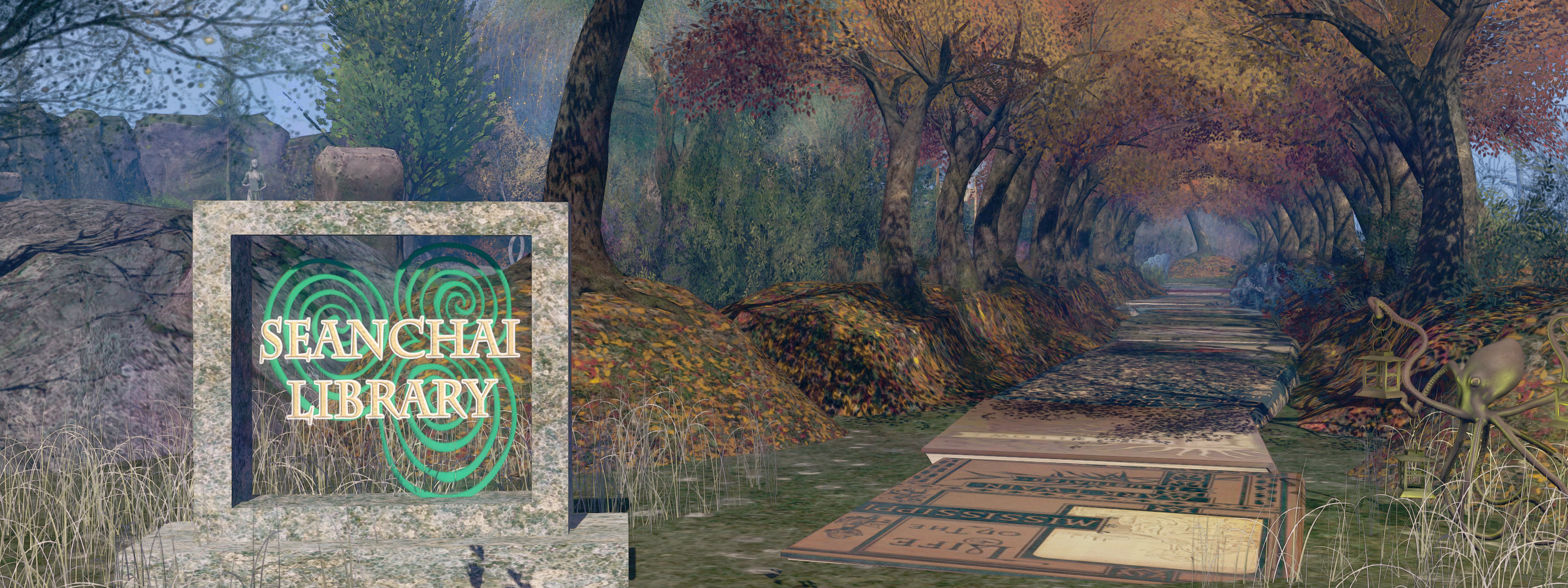
It’s time to highlight another week of storytelling in Voice by the staff and volunteers at the Seanchai Library. As always, all times SLT, and events are held at the Library’s home in Nowhereville, unless otherwise indicated. Note that the schedule below may be subject to change during the week, please refer to the Seanchai Library website for the latest information through the week.

Monday, July 25th, 19:00 Dandelion Wine

The inventor who almost took the pleasure out of life by building a Happiness Machine; the young reporter who fell in love with an alluring lady of ninety; the old gentleman whose last act was listening to the clang of a green trolley car going round a corner, two thousand miles away.

These are just a few of strange and vivid people who entered the secret world of a twelve-year-old boy during one enchanted summer when he discovered the fact that he really was alive…

“The summer of ’28 was a vintage season for a growing boy. A summer of green apple trees, mowed lawns, and new sneakers. Of half-burnt firecrackers, of gathering dandelions, of Grandma’s belly-busting dinner. It was a summer of sorrows and marvels and gold-fuzzed bees. A magical, timeless summer in the life of a twelve-year-old boy named Douglas Spaulding—remembered forever by the incomparable Ray Bradbury.”

With Ktadhn Vesuvino.

Tuesday, July 26th

12:00 Noon: Russell Eponym

With music, and poetry in Ceiluradh Glen.

19:00: The Last Cuentista

There lived a girl named Petra Peña, who wanted nothing more than to be a storyteller, like her abuelita.

But Petra’s world is ending. Earth has been destroyed by a comet, and only a few hundred scientists and their children – among them Petra and her family – have been chosen to journey to a new planet. They are the ones who must carry on the human race.

Hundreds of years later, Petra wakes to this new planet – and the discovery that she is the only person who remembers Earth. A sinister Collective has taken over the ship during its journey, bent on erasing the sins of humanity’s past. They have systematically purged the memories of all aboard – or purged them altogether.

Petra alone now carries the stories of our past, and with them, any hope for our future. Can she make them live again?

Caledonia Skytower read Donna Barba Higuera’s 2021 winner of the  Newbery Medal and Pura Belpré Award.

Wednesday, July 27th, 19:00: Seanchai Flicks

A special for Star Wars month as the Seanchai cinema space plays host to videos and throw popcorn around!

Thursday, July 28th, 19:00: Thursday Night Sci-Fi

With Finn Zeddmore. This week: Goblin Market by Robert R. Chase from, Asimov’s SF Magazine (July/Aug 2022) in a special 90 minute session.

Profiles Viewer reaches RC Status in Second Life

via Linden Lab

In June 2019, Linden Lab released the Legacy Profiles Project viewer, the first step in moving user Profiles back into a viewer floater that does not utilise the web-based profiles that have been in place for the last decade(ish) – see SL Legacy Profiles project viewer.

At the time, it was hoped that the project to move profiles back “into” the official viewer would be relatively easy. However, three years have passed, and it is only now that the work has moved forward.

There are multiple reasons for this being the case: pressure of work elsewhere, the need for back-end updates that were interrupted by the migration to AWS, and so on. So, there was probably an enormous sense of relief at the lab when, on July 21st, 2022, the Profiles Release Candidate (RC) Viewer could finally be issued for users to take a look at ahead of it moving forward to de facto release status.

As with in-viewer profile floaters, this one presents a panel with a series of tabs:

  • Bio – for the user’s / avatar’s biography.
  • Feed – providing a view of the user’s web-based Profile Feed.
  • Picks: the familiar selection of 10 favourite places / other information the user wants to display in their profile.
  • Classifieds: for any classified ads the user has created.
  • Real Life: a further tab the profile owner can use to provide any additional information they wish (it actually does not have to be “real life” related, which is why I whish the Lab would follow the lead of others and call this “Additional Info”, or something, and let users decide how they want to use it.
  • My Notes: a section in which notes can be written about a profile and which can only be seen by the person writing the notes.
The new official viewer Profile panel. On the left: as seen b the account holder, with an editable description field. On the right: as seen by other users. Note the two Action drop-down menus as well. Click for full size, if required

Of these tabs, it is very likely that Bio is going to be the most jarring to anyone familiar with viewer-based legacy profiles, as it presents a very different layout compared to other profile floaters – and also includes some useful extras.

The basic info on the profile owner – picture, partner status and age are rather untidily squished into the top left corner of the tab. This is to allow more room for users to write something about themselves / their avatars. While this is welcome – the “traditional” legacy profile always seemed a tad limiting for expression. However, depending on whether or not this layout is adopted verbatim aby TPVs, I do have a small niggle.

People tend to spend considerable effort in getting their bio info laid out in their Profile, and such is the nature of this floater, such work tends to be lost. For example, in Firestorm, Cool VL, etc., my own bio is relatively centred within the provided window – but here, as shown in the image above right, it appears oddly ranged to the left.

This may sound like nit-picking, but it could actually carry some weight: people put great store by what they see in a profile almost as much as in what they read, and what may come over as a slapdash, hard-to read layout on account of different floater window sizes (again, assuming TPV don’t simply integrate this profile floater design into their offerings, rather than continue with their own) might lead to unfair judgements.

On the positive side, this tab includes up to three handy drop-downs:

  • Show / Hide: (visible to the profile owner only) – sets whether or not the profile is listed in Search, and is tidier than the old check-box.
  • Actions: a context-sensitive menu available to both the profile owner and those viewing a profile, with the menu options (shown left and right in the image above) dependent on who is viewing the viewing the menu.
  • Tools drop-down (person viewing a profile only): provides access to “action” options the person viewing the profile may wish to take in reference to the owner of the profile, as shown below:
The additional options available from a user’s profile for those viewing it

The remainder of the tabs in the floater are really straightforward and require no real expansion here. As per current legacy profiles, when editing your own, editable fields are show in white for text entry.

What one thinks of the overall layout / appearance is subjective; outside of my little niggle on how information is displayed between different styles of profile floater (again, assuming some TPVs keep to the more “traditional” profile floater design rather than adopting this layout), I’ve no issue with this approach. And like I noted above, the additional drop-down options presented through it are handy to have.

Related Links

2022 viewer release summaries week #29

Logos representative only and should not be seen as an endorsement / preference / recommendation

Updates from the week ending Sunday, July 24th, 2022

This summary is generally published every Monday, and is a list of SL viewer / client releases (official and TPV) made during the previous week. When reading it, please note:

  • It is based on my Current Viewer Releases Page, a list of all Second Life viewers and clients that are in popular use (and of which I am aware), and which are recognised as adhering to the TPV Policy. This page includes comprehensive links to download pages, blog notes, release notes, etc., as well as links to any / all reviews of specific viewers / clients made within this blog.
  • By its nature, this summary presented here will always be in arrears, please refer to the Current Viewer Release Page for more up-to-date information.
  • Note that for purposes of length, TPV test viewers, preview / beta viewers / nightly builds are generally not recorded in these summaries.

Official LL Viewers

  • Release viewer: version 6.6.1.572458 – formerly the Maintenance M(akgeolli) RC viewer, promoted June 29 – no change.
  • Release channel cohorts::
    • Izarra Maintenance RC, version 6.6.2.573282, issued on July 20th.
    • Profiles RC viewer, version 6.6.2.573372, issued on July 20th.
  • Project viewers:
    • Love Me Render (LMR) 6 Project viewer version 6.6.2.573263, issued on July 21st.

LL Viewer Resources

Third-party Viewers

V6-style

  • No updates.

V1-style

Mobile / Other Clients

  • SpeedLight updated for Patreon users only.

Additional TPV Resources

Related Links

Space Sunday: galaxies, launches and health in space

Gz-13, as seen by the James Web Space Telescope, one of the earliest known galaxies in the universe and seen as it would have appeared just a few million years after the Bi Bang. Credit: NASA / ESA / CSA / STScI

The above image may not look to be much, but it in fact a glimpse at one of the most distance galaxies from our own, a place called Gz-13. It is so far away, the light captured by the image departed it about 300 million years after the universe itself was born.

Gz-13 is a part of a cluster of galaxies seen within one of the first set of images released by NASA from the James Webb Space Telescope (JWST), and which I covered in my previous Space Sunday update. So far away are these objects, that they can only be seen via the effect of gravitational lensing – using the gravity of an object much, much closer to our own solar system to “bend” the light from them and focus it so that JWST can capture images.

Gz-13 lies tucked away in the SMAC-0723 grouping of very distant objects. Originally imaged by the Hubble Space Telescope (HST), the grouping has been given sharp, new high-definition exposure by JWST. Some much definition, in fact, that GZ-13 hadn’t been seen by Hubble.

While it may seem like a blob of red-shifted light, massively distant objects like Gz-13 (and Gz-11, another far-distant galaxy that was seen when Hubble viewed SMACS-0723) are important targets for study, as they represent a period of time literally just a blink (in cosmic terms) after the universe went off with its Big Bang; thus thus represent an opportunity for us to understand what was going on very close to the origin of literally everything there has ever been.

SMACS 0723 as it appeared 4.6 billion years ago. Tucked away inside this cluster sits Gz-13. Credit: NASA/Goddard Space Centre / STScI

What is particularly interesting about the likes of Gz-11 and Gz-13 is that despite being formed just 150-200 million years after the first stars are believed to have started forming, they still have masses that suggest they are home to several billions stars with a mass equivalent to our own Sun. Thanks to them being so bright in the infra-red, they offer an unparalleled opportunity for astronomers to carry out extensive spectrographic analysis  to help us to discover more about them and the nature of the stars they contain – including, potentially, whether any of their stars might be surrounded by disks of dust and gas that might have gone on to form planets.

Given the nature of the expanding universe, Gz-11 and Gz-13 are liable to be just the tip of a massive iceberg of galaxies far, far, away that are waiting for JWST to find. This is turn will massively increase our total understanding of the nature of the universe, and the formation and growth of the galaxies within it. In fact, it is very possible that JWST will look so far out that we are looking almost back to the very edge of the Big Bang itself.

China Launches First Space Station Science Module

China has launched the first of two science modules to its nascent Tiangong Station (TSS).

The Wentian module was lifted into the sky atop a Long March 5B heavy-lift rocket at 06:25 UTC on Sunday, July 24th, the launch taking place from the Wenchang spaceport on the southern island of Hainan.

Measuring 17.9 metres in length and with a diameter of 4.2 metres, the module has an operational mass of around 23 tonnes, putting it on a par with US and international modules on the ISS. At the time of writing, the module was due to make an automated docking manoeuvres with Tianhe-1, the core module of the Chinese space station.

Chinese Space Station supplemental module Wentian. Credit: Leebrandoncremer via Wikipedia

Wentian, which literally means “quest for the heavens,” is the first of two science modules intended to join with Tinahe-1 to complete the currently-planned elements of TSS and bring its all-up mass to around 66 tonnes (the ISS, by comparison, masses 460 tonnes). In addition, operations aboard the station can be added-to through the use of Tianzhou automated re-supply vehicles.

The module’s docking will be overseen by the three crew of the Shenzhou 14 mission. It will initially dock with Tianhe’s forward docking port, where it will remain during initial tests and check-out by the crew to confirm its overall condition. The crew will then commence initial science activities, which will include a live broadcast via Chinese state media.

At some point in the future, Wentian will be relocated to a side port on Tianhe’s forward docking hub to form one arm of an eventual “T” that will be made by the core module and the two science modules, leaving the forward port free for visiting crews, and the after port at the far end of Tianhe available for visiting Tianzhou vehicles.

Whilst classified a science module, Wentian is actually a multi-purpose facility. It includes an airlock of its own to enable crew members to complete space walks, it has an external robot arm of its own to assist with such spacewalks, and additional living space for 3 tiakonauts, allowing up to six to live in comfort on the station during hand-over periods. The first such hand-over (similar in nature to ISS handovers) is due to take place in December 2022, when the crew of Shenzhou 14 pass the station over to the 3-person Shenzhou 15 crew. However, prior to that event, the second science module, called Mengtian (“Dreaming of Heavens”), is due to be launched to the station in October.

NASA Sets Artemis-1 Launch Dates

On July 20th, 2022, NASA announced they are targeting three dates at the end of August / beginning of September for the first flight of their Space Launch System (SLS) super rocket which sits at the heart of their plans for a return to the Moon.

The Artmis-1 mission will launch an uncrewed Orion Multi-Purpose Crew Vehicle (MPCV) on an extended mission to cislunar space. Each of the three launch dates has different launch windows and mission durations:

  • August 29th: the launch window runs from 12:33 to 14:33 UTC, and would result in a 42-day mission ending with a splashdown on October 10th.
  • September 2nd: the launch window runs from 16:48 to 18:48 UTC, and would result in a 39-day mission splashing down on October 11th.
  • September 5th: the launch window opens at 21:12 UTC for 90 minutes, and would result in a 42-day mission splashing down on October 17th.
The Artemis-1 Space Launch System rocket, seen during the initial Wet Dress Rehearsal test in April 2022. Credit: NASA

Splashdown for all three launch opportunities will occur off the coast of San Diego, California.

The dates themselves have been defined based on the need to complete post-Wet Dress Rehearsal  test work on the vehicle. They all represent “long-class” flights for the Orion, with Artmis-1 originally being planned around shorter 4-week flights in order to test out all of its handling characteristics in cislunar space. However, given all of the delays thus far experienced with Artemis-1, NASA opted to push for these launch dates rather wait until the end of October when windows for shorter-during flights would open, together with a further rick of slippage of the launch back into 2023.

Continue reading “Space Sunday: galaxies, launches and health in space”

An Underwater World at Le Monde Perdu in Second Life

Luane’s Underwater World, July 2022 – click any image for full size

It might not seem that long since I last wrote about LuaneMeo’s Luane’s World – largely because it isn’t; I covered the spring look to the region just a couple of months back, in May 2022 (see Spring 2022 at Le Monde Perdu in Second Life).

However, I have good reason for returning so quickly to the region of Le Monde Perdu (The Lost World), because Laune, again working with Gorba McMahon, has made the Summer 2022 build a place to be enjoyed by both land lovers and those who enjoy dipping under the waves in either human form or as merfolk, as she presents Luane’s Underwater World.

Laune’s Underwater World, July 2022

With this iteration, the setting presents a south-facing arc of land sitting with its back to the rest of Luane’s estate, which embraces a wide and relatively deep bay within its protective arms. The south-facing arc of the land forms a sweeping curve of sun-bleached sand with many places set across it for people to sit or cuddle as gulls wheel and turn overhead, and waves break gently against the sloping sand.

Behind the beach, the land rises sharply but not precipitously or to great height; just enough to present stepped uplands sliced into from the north by a tight inlet, and whose grassy hills carry a suggestion of this being a Mediterranean setting, courtesy of the Tuscan style villas, houses and outlands scattered across them. Furnished within and showing outward signs of being occupied, these are actually public spaces as well, offering further places to sit and pass the time – and, as with the beach, plenty of opportunities for photos.

Luane’s Underwater World, July 2022

However, do be aware that behind the villa occupying the north-east lowlands, there is a trail and bridge leading into the neighbouring regions of the estate. These regions do have private residences scattered across them, so do please take care to avoid trespassing when wandering in that direction.

Throughout the landscape, there is a gentle sense of peace and of time passing slowly; a vibe that this is a place where nothing seems to happen as the minutes and days tick one to the next. But dive into the waters of the bay, and it becomes apparent something has happened here at some point. Caught in the arms of the land and sheltered under the waves is a world which at one time lay above the waters that now guards it.

Luane’s Underwater World, July 2022

This is a place rich in colour, with corals and anemones bloom, oysters hold great pearls, shark, fish, dolphin and turtle swim – and the ruins of an ancient civilisation stand in silence, the wooden wreck of a once proud sailing ship close to hand.

Exactly what caused this place to drown and when it happened is unclear – and actually unimportant; for who is to say this place was ever once above the waters of that bay? Perhaps the ruins and statues here were not carved by human hand, but by those of the merfolk they appear to celebrate?

Laune’s Underwater World, July 2022

What is clear is that here, among the corals and anemone, watched over by sea creatures great and small, are many more hiding places where lovers can rest in one another’s arms, photographers can find ready to be used within their arts, and those who simply want to sit and pass a little time can find peace. Some of these may well be out in the open and easy to spot, but others are tucked away and may require a little effort to find – but it will be time well spent, and are welcoming to both human and merfolk.

As always, Laune’s World offers much to see and appreciate with this Summer 2022 build, and I recommend that rather than reading my twaddle, you go see for yourselves!

Luane’s Underwater World, July 2022

SLurl Details