A Red Beach in Second Life

Panjin, February 2023 – click any image for full size

Jade Koltai is back with another region design which continues the work she began with the late Serene Footman: delivering to Second Life a setting reflective of one of the more intriguing and/or unusual locations to be found in the physical world.

Located in the biggest wetland and reed marsh in the world, some 40 kilometres from Panjin City, Liaoning Province, northeast China, is Bohai Bay. It sits at the mouth of the Panjin Shuangtaizi River, and it is home to the Panjin Honghaitan Scenic Area. Composed of shallow seas and tide-lands, the location is also home to an extensive growth of Suaeda salsa, one of the few species of plant that can live in highly alkaline soil to which it has given the region its more well-known name: the Red Beach.

Panjin, February 2023

This is because the Suaeda – also known as seepweed – turns the river-mouth red between the months of mid-summer and September and October every year, when the colour of the plant reaches its deepest, richest crimson ahead of the onset of winter. From a distance, it causes an 18 kilometre long stretch of the river and bay to look like it has a beach of red sand, although there is no actual sand between the plants.

An obvious tourist attraction, the area is mixed with paddy fields and hosts one of the most complete ecosystems that can be found: more than 260 kinds of birds, including the endangered black beaked gulls and crown cranes (thus giving it another name – “home of the cranes”), and 399 species of wild animal. In 1988, the area was awarded state-level nature protection, and has also been nominated to join the International person and biosphere protectorate network.

Panjin, February 2023

Cut through with river channels, much of the landscape is off-limits to Chinese nationals and tourists alike, although there are a number of vantage point people can go to – locations such as Yishui Yunzhou and Langqiao Aimeng – where wooden boardwalks have been built out over the seepweed, allowing visitors to see the plant without actually interfering with its growth. For those who would like a closer look, there are also boat rides along the river channels, which may offer a better way to see some of the local wildlife.

All of this has been marvellously captured – as one would expect – by Jade in Panjin, a stunning Homestead region design. Caught in the arms of an off-region surround, the region offers an estuary-like setting, open waters to the west and the shallows with the year’s growth of seepweed protected by the arms of the bay.

Panjin, February 2023

From the landing point on the west side, wooden walkways point eastwards, vying with the splayed fingers of water channels which appear to reach inwards over the red plant from the coast, rather than reaching outwards from the river towards the sea.

Steps descend to the red spray of plant growth, allowing visitors the wade through them, whilst open-sided pavilions might be found on the boardwalks or surrounded by the static tide of seepweed, offering places for visitors to sit and pass the time.  Further seating is to be found along the banks of some of the water channels, places which are also home to red-crown crane, a frequent visitor to the actual Red Beach.

Panjin, February 2023

This is a genuinely elegant region design, of which elegantly captures many different aspect of the both the Red Beach and the Panjin Honghaitan Scenic Area., with the flat aspect to the region, the extensive use of canola flower cut through with water channels and dotted her with hints of green to suggest rice growths and presided over by the odd tree and the outstretched boardwalks, gives the impression the region is a lot bigger than first appears.

As always, this is definitely a location in Second Life worth visiting, given most of us likely wont get to witness it first-hand in the physical world.

Panjin, February 2023

SLurl Details

  • Panjin (Overland Hills, rated Moderate)

2023 week 5: SL CCUG meeting summary

Jitters Coffee Shop, Heterocera – December 2022 – blog post
The following notes were taken from my audio recording and chat log transcript of the Content Creation User Group (CCUG) meeting held on Thursday, January 19th 2023 at 13:00 SLT. These meetings are for discussion of work related to content creation in Second Life, including current work, upcoming work, and requests or comments from the community, and are chaired by Vir Linden. Dates and times can be obtained from the SL Public Calendar. Notes:
  • These meetings are conducted in mixed voice and text chat. Participants can use either to make comments / ask or respond to comments, but note that you will need Voice to be enabled to hear responses and comments from the Linden reps and other using it. If you have issues with hearing or following the voice discussions, please inform the Lindens at the meeting.
  • The following is a summary of the key topics discussed in the meeting, and is not intended to be a full transcript of all points raised.

Official Viewers Summary

Available Viewers

  • On Thursday, February 2nd, 2023:
    • The Maintenance Q(uality) viewer, version 6.6.9.577968 was promoted to de facto release status.
    • The PBR Materials project viewer updated to version 7.0.0.577997.
  • On Friday, February 3rd, 2023 the Maintenace R RC viewer updated to version 6.6.10.578087 – translation updates and the return of slam bits.
The remaining official viewer pipelines are unchanged, as follows:
  • Release channel cohorts (please see my notes on manually installing RC viewer versions if you wish to install any release candidate(s) yourself).
    • Performance Floater / Auto-FPS RC viewer, version 6.6.9.577251, January 4, 2023.
  • Project viewers:
    • 7.0.0.577780, January 25, 2023 – This viewer will only function on the following Aditi (beta grid) regions: Materials1; Materials Adult and Rumpus Room 1 through 4.
    • Puppetry project viewer, version 6.6.8.576972, December 8, 2022.

General Viewer Notes

  • It is believed the next viewer due for promotion will be the Performance Floater / Auto FPS viewer, at which point all viewer releases will officially all be based on VS 2022 for Windows, as this is the first RC viewer merged with the VS 2022 release process (previously a separate viewer build fork).

glTF Materials and Reflection Probes

Project Summary

  • To provide support for PBR materials using the core glTF 2.0 specification Section 3.9 and using mikkTSpace tangents, including the ability to have PBR Materials assets which can be applied to surfaces and also traded / sold.
  • To provide support for reflection probes and cubemap reflections.
  • The overall goal is to provide as much support for the glTF 2.0 specification as possible.
  • In the near-term, glTF materials assets are materials scenes that don’t have any nodes / geometry, they only have the materials array, and there is only one material in that array.
    • It is currently to early to state how this might change when glTF support is expanded to include entire objects.
  • The project viewer is available via the Alternate Viewers page, but will only work on the following regions on Aditi (the Beta grid):  Materials1; Materials Adult and Rumpus Room 1 through 4.
  • Please also see previous CCUG meeting summaries for further background on this project.

Status

  • Viewer:
    • The latest update to the viewer includes improvements to probe light blending (e.g. between overlapping manually-placed probes), additional work on radiance and irradiance, and the resolution quality of reflections set back up to 256×256 per face (but will downgrade to 128×128 if the viewer has less than 2 GB of available VRAM). All of this should leave the visual quality of reflection probes “pretty close” to what will be seen in the RC / release version of the viewer.
    • However, there is still a hard transition line between line between overlapping automatic probes and manually place probes, and LL want to encourage those using probes to use full scene manually-placed probes to ensure a much better quality of reflections.
    • Automatically-placed probes have had parallax correction removed, this should prevent the issue of people seeing the ray traced sphere of the probe rather than the reflection of the environment. Parallax correction is now only available with manually-placed probes.
    • Screen Space Reflections (SSR) have also been integrated with the reflection probes so that when the viewer does a look-up on a reflection probe and SSR in enabled, if there is an available SSR that gives a better result than the (generally automatic) reflection probe’s sample, it will be used instead.
    • In addition, there has been further work on optimisation and frame rate smoothing.
    • Still to be addressed in the viewer:
      • Some general artefacts still requiring clean-up, notably water reflections / light speckling, objects being rotated in reflections, and some remaining issues with colour curves on HUD attachments.
      • Further UI work.
      • There are some glTF materials caching issues which have yet to be addressed.
  • LL is in the process of finalising compliance with the glTF standards. This does not impact viewer and glTF testing on Aditi (the beta grid), but will require updates to the viewer which are likely to come into force during RC / beta testing, meaning that only the updated viewer should be used from that point forward. However, it should not impact / alter overall functionality within the viewer.
    • This is the result of an incorrect assumption being made about some of the data required by the glTF specification would “always be there”, when in fact the filtering process LL uses to ensure glTF files uploaded do not contain anything malicious was dropping some of that data (so the visuals were correct, but the data was “wrong” compared to the standard).
  • In an effort to have media on a prim work on glTF materials in a similar manner to the current SL materials (where setting a face to media on an object overwrites the diffuse (texture) map), setting media on a PBR materials face will overwrite both the diffuse and emissive maps, whilst sill allowing media to be viewed on a shiny surface, et., as per the current behaviour.
  • There is concern about the impact of allowing “double-sided” materials as a part of glTF PBR (e.g. the risk of over-use, potential performance impacts, etc.).
    • LL acknowledged that a lot of samples they’ve tested from Sketchfab do contain a a lot of “unnecessary” double-sided surfaces, and so are considering implementing a check and warning on import where this occurs.
    • There is currently a checkbox for enabling / disabling double-sided materials in the PBR viewer’s materials editor, but LL’s view is that allowing double-sided content is not going to “ruin SL forever” – a view not necessarily shared by some creators.

Vulkan

  • It is possible that 2023 will see the resumption of work to add support for the Vulkan / MoltenVK (for OS X) API alongside of OpenGL, as the latter is both growing increasingly long in the tooth and is gradually being deprecated / no longer used / supported on a number of fronts.
  • Within LL, it is believed that implementing this support will not only get SL past the issue of OpenGL’s status, but also offer performance improvements within the viewer (e.g. allowing SL to be less CPU-bound and make more use of the GPU, reducing the volume of draw calls, etc.).

In Brief

  • LL have been experimenting with pulling purchased content using glTF materials from Sketchfab and importing it to SL. The process is not easy, and it is acknowledge more work needs to be done to smooth this out at some point in the future – it will not be improved before the current project moves to a release status.
    • This raised the question of licensing, rights, mesh uploads to SL and the Terms of Service, with a not from LL that this likely needs to be reviewed as a whole, and guidelines provided to specify requirements for uploading content purchased by / built via 3rd party sites and things like license compliance (together the the need for LL to determine the means of gatekeeping things like license compliance).
    • Routes to upload from the likes of Sketchfab would be beneficial, as it would mean creators used to building for those platforms could pull their content into SL without having to learn a further (esoteric) set of content creation requirements.
  • There was a general discussion on texture compression with glTF (which remains in place for all maps other than normal map, where compressed lossless is viewed as important), and on glTF allowing backward-facing normal maps (unsupported with the current SL materials system), and possible problems / benefits these might lead to.
  • In terms of which parts of the glTF specification SL is supporting, LL will likely produce a living document that will detail the initial support, and which will be updated when further support is added / certified by Khronos.
  • For future work, it appears at present that supporting glTF mesh imports would take priority over implementing glTF materials extensions from the specification.
  • Related to the above point, discussions are in progress within LL on how to continue to support COLLADA (.DAE) mesh imports into SL without actively supporting COLLADA format.
    • Reasons for sunsetting direct COLLADA import to SL include:  there are still a lot of traps creators can fall into with the SL implementation of COLLADA support which can be a barrier to entry for those wishing to engage in SL as creators (similar traps do not exist within the glTF standard); maintaining the COLLADA importer adds cost and overheads, as every importer update has to be tested against it and adjustments made where they break COLLADA uploads.
    • One option under consideration is the use of the Open Asset Import Library (Assimp). This acts an an intermediary (so .DAE files get converted to the glTF mesh format), allowing a route of upload for COLLADA file to SL without LL having to maintain the COLLADA import mechanism directly, reducing the overheads of having to both test against it and maintain COOLADA import support.
    • This route would also allow other mesh formats (e.g. .FBX) to be “supported”, with the glTF specification support document mentioned above, available for creators to check which elements within the glTF specification they may need to add in order to get a like-for-like between their build format (.DAE. .FBX, etc.), and glTF.
    • Concern was raised about what the removal of direct COLLADA import might do the the market for full permission .DAE files which can be purchased through the SL Marketplace for upload to SL (although it is not clear how big this market is).
    • It is hoped that any approach taken would offer at least a robust a means of importing COLLDA meshes as the current importer.
  • Also under internal discussion is how to support hierarchies in the context of glTF assets and what that means (e.g. import an asset with a node graph hierarchy, attach it to a mesh, and then manipulate the hierarchy via the edit tools or LSL).

Next Meeting

  • Thursday, February 16th, 2023.

Tayren Theas at Elven Falls in Second Life

Elven Falls: Tayren Theas

My attention was drawn back to Elven Falls, the art collective operated by Ant (AntoineMambazo) and Ares Hax, with the announcement of an exhibition by Tayren Theas within one of the the collective’s main galleries (Gallery 3). The visit to the exhibition also gave me the opportunity to drop into her boutique gallery, also found within the collective (just on the right as you walk down the main thoroughfare from the landing point towards the three main galleries at the far end).

Tayren has been a Second Life resident for over 15 years, and is both an artist and business owner. As a life-long fan of the fantasy genre, Tayren’s early years in Second Life were marked by establishing her business with designing fantasy clothing. Doing so introduced her to photography in Second Life through the act of modelling her designs, and this allowed her to gradually fold her love of art and drawing held since childhood.

Elven Falls: Tayren Theas
Through her photography – which comprises images captured in Second Life and then post-processed via photoshop and other tools – often presents fantasy women of all types: mermaids, fairies, witches, queens, gypsies and more besides. She also offers landscape images, abstract art pieces, wildlife images and more.

The exhibition within the collective’s Gallery 3 has something of a Valentine’s feel to it, celebrating love and expressions of loving feelings, while presenting a range of images which are engaging in both their richness and in their reflections of the work of classical artists such as Austrian symbolist painter Gustav Klimit and Czech painter Alphonse Mucha, among others.

Elven Falls: Tayren Theas

Stating with a glorious series of portraits in the foyer of the gallery, the exhibition proceeds to either side (I would recommend turning to the left first), the collection takes you through a journey encompasses the magic of matrimony, the mischief of naughty undies and the marvel of a kiss in its ability to communicate so much between two people.

Within Tayren’s boutique gallery are samples of her broader art, in which can be found the aforementioned landscape, abstract and wildlife art  – and more.

Elven Falls: Tayren Theas

This is the first time I’ve witnessed the broadness of Tayren’s work, and believe she offer a unique and rich well of art that is well worth taking the time to visit.

SLurl Details

February 2023 SL WUG meeting: Land Portal + Marketplace

The Web User Group meeting venue, Denby

The following notes cover the key points from the Web User Group (WUG) meeting, held on Wednesday, February 1st, 2023.

WUG meetings:

  • Are held in-world, generally on the first Wednesday of the month – see the SL public calendar.
  • Cover Second Life front-end web properties (Marketplace, secondlife.com, the sign-up pages, the Lab’s corporate pages, etc.).
  • They are not intended for the discussion of Governance issues, land fees / issues, content creation & tools, viewer or simulator development / projects. Please refer to the SL calendar for information on available meetings for these topics.

A video of the meeting, courtesy of Pantera, can be found embedded at the end of this article (my thanks to her as always!), and subject timestamps to the relevant points in the video are provided. Again, the following is a summary of key topics / discussions, not a full transcript of everything mentioned.

Updates for January 2023

Land Portal Release

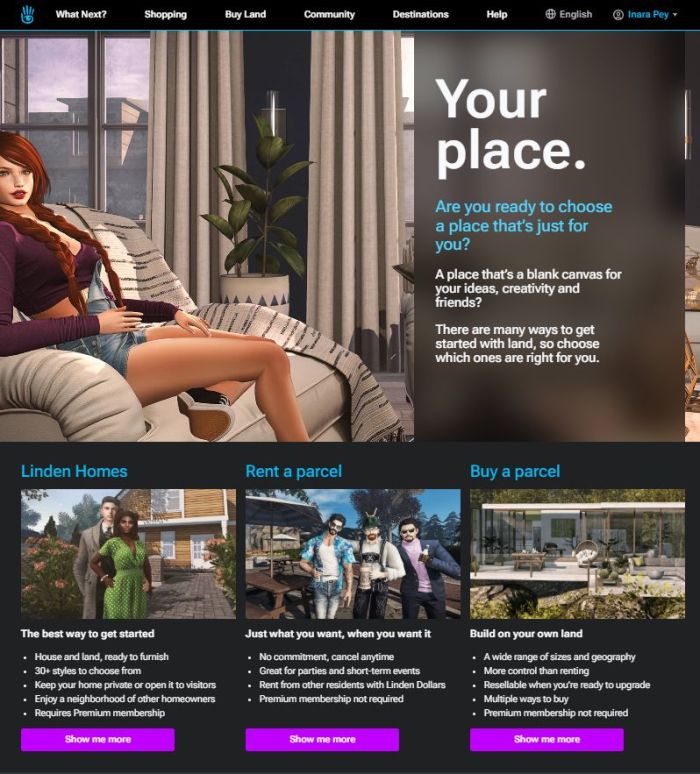
  • [Video: 06:00-08:00] The new Land Portal has been launched. This is intended to be a central hub from which to get to all aspects of land “ownership” – purchasing regions, renting land from a private estate, renting or purchasing Mainland; obtaining a Linden Home.
  • [Video: 10:33-10:49] There are currently no actual functionality changes to the pages behind the portal – these will come in time.
    • [Video: 8:51-9:22] The first of the Land pages to undergo update and improvement will be the Linden Homes page. This will make it easier to see and select available Linden Home styles – but this update “will be a while” before it is surfaced.
  • Translations for the Portal and the Land pages will come in due course.
  • The Portal has been used as something of a prototype, bringing together tools and technologies the Lab intend to use to build-out updated versions of their websites and portals, and ensure they are mobile-friendly.

A portion of the new land portal front-end – click to visit

  • A technical blog post on what the web tools and ongoing website redesign means will be published be the Lab in the near future.

Marketplace Updates

  • [[Video: 08:04-8:43] Search:
    • The deployment of the Marketplace Search updates has been further delayed, as indexing all searched to date is taking longer than anticipated to complete.
    • All other work is completed – the code is in place and ready to go – but LL want to ensure that search and order histories all remain in place when the switch is thrown.
    • once fully deployed, the new MP Search will have a close parity with the updated web search deployed in 2023, including its own relevance engine.
  • [Video: 17:29-20:26] “Marketplace 2.0” – the Refresh / Rebuild:
    • Still being discussed / developed.
    • Will likely included further Search capabilities: fuzzy searching; negative tags / Boolean search options; the potential for improved filtering.

Marketplace Discussion Summary

Marketplace “Gold Star” Mechanism

[Video: 31:49-35:30]

One idea being floated internally at LL is the idea of awarding worn / attached items a “gold star” to items with a “low Land Impact”.

  • The suggested approach would be to have some form of automated “side bake” mechanism which takes avatar attachments and assesses their LI, and then awards them a “gold star” on the basis of whether or not they remain within some defined “LI threshold”.  “Gold star wearables” would then be searchable as a category / categories within the MP.
  • The core aims of this would be to:
    • Encourage wearable items creators to ensure their clothing and avatar attachment are more render performant/efficient (avatars currently have perhaps the highest performance impact, as no real constraints are currently placed on the complexity of worn items, so there is no incentive to model them as efficiently as possible).
    • Encourage consumers to consider what they are purchasing and its impact (“the gold star means it is better for you and SL”).
  • This does raise concerns of further gaming of LOD (level of detail) in order to bring items in under the threshold, with the result that while they gain the “gold star” they nevertheless immediate collapse into one (or a small group) or triangles when seen from even a minimal distance – with creators who do so then “recommending” users set their viewer’s LOD rendering unnaturally high – and in the process further negatively impacting viewer performance.
  • Alternatives offered at the meeting:
    • Utilise the revised avatar complexity calculations which form a part of the ARCTan project by which to measure the complexity of worn items (the problem here being the ARCTan project stalled some 2+ years ago and has yet to be re-started).
    • Utilise the “good LOD” calculations used for Animesh to encourage creators to model their clothing / attachments responsibly.

General Marketplace Discussion / Exchange of Ideas

[Video 20:42-31:45 + local chat]

  • Variants (officially “Styles” – e.g. having multiple colour options for an item in a single listing) was again raised. No further direct feedback on this was given; however, at the January meeting it was indicated the work (which has apparently largely been done) is being “re-prioritised” in the face of the delays in deploying the updated MP Search.
  • “One click demos” were suggested for the MP – being able to click on an attachment offing in the Marketplace and the item is temporarily worn in-world. This is something Garfield Linden indicated was of interest to him, and requested a Feature Request Jira on the idea.
  • Search:
    • Phonetic searching was requested (particularly handy for those not well-versed in the currently-supported languages / dyslexia, where fuzzy search might over-compensate with results).  Sntax [sic] Linden acknowledged the “appeal” of phonetic searching.
    • Filtering clothing / attachments by body type: this is something the Marketplace Team are already looking at in terms of the “most popular” bodies – although how representative this might be of SL’s diversity is hard to determine.
  • Pay what you want – suggested as a possible option to allow merchants to offer items for free, but with the option for buyers to offer a “tip” in payment.
    • The functionality for this may be overly complicated to implement.
    • However, in considering Marketplace updates / a rebuild, LL have looked at options for offering coupons, sales, and “price changey” options, so this idea will be added to the list for further internal discussion.
  • It was acknowledged that Marketplace load times in the viewer’s browser (and the load times of other SL web properties a user may already be logged-in to) are “to darn high”, and that there are “performance skirmishes” to be had in this area.
  • A suggestion was made for the Marketplace to support “related items” between stores. This would require engagement by Merchants, but the idea would be if Merchant A produced items intended for use with something Merchant B produces, they could mutually list one another’s products as being related. It could also be technically complex to implement.
  • Marketplace and CasperVend integration: this is something LL would like to do following the purchase of CasperTech, and have had discussions about, but there are no firm plans as to have it might be tackled as yet.

Misc Items

Smart Landmarks

[Video 47:30-48:10]

World API Update

[Video 48:40-49:25]

  • It has been notes that following a recent update, the World API reports banned agents as a part of the Group member count.
  • It is not clear if the update caused this, but if so, it was not the intent. The matter has been noted for investigation.

Next Meeting

  • Wednesday, March 1st, 2023. Venue and time per top of this summary.

A Celestial Glade in Second Life

Celestial Glade, February 2023 – click any image for full size

Celestial Glade transports you to enchanted forest, full of magic and exploration. Tucked away, you will find romantic spots to dance and cuddle with that special someone.

– Celestial Glade About Land

So reads the introduction to Celestial Glade, a Full private region utilising the Land Capacity bonus primarily designed by Roxy Chronotis (Roxy Christenson).

Celestial Glade, February 2023

A mystical setting, the region is predominantly open to the public, although the north-east corner – separated from the rest of the region by tall curtain cliffs – is given over to a private home, and there are some rental cottages sitting within the south-west corner, so the usual warning about trespass and disturbing people’s privacy is given 🙂 .

The landing point sits to the south-east corner of the region, located within a gazebo formed from living trees. It faces the Lyrical Grove, a place for live music events (schedule on the board alongside of the steps leading up to the Grove) and the Lyrical Star Café, reached by descending a further set of steps from the landing point.

Celestial Glade, February 2023

Two further exits lead away from the landing point; one passes through an open field dominated by a single large and very aged tree. Clearly a space for outdoor events, it is bordered by smaller trees, waterfalls, and gigantic crystals; while there is nothing overtly Hobbiton-like about it, a Tolkienite like myself would likely not be surprised to find Bilbo Baggins and his friends and very extended family to be celebrating his elventy-first birthday under the shade of the tree…

The second route away from the landing point provides access to a path meandering under boughs and past glades, tall walls to one side. The latter partially enclose a small commercial marketplace in which store spaces (if available) can be rented. A path from the “birthday field” also runs past the entrance to this space, passing between it and a pond to join the first path as it continues on it way through the region, branching here and there along the way.

Celestial Glade, February 2023

These paths wind between ribbons of hills, tall peaks and blocky mesas, crossing streams and rivers along the way, passing under the shade of trees and through the coloured carpets of flowers. In doing so, they lead the way those romantic spots for dancing and / or sitting and cuddling. They also pass by or offer the route to, the region’s major points of interest.

The latter – which can also be reached via a network of stone teleport disks – include a glade of table-top games, ruins on a promontory, a restaurant and nearby café of distinctly elven styling, and a winding climb up the highest peak within the land to where the slender finger of a tower points a tall spire towards the sky, its teleport door guarded by a dragon.

Celestial Glade, February 2023

Whilst not specifically inspired by Middle Earth, the touches throughout – the aforementioned field with its great tree, the elven-style buildings, the odd Hobbit hole – all give Celestial Glade as shading of Tolkien; one which is acknowledged in a very subtle manner, as careful explorers may note in their travels.

Also awaiting discovery is a wizard’s hideaway, the ruins of a church where weddings might be held, mystical wells and stairs winding around the trunks of trees to reach high platforms. All of this adds to the attractiveness of exploration, as do the local EEP settings, which I would advise visitors to use in order to appreciate the region fully.

Celestial Glade, February 2023

Should you not feel in the mood for walking through the region and feel the teleport network risks missing some of the details tucked into valleys and under trees or within gardens, there is a horse rezzer just down the steps of the path leading away from the landing point, allowing visitors to explore from the saddle. Just keep in mind the horse will vanish if you opt to dismount 🙂 .

Relaxing, tucked into a river sound scape, Celestial Glade should come as a welcome retreat for those who needed, and an inviting place for photographers and explorers.

Celestial Glade, February 2023

SLurl Details

Magdha’s Sole Fragments in Second Life

Nitroglobus Roof Gallery – Maghda: Sole Fragments

For February 2023, Dido Haas presents Sole Fragments, a themed exhibition of monochrome photography by Maghda, at her Nitroglobus Roof Gallery.

Like Dido, I first encountered Maghda’s work some 8 years ago, but in my case, it was at another shared exhibition hosted at the now-closed DaphneArts Gallery. Also like Dido, I also lost track of Maghda, and had no idea that she had departed Second Life for a time, and only returned in-world in 2022.

Nitroglobus Roof Gallery – Maghda: Sole Fragments

With a focus on avatar studies, often featuring herself as the model and often presented in greyscale or monochrome, Maghda has a talent for pieces that offer single-frame stories, often with an element of introspection or personal discovery.

This is very much the case with Sole Fragments, a title which can be taken both literally – these are pieces offered from a sole perspective – and as something of a double play on words: the images represent a journey – a walk, if you will – through her Second Life and times; and walks are things we undertake on the soles of our feet. At the same time these images are reflections of Maghda’s soul.

Nitroglobus Roof Gallery – Maghda: Sole Fragments

As Maghda herself notes, this is a collection depicting the highs and lows and triumphs and struggles endured; moments of growth and of emotional release. Each image is deeply candid, deeply atmospheric and powerfully resonant – made all the more so through the use of monochrome and greyscale.

Each of the twelve images in the collection is a step on Maghda’s journey, allowing us to share in moments of love, loss, escape, freedom, and self-expression. The order in which we follow the steps in this journey is unimportant; it is the time we take to experience each, both in terms of the story it presents across the entire canvas and the emotional self-expression by the artist – and in allowing that expression and story resonate within us.

Nitroglobus Roof Gallery – Maghda: Sole Fragments

Given theses pieces are offered by the artist as a means of connecting within the emotions they contain and as a window into into her soul, it is really not my place to overlay them or the exhibition with my own subjective interpretations of specific images. What I will say is that this is a softly powerful collection of images, and I have no hesitation in recommending it as a must-see exhibition.

SLURL DETAILS