A Battleship Island in Second Life

Hashima, February 2023 – click any image for full size

Occupying a Full private region leverage the Land Capacity bonus, Hashima Island (or more simply, Hashima, given the -shima suffix can mean “island” alongside the more familiar (to western ears) rendaku form of Jima) is the latest regions design by Titus Palmira, Sofie Janic and Megan Prumier, appearing in-world under the “Skrunda” banner.

Like Skrunda-2, which I wrote about in February 2021 and again in November 2021, and which was modelled after the Soviet-era township / base of Skrunda in Latvia, Hashima is modelled after a physical world location which might not be otherwise well known to many: a tiny abandoned island situated some 15 km from the centre of Nagasaki, and one of over 500 uninhabited islands lying within the greater Nagasaki Prefecture.

Hashima, February 2023

Known to locals as Gunkanjima – “Warship Island”, more usually referenced as “Battleship Island” – it is a place indelibly linked to Japan’s industrialisation in the late 19th / early 20th centuries, and which has more recently been a focus of some international controversy. It is said that the nickname arose in the 1920’s and was due to the resemblance the silhouette of the island had, when seen from the city, with the the hulk of the inter-war battleship Tosa.

The latter had been been launched just months before Japan signed the Washington Naval Treaty of 2022, which effectively outlawed warships of her intended size and armament. As a result, her hull, sans its big guns and much of its superstructure, lay in Nagasaki harbour for much of 1922 prior to her being towed to the Seto Sea, to be used as a target for the Imperial Japanese Navy whilst testing new gun and torpedo systems.

Hashima photographed in 1930, when it had gained the local nickname “Gunship Island”. Credit: Shinkosha publications

By the time of the Tosa’s construction, however, Hashima had already been continuously occupied for more than 30 years. It had come to prominence as the Meiji Restoration sought to establish Japan as an economic and military powerhouse under the slogan Enrich the country, strengthen the military from the 1890s onwards, spurring massively accelerated industrial growth within the country. Coal was known to lie beneath the island, so as part of this drive, Mitsubishi purchased the island to exploit the coal reserves beneath and under the surrounding seabed.

Four deep shafts were cut through the island’s rock to reach the undersea coal seams, and by 1916 work was underway to both expand the island through land reclamation and offer better protection for its growing workforce. In particular, this lead to the construction of large sea wall defences and the first large-scale use of concrete in the construction of extensive housing in Japan through the development of the island’s 7-storey tall apartment blocks, designed to give workers and their families better protection from typhoons.

Hashima, February 2023

The island’s coal production reached its zenith in the late 1950s, when it was home to over 5,000 inhabitants – which is a lot for an island roughly 16 acres in size. It boasted a school, a playground, swimming pool, cinema, welfare centre, shops, a shrine and a hospital – all packed into a space just 480 metres long and 160 metres across. However, the rapid rise of oil and gas in Japan during the 1960s saw an equally rapid decline in the country’s use of coal. By January 1974 Mitsubishi decided continued mining, even at a reduced scale, was no longer viable on the island, and so closed down the pits and within three months had completed removed all inhabitants and all salvageable equipment, leaving the buildings and streets to nature.

For their interpretation of the island, Sofie and Megan offer a setting post the April 1974 island clearance, with nature in a state of rapid take-over – although there are still signs of some activity: steam rises from one area of plant, smoke periodically belches from the finger of a chimney stack, and a small fresh fish market is open on the pier where tourists would normally make their landing. How much of the build is based on the actual Hashima and how much has been pulled from the creator’s imaginations is unclear.

Hashima, February 2023

The apartment blockhouses clustered to one end of the island offer a reasonable facsimile, but some liberties appear to have been taken in the placement of features such as the mine shafts (one of which rather imaginatively leads to a hidden cafeteria). Similarly, while the island’s shrine is represented, the “stairway to hell” which climbed up to it has been replaced by a more roundabout route to reach it.

Not that these differences from the actual island diminish the build in any way; there are plenty of references about Hashima to be found on the web – I would certainly suggest this interactive tour – so those with an interest can research the original with ease; and the build itself is atmospheric enough to give more than a good flavour of the original and encourage one to learn more about its history.

Hashima, February 2023

In 2002, Mitsubishi relinquished their ownership of the island, with Nagasaki city now holding jurisdiction over it. It has been the subject of limited tours 2009 onwards, which is also the year in which the current controversy concerning the island first arose. It was in 2009 that Japan first applied to UNESCO for Hashima and 22 other sites within the country to be awarded World Heritage Site status for their roles in the nation’s development. This led to objections from both South Korea and China on the grounds that from the 1930s through to the end of the Asia–Pacific War, Korean and Chinese nationals were forcibly moved to the island and made to work the mines.

South Korea maintained its objections through until 2015, when Japan agreed to admit the use of forced labour at Hashima and other locations during the war, and to establish a full record of this at visitor centres related to the UNSECO sites. However, immediately following UNESCO granting World Heritage status to the sites, Japanese Foreign Minister Fumio Kishida effectively walked back the agreement, and UNESCO has remained critical of Japan for failing to acknowledge the full history of the island, with the Japanese government refusing to adhere to the agreement as recently at December 2022.

Hashima, February 2023

In the meantime, and while it might not be widely known in terms of its role in the industrialisation of Japan, Hashima is likely known to film goers around the world as the fictitious “deserted island off the coast of Macau” which served as one of the setting for the 23rd James Bond film, Skyfall, in 2015. It was also indirectly referenced in a 2017 South Korean war film, The Battleship Island, which told the fictional story of an attempt by Korean labourers imprisoned on the island to make their escape.

Rich in historical context, and a springboard for explorations both in-world and across the web to capture the story of its namesake, Hashima Island is an engaging place to visit.

Hashima, February 2023

SLurl Details

Seanchai Library: Feb 20th – Feb 24th, 2023 in Second Life

Seanchai Library

It’s time to highlight another week of storytelling in Voice by the staff and volunteers at the Seanchai Library – and this week previews the launch of a very special event.

As always, all times SLT, and events are held at the Library’s home in Nowhereville, unless otherwise indicated. Note that the schedule below may be subject to change during the week, please refer to the Seanchai Library website for the latest information through the week.

Monday, February 20th, 19:00: The Golden Compass (aka Northern Lights)

Originally published in 1995 as Northern Lights, The Golden Compass forms the first volume in Philip Pullman’s multiverse-spanning trilogy His Dark Materials.

In a world resembling Edwardian England, where magic is commonplace, young Lyra Belqcqua slip into the Retiring Room at the collage where he uncle is about to give a lecture – only to witness the Master of the college add poison to the wine intended for her uncle, Lord Asriel, prior to his arrival in the room. Warning him, she is rewarded by being allowed to remain and witness her uncle’s presentation, in which he discusses something called “Dust”, shows images of the northern lights in which there appears to be a city, and something else called the “panserbjørne”.

At the same time, children within Oxford are vanishing, kidnapped by a sect called the Gobblers, for a nefarious purpose – and Lyra is determined to find out why. In doing so, she is brought back into contact with the Master – who surprisingly gives her an alethiometer, a truth-telling device – and is offered the opportunity to live with the glamorous Mrs. Coulter, which comes as a thrill.

But as the mystery of the missing children deepens and Lyra determines to follow their trail north, so she discovers that Mrs. Coulter is not all she appears to be – and nor is her Dust-obsessed uncle, Lord Asriel.

With Gyro Muggins.

Tuesday, February 21st

12:00 Noon: Russell Eponym

Live in words and music at the Glen.

19:00: Cold Clay

It’s autumn in Shady Hollow, and residents are looking forward to harvest feasts. But then a rabbit discovers a grisly crop: the bones of a moose.

Soon, the owner of Joe’s Mug is dragged out of the coffeeshop and questioned by the police about the night his wife walked out of his life–and Shady Hollow–forever. It seems like an open-and-shut case, but dogged reporter Vera Vixen doesn’t believe gentle Joe is a killer. She’ll do anything to prove his innocence. . .even if it means digging into secrets her neighbours would rather leave buried.

Faerie Maven-Pralou reads the second book in the Shady Hollow series by Juneau Black, in which some long-buried secrets come to light, throwing suspicion on a beloved local denizen.

Wednesday, February 22nd, 19:00: Seanchai Flicks

Films, popcorn and fun at the Seanchai cinema space.

Thursday, February 23rd, 19:00: Selections from The Crystal Cave

Born into a time shortly after the Romans have departed Britain, now once again divided into a series of kingdoms, Myrddin Emrys, also known as Merlin, is the illegitimate son of a Welsh princess, who refuses to name his father. Small for his age and often abused or neglected, Merlin occasionally has clairvoyant visions which, together with his unknown parentage cause him to be referred to as “the son of a devil” and “bastard child”.

After being taught to harness his abilities by the hermit, Galapas, Merlin eventually find his way to Brittany, who teaches him to use his psychic powers as well as his earthly gifts, Merlin eventually finds his way to Brittany and the court of Ambrosius Aurelianus, where he joins the war leader’s plans to invade Britain and defeat Vortigern and his Saxon allies, and unify the nation as its High King.

Discovering he is Ambrosius’s son, Merlin returns to Britain and is captured by Vortigern, who believes the only way his new fortress can remain standing is through the sacrifice of the “child with no father” – Merlin. The latter, however, discerns the real reason the walls of Vortigern’s fortress keep collapsing and plays into the king’s superstitious nature, and commences his life as a king’s advisor, even whilst seeking to support Ambrosius in his goal. Thus begins the adventures of a young boy who will eventually become the advisor to Britain’s Once And Future King.

2023 SL viewer release summaries week #7

Logos representative only and should not be seen as an endorsement / preference / recommendation

Updates from the week through to Sunday, February 19th, 2023

This summary is generally published every Monday, and is a list of SL viewer / client releases (official and TPV) made during the previous week. When reading it, please note:

  • It is based on my Current Viewer Releases Page, a list of all Second Life viewers and clients that are in popular use (and of which I am aware), and which are recognised as adhering to the TPV Policy. This page includes comprehensive links to download pages, blog notes, release notes, etc., as well as links to any / all reviews of specific viewers / clients made within this blog.
  • By its nature, this summary presented here will always be in arrears, please refer to the Current Viewer Release Page for more up-to-date information.
  • Note that for purposes of length, TPV test viewers, preview / beta viewers / nightly builds are generally not recorded in these summaries.

Official LL Viewers

  • Release viewer: Maintenance Q(uality) viewer, version 6.6.9.577968, promoted Thursday, February 2, 2023- no change.
  • Release channel cohorts:
    • No updates.
  • Project viewers:
    • glTF / PBR Materials project viewer, version 7.0.0.578161, February 14, 2023. This viewer will only function on the following Aditi (beta grid) regions: Materials1; Materials Adult and Rumpus Room 1 through 4.

LL Viewer Resources

Third-party Viewers

V6-style

  • No updates.

V1-style

Mobile / Other Clients

  • Speedlight updated to version 27 February 18, 2023 – release notes.

Additional TPV Resources

Related Links

Dusty’s artistic fantasy in Second Life

Lost Unicorn Gallery:Dusty (DustinPedroia) – Feb 2023

Currently open at the Lost Unicorn Gallery, curated by Natalie Starlight, is a special exhibition of fantasy photography by Dusty (DustinPedroia), featuring himself and model Justice. Special, because all proceeds from the sale of any of the images will benefit Relay for Life of Second Life and the American Cancer Society.

This exhibition has been my first exposure to Dusty’s work, and while he does not limit himself purely to the fantasy genre – as a look through his Flickr stream will demonstrate – but given the venue for the exhibition, the choice of fantasy as a theme is well taken – and Dusty demonstrate he has a talent for framing scenes and stories that are richly expressive of the genre.

Lost Unicorn Gallery:Dusty (DustinPedroia) – Feb 2023
I’m from the United States and I’m an amateur photographer and art lover in real life. I’ve spent the past few years learning and developing my virtual photography in Second Life. In SL, I do a variety of photographic work for clients, both personal and business. My passion is in creating pictures that tell a story and express emotion.
I like to use songs, real-life events, personal observations, poetry, music, and even friendly challenges to find inspiration. Flickr is my primary platform for expressing art.

– Dusty (DustinPedroia)

From vampires through Vikings, to hints of legends such as Arthur and Guinevere and George and the Dragon, these are pieces laden with story. They also demonstrate the talent of a man who has studies the arts of image creation – angle, focus, cropping – and those of post-processing to perfectly craft and frame his art in a manner befitting the story he wishes to tell.

Lost Unicorn Gallery:Dusty (DustinPedroia) – Feb 2023

Located throughout the ground floor of the gallery’s hall and modesty priced, these are pieces fit to grace any collection and offered in support of a very worth cause.

SLurl Details

Space Sunday: asteroid impacts; ISS update

International work on near-Earth asteroid detection systems is again ramping up as, coincidentally, a very small asteroid caused a stir in northern Europe and the UK.

2023 CX1 (originally known as Star2667 prior to its impact) was broadly similar in nature to the type of object such systems would attempt to seek out, in that it was entirely unknown to astronomers the world over until a mere seven hours before it entered Earth’s atmosphere on February 13th, 2023. Fortunately, it was small enough and light enough – estimated to be around 1 metre across its largest dimension and weighing about 1 kilogramme – to pose no direct threat, although its demise was seen from France, the southern UK, Belgium, The Netherlands and northern Spain.

Thus far, over 30,600 asteroids and comets of various classes have been identified as having some risk of striking Earth’s atmosphere, with around 8% know to be of a size (+100m across) large enough to result in significant regional damage should it to so. However, even asteroids and comet fragments of just 20-40m across could cause considerable damage / loss of life were one to explode in the atmosphere over a population centre, whilst the total number of potential threats remains unknown.

A major problem in identifying these objects from Earth’s surface using visual or infra-red means is that the Sun tends to sharply limit where and when we can look for them, whilst radar has to be able to work around 150,000 satellites and all debris and junk we have put in orbit (excluding military satellites and “constellations” of small satellites such as SpaceX Starlink and OneWeb).

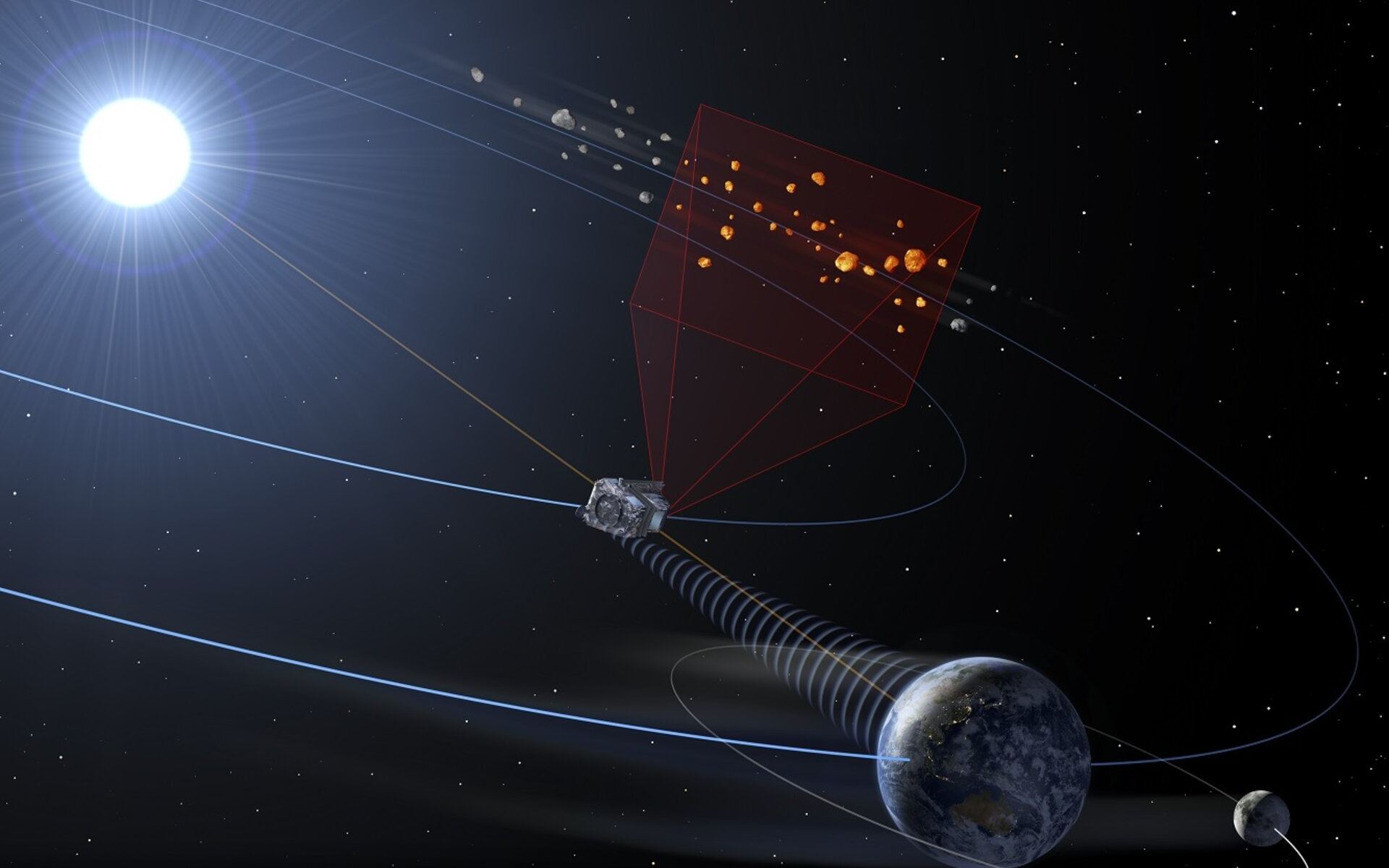
To bypass such problems, the European Space Agency plans to deploy NEOMIR, the Near-Earth Object Mission in the Infra-Red, a spacecraft carrying a compact telescope and placed at the L1 Lagrange point between Earth and the Sun (where the gravitational attraction of the two essentially “cancel each other out”, making it easier for a craft occupying the region to maintain its position). From here, Earth and the space around it would be in perpetual sunlight and the Sun would be “behind” the satellite, meaning that any objects in orbit around Earth or passing close to it will also be warmed by the Sun (and so visible in the infra-red), whilst sunlight would not be able to “blind” the satellite’s ability to see them.

An artist’s impression of NEOMIR occupying the Sun-Earth L1 position as it observe the space around Earth for potential near-Earth asteroids which may pose a threat. Credit: ESA

The half-metre telescope carried by NEOMIR will be able to identify asteroids as small as 20m in size, and would generally be able to provide a minimum of 3 weeks notice of a potential impact with Earth’s atmosphere for objects of that size (although under very specific edge-cases the warning could be as little as 3 days), with significantly longer periods of warning for larger objects.

Currently, NEOMIR is in the design review phase, and if all goes well, it will be launched in 2030. In doing so, it will help plug a “gap” in plans to address the threat of NEO collisions with Earth: NASA’s NEO Surveyor mission, planned for launch in 2026, will also operate from the L1 position – but is only designed to spot and track objects in excess of 140m in diameter. Thus, NEOMIR and NEO Surveyor will between them provide more complete coverage.

At the same time as an update on NEOMIR’s development was made, China announced construction of its Earth-based Fuyan (“faceted eye”, but generally referred to as the “China Compound Eye”) radar system for detecting potential asteroid threats is entering a new phase of development.

The first phase of the system – comprising four purpose-built 16m diameter radar dishes – was completed in December 2022 within the Chongqing district of south-west China. Since then, the system has been pinging signals off of the Moon to verify the  system and its key technologies.

Two of the Fuyan 16m radar dishes on test in China, December 2022. Credit: CGTN

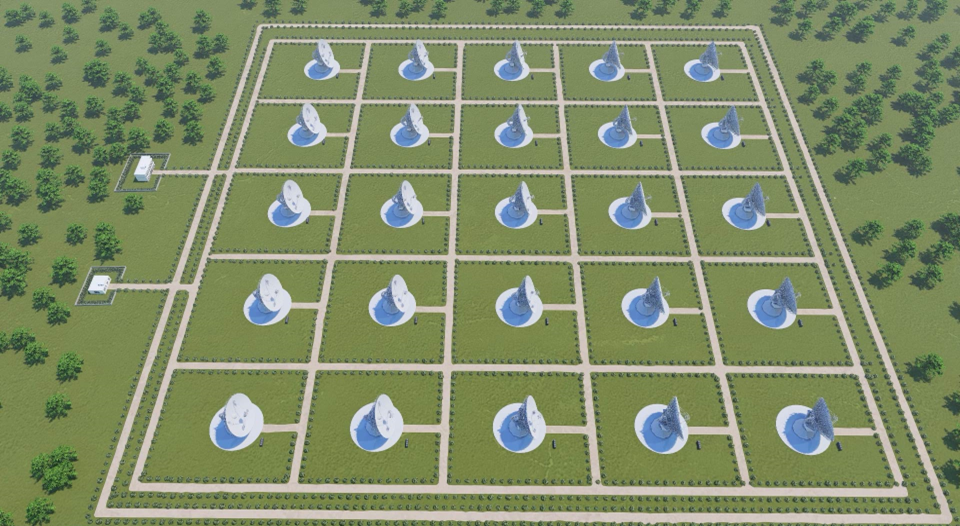
The new phase of work will see the construction of 25 radar dishes of 30m diameter, arranged in a grid. When they enter service in 2025, they will work in concert to try to detect asteroids from around 20-30m across at distances of up to 10 million km from Earth, determining their orbit, composition, rotational speed, and calculate possible deflections required to ensure any on a collision course with Earth do not actually strike the atmosphere.

As this second phase of Fuyan is commissioned, a third phase of the network will be constructed to extend detection range out to 150 million km beyond Earth. At the same time, China is planning to run its own asteroid deflection test similar to the NASA Double Asteroid Redirection Test mission, although the precise timeline for this mission is not clear.

An artist’s impression of the Fuyan grid of 25 radar units due to commence operations in 2025. Credit: CGTN

In the meantime, 2023 CX1 was of the common type of near-Earth asteroids to regularly strike Earth’s atmosphere (at the rate of one impact every other week). It was discovered by Hungarian astronomer Krisztián Sárneczky, at Konkoly Observatory’s Piszkéstető Station within the Mátra Mountains, less than 7 hours before impact.

At the time of its discovery it was 233,000 km from Earth (some 60% of the average distance between Earth and the Moon), and travelling at a velocity 9 km per second. It took Sárneczky a further hour to confirm it would collide with Earth, marking 2023 CX1 as only the 7th asteroid determined to be on a collision with Earth prior to its actual impact.

A graphic showing data on dangerous asteroids as of 2020. Credit: ESA Planetary Defence Office

The object – at that time still designated Star2667 – was tracked by multiple centres following Sárneczky’s initial alert, allowing for its potential entry into and passage through the upper atmosphere to be identified as being along the line of the English Channel, close to the coast of Normandy. It was successfully tracked until it entered Earth’s shadow at around 02:50 UTC on February 13th, just 9 minutes before it entered the upper atmosphere

As both the media and public were alerted to the asteroid’s approach, it’s demise was caught on camera from both sides of the English channel. It entered the atmosphere at 14.5 km/s at an inclination 40–50° relative to the vertical. As atmospheric drag increased, it started to burn up at an altitude of 89 km, becoming a visible meteor. At 29 km altitude it started to fragment, completely breaking apart at 28 km altitude as a bright flash as its fragments vaporised, finally vanishing from view at 20 km altitude, although meteorites fell to Earth in a strewn field spanning Dieppe to Doudeville on the French coast, sparking a hunt for fragments to enable characterisation of the object.

At the time of flash-fragmentation, the object released sufficient kinetic energy to generate a shock wave which was heard by people along the French coast closest to the path of the meteor and recorded by French seismographs.

Following its impact, study of 2023 CX1 s orbital track revealed it to be an Apollo-type asteroid, crossing the orbits of Earth and Mars whilst orbiting the Sun at an average distance of 1.63 AU with a period 2.08 years. It last reached perihelion on 13th February 2021, ad would have done so again on March 15th, 2023 had it not swung into a collision path with Earth in the interim.

Continue reading “Space Sunday: asteroid impacts; ISS update”

A walk through Ely’s Grand Garden in Second Life

Grand Garden, February 2023 – click any image for full size

Elyjia Baxton has a long association with regions designs in Second Life, be it those of her own, or created in collaboration with others or on behalf of others, many of which I’ve covered in these pages. So when she invited me to hop along and visit her latest work, it quickly went up towards the top of my list of places to visit.

Grand Garden, February 2023

Ely’s Grand Garden is a public space Elyjia has designed on behalf of R&G Estates. Located within Nautilus, it presents an opportunity to wander along gravel paths, view the houses offered for rent on either side and make your way through parts of the broader R&G Estate within the region – and even find your way to Ely’s own studio.

At the Grand Garden in Salerio you will find twelve intimate waterfront locations surrounded by gardens, three grand gardens to admire and walk in peaceful nature alone or with friends, one playground, and a rezzer station for boats. It is an enchanting place near the Blake Sea. Take a walk in the gardens, relax, and have fun.

– Grand Garden Destination Guide entry

Grand Garden, February 2023

The landing point sits towards the middle of the region in which the park sits, alongside one of the public pavilions within the gardens. From here the paths run in several directions, with the main one running north to hop back and forth over the stream to reach a broader waterway cutting into the region, crossed by a broad wooden bridge.

North of this, the path continues between a further stream on one side and a large natural pool on the other, fed by falls dropping from the curtain walls of rock which border the gardens here on two sides. A second path switchbacks away from the pavilion sitting alongside the pool and the channel bridge, paralleling the channel as it cuts deeper into the region.

Grand Garden, February 2023

To avoid trespass, the rental houses are set back from the public footpaths, their parcels generally marked by fences if they connect directly to the gardens, with a gate to provide renters with access to the gardens if they want.

With places to sit: benches, chairs and tables, a rowing boat rocking on the pond – while waterfowl fly overhead and rest on rocks, foxes wander the paths whilst a gentle soundscape of flow water from the streams and bird song filling the air. All of which makes for an engaging and relaxing visit.

Grand Garden, February 2023

SLurl Details