Reality Escape, January 2026 – click any image for full size
With the start of a new year, I thought I’d take a trip to one of my favourite SL settings: Reality Escape, the Full private region held by Tripty (triptychlysl).
It’s a place I’ve appreciated over the years both for the way each iteration presents something new to appreciate whilst each carries forward motifs from Tripty’s original Books, Coffee and Chairs, Oh My! which I’d visited in 2023. I’ve been back some four times since then, and Reality Escape have never failed to feel like a safe and welcoming retreat.
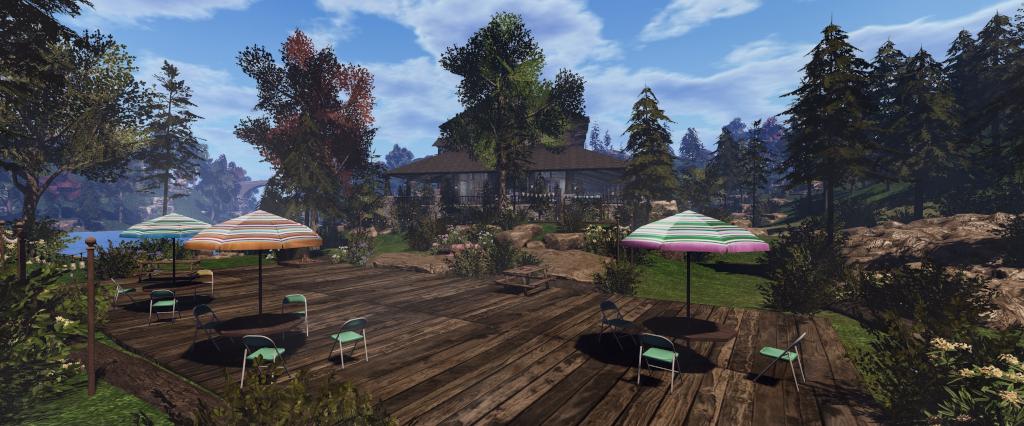
Reality Escape, January 2026For this iteration, the Landing Point sits in the south-western corner of the setting’s main island, where Tripty’s familiar greetings are etched into the boards of the Landing Point decking and can be seen on the sign facing the deck. The latter is a greeting I always find raises a smile – You Are About to Enter Someone Else’s Dream -, and which is joined by another: Blame it on My Gipsy Soul, a sentiment I can fully appreciate for the wanderlust it evokes.
From here, three routes of exploration present themselves to new arrivals. Two take the form of raised wooden walkways and the third a hop over a very narrow channel to a flat, grassy island, home to a bench “borrowed” from a waiting room. The first of the two walkways runs along the southern shore of the the island to the Reality Escape Coffee Shop, whilst the second winds northwards and turns a little inland to arrive at the Reality Escape reading nook.
Reality Escape, January 2026
The Coffee Shop is an open-air affair marked by Tripty’s familiar chair sculptures, the place made cosy by the ivy-hung trelliswork extending out from the cliff and ancient wall adjoining it at a right angle.
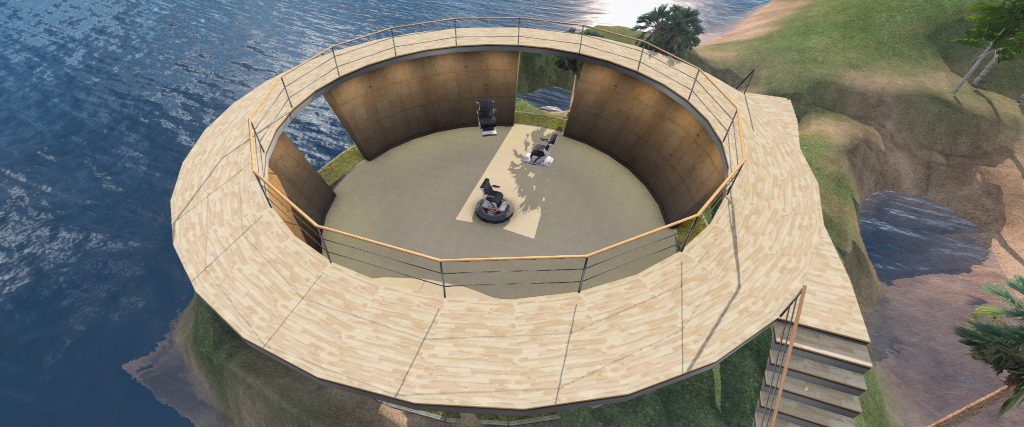
Another walkway here offers a route to the shingles close to the island’s edge and offering a further route onwards, watched over by the island’s Siamese ruler, sitting in his rather novel throne. Beyond the shingle, under an archway of chairs, the walkway continues up the island’s east coast. As it does so, it passes a summer house of unusual design offering a place of retreat.
Reality Escape, January 2026
For those who prefer to stay on the shingle path, this points the way – with the aid of stepping stones – to the crooked finger of another island as it points south and east, wooden decking running over the grass and around a firepit, offering another place for friends to gather.
The walk to the island’s bookshop also offers a way to a raised deck built out over the water, and guarded to one side by a further trellis line of Ivy, whilst below it sits something of a damp orchard. Up the hill, the reading nook is really more of an old tram repurposed as a place to enjoy books, perhaps in the Lewis Carroll-esque garden sitting behind the tram.
Reality Escape, January 2026
Beyond this, the walkway loops around westward to link-up with the route running on from the summer house. As it does so, steps lead down to a grass trail, a little muddy and wet in places, running out to north-pointing, low-lying headland. beyond an arch formed by an aged tree trunk, the path is bordered by candle-lit snowdrops as they form a candle-lit fairy spiral. Beyond these, another raised deck awaits, two pontoon rafts tethered to it. The latter perhaps invite people to take a dip in the water as they are watched over by a rather large goldfish enjoying the shade of a bunta tree which adds its own little sci-fi twist to the setting.
Tripty’s Reality Escape designs always presents setting rich in detail, and this version is no exception. There is much to be found and appreciated throughout – more than I’ve covered here (such as a little island hithertofore unmentioned in this piece and the various animals and wildfowl waiting to be found).
Reality Escape, January 2026
When exploring, I would recommend sticking with the region’s shared environment – although, as again is the case with Tripty’s work, the region does work very well with many other environment settings. Also, do make sure you have local sounds enabled for the fullest experience.
New Year 2026 will get off to a musical start in Second Life with the opening of the month-long Hippiestock festival on January 1st. Originally a day-long music event founded by Hippie Bowman as a way to for him connect directly with friends he’d made through the Second Life forums, the event has grown over the years to allow music fans from across Second Life to come together fun and music and to embrace the “hippie philosophy”, once described by Hippie himself as:
[A belief] in peace as the way to resolve differences among peoples, ideologies and religions. The way to peace is through love and tolerance. Loving means accepting others as they are, giving them freedom to express themselves and not judging them based on appearances. This is the core of the hippie philosophy.
– Hippie Bowman, January 2011
For 2026, Hippiestock will be taking place throughout January within an immersive Flower Power themed region created by CK Ballyhoo, with music and live events coordinated by Owl Dragonash. Key activities throughout the festival include:
General Events
Tuesday DJs:
January 6th: – Dinky Day with DJ Zed at 10:00 and Uli Jansma at 12:00 noon.
January 13th: 10:00 – DJ Samum (10:00); 12 noon – LiTo DJ Team.
January 20th: 11:00 – Ari’s Piano Set; 12:00 noon – DJ Holocluck.
January 27th: 10:00 – DJ Marnie Morningstar; 12:00 noon – DJ Jeff Randall.
Wednesday Live performances:
January 7th: 12:00 noon – Lluis Indigo; 13:00 – Ed Lowell.
January 14th: 12:00 noon – Ronnie Mayes; 13:00 – Laidback Celt.
January 21st: 11:00 – Mark Taylor; 12:00 noon – Mr Wobbit.
January 28th: 11:00 – Joe Paravane; 12:00 noon – Lluis Indigo
Drum circles and social gatherings throughout the festival.
Hippiestock 2025
Special Events
Thursday, January 15th – Feed A Smile Day in support of Live and Learn Kenya. Featuring:
11:00 – Steve Who.
12:00 noon – Mavenn.
13:00 – Bsukmet.
Saturday, January 17th – Hippestock LIVE! Featuring:
09:00 – Hippie Bowman.
10:00 – Alsund.
11:00 – Lluis Indigo.
12:00 noon – Joe Paravane.
13:00 – Shannon Oherlihy.
14:00 – Jed Luckless.
Thursday, January 29th, 12:00-14:00 – Flower Power with DJ Anna Butterfly.
So for some great music and the chance to peace out, why not slip into something suitably flowing and emblematic of the ’60s, put some flowers in your hair and join the Hippiestock fun throughout January?
Wednesday, December 31st 2025 will once again see Bay City celebrate the turning of the year with their annual Prim Drop festivities.
An outdoor, formal dress event, the Prim Drop is open to all Second Life residents, with festivities opening at 23:00 SLT at the Bay City Fairgrounds in North Channel. Marianne McCann will be providing the music and fireworks in a 2-hour extended DJ set, and food and drink will be provided.
This will also be the final opportunity for 2025 to donate to Child’s Play Charity, a US 501c3 non-profit organisation which helps seriously ill children around the globe during their hospital stays with the purchase of games and gaming equipment. So even if you can’t make it to the event itself, do please consider taking a couple of minutes out of your SL day and stopping by the Bay City Fairgrounds and making a donation via one of the collection bins there.
About Bay City and the Bay City Alliance
Bay City is a mainland community, developed by Linden Lab® and home to the Bay City Alliance. The Bay City Alliance was founded in 2008 to promote the Bay City regions of Second Life and provide a venue for Bay City Residents and other interested parties to socialize and network. It is now the largest group for Residents of Bay City.
An artist’s impression of India’s Bharatiya Antriksh Station (BAS), on-orbit assembly of which is targeted to commence in 2028
In my previous Space Sunday piece, I covered the appointment of Jared Isaacman as the new NASA Administrator and the fact that on the day of his appointment, he was effectively given a new set of high priority tasks by the White House. Among these was an order to oversee the decommissioning of the International Space Station (ISS) in 2030, and to move US low-Earth orbit space operations over to the private sector.
The Decommissioning of the ISS is not new – in fact, it was originally intended to only be in operation through until 2015, but such is the success of the mission that it has been periodically extended by mutual agreement of the supporting partners – notably the US, the European Space Agency and Canada, all of who form the nucleus of the International section of the station (officially referred to as the US Orbital Segment, or USOS), together with Russia, operating the Russian Orbital Segment (ROS).
Despite this success, Russia actually started planning to depart the ISS in 2009, when it indicated it would separate the ROS from the ISS in 2016(ish) and use the modules to establish the Orbital Piloted Assembly and Experiment Complex (OPSEK), a new station intended to become the “gateway” to Russian crewed missions to the Moon and beyond. But with the agreements reached to extend ISS operations beyond 2015 and then beyond 2020, Russia opt to push the OPSEK idea to one side, seeing more advantage in remaining part of the ISS programme.
This changed in 2021, when negotiations commenced to extend ISS operations beyond 2024. Roscosmos was initially unhappy about any extension beyond 2024, citing concerns that several of their ISS modules would be approaching their end of life. Whilst a semi-agreement was reached by the majority of parties to see the ISS remain operational until at least 2028, Roscosmos would only commit to the agreed 2024 end-date, stating that Russia would exit the programme some time thereafter. This was an ambiguous statement at best, given that departing the ISS agreement “after 2024” could be taken to mean Russia would remain engaged until 2028 or even 2030 – or could simply announce its intention to pull out at any time in between, simply giving the minimum 12-month notice required of the partnership agreement.
Instead of formally agreeing to stay with the ISS through until at least 2028, Roscosmos indicated that from 2022 onwards, it would start to pivot towards its own new space station, Rossiyskaya orbital’naya stantsiya (or ROS – which, in order to avoid confusion with the existing ROS at the International Space Station, is generally referred to as ROSS: the Russian Orbital Service Station). Under the initial plan put forward, ROSS was to be established in a polar, Sun-synchronous orbit (allowing it to observe the entire surface of the Earth), and would comprise an initial two modules Russia had been developing for the ISS – NEM-1 and NEM-2.
A model of Russia’s proposed Russian Orbital Service Station (ROSS), also called Rossiyskaya orbital’naya stantsiya (ROS), as displayed at the 2022 Armiya International Military-Technical Forum. Note the next generation crew vehicle docked with the station (foreground): the design is remarkably similar to that for India’s Gaganyaan crewed vehicle and China’s Mengzhou next generation crew vehicle.
Under this plane, rather than going to the ISS in 2024 and 2025 respectively, the NEM modules would be repurposed, NEM-1 becoming the Universal Node Module (UNM) at the heart of the new station to be launched in 2027. NEM-2 would then become the Base Module (BM) for expanding the station, with a planned launch in 2028. Further brand-new modules would then be added periodically through until 2035.
However, those plans have now changed again. Whilst the repurposing of the former NEM modules continues and their launch dates remain broadly unchanged, on December 17th, 2025, it was announced that Roscosmos plan to detach their ROS modules from the ISS in 2030 and use them to help form the new ROSS facility, which would now occupy a 51.6º orbit (i.e. one on a par with the ISS, as attempting to move the Russian modules into a high inclination orbit isn’t really feasible).
The Russian Orbital Segment (ROS) of the ISS. Credit: Russianspaceweb.com
The announcement – made by Oleg Orlov, Director of the Institute of Biomedical Problems at the Russian Academy of Sciences (RAS) rather than by Roscosmos – is something of a surprise. As noted, several of the Russian ISS modules are either approaching or have surpassed their planned lifespan (what Roscosmos refers to as their “warranty period”).
Of the major modules, Zarya (the first module of the ISS to be launched and the module directly connecting to the USOS segment of the ISS) commenced construction in 1994 with completion in 1998, and thus will hit 30 years in 2028; Zvezda, the functional core of the Russian segment of the ISS is even older, having initially been laid down in 1985 as a part of the never-flown “Mir-2” space station. It has also, since 2019, been subject to on-going air leaks likely the result of failing welds within a part of its structure.
Nauka is similar to Zvezda in that its core frame was laid down in the mid-1980s, only for work to the halted for a time and the resumed in the 1990s when it was re-purposed to be the back-up for Zarya, prior to work halting again. Thus, whilst it is the most recent of the large modules to be added to the Russian segment of ISS (2021), it is in part one of the oldest at 30 years. Only the three smaller modules, Rassvet, Prichal and Poisk will have reasonable lifespans after they separate from the ISS.
A further concern in the “recycling” of the current ROS modules as a part of any new station is that of contamination. Orlov himself raised concerns over the potential health risks for cosmonauts using the ROS modules in 2022, after it was found that bacteria and fungi had successfully made themselves at home within some of the modules and have proven particularly hard to eradicate.
Speculation is that the move back to continuing to use the ROS elements of the ISS within the new Russian space station despite the risks involved has been driven by economic factors – the cost of the invasion of Ukraine, the impact of western sanctions, and diminishing resources. First Deputy Prime Minister Denis Manturov, when indirectly commenting on Russian space ambitions, indicated the decision to move the new station to 51.6º orbit and use the ISS elements was the result of both economic factors and the fact that operating a station at such an inclination would help facilitate co-operative research between ROSS and the upcoming Indian space station which will occupy a similar orbital inclination, making both stations equally accessible to launches from either nation.
Exactly where all this might lead is still open for debate; critique over the proposed re-use of the ROS elements of the ISS is currently garnering as much concern from inside Russia as it is from the wider international community. As such, exactly if and how ROSS will develop remains to be seen.
And yes, India is also getting in on the space station act, despite never having domestically flown anyone to orbit – yet.
A full-scale mock-up of the core module for India’s Bharatiya Antariksh Station, arriving in New Delhi to form a part of the exhibition displays for India’s National Space Day, August 2025. Credit: ISRO via ANI
The Bharatiya Antriksh Station (BAS) forms a core part of an ambitious and aggressive drive by India to become a major space power, with the country developing plans for an expanding presence in space extending out to 2047. Part of this involves engaging in partnerships and agreements with other major space players – notably the European Space Agency (ESA), NASA and Roscosmos.
However, India is also already well advanced in its development of a human-rated launch capability, with its Gaganyaan (“celestial craft”) crew vehicle and service module due to make its first uncrewed orbital flight in January 2026. Two further uncrewed test flights planned for 2026 prior to a first crewed orbital flight in 2027.
Capable of flying a crew of up to 3, Gaganyaan carries certain similarities to both the upcoming Russian next generation crew capsule and that of China’s in-development new crew vehicle. It is highly automated and capable of independent on-orbit operations of up to seven days duration, and it will be used to ferry crews to / from the upcoming BAS.
India’s Gaganyaan crewed vehicle (sans solar arrays) and its HLV3M launch vehicle. The latter is a crew-rated evolution of the country’s medium-lift Launch Vehicle Mark-3 (LVM3), with a 10-tonne to LEO payload capability. Credit: ISRO
On-orbit assembly of BAS is due to commence in 2028 with the launch of the first module, currently referred to as “Phase-1”. Details of the completed station’s design and appearance are scant, but modules will be launched using India’s LVM3 medium-lift launch vehicle, suggesting they will all not exceed 10 tonnes in mass and thus marking them as slightly smaller than the core modules of the international segment of the ISS. What is known indicates that BAS will likely comprise 5 main modules, including a multiple docking facility, and when complete, mass around 50-55 tonnes orbiting in a 51.4º inclination orbit at an altitude of 400-450km. The size of the station at five core modules suggests it will have an overall pressurised volume of about 260m³, of which roughly 105m³ will be habitable space (the rest being taken up by life support and other essential systems). This would make the completed BAS facility slightly smaller than the current size of China’s Tiangong station.
Not that a lack of size accounts for anything – simply constructing, launching, assembling and operating its own independent orbital facility, capable of supporting 3 or 4 people in relative comfort (and 6 at a squeeze for short periods) would be a truly significant achievement for India. One which would further boost the country to the forefront of dedicated international space research.
Which brings us to China and Tiangong.
A rendering of China’s Tiangong space station showing a Shenzhou crew vehicle docked at the Tianhe module (foreground), an next generation Mengzhou crew vehicle attached to the nadir port on the main docking module and on of the massive Tianzhou automated resupply vessels mated to dock adapter’s rear port (relative to the image). Credit: CMSA
With their space station now well established, China is again indicating a potential further expansion to Tiangong. Originally announced in 2023, the expansion now appears to be going ahead, the plan being to add up to three further modules – a new core habitat module (essentially an updated version of the current Tianhe core module with a new multi-port docking module) plus two improved versions of the physically near-identical Wentian and Mengtian science modules.
The new modules will provide increased living and working space allowing for expanded crews on the station, with the science modules including 3D printing capabilities, improved robotic arms and external experiment bays, with crew supported in their work by robot systems. A new suite of equipment intended for space debris observation, detection and potential collision warning will also be included within the updated core module, underscoring the increasing risk to spacecraft operating in low Earth orbit being exposed to space debris collisions – a lesson the Chinese recently learned with Shenzhou 20.
To further enhance Tiangong’s importance, China has been developing international partnerships to carry out joint research into a range of areas (including human medicine and health) with multiple nations. These cooperative ventures include both Russia and India, and until political and financial tensions ended it, the European Space Agency was forming a collaboration with China that would have seen European astronauts training with Chinese tiakonauts and completing crew rotations on Tiangong.
A computer-generated rendering of the expanded Tiangong space station, showing the existing modules – Tinahe, Mengtian and Wentian with a Tianzhou resupply vehicle docked at the Tianhe module, and the proposed new modules (top of image) as they will likely be attached to the station. Additional solar arrays for power may also be added by means of booms attached to the outer ends of Mengtian and Wentian. Credit: CMSA, annotations by I.Pey.
No time frame has been given as year for the launch of the plan new modules for the Chinese station; the focus right now is in lifting the Xuntian space telescope into orbit.
This state-of-the-art observatory will co-orbit with Tiangong and be capable of periodic automated docking with the station to allow for maintenance and update. Xuntian will have a 2-metre diameter primary mirror (compared to the 2.4 metre diameter primary mirrors on the Hubble Space Telescope and the upcoming Nancy Grace Roman telescope), coupled to a 2.5 gixapixel camera to give it a field of view 300-350 times greater than Hubble and with a higher resolution.
A model of the Xuntian space telescope showing it in launch configuration with its solar panels folded against the main hull and the primary mirror door (at the far end of the model) closed. Visible at the foreground end of the model is the docking adapter that will allow the observatory to attach itself to the Tiangong space station for servicing and repair operations by Tiangong’s crew. Credit: CMSA
Also known as the CSST – Chinese Space Station Telescope – Xuntian is so advanced it has faced several delays in its launch whilst issues were resolved. Originally, it had been planned to lift the observatory to orbit at the end of 2023, this date was first pushed back into 2024 and then to mid-2025. Currently, China is targeting an end-of-2026 launch for Xuntian, after which the focus will switch more to Tiangong’s expansion.
In addition, and further underscoring China’s longer-term intentions in orbit and beyond, 2026 should see the first uncrewed launch of Mengzhou, the country’s next generation crew-carrying vehicle. Capable of carrying up to 6 (or a crew of 3 + a half tonne of supplies), Mengzhou is to form the backbone of Chinese human space activities through the 2020s and 2030s, serving as both a crew transportation vehicle between Earth and Tiangong and as the principle means of ferrying crews to / from lunar orbit as China seeks to establish a presence there.
Also on the horizon for Tiangong is a new automated resupply vehicle. Called Qingzhou, it is intended to operate alongside China’s existing Tianzhou resupply craft, but provide a lower-cost alternative for delivering small loads (around 2 tonnes) to Tiangong quickly and easily. A focus of this will be in the delivery of food and water supplies for crews on the station, including fresh produce which can be stored in a 300-litre capacity “cold chain” food store. As with Mengzhou, the compact resupply vehicle, roughly 5 metres long and 3 metres in diameter, is expected to make an initial test flight in 2026. Further, once operational, Qingzhou will be offered commercially as a cargo delivery service to other space station facilities including both BAS and ROSS.
A scale model of China’s next generation Mengtian crew vehicle (l) and a full-scale mock-up of the new Qingzhou resupply vehicle. Both are expected to undergo orbital flight tests in 2026. Credit: various
As noted in my previous Space Sunday article, the United States has no plans to operate any fully government-funded space station in Earth orbit once the ISS is decommissioned. Instead, it is looking to the private sector to take up the challenge. While there are several in-development private sector space station proposal in development, all of which are seeking partial US government funding, whether any / all of them will offer the kind of space-based research facilities as offered by the ISS is questionable. As is the question as to which of them will actually fly.
For example, two of the leading contenders in the race to develop a private sector space station are a consortium led by Blue Origin (Orbital Reef), and a solo venture by Axiom Space (Axiom Station). However, despite chasing further NASA funding under the LEO Destinations Programme, both of these stations would appear to be primarily focused on the (potentially lucrative) space tourism business, boasting facilities such as private suites with views of Earth, high-definition audio systems, “mood enhancing LED lighting throughout”, cosy, soft fabric coverings for interior walls, and other creature-comforts.
Another seeker of NASA funding is Vast, a company trying to establish two facilities in orbit. The first is a single module station called Haven 1, intended to be launched some time in mid-2026. More of a proof-of-concept than practical orbital facility, the company plans to follow Haven 1 with Haven 2, starting in 2028.
This is a far more ambitious undertaking, intended to expand from a single module in 2028 to a total of nine by 2032, new modules being added at roughly 6 month intervals. However, whilst billed as a successor to the ISS and capable of EVAs and other activities, and of providing “10 external payload facilities, allowing scientific research, development, and manufacturing to take place outside the station”, the exact science capabilities for Haven 2 have not been publicly released.
Vast’s proposed Haven 2 space station in it 2032 completed configuration. Credit: Vast
A small-scale technology demonstrator, Haven Demo, intended to test the propulsion, flight computers and navigation software to be used on Haven 1 and Haven 2 was successfully launched by SpaceX (who will provide all launch capabilities for the Vast projects, including crew transportation using Crew Dragon, together with communications via the Starlink network), so it will be interesting to see what data this returns and whether or not Vast can meet their mid-2026 launch target for Haven 1.
One further project I’ll mention here is Starlab, a joint venture between Voyager Technologies in the US and Europe’s Airbus Defence and Space. This potentially has the firmest footing in space research and science, as is intended to comprise two 8 metre by 8 metre modules (that is, twice the diameter of the modules in the international segment of the ISS) in which up to 400 experiments per year can be performed, putting it on a par with the ISS. However, the entire project is currently dependent on the SpaceX Starship vehicle as its launcher. Given the overall status of that project (which is well behind its promised schedule, and apparently solely focused on being a Starlink delivery system if / when it does start proving it can reach orbit carrying a decent payload and be successfully reused) the proposed late-2028 launch target for Starlab could be best defined as “optimistic”.
Thus, on the one side of things, national interests in operating relative large-scale space station facilities – and offering at least some of them (India, China) for international research opportunities – appears to be one the rise, whilst in the US, the emphasis is on turning LEO capabilities for humans over to the private sector wherein revenue, margins and profit are far more motivating than research. As such, it will be interesting as to which plays out better in terms of on-going space-based R&D – and which facilities actually come to pass.
Natthimmel: The Keepers of Twin Lights, St. Castoris, December 2025 – click any image for full size
Over the last couple of months and for reasons I can’t really explain, I’ve been getting interested in the US and Canadian Great Lakes and parts of their history. Much of this has centred on the role of the lakes in enabling commerce, and the sad tales of vessels such as the Edmund Fitzgerald (perhaps brought to international recognition by songster Gordon Lightfoot, and the loss of which occurred 50 years ago this past November), the Carl D. Bradley and the Daniel J Morrell, to name but three of the largest vessels to go down on the lakes.
I mention this as a roundabout way of introducing the December 2025 Natthimmel build by Konrad (Kaiju Kohime) and Saskia, and which draws inspiration from the shores of Lake Michigan (although not, admittedly, any of the vessel losses which have occurred on Michigan and her sister lakes down the centuries; that was something my little mind just jumped to in visiting the setting, for the reasons noted above).
Natthimmel: The Keepers of Twin Lights, St. Castoris
Entitled The Keepers of Twin Lights, St. Castoris, the region design appears to draw its inspiration from the paired lighthouses of St. Joseph, Michigan, where two very similar lights (now decommissioned) once guarded the entrance to St. Joseph River, some 190 km northeast of Chicago.
The river had long been a trade and transport route linking the Great Lakes with the Mississippi River prior to the arrival of European settlers as they muscled their way westward. However, they established a significant outpost at the mouth of the river at the end of the 1700s, starting a continuous presence there which led to the establishment of St. Joseph village (now city).
Natthimmel: The Keepers of Twin Lights, St. Castoris
The two lighthouses that inspired St Castoris were built in 1906 and 1907. They are very distinctive in terms of both looks and location. Both stand on a long pier extending out into the lake (one of two piers extending out from the mouth of the river), with a raised catwalk running the length of the pier to connect both lighthouses with the land.
The outer lighthouse is of a tapering conical build topped by a distinctive 9-sided lantern room. The inner lighthouse is a little more distinctive: a square lower level with a pyramidal roof rising to an octagonal tower with its own external access via steel dog-leg stair from the pier (and via the catwalk).
Natthimmel: The Keepers of Twin Lights, St. Castoris
Many of these elements are captured in Konrad’s custom models of the lighthouses within St. Castoris; the distinctive similarities (if you’ll forgive the term!) leading me to conclude that St Joseph serves as the inspiration here. Indeed even the frozen water spray hugging the outer tower is mindful of a 2010 snapshot showing much the same.
But again, it’s important to note that even if inspired by the lighthouses at St. Joseph, Saskia and Konrad’s St. Castoris is very much its own place; there is no beach or harbour entrance at what might be the landward end of the setting. Nor do the lighthouses stand on a pier of relatively modern construction, as is the case with St. Joseph.
Natthimmel: The Keepers of Twin Lights, St. Castoris
Instead, St. Castoris’ lighthouses appear to be built upon a long, narrow breakwater formed by earth, boulders and rocks dumped into the water to extend a finger outward, one with enough soil present to allow lines of frosted aspen to march out on either side of the catwalk at least as far as the inner lighthouse. And while the lighthouses of St. Joseph may have been decommissioned in 2005, the lights of St. Castoris remain active, sweeping out towards the horizon, twin beacons indicating the safety of land, while much smaller buoys cast the red glow of warning against vessels coming too close in error to the more dangerous shores and ice floes lurking there.
It is to one vessel in particular that the lighthouses call, and the story of that vessel and its master can be found in the setting’s introductory notecard available at the Landing Point, as always. This offers further insight to St. Castoris, and carries with it the faint suggestion that within its narrative, the story refers to an earlier age whilst also offering a subtle hint as to the wayward nature of the weather over the Great Lakes during the winter months.
Natthimmel: The Keepers of Twin Lights, St. Castoris
As always with Natthimmel, Konrad and Saskia have created an engaging setting which sinks its roots into history and the physical world whilst offering its own uniqueness. Look for the places to sit that await discovery and enjoy!
Luane’s World, Winter 2025 – click any image for full size
It has been a fair while since my last visit to Luane’s World, the estate held and operated by LuaneMeo and her publicly-accessible Full region, Le Monde Perdu (The Lost World). It was summertime 2024 when I made that last visit, so with winter now dominating Second Life, a return for a Christmas-time blog post seemed to be in order.
The lake that often forms a part of the region remains with the latest iteration, but is now frozen, offering a place to go skating. Cabins sit to either side of the lake, with the Landing Point on a third side.
Luane’s World, Winter 2025
Taking the form of a winter market where hot drinks and more might be found, the Landing Point sits under an awning of lights. A small deck offers skates for those who wish to head out onto the ice. For those who prefer their skating on a smaller scale, a wooden gazebo sits to one end of the little market with an ice rink under its awnings. It is located alongside a large Ferris wheel waiting to give visitors a ride.
At the opposite end of the market area, a covered bridge allows explorers to continue onwards around the lake-edge trail. This leads past steps climbing to one of two chapels in the setting, this one ready for services and guarded by a cat.
Luane’s World, Winter 2025
Beyond the chapel, the trail winds past one of the two cabins mentioned above, turning away from the lake as it does so before branching. One part of the trail then climbs the setting’s uplands via log steps set into a relatively gentle slope, while the other offers the way to the bridge connecting the region with the rest of the estate, a shrine-like folly looking out over the water close by for those who seek it.
The path along the uplands runs around to the north, passing cabins among the trees there, including the one directly overlooking the lake, and which has a stairway leading down to a deck close to the water’s edge. None of the cabins are private, allowing them to present visitors with places to rest and enjoy company.
Luane’s World, Winter 2025
Continuing westwards, the path ends abruptly at a sheer cliff, the land dropping to a gorge-like valley through which water would normally flow between the lake and the open sea, but now sits frozen. A tall bridge spans the valley to reach the far side, where a snowy path curls up to the setting’s second chapel.
However, this is not a place of worship; it has been converted into a place where beverages of an alcoholic nature might be imbibed and pool played. These probably explain why Santa is circling overhead in his sleigh (and presumably awaiting clearance to land) – after a busy night zipping around the world delivering presents, the old chap justifiably deserves a drink or two! As well as being reached on foot by the path just described, the chapel bar is also connected to the lowlands by a ski lift as it shuffles back and forth between the bar and a spot close to the Ferris wheel.
Luane’s World, Winter 2025
Another path, this one marked marked by footprints and a sign pointing to the North Pole, runs west from the bottom of the ski lift and out to the icy edge of the region (say “hi!” to the little Santas having some fun along the way).
The ice floes are home to dogs having snowball fights or sleeping in igloos. Further around the ice and cliffs, that familiar SL anachronism of polar bears and penguins mixing together can be found; in this case the penguins are having fun with their versions of skating and sledding while the polar bears appear mostly interested in having fun with Christmas lights.
Luane’s World, Winter 2025
Throughout the setting are multiple places to sit and pass the time, watch the skaters on the lake or observe the local wildlife, while the familiar hot air balloon sits overhead awaiting anyone wishing to pose in it. Walks can be had around much of edge of the setting and there are touches of detail waiting to be found – such as the little Santa figures I’ve mentioned.
And of course, the entire region is highly photogenic, so have fun exploring!