A liberating island in Second Life

Moksha, July 2023 – click any image for full size

In Hinduism, the Puruṣārtha are the four goals of life: moral values / righteousness (Dharma); love, psychological values (Kama);  economic values / prosperity (Artha) and spiritual values / liberation (Moksha), and it is the last of these concepts Effy Nova has used for the name of her public Homestead region.

It’s a place I was first alerted to Effy’s Moksha by Shawn Shakespeare (SkinnyNilla) back in May, but have only recently had the opportunity to give it due attention to write about. It takes the broadest meaning of the Hindu term, emancipation, enlightenment and liberation, free from its more religious connotations, to define her region as a place of blissful escape: a place where we can be freed from the worries and demands of daily life and simply relax and enjoy.

Moksha, July 2023

Set as a tropical island, Moksha blends within itself an interesting mix of ideas and themes. The region’s name, the presence of little elephants dressed as might be seen within the Indian sub-continent and a stone carved bust of Shiva, suggest this might be a small island retreat somewhere off the coast of India (or perhaps Sri Lanka); however, the presence of tuka huts in the shallows gives the setting a hint of the Philippines.

Not that there is necessarily a contradiction here; whilst in the minority, the Philippines does have a small Hindu population, while the market boats floating alongside the over-the-water boardwalks suggest both India and the Philippines, thus making the composition of the region an engaging mix of influences which sit well together.

Moksha, July 2023

In terms of its design, the setting might be seen as the remnants of a long-dead and flooded volcanic cone, the crater now given over to a semi-sheltered seawater lagoon, open to the broader ocean on one side, the southern an eastern flanks of the cone withstanding the erosion of sea and windswept salt air to remain as two fairly substantial islands. To the west and south, the crater perhaps hasn’t faired so well, the rock having been largely worn down to sand bars and sea-flattened rocks helping to protect the entrance to the lagoon – all with the exception of one stubborn thumb of rock pointing skywards.

It is on one of the sandbars that the region’s landing point is located. It sits in front of one of the boardwalks extending out over the waters of the lagoon, a footpath offering a route to the five tuka huts as they sit on their stilts over the calm waters as they sit towards the eastern end of the lagoon and the smaller of the two main islands.

Moksha, July 2023

The lagoonside foot of this island offers a further sandy beach; the volcanic rock rising behind it protecting it from the weather, the fertile soil of the steep slopes offering a richness in which monkeypod and palm trees can find growth. The ribbon of beach is home to a little gathering of beach-side business shacks offering food and refreshments, an over-the-water deck offering plenty of room to sit and eat / drink. In a further touch of Hindu influences, Ganesh is available within one of the shacks, which has been turned into an air-conditioned shrine.

The sandbar on which the landing point sits runs back to the largest of the islands as it forms a tall, steep-sided spine of rock. Once again the soil here is rich and deep enough to allow a good growth of palm, monkeypod and honey trees. A single gravel path runs up the slope from the beach to where a house sits among the trees  to overlook the bay. Built largely of bamboo, it is a place which looks as if it would feel as much at home in Bali as here.

Moksha, July 2023

Lying below this on the south side of the island is a smaller outcrop of rock sitting just off-shore and a small headland of sand reached via a gravel path running down from the bamboo house. With little boats moored in the channel between the large and small island, the southern headland is home to a quiet retreat where singles and couples can pass the time.

Life is given to the setting through the use of static NPCs. From a couple catching the sun on a diving raft through a mother putting a protective towel around her daughter after a swim,to people perusing the shrine and beach shacks, these characters help give a sense that this is a holiday retreat, some of them perhaps having been brought to the islands by the catamaran moored just off the western beach.

Moksha, July 2023

Engaging and photogenic – those requiring props can join the local group for rezzing rights – Moksha is an easy-on-the-eyes visit.

SLurl Details

  • Moksha (Simply Heaven, rated Moderate)

Journeying with The Spirits of the Forest in Second Life

New Life Gallery, : Hermes Kondor – The Spirits of the Forest

July 15th saw the opening of The Spirits of the Forest, an exhibition of pieces by Hermes Kondor at the New Life Gallery within the campus of St. Elizabeth’s University.

As a photographer / artist, Hermes is constantly extending his range of approaches and techniques, with a number of his recent exhibitions focusing on the use of AI tools – largely Midjourney, I believe I’m correct in saying – and also on his macro compositional work featuring still life on the smallest of scales. It is for its richness, range and compositional quality that I’ve come to deeply admire and appreciate Hermes’ work, and it is always a pleasure to cover one of his exhibitions in these pages.

New Life Gallery, : Hermes Kondor – The Spirits of the Forest

Comprising 27 images split across the three levels of the gallery – all of which are connected via an elevator rather than stairs – The Spirits of the Forest represents a collection of his more recent explorations with the use of AI generated pieces combined with other digital photographic techniques to offer some marvellously expressive pieces on the theme of “hidden guardians” – spirits, sprites and minor deities once thought to inhabit and protect forests and woodlands.

Such beliefs  – and the worship of trees themselves –  was common among many cultures, east and west, and often linked with ideas of fertility, renewal / rebirth and the cycle of life. The link to fertility tended to lean many such spirits to be personified as female deities in most cultures, although there were male figures among them. Similarly, while most were considered benevolent and giving, some cultures did have more malevolent forest / tree spirits or at least have a number given to a more mischievous nature.

New Life Gallery, : Hermes Kondor – The Spirits of the Forest

Within The Spirits of the Forest, Hermes appears to draw inspiration from the more western traditions of female woodland spirits, stirring in a touch of  what might be fantasy elven leanings. How much of this is by design and how much is the result of the parameters given to his AI software is unclear, but the majority of spirits within the images appear to have strongly western European looks. Not that this is in any way a critique; the figures are not intended to be representative of specific tree deities, they are rather intended to springboard our imaginations into mental narratives on he nature of the spirits and trees featured within them – and possibly more besides.

For me, these deeply expressive images brought to mind a range of thoughts, from reflections on the nature of matriarchal religion and the argument put forward by Robert Graves that, within western European cultures, the multiple beliefs in female deities in all their forms – including those of the forest – are rooted in an ancient belief in a single “mother goddess” whom he called “The White Goddess”. mixed with this came reflections on how common artistic interpretations of the likes of Tolkien’s elves down the decades since the publication of Lord of the Rings may have played a role in how the AI tools producing the base images on which Hermes has built his finished pieces, all the way through to the sheer artistry of the displayed pieces and how each presents a world of mystical beauty which appears to sit just beyond our reach, but is nevertheless fully visible to the imagination.

New Life Gallery, : Hermes Kondor – The Spirits of the Forest

Given such a rich mix of reactions, it should come as no surprise that I thoroughly recommend The Spirits of the Forest as a very worthy visit, forming as it does an exhibition of deeply captivating images  all of which can be appreciated in their own right both as digital art and for their ability to offer a single-frame story, and which collectively can take the mind on a journey of expositional enquiry and thought.

SLurl Details

2023 SL SUG meetings week #29 summary

Luane’s Magical World, May 2023 – blog post

The following notes were taken from the Tuesday, July 18th Simulator User Group (SUG) meeting. They form a summary of the items discussed and is not intended to be a full transcript. A video of the entire meeting is embedded at the end of the article for those wishing to review the meeting in full – my thanks to Pantera for recording it.

Meeting Overview

  • The Simulator User Group (also referred to by its older name of Server User Group) exists to provide an opportunity for discussion about simulator technology, bugs, and feature ideas.
  • These meetings are conducted (as a rule):
  • They are open to anyone with a concern / interest in the above topics, and form one of a series of regular / semi-regular User Group meetings conducted by Linden Lab.
  • Dates and times of all current meetings can be found on the Second Life Public Calendar, and descriptions of meetings are defined on the SL wiki.

Server Deployments

  • On Tuesday, July 18th, 2023, all simhosts on the the SLS Main channel were restarted without any deployment.
  • On Wednesday, July 19th, 2023, the BlueSteel RC channel should be updated with a new simulator version, comprising:
    • llGetPrimitiveParams will be able to identify animesh.
    •  The estate ban limit gets raised to 750, and the number of estate managers to 20 – however, a viewer-side update is required for these changes to be visible.
    • Two new LSL functions for LSD llLinksetDataDeleteFound and llLinksetDataCountFound.
    • Changes to UUID generation on certain items per my week 26 SUG meeting summary (e.g. textures, notecards, materials (particularly the upcoming PBR Materials)) to reduce the amount of duplication. These changes will not impact  UUIDs for objects rezzed in-world or made by the viewer.
    • Further work to correct some of the friends issues (as seen with BUG-232037 “Avatar Online / Offline Status Not Correctly Updating”). However, how effective these updates might be will not be fully understood until the update has been more widely tested through general use on Agni.

Viewer Updates

No updates at the start of the week, leaving the current official viewers in the pipeline as:

General Discussion

  • Core discussion points in the meeting:
    • [Video: 5:57 (start)] A general discussion on the new LSL / LSD functions and associated constants, which widens into a wider discussion on LSL / LSD.
    • [Video: 18:58 (start – overlapping with LSL / LSD discussion)] Discussion on larger regions vs. attempting to fix current region crossing issues. In short: larger regions would be a deep, fundamental change to SL (much of the simulator and viewer code is built on the assumption that regions are sized at 256x256m) which would likely not resolve the overall issue of region crossing events; ergo, the general consensus was towards trying to solve for crossing issues with the current region size. This led to a broader discussion on region sizing, user on-boarding, etc.
    • [Video: 21:22 (start – overlapping with the above)] Questions on throttling glTF overrides on animations (particularly in reference to puppetry).
  • In brief:
    • Confirmation that the ability to allow experiences to access the key-store from anywhere without land permission should be in the next simulator maintenance update.
    • The work to lighten the impact of avatars entering a region (in particular via teleport) impacting region / viewer responsiveness has yet to reach the main grid.

† The header images included in these summaries are not intended to represent anything discussed at the meetings; they are simply here to avoid a repeated image of a rooftop of people every week. They are taken from my list of region visits, with a link to the post for those interested.

An Evergreen visit in Second Life

Evergreen, July 2023 – click any image for full size

Elyjia Baxton sent me an invitation to tour her latest region design which recently opened to the public, and given her past work – often featured in this blog – I was delighted to accept as soon as time allowed.

Evergreen is a Full private region leveraging the land capacity bonus, and held by Karo Camorra (abella74). It has been designed as a public space by Ely to provide, in Karo’s words, a place where people can:

Chat with your friends in the town overlooking the beach, or enjoy a solitary or romantic stroll in the forest or follow the path along the river while taking advantage of the various places to relax in a calm and lush setting, and take some photos.

– Karo Camorra (abella74)

Evergreen, July 2023

The town and beach in question lie to the north-east of the region, the landing point sitting at the top of steps connecting the former with the latter. Extending into the south-eastern quarter of the region, the town is a small, but distinctly European-looking affair, the tall houses  – some with ground level business – are all façades, rather than furnished buildings. However, it offers numerous little places to sit and pass the time, while the steps and path leading down to the beach run between saplings and shrubs before reaching the warm sand. This is guarded by a tall tall wooden watchtower / radio shack, now converted into another cosy hideaway, under which the path runs, but accessed directly from the beach.

The beach also offers various places to sit and pass the time as it runs along the north coast to arrive at stone steps rising to the western side of the main island, passing by way of a raised wooden deck where an artist appears to have taken up shop. The beach is given a sense of popularity courtesy of a schooner apparently passing by in full career just off-region, and two Linden Endurance-class sailing boats moored in the shallows.

Evergreen, July 2023

Prior to reaching the beach, the gravel path almost branches to the left, passing alongside a low wall separating the little town from the land flowing down to the sands. With birch trees lining one side of it and saplings  the other, the latter also providing some shade to the wild growth of flowers sitting between the path and the beach. Narrowing as it reaches the western side of the town, the path meanders its way west, passing by a summer house, a cylindrical folly and a gravel pool, all of which offer places to sit, with the latter linking to a path pointing back eastwards to a gazebo and chaise lounge sit among the wildflowers and overlooking the beach.

As it reaches the summerhouse and folly, the westward-pointing path splits, a rougher trail continuing west to offer the way up to the region’s lighthouse as well as the means to reach what had likely once been a north-western headland.

Evergreen, July 2023

Now separated from the rest of the land by a narrow channel, this former headland has the feel of having been long since deserted; Nature is in command, what had once been a brick-and-wood greenhouse sits abandoned to her claim. This may have once have been a base of operations for the artist who has taken over the wooden deck mentioned above; if so, then perhaps advancing years had caused the artist to foreshorten the walk from town to studio, leaving the latter to its fate in favour of using the deck for their artistic expression.

The path to the western isle also branches prior to reaching the channel separating the headland from the bulk of the region. Pointing south, this passes by a very modern-looking pavilion built over the west coast before branching yet again, one arm looping back to the summer house and folly, the other continuing on through the trees and plants to a little cove cuddling a secluded shack and its dock within its shallow arms, a home for moored rowing boats and deckside rocking chairs.

Evergreen, July 2023

Inland from this shack, the land is split by a stream which descends in a series of low falls from the uplands on which the town sits, to finally turn south and fall into a broad pool which does much to help form the landscape of southern half of the region. In doing so, the stream gives form to a tongue of land running east from the edge of town, caught between the stream to one side and the drop down to the waters below on the other. It is home to a steel-framed conservatory, home to tropical plants within an otherwise temperate setting.

With the waters of the pool and the streams flowing outward from it, the southern side of the region is perhaps the most photogenic. Once again, paths meander around it, starting with the one descending from the town to the south-east. Here, streams flowing out from the pool cut the land into slices and give rise to very natural lowlands which are in equal part rocky, rich in plant life and with plenty of places to sit and pass the time – as well is in which to take photos.

Evergreen, July 2023

The south-eastern corner of the region is dominated by a wooden windmill overlooking the south coast. It is reached via a gravel path which curves south and west from the foot of the steps descending from the town and carried over the gorge of a stream by a covered bridge. After passing the furnished windmill, this path continues onwards to offer the best route of southern exploration.

Following it will take visitors past a pier extending out into a shallow bay (and the home of table-top games which can also be reached from a teleport station near the region’s landing point), and by more places to sit – a riverside covered picnic spot, another folly and an old bandstand – to cross another small stream before curling itself around the large pool mentioned above. It ends in at a little cottage on the east coast.

Evergreen, July 2023

All of which is a long-winded way of saying this is a region worthy of seeing first-hand; there is a lot to see and appreciate – more so than I’ve presented in the last 1,000+ words. Offered under a fairly neutral selection of environmental settings, Evergreen naturally lends itself to a broad range of EEP settings, with opportunities for photography large and small throughout.

Finished with a matching natural soundscape and given a sense of age through the scattered ruins and derelict building awaiting discovery and live via the presence of wild and domestic animal and the furnished cottages and cabins, Evergreen makes for a thoroughly engaging visit.

Evergreen, July 2023

SLurl Details

2023 SL viewer release summaries week #28

Logos representative only and should not be seen as an endorsement / preference / recommendation

Updates from the week through to Sunday, July 16th, 2023

This summary is generally published every Monday, and is a list of SL viewer / client releases (official and TPV) made during the previous week. When reading it, please note:

  • It is based on my Current Viewer Releases Page, a list of all Second Life viewers and clients that are in popular use (and of which I am aware), and which are recognised as adhering to the TPV Policy. This page includes comprehensive links to download pages, blog notes, release notes, etc., as well as links to any / all reviews of specific viewers / clients made within this blog.
  • By its nature, this summary presented here will always be in arrears, please refer to the Current Viewer Release Page for more up-to-date information.
  • Note that for purposes of length, TPV test viewers, preview / beta viewers / nightly builds are generally not recorded in these summaries.

Official LL Viewers

  • Release viewer,  version 6.6.13.580918, formerly the Maintenance T RC viewer, promoted July 14th.
  • Release channel cohorts (please see my notes on manually installing RC viewer versions if you wish to install any release candidate(s) yourself).
    • No updates.
  • Project viewers:
    • No updates.

LL Viewer Resources

Third-party Viewers

V6-style

  • No updates.

V1-style

  • Cool Viewer Stable release updated to version 1.30.2.20 on July 15 – release notes.
  • Genesis viewer updated to version 1.7.880 on July 15 – release notes.

Mobile / Other Clients

  • No updates.

Additional TPV Resources

Related Links

Space Sunday: the Moon, money and the universe

A GSLV variant of India’s LVM-3 expendable medium-lift launch vehicle carrying the Chandrayaan-3 mission lifts off from Satish Dhawan Space Centre on July 14th, 2023. Credit: ISRO/You Tube

India has finally launched its third lunar exploration mission, Chandrayaan-3, after a series of delays pushed it back from a November 2020 target to August 2022 (thanks largely to the COVID pandemic), and then back to July 2023. Part of an ambitious programme initiated by the Indian Space Research Organisation to join in international efforts to explore the Moon (under the umbrella name of Chandrayaan – “Moon Craft” – initiated in 2003), the mission is also the result of an earlier failure within the Chandrayaan programme.

The first mission – Chandrayaan-1 – delivered a small orbiter to the Moon in 2008. It scored an immediate success for ISRO, when a lunar penetrator fired into the Moon’s surface by the orbiter confirmed the existence of water molecules trapped within the lunar sub-surface, whilst the orbiter did much to profile the nature of the Moon’s almost non-existent atmosphere.

In 2019, ISRO launched Chandrayaan-2, comprising an orbiter, a lander (Vikram,  named after cosmic ray scientist Vikram Sarabhai, regarded as the founder of India’s space programme), and a small rover called Pragyan (“Wisdom”).

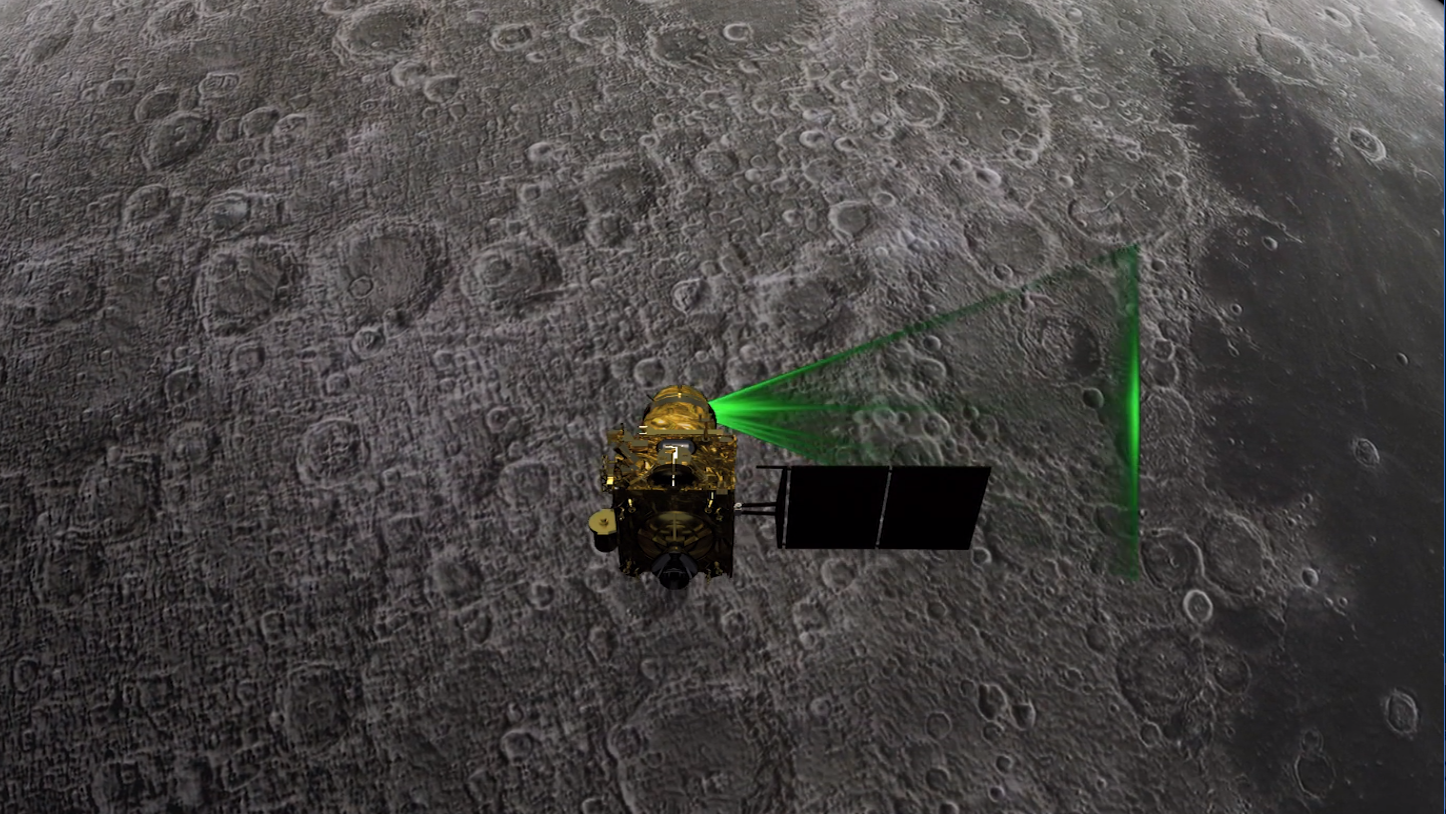
An artist’s impression of the Chandrayaan-2 orbiter studying the lunar surface. Credit: ISRO

The orbiter is currently approaching the end of its fourth year of continuous lunar operations out of a planned 7.5-year primary mission. However, following a successful separation from the orbiter in September 2019, the Vikram lander deviated from its intended trajectory starting at 2.1 km altitude, eventually crashing onto the Moon’s surface, destroying itself and the rover, apparently the result of a software glitch.

Originally, that mission was to have been followed in 2025 by Chandrayaan-3, part of a joint mission with Japan and referred to as the Lunar Polar Exploration Mission. However, following the loss of the Chandrayaan-2 lander and rover – both of which were also testbeds for technologies to be used in 2025 -, ISRO decided to re-designate that project internally as Chandrayaan-4, and announce a new Chandrayaan-3 mission to replicate the lander / rover element of Chandrayaan-2 mission.

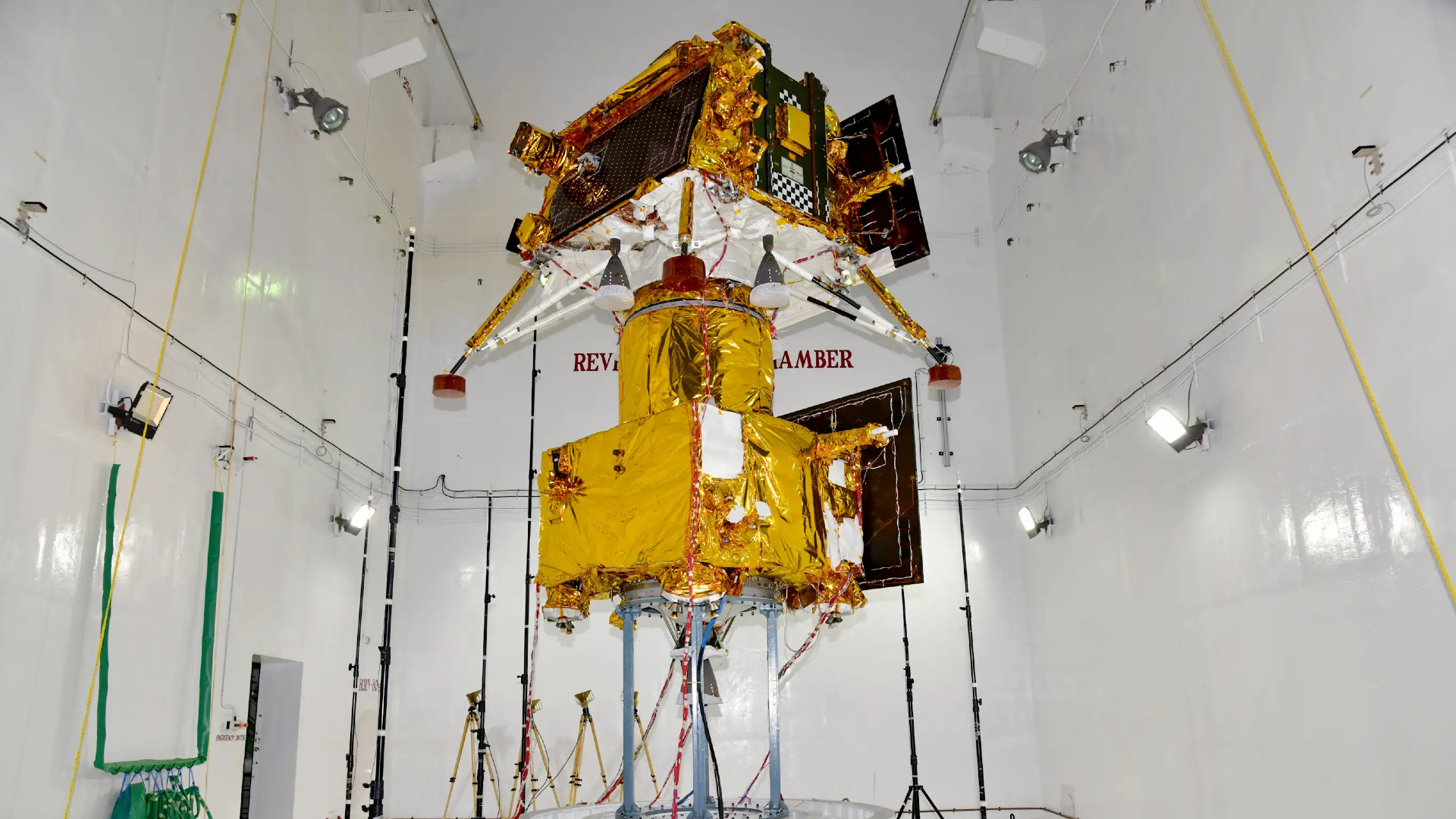
The Chandrayaan-3 Vikram lander mounted on its propulsion module during acoustic testing by ISRO. Credit: ISRO

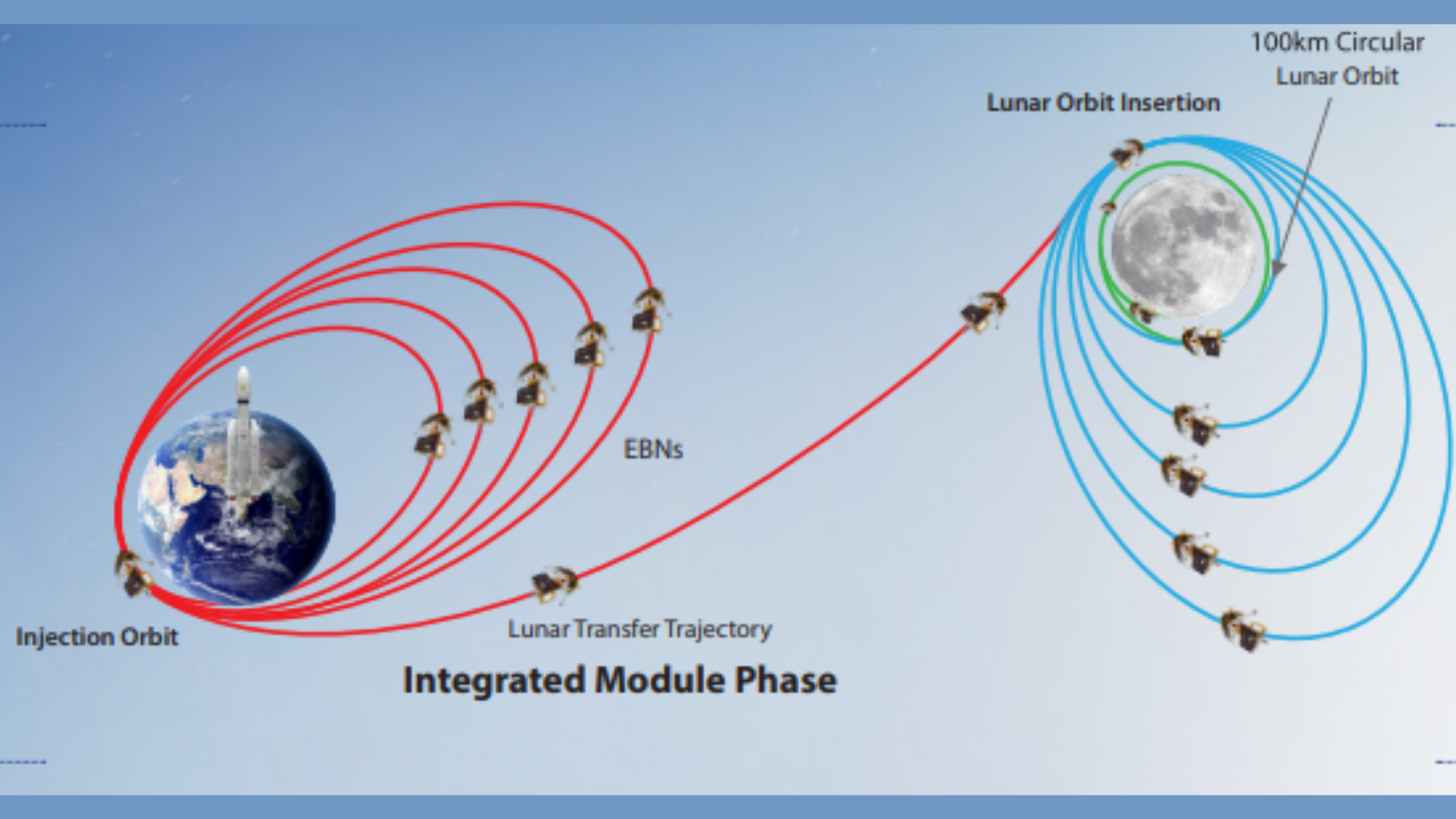
The revised Chandrayaan-3 mission lifted-off Satish Dhawan Space Centre at 09:05 UTC on July 14th, entering an elliptical orbit around Earth with a perigee of 173km and apogee of 41,762km. Over the next couple of weeks, the mission’s power and propulsion module will use 5 close approaches to Earth to further extend its orbit’s apogee further and further from Earth until it can slip into a trans-lunar injection flight and move to an initial extended orbit around the Moon around August 5th.

After this, the orbit will be reduced and circularised to just 100km above the Moon’s surface at this point, around August 23rd or 24th, 2023, the lander – also called Vikram, this time meaning “valour” – will separate from the propulsion module and attempt a soft landing within the Moon’s south polar region.

From Earth to the Moon: the three-phase flight of Chandrayaan-3 to the Moon. Credit: ISRO

If successful, rover and lander will then commence a 15-day mission  – the length of time sunlight will be available to power them before the onset of a month-long lunar night. The lander will conduct its work using three science instruments, and the 6-wheeled rover using two science payloads. These will be used to probe the composition of the lunar surface and attempt to detect the presence of water ice in the lunar soil and also examine the evolution of the Moon’s atmosphere. Communications with Earth will be maintained by both the orbiting propulsion module and the Chandrayaan-2 orbiter. If, for any reason, a landing on August 23rd or 24th cannot be achieved, the lander and rover will remain mated to the propulsion module through until mid-September, when the Sun will again deliver light (and power) to the landing area, allowing the landing attempt to be made.

How Old is the Universe?

It’s long been assumed that the universe is around 14 billion years old – or 13.7, according to a 2021 study using the Lambda-CDM concordance model. However, such estimates fail to account the likes of HD 140283, the so-called “Methuselah star”, which also estimated to be between 13.7 and 12 billion years old – as old as the universe itself, which in theory it should be a good deal younger.

This oddity has been further compounded by the James Webb Space Telescope locating numerous galaxies which appear to have reached full maturity – in cosmic terms – within 300 million years of the birth of the universe, rather than taking the billions evidenced by the vast majority of the galaxies we can see – including our own.

In an attempt to try to reconcile these oddities with our understanding of the age of the universe, a team led by Rajendra Gupta, adjunct professor of physics in the Faculty of Science at the University of Ottawa, has sought to develop an alternate model for the age of the universe – and appear to have revealed it could be twice its believed age.

They did this by combining a long-standing (and in-and-out of favour) theory called “tired light” with tweaked versions of certain long-established constants. “Tired light” suggests light spontaneously loses energy over time, and as it travels across the cosmos over billion years, it naturally red-shifts and so gives a false suggestion of cosmic expansion. It’s an idea which fell out of favour when other evidence confirmed cosmic expansion, but has regained so popularity since JWST started its observations; however, it doesn’t work on its own, so the researchers turned to various constants deemed to by immutable in terms of the state of the universe – the speed of light, the charge of an electron, and the gravitational constant.

By tweaking these, in a manner that is possible given our understanding of the universe, Gupta and his team found that it is possible to model a universe that appears younger than it actually is – in their estimation, 26.7 billion years of age. However, there is a problem with the idea: when you start tweaking known constants which cannot be proven to have changed, and it is potentially possible to come up with any model to fit an assumption. Ergo, the research cannot be seen as in any way definitive.

To counter this, Gupta points out there are a couple of hypothetical constants we use to account for the universe appearing and acting as it does – dark matter and dark energy. As I’ve noted previously, the latter is believed to be in part responsible for the expansion for the universe, and thus its age. However, its influence is currently hypothetical, and thus also subject to potential revision as such, the study suggests that if in influence of dark energy is found to be different to what is generally believed, it might yet indicate that the universe is a good deal older than is generally accepted.

Time will tell on this, but with ESA’s recently-launched Euclid mission is attempting to seek and characterise and potentially quantify both dark matter and dark energy, an answer might be coming sooner rather than later.

Continue reading “Space Sunday: the Moon, money and the universe”