Having opened on August 21st, 2024 at Frank Atisso’s Artsville Galleries and Community, Lalie Sorbet’s Breaths is a visually engaging installation of animated 3D art and 2D elements accompanied by a subtle sound scape.
Lalie has a talent for producing art and installations that stand as moments in time, encouraging us to set aside the rush and hubbub of life and simply relax and be immersed in the beauty of what we are seeing. As I noted with Carousels, her work is gentle to the point of being hypnotic, wrapped in a natural, organic beauty.
Artsville, August 2024: Lalie Sorbet – Breaths
With Breaths, Lalie further embraces all of the above in a most marvellous installation that is not there simply to be assessed or viewed, but to be experienced inwardly by encouraging us to see the animated elements as visual representations of one of our most fundamental autonomous acts: that of breathing.
Of all our autonomous acts, governed by several homeostatic mechanisms, breathing is the one of which we are perhaps most often consciously aware, and the one we might most readily consciously influence: we intentionally breath deeply to offset panic / fear (and the primal flight or fight reaction) and restore equanimity, or to help lower heart rate and bodily functions after excessive physical exertion, etc. During certain types of therapy, it is the mechanism we are often asked to focus upon to induce a state of relaxation, and so on. And the fact is, that the simple act of breathing is both naturally calming; an invisible force with a reach across every aspect of our lives; a natural cycle of inhalation and exhalation marked – when the rhythm is unforced – by natural pauses that can so induce a restful, composed state.
Artsville, August 2024: Lalie Sorbet – Breaths
Breaths beautifully capture all of this through the gentle motion and pauses evident in the 3D elements and the 2D elements beneath them, coupled with their attendant sound scape (do have local sounds enabled). They encourage calmness, their motion gently hypnotic, working with the breath-like susurrations encouraging us to turn inwards and be aware of our own breathing, of our simple state of living within this very moment.
How one might interpret this installation is highly personal – leaving aside the risk of over-analysing. Hanging over the centre of the installation, for example is an element perhaps most clearly suggestive of breathing: a central spherical element offering, perhaps a suggestion of the fine networking of the lungs with the motion of air in and out of them on a that cyclic basis of inhalation and exhalation.
Artsville, August 2024: Lalie Sorbet – BreathsThere is also the sheer organic look and feel to the individual spherical pieces and their 2D companions that encourages broader thinking. Within the animated spheres exotic shapes move; objects seem to divide and reform, or offer visions of what might be strange creatures suspended before us. Observing them individually in motion is like peering into the eyepiece of a powerful microscope and seeing the physical essence of life: cells dividing and joining, repairing damage, providing renewal and growth, or witness the motion of the microbes and antibodies that also play such a vital role in maintaining us as living, breathing organisms.
Breaths is a further rewarding and elegant installation by an artist with a gift of presenting us with images and reflections on the organic beauty of Nature and life. Richly layered yet utterly approachable, it is an exhibition that speaks for itself, whether seen purely as art-in-motion or as the metaphor it has been designed to be. When visiting, do be sure to have your viewer set to Use Shared Environment (World → Environment), and if you are using a non-PBR viewer, make sure you have Advanced Lighting Model (ALM) enabled via Preferences → Graphics.
Walsh County, August 2024 – click any image for full size
It’s been almost four years since the last time I visited Walsh County, the Homestead region designed by Randonee Noel (see: Walsh County’s changing seasons in Second Life), so when Moon Cloud contacted me to tell me there had been an “incident” there which needed investigating, I decided to don my Dana Mulder disguise (see what I did there? 🙂 ) and head off to take a look.
Walsh County takes its name and inspiration from the North Dakota county of the same name, a place describing itself as “a land of prairies, croplands, river valleys, and rolling hills.” As one might expect from this, the actual Walsh County derives most of its income from farming – crops, together with beef, dairy cattle and swine.
Walsh County, August 2024
Walsh County (SL) very much reflects the first of these farming influences, presenting a simple but effective setting of rolling croplands around a pair of fields (the region itself) where the crops are either being grown or harvested (at least during my previous visits!). Not much has changed in this respect when arriving in the region – except it’s now night, rather than day. The fields are there, crops growing, the land apparently peacefully, the familiar tree and water hole sitting within the larger of the two fields as it lay bounded on two sides by unpaved roads (or tracks). But A simple look up with reveal something unusual; whilst the familiar forms of clouds are draped are draped here and there under a canopy of stars, the sense of a serene summer’s night is tilted sideways by the fact the entire sky is – cue that theme music) – casts in an eerie green tint, complete with a faint glow!
Arrive at the right time and whilst looking out across the sky, you might spot an aerial vehicle retreating into the sky (if not, never fear, it will be back soon enough to let you spot it!), having just buzzed one or other of the two fields as if if crop dusting or engaged in aerial topdressing – but who does either at night? More particularly, who does that at night whilst flying a saucer-like vehicle with a domed canopy and sans wings? No, this craft has an altogether different intent than the innocent pursuit of crop=caring. Indeed, one might say that it is patrolling the sky.
Walsh County, August 2024
As to why it might be patrolling over the fields, well that answer might be the fact that a somewhat larger craft of a similar style is busily helping itself to a sample of the local diary produce – by which I mean it is hauling aloft by way of a tractor beam a poor cow. Nor does this appear to be a singular event; there is much evidence to suggest these craft have been around before. Tables have been set-out with food and drink on the road close by, with bunting strung between tall posts, balloons, and much sign of merry-making. The revellers (whomever they might be) also seem to have come prepared for a potentially length shindig-come-vigil: a pair of portaloos (as we often call them in the UK) also being present.
Quite where everyone has gone is unclear. Maybe the party ended and they staggered home; or maybe something started them. Whatever the reason, the table and its detritus did fleetingly put me in mind of the scene from Close Encounters of the Third Kind, with the folk up on the Indiana hillside awaiting the return of their strange aerial guests – although in that case, what did turn up wasn’t quite so mysterious or other-worldly as found here.
Walsh County, August 2024
Nor is that all for the setting. Along the road from the landing point sits a Winnebago-style camper (with room to sit within) and apparently parked for the night. Whether attracted to the spot by the strange goings-on over the field, or as a result of the Cadillac Ranch-like installation of vehicles on the other side of the track, I’ll leave to you to decide. Those who fancy more than walking around might want to ignore the Road Closed sign next to the landing point and head west to where a go-kart rezzer awaits those wishing to add their own noises (and mayhem?! 🙂 ) to the setting.
With these hints of CE3, The X Files (and doubtless other films / series you could mention), this iteration of Walsh County presents a fun setting in the same easy-to-explore vein of previous iterations of the location, with opportunities for photography and fun.
Updated with Video: apologies to Pantera, did not see her at the meeting!
The following notes were taken from the Tuesday, August 20th, 2024 Simulator User Group (SUG) meeting. They form a summary of the items discussed, and are not intended to be a full transcript, and were taken from my chat log. Pantera’s video is embedded at the end – my thanks to her for providing it.
Meeting Overview
The Simulator User Group (also referred to by its older name of Server User Group) exists to provide an opportunity for discussion about simulator technology, bugs, and feature ideas.
Meetings are open to anyone with a concern / interest in the above topics, and form one of a series of regular / semi-regular User Group meetings conducted by Linden Lab.
Dates and times of all current meetings can be found on the Second Life Public Calendar, and descriptions of meetings are defined on the SL wiki.
Simulator Deployments
On Tuesday, August 20th, the Summer Fun simulator release (which includes the Combat 2.0 updates and the new back-end Game Controller support, although the viewer-side elements of the latter have yet to make it into a formal project or RC viewer) was deployed to the SLS Main channel, making it grid-wide.
On Wednesday, August 21st, the simulator RC channels will be restarted without any new deployment / update.
SL Viewer Updates
It appears that all RC viewer except Atlasaurus (which now included the viewer-side WebRTC work) have been pulled to allow LL to focus on PBR / glTF issues per my CCUG meting summary of August 15th.
Release viewer: version 7.1.8.9375512768, formerly the Graphics Featurettes RC viewer dated June 5 and promoted June 10th.
Release channel cohorts:
Atlasaurus RC (Web RTC; PBR fixes; object take options; improved MOAP URL handling), version 7.1.9.10326512121, August 14.
WebRTC Update
On Tuesday, August 20th, Linden Lab issued an update on the WebRTC work.
Move to a “defacto standard” for voice services, with features such as automatic echo cancellation, better noise cancellation and automatic gain control, etc., and offers much improved audio sampling rates for improved audio quality
WebRTC can be supplied within the viewer using a library and wrapper, ending the need for any additional third-party plug-in for Voice like SLvoice.exe, as supplied by Vivox.
Opens the door to adding new features and capabilities to SL Voice, some of which have been long-requested.
Care is being taking to address potential security issues (e.g. preventing eavesdropping, exposing users’ IP address (by using an internal proxy server), etc.).
Feature requests for WebRTC made via the WebRTC board on the SL Feedback Portal are being evaluated and some are being actioned, together with issues being investigated.
LL will be looking to Linux devs to help give feedback on how well WebRTC is working on their Linux viewers.
Key Points from LL’s Update
As per my viewer notes above, the viewer-side WebRTC work has been combined with the Atlasaurus RC viewer.
Conference/Group/P2P in WebRTC is not yet available on the WebRTC Voice regions.
An occasional popup regarding voice server incompatibility can appear. Restart voice if you see this. To restart voice in the viewer:
Hover over the speaker icon in the upper right corner of the viewer.
Wait for the dialogue to appear.
Uncheck the voice checkbox and wait a few seconds.
Recheck the voice checkbox.
Selecting another voice device while in a group, conference, or peer-to-peer call may drop the call.
Voice morphing is not available in WebRTC-Voice enabled regions. If voice morphing had been enabled via an older viewer, you will see a dialogue to let you know the implications of using voice:
Voice morphing notification. Via; Linden Lab
As voice morphing is currently tied to Vivox, those currently using it are advised to look at the “many excellent alternatives for voice morphing that have become available to the general public as technology has developed”. In addition an FAQ has been produced to help with questions about WebRTC and Voice Morphing.
In Brief
Map System Update
Pepper Linden provided an update on the work to improve the world map and map tile updates (see my week #29 summary for more on this):
We had several deploys related to maps, included among them were changes to fix region surrounds in map tiles, as well as a fix to our maps CDN — hopefully they’ve been acting better for you all. Stale tile pruning is still on hold, as there’s a few regions on the grid that weren’t generating their tile — we have a fix that we’re hoping to get out soon, and once that is out, we’ll finally be able to turn on stale tile pruning.
Bumping the tile resolution is on the roadmap. The current maps is very limited in what it can render — we’ve discussed moving to a viewer-based bot that would be capable of rendering mesh, etc.
Pepper also noted that Maps should load a lot faster.
General
2K Bakes on Mesh:
Pepper Linden noted LL has an initial prototype working, which will hopefully be deployed to Aditi (the Beta grid) “soonish” for people to test.
As of now, the prototype will bake at the highest resolution of the included textures; so if the textures are only 1024; the bake will be at 1024.
Combat the following issues / requests have been raised:
An extended discussion on extending llSetAlpha/llSetColor (or something similar) to influence PBR materials. This is being worked upon, but creators are finding a lack of any provision / ability use scripted means to influence PBR materials is causing delays in take-up of PBR (see also: Need a function for easy PBR alpha switching).
Monty Linden continues to work on avatar region crossing issues, noting:
We have some decent tests, found ways to hit weird edge cases, and general improvements are to be had. Vehicles with riders are still hilariously bad. We’ll have to tackle that in subsequent projects. It’s just hard to fathom.
† The header images included in these summaries are not intended to represent anything discussed at the meetings; they are simply here to avoid a repeated image of a rooftop of people every week. They are taken from my list of region visits, with a link to the post for those interested.
Logos representative only and should not be seen as an endorsement / preference / recommendation
Updates from the week through to Sunday, August 18th, 2024
This summary is generally published every Monday, and is a list of SL viewer / client releases (official and TPV) made during the previous week. When reading it, please note:
It is based on my Current Viewer Releases Page, a list of all Second Life viewers and clients that are in popular use (and of which I am aware), and which are recognised as adhering to the TPV Policy. This page includes comprehensive links to download pages, blog notes, release notes, etc., as well as links to any / all reviews of specific viewers / clients made within this blog.
By its nature, this summary presented here will always be in arrears, please refer to the Current Viewer Release Page for more up-to-date information.
Note that for purposes of length, TPV test viewers, preview / beta viewers / nightly builds are generally not recorded in these summaries.
Official LL Viewers
Release viewer: version 7.1.8.9375512768, formerly the Graphics Featurettes RC viewer dated June 5 and promoted June 10th.
Release channel cohorts:
Atlasaurus RC (WebRTC; object take options; improved MOAP URL handling), version 7.1.9.10326512121, August 14.
All other RC viewers have been pulled to allow a focus on PBR issues.
[REN], August 2024, click any image for full size
I last visited [REN], the engaging parcel designed and held by Noa (Noa Cloud) in May 2023 (see here for more), so a return visit has been well overdue. At the time I last dropped in, the setting covered a little under 13,000 square metres within a Full Mainland region. Whilst still in the same location, [REN] has expanded to a touch over 19,000 square metres and has gained a further sky setting as well.
One of the things I’ve always enjoyed with Noa’s work is the blending of ideas and influences he brings to [REN], and this was much in evidence when I made my return in August 2024. This is evident from the moment one touches down at the landing point.
[REN], August 2024Overlooking the western coastline of the setting from the top of a high shoulder of rock, the landing point looks north across a shallow bay to where a castle with a Norman look and feel sits on a high promontory of rock being slowly eaten into by the sea far below, whilst immediately to the south, Torri gates mark the presence of a rope bridge spanning a narrow but deep gorge to reach a neatly laid-out garden area front a Japanese shrine, complete with a little gift shop where actual gifts can be obtained.
The gorge appears to have been cut by a mix of the tide working its way inland against the rock and waterfalls cutting their way towards the sea. Deep and narrow, it contains a little secret spot of its own – although I’m not sure entirely how to reach it directly; while a ladder descends into the gorge at one end, it didn’t appear climbable and I didn’t spot a direct TP or anything (but could’ve missed it!), so just did a double-click TP hop.
[REN], August 2024Northwards from the landing point (I leave you to wander the little woodland on the landward side of the landing point) stairways descend to the lowlands behind the by, offering a route to the castle up on its high perch and also further inland to the gardens proper. The castle can be reached in one of two ways: via the steps up to the courtyard, or for the keen-eyed, via the entrance to what might otherwise be the entrance to catacombs (the latter may require acceptance of the local teleport experience).
The castle gives an opportunity to explore its rooms, enjoy music and a dance or indulge in a game of Wanderlust (although the drinks trolley might make playing interesting! Music is very much a theme throughout the setting (no pun intended!); opportunities to dance can be found throughout, pianos are to be found throughout, together with other instruments awaiting discovery.
[REN], August 2024A second stairway provides a way up to the setting’s expansive gardens. These offer a captivating mix of locations, starting with the pavilion-like greenhouse where more the aforementioned music can be heard and dances enjoyed. Walks meander through the gardens and the trees. Following any of these will bring visitors to at least one point of interest – if not more – and the potential to find more semi-hidden teleports.
Some of the points of interest include 3D art elements, delightful waterfalls, a small lake, picnic spots and places to sit and places to sit and pass the time. Also awaiting visitors are the teleport boards (again, requiring acceptance of the local experience, if you haven’t already) waiting to carry visitors to the sky platforms within the setting.
[REN], August 2024One of these is the Gallery and its courtyard café. As I’ve also mentioned in the past, Noa is a gifted landscape photographer, and the gallery presents people with the opportunity to appreciate his work and collect his his gifts if so minded. Spread across the two floors of the gallery, the art is laid out in such a way as to offer a relaxing walk whilst enjoying it.
The second sky destination is the cinema salon and gardens. Caught under a glowing full Moon, this space offers exactly what its name suggests: a salon-style cinema showing a film recorded within the main gardens and, along side it, a formal garden space laid out around and over water features and with a fine dining area on its far side from the cinema. Also tucked away here, and possibly private given its location is an outdoor photo studio.
[REN], August 2024One of the many aspects of the setting I like is the way in which Noa has used the rocky curtain around three sides of the garden and cinema. These closely match the rocks and cliffs down on the ground level, helping to give the impression that – night-time ambience aside – the sky platform is still part of the ground-level setting.
[REN] is always a delight to visit, and this iteration is no exception. Whether you wish to capture it in photographs, want a place to enjoy a romantic time with some close, or simply enjoy time exploring all the setting has to offer.
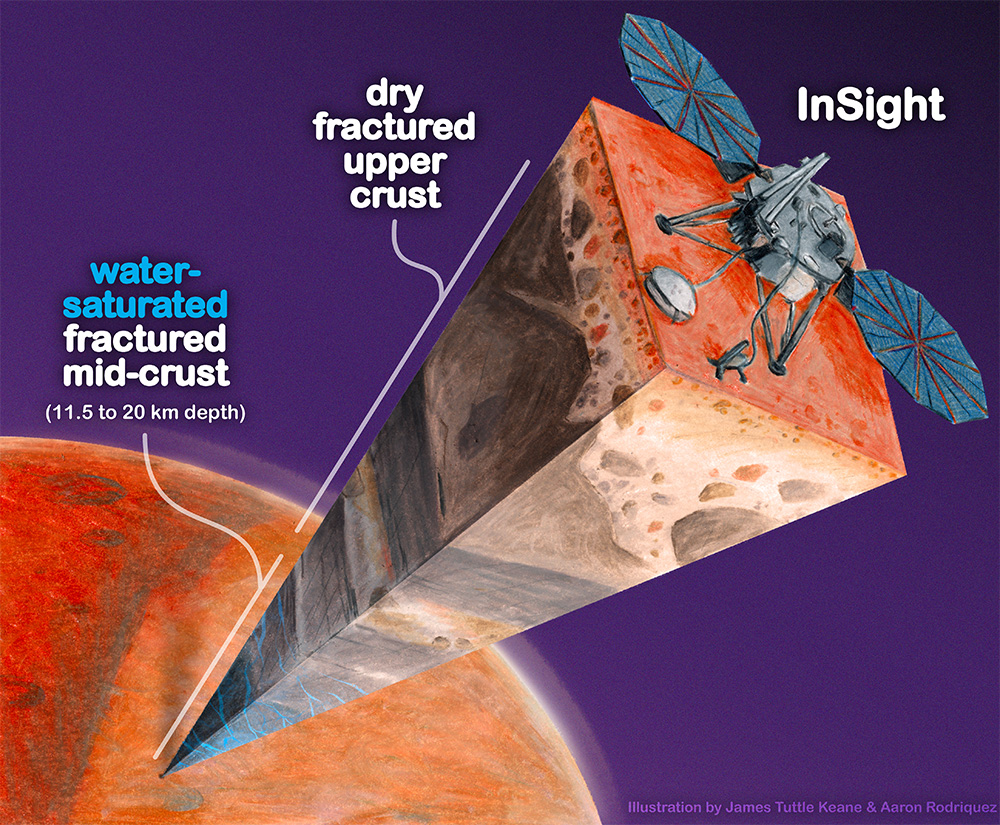
An artist’s illustration of NASA’s INterior Exploration Using Seismic Investigations, Geodesy and Heat Transport (InSight) lander on Mars (active: 2018-2022), which attempted to give the planet its first thorough check up since it formed 4.5 billion years ago. In particular, the mission sought to understand the planet’s interior composition and monitor things like tectonic activity (marsquakes), meteorite impacts, study how much heat is still flowing through the planet, and track Mars’ wobble as it orbits the Sun. Credit: NASA/JPL
The subject of water on Mars has been a topic of scientific debate and speculation for well over 100 years. Since the earliest reliable observations of Mars via telescope, it had been thought that water ice and water vapour existed on the planet and in its atmosphere as a result of the seeing the polar ice caps (although we now know the major stakeholder in these is carbon dioxide) and cloud formations.
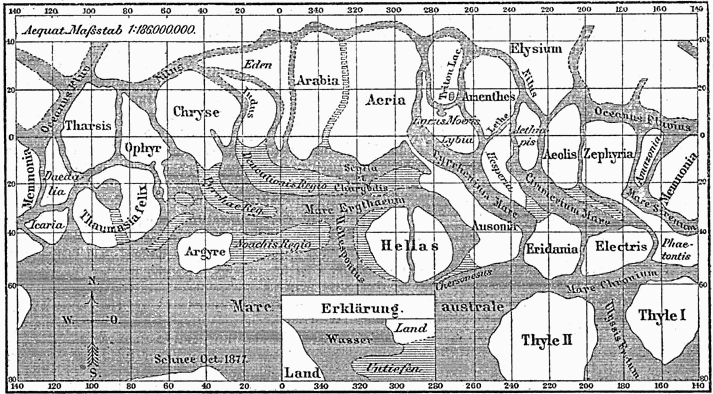
However, the idea that Mars was still subject to liquid water flowing across its surface in our modern era became popularised in the late 1800s. In 1877, respective Italian Astronomer Giovanni Schiaparelli – already noted for his observations of Mars in which he correctly identified and named multiple visible surface features – used the Great Opposition of 1877 (when Mars and Earth were both on the same side of the Sun relative to one another and Earth was effectively “overtaking” Mars in their respective orbits, thus bringing the two into “close” proximity to one another) to carry out further observations. During these he noted the presence of multiple canali on Mars.
One of Schiaparelli’s 1877 surface maps of Mars. Note the looping canali (“channels”) he thought he observed in the northern hemisphere of the planet, and which he saw as entirely natural phenomena, although most were later shown to be optical illusions / the misidentification of other features. Credit: Public domain
Canali is an innocent term, meaning “channel”, and Schiaparelli simply used this term to differentiate what he thought is saw from other features he observed. But in English-speaking newspapers it was later translated as canals, evocative of artificial and intelligent construction. This resulted in wealthy Bostonian businessman Percival Lowell, following his return to the United States in the early 1890s to establish an observatory in Flagstaff, Arizona, specifically (initially at least) so he could observe these “canals” for himself.
Over the course of 15 years (1893-1908), Lowell saw his canals, which grew into a globe-spanning network and led to the publication of three books (Mars (1895), Mars and Its Canals (1906), and Mars As the Abode of Life (1908 – an original copy of which I actually own!) in which he expounded his theory that Mars had a network of canals built by an ancient civilisation in a last-ditch effort to carry liquid water from the planet’s poles to their equatorial and temperature cities as the planet increasingly became more desert-like.
A manuscript globe of Mars made by Danish amateur astronomer, Emmy Ingeborg Brun, presenting an image of Lowell’s network of Martian “canals” (together with the names he assigned individual “canals”), and made by combining sketches of his observations and which were published in Mars and Its Canals (1906), and Mars As the Abode of Life (1908). Credit: Royal Greenwich Observatory
Lowell stuck to this belief throughout his observations in spite of increasing scientific evidence that Mars was likely incapable of supporting liquid water on its surface and observations from other observatories with larger telescopes than his which could not find any evidence of “canals”, and that at least some of what he was seeing was actually (as Schiaparelli had believed) lines of demarcation between different elevations / terrains.
As a result of this belief, Lowell has become regarded as a bit of a crackpot – which is a same, as he led a remarkable life with multiple achievements as a traveller, diplomat, writer and armchair scientist, and did gain recognition in his lifetime for his work – He was elected a Fellow of the American Academy of Arts and Sciences in 1892 and then to the American Philosophical Society in 1897, whilst the volume of work he carried out as an astronomer outside of his theories about Mars saw him receive the Prix Jules Janssen, the highest award of the Société Astronomique de France, in 1904.
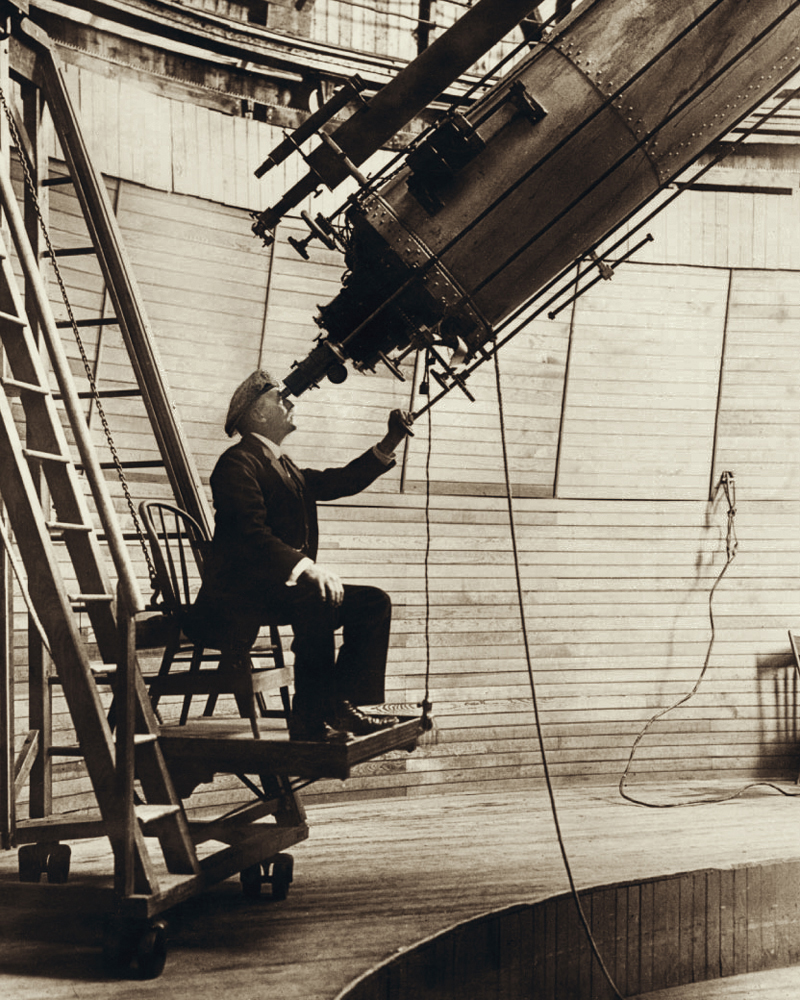
Lowell pictured in 1914 seated at the 61-cm (24-in) Alvan Clark & Sons refracting telescope at the Lowell Observatory, Flagstaff, Arizona, as he observes Venus. Credit: Unknown and reconstructed
This volume of work include daytime studies of Venus and the search for “planet X”, a planetary body believed (and still believed by some) to be orbiting the Sun far out beyond the orbit of Neptune. In fact, the Lowell Observatory became a centre for this work, for which it was rewarded in 1930 when Clyde Tombaugh located Pluto using the observatory’s telescopes and equipment.
Of course, whilst liquid water does not exist on the surface of Mars today and hasn’t for billions of years, we have found plenty of evidence for its past presence on the planet’s surface.
In my previous Space Sunday article, for example, I wrote about the Great Lake of Mars, Lake Eridania, whilst both the Mars Science Laboratory Curiosity and Mars 2020 rover Perseverance have literally been following the evidence for free flowing water in both of the locations on Mars they are exploring. Prior to them, the Mars Exploration Rovers Spirit and Opportunity both uncovered evidence of past liquid water on Mars, as have orbital vehicles from NASA, Europe and other nations. But the two big questions have always been – where did it go, and where did it come from?
In terms of where it went, the most common theories are that the water either evaporated and was lost to space along with Mars’ vanishing atmosphere relatively early in the planet’s life or retreated down into the Martian crust where it froze out into icy “reservoirs”. The first is likely for a certain volume of water, whilst subterranean tracts of water ice have been located not too far under the surface of Mars. However, the latter cannot possibly account for the amount of water believed to have existed on the surface of Mars in its early history, not could simple evaporation account for the disappearance of to greater majority of it. So where did the rest go? And where did it come from originally?
Well, in a new report published this month a team of scientists believe they have the answer, and it lay within data obtained by NASA’s InSight (INterior exploration using Seismic Investigations, Geodesy and Heat Transport) lander.
This ambitious craft landed on Mars in 2018, with the mission running from November of that year through until the end of December 2022. In particular, the lander carried with it two unique instruments it deployed onto the Martian surface using a robot arm. One of these was the French-lead Seismic Experiment for Interior Structure (SEIS), designed to measure marsquakes and other internal activity on Mars and things like the response to meteorite impacts, in order to better understand the planet’s internal structure. The data continues to be studied, and has revealed much about the planet’s internal structure and its history.
Most recently, a US team from the Scripps Institution of Oceanography at the University of California, San Diego and the University of California, Berkeley, have been reviewing the SEIS findings specifically to try to answer the question of where the water went. In particular, they have been using mathematical models employed here on Earth to locate aquifers and oil and gas fields deep underground. By adjusting the models so they provided results consistent what is largely known about the Martian crust down to a depth of several kilometres below the surface, they ran a series of passes on data gathered from deeper and deep within the planet’s crust, In particular, the came across two interesting results. The first indicated that while deposits of water ice do exist below the surface of Mars, and less than 5 km from the surface, they are likely to be far less commonplace than had been thought. The second result they took note of was consistent with those indicative of layers of water-saturated igneous rock deep within the Earth’s crust.
Most interestingly, the results of the SEIS data modelled suggest this deep layer of rock and water – laying some 11.5 to 20 km below the surface of Mars could be widespread across the planet to the extent that it could contain more water than would have been required to fill the oceans and seas of ancient Mars.
Taken together, these result indicate that while the theories about water on Mars being lost to space or frozen into subsurface ice are still valid, the vast majority of the water most likely retreated deep down into the planet, possibly returning to the reserves from which it might have originally burst forth to flood parts of Mars during the planet’s late Noachain / early Hesperian period of extreme volcanic activity.
A “core sample” of the Martian interior beneath NASA’s InSight lander from the Scripps / UC Berkeley study. The top 5km of the crust appear to be dry, with limited large-scale deposits of water ice, while a water-saturated zone of fractured rock lies some 11.5 to 20 km below the surface. This is believed to by a widespread layer within the crust, potentially containing more liquid water than the volume believed to have been present in ancient Martian oceans. Credit: J Tuttle; Keane and Aaron Rodriquez, via Scripps Institution of Oceanography
One intriguing question that arises from this work is related to the potential for Mars to have harboured life, and what happened to it as the water vanished. if the modelling in the study is correct, and the water did retreat deep under the surface of Mars and form aquifers and pools with the rocks there, did any ancient microbial life gone with it, and if so – might it have survived? The pressure and temperatures at the depth which the water appears to reside would keep it both liquid and warm and provide energy, as would mineral deposited within the rock; so the question is not without merit.
Establishing that there is a big reservoir of liquid water provides some window into what the climate was like or could be like. And water is necessary for life as we know it. I don’t see why [the underground reservoir] is not a habitable environment. It’s certainly true on Earth — deep, deep mines host life, the bottom of the ocean hosts life. We haven’t found any evidence for life on Mars, but at least we have identified a place that should, in principle, be able to sustain life.
– Michael Manga, Professor of Earth and Planetary Science, UC Berkeley
But the is a question that’s unlikely be to answered any time soon. Determining if the environment is at the very least amenable to life, much less actually finding evidence for life within it – or even simply reaching any of the water deposits –is going to be pretty much impossible for a good while yet. Current deep drilling techniques here on Earth for extracting oil and gas only go down to around 2 km; getting that sort of equipment to Mars and enabling it to dill down at least 11-12 km will pretty much remain the stuff of dreams for a good while to come.
JUICE to Swing by the Moon and Earth
The European Jupiter Icy Moons Explorer (JUICE) mission will be making a first-of-its kind fly-by of the Moon and Earth this week, the first in more than 5 gravity assist manoeuvres the vehicle will make (excluding those made while orbiting Jupiter) during its mission to study the icy moons on the Jovian system.
An artist’s impression of ESA’s Juice mission approaching the Jovian system in 2031. Credit: ESA
Such manoeuvres are often used with space missions and for a variety of reasons. With JUICE, it means the craft could be flown into space using a medium-lift launch vehicle and make (and albeit relatively sedate) flight to Jupiter, involving a total of three fly-bys of Earth and one of Venus to accelerate it to a peak velocity of 2.7 km per second using the minimum of fuel and then slingshot it out to a point in space where it will intercept the Jovian system, and they use further flybys of the planet and its Moons to both slow itself down into orbit around them and then adjust its course so it can study the icy moons of Jupiter – Ganymede, Callisto, and Europa.
This first fly-by comes 16 months since the launch of the vehicle, and will be the very first Earth gravity assist which also employs the Moon as a critical component. On August 19th, Juice will as around the Moon at a distance of just 700 km (reaching the altitude at 21:16 UTC), using the Moon’s gravity to swung it onto a trajectory that will see it pass by Earth just over 24 hours later, passing over north-eastern Asia and the Pacific at an altitude of just 6,807 km on the morning of August 20th (local time) before heading back out to loop around the Sun. After this it will get a further gravity assist from Venus in August 2025 and then two more from Earth (without the Moon helping) in 2026 and 2029, that latter of which will slingshot the vehicle on it way to rendezvous with Jupiter and its moons.
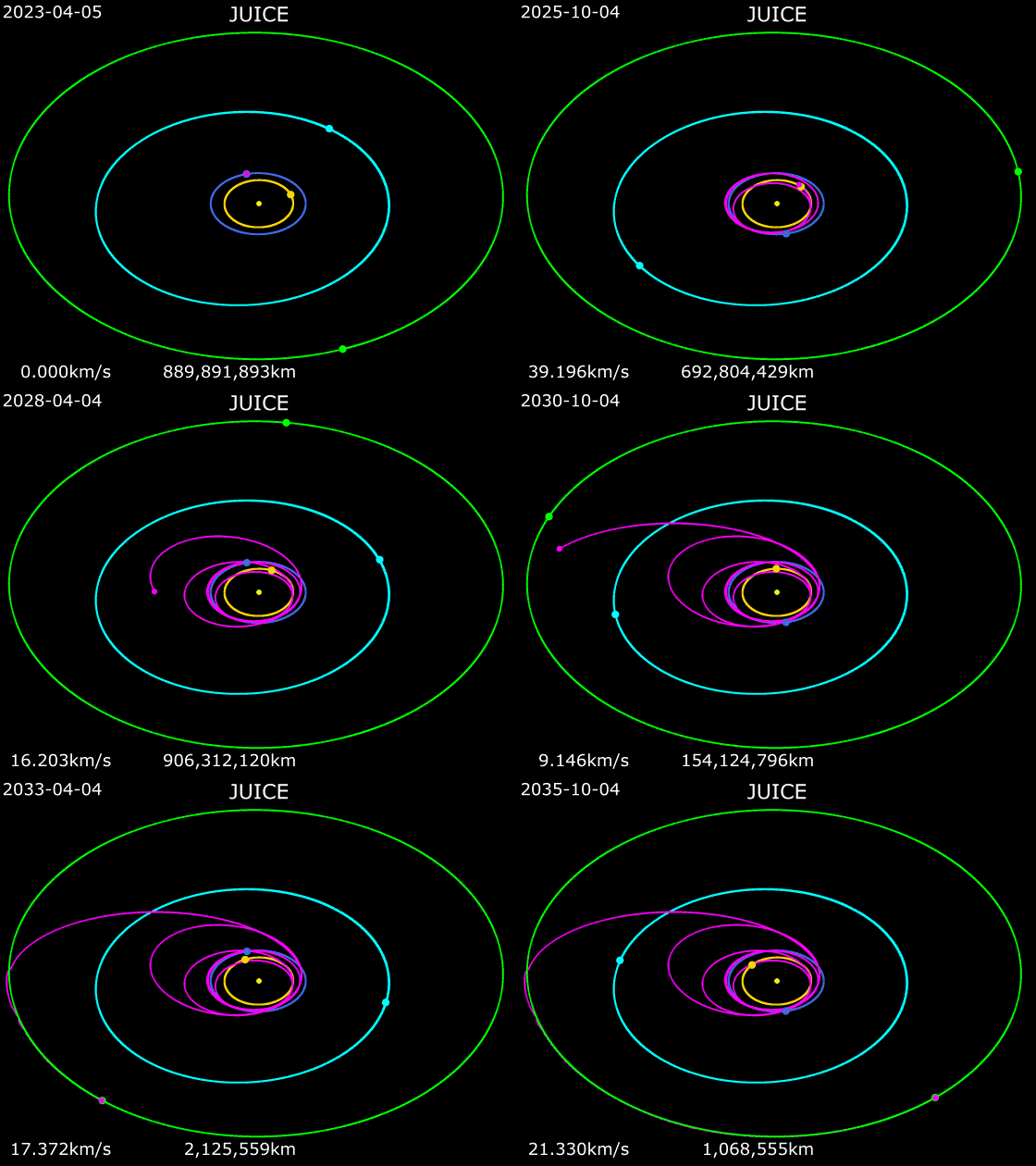
An animated GIF showing Juice’s flightpath as it loops around the inner solar system (2023-2029 – Yellow= Venus; blue = Earth) prior to gain the velocity required to slingshot out to intercept Jupiter, passing by way of asteroid 223 Rosa (teal). Credit: Phoenix777, using NASA HORIZONS system data, via Wikipedia
On August 15th, Juice briefly caused a stir when it was mistaken as a near-Earth object (NEO) on a potential collision course with Earth. At 27 metres across, most of which is some 85 square metres of solar arrays, Juice is a strong reflector of sunlight, and this briefly confused systems at the ATLAS Sky Survey, Hawai’i, which attempts to locate, identify and track potentially threatening NEOs. However, the system’s confusion was quickly identified as actually being the Juice spacecraft and the alert corrected.
This was actually the second time an ESA deep-space vehicle has been mistaken as a hazardous NEO; in November 2007, and as it approached Earth for a flyby, Europe’s Rosettta mission spacecraft – also with a large span of solar arrays – was also briefly mis-identified as a NEO on a possible collision course with Earth. On that occasion, it was mis-identified by a human observer, and further manual checking was required before it was confirmed the object being tracked was actually the Rosetta spacecraft and not of any threat to Earth.
Following its arrival at the Jovian system, Juice will spend 1259 days orbiting the system, the majority of which will be in Jupiter-centric orbits that will allow it to study Ganymede, Callisto and Europa, with numerous gravity-assists of both Ganymede and Callisto used to alter its trajectory and velocity, allowing it to study them from different orbital inclinations and also to dip down into the inner Jovian system to study Europa.
However, the final 284 days of the time (from early 2035) will be spent in a dedicated orbit around Ganymede, allowing the spacecraft to complete some 6 months of dedicated studies of the moon once it has settled into a 500 km circular orbit around Ganymede. By the end of 2035, the spacecraft is expected to have expended the last of its 3 tonnes of manoeuvring propellants, bringing the mission to an end. without the ability to manoeuvre, Juice is expected to quickly fall victim to further Jupiter gravitational perturbations and crash into Ganymede within weeks of running out of propellants.