Sakura Cranes, December 2023 – click any image for full size
Occupying just under an eighth of a full region (which itself leverages the additional land capacity bonus available to private regions) sits Sakura Cranes, as attractive, Japanese / oriental themed setting created by Brian Ravenhurst, and which I recently visited by way of the Second Life Destination Guide. It is actually one of three parcels within the region Brian has designed, but will be the focus of this article – the other two can be reached via the raised walkway which wends its way through a part of Sakura Cranes.
The setting has – according to its About Land description – been inspired by the Takedera Temple, which I believe is a reference / alternate name for the Hôkoku-ji Temple (although the date given in the About Land description differs to that for Hôkoku-ji) – and additionally known as the Bamboo Temple, on account of its position deep within a bamboo garden. Like Hôkoku-ji, Sakura Cranes has its own bamboo feature – a curtain of tall trees which act as a curtain of green running west-to-east between the rocks and walls forming the north-south borders of the parcel.
Sakura Cranes, December 2023
South of this curtain and sitting high on the cliffs, sits an ancient pavilion guarded by two kitsune foxes as steps climb gracefully down along the instep of the long foot of rock extending northwards from the pavilion’s perch. Torii gates mark the stairway as reaches a raised wooden walkway set over mist-shrouded ground, the mist broken in several places by fingers of rock pointing to the sky. The bell towers of a shine sit either side of the walkway as it reaches another pavilion, this one set between the arms of the bamboo curtain, offering a view over a large body of water fed by dragon fountains and partially shaded by Sakura blossoms.
A second walkway winds through the bamboo trees, this one splitting so that one arm forms the connection to the neighbouring parcels, and the other to span – by way of a slightly off-centre bridge – the water and descend to the lowlands bordering the water on the far side. This northern half of the region presents a rich, calming garden. Gravel and cobble paths wind their way over the grass and down over the rocks and under the boughs of bamboo, Sakura and other trees as then pass between an assortment of buildings.
Sakura Cranes, December 2023
The garden is reached by another walkway and wooden steps descending from the bridge, a pair of open gates to one side provide access to a small market area, a further gateway providing the means to loop back along the path paralleling the fountain-fed waters, passing under the bridge as it does so. At the far end of the this path is a shaded place in which to spend time, whilst mid-way along the path stepping-stones pass over the water to reach another place to pass the time playing a Chinese gu zheng within an open-sided pagoda rising from the rippling waters.
Mirroring the stepping stones crossing the water is a second set, these passing over the grass of the gardens to reach a teahouse where another gu zheng sits, together with the opportunity to enjoy some tea and appreciate the artist’s studio on the upper floor.
Sakura Cranes, December 2023
The tea-house is one of four structures within the low gardens, excluding the little market. Of the remaining three, one is a small shrine sitting next to the teahouse, around which a gravel path loops on its way north. The remaining two, located at the northern extreme of the setting and separated by another curtain of bamboo and a further body of water, are two rental homes. Both were available at the time of my visit, but this might not always be the case, so do please be careful about trespassing on people’s privacy. The waters between these two houses forms a home for a small boat, open to the public and offering another place to pass the time – possibly in contemplation of Buddha as he watches over the water.
Sakura Cranes, December 2023
With lanterns together with kites floating overhead, Japanese cranes dancing and nesting in or near the waters, and with enough paths winding through the landscape, Sakura Cranes offers a lot to appreciate within its comfortable, small space – and does so without ever feeling overcrowded for its size or in any way enclosed. In other words, it makes for a perfect and relaxing visit.
SL Mobile, December 2023 – screen cap via Linden Lab
Update, December 13th: – the Lab now has an official blog post on the Alpha.
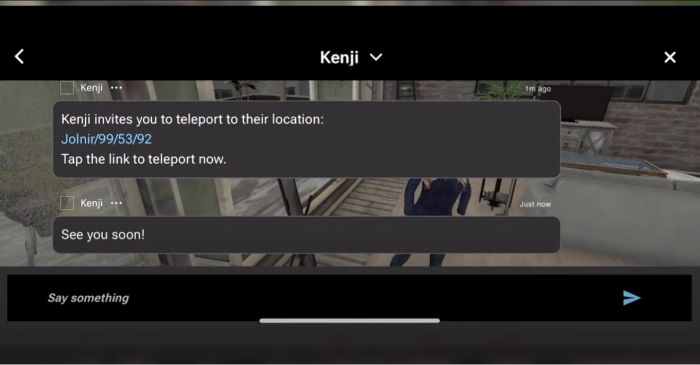
Linden Lab have announced – by way of a You Tube video (at the time of writing, I’ve not seen any official blog or forum post commentary to accompany it) – the launch of a Second Life Mobile “Private Alpha” allowing Premium Plus subscribers to sign-up for the opportunity to take the app for a test drive and provide feedback to help with development.
Narrated by – I believe – user Boston Blaisdale, the short video (just over a minute in length) introduces the features and capabilities those accepted into the alpha will be able to try. These include:
See your avatar & edit appearance / change outfits.
Explore the world via the Destination Guide, mobile showcase, teleport, deep links, TP offers.
Interact with the world through a limited set of movements (walk, run, fly, sit, stand) and object interactions (touch, sit) – or park your avatar and explore via flycam.
Socialise and stay connected (nearby chat, group chat, IM, group notices, find contacts, inspect profiles).
Create and log in with a new account.
The app is currently available on the following platforms:
iOS (minimum: iPhone X running iOS 16.6.1).
Android: mid-to-high-end Android device (comparable to Google Pixel 6 or higher) running Android OS 13 or higher.
Those participating on iOS will also require the TestFlight app for testing and feedback, whilst Android users will need to provide feedback through Google Play.
Premium Plus subscribers can find out more by following this Support Page link and (I believe) submitting a support ticket. There is also a link on this page to a FAQ on the Mobile app. It is not clear if this testing is subject to any form of NDA.
SL Mobile, December 2023 – screen cap via Linden Lab
Commenting on more general availability for the app, Linden Lab state:
It’s still early days for our mobile app. Our mobile team has been hard at work building a mobile-centred design and foundational features so that we can all enjoy Second Life anywhere we want. We’re ready to share what we’ve built so far with our most dedicated residents and we ask for your help as we continue to develop this project through this early Alpha stage, but we do not have a date for the next phase of testing or full release at this time.
Using Premium Plus members for initial feedback is an interesting choice. On the one hand, it would appear to greatly limit the potential resource pool of people willing to work on the app and give objective feedback; on the other it does allow Linden Lab to manage the size of the pool of likely applications at this point in time. Whilst some might feel snubbed at the restrictive nature of this initial Alpha, it is probably worthwhile noting that the SL Mobile app has already had input from users and will continue to do so; so will hopefully include more broad-based Alpha and Beta testing using an expanded pool of users in 2024, as LL continue to develop the app.
Subcutan Art Gallery: Japanese Garden (lower area) blog post †
The following notes were taken from the Tuesday, December 12th Simulator User Group (SUG) meeting. They form a summary of the items discussed, and is not intended to be a full transcript. A video of the meeting is embedded at the end of this summary, my thanks as always to Pantera for recording the meeting and providing it.
Meeting Overview
The Simulator User Group (also referred to by its older name of Server User Group) exists to provide an opportunity for discussion about simulator technology, bugs, and feature ideas.
They are open to anyone with a concern / interest in the above topics, and form one of a series of regular / semi-regular User Group meetings conducted by Linden Lab.
Dates and times of all current meetings can be found on the Second Life Public Calendar, and descriptions of meetings are defined on the SL wiki.
Simulator Deployments
Tuesday, December 12th: the SLS Main channel was re-started without any simulator updates being deployed.
Wednesday, December 13th: the “Fall Colours” maintenance update should be expanded across all RC channels. This update includes llRezObjectWithParams, llIsFriend, but will not include the game controller updates.
Viewer Updates
On Tuesday, December 12th, the glTF PBR Materials Maintenance RC, version 7.1.1.7173980941, was issued. Among the updates / fixes included are:
Fix: BUG-234706 “[GLTF] [PBR] Performance unstable / massive performance loss compared to default release”.
Fix: BUG-234740 “[PBR] [Windows] Scaled/Offset Textures Quality Degrades at Short Distance”.
Fix: BUG-234632 “[PBR] – Regression – Lossless compression normal map upload via GLTF asset is broken”.
Fix: BUG-234740 “[PBR] [Windows] Scaled/Offset Textures Quality Degrades at Short Distance”.
Improvement: “SL-20611 Haze has no effect on local lights”.
Update: 17 new Materials available via the Library.
Please refer to the release notes for the full list of fixes / updates / known issues for this release.
Other viewers in the pipe remain as:
Release viewer: version 7.0.1.6894459864, the glTF / PBR Materials viewer, issued November 17, promoted November 28.
Release channel cohorts:
Maintenance V(ersatility) RC viewer, version 7.1.1.7039128750, December 1.
Maintenance X RC, version 6.6.17.6935636398, issued November 21 – usability improvements.
Maintenance Y, version 6.6.17.6935642049, issued November 21 – My Outfits folder improvements; ability to remove entries from landmark history.
Puppetry project viewer, version 6.6.12.579958, May 11.
Game Controllers
From Leviathan Linden:
I’m trying to provide an updated viewer that allows for keyboard support: send game_control data even if you don’t have a game controller. I hope to have something available for download today, but just got the Mac version to build but it is missing some UI and I don’t know why yet.
What would be new in that game_control viewer are two things:
The ability to map most avatar movement controls (e.g. push_forward, strafe_left, etc) that have keyboard bindings… to game_control axes and/or buttons.
[A] small change where I negate the axis by default on the X-components of the joysticks on your controller. This to make it so that LEFT is in the positive direction [so] if you’ve already negated that channel in test scripts then you will need to remove your own negation.
What is NOT in the new viewer:
Remapping of controller inputs
Arbitrary keyboard mappings to game_control inputs — you can map the “Actions” of avatar movement/control that already have keyboard mappings… to game_control inputs.
Detection of odd game controller hardward — I still have a Thrustmaster HOTUS controller on order but it hasn’t arrived yet. I blame X-mas package traffic jams.
Combat Simulation
Rider Linden has published his outline document on improving SL’s combat capabilities, which can be found within the combat systems discussion thread on the forums, and is gaining good feedback on it.
This led to a general discussion on requirements / concerns over conflicts in trying to address multiple combat systems, managing Damage (and the potential for a “damage budget” / sliding scale of damage based on weaponry.
The new user group for combat systems should be starting up in the new year. For now, please refer to the meeting video for the general discussion, which starts around 18 minutes into the meeting and continues through until the end.
In Brief
Rider Linden continues to prove himself cool and hip – this week referencing Carl Reiner’s classic neo-noir mystery comedy film Dead Men Don’t Wear Plaid. At least he didn’t get in T-R-U-B-I-L for doing so.
† The header images included in these summaries are not intended to represent anything discussed at the meetings; they are simply here to avoid a repeated image of a rooftop of people every week. They are taken from my list of region visits, with a link to the post for those interested.
Logos representative only and should not be seen as an endorsement / preference / recommendation
Updates from the week through to Sunday, December 10th, 2023
This summary is generally published every Monday, and is a list of SL viewer / client releases (official and TPV) made during the previous week. When reading it, please note:
It is based on my Current Viewer Releases Page, a list of all Second Life viewers and clients that are in popular use (and of which I am aware), and which are recognised as adhering to the TPV Policy. This page includes comprehensive links to download pages, blog notes, release notes, etc., as well as links to any / all reviews of specific viewers / clients made within this blog.
By its nature, this summary presented here will always be in arrears, please refer to the Current Viewer Release Page for more up-to-date information.
Note that for purposes of length, TPV test viewers, preview / beta viewers / nightly builds are generally not recorded in these summaries.
Official LL Viewers
Release viewer: version 7.0.1.6894459864,the glTF / PBR Materials viewer, issued November 17, promoted November 28 – No Change.
Nitroglobus Roof Gallery, December 2023: Bamboo Barnes – Broken Chair
My idea of art is not the refraction of light, but the expression of what lies behind it. I want to create something that is inside a person, something that has a fragrance like fermented love. Therefore you rarely find anything cheerful or uplifting in most of my work, nor do I want to express such things.
Thus states Bamboo Barnes in discussing her latest exhibition – and her third at Dido Haas’ Nitroglobus Roof Gallery over the years – which opens on December 11th, 2023.
As I’ve frequently noted in these pages, Bamboo is one of the most vibrant, evocative, provocative, and emotive artists in Second Life. Her work is far removed from that of other artists who mix digital techniques with images from the physical world and those from SL, in that it it is both introspective and yet often – through the use of colour and tone – strongly assertive such that individual pieces can both reflect her inner thoughts, personal perceptions and feelings whilst at the same time speaking directly to the person viewing them in an equally personal and also entirely unique way.
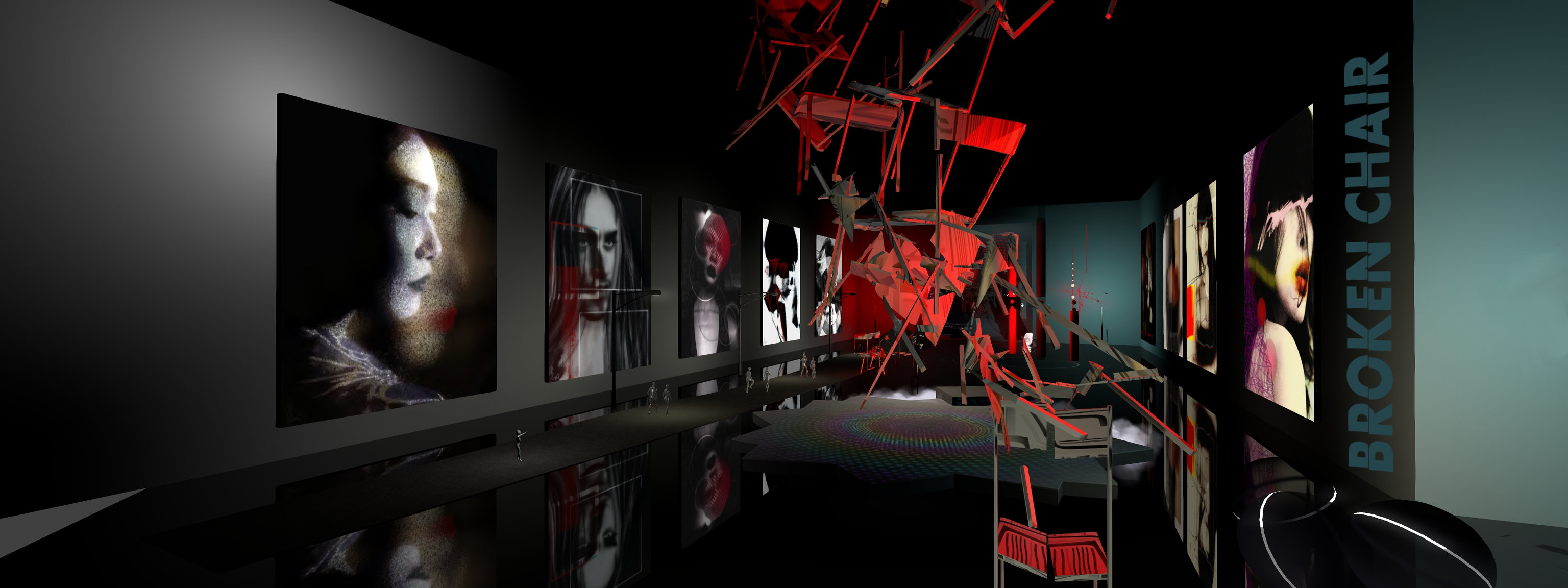
Nitroglobus Roof Gallery, December 2023: Bamboo Barnes – Broken Chair
Such is the case with Broken Chair, an exhibition of 19 studies by Bamboo, supported by a series of 3D elements by the artist, some of which reflect the title of the exhibition, others of which might appear more abstract at first glance.
The images are predominantly monochrome in nature, colours – outside of red – sparingly used. Each offers its subject in Bamboo’s trademark style: a face, sometime in full, sometimes in profile, often in sharp focus, just as often not; each one looking outwards at or beyond the observer, expression and pose – even when the eyes are unseen – giving voice to the tumult of thought and feelings tumbling through the mind within the head. What these thoughts and feeling might be is up to observers to interpret for themselves, but there is more than enough within each one to resonate with each of us, and cause a sense of understanding and familiarity.
Where colour is used, it is done so in emphasis of a mood, emotion or feeling, whilst the title of the exhibition speaks to what so often lies within us all: the introspections that are so personal we cannot give voice to them; thoughts that can – whatever their origin or cause – leave us spiralling in silence, trapped without ourselves – but which also demand expression, be it through physical or mental reflection. These are thoughts which can leave us feeling less-than-whole – or broken, if you will. Yet even whilst bringing forth this sense of brokenness, such thoughts and feelings can so often also impart an inner strength or drive to overcome, to mend; a determination to learn, to overcome, to become more whole and move forward in life.
Nitroglobus Roof Gallery, December 2023: Bamboo Barnes – Broken Chair
So yes, we might so often feel broken inside, but as with a broken chair, we have the ability within ourselves to mend and heal. Perhaps not fully – even a repaired chair can so signs of the work applied to make it so – but enough to carry us forward in life. And within Broken Chair, Bamboo perhaps reminds us of that such feelings – and the drive they encourage – are both common to us all.
Image of the ISS taken by SpaceX Crew-2 mission on November 8th, 2021 after it successfully undocked from the ISS Harmony module. Credit: NASA
The International Space Station celebrated its 25th anniversary on December 6th, 2023 – the date marking the orbital mating of the first two modules forming the station in 1998.
This operation was undertaken by the US space shuttle Endeavour, commanded by astronaut Robert Cabana. Launched on December 4th, 1998 from Launch Complex 39A at Kennedy Space Centre on STS-88, Endeavour carried the US- built Unity module in its cargo bay. Once in orbit, it started a series of manoeuvres to rendezvous with the 19.3 tonne Zarya Functional Cargo Block (referred to as the FGB, this being the Russian funktsionalno-gruzovoy blok), which had been launched out of Baikonur Cosmodrome Site 81 in Kazakhstan on November 20th, 1998.
As Endeavour approached the Russian module, the shuttle’s robot arm lifted the 11.6 tonne Unity node from its cavernous cargo bay and rotating it so that one of the module’s two Pressurized Mating Adapters (PMA) could be attached to the Orbiter Docking System also located in the shuttle’s cargo bay and connected to the shuttle’s airlock.
On reaching Zarya, Cabana then slowly eased Endeavour so it was paralleling Zarya’s orbital track whilst “below” the Russian module. He then gently manoeuvred the shuttle to within 10 metres of Zarya – close enough for Mission specialist Nancy J. Currie, who had mated Unity to the shuttle’s Docking System, to use the shuttle’s robot arm to “grab” the Russian module and gently mate it with the second PMA on the far end of Unity.
December 6th, 1998. Operated by NASA astronaut Nancy Currie uses the robot arm on the space shuttle Endeavour to gently position the Russian Zarya module over the USS Unity module, anchored against the Shuttle Docking System, in readiness to mate the two. Credit: NASA
EVAs were then conducted by Mission Specialists Jerry Ross and James Newman to connect power and data services between the two modules, and on December 10th, 1998 Cabana and Russian Cosmonaut Sergei Krikalev opened the hatch between the shuttle and the Unity module and entered the latter together as a symbol of US-Russian cooperation, after which members of the shuttle’s crew completed bringing the station’s power and communications systems on-line.
Whilst this marked the first time humans entered the nascent space station, it would not be until November 2001 that the first official crew – Expedition 1 – arrived at the ISS that the station’s “operational” phase would begin, the period between STS-88 and Expedition 1 being regarded as a “construction” period. However, given the latter actually continued well beyond the arrival of Expedition 1, the mating of Unity and Zarya has come to be regarded as the official anniversary of the ISS.
Excluding the astronauts who visited the ISS as a part of STS-88 and those missions ahead of Expedition 1, the space station ISS has hosted 273 individuals from 21 countries around the world. Together they have conducted over 2,500 short- and long-term science experiments and studies involving researchers from 108 countries and multiple disciplines including Earth and space science, educational activities, human research and healthcare, physical science, and technology.
To mark the 25th anniversary, NASA held a special event with the current ISS crew of Expedition 70 – who themselves represent the international nature of the project, as shown below – and special guest Robert Cabana, commander of STS-88.
The official Expedition 70 crew portrait with (top row from left) Roscosmos cosmonauts Nikolai Chub, Konstantin Borisov, and Oleg Kononenko; JAXA (Japan Aerospace Exploration Agency) astronaut Satoshi Furukawa; and NASA astronaut Loral O’Hara. In the front row are, ESA (European Space Agency) astronaut and Expedition 70 Commander Andreas Mogensen and NASA astronaut Jasmin Moghbeli. Credit: NASA
For Cabana, the event was something of a triple celebration. Not only did it mark space station’s anniversary, but also the 25th anniversary of his 4th and final space mission with STS-88, and the fact that at the age of 74, he is now retiring from NASA. Throughout his later career at the agency, he remained close to the ISS project, joining the Operations team in 1999 to head-up its international aspect, working with other national space agencies. From here he went to work in Russia, heading up NASA’s ISS team there, before becoming the deputy head of the entire ISS project in the US for a two-year period through to 2004. After this he served as the Director of Flight Crew Operations, all the while maintaining his “active” flight status as an astronaut. In May 2021, after stints managing various NASA facilities – including Kennedy Space Centre -, Cabana was promoted to NASA Deputy Administrator, one of 16 former US astronauts holding senior management roles in the agency, the post from which he will now be retiring.
The event itself was a little dry, but also fascinating in the way to shone a light on the astronauts themselves in terms of their thoughts on living and working in space and what captivates them.
The celebration of the space station’s 25th anniversary came alongside the news that NASA is revising contract options and timings for the station’s “retirement”. This is due to come in late 2030 or early 2031, when the ISS will be de-orbited in a controlled manner so that it will break-up on entering the upper atmosphere, with any large elements falling into the South Pacific.
Originally, it had been planned to announce the contract for building the de-orbit vehicle at the end of 2023. However, this has now been pushed back until February 2024, the additional time to allow prospective bidders for the contract to review its updated options, which have been altered from a fixed-price basis to something a little more flexible.
This new contract calls for the de-orbit vehicle to be ready for launch no later than mid-2029, so that it can be launched to dock with the ISS where it will remain until called upon to de-orbit the station. Whilst planned for the end of 2030 / start of 2031, the new contract requires the vehicle must have “dwell in place” capability, allowing it to remain docked at the station but capable of performing its task for a period beyond 2031 so as to provide increased flexibility in the time frame for the decommissioning and de-orbit of the station.
Blue Origin to Purchase ULA?
United Launch Alliance (ULA) is something of the “granddaddy” of US government launch system providers. A joint venture between Lockheed Martin Space and Boeing Defense, Space & Security, it was formed in 2006 with its primary customers being the US Department of Defense (DoD) and NASA, proving them with the expendable Delta IV Heavy and Atlas V boosters and which will soon be replaced by ULA’s new Vulcan Centaur rocket.
However, at the end of October 2023, ULA’s current CEO Tory Bruno indicated the entire company could available for purchase by anyone willing to obtain it as a going concern, rather than breaking it up, stating the overall structure of the company – answerable in equal portions to the two parent companies – has prevented the company from flourishing as well as it could if under single ownership.
Prior to Bruno’s announcement it had been rumoured that either Boeing or Lockheed would buy the other out, but neither appeared willing to do so, each pursuing its own space contracts. As a result, and at the end of November 29th, 2023, it appeared that three bidders had expressed an interest in taking over ULA – although one has yet to be confirmed.
Th “possible” bidder has been referred to as a “well-capitalized aerospace firm that is interested in increasing its space portfolio” but which “does not have a large amount of space business presently”. Meanwhile the two “known” organisations interested in ULA are said to be a private equity fund – and Blue Origin, the privately-owned company founded (and largely funded) by billionaire Jeff Bezos.
The idea of Blue Origin gobbling up ULA might seem inconceivable, but there is actually a lot of synergy between the two already: Blue Origin has worked closely with ULA in the development of the company’s BE-4 engine which will be used to power ULA’s Vulcan Centaur and upgraded Atlas V (as well as Blue Origin’s own New Glenn).
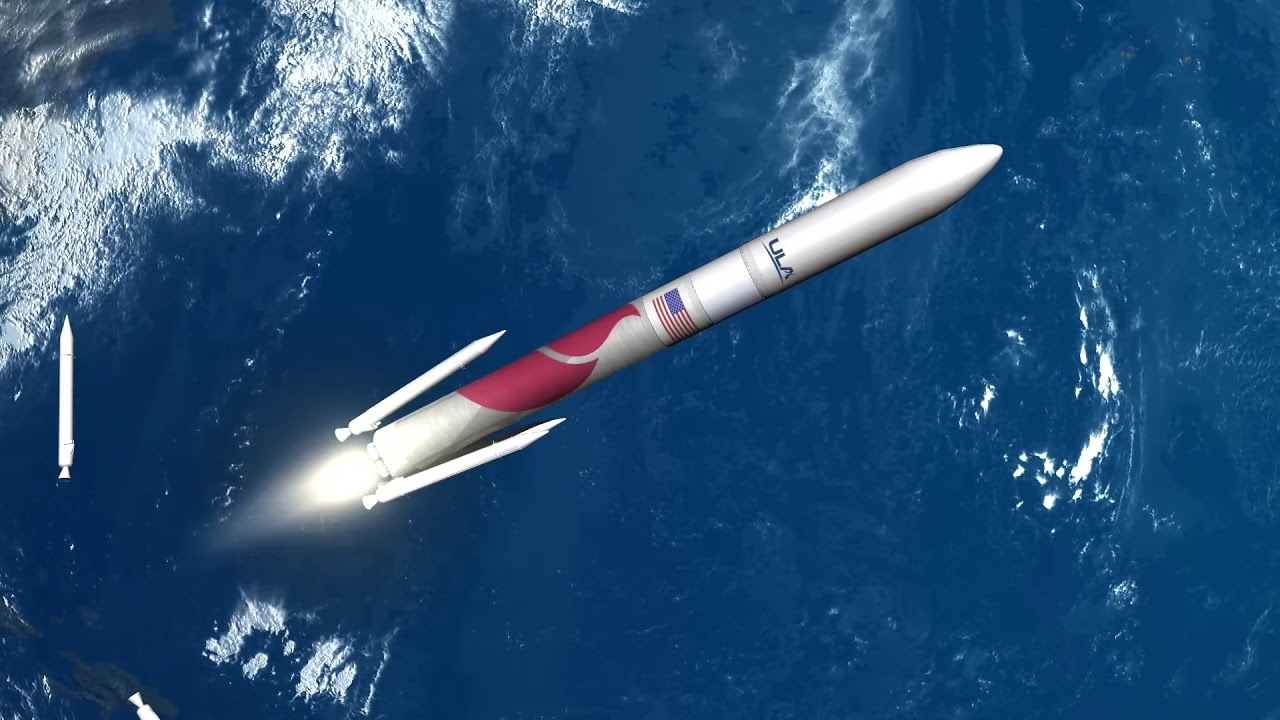
An artist’s impression of the Vulcan Centaur rocket – designed by ULA and with a core stage powered by the Blue Origin BE-4 engine. Credit: ULA
Further, Vulcan Centaur’s capabilities overlap nicely with those of New Glenn, offering Blue Origin with a broad range of launch capabilities. ULA has also sought to eventually make Vulcan Centaur semi-reusable, the engine module being detached from the rocket’s first stage and recovered after splashdown, allowing it to be refurbished and re-used. Such a capability would both dramatically reduce operating costs with Vulcan Centaur – and also match Blue Origin’s desire to develop semi-reusable launch systems, as with its New Glenn. So again, there is a synergy here.
Perhaps most beneficial to Blue Origin is that an acquisition of ULA is the fact that the latter is already an establish provider of launch vehicles to the lucrative US defence market, which Blue Origin could then capitalise upon. In addition, ULA’s Atlas V and the Vulcan Centaur launches are designed to carry humans into space via the Boeing CST-100 Starliner capsule. Thus, Blue Origin gain the means to fly crews into space in partnership with Boeing – potentially vital to its space station plans.
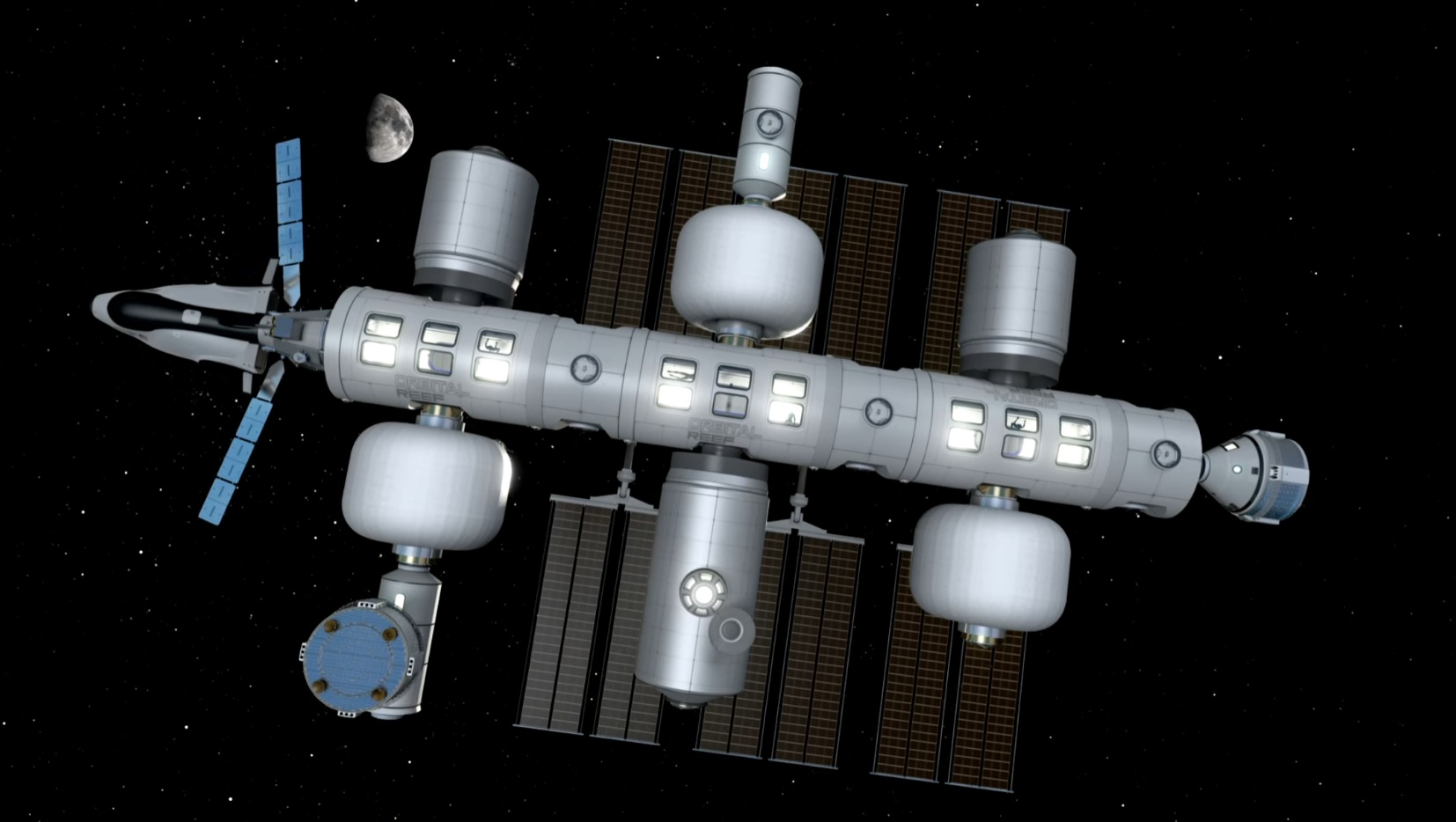
An artist’s concept of the Orbital Reef facility proposed by Blue Origin and Sierra Space, showing the core modules (to be built by Blue Origin) with a Sierra Space Dream Chaser (l) and Boeing CST-100 (r) docked against them, with smaller inflatable and rigid modules mated to either side, with another CST-100 approaching. Credit: Blue Origin / Sierra Space
In 2021, Blue Origin and Sierra Space announced plans for an orbital facility called Orbital Reef, designed to provide facilities for up to 10 people at a time. Under current plans, Blue Origin would provide the station’s large-diameter modules and the launch vehicle (New Glenn), Sierra Space the smaller modules and cargo support via their Dream Chaser vehicle, and Boeing / ULA crew launch capabilities via Starliner / ULA launchers. If Blue Origin obtained ULA, it would further streamline Orbital Reef development / operations. Plus, being able to fly the CST-100 via the Atlas and Vulcan Centaur allows Blue Origin to access a share of NASA’s crewed launch requirements to service the ISS, again through Boeing.
Thus far, neither Boeing nor Lockheed have either confirmed or denied whether ULA is in fact up for sale – but industry insiders believe an announcement on the state of play with ULA – including any winning bid – will be made in early 2024. However, exactly how long any acquisition might take to complete is also unclear, requiring as it would the approval via the US Federal Trade Commission.






 Inara Pey: Living in a Modemworld