The following notes were taken from the Tuesday, June 11th, 2024 Simulator User Group (SUG) meeting. They form a summary of the items discussed, and are not intended to be a full transcript, and were taken from my chat log and the video by Pantera – my thanks to her as always for providing it.
Meeting Overview
The Simulator User Group (also referred to by its older name of Server User Group) exists to provide an opportunity for discussion about simulator technology, bugs, and feature ideas.
Meetings are open to anyone with a concern / interest in the above topics, and form one of a series of regular / semi-regular User Group meetings conducted by Linden Lab.
Dates and times of all current meetings can be found on the Second Life Public Calendar, and descriptions of meetings are defined on the SL wiki.
Simulator Deployments
On Tuesday, June 11th, the Main SLS channel was restarted without any deployment due to a bug in the Spring Break release.
On Wednesday, June 12th, all RC channels should be updated with the bug fixed version of Spring Break, if it clears QA.
The server team has recently switched over to Gitflow as their workflow. This may enable the team to provide very bleeding-edge simulator channels on Aditi (the Beta grid), where the curious can poke at code that is mostly untried and certainly untested.
For the current week, the server team is engaged on a bugsmash run: suspending work on their core projects and spending a week(ish) focusing on resolving bugs and smaller features for inclusion in a future simulator release. Further requests for simulator-side fixes were taken at the meeting.
Monty’s work on smoothly the impact of teleports into regions is starting on its way to being included in a simulator update – no time frame on when it will surface, however.
Leviathan Linden pointed out that there is a public github repository for the official “master message template”. This is the file which describes all of the “message” blocks that can be packed in the UDP SL protocol, both between the viewer and the server and also between the backend servers, and which can be used during local builds of the viewer. However, the repository has been stale for 7 years, and he is now updating it with up-to-date information.
A discussion on avatar physics shapes, physics on avatar attachment (none), avatar physics shapes and hit boxes (the latter related to future Combat 2.0 work).
General discussions on features and options (not all of them simulator-related).
† The header images included in these summaries are not intended to represent anything discussed at the meetings; they are simply here to avoid a repeated image of a rooftop of people every week. They are taken from my list of region visits, with a link to the post for those interested.
Logos representative only and should not be seen as an endorsement / preference / recommendation
Updates from the week through to Sunday, June 9th, 2024
This summary is generally published every Monday, and is a list of SL viewer / client releases (official and TPV) made during the previous week. When reading it, please note:
It is based on my Current Viewer Releases Page, a list of all Second Life viewers and clients that are in popular use (and of which I am aware), and which are recognised as adhering to the TPV Policy. This page includes comprehensive links to download pages, blog notes, release notes, etc., as well as links to any / all reviews of specific viewers / clients made within this blog.
By its nature, this summary presented here will always be in arrears, please refer to the Current Viewer Release Page for more up-to-date information.
Note that for purposes of length, TPV test viewers, preview / beta viewers / nightly builds are generally not recorded in these summaries.
Official LL Viewers
Release viewer: 7.1.6.8745209917, formerly the Maintenance Y/Z RC ( My Outfits folder improvements; ability to remove entries from landmark history), dated April 19 and promoted April 23 – No Change
June 2024 will mark the 21st anniversary of Second Life opening to public access – and to mark it, Linden Lab has announced the 2024 Birthday celebrations as being marked across an entire month – from Friday, June 21st through until Sunday July 21st, 2024.
Theme
This theme for Second Life’s 21st birthday (SL21B) has been given as Elements, which the Lab describes thus:
This theme invites us to explore the fundamental components that make up our vast virtual landscape and the diverse communities within it. From the fiery passion of creators and artists to the fluid adaptability of our social environments, from the solid bonds within our communities to the fresh breezes of innovation that propel us forward, “Elements” is a celebration of the core forces that shape our experiences in Second Life.
For the last several years, the birthday celebrations have included a series of sessions called Meet the Lindens: opportunities for people to hear from and put questions to Linden Lab personnel, generally with questions submitted beforehand. In 2023, these Meet The Linden sessions morphed into Lab Gab sessions, and this year they are being referred to as Town Hall meetings, all to be held live at the SL21B event, and which will include the second of the Community Round Table events, at which questions can be specifically put to members of the Linden Lab leadership team.
It is not clear as to who will be representing the Lab at each of these sessions, or when the sessions will be held. In the announcement that they would be taking place, the Lab only promise details to come and indicate:
The founder of Second Life Philip Linden and Executive Chairman Oberwolf Linden will be among the participants, which also include many leading executives and team leads from Second Life’s Product, Engineering, and Product Operations departments.
However, the blog post does include a link to a form those wishing to ask questions of the Lab can complete and submit, which includes the opportunity to indicate to whom the question should be addressed, if required (although a little difficult outside of the usual suspects for these events given that, as noted, exactly who will be attending them has yet to be announced).
BUT – if you do wish to submit a question, then hop over to the form and do so, and note that it will remain available until Thursday, June 20th, 2024.
Kingsand, June 2024 – click any image for full size
I recently received an invitation from .Tempest Rosca-Huntsman and her SL partner, John (Johannes Huntsman), to visit their latest project, completed under the banner of the Formal Knot group and in association with Kultivate Magazine and Art Hub.
Kingsand is a Homestead region designed by Tempest and adjoining the Kultivate Gallery region. It is offered as a location for relaxation and photography – and to mark its opening, it is also host to a photographic competition running through until June 30th, 2024 offering a combined prize pool of L$30,000 – of which more anon.
Kingsand, June 2024
Accessed via the southern side of the Kultivate Water Haven region, Kingsand presents an open, semi-rugged setting sharing the same region surround as the former, thus allowing it to be enclosed on three sides with high mountains which add depth to photographs taken within it.
The land comprising the region has been divided into three parts, each separated from the others by water channels. The land directly adjoining the Kultivate gallery spaces is fairly low-lying, carrying with in a hint of a wildling garden, ancient paths and steps providing routes between the more even elements of the land, walls and gates offering a further sense of sub-division among the trees and flowers. To the east, this land forms a long finger of a headland, far rockier in nature, bordered by relatively open waters to one side and that larger of the channels cutting into the land on the other. Cut through by a narrow gorge, this headland ends in a low-lying promontory topped by a giant windmill.
Kingsand, June 2024
Across the channel, the larger of two islands cam be reached via a stone bridge. Low-lying to the south and west, this island rises to a tall central peak with highlands reaching up to it from the eastern side. These slopes provide the means to reach the ruins of a cathedral or some similar structure sitting on a shoulder of rock thrusting outwards from the peak.
Apparently now the home of a library / story-telling space rich in flowers and blossoming vines and presided over by a dryad caved into a tree at its centre, the ruins might also be used as a means to reach the top of the mountain – although this does entail dropping down their flank and scrambling through the brambles at their base, and getting back again might be a challenge on foot, given there is no mean to climb back up into the ruins. Although that said, the bare peak is easily visible from the ruins, so such a climb isn’t really necessary unless you’re really wanting to take a photograph of yourself up there.
Kingsand, June 2024
To the west, the land sweeps around the mountain and along the second of the water channels to reach another bridge, this one offering the way to the smaller of the two islands. The most rugged element of the region, this island forms two rocky hills cut through by a natural canyon. The latter leads the way to a deck built out over semi-turbulent waters and offering one of multiple places to sit and pass the time spread throughout the setting.
The overall design is such that the region might be enjoyed by multiple visitors without them necessarily tripping over one another, and with sufficient space for photographers to rez-out props for photography again without necessarily interrupting others. Those who wish to do so should join the Formal Knot group; there is no charge and auto-return is set for 90 minutes. This should be more than enough time to compose props and photographs – but if you take advantage of this and complete your work within the time limit, do please consider taking back your items.
Kingsand, June 2024
Which brings me neatly to the June 2024 photo contest. Full details are in a notecard available from the region’s landing point – together with another card providing region information and rules – however, and in short:
Entries must comprise images taken within the Kingsand region, and entrants are limited to two such images apiece.
Entries must be submitted to the Kingsand Flickr group and bear the tag “Kingsand”.
Prizes will be awarded on the basis of L$10,000 each to two winners and L$5,000 each to two runners-up, for a total prize pool of L$30,000.
In addition, winners, runner’s up and a selection of commended entries to the competition will be exhibited at Kultivate Art Gallery at a date to be announced.
Kingsand, June 2024
Sitting under a fairly neutral environmental setting, Kingsand is perhaps best suited to being photographed using your own EEP settings – the landscape being such that its naturally lends itself to a range of day cycles and settings extremely well. It also seems to lack any ambient sound scape, which is a shame given its natural beauty. However, accepting the region is primarily designed for photography, this does not overly detract from its appeal.
In all a superb setting ideal for photography and avatar studies. My thanks to Tempest and John for the invitation to make a pre-opening visit.
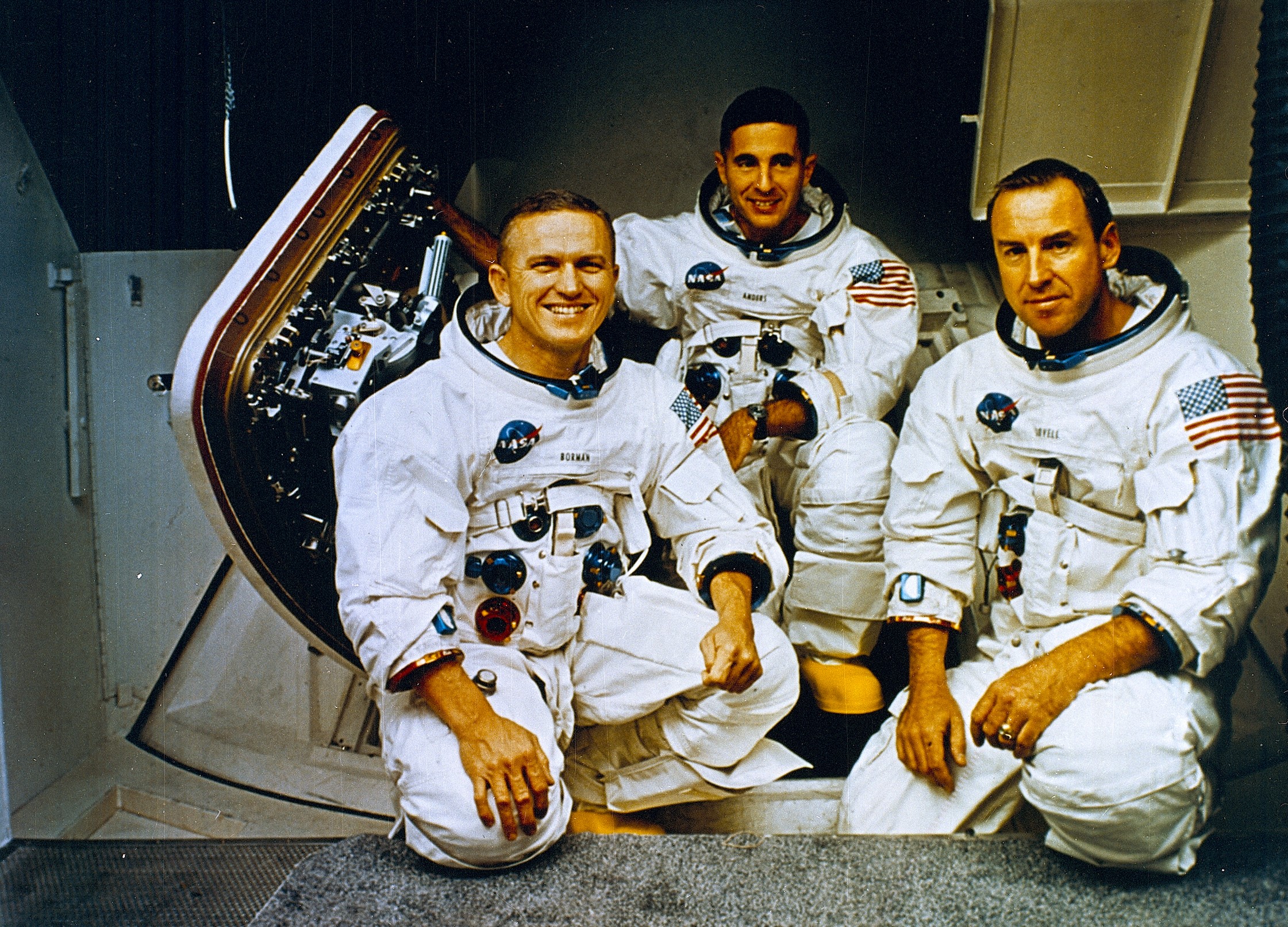
William “Bill” Anders (centre) flanked by his fellow Apollo 8 crew members Frank Borman (l) and Jim Lovell, pictured prior to the launch of their mission on December 21st, 1968. Credit: NASA
Another of the first cadre of humans to visit the Moon and its vicinity was lost to us on June 7th, with the death of William Alison “Bill” Anders at the age of 90.
Born in 1933 in the (then) British Crown Colony of Hong Kong, Anders was the son of a US naval officer on deployment to Hong Kong and China, the family becoming embroiled in the Sino-Japanese War when it broke out in 1937. This forced Anders’ mother to flee Nanjing with her son and survive by wits alone to get them both back to the United States, where they were reunited with Anders’ father, who had been wounded and subsequently rescued by British forces after the Japanese dive-bombed his patrol vessel out from underneath him.
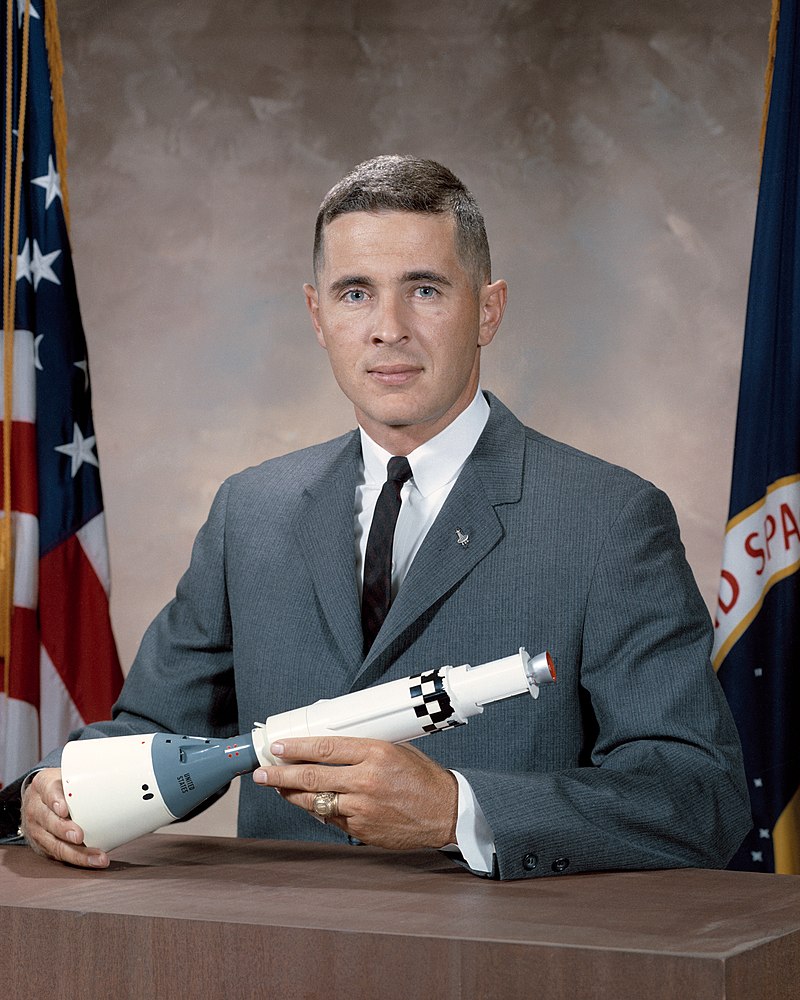
Initially opting to follow his father into the Navy, Anders studied at the US Naval Academy at Annapolis, gaining a degree in electrical engineering. However, enamoured with flying, on graduation he opted to take a commission into the US Air Force and became a fighter pilot. After a series of non-combat operational tours, he sought to become a test pilot – which required he have an MSc. Initially studying aeronautical engineering, he switched to nuclear engineering, gaining his MSc in 1962. However, at that time NASA was recruiting its third astronaut intake and applied and was accepted.
“Bill” Anders in an official NASA portrait photograph from 1964, when he responsible for developing astronaut procedures for dosimetry, radiation effects and environmental controls. Credit: NASA
In late 1966, Anders was assigned to the crew of Apollo 9, alongside Frank Borman and Michael Collins. Together, they would carry out the second Earth-orbiting, crewed check-out of the Apollo Lunar Module (LM), following-on from the Apollo 8 mission crewed by James McDivitt, David Scott and Russell “Rusty” Schweickart. However, by mid-1968, and with both flights due before the end of that year, the LM was not fit for supporting astronauts in space. Fearing the Russians were about to fly a crew around the Moon, NASA decided to switch gear: Apollo 8 would become a cislunar mission, flying with just the Apollo Command and Service Modules (CSM), and Apollo 9 would then complete 1 Earth-orbit crewed test of the LM.
Only McDivitt and his crew didn’t want to go around the Moon, feeling their expertise was better suited to the LM test flight. So instead, the crews were swapped – Borman and Anders, now joined by James “Jim” Lovell, Michael Collins having suffered a back injury requiring surgery – became the Moon-orbiting Apollo 8 crew, and McDivitt’s mission was re-designated Apollo 9, to fly in early 1969.
Thus, on December 21st, 1968, Apollo 8 lifted-off for the Moon, racking up a number of firsts along the way: the first crewed flight of the Saturn V rocket, the first crewed spacecraft to leave Earth’s gravitational sphere of influence; the first crewed spaceflight to reach the Moon; the first crew to broadcast to Earth from lunar orbit – and most famously of all – the first humans to ever witness Earthrise, with Anders capturing what is now regarded as “the most influential environmental photograph ever taken”.
The picture was captured on Christmas Eve 1968, as Anders was using a 70mm Hasselblad camera loaded with a black-and-white film cartridge to image the lunar surface when he happened to look up through the Command Module’s window and see Earth starting to come into view over the Moon’s limb. Calling to Lovell for a colour film cartridge, he quickly re-loaded his camera with it and then took the iconic shot we all now know as Earthrise.
In doing so, he was actually the second human to photograph the Earth rising over the Moon’s limb; the honour of being the first actually goes to Frank Borman – only his camera was also only loaded with black-and-white film. Thus Anders is the first human to capture the sight in the colour image which has come to represent the beauty, loneliness and fragility of the world we call.
The iconic Earthrise image, as captured by Bill Anders on December 24th, 1968. On the left, the enhanced, post-processed version turned through 90-degrees. On the right, the original as it appeared to Anders from within Apollo 8, dur to his orientation in the vehicle. Credit: NASA
If you can imagine yourself in a darkened room with only one clearly visible object, a small blue-green sphere about the size of a Christmas-tree ornament, then you can begin to grasp what the Earth looks like from space. I think that all of us subconsciously think that the Earth is flat … Let me assure you that, rather than a massive giant, it should be thought of as the fragile Christmas-tree ball which we should handle with considerable care.
– Bill Anders describing how he felt when seeing the Earth appearing from behind the limb of the Moon
Bill Anders would only make that one flight in space. In May 1969 he was appointed to the influential position of executive secretary of the National Aeronautics and Space Council (NASC), where he did significant work in developing US space policy. In 1973 he was appointed to one of the five leadership slots of the US Atomic Energy Commission (AEC), transferring to chair the Nuclear Regulatory Commission (NRC) when that was formed in 1975.In mid-1976 he was appointed (at his request) as the US Ambassador to Norway, prior to moving to the private sector and the start of a highly successful career in business in 1977, finally retiring in 1994.
Passionate about flying, Anders, together with his wife Valerie and two of his sons – Alan and Greg – founded the Heritage Flight Museum in 1996, regularly flying the museum’s pistoned-engined aircraft and air shows around the United States. He also owned and operated a T34 Mentor training aircraft, and on June 7th, 2024, he took to the air in this aircraft to fly circuits over Puget Sound, Washington State, where he lived. During this flight it appears – via eye witness video – he attempted a low-altitude loop in a channel between two islands, but the aircraft failed to pull up in time, slamming into the water and breaking up, likely killing Anders instantly. The accident is now under investigation by the US National Transportation Safety Board (NTSB).
Anders is survived by his wife of 67 years, Valerie, and their six children.
Starliner Launches; Issues Persist
Boeing’s much-troubled CST-100 Starliner finally lifted-off on its first crewed test flight at 14:52 UTC on Wednesday, June 5th, finally sending astronauts Barry “Butch” Wilmore and Sunita “Suni” Williams on their way to the International Space Station (ISS) in a flight intended to help clear the Starliner capsule for use in ferrying up to four crew at a time to the ISS, and in an emergency (and depending on available seating), returning up to 7 to Earth.
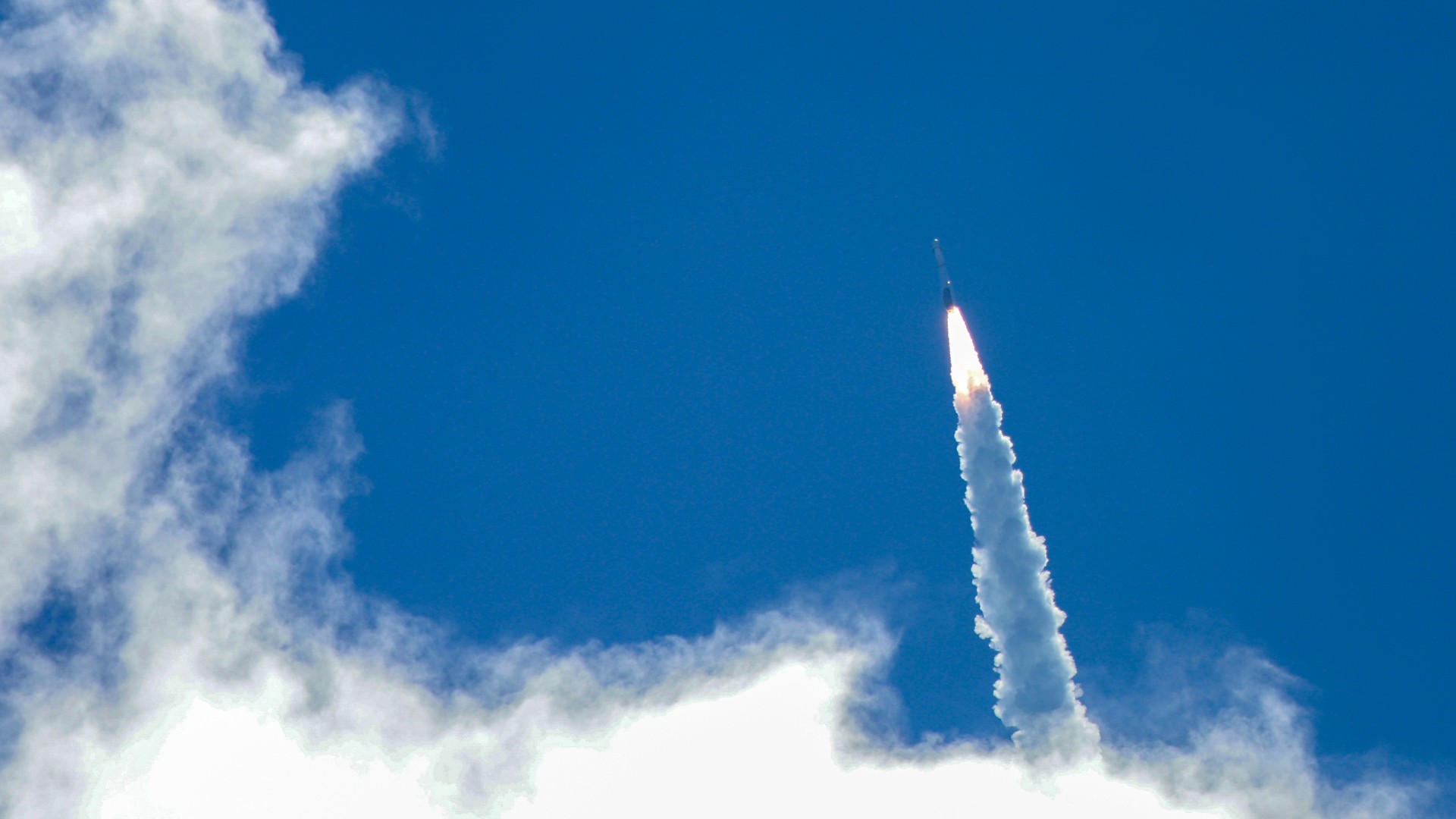
June 5th, 2024: Boeing’s Starliner spacecraft climbs into the sky atop a United Launch Alliance Atlas V-N22 from Cape Canaveral Space Force Station in Florida at the start of the Crew Flight Test. Credit: Joe Raedle via Getty Images
As I’ve reported in past Space Sundays, the Crew Flight Test of the vehicle has been plagued by problems – many with Starliner itself, but also extending to launch systems on the ground and systems within its launch vehicle, the Atlas-Centaur V-N22. However, the launch on June 5th was flawless, and marked both the first time in history that humans have flown atop the veritable Atlas V, which is more usually employed for cargo carrying launches, and the first time since Apollo 7 in 1967 that a crewed vehicle has lifted-off from facilities at Cape Canaveral Space Force station (then called the Cape Kennedy Air Force Station).
Fifteen minutes after launch the Starliner separated from the Centaur upper stage, entering a sub-orbital trajectory around the Earth, allowing for a preliminary vehicle check-out and a rapid return to Earth in the event of issues. With the crew and ground personnel satisfied all was well, Wilmore and Williams used the vehicle’s propulsion system to increase its altitude and velocity, enabling it to enter orbit 31 minutes after lift-off.
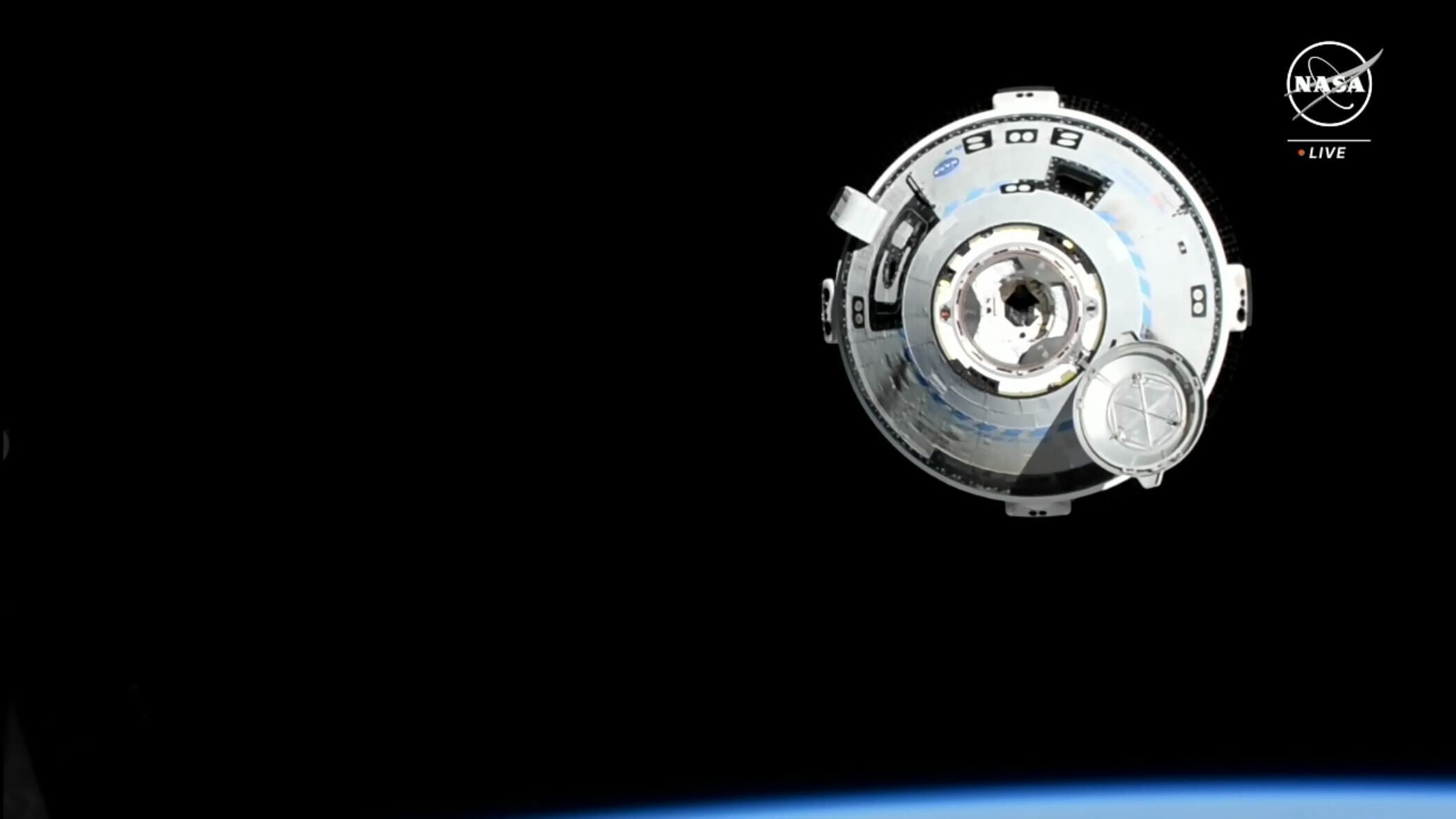
Starliner Calypso sits just off the ISS prior to docking on June 6th, 2024. Credit: NASA
The rest of June 5th saw the crew carry out a series of tests with the vehicle as it climbed towards the ISS, putting it through various manoeuvres and testing communications and other systems. During this time further helium leaks were detected in the vehicle’s thruster system – a known leak having been the cause of one of the delays to the mission’s launch – and 6 of the vehicle’s 28 thrusters were shut down. This did not impact vehicle performance, but the fact that four further helium leaks were detected on top of the known leak indicates there may be a systematic issue within the design of the propulsion system.
Further issues occurred during the vehicle’s approach to the ISS on June 6th, when five of the reaction control system (RCS) thrusters were automatically deactivated, forcing the actual docking to be delayed, Starliner held in a station-keeping position by Wilmore and Williams some 200 metres from the station whilst a team on the ground recovered four of the recalcitrant thrusters, enabling the vehicle to dock with the Harmony module on the station. Hatches between vehicle and station being opened 2 hours after docking, to allow for further post-flight checks on the dock seal within the vehicle and for Williams and Wilmore to change out of their pressure suits.
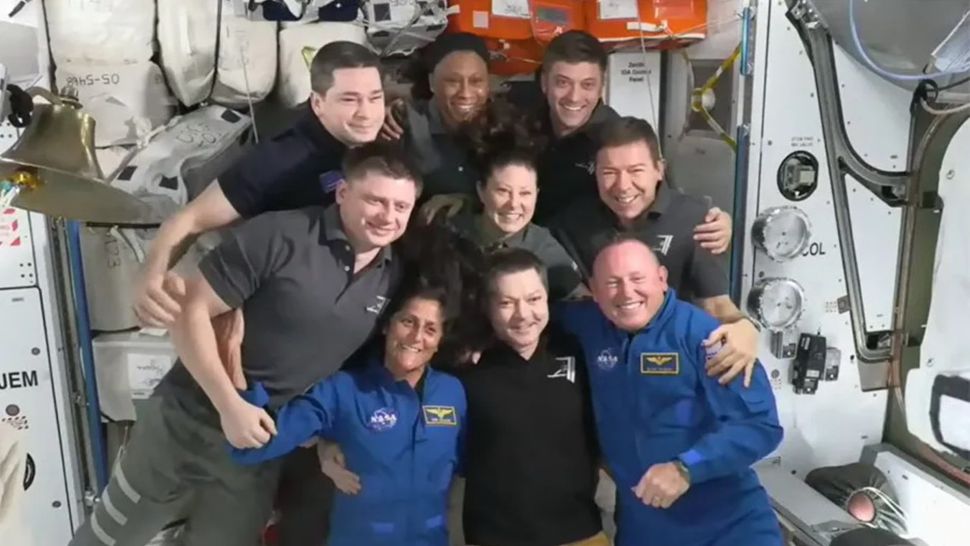
“Suni” Williams and “Butch” Wilmore (in blue NASA jumpsuits) celebrate their arrival aboard the ISS with the crew of Expedition 71. Credit: NASA
The vehicle will remain docked at the ISS for several more days prior to departure with Wilmore and Williams for a return to Earth and a soft landing in New Mexico on June 14th.
June brings with it Cica Ghost’s installation for the the month, located on her Homestead region of Mysterious Isle, and this time it is a little different from recent installations from Cica.
Entitled Under the Stars, it comes with a quote from John Green’s debut novel (2005), Looking for Alaska, which – as with the majority of the quotes Cica uses – frames the theme of the installation, without necessarily reflecting the source it is taken from (in this case, Looking for Alaska being a coming of age story):
At some point we all look up and realize we are lost in a maze.
– John Green
Cica Ghost: Under the Stars, June 2024
Instead, the quote literally describes the core of the setting – a maze carved into the ground and sitting under s starry sky. The landing point sits at the start of the maze and to one side of the region, the way forward marked by high walls of terrain and the path quickly splitting. Which arm you take is entirely up to you – but what I would suggest is that you resist the temptation to cam upwards and look at what might be sitting above and instead allow the maze to unfold before you.
This actually makes describing the setting a little hard, as it really is best taken as a voyage of discovery. However, within the maze is a series of open spaces, some of which are home to giant creatures of fantasy; but these are not monsters; rather they are more like oversized cuddly toys, some of which bring to mind memories of Dr. Seuss. All are sleeping, the stars overhead looking like lights spread across a green sky of grass, presenting the feeling we are somehow underground whilst at the same time suggesting the creatures are all lost in happy dreams. Those spaces with a creature contain one of Cica’s marvellous drawings.
Cica Ghost: Under the Stars, June 2024
Also scattered through the maze are ladders leading up to the ground above. These can be climbed to reveal what lay overhead. Again, I don’t want to spoil things by saying too much here.
With a number of places to sit, creatures to photograph (and purchase!), Under the Stars is another genuine delight from Cica and fully deserving of a visit.







 Inara Pey: Living in a Modemworld