
If all goes according to plan, this coming week – possibly Wednesday, April 1st – we’ll see the Artemis 2 mission lift-off from Kennedy Space Centre, Florida, carrying four humans to the vicinity of the Moon, the first mission to do so in over half a century.
The journey to get to this point has been long and arduous; projects have been initiated, cancelled, re-organised and recommenced, funding has been provided, cut, renewed, reduced, extended… but the dream of returning to the Moon had remained steadfast in the eyes of enough people (doubtless aided by China’s emergence on the human spaceflight scene with their announced intent to go to the Moon), to keep political minds engaged in the journey.
Artemis 2 is very much a proving mission, aimed at ensuring the Orion Multi-Purpose Crew Vehicle and its European-built service module are both fit for purpose in supporting crews of four on extended missions to the Moon, as well as testing critical capabilities required for those missions which will actually deliver humans to the South Polar Region of the Moon starting with Artemis 4 – such as rendezvous and docking with the lander vehicle those headed for the Moon will use.
But who are the four people who will be aboard Artemis 2’s Orion capsule, with its “space toilet” that has so fixated much of the media? I thought I’d offer some brief biographical notes.
Commander Gregory Reid Wiseman, Mission Commander

Known simply as Reid, and a US Naval aviator and Captain, Wiseman has already accumulated 165 days, 8 hours and 1 minute in space (including 12 hours and 47 minutes split across 2 EVAs), having flown to the International Space Station aboard Soyuz TMA-13M and as a part of the Expedition 40/41 crew between May and November 2014.
Born in Baltimore, Maryland in 1975, Reid earned a degree in computer science from Rensselaer Polytechnic Institute, new York. In 2006, whilst a member of the Navy Reserve Officer Training Corps (NROTC), he gained a master’s degree in systems engineering from Johns Hopkins University.
In 1999, Wiseman was designated a Naval Aviator and underwent training to fly the famous F-14 Tomcat. Initially based at Naval Air Station Oceana, Virginia, he was deployed prior to being deployed to the Middle East for two tours of combat duty. During his second tour of duty, he was selected to attend the US Navy Test Pilot School, where on graduation he was assigned as a test pilot and Projects Officer at the Naval Air Station Patuxent River, Maryland. Following this, he was assigned to carrier duty and transitioned to flying the F/A-18 super Hornet, once again seeing overseas deployments. He transferred to NASA in 2009.
Following his time aboard the ISS as a part of Expedition 40/41, Wiseman was appointed Chief of the Astronaut Office, a post he held for 2 years (December 2020 through the end of November 2022), stepping down from the post to active flight status in the hope of securing a position on one of the Artemis missions. In April 2023, he was selected to command Artemis 2.
Wiseman was married to Carroll Wiseman (nee Taylor), with whom he had two daughters, through to her death from cancer at age 46.
Victor Jerome Glover Jr, Mission Pilot

During the three years between 2007 and 2010, Glover earned three further degrees: a Master of Science in flight test engineering; a Master of Science in systems engineering and Master of Military Operational Art and Science, all of which were earned whilst he was a serving officer in the US Navy. He gained his aviator wings in 2001, and like Wiseman, trained on the F/A-18 Hornet. Also like Wiseman, he saw duty at NAS Oceana prior to being assigned to the USS John F. Kennedy and deployed to the Middle East as a part of Operation Iraqi Freedom.
Following this, Glover also entered the US Navy Test Pilot School, and served as a test pilot based at China Lake, California. Subsequent to this, he was sent to the US Naval Air Facility, Atsugi, Japan, and thence to the USS George Washington for a Pacific Ocean tour of duty. Throughout his military career, Glover used the call sign “Ike”, a sobriquet jokingly given him by his first commanding officer, which was said to mean “I know everything”, on account of his long list of degrees.
As well as earning multiple technical degrees, Glover also obtained a Certificate of Legislative Studies which led him being offered a role within Senator John McCain’s staff.
Glover joined NASA in 2013, and following the completion of his training, he was assigned to fly on the first operational flight (and second crewed flight overall) of SpaceX’s Crew Dragon, also serving as a crew member for Expedition 64/65. The mission launched in November 2020, with Glover clocking 167 days 6 hours and 19 minutes in space, 26 hours and 4 minutes of which were spent performing four separate EVAs.
He was announced as the Artemis 2 Pilot alongside Wiseman and the other crew members in April 2023. He is married to Dionna Odom Glover and they have four daughters.
Mission Specialist Christina Koch

Christina Koch (nee Hammock) has accumulated the most time in space thus far of any of the Artemis 2 crew – a total of 328 days 13 hours and 58 minutes; 42 hours and 15 minutes of which were spread across 6 individual EVAs.
Born in Grand Rapids, Michigan in 1979, Koch was raised in Jacksonville, North Carolina. From the earliest she can remember she had always wanted to be an astronaut. Following schooling, she enrolled in the North Carolina State University, earning Bachelor of Science degrees in engineering and physics before going on to gain a Masters in electrical engineering. In 2001, whilst still studying, she was accepted into the NASA Academy Programme at the Goddard Space Flight Centre (GSFC), Maryland.
At GSFC, Koch worked out of the High Energy Astrophysics facility, contributing to scientific instruments on several NASA missions that studied astrophysics and cosmology. In 2004, Koch took a 3-year secondment with the US Antarctic Research Programme as a Research Associate, spending her time in both the Antarctic and Arctic regions. Whilst in Antarctica, Koch experienced temperatures of -79.4º C. She also served as a member of the fire fighting teams at the various bases she worked at, and also joined the Ocean / Glacier Search and Rescue teams.
Returning to the US in 2007, Koch contributed to instruments studying radiation particles for NASA missions, including the Juno and Van Allen Probes whilst seconded to the Applied Physics Laboratory at John Hopkins University. She then spent time at NASA’s sister organisation, the National Oceanic and Atmospheric Administration (NOAA).
In 2013, Koch was selected for astronaut training alongside Victor Glover. She was subsequently selected for Soyuz MS-12 as a part of the Expedition 59/60/61 crew. Koch joined astronaut Jessica Meir in the first all-female EVA ever undertaken, carrying out a series of upgrades to the power systems on the ISS across a total of three joint EVAs.
Originally, Koch was to have returned to Earth at the end of the Expedition 60 rotation. However, due to reassignment schedules, she was asked to remain aboard the ISS a further 6 months, allowing her to clock up her 328 days record in space – the longest continuous stay in space by a woman.
Jeremy Hansen (CSA), Mission Specialist

Jeremy Roger Hansen is the rookie among the crew and the only non-American. Born in London, Ontario, Hansen attended the Royal Military College, Ontario following his high school education. At RMC Ontario, he earned a Bachelor of Science degree with First Class Honours in space science in 1999, before going on to earn a Master of Science degree in physics with a research focus on wide field of view satellite tracking.
In 2009, Hansen was accepted into the ranks of the Canadian Space Agency, training as an astronaut. In 2013 he was selected to join the European CAVES programme, becoming a “cavenaut”. The following year NASA selected Hansen to serve as an “aquanaut” aboard the Aquarius underwater laboratory during the 7-day NEEMO 19 undersea exploration mission.
Hansen is married to Doctor Catherine Hansen, a distinguished expert in women’s health. Together, they have three children.
The Artemis 2 Mission Patch
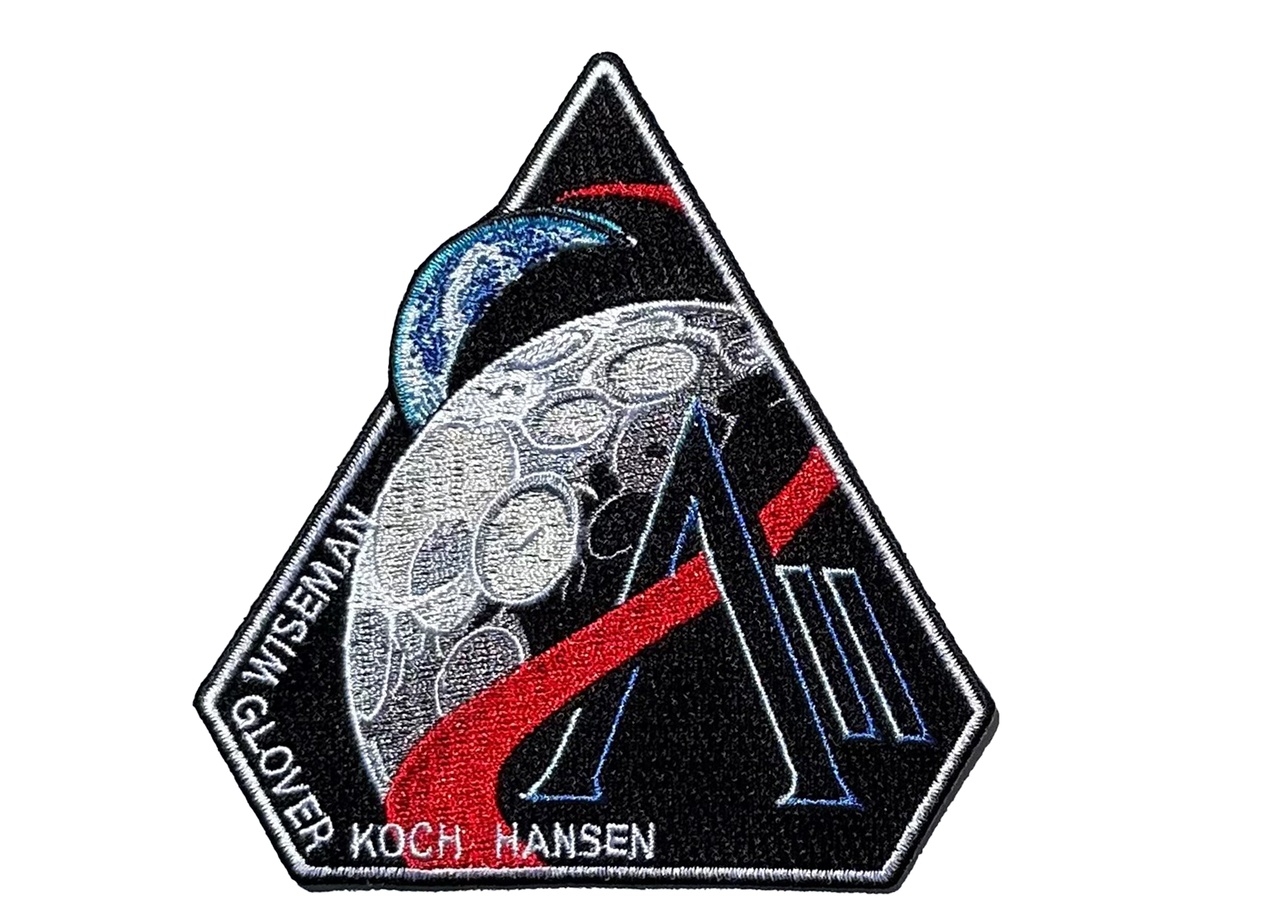
All NASA missions traditionally have a mission patch designed by the crew (with NASA management approval over the final design!).
These patches are generally symbolic in nature, often containing references to the mission or to current or past space events. In this, the Artemis 2 mission patch is no exception.
Firstly, its shape is symbolic of the Orion capsule’s general shape, indicating the vehicle as a home for the 4 crew. A stylised “A II” occupies the right side of the patch, directly over the lunar far side – thus denoting the mission’s trip around the Moon, a red ribbon running from Earth and around the Moon mirrors a similar ribbon in the Project Artemis patch, the red of the ribbon indirectly referencing NASA’s role in aeronautics – as per the red chevron in the NASA insignia). The Moon is dominant in the patch, with the Earth rising behind it.
If this particular part of the patch rings bells, rest assured it is intentional: the Moon with the Earth rising behind it is designed to evoke memories of the famous Apollo 8 image Earthrise, thus linking Artemis II with the first Apollo space mission to fly around the Moon and back to Earth.
How to Watch the Launch
Artemis 2 is due to launch no earlier than 22:24 UTC on April 1st, 2026. You can watch the countdown and launch via NASA’s livestream (commencing 16:50 UTC on April 1st).
Lunar Gateway ”Paused”
Jared Isaacman, NASA’s current Administrator, continues to shake things up around Project Artemis – and quite possibly for the better in terms of focus and goals.
As I’ve previously covered, Isaacman has already made significant changes to Project Artemis which impact both missions and hardware (e.g. Artemis 3 will now be an Earth-orbiting mission, not a lunar landing mission).

On March 24th, 2026, Isaacman informed NASA personnel and the press that the space agency will be “pausing” work on its proposed Gateway Station, the much heralded space station occupying an extended halo orbit around the Moon. For those (myself included) who could not see any practical benefits in spending time and money developing yet another (if much smaller than the ISS) space station in lunar orbit, this is welcome news.
Gateway station has always come across as an unnecessary complication in getting people to / from the Moon. It’s halo orbit means it will only be within reach of crews on the lunar surface once every seven days – which is great when you have an emergency and need to evac someone pronto and then have to rendezvous with the station in order to get them back to Earth. It will also require a lot of additional faffing around with rendezvous and docking manoeuvres and generally act as something of a boondoggle, drawing on funding that could be better spent elsewhere – such as the infrastructure actually required to establish a permanent base on the Moon.

This is what Isaacman is proposing: spending some US $20 billion over a period of seven years – a good portion of that money coming from allocations that would otherwise have gone to gateway – to develop and construct a permanent base on the Moon. Isaacman also expects member states involved in the Artemis Accords to help cover a portion of the of the costs – although as I’ll come to, this might not be so easy.
No hard details on the base were given – such as location, what infrastructure will be required (such as power systems – presumably nuclear – and so on), or how delivering the infrastructure and materials required to build the base will be achieved – although presumably Isaacman will be looking to the likes of Blue Origin and SpaceX with cargo variants of the lunar landing systems.
Not everyone is happy with the move, however. Japan and the European Space Agency were already partners in Gateway and due to provide core components and elements for the station and have been gradually ramping-up for production of said elements. Neither appear to be entirely sanguine over Isaacman’s decision, with ESA issuing a terse statement that could be read as meaning they’d been giving little or no warning of Isaacman’s decision, re Gateway.
The European Space Agency is currently holding close consultations with its member states, international partners and European industry to assess the implications of this announcement.
– ESA quote via AFP in response to Isaacman’s announcement on “pausing” Gateway Station
If this is the case – that there was no in-depth consultation on Gateway’s future with the likes of ESA and JAXA, then while the “pausing” of Gateway is welcome, the handling of the announcement could be seen as somewhat less than diplomatic.
 Inara Pey: Living in a Modemworld