2026 week #3: SL CCUG and Open Source (TPVD) meetings summary

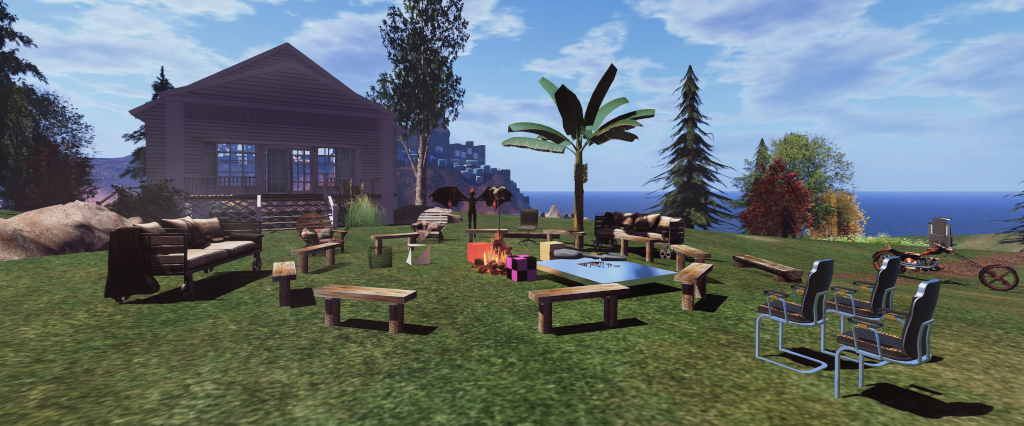
Hippotropolis Campsite: venue for CCUG meetings
The following notes were taken from:

  • My chat log of the Content Creation User Group (CCUG) meeting of Thursday, January 15th, 2026 and my chat log of that meeting
  • Pantera’s video (embedded at the end of this article) and my chat log of the Open-Source Developer meeting held on Friday, January 16th, 2026.
Table of Contents

Please note that this is not a full transcript of either meeting but a summary of key topics.

Meeting Purpose

  • The CCUG meeting is for discussion of work related to content creation in Second Life, including current and upcoming LL projects, and encompasses requests or comments from the community, together with related viewer development work.
    • This meeting is generally held on alternate Thursdays at Hippotropolis and is held in a mix of Voice and text chat.
  • The OSUG meeting is a combining of the former Third Party Viewer Developer meeting and the Open Source Development meetings. It is open discussion of Second Life development, including but not limited to open source contributions, third-party viewer development and policy, and current open source programs.
    • This meeting is generally held twice a month on a Friday, at 13:00 SLT at the Hippotropolis Theatre and is generally text chat only.
  • Dates and times of meetings are recorded in the SL Public Calendar.

Official Viewer Status

  • Default viewer 2025.08 – 7.2.3.19375695301 – maintenance update with bug fixes and quality of life improvements – December 2 – No Change.
    • Notable addition: new VHACD-based convex decomposition library for mesh uploads.
  • Second Life Project Lua Editor Alpha version 7.2.3.19911032641, December 5 –  No Change.
  • Second Life Project Voice Moderation viewer 26.1.0.20139269477, December 12 – No Change.
    • Introduces the ability to moderate spatial voice chat in regions configured to use webRTC voice.

Upcoming Viewers

Viewer 2026.01 – One-click Installer / Updater

Viewer 2026.01 is in progress. This will include:

  • Improved bugsplat support (we want better reporting for freezes, and just generally better crash reporting). This work builds on the successes of 2025 in detailing with viewer crashes and reducing overall causes for crashes.
  • A new one-click installer, which in brief:
    • Will be powered by a new dependency called velopack, and will allow a single-click installation of the viewer (with a brief pop-up message), with the viewer launching once the install process is complete.
    • Will default to installing under Apps/Local on windows; will remain as a drag-and-drop process on Mac OS, while Linux is currently TBD. It will still be possible to install the viewer to a custom location, initially via a command line argument.
    • Will not change the install location of config files, or anything that counts as user data.
  • Development work on this did hit a delay, which has now been cleared, the hope remaining to get an Alpha (previously known as Project) viewer out with the update code in place sooner rather than later.
  • As an added benefit to the switch to velopack for TPVs, LL will be providing a solution to add auto-update functionality to TPV projects, if TPVs wish to leverage it. More information on this is due to be made available in the next week or so.

Viewer 2026.02 – “Flat” UI, Font Changes

  • This viewer is to be part of the Lab’s “first impressions” push to make SL resonate more with incoming new users and hopefully encourage them to keep logging in.
  • This first impression work is on multiple fronts, and for the 2026.02 viewer will be a switch to the “flat” UI seen in the Project Zero (viewer in a browser) version which comprises things like a font change, a colour scheme change,  and generally giving the viewer a more “modern” look and feel.
  • The font update:
      • Should not impact people’s use of unicode.
    • Will require XUI updates which will likely require updates for TPVs using their own custom XUI – TPVs are advised to keep an eye on Discord and Github for more information on these changes as they develop, and to particularly track this github issue.

General Viewer Notes

  • Linux support will likely ship as a part of the in-progress SLua beta viewer.
  • The viewer development roadmap is still being worked on in terms of fixes and updates and actioning feature requests, the focus being to work these into the viewer without disrupting major initiatives the Lab is looking to develop (such as the “first impressions” drive).
  • 2026.02 might include some screen space reflections (SSR) updates to help improve the appearance of Linden Water under PDR/HDR.
  • The avatar appearance fixes contributed by Kitty Barnett and intended to make the current outfit folder more reliable when changing outfits, messing with outfits, etc., may get to see the light of day in viewer 2026.03 – but this had yet to be confirmed.

Grid-Wide WebRTC Deployment – Initial Announcement (OSD Meeting)

  • The Lab is currently looking at a March deployment of WebRTC voice across the grid.
  • The schedule is not firmly set as yet, but will follow the usual server-side deployment routine: first to one (or more) simulator RC channels, then to all simulator RC channels (if not all rolled at once), and then a week after this, deployment to the Main simulator channel.
  • The important point in this is that once grid-wide, WebRTC will completely supplant Vivox Voice, and those who use Voice by who are not running a WebRTC voice capable viewer (which generally means anyone not on a non-PBR supporting viewer) will be unable to use Voice.
    • This does not mean that the Vivox service will be immediately shut-down. It will remain an option for the Lab to re-enable until such time as LL is confident in the WebRTC service and no surprises have come to light.
  • There is one remaining WebRTC critical issue in the viewer that makes the experience not great for a small body of users:
    • People with certain network characteristics may see a dropout because the WebRTC provider is not properly handling renegotiation.
    • LL has a fix which should be deployed with viewer 2026.01. However, TPVs wishing to merge it now can do so via Pull Request 5126.
  • In the meantime, the beta for WebRTC has expanded – see this official blog post for details.
  • Roxie Linden also indicated that LL is experimenting with speech-to-text using WebRTC, but does not as yet have anything available for public demonstrations.
  • The issue of Linux builds not using Pulseaudio but with the WebRTC code crashing on start-up was reiterated at the meeting. Whilst this might not be a widespread issue, the feeling was that it should be looked at; however, if the pool of impacted users is liable to be very small, it will not be seen as a reason to block / delay WebRTC deployment as a whole and any fix is liable to be prioritised in terms of resources / impact of the issue, post-deployment.

General Discussion – Both Meetings

  • Avatar support related:
    • Shape key support and / or custom bone hierarchies – seen as complex area of work, and not being looked at.
    • While the current avatar does technically use shape keys, it is very different to how modern blend shapes are used.
    • SL’s internal format also doesn’t store bones.
  • Questions were raised on the status of game_control. This is more a subject for the Simulator User Group meetings, where Leviathan Linden indicated he was trying to resume work on the code. However, it was also indicated during this meeting that Leviathan had again been “borrowed” to work on other code.
  • Despite rumour to the contrary, Puppetry is not currently set for revival or on the current 2026 roadmap.
  • Geenz noted that while work on things like new tools, updates to the GLTF uploader, etc., are not “done”, the focus for the time being in more on dealing with technical debt together with the aforementioned “first impressions” initiative, etc.
  • Questions were asked on auto / planar-aligning PBR materials  – see: Aligning Faces when using PBR and Planar face alignment with PBR GLTF materials. This is something the Lab has yet to resolve, and has offered a contribution bounty for any developer who is able to provide a solution. Geenz also indicated he would try to get bugs like this better prioritised.
  • A general discussion on ideas for improvements to chat, including: ability to have a “last unread” indicator in chat when logging-on; having the chat rings on the mini-Map on by default, some idea about a special chat tab that would allow region-wide chat (presumably at the region owner’s discretion to enable), ability to correct text in chat / IM after sending(!), etc.
  • The You Tube embedding issues was again raised (see here for more), with a possible (if hacky) workaround. LL are looking to You tube to address the problem, as they created it.
  • There was a general discussion on the complexities of Land Impact, particularly – but not restricted to – mesh objects. In short, LI is a complicated subject, and not easily addressed; hence why the Lab backed away from the subject recently. This also strayed into the equally complicated realm of LOD generation.
    • On the subject of LOD generation, it was suggested that the Lab should look to implement a LOD generator and then inform creators LODs have to be generated  to fit a defined set of criteria – or defaults will be forced.
  • A discussion on the choice of VHACD over HACD as a replacement for Havok in mesh decomposition. The latter is seen as more mature, but LL opted for VHACD is a “middle ground” solution as it is more regularly maintained, it is also apparently more reliable when dealing with the “weirder meshes” some SL creators produce, when compared to something like CoACD. However, Geenz indicated it would be “nice” to have “swappable”  convex decomposition solutions at runtime.
  • A further request for Error creating thumbnail” message on SL wiki, breaking images  to be addressed.

Next Meetings

January 2026 SL Web User Group

The Web User Group meeting venue, Denby

The following notes cover the key points from the Web User Group (WUG) meeting, held on Wednesday January 14th, 2025. These notes form a summary of the items discussed and is not intended to be a full transcript. Pantera’s video is embedded at the end of this article, my thanks to her for providing it.

Meeting Overview

  • The Web User Group exists to provide an opportunity for discussion on Second Life web properties and their related functionalities / features. This includes, but is not limited to: the Marketplace, pages surfaced through the secondlife.com dashboard; the available portals (land, support, etc), and the forums.
  • As a rule, these meetings are conducted:
    • On the first Wednesday of the month and 14:00 SLT.
    • In both Voice and text.
    • At this location.
  • Meetings are open to anyone with a concern / interest in the above topics, and form one of a series of regular / semi-regular User Group meetings conducted by Linden Lab.
  • Dates and times of all current meetings can be found on the Second Life Public Calendar, and descriptions of meetings are defined on the SL wiki.

Updates

  • The past month hasn’t been very active for the web team due to the holiday season. There has been a focus on internal updates, security patching, and clean up.
  • Some of the above include:
    • Additional security features around marketplace to increase security and add resilience.
    • Version upgrades to LL’s internal services for security upgrades.
    • Upcoming security feature to nudge residents to update and verify their email address on file.
  • There is also something of a focus on trying to clear-up outstanding Canny issues (so maybe this and this will get addressed?).
  • There is a hope that the focus on back-end services, whilst not necessarily visible to users will this help to see the overall experience of using the Marketplace, etc., become far smoother with fewer outages, issues with people being overcharged for product listing enhancements (PLEs), etc.
  • A significant push for 2026 will be “first impressions” / the new user experience -trying to further improve things so that incoming users have a generally positive experience which encourages them to keep logging-in.

In Brief

  • Kali Linden departed the Lab around the end of November / beginning of December to become VP of system security at a new start-up. Many thanks to her in absentia for all her work a LL.
    • As a result of this, the Lab’s web engineering are operating on a “shared ownership” basis until someone can be hired-in to fill Kali’s role.
    • Kali’s departure also means that some of the planned roadmap for web properties (e.g. the Marketplace UI overhaul) are being reassessed in terms of what can / should be achieved, etc.
  • There have been reports of the SL forums running “slowly” for people in the UK (and Europe?). The Forums are operated by a third-party supplier, and somewhat outside of LL’s direct control. This has been escalated to the forum vendor, but not other updates at present.
  • A request was made to be able to transfer L$ amounts between accounts / to others via a user’s secondlife.com Dashboard – with suitable security in place.
    • This was seen as an “interesting” idea, but would likely require some additional security – such as being tied-into MFA.
    • No commitment was made towards implementing the idea at this time, because further investigation on requirements, etc., would be required.
    • A suggestion was made to set a limit on how much a user directly transfer – or allowing a user to set a limit on the amount (e.g. account-to-account, rather than via a vendor or similar system) at any one time, in order to safeguard accounts against being emptied if successfully hacked. This was also seen as potentially interesting, but could be a  dynamic / fluid set of rules.
  • LindeX use, transaction fees, etc., came up for discussion (although perhaps better placed at the content Creation meeting, where people who routinely cash-out from SL are liable to be in attendance).
    • A loose consensus at the Web meeting was that greater clarification should be given as to what can be paid for directly using L$ / the USD wallet &without incurring additional processing fees (e.g. some users apparently think they have to convert L$ to dollars in order to pay their tier, etc.).
    • A clearer break down of the current transaction fees in a single place (buy for L$, credit processing for cashing-out, cost for subscribers, etc.) could perhaps be given within the Dashboard.
  • A discussion on SL maps – including searching by region name, improving World Map tile resolution, enhancing the map capabilities in general, etc.
    • A fair point was made that the maps are a core way of expressing the size and persistence of SL – yet the capability and the functions around it are perceived as being of little interest to LL management when it comes to prioritising updates, etc., with the focus appearing to be only on areas that directly affect commence in SL.
    • Maps are a vital component in the “first impression” aspect of Second Life – if incoming users can be encouraged to understand the SL is bigger than the welcome hubs and the selected destinations beyond them – and that they can, using the maps – explore on their own / in conjunction with the Destination Guide, then there is a motivation for them to keep logging-in and to start exploring.

Next Meeting

  • Wednesday, February 4th, 2026.

A short personal note and apology

Luane’s World, Winter 2025 – blog post

At the start of October 2025 I noted that I would be taking something of a break from SL and blogging in order to address a health issue which had been developing since earlier that year. At the time I did not go into specifics – nor do I intend to here. Rather, I wanted to let people know that circumstances were such that a break was required, and its exact length might well be indeterminate.

As it turned out, things initially appeared to go better than planned: the surgery proved to be less complicated than had originally described, and the immediate cause for concern fully excised. As a result, my immediate recovery proved to be faster than anticipated, notably in terms of the time I was actually in hospital, such that by the latter third of October I was hoping I’d be returning to SL and blogging pretty much “full time” as it were.

Unfortunately, by mid-November it became apparent that despite these positives, the underlying cause of my problem had not been completely eliminated, and I would therefore require a more sustained period of treatment in order for it to hopefully be dealt with. As a result, my focus on SL and blogging has continued to be reduced and noticeably haphazard throughout the end of 2025 and into 2026 – and will most likely continue to be the case for at least the immediate future.

I mention all of this not to elicit thoughts and messages of sympathy and / or support, but because I’m aware that during the latter part of November and through December I received a lot of personal requests to attend a range of events (art, charity, music, etc.) and / or to ask for my help in promoting specific activities, the openings of public regions, etc., the majority of which went unanswered. As such I genuinely believe an apology for such a lack of response is warranted; the fact that my ramblings and this blog are viewed with regard by many is something I never wish to take for granted – it has and remains something for which I am ever grateful. Thus, I hope readers will take this post in the manner it which it is offered, and continue to bear with the unpredictable nature of my blogging until things again start to settle down for me.

In the meantime, my thanks to everyone for continuing to read this blog, and especially to those who have asked after my health through IMs, DMs, and the like; it really has helped lift my spirits.


IP.

Space Sunday: an evacuation and astronaut health

The International Space Station as it appeared from a Crew Dragon vehicle in 2021. Credit: NASA / SpaceX

For the first time in the history of the International Space Station (ISS), NASA is curtailing an entire crew rotation in order to bring an astronaut with an undisclosed medical condition back to Earth in order for them to receive full and proper treatment.

Exactly what the medical issue is has not been disclosed, although NASA has confirmed it is not injury related and the move is being made out of an abundance of care rather then the crew member suffering any immediate threat to their life. Nor has the name of the affected astronaut been made public as yet. What is known is the affected individual is one of the four people making up the Crew 11 (NASA ISS Expedition 73/74) mission, who arrived aboard the ISS in August 2025, and who were due to return to Earth later in February 2026 following a hand-over to the upcoming Crew 12 mission.

Crew 11 comprises veteran NASA astronaut Michael “Mike” Fincke, who took over the role of ISS commander after arriving there in August 2025, NASA astronaut Zena Maria Cardman, making her first trip into space and who is serving as the station’s Flight Engineer, together with Kimiya Yui of the Japan Aerospace Exploration Agency (JAXA) on his second mission to the ISS, and Russian cosmonaut Oleg Platonov, on his first flight to orbit.

The Crew 11 / NASA Expedition 73/74 crew, clockwise from top rear: Roscosmos cosmonaut and Mission Specialist Oleg Platonov; JAXA (Japan Aerospace Exploration Agency) astronaut and Mission Specialist Kimiya Yui; NASA astronaut (and Crew 11 Commander) Zena Cardman; and NASA astronaut (and Crew 11 Pilot) Mike Fincke. Credit: NASA.

For Cardman this is the second time in succession her debut space flight his been the focus of changes; originally, she was to have flown as part of the Crew 9 mission in 2024, but was removed from that flight alongside astronaut Stephanie Wilson so their positions could be used to return Barry Wilmore and Sunita Wilson to Earth, following the issues with their Boeing Starliner which caused NASA to elect not to use that vehicle to bring them back to Earth.

News of the medical issue first broke on January 7th, when NASA announced the first EVA “spacewalk” of 2026 had been cancelled. This was to have been the first of 4 EVAs carried out by Crew 11 and the upcoming Crew 12 missions to install the last pair of iROSA solar arrays on the ISS as part of a years-long operation to boost the station’s power generation capabilities.

When originally launched, the ISS was furnished with eight pairs of massive 1-tonne solar arrays, each measuring 35 metres in length and 12 metres in width and originally capable of generating some 31 kW of electricity per pair. Called Solar Array Wings (SAWs) by NASA, these massive arrays have slowly become less and less efficient in generating electricity for the station, both as a result of their increasing age and because they are fairly fragile, and some have suffered certain amounts of damage over the decades.

A close-up view of damage done to the 4B SAW of the ISS in 2007, following a move and redeployment of the array during STS-120. Credit: NASA

Initially developed for NASA deep space missions, ROSA – Roll-Out Solar Arrays – are much more compact, much lighter and more robust than the SWs, as well as being far more efficient. The version used on the ISS – iROSA – for example, masses just 325 kg per array, with each array being half the size of the SAW units and able to generate up to 2/3rd the original SAW output. Since 2022, pairs of these iROSA units have been added to the ISS to supplement the SAW units, both stabilising and boosting the station’s power generation capabilities significantly.

As the medical issue was first announced at the time the EVA crew – Fincke and Cardman –  would have been going through personal and equipment check-outs in advance of the actual EVA preparation and execution period planned for January 8th, initial speculation was that one of them had suffered some form of medical issue severe enough to curtail the planned activity. However, speculation as to who the affected crew member might be shifted to JAXA astronaut Kimiya Yui after a press briefing on January 8th revealed that he had requested a private consultation with medical experts on Earth around the same time as the EVA pre-prep work.

Whoever the individual affected is, the result is the same: as they require evacuation to Earth as a matter of safety and well-being, then all four members of Crew 11 must return early from the ISS, so that no-one ends up (dare I use the term beloved of the media?) “stranded” on the ISS “without a ride home”.

A 2021 enhanced image of the International Space Station showing how it would appear with six iROSA solar arrays deployed over three pairs of the the station’s existing primary arrays. At the time, it was only planned to deploy six of the 8 iROSA units to the ISS, the decision to add the final two being made in 2024. Credit: NASA

Currently, the plan is to return Crew 11 to Earth on the 14th / 15th January, with Crew dragon Endeavour departing the ISS at around 22:00 UTC on the 14th, with splashdown off the coast of California planned for around 08:40 UTC on the 15th. Following recovery, the entire crew will likely be flown to shore-based medical facilities.

As a result of this, the ISS is likely to undergo a period when it is under-staffed, with just three people aboard to run things: US astronaut Christopher Williams, on his first rotation at the ISS, together with cosmonauts Sergey Kud-Sverchkov, who is on his second stint on the ISS and will take over as station commander as from January 12th, and Sergey Mikayev, another ISS rookie. Whilst this is not the first time a reduced crew has operated the station (the last was during the COVID pandemic), the early return of Crew 11 does raise some complications for the immediate future of ISS operations.

The first of these is that without the Crew 11 personnel, the first two EVAs required to prepare the external power systems etc, for the installation of the new iROSA units (which would have been carried out by Crew 12 following their arrival on the ISS in February). Nor can the members of Crew 12 or the other personnel on the ISS simply “slot into” the work Cardman and Fincke were to have performed: each EVA requires specialised training and techniques – and none of Crew 12 nor those remaining on the station have received said training. Thus, the iROSA deploy is liable to be subjected to some delay.

Nor is it clear as to when Crew 12 will be in a position to launch to the ISS and take some of the pressure off of Williams, Kud-Sverchkov and Mikayev. Usually, NASA prefers to launch an outgoing crew several days ahead of a departing crew, so as to allow a formal hand-over one to the next. With Crew 11 now set to return early,it is unlikely such a hand-over will be possible, and as a result, additional time will be required by Crew 12 to get fully up-to-speed with the overall status of the ISS and the revised work schedule for their rotation.

A major determining favour in this could be that of Artemis 2. Under the current launch schedule, the SLS rocket for that mission is set to roll-out to Launch Complex 39B at Kennedy Space Centre on January 17th. Once there, the vehicle will undergo the last remaining tests required to clear it for a planned February 6th, mission lift-off.

Like Artemis 1 in 2022 (see here), Artemis 2 is due to make the drive from the Vehicle Assembly Building at NASA’s Kennedy Space Centre to Launch Complex 39B mounted on its Mobile Launch Platform atop NASA’s huge Crawler Transporter. The multi-hour roll-out is currently targeting January 17th, 2026. Credit: NASA

Given this, and while ISS and Artemis missions are essentially separate entities with no real cross-over, NASA is likely to be very cautious about having any parallel launch preparations going on at the “neighbouring” Launch Complex 39A, where SpaceX operate all of their crewed launches, simply because both facilities have a degree of overlap in the use of launch support services – notably radar and tracking capabilities which could bring preparations for both launches into a degree of conflict, particularly if one or the other experiences delays whilst on the pad.

So unless SpaceX is able to demonstrate it is able to accelerate Crew 12 launch preparations to a point where an attempt can be made before the Artemis 2 roll-out and launch and without interfering with the final ground tests Artemis 2 must complete to meet its planned launch date, it is entirely possible Crew 12 will have to wait until around its originally target launch date of February 15th in order to get off the ground. And that’s assuming issues with Artemis 2 don’t push its launch back during a time when Crew 12 could otherwise have been on its pad and otherwise ready to go. As a result, the entire situation remains in something of a state of flux, and this story will continue to develop over the coming week.

Astronaut Health and Welfare

All of the above has forced a degree of focus on the questions of astronaut health and welfare, both on the ISS and in terms of missions to the Moon and Mars. The ISS has the overall advantage in this regard, as it is obviously the closest to Earth, and is the best equipped off-Earth facility when it comes to astronaut health – albeit one that is necessarily limited when it comes to more serious conditions or significant injuries. In particular, the ISS has extensive first-aid and medical facilities, including the likes of an ultrasound scanner, defibrillators and other specialised equipment, with many crew members receiving paramedic levels of medical training, backed by the ability to be able to call on Earthside expertise rapidly and with minimal delay in real-time communications and, in a worse-case scenario, have stricken crew returned to Earth in relatively short order.

While much of this can be replicated in missions to the Moon and Mars, there limitations. Getting back from the Moon is not exactly “immediate”, particularly with regards to the way Artemis using cislunar space rather than a direct Earth-Moon-Earth approach, and Mars is obviously even less so. Further, two-way communications are more limited.; there is always at least a 2.6 second delay in two-way Earth-Moon / cislunar space communications, for example. While this might not sound a lot, it could be the difference between saving and losing a life.

For Mars missions the situation is even worse, given delays are always at least 4 minutes for two-way communications, and can be as much as 24 minutes. Whilst the latter clearly means that practical real-time medical advice and support cannot realistically be offered during medical emergencies, it also means that crews on such mission face the additional psychological strain of being unable to communicate in real-time with family and loved ones, leaving all such contact to pre-recorded messages.

In terms of general health, there are a wide range of issues to be considered. The most obvious is that of physical fitness in micro-gravity conditions: as is only too well-known, long-term exposure to micro-gravity can result in a range of muscular and cardiovascular issues. While these can be addressed through discipline and exercise (around 2.5 hours a day), it’s still a major commitment to do so day in and day out for between 6 and 8 months journey time between Earth and Mars. But whilst such issues are the most referenced of those associated with living and working in microgravity, they they are not the only issues. There are many physiological and psychological matters we have yet to fully understand and address as best we can.

One example of this takes the form of the so-called 2015-16 One-Year Mission (although its duration was technically 11 months). In it, identical twins and astronauts Scott and Mark Kelly where the focus of an in-depth study of physical and psychological impacts of long duration space flight. This saw Scott Kelly spent the time on the ISS, whilst Mark remained on Earth as a control subject. Doing so allowed ten different teams of medical, health and psychology experts to monitor changes in Scott Kelly’s overall health, physiology and psychology using Mark as a baseline reference. Hus, they were able to analyse in detail a wide range of elements and their associated changes in Scott, including body mass changes / redistribution, eye and bone deformation, immune system responses, molecular and psychological changes, alterations in cognitive capabilities and more. The results were in many ways both surprising and unexpected.

Astronauts and identical twins Mark and Scott Kelly after the One-Year Mission (2015/16). Credit: NASA

Whilst Scott Kelly remained in overtly good physical health, he did undergo changes to his cognitive abilities, his DNA and immune system and changes to his body’s gene regulation processes. He also experienced changes to his retinas and eyesight, as well as to his carotids and gut microbiome. Whilst none of these changes were significantly debilitating (and did correct themselves over a period of time following his return to Earth), they were not entirely without outward impact on him, and pointed the way to the potential for serious psychological and other issues being a problem within especially isolated, long-duration missions where direct contact with others outside of the immediate crew is next to impossible in real time.

Nor is this all. As I recently related to friend and fellow space enthusiast Hugh Toussant, there are significant health implications linked to deep space radiation exposure which have only really come to light in the last 6 years and which require much more in the way of study. Some of these issues are, as an example, related to Galactic Cosmic Rays (GCRs), the so-called “background radiation of the Big Bang”, and a subject which has been somewhat overlooked due to a preoccupant with addressing the impact of solar radiation effects such has coronal mass ejections (CMEs) which can admittedly be utterly devastating to an unprotected crew in very short order.

Whilst GCRs perhaps don’t have the immediate threat of something like a CME, they are also potentially much more of a risk over time and harder to address, simply because of the amount of energy they contain. In particular, a 2018/19 study demonstrated that GCR collisions with the human body can result in the reactivation of various strains of Herpes viruses which are otherwise generally dormant. These include the relative mild (but sill unpleasant varicella-zoster virus (VZV), which can cause issues such as glandular fever, all the way through to the highly contagious Epstein–Barr virus (EBV). The latter is particularly nasty, as it is very tightly linked to malignant diseases such as cancers (both lymphoproliferative – Burkitt lymphoma, hemophagocytic lymphohistiocytosis, and Hodgkin’s lymphoma – and non-lymphoid malignancies such as gastric cancer and nasopharyngeal carcinoma).

What was particularly unsettling about this study was that not only did it show that viruses like EBV could be re-activated by exposure to GCRs – but that it had happened to astronauts aboard the ISS, which operates within the relative shelter of Earth’s magnetic field and the protection it offers by diverting GCRs away towards the polar regions and thus out of the path of the ISS as it orbits the Earth.  In particular a check back across the medical histories of 112 astronauts who flew on the ISS and shuttle missions revealed that between 61% and 96% of them had demonstrated shedding one or more re-activated Herpes viruses, including both EBV and VZV.

Exactly how much risk of such viral reactivation might occur on something like a mission to Mars – which largely takes place outside of any protection afforded by Earth’s magnetic field – is utterly unclear. However, given the potential for something like EBZ to give rise to a host of long-term malignant illnesses, it is clear that the apparent link between GCRs and the reactivation and shedding of such viruses needs to be more fully understood in order to enable proper mitigation techniques to be developed well before anyone starts mucking about with trying to send people to Mars.  All of which is a long way of saying that while we have learned a lot about living and working in space, we very much have much more to understand.

Of Whithermere’s ancient beauty in Second Life

Whithermere, January 2026 – click any image for full size

Landscaping creator and friend Cube Republic pointed me in the direction of Whithermere, a Homestead region designed by Dargason L’Ardente (rlhaydenfield) as both her home and a public space. Incorporating multiple settings within it, the region also forms a showcase for Dargason’s own landscaping skills.

Whithermere’s Dryad Sanctuary, and the home of Dargason L’Ardente, Dryad of Sedany Wood.  Enjoy the myriad winding paths through dappled wood & glade, uphill & over stream. The sharp of eye may spot some of the lovely dryads hidden throughout the woods.

– Whithermere  About Land description

Whithermere, January 2026

No Landing Point is set within the region, so the SLurl I’m giving here is quite arbitrary on my part. It will deliver you to a stone gazebo on the southern side of the region, sitting on a rocky shoulder of tall hills rising behind it, and overlooking the setting’s lake.

I selected the gazebo as it offers both a view across the setting to its northward extent, and the distinctive curl of land there almost forming an island in its own right rising from the waters on either side; and because it offers multiple routes of exploration.

Whithermere, January 2026

For example, step out of the gazebo and follow the grassy trail downhill to the left, and there is a choice of stepping down to a little wharf at the lake’s edge or following the trail along the step bank of the lake about 5 metres above the water, as it leads the way eastwards to where another path passes by way of a little bridge into Sedany Woods, passing by way of hither moors.

Alongside of the trail leading down to the lake, a paved path also sets out from the gazebo, rising and turning gently to also follow the curve of the lake below. A stone dragon – one of many sculptures in stone or wood to be found throughout the region – marks a branch of the path, where steps climb up to a cliff-edge walk leading to what I’ll call dragon’s hill (if reasons which are pretty self-explanatory!).

Whithermere, January 2026

Passing this, the paved footpath passes into the misty peace of Thither Wood, where visitors might dance around a fire to the woodland’s sounds and under the eyes of silent sentinels in a shaded clearing where plants glow with bioluminescence. Beyond the glade, the path continues on, turning towards the north and dropping down to become the route to the little bridge crossing to Sedany Woods, passing the grassy trail as it does so. Or, for those turning right as the path clears the trees of Thither Wood, it drops down to the region’s southern coast.

Head west from the gazebo, and another cliff-edge trail runs below the shoulder of “dragon’s hill”, passing steps cut into the rock to lead up to its promontory before dropping sharply down to a rock slab as it offers passage over a narrow channel to the sands at the edge of Mistwold, the island-like formation on the region’s north side.

Whithermere, January 2026

Here there are multiple paths of exploration up and around this rocky swirl as it exudes a sense of ancient history and mystery, crowned as it is by standing stones and tall pines. Goats graze here, watched over by eagles overhead whilst water tumbles by way of falls and channel to reach the lake.

Two paths from Mistwold point the way east to where Sedany Woods may once again be reached, and explorations can thus continue, completely circling the region.

Whithermere, January 2026

To call this region peaceful and mystical would e an understatement; the entire setting mix natural beauty with a sense of mystery and fable, that latter helped in part by the presence of dragons and the glowing plants and growths.

At the same time there is a the undeniable feel of magic and ancient (I will not say “pagan”, as that does not do justice to the depth of the feeling that might be evoked here) mystery. So much so, that in wandering the land and passing through the mist and trees, I would not have been surprised had I encountered the likes of Herne the Hunter. Indeed, and while the show itself dramatically relocated Herne’s place of residence, I did find myself listening to Clannad’s Legend, the soundtrack for the very excellent TV series Robin of Sherwood and its reimagining of the legend of Robin Hood.

Whithermere, January 2026

With dryads to be found throughout and plenty of opportunities for appreciating the beauty of the region and for photography, Whithermere is well worth visiting, and my thanks to Cube for recommending it to me.

SLurl Details

Whithermere (rated Moderate)

Cica’s Woodland in Second Life

Cica Ghost, January 2026 – Woodland

January 2026 is here and with it, a visit to Cica Ghost’s Mysterious Isle to visit her latest installation there, Woodland. The setting comes with a quote oft attributed to the Master of the Imagination, Walt Disney:

If you can dream it, you can do it.

The reality of the world is that there is no evidence Disney ever uttered these words. Rather, the first public attribution of the quote to anything related to Disney appears to have come in 1983, seventeen years after his passing. They appeared in a script used in Horizons (1983-1994), an animatronic attraction at the EPCOT Centre (as it was then) at Walt Disney World, Florida.

Cica Ghost, January 2026 – Woodland

Exactly who coined the phrase – script writer Tom Fitzgerald or copywriter Sheralyn Silverstein – remains a topic of debate; it only became associated with Disney himself much later – in 2007, when it was used in a DVD series on the Disney phenomena and the marketing machine at Disney wasted no time in acquiring the idea the words were Walt’s – and started marketing them at every turn.

However, all this be as it may, the idea the words convey is totally applicable to Cica’s work. Month after month she presents us with installations grown from her dreams and made into living experiences for us to enjoy. Some of her works have carried subtle messages; some have offered new takes on various folk tales and fables; many have been twists of whimsy and lightness, speaking to  Cica’s spirit of positivity; some have been perhaps pensive and forward-looking. All have have had deep roots in the dreams of a creative imagination – and such is the case here.

Cica Ghost, January 2026 – Woodland

The term “woodland” probably conjures images of trees heavy in leaf, grassy trials meandering between their trucks, sprinkled with bursts of flowers, light and shadow rippling and playing over them as a breeze moves the boughs overhead. A place where creatures, possibly stranger or exotic, and insects reside, all going about their business.

The flowers and the creatures and insects are all within Cica’s Woodland, and many of them are exotic – a chameleon-like lizard, stick insects and more. However, in a twist of imagination they all appear to be carved or grown from wood, and the majority of “trees” of this woodland are all houses and buildings, many of them rising slender and tall, like tree trunks with the unblinking eyes of windows cut into them, others offering a unique take on the windmill. All stand four-square on stout legs as if ready to set out across the surrounding hills.

Cica Ghost, January 2026 – Woodland
Actual trees do also grow here, but the entire installation speaks to a place that is literally wood land. Even the brown and greying soil carries a woodgrain, the hills exhibiting a gridwork against which the grain laps, as if attempting to rise up and cover them.

All of this – creatures, houses, flowers, trees, is being watched over by a satisfied King (or Prince?) Frog. Is he responsible for this wonderland? If so, why? That’s a dream for your imagination to create, perhaps as you try the dances scattered across the setting and wander among the land’s friendly inhabitants.

Cica Ghost, January 2026 – Woodland

SLurl Details

  • Woodland (Mysterious Isle, rated Moderate)