Luna Sea, May 2025 – click any image for full size
Yoyo Collas – he of Borkum fame (which I last covered at the start of the year) – is now back with a new Homestead region design in the form of the rugged, mysterious islands of Luna Sea, assisted in his work this time by AmyDenise.
These low-lying islands, sitting under a misted sky marked by a recently-risen Sun, are home to a plethora of wildlife, and form an interesting and interconnected trio. Between them they are rich in detail, colour and opportunities for exploration, relaxation and photography.
Luna Sea, May 2025
The Landing Point sits on the largest of the three islands, a long finger of west-pointing rock where hardy grass, shrubs and a few headstrong trees with their back bent as if twisted by ocean winds over the years, have gained a toe-hold.
The ground gives the suggestion of a possible volcanic origin, which together with some of the mammals present – notably the walrus and grey seals – suggesting the islands could be a remote part of the High Arctic Large Igneous Province; not that anywhere in SL has to be based or inspired on any actual physical world location, this is just a game I like to play in the hope of additional sparking imaginations. A colony of eared seals has also come ashore close by the Landing Point, further suggesting a north Atlantic vibe to the islands (although eared seals can in fairness be found the world over).
Luna Sea, May 2025
This island is dominated by three structures. Two are built out over the waters between it and the southern island, and the third –and largest – raises itself over the island’s high point on study legs – although “high point” is here a relative term, it being little more that a hump of rock at towards the island’s eastern end and sitting just a little above the island’s general elevation.
Reached via stairs leading up to a central covered deck, this large unit forms a comfortable home sturdily built in steel and wood, the decks available on three sides offering commanding views to the west, north and east. It does not appear to be a private residence, but open for visitors to enjoy, the décor perfectly put together by AmyDenise.
Luna Sea, May 2025
The two buildings built out over the water share a common deck. They stand as a pair of artist’s studios and the local café offering refreshments on the seaward part of their shared deck; just be prepared to share your nibbles with the local kitties! This deck also offers sheltered moorings for boats visiting the island. In addition, a large fishing trawler sits alongside, whilst pedal boats are tied-up below one of the studio units. Access to the majority of these moorings from the eastern ends of the island is prevented courtesy of the pier bridge connecting to the second largest island – although this pier can (and does) also offer places where boats can be brought alongside and moored.
Roughly half the size of the main island, the second isle is more of a bump of granite shingle rising from the surrounding waters. Again, shrubs and grass cling to it, together with a single tree. However, its most striking feature takes the form of two large huts.
Luna Sea, May 2025
These look as if some giant hand has taken the hull of a wooden ship and planted it keel-side up on the island, before using a cleaver to slice it neatly into two halves, then moving them apart. They are set as a surfer’s retreat and workshop, and thus suggest a further geographical influence for (and mystery to) these islands. A further geographical mix is added by the presence of several giant turtles, monitor lizards and red-crowned crane (whose height strongly suggests they will brook no argument from mere humans!).
The third island lies to the north side of the region, barely off the coast of the main island. So close, in fact, it is connected by a short, low wooden bridge passing over a narrow neck of shallow wetland, suggesting that it one time the two were once a singular landmass. Further shallows lie to the west, extending both to the main island and out to where a trio of massive wind turbines stand as sentinels watching over the setting. With nets staked out across their length and breadth ready to herd fish into their various traps, the nets have become a feeding ground for egrets, seagulls and heron.
Luna Sea, May 2025
Largely comprising igneous shingle, this smallest of the three islands has a single blunt thumb of a thumb-tip of rock poking upwards, capped by the most extraordinary structure. Resembling a recently-landed space vehicle, it is reached via step hammered into the rock on which it stands, its upper level marked by four large, leaf-like hatchways folded back to reveal its interior. Here can be found a celebration of the island’s most mysterious inhabitant, and the one which perhaps brings visitors to the islands’ shores: actias luna, the luna moth (aka the American moon moth).
A mysterious silence reigns on a remote, mist-shrouded island of black sand and jagged rocks. Sharp cliffs rise from the sea like ancient sentinels, and strange, silvery plants grow among glittering lava rocks. This is where the Luna Moth lives—a rare, luminous creature with moon-coloured wings that only appears at night. Its silent flight seems to pierce time and space, as if guarding the dreams of the island itself.
– Yoyo Collas’ description of Luna Sea
Luna Sea, May 2025
This is not the only place these North American moths might be found; at least one pair are hiding in plain sight on one of the islands. However, I’ll leave it to you to find them and the little family of meerkats which has also made the islands its home 🙂 .
Beautifully conceived and executed, Luna Sea is a highly rewarding visit – so do be sure to hop over and explore!
The Annex, Nitroglobus Roof Gallery, May 2025: YO – Love is a Stranger
Having opened on May 12th, 2025 for a (roughly) two-month run, Love is a Stranger is an evocative exhibition of black and white photography by – YO – (yoasa) being hosted by Dido Haas within the Annex of Nitroglobus Roof Gallery. Dido notes that the first time she came across YO’s work, she was immediately drawn to it, such was the emotive – almost physical – strength with the images. Given this is also my first exposure to YO’s work, I can understand why she felt so drawn; working in monochrome brings a depth of raw humanity to their work, carrying within it a persistence of passion that is enthralling.
Colour brings joy to the eyes – but black & white reaches the heart.
Yo(asa)
The title of the the exhibition – which features eighteen marvellously composed and processed pieces – is taken from the song of the same name by Annie Lennox and Dave Stewart, aka Eurythmics, and which formed the opening track of their second album Sweet Dreams (Are Made of This).
The Annex, Nitroglobus Roof Gallery, May 2025: YO – Love is a Stranger
The lyrics, penned by Lennox, sought encapsulate the dichotomic relationship of love and hatred – so often two sides of the same coin – by putting opposites together, expressing how one can lift you up, lead you forward, whilst the other is just awaiting the opportunity to cut you down through doubt, confusion, and more; and where one can be so glamourous and appealing, with the other lurking just beneath with cruelty and unkindness; the promise of both, when taken together, equally rich and false.
To be honest, with one or two exceptions, I did not see many parallels between Lennox’s intent and the images YO presents – and if they are present, the failure to see them is purely mine, and not that of the artist. What I did find, however, are images that are simply breath-taking in their emotive depth and resonance; pieces beautifully focused and framed as an ode to the fickleness of love itself.
The Annex, Nitroglobus Roof Gallery, May 2025: YO – Love is a Stranger
Each picture is a masterpiece of visual storytelling, conveying a richness of desire, loneliness, loss, need, innocence, uncertainty. These are all emotions common to love. We all want to be loved, to be in love, and feel the same in return: to feel wanted cherished, desired. Yet love itself is mercurial; even in the midst of all the the sense of fulfilment, of finding that desire and cherishment in the eyes and arms of another, so too can it all too easily give forth doubts, take away the comfort as easily as it provides. It can turn thoughts of certainty and contentment into those of incertitude, and feelings of warmth to those of uncertainty.
Thus, we become alone in thought and trapped contradictions, literally and figuratively wandering; driven, perhaps to feel the very world around us is alien or as if the feelings that at first lifted us, made us feel a part of something so easily turn to feel apart from everything; standing outside and looking in. We have discovered that love itself has turned from welcoming friend to a complete stranger.
The Annex, Nitroglobus Roof Gallery, May 2025: YO – Love is a Stranger
All of this is conveyed within YO’s images, and quite powerfully and evocatively so. It is, in short: an absolutely exquisite collection.
The following notes were taken from the Tuesday, May 27th, 2025 Simulator User Group (SUG) meeting. They form a summary of the items discussed, and are not intended to be a full transcript. The notes were taken from my chat log of the meeting. No video this week.
Meeting Overview
The Simulator User Group (also referred to by its older name of Server User Group) exists to provide an opportunity for discussion about simulator technology, bugs, and feature ideas.
Meetings are open to anyone with a concern / interest in the above topics, and form one of a series of regular / semi-regular User Group meetings conducted by Linden Lab.
Dates and times of all current meetings can be found on the Second Life Public Calendar, and descriptions of meetings are defined on the SL wiki.
Simulator Deployments
There are no planned deployments to any channels this week, only restarts.
The team has been working on a lot of backend work getting things rebuilt for a more modern artifact management solution (think: rebuilding docker containers, libraries, etc.) –this is ongoing work. We also are doing more invisible work updating hardware to a newer configuration.
– Signal Linden
SL Viewer Updates
Default viewer: 2025.03 7.1.13.14343205944, issued April 9th and promoted April 15.
A question on whether or not a viewer should expose the channel llDialog is operating on, or whether that is private information. Short answer: no it is not private; it’s in the viewer.
A debate as to how many regions run on a simulator and how many simulators run on a server, after a claim was made it is not 1:1:1.
Leviathan Linden: SL runs one Region per Simulator process. The actual Server (machine) runs multiple Simulators.
Monty Linden: the old 1/core vs 4/core is long gone – departed with uplift.
Confusion was voiced about region crossings and the idea that an avatar’s inventory is “handed over” between regions. This is not the case; only object inventory (scripts in your attachments) is transferred.
The confusion may have arisen by conflating issues of inventory size causing issues at log-in (which the Lab has been investigating) with the idea that the same is true for region crossings.
WebRTC “switch on” is still being held – currently because it still needs some bugs fixed; LL is looking to get the infrastructure sorted for a wider deployment across regions and is also looking at performance optimisations (as well as the issue of around 21% of Firestorm users not running a WebRTC capable version of that viewer).
A lot of general chit-chat about myths, frame rates, PBR and its impact on older hardware, why the avatar count in the Destination Guide tend not to match the actual count in the region (because people can come and go quickly / time is required for the simulator to forward the information to the relevant service handling the DG and for it to be processed and displayed; updates to the DG are not real-time), and science fiction series (sorry, you had to be there).
† The header images included in these summaries are not intended to represent anything discussed at the meetings; they are simply here to avoid a repeated image of a rooftop of people every week. They are taken from my list of region visits, with a link to the post for those interested.
Caerleone Manor, May 2025 – click any image for full size
Dear Inara,
I’m writing to warmly invite you to visit Caerleone Manor, a recently completed destination in Second Life inspired by the elegance and cultural richness of 18th–19th century grand estates. The region features formal gardens, a grand ballroom, intimate salons, equestrian trails, and curated event spaces — all designed with immersive detail and historical ambiance in mind.
This was the opening to a personal invitation I received from Sethos Lionheart to visit his – frankly – stunning Full region design celebrating a bygone era of grand estates and magnificent homes. It was an invitation I was delighted to take up at the earliest opportunity for two reasons – beyond the extreme grace with which it was written, that is. The first being that I am a lover of what we in the UK call stately homes and thoroughly enjoy visiting them and appreciating their history. The second being that I have admired Sethos’ region designs, having written about them in the past – but to my shame, I’d actually lost track of his work.
Caerleone Manor, May 2025
As noted in the extract from Sethos’ invitation, Caerleone Manor (Lionheart(?) Manor) seeks to evoke the grand estates to be found across much of Europe in the 18th and 19th centuries (although its style perhaps suggests a strong French architectural influence). It’s not the first such region design to do so (perhaps the multi-region Angel Manor stands as the most famous example), but it is undoubtedly one of the best, and in being set within a single region, offers one of the most concise and visually engaging demonstrations of how a slice of physical and cultural history can be immersively brought into Second Life for the appreciation of many.
What is particularly impressive about Caerleone Manor is the fact that it brings together all the major aspects we find within a stately home held by a single family over several generations, all without ever feeling cramped or overcrowded. Building are all neatly spaced apart, giving lots of room for the gardens to breathe; the gardens themselves follow the familiar lines of such formal spaces, utilising geometry to present a sense of balance and harmony. Part of the estate – notably the chapel and family burial area – given the estate a sense of established history; while the house itself speaks to potential generational occupancy – or at least, it plays host to a richness of family history.
Caerleone Manor, May 2025
In fact, this sense of familial history and the passage of time might be seen as existing within the buildings of the estate. Located to the rear of the main house, and elevated to offer a similar sense of command over the gardens, is the grand ballroom. It offers a different, and possibly later-era, architectural design compared to the house and its stables, suggesting it was built some time after them (the cocktail bar up on the gallery is certainly of a more recent vintage!). There is also an outdoor pool and terrace which might be a more recent addition to the estate.
The pool terrace offers one of a number of routes to a long ribbon of beach – passing by way of a magnificent folly. At the northern end of this beach is a further element which might conceivably been added well after the construction of the original house and outbuildings, in the form of an iron and stone (concrete?) pier with a distinctly late-Victorian lean. Such elements give a huge sense of the estate as a living entity, generations beyond the first placing their mark upon it in some way, large or small, living or sleeping within their burial houses.
Caerleone Manor, May 2025
While there is no grand approach to Caerleone Manor that is often in keeping with such great estates – the long drive being intended to focus the eye and awe of visitors on the grandeur of the house sitting at its end -, the house does offer grounds beyond the immediate buildings and gardens, again in keeping with such grand estates. These grounds can be explored by following the paved road that loops out from the carriage house to pass before the gates of the main estate (and the Landing Point) before then looping around the east side of the main estate and making a return. The road can be followed on foot or on horseback – a steed can be rezzed from the courtyard doors of the stables.
There is so much attention to detail outside of the main house that time should be spent exploring the paths and outer buildings; I particularly likes the two pavilions flanking the main garden and sitting between the main house and ballroom. The mottos inscribed over their entrances beautifully speak to life as they reveal the intended use.
Caerleone Manor, May 2025
Also within the grounds is a little kitchen farm, complete with hives for honey, chickens for eggs (and poultry for the table!), sheep (likely also destined for the dining table by way of the butcher’s cleaver) and a hutch of rabbits (which probably weren’t kept for petting by the children!). Also within the grounds is a feature oft found among grand homes: a hedge maze, this one offering those finding their way to its heart the opportunity for a dance – so taking a partner when following its paths are encouraged!
The House itself is beautifully furnished and rich in décor. The reception rooms and salons on the ground floor offer just the right mix of comfort and ostentatious design often found in these houses (take the monkeys holding up the room lights in the dining room!) without spilling over into gauche. The walls and ceilings feature beautiful panelling and decoration to give them a suitable Rococo sensibility.
Caerleone Manor, May 2025
The paintings and wall hangings all speak to the core period represented by the house, and more besides. In regard to the former, works by French artists Jean-Honoré Fragonard and François Boucher, together with pieces by Giovanni Paolo Panini – notably his Departure of the Duc de Choiseul from the Piazza di San Pietro (1754, and now displayed within the Staatliche Museen, Berlin) and View of the Campidoglio (1750) are to be found on walls. Meanwhile, carefully hung tapestries speak to much earlier periods, their presence suggestive of commemorating family history, whilst Auguste Bonheur adds a further Victorian era touch, although the precise time frame for the house’s presence to remain fluid within Sethos’ stated 18th-19th century intent.
As well as being historically relevant, I found the mixing of French and Italian artists, together with the statue of Napoleon Bonaparte to be found within the gardens as a reason for thinking the house is of French origin. Taken together, they brought to mind Napoleon’s foray into Italy (1796/7) with its associated territorial gains for France, and which came just prior to his ascendancy to the position of Emperor (1799). However, this is my personal view, and not anything which may have been intended by Sethos; so take it with a grain or two of salt 🙂 .
Caerleone Manor, May 2025
Like stately homes in the modern era, Caerleone Manor does not only stand as a monumental to bygone eras; it also hosts events and gatherings. These will commence on June 9th, 2025, with the Grand Opening of the house and its gardens estate, featuring the music of Jess Blues and an exhibition of art by Hermes Kondor. Information on the Grand Opening and other forthcoming events can be found on the website accompanying the Manor. Meanwhile, the wrought iron conservatory in the ground appears is if it might be suitable for weddings.
With more to be discovered than I’ve covered here (including the opportunity to rest in the woods!), Caerleone Manor is a genuine delight and feast for the eyes of the detail-oriented. Or to put it another way: a must-see destination for Second Life explorers!
Logos representative only and should not be seen as an endorsement / preference / recommendation
Updates from the week through to Sunday, May 25th, 2025
This summary is generally published every Monday, and is a list of SL viewer / client releases (official and TPV) made during the previous week. When reading it, please note:
It is based on my Current Viewer Releases Page, a list of all Second Life viewers and clients that are in popular use (and of which I am aware), and which are recognised as adhering to the TPV Policy.
This page includes comprehensive links to download pages, blog notes, release notes, etc., as well as links to any / all reviews of specific viewers / clients made within this blog.
By its nature, this summary presented here will always be in arrears, please refer to the Current Viewer Release Page for more up-to-date information.
Outside of the Official viewer, and as a rule, alpha / beta / nightly or release candidate viewer builds are not included; although on occasions, exceptions might be made.
Official LL Viewers
Default viewer: 2025.03 7.1.13.14343205944, issued April 9th and promoted April 15 – No Change.
Chat Mentions Type @ then pick a name. To follow: audible alerts and highlight colour pickers. This does not support generic mentions such as @everyone or @here.
My Outfits subfolders: now supports the use of subfolders.
Build Floater improvements: increase to scale boundaries; Physics Material Type now updates when selecting linked objects; Repeats per Meter value no longer incorrect for non-uniform sized objects.
Hover height: the minimum/maximum is now +/- 3 meters.
Snapshot floater: L$ balances can be hidden independently of the rest of the UI.
Preference Search bar: general usability and readability improvements.
Refer to the release notes for full updates and fixes.
Second Life Project Lua Editor Alpha (Aditi only), version 7.1.12.14888088240, May 13 – No Change.
Comparing the large dwarf planets with Earth and the Moon. Credit: unknown
As I noted back in July 2024, classifying just what “is” and “is not” a “planet” is something of a minefield, with the entire debate going back to the 1800s. However, what really ignited the modern debate was – ironically – the search for the so-called “Planet 9” (or “Planet X” as it was then known), a body believed to be somewhere between 2 and 4 times the size of Earth and around 5 times its mass (see: Space Sunday: of “planet” and planets).
That hunt lead to the discovery of numerous bodies far out in the solar system’s Kuiper Belt which share similar characteristics to Pluto (size, mass, albedo, etc), such as Eris (which has at least one moon) Makemake, Haumea (which has two moons), Sedna, Gonggong and Quaoar (surrounded by its own ring of matter), all of which, like Pluto, appear to have reach a hydrostatic equilibrium (aka “nearly round shape”).
Is it a dwarf planet? A TNO? A Plutoid? This Euler diagram, used by the IAU Executive Committee, demonstrates the complexity in trying to classify objects within the solar system. Credit: Holf Weiher
The discovery of this tiny worlds led to an increasing risk that the more we looked into the solar system, so the number of planets would require updating, causing confusion. So, in 2006, the IAU sought to address the issue by drawing up a definition of the term “planet” which would enable all these little planet-like bodies to be acknowledged without upsetting things too much. In the process, Pluto was relegated to the status of “dwarf planet”, in keeping with the likes of Ceres in the inner solar system, Eris, Makemake et al. This make sense – but that’s not to say it didn’t cause considerable upset.
The definition was also flawed from the outset in a couple of ways. Firstly, if taken strictly, the criteria the IAU had chosen meant that Saturn Jupiter, Mars and Earth were actually not planets, because all of them have not “cleared the neighbourhood around [their] orbit[s]”: all of them have gatherings of asteroids skipping around the Sun in the same orbit (notably some 10,000 for Earth and 100,000 for Jupiter).
Secondly, that body has to be “in orbit around the Sun” pretty much rules out calling called planet-like bodies orbiting other stars “planets”; something which given all the exoplanet discoveries by Kepler and TESS et al has become something of a bite in the bum for the IAU. As a result, the “pro-Pluto is a planet” brigade have felt justified in continuing their calls for Pluto to regain its planetary status.
Several attempts have been made to try to rectify matters in a way that enables the IAU to keep dwarf planets as a recognised class of object (including Pluto) and which addresses the issues of things like exoplanets. The most recent attempt to refine the IAU’s definition took place in August 2024, at the 32nd IAU General Assembly, when a proposal offering a new set of criteria was put forward in order for a celestial body to be defined as a planet.
Unfortunately, the proposal rang headlong into yet more objections. The “Pluto is a planet” die-hards complained the new proposal was slanted against Pluto because it only considered mass, and not mass and hydrostatic equilibrium, while others got pedantic over the fact that while the proposal allowed for exoplanets, it excluded “rogue” planets – those no longer bound to their star of origin but wandering through the Galaxy on their own – from being called “planets”. Impasse ensued, and the proposal failed.
In the meantime, astronomers continue to discover distant bodies that might be classified as dwarf planets, naturally strengthening that term as a classification of star system bodies. This last week saw confirmation that another is wandering around the Sun – and a very lonely one at that.
Called 2017 OF201 (the 2017 indicating it was first spotted in that year), it sits well within the size domain specified for dwarf planets, being an estimated 500-850 metres across, and may have achieved hydrostatic equilibrium (although at this point in time that is not certain). Referred to as an Extreme Trans-Neptunian Object (ETNO, a term which can be applied to dwarf planets and asteroids ), it orbits the Sun once every 25,000 years, coming to 45 AU at perihelion before receding to 1,700 AU at aphelion (an AU – or astronomical unit – being the average distance between Earth and the Sun).
As well as strengthening the classification of dwarf planets (and keeping Pluto identified as such), 2017 OF201 potentially adds weight to the argument against “Planet 9”, the original cause for the last 20 years of arguing over Pluto’s status.
2017 OF201 imaged by the Canada–France–Hawaii Telescope on 31 August 2011
To explain. Many of ETNOs and Trans-Neptunian Objects (TNOs) occupy very similar orbits to one another, as if they’ve somehow been clustered together. For example, Sedna has a number of other TNOs in orbits which closely match its own, leading the group as a whole to be referenced informally as “sednoids”. Among “Planet 9” proponents, this is taken as evidence for its existence, the argument being that only the influence of a large planetary body far out beyond Neptune could shepherd these ETNOs and TNOs into clusters of similar orbits.
However, by extension, this also means that 2017 OF201 – together with 2013 SY99 and 2019-EU5 should have also fallen to the same influence – but none of them have, orbiting the Sun quite independently of any clusters. This potentially suggests that rather than any mysterious planet hiding way out in the solar system and causing the clustering of groups of TNO orbits, such grouping are the result of the passing influence of Neptune’s gravity well, together with the ever-present galactic tide.
Thus, the news concerning 2017 OF201 confirmation as a Sun-orbiting, dwarf planet-sized ETNO both ups the ante for Pluto remaining a dwarf planet and simultaneously potentially negating the existence of “Planet 9”.
Jupiter: Only Half the Size it Once Was?
Definitions and classifications aside, Jupiter is undoubtedly the planetary king of the solar system. It has a mass more than 2.5 times the total mass of all the other planetary bodies in the solar system (but is still only one-thousandth the mass of the Sun!) and has a volume 1,321 times that of Earth. It is also believed to have been the first planet to form in the solar system; possibly as little as one million years after the Sun itself was born, with Saturn following it shortly thereafter.
Jupiter is an important planet not just because of its dominance and age, but because of the role it and Saturn played in the overall formation of the solar system, although much of this is subject to contention. The primary concept of Jupiter’s and Saturn’s voyage through the solar is referenced as the “grand tack hypothesis“, on account of the two giants migrating through the solar system in the first few millions of years after they form.
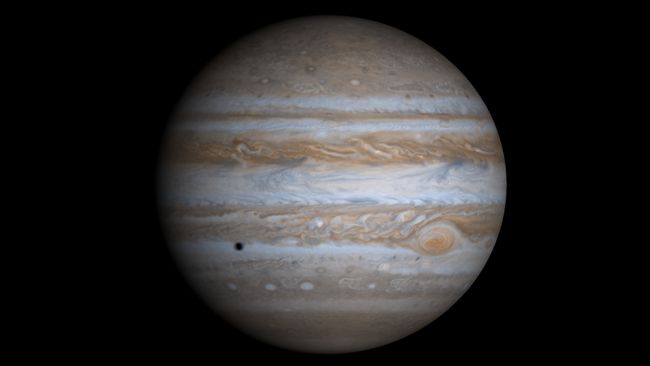
Jupiter as it is today, as seen by the Hubble Space Telescope. Not long after its formation, it might have been twice its current size. Note the black dot to the left of the image is the shadow Io, the innermost of Jupiter’s large moons. Io itself is outside of the frame. Credit: NASA/JPL / University of Arizona
Under this theory, Jupiter formed around 3.5 AU from the Sun, rapidly accreting a solid core and gaining mass to a point where it reach around 20 times Earth’s mass (although Earth would not form for another 45-50 million years). At this point, it’s mass and size (and those of Saturn) were such that they entered into a complex series of interactions with one another and the Sun, with both migrating towards the Sun, likely destroying a number of smaller proto-planets (all of them larger than Earth) along the way. At some point, these interactions reversed, and both infant planet started migrating away from the Sun again, clearing the way for the remnants of the smaller proto-planets they’d wrecked to gradually accrete to form what we now know to be the inner planets, as Jupiter and Saturn continued outwards to what are now their present orbits.
Believed to have occurred over between 4 to 6 million years, the “grand tack hypothesis” is contentious, as noted, and there are alternate theories concerning Jupiter’s formation and the early history of the solar system. Because of this, astronomers Konstantin Batygin (who, coincidentally, is one of the proponents of the “Planet 9” theory) and Fred C. Adams used complex computer modelling to try to better understand Jupiter’s formation and early history, in order to try to better determine how it may have behaved and affected the earliest years of the solar system’s formation.
In order to do this, and not be swayed by any existing assumptions concerning Jupiter’s formation, they decided to try to model Jupiter’s size during the first few million years after its accretion started. They did this using the orbital dynamics of Jupiter’s moons – notably Amalthea and Thebe, together with Io, Jupiter’s innermost large moon – and the conservation of the planet’s angular momentum, as these are all quantities that are directly measurable.
Taken as a whole, their modelling appears to show a clear snapshot of Jupiter at the moment the surrounding solar nebula evaporated, a pivotal transition point when the building materials for planet formation disappeared and the primordial architecture of the solar system was locked in. Specifically, it reveals Jupiter grew far more rapidly and to a much larger size than we see today, being around twice its current size and with a magnetic field more than 50 times greater than it now is and a volume 2,000 times greater than present-day Earth.
Having such a precise model now potentially allows astronomers to better determine exactly what went on during those first few million years of planetary formation, and what mechanisms were at work to give us the solar system we see today. This includes those mechanisms which caused Jupiter to shrink in size to its present size (simple heat loss? heat loss and other factors?) and calm its massive magnetic field, and the time span over which these events occurred.
Yeah. Finding Life is Hard
In March, I reported on a possible new means to discover evidence of biosigns on worlds orbiting other stars by looking for evidence of methyl halides in their atmospheres (see: Space Sunday: home again, a “good night”, and seeking biosigns). In that reported, I noted that astronomers had potentially found traces of another element associated with organics, dimethyl sulphide (DMS) , within the atmosphere of exoplanet K2-18b, a hycean (water) world.
This is the strongest evidence yet there is possibly life out there. I can realistically say that we can confirm this signal within one to two years. The amount we estimate of this gas in the atmosphere is thousands of times higher than what we have on Earth. So, if the association with life is real, then this planet will be teeming with life.
– Prof Nikku Madhusudhan, lead investigator into the study of the atmosphere of K2-18b and the apparent discovery of dimethyl sulphide.
Now in fairness, the team behind the discovery did note that it needed wider study and confirmation. Extraordinary claims requiring extraordinary proof and all that. And this is indeed what has happened since, and the findings tend to throw cold water (if you forgive the pun) on that potentially wet world 124 light-years away, having dimethyl sulphide or its close relative, dimethyl disulfide (DMDS) in anywhere near detectable levels.
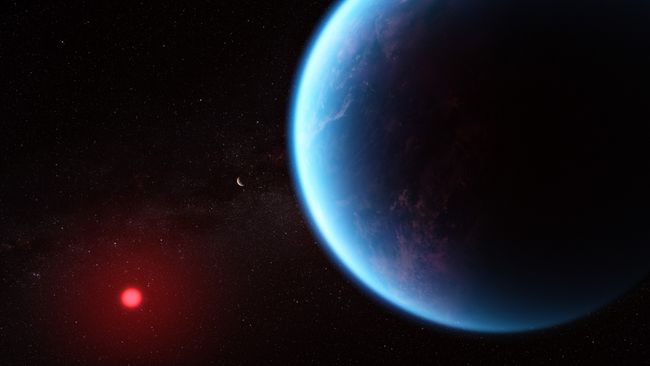
An illustration of what K2-18b may look like. Credit: NASA / ESA / CSA / Joseph Olmsted
The more recent findings come from a team at the University of Chicago led by Rafael Luque and Caroline Piaulet-Ghorayeb. Like Madhusudhan and his team at Cambridge University, the Chicago team used data on K2-18b gathered by the James Webb Space telescope (JWST). However, in a departure from the Cambridge team, Luque and his colleagues studied the data on the planet gathered by three separate instruments: the Fine Guidance Sensor and Near Infrared Imager and Slitless Spectrograph (FGS-NIRISS), the Near Infrared Spectrograph (NIRSpec) and the Mid-Infrared Instrument (MIRI) – the latter being the sole source of data used by the Cambridge team.
Combing the data from all three instruments helps ensure a consistent, planet-wide interpretation of K2-18b’s atmospheric spectrum, something that cannot be obtained simply by referencing the data from a single instrument. And in this case it appears that by only focusing on MIRI, the Cambridge team inferred a little too much in their study.
We reanalyzed the same JWST data used in the study published earlier this year, but in combination with other JWST observations of the same planet … We found that the stronger signal claimed in the 2025 observations is much weaker when all the data are combined. We never saw more than insignificant hints of either DMS or DMDS, and even these hints were not present in all data reductions.
Caroline Piaulet-Ghorayeb
Most particularly, the much broader set of spectrographic data gathered from the three instruments points to some of the results observed by Madhusudhan’s team could actually be produced entirely abiotically, without any DMS being present. The Chicago paper has yet to be peer-reviewed, but their methodology appears sufficient to roll back on any claims of organic activities taking place on K2-18b or within its atmosphere.
AAS Recognises Gene Kranz
The “original four” NASA Flight Directors. Back row, (l to r): Glynn Lunney and John Hodge. Bottom (l to r): Gene Kranz and Chris Kraft. Credit: NASA
He is particularly most well-known for his leadership of his White Team during the Apollo 11 Moon landing in 1969, and for leading the work to get the crew of Apollo 13 back to Earth safely when that mission faced disaster. As a result of the latter, Kranz and his entire White Team received the Presidential Medal of Freedom in 1970 as well as being immortalised in film and television (although the line “Failure is not an option” was not something Kranz ever said – he instead used it as the title for his 2000 autobiography; the quote was purely fiction and used in the 1995 Ron Howard film Apollo 13, which saw Ed Harris play Kranz).
His career at NASA ran from 1960 through 1994, during which he rose from Mission Control Procedures Officer to Director of Mission Operations. As a result, he has been the recipient of NASA’s own Distinguish Service Medal, Outstanding Leadership Medal and Exceptional Service Medal.
And he has now been similarly recognised by the American Astronautical Society, which on May 21st, 2025, named him the recipient of their 2024 Lifetime Achievement Award. Only presented every 10 years, the award recognises Kranz for his “exemplary leadership and a ‘must-never-fail’ style that ensured historic mission successes, empowered human space exploration, saved lives and inspired individuals around the world.”
The ceremony took place at the Johnson Space Centre, Houston, Texas, where Kranz was also able to revisit the place where he and his teams and colleagues made so much history: the Apollo Mission Operations Control Room (MOCR – pronounced Mo-kerr – NASA has to have an acronym for everything 🙂 ).
Gene Kranz, with his AAS Lifetime Achievement Award, seated at the restored console he occupied at the White Team Lead Flight Director, notably during the Apollo 11 and Apollo 13 missions. Credit: NASA
The latter had been recently restored as a direct result of a project initiated and driven by Kranz in 2017 in memory of Apollo and so many of his colleagues who have since passed away (the most recent, sadly, being Robert Edwin “Ed” Smylie whose team worked alongside Kranz’s White Team to make sure the Apollo 13 astronauts returned to Earth safely, and who passed away on April 21st, 2025). Fully deserving of the AAS award, Gene Kranz remains one of the stalwarts of NASA’s pioneering heydays.







 Inara Pey: Living in a Modemworld