Soul Deep, March 2025 – click any image for full size
It’s been a while since I’ve visited Kaelyn Elara’s Soul Deep. and by “a while”, I mean nigh-on four years, my first (and thus far only) visit being back in May 2021!
I’m not sure if the setting has been around in Second Life for the entire intervening period – back then it bore the same name as the region, where as now it appears to have relocated. However, given it popped out at me from the Destination Guide whilst browsing recently, I decided to hop over and take a look once more.
Soul Deep, March 2025
A peaceful spring landscape designed for relaxation and connection. Explore cosy little islands, stroll along flower-lined paths, and unwind by the shimmering lake … Whether you’re looking for a quiet escape or the perfect photo backdrop, Soul Deep invites you to breathe deep and stay awhile.
– Kaelyn Elara on Soul Deep
For this iteration of the setting, Kaelyn has joined forces with region designer Jacky Macpherson, and together they present a gorgeous, easy to appreciate and enjoy location entirely rural in nature. In this, roughly half the region is used, the rest – particularly to the south and around the the west – being given over to open water.
Soul Deep, March 2025
The Landing Point sits close to the northern coastline of the main island, alongside to a large barn now converted to a café space – although its ranch / farm heritage is memorialised by a bucking bull for those wishing to try a ride. For the less adventurous there are a couple of calmer table-top games inside as well. Outside, at the hitching rail is a horse rezzer so visitors fancy touring on horseback can do so (and, obviously, if you have a wearable horse, you can wear and ride your own).
The trail alongside the hitching rail points the way to a bridge providing access to one of the smaller islands, which is in turn connected to a slightly larger island with a bridge back to the main land. Both of these islands are unencumbered by permanent structures, although the smaller one is home to a camper trailer and little campsite.
Soul Deep, March 2025
Finding your way around the setting is simply a matter of following the main trail circling the central lake. While this does split just to the east of the barn to encircle a copse of fir trees, it does provide a complete route for exploration, starting with the ruins in the copse and the campsite tucked into the corner close to where the two arms of the trail reunite.
Following the trail south and away from the campsite just mentioned and taking the bridge over the neck of water linking lake to open water, will bring you to the setting’s one real hill. This hides an easy-to-find secret “under” it (do be sure to click on the arrow!) while hiding another of the setting’s three permanent structures in the form of another design by Cory Edo behind its bulk.
Soul Deep, March 2025
The third structure is located on the remain small island off to the south-east of the region, and takes the form of a cosy cabin watched over by a pair of elk. The latter are joined by red deer, reindeer, rabbits and birds scattered across the setting to give it further depth and life, with some of the latter imaginatively and naturally set – so its worth paying attention when exploring as you might easily miss them!
All of the buildings are open to public use and offer places to sit and converse and / or cuddle together with the camp sites scattered around. In addition there are trailside benches, blankets and a couple of romantic spots in which to pass the time (as well as the hidden one!). It’s even possible to enjoy an outdoor candlelit meal with friends if you’re so minded! Swan boats offer places to sit on the lake, while rowing boats out on the open waters do the same there as well.
Soul Deep, March 2025
Rich in detail, highly photogenic and a delight to visit, Soul Deep offers the perfect spring setting.
Having written the title to this piece, I realised that it could just as easily be “Cica’s Playground IS Second Life”, because for well over a decade now, Cica Ghost has been presenting 3D art installations within Second Life – and has been doing so monthly for the last few years.
As a result she has, and continues to, present a wide range of environments and settings, many of them more-or-less entirely whimsical, some of them wonderfully layered, offering views of folk tales or myths or ideas with a depth of perception and evocation which have never failed to inspire. Throughout much of her work there is a simple statement of joy in life, and it is this, as much as everything else she carefully wraps in her installations which has made me a long-time fan of her work, and why I have always tried to cover her installations in these pages, collecting them under my Cica Ghost tag.
Cica Ghost, March 2025: Playground
One of the first of Cica’s builds I both saw and wrote about was Ghostville, a 3D village inhabited by Cica’s (already by then) famous animated stick figures (see: A short stay in Ghostville). It was a wonderful experience, and led to further encounters with her little people in installations such as The Visitors, which made marvellous use of the pre-existing (but long since sadly departed from Second Life) art venue of La Città Perduta, aka The Lost City (see Visiting the Visitors).
I mention all of this because within Playground, which opened on March 25th, 2025, there is something of a nod towards those wonderfully animated stick figures, together with a range of other 2D elements offering memories of some of Cica’s past creatures and creations. They sit within a village-like environment which might also be regarded as an avant-garde playground (given everything appears to be made of carboard, adding to the playtime like feel) in which new 3D creatures bot large and small and quite wondrous in their respective forms might be found. I loved them all but the almost Yaphit-like pair brought a particular smile to my face – but that’s purely the sci-fi nerd in me!
Cica Ghost, March 2025: Playground
Such is the jollity here that even stars appear to have sprung from the ground along with flowers and clover, bopping to an unheard melody (there is an audio stream, but I preferred to keep it turned off) as much as some of the painted creatures and the various Cicas awaiting discovery.
The potential call-outs to many of Cica’s past design might be pointed to by fans of Cica’s work; however, whether they are intentional or not, I’ve no idea. This being the case I’ll leave it to people to decide for themselves, because I don’t want to give the impression this is a place that cannot be enjoyed in its own right or is in any way some form of intentional retrospective – it is not; it is simply that there are a lot of perfect little bells that might chime for some in visiting, but which also do not diminish Playground in any way if they pass unheard.
Cica Ghost, March 2025: Playground
As is common with Cica’s build, visitors can join in with the fun via dancing, while the particularly energetic can jump up onto one of the local flying saucers and help keep them spinning (and flying?). These are not the only way to get airborne – hidden in plain sight is the means to bring out your inner Supergirl / Superman – but you can find that on your own 😀 . For those seeking a little rest afterwards (or perhaps a mug of 2D coffee!) there are various places to set down and recover.
The following notes were taken from the Tuesday, March 25th, 2025 Simulator User Group (SUG) meeting. They form a summary of the items discussed, and are not intended to be a full transcript, and were taken from my chat log of the meeting – sorry, no video from Pantera this week.
Meeting Overview
The Simulator User Group (also referred to by its older name of Server User Group) exists to provide an opportunity for discussion about simulator technology, bugs, and feature ideas.
Meetings are open to anyone with a concern / interest in the above topics, and form one of a series of regular / semi-regular User Group meetings conducted by Linden Lab.
Dates and times of all current meetings can be found on the Second Life Public Calendar, and descriptions of meetings are defined on the SL wiki.
Simulator Deployments
On Tuesday March 25th, the SLS Man Channel was updated with any deployment.
On Wednesday March 19th the Durian Scones update should be deployed to all remaining RC channels RC – this update incudes the SSL certificate renewal – see below for more.
Production Grid SSL Certificate Renewal
The SSL certificate for the Second Life Production Grid is set to expire on April 16th, 2025 02:40 GMT.
A new certificate anchored by DigiCert started deployment via the BlueSteel RC on Wednesday, March 19th, and will progress across the RC channels and to the SLS Main Channel in the normal cadence of simulator releases, to be completed in advance of the old certificates expiring.
Testing of this certificate can be done either within the nominated simulator channels as it is deployed, or on Aditi (the beta grid), on the following regions:
Bonifacio.
Blake Sea (Very nearly the entire set of regions).
Signal Linden highlighted a Feedback Ticket he has raised, proposing the removal of scale from Land Impact calculations.
This is being possibly earmarked for a simulator update after Durian Scones.
This essentially means that the LI of object should not dramatically change as a result of resizing (particularly when increased in size). It could also mean that some large objects in world could see LI reductions.
Understandably, this announcement led to a lot of discussion / debate throughout the meeting.
Please refer to the the video for details on the following.
A SLua update was deployed to Aditi during the meeting, containing the requested JSON and the B64 stuff in it.
Signal indicated that LL’s visit to the 2025 Game Developer Conference (March 17th-21st, 2025) in San Francisco to promote Second Life appears to have been well received, the the stand receiving a lot of visitors and interest.
There has been some discussion in the Content Creation channel of the Second Life Discord Server about allowing rezzing of prims and meshes larger than the current 64m limit, either for everyone, or as a switch which could be set at the estate/region level. LL are tracking this.
However, Signal and Leviathan Linden noted that in terms of meshes exceeding 64m in size, some research into potential physics impacts might be required.
Signal further suggested that if there are physics issues, such large meshes could be made non-physical on rezzing.
On the subject of physics, there have been reports of objects getting “stuck” with a convex version of their physics mesh until are selected by their owner, and also that sometimes the simulator forgets the mesh physics type and sets it to convex hull.
Rider Linden noted he spent some time trying to trace down a similar issue some time ago, without success.
Leviathan Linden would like to look into these issues, so Feedback reports would likely be appreciated, with logs.
Signal again indicated a preference to get the Havok sub-libraries out of the viewer, replace the decomp. library with an open-source one, and replace Navmesh with a solution “that isn’t janky”. However, decisions on all of this have yet to be taken.
A discussion on the “energy” effect within llPush – where it has use (e.g. feeding into impact damage calculations for weapons), issues, etc., and whether or not there is a case for it being removed for SLua scripts (but not Lua VM to run LSL, so as to maintain compatibility), if at all possible (possibly not).
Signal Linden also dropped a request into the meeting:
If you would be seriously interested in contract work to convert the LSL wiki over to readme.com, including a Github action to generate LSL/SLua function documentation from a giant LLSD manifest, drop me a line. One thing I’m thinking about is improving documentation. Readme.com is the same platform VRchat uses for their docs rather effectively, and it would allow us to accept changes from unregistered users once again.
† The header images included in these summaries are not intended to represent anything discussed at the meetings; they are simply here to avoid a repeated image of a rooftop of people every week. They are taken from my list of region visits, with a link to the post for those interested.
Logos representative only and should not be seen as an endorsement / preference / recommendation
Updates from the week through to Sunday, March 23rd, 2025
This summary is generally published every Monday, and is a list of SL viewer / client releases (official and TPV) made during the previous week. When reading it, please note:
It is based on my Current Viewer Releases Page, a list of all Second Life viewers and clients that are in popular use (and of which I am aware), and which are recognised as adhering to the TPV Policy. This page includes comprehensive links to download pages, blog notes, release notes, etc., as well as links to any / all reviews of specific viewers / clients made within this blog.
By its nature, this summary presented here will always be in arrears, please refer to the Current Viewer Release Page for more up-to-date information.
Note that for purposes of length, TPV test viewers, preview / beta viewers / nightly builds are generally not recorded in these summaries.
Official LL Viewers
Default viewer: 7.1.12.13550888671, formerly the ForeverFPS, dated March 1, 2025, promoted March 5th – No change.
Numerous crash and performance fixes.
Water exclusion surfaces.
Water improvements.
Second Life Release Candidate viewer 2025.03 version 7.1.13.13906285233, March 20th – NEW.
New UI element for water exclusion surfaces: Build / Edit floater → Texture Tab → Hide Water checkbox.
The maximum amount of Reflection Probes can now be adjusted to better accommodate low VRAM scenarios.
Values will be set automatically depending on your chosen graphics quality. OR
Use Preferences → Graphics → Advanced Settings → Max. Reflection Probes to manually set.
An issue with being unable to see Sky Altitude values in the Region/Estate window has now been resolved.
Preferences → Graphics → Max. # of Non-Imposters has been renamed Max. # of Animated Avatars for clarity.
Bug and performance fixes and memory optimisations.
Second Life Project Lua Editor Alpha, version 7.1.12.13973830462, March 20th, 2025 – NEW.
Memories of Spring, March 2025 – click any image for full size
In a follow-up to her Memories of Dreams, a Homestead region I wrote about back in April 2024 (see: Memories of Dreams in Second Life), Yxes (Yxes Evergreen) recently opened a new Homestead region design she is calling Memories of Spring – and it is as eye-catching as Memories of Dreams as it is different.
Spring, a time to wake up and explore all our worlds. Follow picturesque paths along a rocky coast. A special thank you to some of the artists of SL, who make our world more beautiful. Look for their work here and throughout SL!
– Yxes, writing about Memories of Spring
Memories of Spring, March 2025
Backed by a partial off-region surround and against which it abuts, Memories of Spring gives the suggestion of being a rugged headline extending outwards from a mountainous coastal region. However, whether this coastline is part of an island or a much larger land mass is up to your imagination. The mountains sit to the east side of the region, their faces masked in shadow and haze, their domed heads frosted with snow as they appear to stand guard over the setting.
The Landing Point sits close the where the mountains touch the region, and specifically on the terrace of a large Tuscan-style villa, a curtain of rock to its rear separating it from the off-region surround as both house and terrace look westward along the island’s length. The house is open to the public and is tastefully furnished, with the covered entranceway set out ready for a shared meal. Inside, one of the room contains the first hint of the art and artists of SL referenced in Yxes’ description, in the form of a series of figures by Alpha Auer.
Memories of Spring, March 2025
Stone steps descend from the terrace and its modern fountain to a paved depression amidst the rock. A further fountain sits here, moss-aged but with clear waters. As well as occupying the sides of the fountain, the moss has spread out over the paving, suggesting the stone was laid a long time ago, while stone blocks to one side stand together in the suggestion that they, the paving and the fountain are the remnants of a structure that once occupied this hollow. But again, perhaps that is the illusion they are meant to present, their having been placed there to give the villa a sense of having a sunken garden space before it.
Further steps rise from the fountain to where another Tuscan-style building sits on a shelf of rock. It stands above a sandy bay and offers a cosy summer house feel within its walls – and it must be passed through in order to continue onwards – unless you want to scramble and slide over rocks to reach the beach; for it is on the far side of the summer house that the path and steps continue, descending via piers of stone to reach the sand.
Memories of Spring, March 2025It is here that the setting marvellously opens out. On the beach, sandpipers search for food as rivulets of water flow over the sand to reach an incoming tide which has, over the years, carved the sand so as to form a small, natural lagoon-like hallow within it. A further house sits on the headland here, its piers offering room for boats to come alongside, the terrace above them welcoming painters despite the downpour going on on the other side of its bulk. This rain, falling steady and quite locally, is slowly drowning the large courtyard backing onto the house and reached via a path running through a grove of silver birch also caught under the rain’s cloak.
It is in the courtyard that the first real hints of much older structures than the villa and its summer house might be found. Partially-demolished – presumably by some passage of violent weather – walls and a stairways appear to be undergoing repair. More ruins lie beyond the gates at the back of the courtyard, the hollowed rooms, empty window sockets and open maws of doorways forming a most attractive means to display 3D art by Mistero Hifeng and Bryn Oh, whilst coffee might be enjoyed within the walls of one of the aged towers.
Memories of Spring, March 2025
Looking out over the southern aspect of the island, these ruins in turn provide a glimpse of still more remnants of habitation. Reached via a further path, they sit as a magical place built on the water’s edge where chandeliers both hang from the ceiling and sit suspended in air where crystalline shapes float like strange and exotic creatures – or the petals of plants. Within this space visitors can appreciate further 3D art from the vantage point of comfortable armchairs or a bronze hoop also suspended in the air in defiance of gravity or a glass of wine might be enjoyed at the makeshift bar.
Nor do things end here, for the path continues onwards to yet more ruins, these perhaps the source of the stonework used within the hollow become the main villa.
Memories of Spring, March 2025
As much a part of the landscape as built upon it, these ruins are, to me, sublimely photogenic and beautifully natural in placement and look. It is as if whoever built them did so in order to maximise the shelter provided by the rocky spines and rises of the land behind them, although whether they were all originally part of the same group of buildings or represent different generations of construction is up to you to decide. What I will say is, they offer one of the most eye-catching uses of The looking Glass Chapel Ruins by Marcus Inkpen that I’ve seen in a while.
Watched over by a batter and weather beaten lighthouse at its north-western extent, rich in both art, décor and detail throughout, Memories of Spring is an engaging visit.
Crew Dragon Freedom splashes down off the Florida coast March 18th to conclude the Crew-9 mission. Credit: NASA/Keegan Barber
On Tuesday, March, 18th, 2025, A SpaceX Crew Dragon – mission Crew-9 – made a safe splashdown off the Florida coast prior to being successfully brought aboard the waiting recovery vehicle. This brought to an end what has been perhaps the most mis-reported human space mission thus far.
This is because the vehicle which carried NASA astronauts Barry “Butch” Wilmore and Sunita “Suni” Williams into space back in June 2024 was the much-troubled Boeing CST-100 Starliner. Whilst the vehicle reached orbit successfully, it suffered further problems with it primary propulsion system – located on the vehicle’s expendable service module. As a result, and exercising an understandable over-abundance of caution, NASA opted to leave Wilmore and Williams on the ISS until an alternate means of bringing them home could be scheduled.
However, at no time did this ever mean Williams and Wilmore were “stranded” on the ISS: just because NASA did not want to bring the astronauts back to Earth in an emergency did not ever equate to the agency being unable to do so. This was proven in July 2024 when, following the disintegration of a Russian satellite led to a short-term threat of possible debris impact with the ISS. As a result the station’s crew were ordered by NASA and Roscosmos to “shelter in place” aboard their respective space vehicles – including Wilmore and Williams aboard the CST-100 – in case an emergency departure and return to Earth was required if the debris could showed signs of intersecting the ISS in orbit.
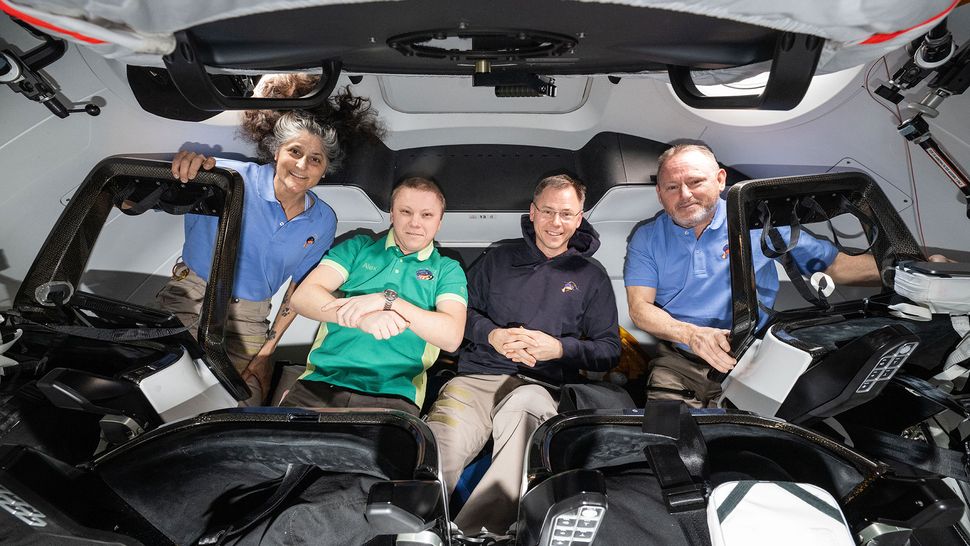
Sunita “Sunni” Williams (l) and Barry “Butch” Wilmore (r), pose aboard the docked Crew Dragon Freedom shortly after it arrived in September 2024, bringing Aleksandr Gorbunov and Nick Hick (sandwiched respectively between Williams and Wilmore) to the ISS. Credit: NASA
In fact, one of the reasons Starliner remained at the ISS even after the decision had been made to return Williams and Wilmore to Earth via other means was as much about providing them with a “lifeboat” return to Earth for as long as possible, as it was about carrying out further tests on the vehicle.
As it was, Starliner did eventually undock from the ISS in September 2024 ahead of the launch of the Crew 9 mission, with the crew capsule Calypso successfully landing on Earth at the end of a fully automated flight and despite two further system hiccups. Meanwhile, the Crew-9 mission also arrived at the ISS in September 2024 to become NASA Expedition 72, with Williams and Wilmore slotting into the two Expedition 72 crew slots vacated for them, in order to see out the mission’s 170-day rotation on the station.
The rotation came to an end on Tuesday, March 18th, 2025 when Crew 9 – Williams and Wilmore together with mission commander Nick Hague and cosmonaut Aleksandr Gorbunov undocked from the ISS at 0505 UTC, their places having been taken by the Crew 10 / Expedition 73 crew, who arrived at the ISS two days previously.
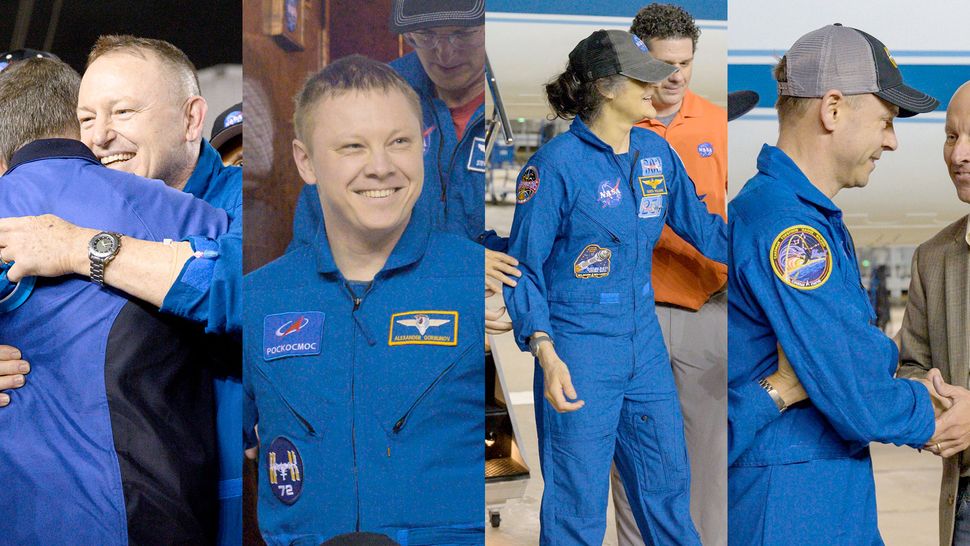
A composite image showing astronauts Butch Wilmore (l) and Suni Williams (second from right), with Aleksandr Gorbunov (second from left) and Nick Hague being greeted by fellow astronauts and family members at Ellington Field, Houston after their flight from Florida. Credit: NASA
And while much has been made of Williams and Wilmore’s extended stay on the ISS, overall, the 286 days they spent on the station is not exactly record-breaking or that unusual. Among NASA’s astronauts, five others have spent longer periods of time on a single ISS crew rotation (even if their time was planned from the outset to be so), whilst four cosmonauts have spent in excess of 330 days each (437 in the case of Valeri Polyakov) on either the Soviet / Russian Mir station or the ISS. That said, Williams has now accumulated the second highest number of continuous days in space by a US astronaut – 608 days – slotting in behind Peggy Whitson who accumulated 675 days in space with NASA and a further 9 days as a private citizen astronaut on the Axiom Ax-2 mission.
What of Starliner?
Whilst Wilmore and Williams may not have been stranded in space, the Starliner programme does have issues, notably with the design of the four propulsion pods – dubbed “doghouses” because of their appearance – mounted on the Starliner’s service module, and which have yet to be fully resolved.
The CST-100 Starliner comprising the capsule Calypso and its service module slowly back away from the ISS following undocking in September 2024. Two of the problematic “doghouse” thruster pods are visible on the cylinder of the service module. Credit: NASA
The pods, each of which mounts five “large” orbital manoeuvring and control (OMAC) thrusters as a “primary” means of propulsion and seven smaller reaction control system (RCS) thrusters used for very precise manoeuvring and control, have been something of a bane to Starliner for the last several years. During preparations for the second uncrewed flight of the CST-100 system (itself the result of an embarrassing cock-up in integrating the timing systems between the launch vehicle and the Starliner craft in the first orbital test flight), it was found that a large number of the values within the thrusters had jammed, delaying the launch by several months, only for a number of the thrusters to have issues during the flight.
During the first Crew Test Flight with Williams and Wilmore, no fewer than five of the RCS thrusters failed during initial docking attempts at the ISS, although four were brought back on-line and the docking completed. This failure, coupled with the discovery that the issue was related to overheating within the “doghouse” units which had not been picked up during the development and testing of the units, then led to something of an embarrassing public spat between Boeing, as the main vehicle contractor, and Aerojet Rocketdyne, makers of the propulsion units, prior to NASA banging some heads together.
Since then, work on rectifying the propulsion unit issues has continued in near-silence. However, the return of the two astronauts to Earth inevitably caused some of the spotlight to swing back towards Boeing and Starliner and if / when / whether it night fly again. There is little doubt that NASA does want Starliner to continue: having all of their eggs in the Crew Dragon / Falcon 9 basket is far from ideal despite that successes of those systems thus far. This was something noted by Steve Stich, NASA’s Commercial Crew Programme Manager, following the Crew 9 splashdown.
We really need to get Boeing into a crewed rotation. Butch and Suni’s return on Dragon, to me, shows how important it is to have two different crew transportation systems, the importance of Starliner and the redundancy that we’re building into human spaceflight for our low Earth orbit economy.
– Steve Stich, NASA Commercial Crew Programme Manager
The Boeing CST-100 Starliner: A: Crew capsule (reusable) 1: Nosecone protecting the docking system during launch (expended) 2: Parachute cover (ejected during landing) 3: Crew access hatch 4: capsule RCS thrusters (x25) 5: Airbags (x6) 6: Heat shield (ejected during landing) 7: NASA Docking System port 8: Parachutes (x3) 9: Window (x3) B: Service module (expended) 10: Power umbilical connecting the command and service modules 11: Radiators (x4) 12: “Doghouse” thruster pods (x4) 13: Propellant tanks 14: Roll control thruster on “Doghouse” 15: Launch abort motors (x4) 16: Solar panels. Credit: NASA
While progress has been made on mitigating the overheating issue by means of changing the operating parameters of the thrusters software system so as to avoid the need for any excessive redesign of the “doghouse” systems, these changes will need to be tested at some point through an actual flight test – and the same is true of the more minor, but still required, alterations to the helium purge systems within the propulsion systems. This raises another issue: should such a test be carried out via a crewed or uncrewed mission.
The final decision on this lies with NASA, although in their rare comments on the work, Boeing has been somewhat bullish, pushing for the flight to be crewed. For its part, the space agency will not be drawn on what form any additional test flight should take – only that the vehicle used should be “mission ready”, with Boeing in a position to rapidly pivot from completion of a test flight to flying a full crew rotation afterwards.
Even if we were to fly the vehicle without a crew in the return, we want that to be crew-capable. So, we want it to have all the systems in place that that we could fly a crew with. What we’d like to do is that one flight and then get into a crew rotation flight. So, the next flight up would really test all the changes we’re making to the vehicle, and then the next fight beyond that, we really need to get Boeing into a crew rotation. So, that’s the strategy.
– Steve Stich, NASA Commercial Crew Programme Manager
As to when any such flight might take place remains an open-ended question. NASA continues to signal it would like at least the test flight to occur in 2025, but the overall mission schedule for the ISS this year – crew rotation flights, resupply missions (including the demonstration flight of the Dream Chaser resupply vehicle) – mean that docking opportunities for any Starliner test flight are not that numerous in the near-to-medium term.
Blue Ghost says “Night-night” with Stunning Images
In my previous Space Sunday update, I wrote about the private Blue Ghost lander by Firefly Aerospace, which successfully touched-down on the Moon on March 2nd, 2025, marking the company as the first to carry out a “fully successful” (e.g. without rolling or toppling over) commercial lunar landing.
The Earth as captured by Blue Ghost from the surface of the Moon. Credit: Firefly Aerospace / NASA
Over the next lunar daylight period (14 terrestrial days), the vehicle carried out its assigned surface science work, with only the drill system – called LISTER (for Lunar Instrumentation for Subsurface Thermal Exploration with Rapidity rather than having any reference to a character from Red Dwarf) failing to operate as hoped, only reaching a depth of around 1 metre than the hoped-for 3 metres.
However, on Sunday, March 16th, the lander went quiet as the lunar night took hold, denying it the sunlight it needed to convert into electrical power and heat, and temperatures plummeted.
The “diamond ring” is a famous feature of solar eclipses seen from Earth. However, its one is the result of the Earth eclipsing the Sun, as seen from the Moon. Credit: Firefly Aerospace / NASA
While there is a chance residual energy stored in the lander’s batteries might be sufficient to keep its essential electronics functioning, the Firefly team are not expecting to be able to re-establish contact when daylight returns on the vehicle in April.
Rather than simply bid farewell to their plucky little lander, however, on March 18th, Firefly Aerospace, via NASA – the mission being part of NASA’s Commercial Lunar Payload Services (CLPS) programme – released some images captured during the mission to highlight its success. Taken in high definition, they are regarded as some of the best ever taken from the surface of the Moon, and I’ve reproduced some of them here for your appreciation.
As the Sun sets against the lunar horizon, its reflected light turn Earth into another “star” as seen from Blue Ghost, as Venus also appears a bright dot above and to the right of the Sun. Credit: Firefly Aerospace / NASA
Discovering Biosigns on Other Worlds Just Go Easier. Sort-of
So far, we’ve discovered in excess of 4,000 planets orbiting stars beyond our own, and while many are unlikely to support life of any kind, much less life as we know it, there are equally many that just might. The trick is actually recognising the fact they do across the vast interstellar distances involved.
Thus far, the common technique used to try to determine whether or not an exoplanet might harbour life is to look for biosignatures – the by-products of life processes – when analysing the composition of its atmosphere. However, there are a number of problems with this approach, including the fact that many biological interactions can be similarly produced through purely abiotic means such as inorganic chemical reactions, and determining one from the other over interstellar distances in next to impossible.
Might the study of hycean worlds help determine the presence of life beyond our own solar system?
To combat this, researchers from University of California, Riverside, have suggested that astronomers looking for potential signs of life examine the atmospheres of potentially habitable worlds for concentrations of methyl halides. These are gases combining a methyl group with a halogen atom – and they are only produced via organic means by anything from bacteria through to plants. Ergo, if they can be detected in the atmosphere of a planet, they would potentially point to some form of organic process at work on that world.
Clever, right? Well, yes, but there is a hitch. Even here on Earth, atmospheric concentrations of methyl halide are low and prone to being broken-up and “lost” within the general atmospheric “noise”, thus making them hard to detect – and this would likely be true for many potentially life-bearing worlds orbiting other stars. Fortunately, the researchers have an answered for that: look for methyl halides in the atmospheres of hycean worlds.
These are planets which have been shown to have hydrogen-rich atmospheres and are believed to have liquid water surfaces (“hycean” being a portmanteau of “hydrogen” and “ocean”). Generally, speaking, these worlds exist within the “Goldilocks zone” around their parent star: the region wherein all the “right” conditions come together to potentially give life the “kick start” it needs. Further, such are their general atmospheric composition and character, they could support far higher – and more detectable – concentrations of methyl halides.
In this, the researchers are supported by the fact that one biosignature appears to have been detected within the atmosphere of an exoplanet – dimethyl sulphide. This was reported as being discovered within the atmosphere of K2-18b, a hycean world, in 2023. And even while the overall number of hycean worlds thus far discovered is small, finding traces of methyl halides in the atmosphere of just one would be ground-breaking news.
Might the study of the water vapours ejected by Enceladus (seen here in false colour to highlight its surface structure) and Europa reveal the presence of methyl halides?
Another potential area where the detection of methyl halides might work is in the study of the water vapours expelled from the likes of Europa and Enceladus in our own solar system. Both of these moons give off plumes of water vapour through geysers, which in the case of Enceladus, is sufficient to actually help renew the otherwise unstable E- ring around Saturn. Were methyl halides to be found within these vapours (assuming they could survive in the tumult), it could dramatically increase the potential for one of these moons to be harbouring microbial life in its waters.







 Inara Pey: Living in a Modemworld