
The latest hype cycle about Elon Musk’s Starship / Super Heavy is starting to ramp in the lead-up to the next “integrated flight test” (IFT) of the system (SpaceX stopped calling them “orbital flight tests” aft the first one spectacularly firecrackered less than 4 minutes into the flight), and the second one fared somewhat better, prior to the booster and the starship both going the same way in separate explosions. As usual, the hype is being led by Elon Musk, stating that the third attempt could come on March 14th, 2024.
The Federal Aviation Administration (FAA) investigation into that mishap – actually led by SpaceX (as tend to generally be the case) – closed at the end of 2023; however, the closure did not mean SpaceX would be granted a license for resuming launches. That was dependent upon the company completing all identified remedial / corrective actions the FAA felt required in light of the mishap report. As of the end of February, 2024, it was not clear if all such action points had been addressed. However, SpaceX have renewed preparations for the next launch from the Starbase facility at Boca Chica, Texas.
If this third flight – regardless of when it takes place – does in fact deliver a starship test vehicle to orbit, it will be the first genuine success of the launch attempts thus far (whilst SpaceX fans might have lauded the first two attempts as successes, the fact remains that if ULA, NASA or any other company had seen their vehicles similarly destroyed, their flights would have been seen as abject failures), it is merely the smallest of steps SpaceX is committed to taking if it is to meet its obligations to NASA in providing the agency with a lunar lander vehicle in a timely manner – or at all.
As a quick recap: unlike Apollo, NASA is not relying solely on “in-house” designed hardware and systems for their return to the Moon, but are utilising private sector capabilities as well, theoretically on a fix-price basis. In particular, they have turned to the private sector for the development and operation of their Human Landing Systems (HLS) – that’s lunar landers to you and me.
Originally, two major teams of companies bid for the contracts for NASA’s first HLS systems, one led by Blue Origin (with Lockheed Martin) and one by Dynetics. SpaceX jumped into the proceedings very late in the process with a very questionable proposal to use a modified version of their Starship vehicle, and not only walked off with the contract under somewhat extraordinary decision-making at NASA, actually ended up as the sole contractor, despite NASA stating two contracts would be awarded.

That was in 2021. Since then, SpaceX has failed to achieve every single milestone Musk has set for Starship development, leaving a lot for the company to achieve if they are to meet NASA’s goal of delivering two people to the surface of the Moon and returning them safely to the surface of the Earth by late 2026 / early 2027. In particular, they need to not only get a Starship into orbit, they must:
- Show they can launch a starship / super heavy combination not just once, but multiple times – and show they can actually capture them again on landing at the launch site without actually having them fall short or even crash into the launch / recovery tower.
- Demonstrate this can be done over multiple launches in a relatively short time frame (e.g. at least once a day) without incident.
- Develop, test and prove capabilities to deliver large payloads (100 tonnes) of cryogenic propellants to orbit and transfer them between craft with minimal boil-off, and again do so up to 14 or 15 times.
- Carry out two demonstration flights of the HLS vehicle in orbit, one uncrewed and the other crewed.
Given the company’s rate of progress thus far, a 2 to 2.5 year time frame to complete all this is, frankly, liable to be well beyond SpaceX’s capabilities; particularly when you consider that in a Twitter Spaces meeting in December 2023, SpaceX personnel engaged in the HLS development programme admitted they hadn’t even started to conceptualise the crew facilities and support systems the vehicle must carry. Add to that the fact that the only actual hardware under development are both coming in part from NASA: the elevator needed to get the crew down and up the 30 metres of spacecraft and the lunar surface and the docking mechanism to allow the Orion crew vehicle to transfer crew from itself to the lander, once in lunar orbit.
And that’s not me saying it subjectively; Musk himself has stated Starship HLS will take around another 5 years to be realised. That’s 2029, and the time frame of the Artemis 5 mission. Hence why Jim Free, the man at NASA charged with overseeing the Artemis programme, is talking more and more robustly about bypassing SpaceX altogether in terms of that first crew landing. And there is a strong contender to take SpaceX’s place to take over the primary slot: Blue Origin.

One of the original bidders for the first HLS contract, Blue Origin were awarded a contract to develop NASA’s “sustainable” lunar lander in May 2023 (the “sustainable” term a tacit admission by NASA that the SpaceX design, with its maximum 2 landing capability and the need for as many as 15 support launches to get it to the Moon is entirely unsustainable). Since then – and allowing for the fact they continued to develop their lander idea between 2021 and 2023 in the form of a cargo variant (“Blue Moon 1”) which shares several significant systems as the crewed lander proposal (“Blur Moon 2”), including navigation and landing systems, propulsion module / landing legs and power generation – the Blue Origin design is potentially far ahead of that of SpaceX.
Specifically, Blue Original have already delivered to NASA a walk-through mock-up on the lander’s pressurised module, allowing NASA engineers and astronauts to properly determine how the module should be laid out, workspaces and living areas be defined, and where and how all the required internal systems and services should be best installed.
In addition, the development of the cargo lander has reached a point where Blue Origin has announced it plans to send the lander to the Moon at its own expense, with the first taking place in 2025. Whilst these will deliver science payloads to the Moon, their primary goal will be to check-out those same navigation, propulsion, power and landing systems that will be used on the crewed lander, thus demonstrating their fitness for purpose (and flight readiness).
Given all this, and the pace of development at Blue Origin, it is possible their Blue Moon 2 lander system could be ready to fly in late 2027 – still outside of the NASA time frame, but likely well in advance of SpaceX’s HLS. This is something Free has openly acknowledged, expressing the point of view that if SpaceX isn’t ready, not only will they be held accountable for failing to meet their contract, the Artemis 5 mission featuring the first use of Blue Origin’s lander could be brought forward as the first Artemis crewed landing mission, and Artemis 3 shuffled back.
That said, the Blue Origin / Lockheed approach must clear some of the same hurdles as face by SpaceX in order to be able to perform crewed landing on the Moon. These include developing the means of transferring cryogenic propellants between spacecraft, and limiting propellant boil-off. However, the overall scale of operations is much smaller: Blue Origin and Locked are only dealing with tens of tonnes of propellant transferred in relatively small quantities (but stored in lunar orbit for a much longer period), rather than up to 1000-1200 tonnes for Starship HLS. This means that a Blue Origin lander only needs a single refuelling launch to see it through a number of lunar landings / lift-offs, not anything between 10 and 15 required by Starship HLS requires.

Another critical aspect of the Blue Origin lunar capabilities is to enter service this year: the New Glenn rocket. Capable of delivering 45 tonnes to low Earth orbit and smaller payload out as far as Mars, New Glenn will enter service in August of this year, its maiden flight being to launch NASA’s EscaPADE spacecraft to Mars. With the lunar missions, it will be lifting the cislunar transporter (under development by Lockheed Martin) and the fuelling / refuelling tank the mission will require, as well as the lander itself. Providing there are no issues with the August 2024 launch, New Glenn should have an established track record by the time Artemis 5 is ready to fly.
This gives rise to the possibly that NASA might, if Blue Origin and their team are ready, simply drop the SpaceX option altogether. Why have a non-sustainable, complex lander system utilising a vehicle inherently unsuited to the task, when there is a sustainable, proven vehicle already doing the work? The issue here would be one of when such a decision should be taken. NASA has already contracted SpaceX to the tune of close to US $3 billion for Starship HLS – and has precious little to show for it; given the contract negotiated between SpaceX and a former NASA deputy administrator who might be said to have been overly biased towards SpaceX (the company now employing her as a senior executive), it is hard to know what, if any, penalty / get out clauses might have been written-in.
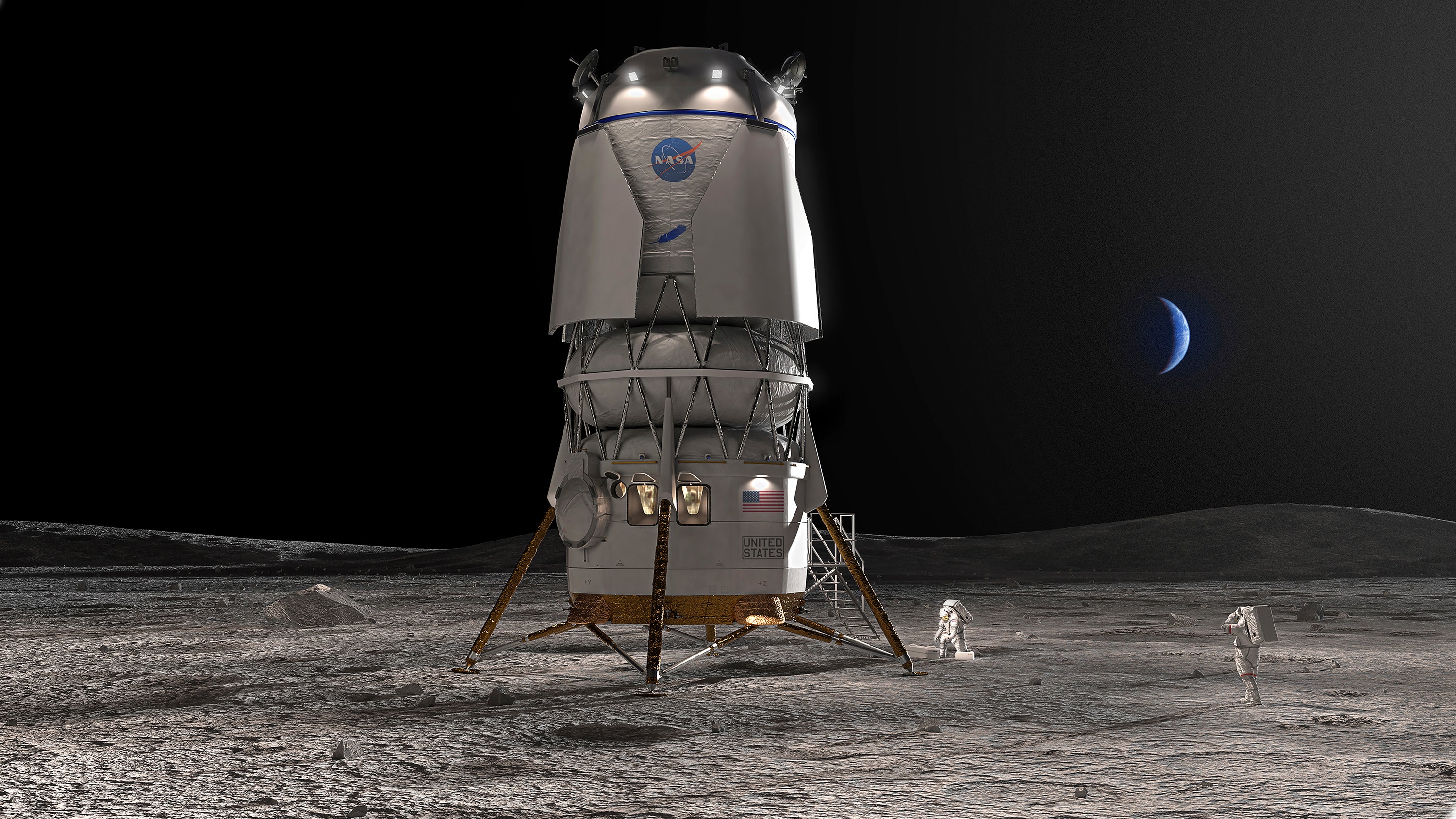
That said, there are those – such as NASA’s own Office of Inspector General and the federal Government Accountability Office (GAO) – who feel that the Artemis programme is inherently too costly to be sustained beyond the currently defined missions (Artemis 3 through 9), and that it might be too costly to even go beyond Artemis 5 or 6. As such, a move to cut (and perhaps reclaim) costs associated with the system that is somewhat questionable in its ability to meet the requirements placed on it, and which could be redundant by the time it is ready, might go some way towards NASA demonstrating it really is trying to manage its costs effectively.
Continue reading “Space Sunday: landing humans on the Moon and an ISS taxi”

 Work continues on the GLTF Featurettes viewer, and it is hoped the release on an official project viewer is now not far off. This viewer includes:





 Inara Pey: Living in a Modemworld