Lost Unicorn Gallery, July 2023: Lori Bailey – A Touch of Magic
A Touch of Magic is the title Lori Bailey has given to her latest art exhibition, opened at the Lost Unicorn Gallery on July 23rd, 2023. Curated by Natalie Starlight and Nessa Nova, who together operate the always enchanting Lost Unicorn estate, the gallery is a fitting venue of Lori’s art, offering as it does a fantasy-style venue within its fairy tale castle walls that is entirely in keeping with Lori’s dream-like images.
Like myself, Lori is one of Second Life’s travellers, spending her time exploring regions and settings across the grid, and recording the things she sees in photographs presented through her Flickr account. Also like myself, she enjoys playing with EEP settings and experimenting with them to produce her core images.
Lost Unicorn Gallery, July 2023: Lori Bailey – A Touch of Magic
However, and quite unlike, me, she possesses an artist’s eye and a compositional style that combine to produce genuinely enchanting images of the the places she visits, together with thoroughly engaging avatar studies (an ability I have never come close to mastering), in which post-processing plays a minor role compared to the overall original composition and framing of each picture.
All of this is every much in evidence within A Touch of Magic as it occupies the main lower gallery space at Lost Unicorn Gallery, mixing avatar studies and landscape pieces with easy grace whilst fully demonstrating Lori’s self-developed talent as a Second Life photographer-artist.
Noting that she prefers other tools to PhotoShop, she exposes her pieces to minimal re-touching / editing, tending to limit such activities to colour enhancement, some depth of field blurring, and light touches to adjust light. The result of this are images which have an genuine ethereal air about them, which has unique, and very different ways of drawing the observer into them.
Lost Unicorn Gallery, July 2023: Lori Bailey – A Touch of Magic
Within the landscape pieces, this etherealness manifests as unique interpretations of the the locations captured, allowing us to view the scenes through Lori’s eyes and imagination whilst simultaneously both presenting their beauty while also translating it into a dreamlike, almost empyrean state, where light become a gossamer, almost tactile presence which seems to drift through each piece as if as much a physical part of the scene despite its impalpable nature, making it as much an embodiment of the scene as anything to be be found within it, be it tree, plant, boat, object or structure.
For the avatar studies, this ethereal quality gives a sense of narrative and emotion that reaches well beyond the limits of the image itself; a narrative mostly clearly, perhaps, suggested through a gaze directed beyond the canvas by the subject of the image, or through the look being exchanged between those featured within the image.
Lost Unicorn Gallery, July 2023: Lori Bailey – A Touch of Magic
Like the music she adores and which forms such an important part of her life (something else we happen to share; I am rarely without music surrounding me), Lori’s art is melodic in form and presentation, each piece combining individual notes and movements – from focus to subject, to lighting to environment – to deliver a finished pieces which, whilst “symphonic” might sound overly descriptive, are undeniably both lyrical and harmonious – and a delight to the eye and the imagination.
Logos representative only and should not be seen as an endorsement / preference / recommendation
Updates from the week through to Sunday, July 23rd, 2023
This summary is generally published every Monday, and is a list of SL viewer / client releases (official and TPV) made during the previous week. When reading it, please note:
It is based on my Current Viewer Releases Page, a list of all Second Life viewers and clients that are in popular use (and of which I am aware), and which are recognised as adhering to the TPV Policy. This page includes comprehensive links to download pages, blog notes, release notes, etc., as well as links to any / all reviews of specific viewers / clients made within this blog.
By its nature, this summary presented here will always be in arrears, please refer to the Current Viewer Release Page for more up-to-date information.
Note that for purposes of length, TPV test viewers, preview / beta viewers / nightly builds are generally not recorded in these summaries.
Official LL Viewers
Release viewer, version 6.6.13.580918, formerly the Maintenance T RC viewer, promoted July 14th – No Change.
Inventory Extensions RC viewer, version 6.6.14.581058, July 20.
Project viewers:
No updates.
Note: The Alternative Viewers page appears to have suffered a hiccup, listing version 6.6.12.579987 as the “Win32+MacOS<10.13” RC viewer. However:
The Win 32 + Pre-MAC OS 10.3 viewer was version 6.6.13.580794, promoted to release status on July 5th, and no subject to further update.
6.6.12.579987 was the version number assigned to the Maintenance S RC viewer (primarily translation updates), originally issued on May 11th, and promoted to de facto release status on May 16th.
This entry on the Alternate Viewers page is therefore ignored on my main Viewer Releases Page.
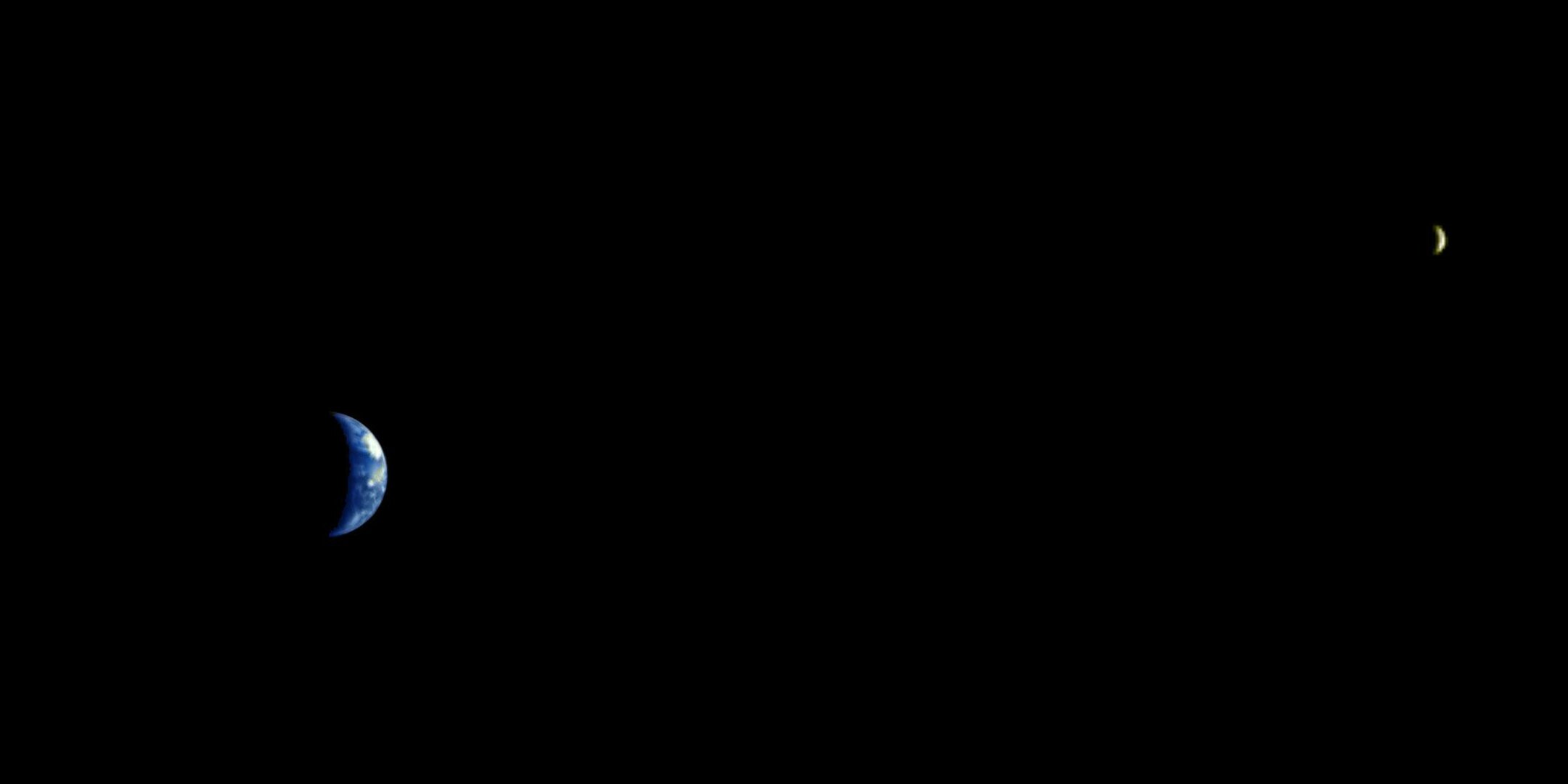
A farewell to Earth: an image of our Earth and her Moon, captured by ESA’s Mars Express mission as it heads towards Mars, June 2003. Credit: ESA
When discussing the robotic exploration of Mars, the focus tends to be on the current NASA missions: the Mars Science Laboratory (MSL) rover Curiosity and the Mars 2020 rover Perseverance and its flight-capable companion, Ingenuity. This is because of all the active Mars missions, these are the most visually exciting. But it does mean the other missions still operating around Mars – a total of 8, including China’s Tainwen-1 orbiter and Zhurong rover and UAE’s Hope mission – tend to get overlooked.
One of those that tends to get overlooked is actually the second longest running of the current batch, the European Space Agency’s Mars Express, the orbital component of a 2-part mission using the same name. This recently celebrated the 20th anniversary of its launch (June 2nd, 2003) and will reach the 20th anniversary of its arrival in its operational orbit around Mars on December 25th, 2023.
The mission’s title – “Mars Express” – was selected for a two-fold reason. The first was the sheer speed with which the mission was designed and brought together as a successor to the orbital component of the failed Russian Mars 96 mission, for which a number of European Space Agency member nations had supplied science instruments, using an ESA-designed satellite unit (based on the Rosetta mission vehicle).
An artist’s impression of Mars Express passing over Mars in its extended elliptical orbit. The two long booms extending fore-and0aft from the vehicle are part of the MARSIS sounding radar designed to locate frozen bodies of water beneath the planet’s surface. Credit: ESA
The second was the fact that 2003 marked a particularly “close” approach of Earth and Mars in their respective orbits around the Sun, allowing the journey time from one to the other to be at the shorter end of a scale which sees optimal Earth-Mars transit times vary between (approx.) 180-270 days. In fact, Earth and Mars were at the time the “closest” they have been in 60,000 years, hence why NASA also chose that year to launch the twin Mars Exploration Rover (MER) mission featuring the Spirit and Opportunity rovers.
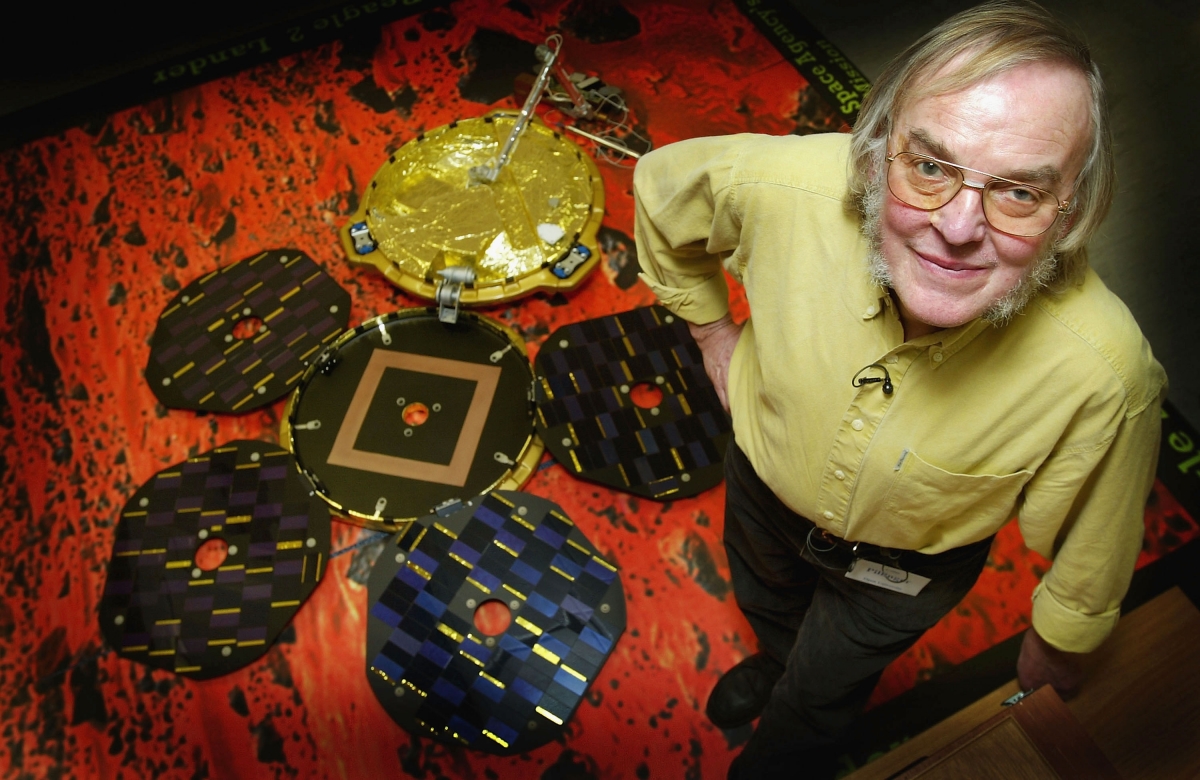
Taken as a whole, the Mars Express mission is perhaps more noted for its one aspect that “failed”: the British-built Beagle 2 lander (named for the ship that carried Charles Darwin on his famous voyage). This was a late addition to the mission, and the brainchild of the late Professor Colin Pillinger (whom I had the esteemed honour to know ); given it was effectively a “bolt on” to an established ESA mission, it was subject to extremely tight mass constraints (which tended to change as the Mars Express orbiter evolved). These constraints led to a remarkable vehicle, just a metre across and 12 cm high when folded and massing just 33 kg, yet carrying a considerable science package capable of searching for evidence of past or present microbial life on Mars.
Sadly, following its separation from Mars Express on December 19th, 2003, ahead of both vehicles entering orbit around the planet and a successful passage through the upper reaches of Mars’ atmosphere, Beagle 2 never made contact following its planned arrival on the planet’s surface. For two months following the landing, repeated attempts to make contact with it were made before it was finally officially declared lost. While multiple theories were put forward as to what had happened, it wasn’t until 12 years later, in 2016 – and a year after Collin Pillinger had sadly passed away – that evidence was obtained for what appeared to have happened.
The late Professor Colin Pillinger pictured with a full-scale model of the Beagle 2 lander in its deployed mode, showing the four solar array “petals” unfolded from the vehicles “cover” to expose the communications antenna, the the power and science instruments – including the little’s landers robot arm and “PAW” – the Payload Adjustable Workbench – designed to study the rocks around the lander and obtain samples of rock and soil for on-board analysis. Credit: Getty Images
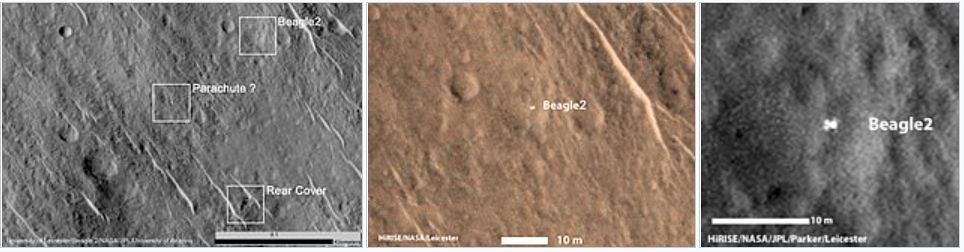
Using a technique called super-resolution restoration (SRR) on images obtained by NASA’s Mars Reconnaissance Orbiter in 2015 and which appeared to show the lander intact on the surface of Mars, experts were able to enhance them to a point where they appeared to show it had in fact managed to land safely on Mars and had partially deployed its solar arrays.
The significance here is that due to its mass and size constraints, Beagle 2 was of a unique design, resembling an oversized pocket-watch and its cover. The “watch” contained the science and battery power systems, and the “cover” the communications system and flat antenna, with four round solar arrays stacked on top of it.
Following landing, Beagle 2 was supposed to fold back its “lid”, and then deploy the four arrays like petals around a flower. This would allow the arrays to recharge the lander’s batteries so it could operate for at least a Martian year, and expose the communications antenna. However, after enhancement using SRR, the NASA images appeared to show only two of the solar array petals had actually deployed; the other two remaining in their “stowed” position, blocking the lander’s communications antenna and denying it with a sufficient means to recharge its batteries.
Left: the MRO image of the Beagle 2 landing site captured in 2015 showing the lander, what appears to be its parachute and its backshield. Centre: an enlargement of the orbiter using traditional processing enhancements, including the use of false colour to try to increase the available detail. Right: the SRR work, appearing to show the lander with 2 (of 4) solar arrays deployed. Credit: NASA / ESA
However, there is one further element of intrigue: because it was known initial communications with Earth might be delayed – Beagle 2 was reliant on either Mars Express itself to be above the horizon post-deployment, or failing that NASA’s venerable Mars Odyssey orbiter – the lander was programmed to go into an automated science-gathering mode following landing. As the science instruments were quite possibly able to function, some of them might actually have deployed, allowing data to be recorded Solid State Mass Memory (SSMM) – data which might still be available for collection were the lander to ever be recovered by a human mission to Mars.
The mystery over the lack of contact with Beagle 2, coupled with the arrival of NASA’s Spirit and Opportunity on Mars at the start of 2004 combined to mean that Mars Express received very little attention following its arrival in its science orbit on December 25th, 2003 – and apart from occasional reporting on its findings, this has continued to be the case for the last 20 years.
The 82 km wide Korolev crater located in the northern lowlands of Mars, home to a body of water ice 1.8 km deep and up to 60 km across. This image was created from a series captured by the High Resolution Stereo Camera (HRSC) on Mars Express, and has a resolution of roughly 21 metres per pixel. Credit: ESA / DLR
Which is a shame, because in the time, Mars Express has carried out a remarkable amount of work and has been responsible for some of the most remarkable images of Mars seen from orbit. 0For example, and just as a very abbreviated list intended to outlines the diversity of the orbiter’s work, within two months of its arrival around Mars, it was able to confirm the South Polar icecap is 15% water ice (the rest being frozen CO2).
In April and June 0f 2003, the vehicle confirmed both methane and ammonia to be present in the Martian atmosphere; two important finds, as both break down rapidly in Mars’ atmosphere, as so required either a geological or biological source of renewal.
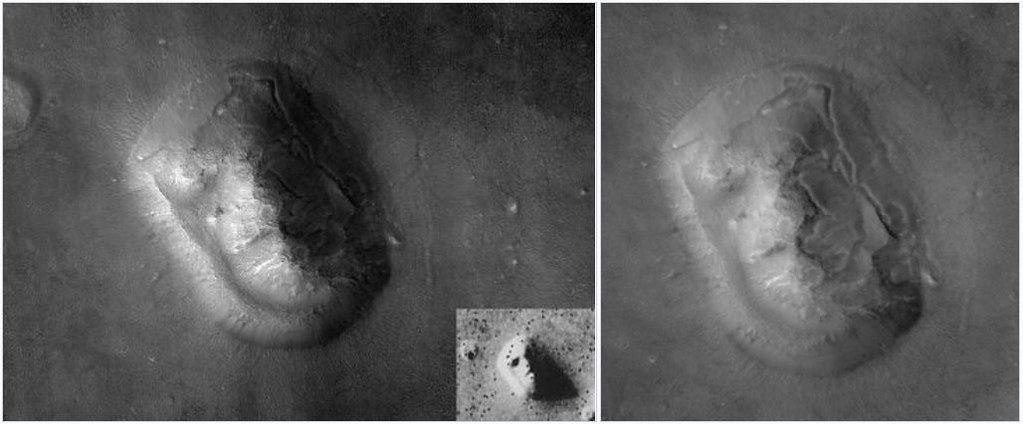
Pareidolia at work: the Cydonia mesa said to be carved into a “human face” following the Viking missions of the 1970s, as seen by NASA’s Mars Reconnaissance Orbiter (2007 – left) and Mars Global Surveyor (2001- right), compared to the Viking image which gave birth to the myth of the “face”. Credit for all images: NASA
In 2006, the orbiter put another nail in the coffin of the “ancient Martians” theories which abounded following the the Viking missions in the 1970s. In one set of images of the Cydonia region of Mars taken by the orbiter vehicles, there was a was a mesa which, thanks to the fall of sunlight, and the angle at which the image was taken, appeared to give it the appearance of a “face”. This quickly spiralled into ideas the 2 km long mesa had been intentionally carved as a “message” to us, together with claims of pyramids and the ruins of a city close by.
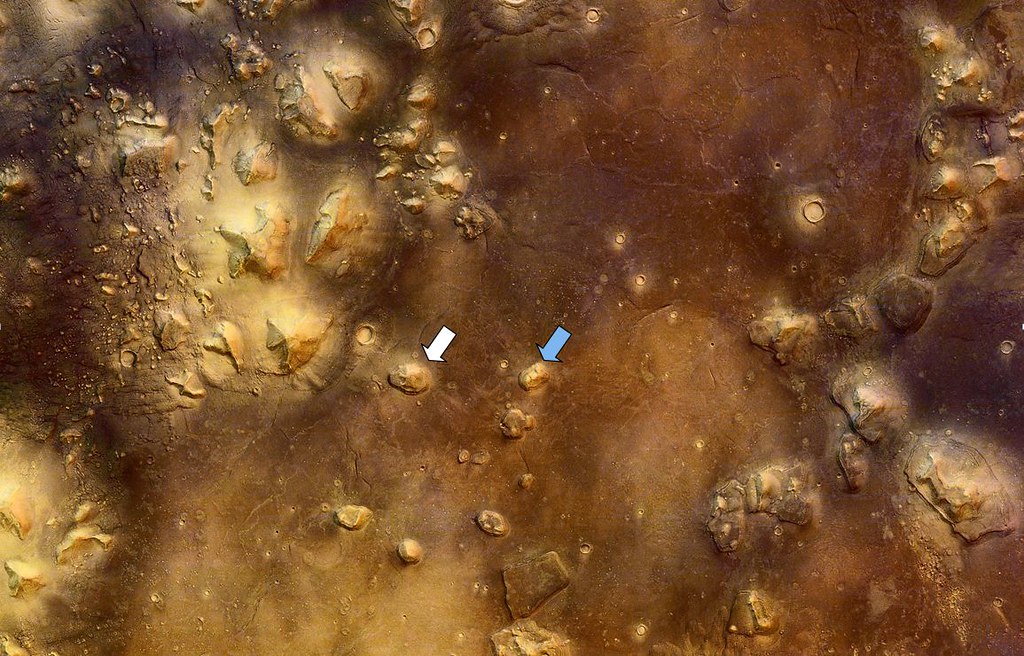
All of this was the result of pareidolia rather than any work by ancient Martians – as evidenced by much higher resolutions of the mesa taken by NASA’s Mars Global Surveyor orbiter in 2001, and Mars Reconnaissance Orbiter in 2007 (above). Mars Express further demonstrated the effects of pareidolia in an image of Cydonia captured in 2006, which showed both the “face” mesa, and – around 50 km to the west – another which looks like a skull. While the latter mesa is also visible in some of the Viking era images, it is no way resembles a skull; the resemblance on the Mars Express image again being the result of natural influences – the fall of light, etc., – coupled with the human brain’s propensity to impose recognisable form and meaning to shapes where none actually exists.
A 2006 image of the Cydonia region, captured by Mars Express, demonstrating the pareidolia effect associated with the so-called “face”. Arrowed in blue is the mesa supposedly carved into the form of a “face” in a similar manner to how it was “seen” by Viking in 1976, together with a “skull” mesa close by (some 50 km away), which looked nothing like at skull when reviewed in the Viking images. Credit: ESA
The Enchanted Library, July 2023 – click any image for full size
Lewis Carroll’s creation, Alice, and her adventures in Wonderland and Through the Looking Glass, are a popular inspiration for Second Life creators and region designers. I’ve covered numerous Alice-inspired builds within these pages; some of which focus on the stories as a whole, others of which take specific elements of the stories to offer something of interest / fun for Second Life residents to explore.
With The Enchanted Library, Kaneha (Kaneha Atheria) uses Alice’s trip down the the rabbit hole – a trip which first appeared within the manuscript Alice’s Adventures Under Ground before being expanded into the published Alice’s Adventures in Wonderland – as the leaping off point for the exploration of the magic of books and stories, with a focus on not a single tale, but 16 books hidden within her 4096 sq metre setting.
The Enchanted Library – July 2023
The adventure begins by following the White Rabbit literally down his hole to arrive a very particular wonderland. Further references to Carroll’s stories can be foot at the hole and along the path leading to a twilight garden. Here, scattered among the trees, flowers and ruins are numerous places to sit – and one to dance – all gathered under a skydome of stars.
Meandering between the various locations is a path of stepping stones. This switchbacks its way to where a large draughts board forms a waiting dancefloor, overlooked by the remnants of the chapel. Along the way are clues to the 16 stories and books – I’m not going to list them all here; the fun is in discovering them, and some might be a little more obvious than others, depending on your point of view.
The Enchanted Library – July 2023
That said, there are hints that a girl will go to the ball, that a Modern Prometheus may not be quite a monster or that whilst also being undead can suck or that winter might well be coming. There’s also at least one direct reference to a specific young wizard sitting within the broader pointers towards the world of magical tales, whilst a table apparently set for an afternoon cup of tea reminds us that poison was a favourite form of murder for a certain writer of mysteries – although this might also be a reference to wider forms of writing, such as plays.
This latter point might be further indicated by the presence of an advice booth which brings to mind the one oft visited by a little boy who doesn’t have the greatest amount of luck when it comes to baseball (or with footballs – although that’s largely down to the little girl sitting behind the booth). Also awaiting discovery are interactive elements; not just the dance machine or places to lie or sit, but givers allowing visitors to enjoy a touch of poetry, adding another twist of interest for visitors.
The Enchanted Library – July 2023
The Enchanted Library – July 2023
Small but making good use of the available space, The Enchanted Library offers visitors an warm and engaging visit.
Now open through until the end of the month is the SL Fandom Con, a new Mega Event for Relay for Life of Second Life and the American Cancer Society, and one not to be confused with the Sci-Fi Expo / Con events many of us are likely familiarly with – although there is a good degree of cross-over.
SL Fandom Con is using the love of stories, comics and all forms of art to bring people together in the virtual world of Second Life while supporting the American Cancer Society’s mission to lead the fight to end cancer as we know it, for everyone. The SL Fandom Con is a fan event bringing you various roleplay groups, resources, shopping, and entertainment from across all of Second Life and we are proud to be part of a community of courage and caring in Second Life.
[It is] A social event focused festival with wider inclusivity for all genres of anime, comics, movies, RL & SL artist creator content, video and tabletop games, pop culture, SL Film Festival, and a specific emphasis on RL & SL Costumes and Cosplay.
– From the SL Fandom Con website
Active across seven regions circling out from and back to the American Cancer Society 2 island (which itself forms the convention’s eighth region), the SL Fandom Con mixes the “traditional” SL approach for such events through the use of sponsored / themed / entertainment regions, with something of a physical world convention feel. By this I mean that as well as American Cancer Society 2 forming the primary landing point for those visiting the convention, it also presents two large convention halls of the kind generally seen at sci-fi, comic, gaming, and so on conventions in the physical world. As with their physical counterparts, these two halls offer a mix of exhibitor booths as a part of the Rep Your Fandom contest, together with activity space.
SL Fandom Con, July 2023
The main landing point includes information boards where people can obtain teleport / guide HUDs, links to relevant parts of the event’s website where information on shopping, activities, etc., can be found. Experience activated teleport portals flank one side of the landing point, awaiting those who wish to get on with their wandering through the rest of the event regions, while on the other side of the landing point sits the Memorial Garden, ready for those wishing to remember someone they’ve lost to cancer.
Foot access to the adjoining shopping regions – Space and Underwater – can be reached through the two convention halls. With clear roadways / footpaths directing people through each region and on to the next. The region names themselves tend to give a clue as to their main focus (e.g. Space includes a heavy space-based sci-fi focus; New Tokyo a lean towards Japanime, Japanese franchises, etc.) – although none are entirely exclusive to a specific theme of store.
Most of the shopping regions also offers a themed mode of transport as well – little flying saucers at Space, for example. These can be used to travel through each region, with rezzing points at either entry / exit point to a region, with some regions offering additional vehicle rezzing points for those who hop out of their vehicle to explore the local shops, but wish to resume their rides afterwards. Some of these vehicles, frankly, work better than others, but they all offer a potentially different means of skipping through regions.
SL Fandom Con, July 2023
Entertainment stages are located throughout the regions and feature a range live performances, dance troupes, DJ events, whilst the Con also includes its own auction, hunt and contest (the Rep your Fandom Contest, mentioned above). The auction – which can be entered at the main landing point – includes a series of special prizes courtesy of Linden Lab, comprising:
One annual Premium Plus subscription.
Two annual Premium subscriptions.
A Full private region (20K Land capacity) for 6 months free tier.
A Homestead region for 6 months free tier.
Two Name Changes (using the currently available last names).
One Name Change as a gift for a friend (using the currently available last names).
In addition to the above, some of the folk from the Lab will be participating in the event along with some of the Moles from the LDPW participate in the Fandom Con Fashion Show on Thursday, July 27th between 13:00 and 15:00 SLT, when they will be joining residents in showing off their favourite fandom-inspired look.
SL Fandom Con, July 2023
Full information on the event can be obtained via the website, but the following is a list of key SLurls and URLs.
The following notes were taken from my audio recording and chat log transcript of the Content Creation User Group (CCUG) meeting held on Thursday, July 20th, 2023.
The CCUG meeting is for discussion of work related to content creation in Second Life, including current work, upcoming work, and requests or comments from the community, together with viewer development work.
As a rule, these meetings are:
Held in-world and chaired by Vir Linden.
Conducted in a mix of voice and text.
Held at 13:00 SLT on their respective days.
Are subject to the schedule set within the SL Public Calendar, which includes locations for both meetings (also included at the end of these reports).
Open to all with an interest in content creation.
Viewer Updates
The Maintenance U(pbeat) RC viewer, version 6.6.14.581101, was released on July 21st. Key changes in this viewer comprise:
Improvement parcel audio as the viewer leverages VLC for audio streams.
The Inventory Extensions viewer was promoted to RC status with version 6.6.14.581058, on July 20th.
A new option Show Ban Lines On Collision (toggled via World→Show) which will only show banline on a direct collision (foot or vehicle) rather than constantly visible when within camera range.
The Alternative Viewers page appears to have suffered a hiccup, listing version 6.6.12.579987 as the “Win32+MacOS<10.13” RC viewer. However,
The Win 32 + Pre-MAC OS 10.3 viewer was promoted to release status on July 5th.
6.6.12.579987 was the version umber assigned to the Maintenance S RC viewer (primarily translation updates), originally issued on May 11th, and promoted to de facto release status on May 16th.
The release and Project viewers currently in the pipeline remain unchanged:
Release viewer: 6.6.13.580918, formerly the Maintenance T RC viewer, promoted on July 14.
Project viewers:
Emoji project viewer, version 6.6.13.580279, May 30.
Puppetry project viewer, version 6.6.12.579958, May 11.
Senra NUX Avatars
There was a stir in the week when the Senra brand of mesh avatars designed by LL (and primarily intended for new users as a part of the New User eXperience – NUX) were made available through the system Library and then withdrawn.
This was apparently not an error on LL’s part, but rather the result of an issue with the avatars being noted, prompting their removal from the Library.
The removal did not prevent some users grabbing copies of the avatars + accessories (presumably by copying items from the Library to their inventory), which weren’t removed as a part of the “recall”.
The appearance of the bodies + accessories also sparked a fair degree of forum discussion, approximately starting towards the bottom of page 17 of this thread.
In reference to the thread, LL encourage those who did manage to retain the Senra bodies and are observing issues / have concerns to continue to record feedback there, as “all eyes” involved in the project are watching that thread.
glTF Materials and Reflection Probes
Project Summary
To provide support for PBR materials using the core glTF 2.0 specification Section 3.9 and using mikkTSpace tangents, including the ability to have PBR Materials assets which can be applied to surfaces and also traded / sold.
Substance Painter is also used as a guiding principal for how PBR materials should look in Second Life.
Up to four texture maps are supported for PBR Materials: the base colour (which includes the alpha); normal; metallic / roughness; and emissive, each with independent scaling.
Given the additional texture load, work has been put into improving texture handling within the PBR viewer.
In the near-term, glTF materials assets are materials scenes that don’t have any nodes / geometry, they only have the materials array, and there is only one material in that array.
As a part of this work, PBR Materials will see the introduction of reflection probes which can be used to generate reflections (via cubemaps) on in-world surfaces. These will be a mix of automatically-place and manually place probes (with the ability to move either).
The overall goal is to provide as much support for the glTF 2.0 specification as possible.
As a result of the updates, SL’s ambient lighting will change (e.g. indoor spaces will appear darker, regardless of whether or not Shadow are enabled), and so there will be a period of adjustment for users (e.g. opting to install lighting in indoor spaces, choosing between the HDR lighting model of glTF or opting to set a sky ambient level).
Many in the team have been out-of-office recently, and so work had slowed for a while.
The focus remains on bug fixing within both the viewer and the simulator code.
Double-Sides Materials Concerns
A request was made for LL to remove double-sided materials from the PBR work, due to the following concerns:
Inexperienced creators misunderstanding the capability (e.g. a content creator who makes a pendant with 500,000 triangles and applying materials to all of them, overriding backface culling), and:
Clothing creators who add additional tris along the edges of clothing (e.g. cuffs, lapels, collars, etc.), to given the illusion of an “inner” material instead utilising double-sided materials instead, leading to:
The potential of both of these leading to noticeable viewer performance impacts (e.g. due to doubling the amount of rasterising the viewer must perform).
In response Runitai Linden noted:
Double-sided materials is a part of the glTF specification, and so will remain within the PBR project, and so forms a part of the overall requirements for obtaining Khronos 3D commerce certification, which LL would like to achieve for Second Life, and for that reason will not be removed.
In terms of performance LL believe:
Double-sided materials generally do not get rasterised twice (e.g. if you are looking at the front face of a leaf with double-sided materials, the back face is not rasterised) – although there are some exceptions to this.
Double-sided materials are a “fill” hit, not a per triangle hit, so the performance hit decreases exponentially as the camera moves away from the object – so for actual double-sided objects, it is a performance win.
To help safeguard against accidental misuse, the option to apply double-sided materials must be explicitly enabled when uploading, even if the materials themselves have been created as double-sided (if the option is not explicitly set, then they will be uploaded as single-sided).
The issue does admittedly have edge-cases, and there are issues around any implementations for double-sided materials (e.g. how do you penalise for incorrect use? Increased LI? But then – a) what about worn items (which are immune to LI), and b) how does the viewer differentiate between “correct” use of double-sided materials and an “incorrect” use, in order to avoid penalise good practices in error?
However, LL are not going to disable / artificially limit the use of double-sided materials due to the potential for misuse, either accidental or deliberate.
PBR Mirrors
This is a follow-on project to the PBR Materials, intended to provide a controlled method to enable planar mirrors in SL (i.e. flat surface mirrors which can reflect what is immediately around them, including avatars).
As per my previous CCUG update, the approach being taken is to use a “hero probe”.
This uses a materials flag added to a surface which allows it to be considered as a mirror face, based on the proximity of a camera to it.
When a camera is within the expected range, the flag will instruct the viewer to create a “hero probe”, rendering high resolution (512×512) reflections on the mirror surface until such time as the camera moves away.
It is an approach which allows for multiple mirrors within a scene, whilst minimising the performance impact to only one mirror per viewer.
The concept is now working in tests, and depending on performance, it is possible the viewer might be allowed to support up to two hero probes at a time: one for any nearby mirror surface, and the other for generating reflections on any nearby Linden Water.
It is hoped that a project viewer will be available for public testing of the idea will be available Soon™.
ARC – Avatar Render Cost
Intended to be a means of calculating the overall cost of rendering individual avatars by the viewer, ARC has long been acknowledged as inaccurate.
Currently, the project to adjust both ARC calculations and the actual cost of rendering in-world objects to make them more reasonable – Project ARCTan – remains inactive.
The problem with such metrics like ARC is that they depend on a range of analyses which, when combined, do not necessarily result in an accurate reflection of real-world rendering very well.
However, those curious about the rendering cost can use:
World→Improve Graphic Speed→Your Avatar Complexity to seen the render impact (in ms, currently for the CPU, but with the PBR viewer, for the GPU) of their own attachments can have on own and other viewers.
World→Improve Graphic Speed→Avatars Nearby to see the rendering impact of other avatars within view.
Note that both will fluctuate do to the general “noise” of rendering, however, the generated figures are far more accurate in real terms than those for ARC.
Details of these capabilities – first deployed in Firestorm, and contributed to Linden Lab for inclusion in all viewers, can be found in this blog, here.
Questions were asked over the ability to see these figures displayed over avatars heads vs. having to go to a “specialised” menu, with some at the meeting pointing to the overhead display being preferable, because it it “there”. However, this overlooks the facts:
It could be received as “cluttering” the in-world view and reducing immersiveness.
If displayed as hover text, it could be easily disabled either by an dedicated UI setting or simply by exposing the debug to disable avatar-related hover text
Most particularly, any such display (even if added to name tags) would in fact adversely impact performance due the CPU / GPU cycles taken up by performing the calculations and then displaying them – with Runtai noting it can takes “several times longer” CPU time to calculate and display avatar render cost on the than it does to render the avatar.
The above led to a broader discussion on how to encourage better awareness of avatar impact on viewer performance (ARC shaming not being a positive approach to things), such as general education among users and having some form of “try before you buy” capability (if this were possible to implement) which would offer the ability to see the impact of wearing a specific attachment ahead of wearing it), or some form of inspection capability at upload which might encourage creators to go back and better optimise their avatar attachments.
One noted issue here is ensuring both sides of the equation have the tools to make more informed decisions: creators in terms of making their content more performant / efficient, and consumers to enable them to be able to better identify performant / efficient content. The latter is particularly important in its ability to drive market forces through users being able to naturally gravitate towards more efficient content.
Tags for Wearables
This was an idea mooted by the Lab in the meeting – not a project currently being worked upon.
A tag system which allows items with a certain tag to automatically replace another of the same tag type with a single click and without also replacing other items using the sane attachment point. For example, an item tagged as “hair” replaces the currently worn hair with a single click, but without also knocking off a hat also worn on the skull.
This was expanded upon by the idea of tags being used with demo items – the tag being used to perform tasks such as:
Only allowing the demo item to be worn within a certain location (e.g. the “dressing” area of the store).
Somehow records the item being worn prior to using the demo, o that it is automatically replaced when the demo item is removed.
The problem with the latter idea is that everyone uses demos differently, so assigning a single place at which a demo can be tried is a non-starter (do we really wany people trying demos at already busy events? What about items purchased via the MP or affiliate vendors, what location should be assigned to them? How is the creator to differentiate? Multiple versions of the same item for different points-of-sale? What about people who don’t have a home location by use sandboxes, but the demo tagged for use only within the avatar’s home location? Can this realistically even be done?).
An alternative suggestion for tags put forwards at the meeting was to have them as a part of the upload process, so creators could be reminded / encouraged to specific the desired attachment point via a tag list, so that users are not left with items defaulting to their avatar’s right hand.
There are a range of issues over any tag system, including:
a) How well the option would be used unless enforced; b) Even if enforced, how many content creators, would actually define the preferred attach point over just selecting the first one on the list?
The idea leans towards WEAR, rather than ADD – so will not necessarily overcome the confusion of new users who wish to ADD an item to their avatar, only to find it knocks something else off of their avatar.
How many tags should be in the system? “Hair”, “shirt”, “pants”, “gloves”, “shoes” are all straightforward – but what about shawls or shoulder wraps? should they be classified as a shirt or a collar, or have their own tag or individual tags? How are rings, earrings, pendants, etc., be classified / tagged?
† The header images included in these summaries are not intended to represent anything discussed at the meetings; they are simply here to avoid a repeated image of a gathering of people every week. They are taken from my list of region visits, with a link to the post for those interested.







 Inara Pey: Living in a Modemworld