Space Sunday: rockets, moons, leaks and a ring

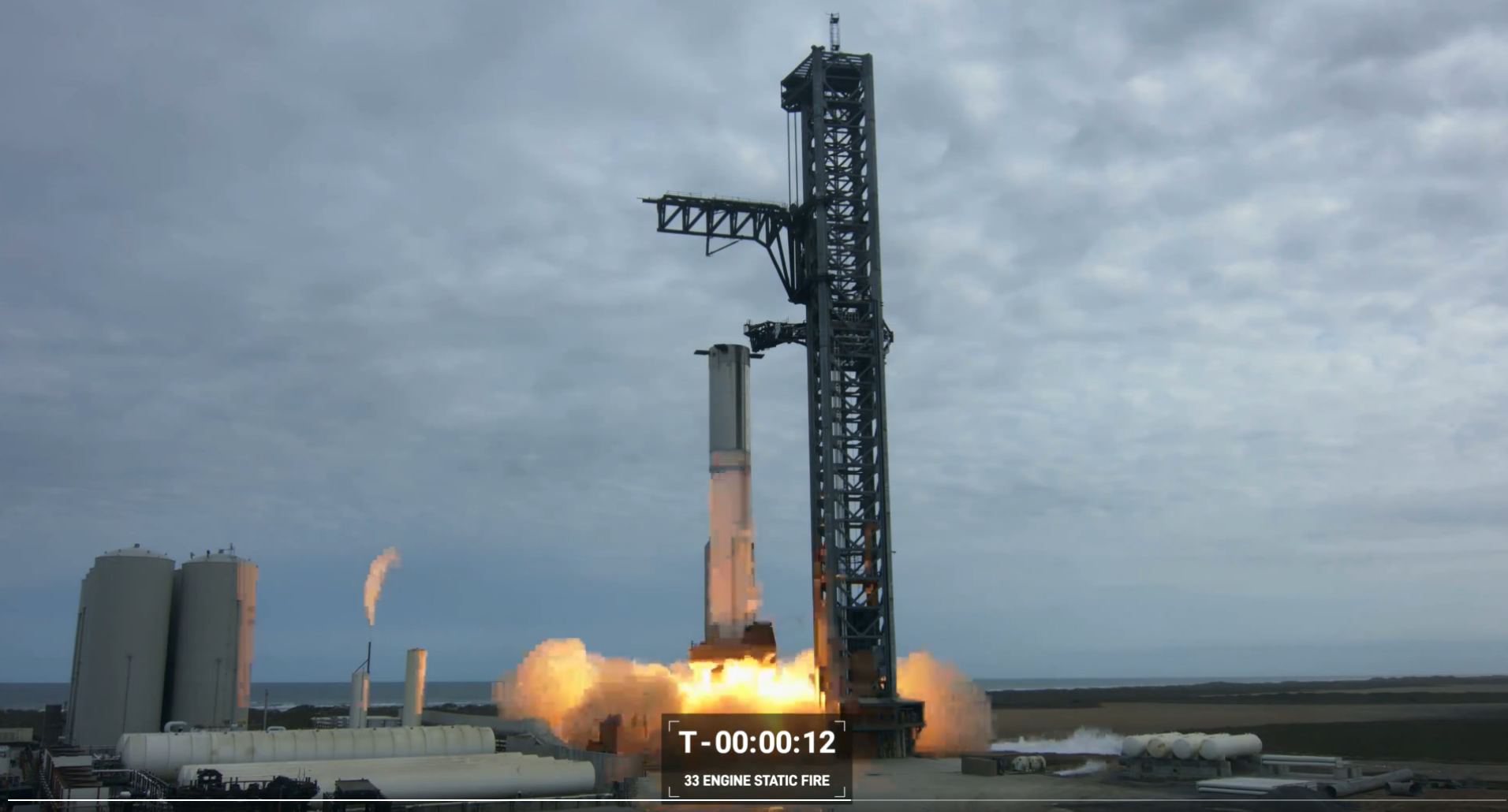
The moment of ignition: 31 Raptor motors ignite: Booster 7 during its full static fire test, February 9th, 2023. Credit: SpaceX

SpaceX has completed the largest static fire test for this Starship / Super Heavy launch system, with the 70-metre tall Booster 7 – expected to be part of the first orbital launch attempt – completing a “full duration” 5-7-second test of 31 of its 33 Raptor 2 engines.

The test was made on Thursday, February 9th, amidst on-going work at the orbital launch facilities at the company’s Boca Chica, Texas Starbase site. It had been intended to be full 33-engine test, but one engine was “turned off” during a pause in the countdown at the T -40 second mark, presumably due to an issue being detected, and a second automatically shut down at, or immediately following, ignition.

Even so, the burn was enough for the SpaceX CEO to proclaim the 31 firing engines developed sufficient thrust that, if sustained throughout an 8-minute ascent, it would be enough for Super Heavy to push a fully laden Starship to an altitude where it could reach orbit under the thrust of its six engines.

Ignition came at 21:13:53 UTC, after a partial filling of the booster’s liquid methane and liquid oxygen tanks – Starship 24 had already been destacked from the booster earlier in the month, leaving just the booster on the launch table. Everything appeared to go well, with SpaceX afterwards reporting the engines reached a peak thrust of 7,900 tonnes, or almost twice that generated by the Space Launch System Block 1/1A launcher, and 3,000 tonnes more than the Block 2 SLS cargo launcher.

However, such comparisons need to be put into context: Super Heavy must lift 1200+ tonnes of Starship to low-earth orbit (LEO), carrying 100 tonnes of cargo. SLS is already capable of lifting 95 tonnes of payload to LEO if required, which will increase to 105 tonnes and then 130 tonnes. It is also capable of delivering 27 tonnes to cislunar space, which will increase up to 46 tonnes. The flipside is that Starship and its booster are fully reusable, lowering launch costs; SLS is not. Also, if the booster is not re-used, they Starship could in theory life up to 250 tonnes to LEO; conversely, SLS can reach cislunar space, whereas Starship cannot, not without a complex series of on-orbit refuelling operations.

The test came after extensive work had been carried out at the launch facility after the first two Super Heavy static fire tests (with 7 and 14 Raptor motors respectively) literally stripped the concrete from the base of the launch stand, peppering the launch mount and its surroundings with high velocity cement debris and necessitating extensive repairs to the site.

The problem was one of basic engineering (and frankly, something SpaceX should have considered): the launch table legs and apron underneath the rocket are coated in concrete. A key ingredient of concrete is water, some of which is retained in the concrete as pockets of moisture. Heat concrete to 600°C or more, that moisture flash vaporises into expanding gases, causing the concrete to violently explode.

As I’ve previously noted, this risk is usually negated by the inclusion of a water deluge system which delivers thousands of litres of water to a launch facility, serving a dual purpose: it both absorbs the enormous heat generated by multiple rocket motors by flashing into stream by the force of that exhaust, and it also absorbs the sound waves generated by the motors, further preventing that sound being deflected back up against the rocket and potentially damaging it at launch.

Following the 14-engine test, SpaceX replaced the concrete at the launch facilities with a type designed to withstand very high temperatures. At the time of writing, it is not clear how well this mix withstood the engine test, however the test came at a time when SpaceX is – belatedly – attempting to install a water deluge system to work alongside the existing (and minimal) sound suppression system already part of the launch table.

Tanks for a water deluge system arrive at Starbase Boca Chica via barge. Credit: RGV Aerial Photography
Many – including the SpaceX CEO – are proclaiming the way is now clear for an orbital launch attempt to be made in March. However, this actually depends on a number of factors – the most key of which is whether or not the FAA is satisfied that SpaceX has done / is doing enough to ensure its compliance with all 75 remedial actions specified in its Programmatic Environmental Assessment (PEA).

NASA Tests Upgraded RS-25 Motor

The SpaceX static fire test overshadowed NASA’s test of its updated RS-25 engine for the Space Launch System.

The initial four SLS launches utilise a total of 16 refurbished RS-25 motors originally used with the space shuttle system and referenced as the RS-25D. However, beyond Artemis 4, NASA will be switching to a version of the RS-25 which has been extensively updated. Called the RS-25E, it will deliver 30% more thrust; allowing SLS achieve the upper end of its payload capabilities noted above.

The test, which took place at NASA’s Stennis Space Centre in Mississippi, saw a test stand mounted RS-25E motor fire at 111% of its rated thrust for a total of 8.5 minutes – the amount of time the engines would be used in an actual launch.
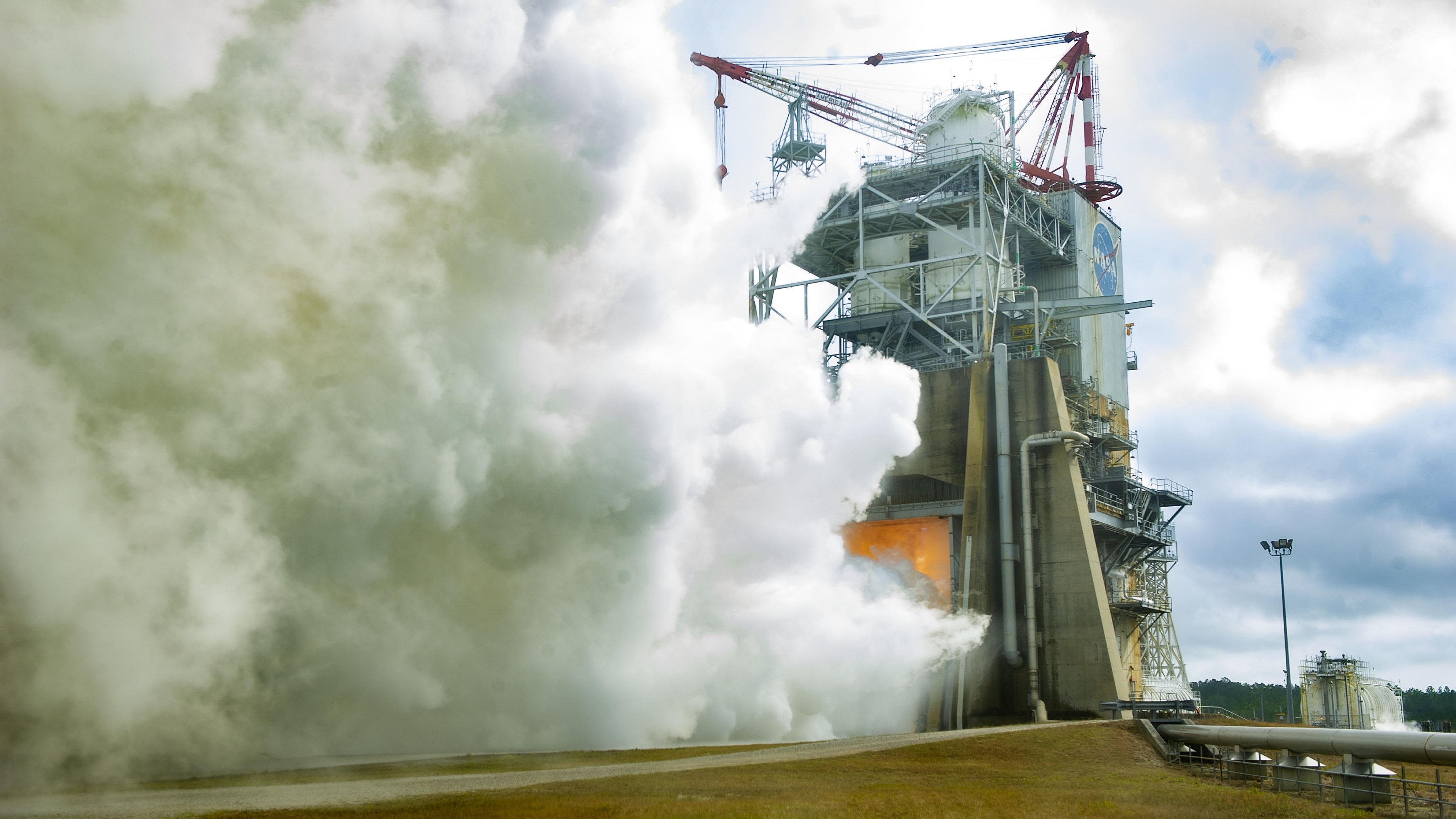
A single RS-25E under 1!1% of rated thrust during testing at Stennis Space Centre. The great cloud to the left of the test stand is, in part, steam generated from the engine exhaust striking water from the deluge system Credit: NASA

The RS-25E will commence operations with the Artemis 5 mission in 2028. They will operate alongside the new Exploration Upper Stage (EUS) which will also help raise the SLS system’s performance. EUS itself will entire service with Artemis 4.

Image of the Week

The image below is a computer-generated top-down view of Jupiter and the orbits of its (currently) 92 moons. At the centre of the image is Jupiter and (purple) the orbits of its four most famous Galilean moons – Io, Europa, Ganymede and Callisto. Beyond them, predominantly shown in red, are the remaining 88 moons.
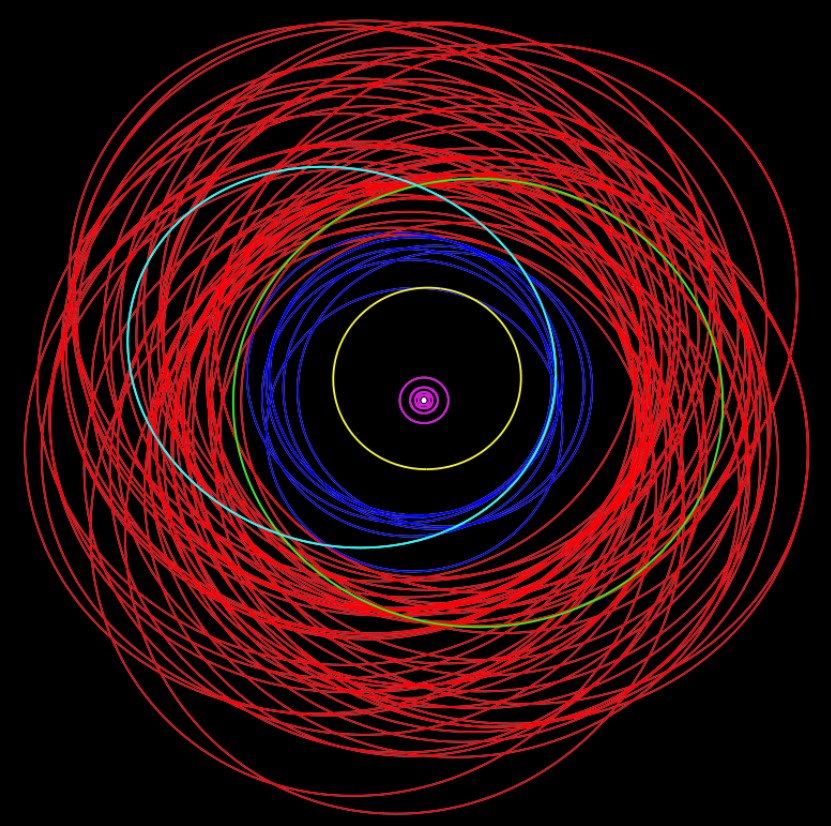
A computer model of the moons of Jupiter in their orbits, with the planet at the centre, as seen from overhead. Credit: Scott Sheppard

Until recently, Saturn held the record for the greatest number of moons (82), the majority of which (43) have been discovered by a team led by astronomer Scott Sheppard. However, Sheppard’s team have also been busy over the years seeking moons orbiting Jupiter – racking up and impressive 70, including the most recent batch of 12 which handed the moon record back to the largest planet in the solar system.

The newest moons were discovered over a period of observations by Sheppard and his team using a number of observatories around the world across 2021 and 2022. They range in size from 1 to 3.2 km across. Most have very large orbits, with nine having periods of more than 550 days. None have been named as yet, as all are awaiting further independent verification.

Continue reading “Space Sunday: rockets, moons, leaks and a ring”
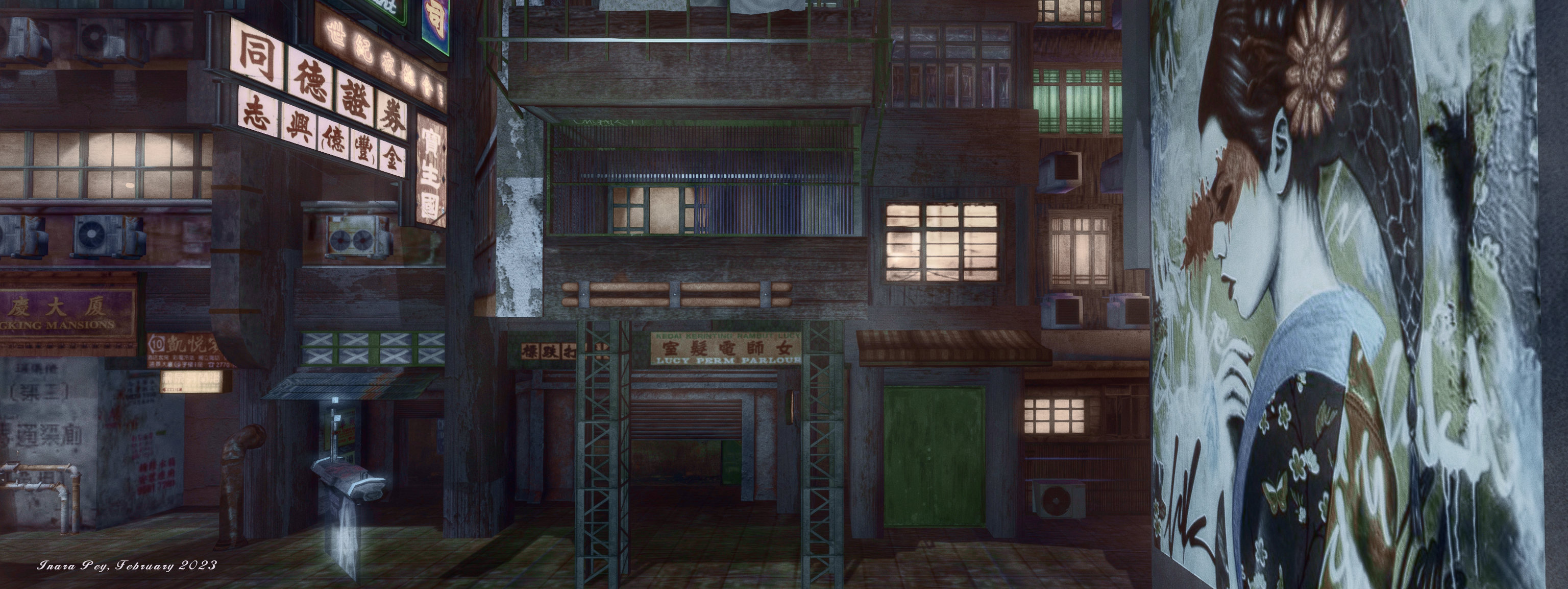
The streets and alleyways of Kawaii City in Second Life

Kawaii City, February 2023 – click any image for full size

Kawaii City is a place of two halves, occupying as it does a pair of sky platforms. Built by Naru Darkwatch, the city is named for the Japanese culture of cuteness – although its dystopian-come-cyberpunk lean doesn’t perhaps at first match the more familiar appearance of Kawaii as exemplified by the phenomena of Hello Kitty and Pikachu, although it does resonate with manga / anime styles of cuteness.

Each half of the city – called simply Kawaii City and Kawaii City II – has its own landing point, and given they are both located in the same region, it is possible to move easily between the two, and noted below. Whilst there is a commonality of looks and backdrops between the two, each very much has its own character.

Kawaii City, February 2023
A place where you can come and chill and relax or roleplay in a cyberpunk post apocalyptic setting please respect the TOS and have fun.

– Kawaii City About Land

Kawaii City is the larger of the two builds, its landing point located on a broad street running north to where the entrance to the Kawaii Café can be reached up a flight of stairs and a covered auto teleport provides access to Kawaii City II. The café and the teleport require acceptance of the local experience order to reach / use either one, whilst the structures around the entrance and the street provide a mix of façades, places to sit, eateries and places with casual role-lay might take place.

Kawaii City II, February 2023

Further south, the street narrows to pass through a narrow, arched neck to become a warren of alleyways rising and descending, each with its own little attractions and the occasional dead-end.

The landing point for Kawaii City II sits alongside a small café at the edge of what appears to be an industrial complex of some description. Pipes run overhead and alongside the waters as they are channelled away from a large pool that sits as a barrel blocking the way forward. However, a freight elevator running horizontally on rails offers a way across the water for those who wish to explore further, and who may as a result find their way to a subterranean club. Alternatively, metal steps rise to an elevated walkway which also spans the water; beyond it, raised roads and alleys run between buildings and places of business, most of which are, like those in Kawaii City, façades which form backdrops for potential photography and / or role-play.

Kawaii City, February 2023

A single street opens off of the industrial complex, but doesn’t run far, wedged as it is between more façades. However, looks can be deceptive: those who look will find the entrance to a bar which looks like it might have send the Mandolorian walk into it. Close by, the narrow neck of an alley leads the way to where a decidedly deco-looking frontage of an old radio hall theatre has clearly seen better days. Another alley provides access to a further upper level forming an L-shaped brace of alleys in which RP might take place and where one might find the auto-teleport connecting it with Kawaii City.

I’m purposefully not saying too much more about the locations, as explorers and photographer will doubtless find their own particular points of interest, and there are elements what are better explored than described. Suffice it to say, Kawaii City and Kawaii City II make for an interesting diversion and offer the potential for a range of casual role-play activities.

Kawaii City II, February 2023

SLurl Details

Note that Direskin is rated Adult

The Book of Caligula in Second Life

Artsville Gallery: Chuck Clip – The Book of Caligula

Gaius Julius Caesar Augustus Germanicus was born in 12 CE into the Julio-Claudian dynasty. The son of beloved Roman general and hero Germanicus, he became popular with his father’s troops when, at just three years of age, he accompanied them on a campaign in Germania wearing a full miniature soldier’s uniform, right down to little versions of their hardy footwear. It was from these little boots that he would gain a nickname from the troops which would follow hi throughout his life: Caligula.

Caligula succeeded Tiberius – with whom he had a strange relationship as the second emperor’s “ward”-come-prisoner – in 37 CE to become the third emperor of Rome. His rule started as a time of get popularity: he seemingly put a stop to the terror of Tiberius’ treason trials with their executions and exiles; he recalled those exiled back to the freedom of Rome; he decreased the overwhelming burden of tax on those the most affected; he re-established elections to public service positions, and spent treasury money on lavish games and entertainments for the citizens.

Artsville Gallery: Chuck Clip – The Book of Caligula

Almost all of that largesse vanished barely eight months into his rule. Struck down by a sudden and potentially life-threatening illness, his recovery left him with a far darker, crueller demeanour, one which saw the return of executions and exile, a lust for money and power, the ruthless extermination of real or perceived threats, and a growing belief in his own righteousness. It is claimed that the latter reached a point where he allegedly demanded he be regarded as Neos Helios, the “New Sun”, and in 40 CE announced his intention to relocate his seat of power from Rome to Alexandria, Egypt, where he believed he would be worshipped as a living deity. Whether or not this is true is subject to debate; however it was later recorded as the primary reason for his assassination in early 41 CE, allegedly because such a move to Alexandria would result in Rome – and the Senate – losing its power and prestige as the seat of the empire.

History tends to regard Caligula as insane; but is this true? Certainly in the generations that followed, Suetonius and his contemporaries looked back on Caligula as such. But they based their views on the contemporaneous writings of Seneca and Cluvius Rufus – neither of whom may have had an unbiased view of the emperor; Caligula almost executed Seneca out of malice in 39 CE whilst Rufus was a conspirator in Caligula’s assassination – and of Philo of Alexandria. They also potentially took Seneca’s and Philo’s references to insanity out-of-context, as both couched the word in terms of Caligula being corrupted over time in his role as emperor, rather than being genuinely mentally unstable.

Artsville Gallery: Chuck Clip – The Book of Caligula

So what is the truth behind Caligula? Was he born a sociopath who would inevitably cave in to his own blackness of heart and be regarded as a madman? Or was he born of good heart and intent, only to be corrupted by the absolute power bestowed upon him as emperor? Or did the legacy of his upbringing – the imagined ancestral weight of the dynasty into which he was born, coupled with all he witnessed first-hand as the prisoner / ward of Tiberius – ultimately combine to drive him to excess? Or did all three combine within him over time?

Which of these might be true is lost to the passage of history. But while time may well have moved on, and the structures of family, society and power have changed, are we, as individuals and a society, really that far removed from Caligula and the Rome over which he held sway? These are the questions swirling through The Book of Caligula, an exhibition by Chuck Clip and hosted within a suitable Roman villa-like setting at Frank Atisso’s Artsville Galleries and Community.

Comprising 40 individual pieces (including three positioned to suggest a triptych), these are fantastical and not a little disturbing works offered almost as etchings, rich in detail. Each offers a window into Caligula’s life and times: the elevation of bloody gladiatorial games; the corruption born of power (be it emperor or the Senate); the mercurial swings between generosity and and brilliance and bloody, murderous intent, and more. Some, such as Incitātus, offer a very direct reference to the legend (if not necessarily the reality) of Caligula’s life. Others, like Mockery, offer a more subtle hint as to the foundations of the darkness in his heart (his young adult view that the nickname bestowed upon him by his father’s troops was intended as form of derision).

Artsville Gallery: Chuck Clip – The Book of Caligula

But within each of the intricate nightmarish twisting of form and content – almost Boschian in extent – each offers lies something deeper. Note only might they be seen as windows opening onto Caligula’s time, but also mirrors reflecting the realities of the human condition.

Yes, times have changed, as have the strictures of society such that murder, assassination and blood games are no longer considered openly acceptable and apart of the natural order of things; but are we not all still as potentially fallible as Caligula, whether through a failure of mental health or through the corruptions of society and (particularly) political power? Are we not equally vulnerable to excesses which can so easily swing our moods erratically from kindness and generosity to cruelty of word and viciousness of action? Does not power still corrupt, and do we still not, when perceiving ourselves as victims, all too often lash out viciously and blindly? In short, when all is said and done, are we really any more immune to the underpinning weaknesses and failings evident in Caligula’s rule?

Thus, as Chuck notes in the introduction to the exhibition, The Book of Caligula is not merely about the life and times of a fallible Roman emperor ages dead, it is about all of us, and the continued complexities and failings of the human condition.

SLurl Details

2023 SL Puppetry project week #6 summary

Puppetry demonstration via Linden Lab – see below.  Demos video with the LL comment “We have some basic things working with a webcam and Second Life but there’s more to do before it’s as animated as we want.”

The following notes have been taken from chat logs and audio recording of the Thursday, February 9th, 2023 Puppetry Project meetings held at the Castelet Puppetry Theatre on Aditi. These meetings are generally held on alternate weeks to the Content Creation User Group (CCUG), on same day / time (Thursdays at 13:00 SLT).

Notes in these summaries are not intended to be a full transcript of every meeting, but to highlight project progress / major topics of discussion.

Project Summary

General description of the project and its inception:

LL’s renewed interest in puppetry was primarily instigated by Philip joining LL as official advisor, and so it really was about streaming mocap. That is what Philip was interested in and why we started looking at it again. However since Puppetry’s announcement what I’ve been hearing from many SL Residents is: what they really want from “puppetry” is more physicality of the avatar in-world: picking up objects, holding hands, higher fidelity collisions. 
As a result, that is what I’ve been contemplating: how to improve the control and physicality of the the avatar. Can that be the new improved direction of the Puppetry project? How to do it?

Leviathan Linden

  • Previously referred to as “avatar expressiveness”, Puppetry is intended to provide a means by which avatars can mimic physical world actions by their owners (e.g. head, hand, arm movements) through tools such as a webcam and using technologies like inverse kinematics (IK) and the  LLSD Event API Plug-in (LEAP) system.
    • Note that facial expressions and finger movements are not currently enabled.
    • Most movement is in the 2D plain (e.g., hand movements from side-to-side but not forward / back), due to limitations with things like depth of field tracking through a webcam, which has yet to be addressed.
  • The back-end support for the capability is only available on Aditi (the Beta grid) and within the following regions: Bunraku, Marionette, and Castelet.
  • Puppetry requires the use of a dedicated viewer, the Project Puppetry viewer, available through the official Second Life Alternate Viewers page.
  • No other special needs beyond the project viewer are required to “see” Puppetry animations. However, to use the capability to animate your own avatar and broadcast the results, requires additional work – refer to the links below.
  • This project is taking in a lot of additional ideas – animation standards, improving the current animation system, enabling truer avatar / avatar and avatar object interactions such that it is likely to evolve into a rolling development, with immediate targets for development / implementation as they are agreed upon, to be followed by future enhancements.
  • As such, much of what goes into the meetings at present is general discussion and recommendations for consideration, rather than confirmed lines o development.
  • There is a Puppetry Discord channel – those wishing to join it should contact members of LL’s puppetry team, e.g. Aura Linden, Simon Linden, Rider Linden, Leviathan Linden (not a full list of names at this time – my apologies to those involved whom I have missed).

Bugs, Feature Requests and Code Submissions

  • For those experimenting with Puppetry, Jiras (bug reports / fixes or feature requests) should be filed with “[Puppetry]” at the start of the Jira title.
  • There is also a public facing Kanban board with public issues – those experiencing issues can also contact Wulf Linden.
  • Those wishing to submit code (plug-ins or other) or who wish to offer a specific feature that might be used with Puppetry should:

Further Information

Meeting Notes

Animation Streaming

  • Leviathan Linden has been experimenting with animation streaming over the viewer’s animation channel, such that whatever is sent from the controlling viewer is played directly by all receiving viewers without any further processing of the animations by those receiving viewers.
  • This had been discussed in previous meetings as a potential means of lightening the load of animation data processing individual viewers would have to perform, reducing the potential performance impact in situations where animation synchronisation is important. It also lays something of a further foundation for more procedural-based animation processing, allowing viewers to work smarter – sending less data more frequently, which will in turn help enable synchronised animations through puppetry, such as spontaneously sharing a high five.
  • With this initial test, featuring just one viewer using puppetry and one receiving it, actually revealed a more noticeable lag in streaming compared to individual processing and playback of received animation data. It is not clear at this time whether this would worsen in situations where multiple puppetry animations are being streamed / received.
  • The videos were initially posted to the restricted-access Second Life Content Creation Discord server, and then combined into a single video by Kadah Coba, which is reproduced here as an animated GIF – my thanks to Kadah for the work in combining the videos.
Puppetry streaming test: top – animation played in one viewer (large image) with data sent for processing by a receiving video (inset). Bottom: the same animation played on the same viewer and then streamed to the receiving viewer (inset) and played on receipt without any additional animation processing.
  • Leviathan notes this is a very quick and dirty test, requiring “some hackery” within the viewer’s animation code, but does not (as yet) require any changes to the server-side puppetry management code.
  • Further refinement of the code is required, together with further testing to see if the approach can be smoothed / improved, as such, the work is not currently fit for integration into the Puppetry Project viewer, although it has been suggested it might be offered as a temporary, separate test viewer to allow broader testing.
  • On potential issue is that the streaming is currently dependent on the reliability of the originating viewer; if it is running at a low FPS, potentially causing the receiving viewers see a “choppier” result with lagging and smooth animations within the stream.

LSL Integration

  • See: OPEN-375: “LSL Functions for reading avatar animation positions”.
  • Rider Linden has been working on an LSL API to control animation on an avatar.
Conceptually it would behave like LEAP from LSL. The simulator will send the animation instructions down to the targeted viewer which will perform the IK and animation, and then send the results back as though they were coming from any other LEAP plugin. Targeting objects should be possible with the API (although I’ll add a world position/rotation parameter so you don’t have to do the math yourself).

– Rider Linden

  • This work is possibly best described as moving a step towards enabling an avatar using puppetry to reach out and pick up an apple by allowing a script to position the avatar’s hand at the location of the apple, from where the user can use a supported capture tool to “pick up” the apple.
  • The envisioned actions would be: the user move their avatar’s arm towards the apple, the apple detects the collision between the avatar hand and itself and attaches to the hand as if it has been directly picked up.
  • Further work is required involving collisions between the apple and the avatar’s hand, so the apple knows it is being “grabbed”. This might be achieved by using an existing collision event as the trigger for attachment, or an entirely new event.
  • One problem is to avoid having multiple extra collision objects bouncing around the physics engine for every single attachment point on an avatar (55 in total), which would add-up, performance-wise, very quickly.
    • One suggestion for mitigating this is that as region knows where your hand is (which is true with the attachment update stream), it could be possible by implementing a new “grab” action that works in the physics simulation for picking up small objects; however, it would likely need some hint/magic on the viewer to render the object “at the hand” rather than “near the hand”..
  • Beyond this, there is also additional work to allow avatar-to-avatar interactions via puppetry – such as the aforementioned high five – which involves addressing some permission issues.

In Brief

  • Concern was raised that emphasis on puppetry over the traditional canned animation assets is that it could make SL inaccessible for some (because of the need for additional motion capture hardware, a possible need for more powerful client computers, etc). In response, those at the meeting pointed out:
    • The approach being taken by the Lab is not new – it has been a common factor (albeit implemented in a verity of ways) within games for well over a decade, and is used in multi-player games without participants being “lagged” to the point where gameplay is broken.
    • What is being proposed with Puppetry is not even “new” (in the broadest sense); rather it is adding a further layer of animation capabilities to Second life which can enable a greater sense of interactivity to the platform.
    • In terms of hardware, it was further pointed out that while some at the meeting are using VR hardware – headsets and peripherals – all that is actually required to start leveraging the capabilities (and as LL have demonstrated in the animated GIF forming the banner of this summary is a basic webcam.
  • In a more general conversation, it was pointed out by those at the meeting and the Lab engineers that:
    • Whilst things like streaming puppetry animations may at times result in more visible lag / animation desynchronization, it offers so much more in the way of avatar interaction with the world, it would be more than worthwhile.
    • This work is purely about puppetry and interactivity; it does not actually alter the way more general animations – walking, standing, etc., work, as the underpinning locomotion engine within the simulator and how the viewer calculates motion based on data from the simulator is not being altered.
    • Instead, the LSL API (and the LEAP API?) will enable general avatar orientation and attachment point orientation / movement to ensure that arm correctly reaches out to “grab” the apple mentioned above, by effectively running in conjunction with the locomotion engine.

Date of Next Meeting

  • Thursday, February 23rd, 2023, 13:00 SLT.

2023 RFL of SL Fantasy Faire and SL living Applications

via the SL Living Expo website. Click to go to the ACS donations page

The American Cancer Society (ACS) Relay for Life Second Life (RFL of SL) campaign for 2023 is ramping up in preparation for two mega events: Fantasy Faire 2023 and SL Living Expo 2023

As per the banner above, SL Living Expo is a new signature event for RFL of SL, taking over from the Home and Garden Expo. It will offer a new opportunities for creators, performers and artists whilst introducing the worlds of Second Life aviation and nautical activities to the rich mix of homes and gardens which have formed the backbone of the Home and Garden Expo.

The event will open its doors on Friday, March 3rd, 2023 and run through until Sunday, March 12th, 2023, and right now the organisers are looking for applications in the following areas:

Participants and Sponsors: SL Living Expo is a great way for your store, community or group to showcase their talents and connect with thousands of people.  For creators, stores, communities and groups, booths start at just L$ 1,000 for an 8m x 8m unit and 100 LI, and run through to L$10,000 for 32m x 32m and 700 LI. All booths must provide at least one vendor with 100% of proceeds being donated to ACS / RFL of SL.

Those wishing to raise their visibility further / offer greater support for RFL of SL / ACS can do so by becoming a Landing Hub sponsor (L$ 20,000) or Event Region sponsor (L$ 5,000 – although both have limited availability.

  • Full details on participant packages can be found here.
  • Full details on available sponsor packages can be found here.
  • All applicants for participant or sponsorship packages should also read the Expo Participant Rules.

Regions at SL Living Expo will all be themed, with a total of five themes:

  • Seaside – with vibes of a New England seaside village, this region has a mix of land and sea, perfect for maritime, beach and water-loving folk.
  • Countryside – for laid back and easy living, our Countryside region is great for equestrian and farming communities.
  • Fairgrounds – for community, family and fun-loving groups, the fairgrounds region will feature rides and games to keep folk attendees entertained.
  • City Life – put put the pedal to the metal on the paved streets and watch the tall buildings and busy city life will provide lots of entertainment.
  • Mountainside – take to the air and fly through the mountains as they overlook rest of the region.

Performers: Entertainment has also been an important element of RFL of SL It helps to both attract visitors and helps raise donations. The SL Living Expo is looking for DJs, live performers, group performers (dance troupes, etc.), game show/trivia organisers, speakers/presenters/class leaders, and more.

Artwalk: SL Living Expo provides a chance for artists across the grid to share with us their talent and creative minds.  Successful applicants will be given two stands to display and sell their work. One piece of art must be placed in an ACS vendor with 100% of proceeds of sales donated to ACS / RFL of SL, while the other can be used for personal sales.

Further general information can be found at the SL Living Expo.

Fantasy Faire 2022 banner

Fantasy Faire

The largest fantasy-related event to take place in Second Life, Fantasy Faire 2023, will run from Thursday, April 20th, 2023 through until Sunday, May 7th, 2023 inclusive. As usual, there will be the expected rich mix of events, activities, stores and regions to explore.

However, in a change to past events, Fantasy Faire will focus on entertainment events and performances across the three weekends it spans, with the weeks in between left more for exploring and shopping. Hopefully, this will offer a packed programme throughout the weekends to accommodate visitors from around the globe and keep them entertained.

In particular, the Faire is seeking dancers, actors, music & magic makers. If you are interested, then drop by the Fantasy Faire Performance Application form before Sunday, February 26th, 2023, when applications will close.

For updates and news on Fantasy Faire, be sure to keep an eye on the Fantasy Faire website.

An artistic Pas de Deux in Second Life

Galerie L’autre Monde: Hermes Kondor – Pas de Deux

The pas de deux (“step for two”) is a dance for two people, generally male and female and most readily identified as a core element within a ballet performance.

Starting with the entrance (entrée), which is both the prelude to and opening of, the dance, the classic grand pas de deux comprises five parts. Once the principals have positioned themselves and the dance commences, so comes the adagio (or adage – “slowly”), in which the ballerina performs elegant, often slow and sustained movements, as she is supported by the danseur; he in turn strives to maintain poise and an effortless strength through lifts and turns whilst also being a graceful “mobile barre” helping her through the intricacies of her steps.

From the unity of the adagio, the dancers separate to perform their variations; dancing independently and perhaps almost competitively to one another, the danseur first, with the ballerina responding to him. Then comes their reunion within the coda (tail), playing back elements of the dance seen in the previous elements of the dance whilst building towards the final musical climax.

Galerie L’autre Monde: Hermes Kondor – Pas de Deux

With a ballet, the grand pas de deux is considered the highlight, performed by the principal dancers to great acclaim. For Hermes Kondor, the pas de deux is the focus of a new exhibition of his digital art, available for viewing at Galerie L’autre Monde, curated by Lady Anais (Anais Yuhara), at The Uzine.

Assuming it is not re-dressed for each exhibition – this was my first visit to Galerie L’autre Monde (“another world”), so I admit I’m unsure as to whether or not the setting was specifically designed for Hermes’ exhibition – the gallery itself is quite remarkable. It takes the form of what appears to be a series of bombed-out (or partially demolished) structures surrounded by trees and caught under a twilight sky, it presents a most unique backdrop for the exhibition, encouraging visitors to wander around and through broken buildings and deserted remnants to find what may be mounted on walls and within sheltered corners, hidden until onw comes upon them.

Galerie L’autre Monde: Hermes Kondor – Pas de Deux

Pas De Deux is another series by Hermes in which he utilises a combination of Midjourney AI and Photoshop o produce a series of digital images. I recently noted my personal reservations around how those behind the programme have a cavalier attitude towards matters of copyright – something we should all be aware of; but Hermes offers us another sterling demonstration of what can be produced as genuinely original art when care is applied, and which have a depth and richness which as a unique as anything produced completely by hand.

Appearing to have been etched into burnished metal plates, these are truly gorgeous pieces, partially atonal in terms of their use of black and white. Each comprises two figures caught in a moment of motion and passion. The fluidity and richness of their interplay of steps and moves is beautifully presented through the use of white upon their darkened, etched forms, a whiteness which also evokes spotlights against the darken backdrop of their stage and further enhances their fluidity as it is reflected liquid-like across the floor beneath their feet.

Galerie L’autre Monde: Hermes Kondor – Pas de Deux

This richness of motion is further emphasised with the bright colours of fire burning their way through each piece, a blazing trail of illumination tracing the motion of arm, leg or body, or billowing in a rising flame, visually underscoring the passion and life within the dance, and the heat and passion doubtless felt by the dancers, if not towards one another, but almost certainly between each of them and their craft. In this, I found some of the images evocative not just of ballet, abut also of the raw heat of the flamenco.

Beautifully conceived and executed, Pas de Deux is a glorious collection of digital images from a master in his craft.

SLurl Details