Lost Unicorn Gallery:Dusty (DustinPedroia) – Feb 2023
Currently open at the Lost Unicorn Gallery, curated by Natalie Starlight, is a special exhibition of fantasy photography by Dusty (DustinPedroia), featuring himself and model Justice. Special, because all proceeds from the sale of any of the images will benefit Relay for Life of Second Life and the American Cancer Society.
This exhibition has been my first exposure to Dusty’s work, and while he does not limit himself purely to the fantasy genre – as a look through his Flickr stream will demonstrate – but given the venue for the exhibition, the choice of fantasy as a theme is well taken – and Dusty demonstrate he has a talent for framing scenes and stories that are richly expressive of the genre.
Lost Unicorn Gallery:Dusty (DustinPedroia) – Feb 2023
I’m from the United States and I’m an amateur photographer and art lover in real life. I’ve spent the past few years learning and developing my virtual photography in Second Life. In SL, I do a variety of photographic work for clients, both personal and business. My passion is in creating pictures that tell a story and express emotion.
I like to use songs, real-life events, personal observations, poetry, music, and even friendly challenges to find inspiration. Flickr is my primary platform for expressing art.
– Dusty (DustinPedroia)
From vampires through Vikings, to hints of legends such as Arthur and Guinevere and George and the Dragon, these are pieces laden with story. They also demonstrate the talent of a man who has studies the arts of image creation – angle, focus, cropping – and those of post-processing to perfectly craft and frame his art in a manner befitting the story he wishes to tell.
Lost Unicorn Gallery:Dusty (DustinPedroia) – Feb 2023
Located throughout the ground floor of the gallery’s hall and modesty priced, these are pieces fit to grace any collection and offered in support of a very worth cause.
International work on near-Earth asteroid detection systems is again ramping up as, coincidentally, a very small asteroid caused a stir in northern Europe and the UK.
2023 CX1 (originally known as Star2667 prior to its impact) was broadly similar in nature to the type of object such systems would attempt to seek out, in that it was entirely unknown to astronomers the world over until a mere seven hours before it entered Earth’s atmosphere on February 13th, 2023. Fortunately, it was small enough and light enough – estimated to be around 1 metre across its largest dimension and weighing about 1 kilogramme – to pose no direct threat, although its demise was seen from France, the southern UK, Belgium, The Netherlands and northern Spain.
Thus far, over 30,600 asteroids and comets of various classes have been identified as having some risk of striking Earth’s atmosphere, with around 8% know to be of a size (+100m across) large enough to result in significant regional damage should it to so. However, even asteroids and comet fragments of just 20-40m across could cause considerable damage / loss of life were one to explode in the atmosphere over a population centre, whilst the total number of potential threats remains unknown.
A major problem in identifying these objects from Earth’s surface using visual or infra-red means is that the Sun tends to sharply limit where and when we can look for them, whilst radar has to be able to work around 150,000 satellites and all debris and junk we have put in orbit (excluding military satellites and “constellations” of small satellites such as SpaceX Starlink and OneWeb).
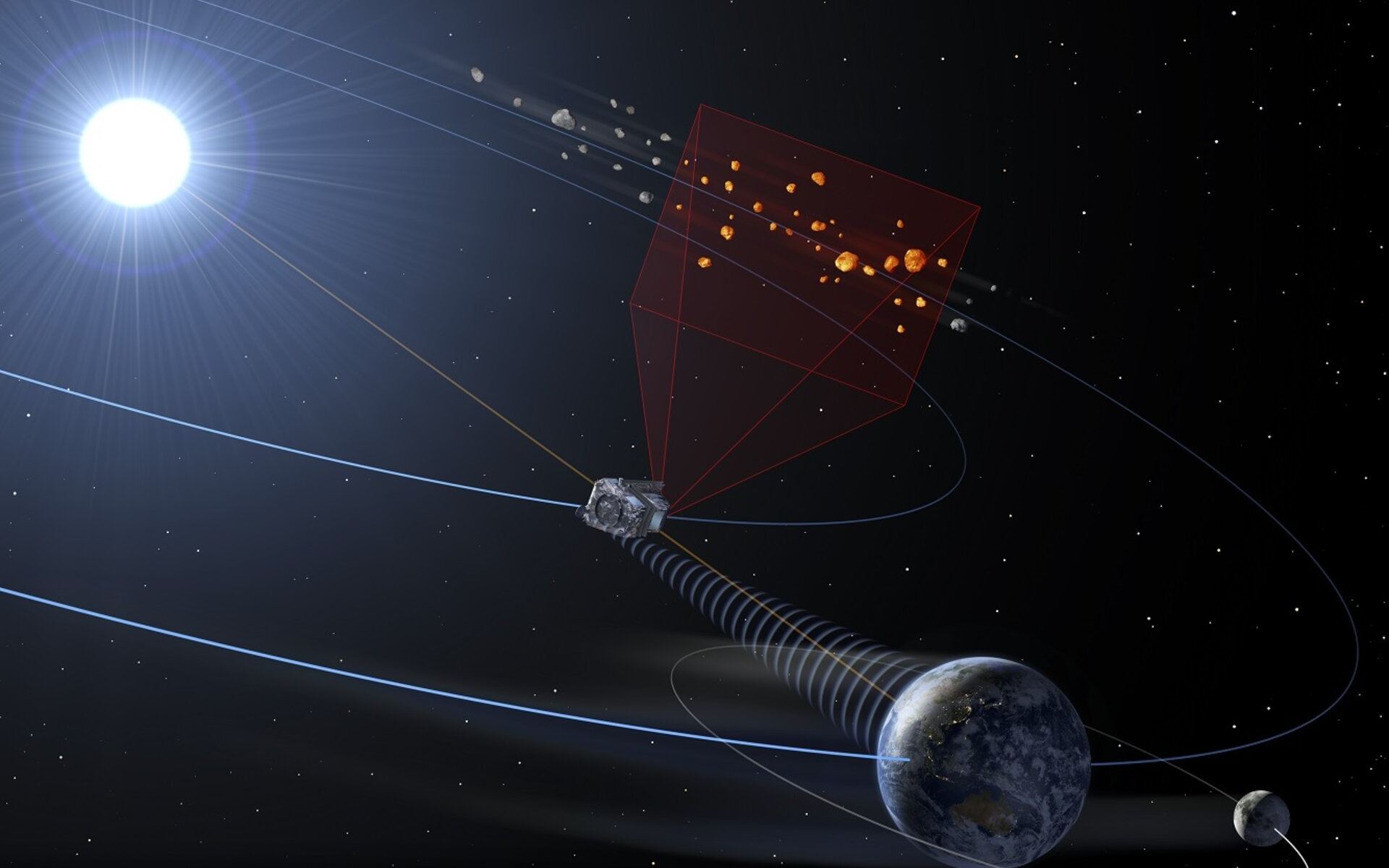
To bypass such problems, the European Space Agency plans to deploy NEOMIR, the Near-Earth Object Mission in the Infra-Red, a spacecraft carrying a compact telescope and placed at the L1 Lagrange point between Earth and the Sun (where the gravitational attraction of the two essentially “cancel each other out”, making it easier for a craft occupying the region to maintain its position). From here, Earth and the space around it would be in perpetual sunlight and the Sun would be “behind” the satellite, meaning that any objects in orbit around Earth or passing close to it will also be warmed by the Sun (and so visible in the infra-red), whilst sunlight would not be able to “blind” the satellite’s ability to see them.
An artist’s impression of NEOMIR occupying the Sun-Earth L1 position as it observe the space around Earth for potential near-Earth asteroids which may pose a threat. Credit: ESA
The half-metre telescope carried by NEOMIR will be able to identify asteroids as small as 20m in size, and would generally be able to provide a minimum of 3 weeks notice of a potential impact with Earth’s atmosphere for objects of that size (although under very specific edge-cases the warning could be as little as 3 days), with significantly longer periods of warning for larger objects.
Currently, NEOMIR is in the design review phase, and if all goes well, it will be launched in 2030. In doing so, it will help plug a “gap” in plans to address the threat of NEO collisions with Earth: NASA’s NEO Surveyor mission, planned for launch in 2026, will also operate from the L1 position – but is only designed to spot and track objects in excess of 140m in diameter. Thus, NEOMIR and NEO Surveyor will between them provide more complete coverage.
At the same time as an update on NEOMIR’s development was made, China announced construction of its Earth-based Fuyan (“faceted eye”, but generally referred to as the “China Compound Eye”) radar system for detecting potential asteroid threats is entering a new phase of development.
The first phase of the system – comprising four purpose-built 16m diameter radar dishes – was completed in December 2022 within the Chongqing district of south-west China. Since then, the system has been pinging signals off of the Moon to verify the system and its key technologies.
Two of the Fuyan 16m radar dishes on test in China, December 2022. Credit: CGTN
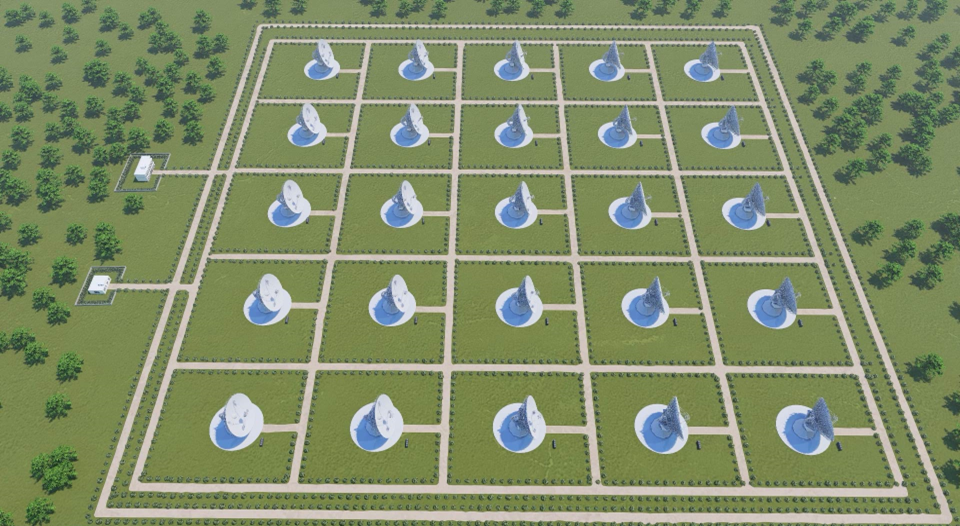
The new phase of work will see the construction of 25 radar dishes of 30m diameter, arranged in a grid. When they enter service in 2025, they will work in concert to try to detect asteroids from around 20-30m across at distances of up to 10 million km from Earth, determining their orbit, composition, rotational speed, and calculate possible deflections required to ensure any on a collision course with Earth do not actually strike the atmosphere.
As this second phase of Fuyan is commissioned, a third phase of the network will be constructed to extend detection range out to 150 million km beyond Earth. At the same time, China is planning to run its own asteroid deflection test similar to the NASA Double Asteroid Redirection Test mission, although the precise timeline for this mission is not clear.
An artist’s impression of the Fuyan grid of 25 radar units due to commence operations in 2025. Credit: CGTN
In the meantime, 2023 CX1 was of the common type of near-Earth asteroids to regularly strike Earth’s atmosphere (at the rate of one impact every other week). It was discovered by Hungarian astronomer Krisztián Sárneczky, at Konkoly Observatory’s Piszkéstető Station within the Mátra Mountains, less than 7 hours before impact.
At the time of its discovery it was 233,000 km from Earth (some 60% of the average distance between Earth and the Moon), and travelling at a velocity 9 km per second. It took Sárneczky a further hour to confirm it would collide with Earth, marking 2023 CX1 as only the 7th asteroid determined to be on a collision with Earth prior to its actual impact.
A graphic showing data on dangerous asteroids as of 2020. Credit: ESA Planetary Defence Office
The object – at that time still designated Star2667 – was tracked by multiple centres following Sárneczky’s initial alert, allowing for its potential entry into and passage through the upper atmosphere to be identified as being along the line of the English Channel, close to the coast of Normandy. It was successfully tracked until it entered Earth’s shadow at around 02:50 UTC on February 13th, just 9 minutes before it entered the upper atmosphere
As both the media and public were alerted to the asteroid’s approach, it’s demise was caught on camera from both sides of the English channel. It entered the atmosphere at 14.5 km/s at an inclination 40–50° relative to the vertical. As atmospheric drag increased, it started to burn up at an altitude of 89 km, becoming a visible meteor. At 29 km altitude it started to fragment, completely breaking apart at 28 km altitude as a bright flash as its fragments vaporised, finally vanishing from view at 20 km altitude, although meteorites fell to Earth in a strewn field spanning Dieppe to Doudeville on the French coast, sparking a hunt for fragments to enable characterisation of the object.
At the time of flash-fragmentation, the object released sufficient kinetic energy to generate a shock wave which was heard by people along the French coast closest to the path of the meteor and recorded by French seismographs.
Following its impact, study of 2023 CX1 s orbital track revealed it to be an Apollo-type asteroid, crossing the orbits of Earth and Mars whilst orbiting the Sun at an average distance of 1.63 AU with a period 2.08 years. It last reached perihelion on 13th February 2021, ad would have done so again on March 15th, 2023 had it not swung into a collision path with Earth in the interim.
Grand Garden, February 2023 – click any image for full size
Elyjia Baxton has a long association with regions designs in Second Life, be it those of her own, or created in collaboration with others or on behalf of others, many of which I’ve covered in these pages. So when she invited me to hop along and visit her latest work, it quickly went up towards the top of my list of places to visit.
Grand Garden, February 2023
Ely’s Grand Garden is a public space Elyjia has designed on behalf of R&G Estates. Located within Nautilus, it presents an opportunity to wander along gravel paths, view the houses offered for rent on either side and make your way through parts of the broader R&G Estate within the region – and even find your way to Ely’s own studio.
At the Grand Garden in Salerio you will find twelve intimate waterfront locations surrounded by gardens, three grand gardens to admire and walk in peaceful nature alone or with friends, one playground, and a rezzer station for boats. It is an enchanting place near the Blake Sea. Take a walk in the gardens, relax, and have fun.
– Grand Garden Destination Guide entry
Grand Garden, February 2023
The landing point sits towards the middle of the region in which the park sits, alongside one of the public pavilions within the gardens. From here the paths run in several directions, with the main one running north to hop back and forth over the stream to reach a broader waterway cutting into the region, crossed by a broad wooden bridge.
North of this, the path continues between a further stream on one side and a large natural pool on the other, fed by falls dropping from the curtain walls of rock which border the gardens here on two sides. A second path switchbacks away from the pavilion sitting alongside the pool and the channel bridge, paralleling the channel as it cuts deeper into the region.
Grand Garden, February 2023
To avoid trespass, the rental houses are set back from the public footpaths, their parcels generally marked by fences if they connect directly to the gardens, with a gate to provide renters with access to the gardens if they want.
With places to sit: benches, chairs and tables, a rowing boat rocking on the pond – while waterfowl fly overhead and rest on rocks, foxes wander the paths whilst a gentle soundscape of flow water from the streams and bird song filling the air. All of which makes for an engaging and relaxing visit.
Currently open within the Sky Gallery at Mareea Farrasco’s Imago Art Galleries is Vague Disclosures, a collection of twelve images by Carelyna, who herself runs the ArtCare gallery within Second Life.
Having studied art, focusing on oil-on-canvas, Carelyna has carried her love of painting into the digital realm, using the tools available to her via her computer to take the images she produces using the viewer and turn them into digital paintings. This gives her work a freshness and an almost tangible depth rich in a sense of life.
This is very much in evidence with the pieces presented at Vague Disclosures. No gallery or artist’s notes are supplied for the exhibition, leaving all twelve open to personal interpretation. There is no accident or oversight in this: Carelyna openly admits she does not plan her works in advance; each piece she creates is part free-form composition, part experimentation and part therapy / a release of a sense of creative fun, often given birth through a need to delve in a new world of such expression.
Imago Art Galleries: Carelyna – Vague Disclosures
Vague Disclosures is such a dive; whilst each piece is unique and open for study / interpretation, all of them offer explorations in the use of soft focus / depth of field as a starting-point for expressing moment of shared and personal intimacy. Each suggests a story within its frame; but what that story might be is up to the eyes of the beholder to decide.
Is the ring mounted on extended finger a gift symbolising the love the giver wished to express to the wearer, or might it be a something the wearer saw and liked, and so purchased on whim? Is there perhaps another story waiting to reveal itself to you? Similarly, and across the room, is the single arm and hand resting languidly along the side of a bath as the owner luxuriates in hot water and bubbles? Might it be a hand gripping the back of a sofa or bed in a moment of passion, or again, something else?
Imago Art Galleries: Carelyna – Vague Disclosures
Thus, throughout, there are stories here; from initial opening to final chapter; stories capable of remaking themselves each time we look at them, allowing us to share in Carelyna’s explorations and discoveries in her journey through art and expression.
Under the Northern Lights, December 2022 – blog post
The following notes were taken from:
My audio recording and chat log transcript of the Content Creation User Group (CCUG) meeting held on Thursday, February 16th 2023 at 13:00 SLT.
My chat transcript and the video recording of the Friday, February 17th TPV Developer’s meeting, recorded by Pantera Północy and embedded at the end of this article. My thanks, as always, to her for recording these meetings.
These meetings are for discussion of work related to content creation in Second Life, including current work, upcoming work, and requests or comments from the community, together with viewer development work. They are chaired by Vir Linden, and dates and times can be obtained from the SL Public Calendar.
Notes:
These meetings are conducted in mixed voice and text chat. Participants can use either to make comments / ask or respond to comments, but note that you will need Voice to be enabled to hear responses and comments from the Linden reps and other using it. If you have issues with hearing or following the voice discussions, please inform the Lindens at the meeting.
The following is a summary of the key topics discussed in the meeting, and is not intended to be a full transcript of all points raised.
Official Viewers Summary
Available Viewers
The have been no further updates to the currently available official viewers sine the PBR materials viewer was updated at the start of the week, as reported in my week #7 SUG meeting summary. Therefore the pipelines remain as follows:
Release viewer: Maintenance Q(uality) viewer, version 6.6.9.577968 Thursday, February 2, 2023.
Performance Floater / Auto-FPS RC viewer, version 6.6.9.577251, January 4, 2023.
Project viewers:
PBR Materials project viewer, version 7.0.0.578161, February 14, 2023. This viewer will only function on the following Aditi (beta grid) regions: Materials1; Materials Adult and Rumpus Room 1 through 4.
Puppetry project viewer, version 6.6.8.576972, December 8, 2022.
General Viewer Notes
It is hoped that the Performance Floater RC viewer will be promoted to de facto release status within the week, which would allow all official viewers to leverage Visual Studio 2022 on Windows builds going forward.
There are some changes to be made to github due to all the pull requests (PRs) going to branches which can change over time, causing issues as they do so. In the future, it is likely that PRs will go into the Main branch (which only changes on a per release basis) and from their moved into their intended branch.
CCUG – glTF Materials and Reflection Probes
Project Summary
To provide support for PBR materials using the core glTF 2.0 specification Section 3.9 and using mikkTSpace tangents, including the ability to have PBR Materials assets which can be applied to surfaces and also traded / sold.
To provide support for reflection probes and cubemap reflections.
The overall goal is to provide as much support for the glTF 2.0 specification as possible.
In the near-term, glTF materials assets are materials scenes that don’t have any nodes / geometry, they only have the materials array, and there is only one material in that array.
It is currently to early to state how this might change when glTF support is expanded to include entire objects.
The project viewer is available via the Alternate Viewers page, but will only work on the following regions on Aditi (the Beta grid): Materials1; Materials Adult and Rumpus Room 1 through 4.
A major new bug is the discovery that the UV treatment is off-specification. This appears to be due to OpenGL putting the 0,0 coordinate in the lower left corner of the image rather than the top left. This does mean that all PBR materials uploaded to Aditi (the beta grid) prior to the fix going into the viewer will effectively be “broken” post-fix. Viewer:
The lighting model for water in the project viewer has been updated to use the glTF specification lighting model for water so that reflection probes can be used to generate reflections on water. However, trying to adapt the “old” water shader to use the glTF lighting model is proving difficult, due the “bonkers” way things like fresnel offset and scale have been implemented. This issue is to be addressed.
It is believed that most existing content should render reasonably faithfully under the PBR / glTF, with the exception of the known issue of alpha blending on colour curves. Runitai Linden has a couple more ideas how this might be improved, but overall, it might come down to having to explain that the colour space is changing for glTF, and as a result some alpha blended content will need to be adjusted in order to render correctly.
As Advanced Lightning Model (ALM) will be enabled all the time in the PBR viewer (the Forward renderer will be disabled), the viewer’s quality settings are being updated so that Shadows will be disabled by default across a much wider range of settings, as these are what causes the significant performance hit when ALM in enabled, rather than ALM itself (but Shadows can still obviously be manually enabled).
This viewer also causes instrumentation regressions within the Performance Floater viewer, which will likely be addressed when the code is ready to be merged with the release version of the viewer. .
It is hoped that the simulator-side support can be deployed to an RC on the Main grid (Agni) in the near future in order to further advance viewer testing as that moves from project to RC status as well.
CCUG – Mirrors(!)
The “very next thing” LL plans to implement after PBR Materials reaches Release Candidate status is – mirrors!
These will be planar mirrors, so best suited to flat surfaces such as the face of a cube, rather than curved or spherical surfaces.
Mirrors will effectively be a real-time 1:1 rendering of what is seen within the scene that is being reflected, but with some limitations to cater for performance. Those limitations / controls under discussion at the Lab include:
The mirror effect will only be generated in viewers that are very close to it.
Perhaps limiting the number of mirrors which can be active within a viewer to just one per scene (so if there are two mirrors close by your avatar, only one will be active at a time). Or allowing user select the number of mirrors they wish see “working” at any given time.
Adding a viewer Preferences option to enable / disable mirrors, depending on the user’s needs.
Nevertheless, even with precautions such as the above, there will be a performance impact in having real-time mirrors active in the viewer.
Mirrors will likely support LSL control over them.
It is already being recommended that mirror surfaces are only used as mirrors, not as a means of generating “reflections” in general – which should be left to reflection probes / cube maps.
It is hoped that the way the mechanism for rendering reflections onto a mirror surface would use the same channels as reflection probes – so when the mirror is seen from a distance, it uses the reflection rendering based on the local reflection probes, but when approached, the reflection probe rendering would fade out, and the real-time planar mirror reflection rendering would fade in.
That said, precisely HOW real-time mirrors will work is still subject to discussion and planning: at the moment, the focus has been only considering time in terms of ensuring the PBR work does not block opportunities for adding real-time reflections, and that they will play nicely with the PBR Materials work when they are being developed.
CCUG – Avatars / New Start Avatars / Ecosystem
A question was raised about the upcoming new mesh starter avatars previewed at SL19B in June2022. These have yet to be releases, and are not intended to compete with existing mesh avatars, also LL hopes creators will help develop an ecosystem in support for the avatars as the devkits for them are released – there is no confirmed release date for the avatars.
The above lead to a general discussion on the learning curves involved in getting to grips with avatar bodies and heads, trying to math heads to bodies, etc., the need for more discussions on avatar capabilities, helping people understand the avatar content creation process so they can join the ecosystem, etc.
The was an agreement that more discussion on avatar-related content creation, real and perceived limitations on the avatar system – particularly rigging clothing and attachments and the reliance on additional toolsets (e.g. AvaStar MayaStar, etc.), issues of supporting information available through the SL Wiki / Knowledge Base, etc. See In Brief for more on discussions / potential new meetings.
There are internal discussions going on at the Lab concerning avatar physics, enabling the simulator to “know” more bout the avatar, how it is being animated, having the simulator-side physics engine fully recognise the avatar body as a physical object (rather than just a simplified capsule), etc., via the likes of the Puppetry project and elsewhere, but solutions are still TBD.
In Brief
CCUG: Alpha blending issues on avatars – there was a general discussion on alpha stacking/ordering and blending issues, with Beq Janus’ blog post on the subject relating to avatars / outfits being referenced as a good primer on the issue and steps to mitigate problems.
TPVD: work is continuing on the Inventory thumbnails work, but nothing ready for any form of public release.
TPVD: it has been suggested that LL might want to add code to the new Group Chat History functionality to indicate the end of historic Group chat within a Group chat tab / panel, as people appear to be getting confused as to why they are opening Group chat to find past conversations displayed (due to word about the new functionality taking time to spread).
TPVD: concern was raised that the allowance of lossless Normal Map under PBR will lead to a lot of abuse with people using it to upload lossless textures as well, which it was feared would hit people’s VRAM. Runitai pointed out that lossless does not necessarily hit VRAM, but does impact caching and bandwidth. This sparked a general conversation on textures, resolution, quality, etc. However, the risk of people abusing the upload was acknowledged, and store will be monitored for unexpected spike in usage after the release of PBR.
TPVD: a discussion on viewer development as support for AAA game-style rendering. Please refer to the video for details,
Both meetings: user on-boarding – at both the CCUG and the TPVD meeting it was suggested that there needs to be a regular user group meeting to discuss user on-boarding, engagement and retention and how to address these on an ongoing basis.
This led to a lengthy discussion on the issues of engagement + retention which illustrated one of the core issues in just discussing it: everyone has a different opinion on what “the problem” is with engagement / retention. Some see it as primarily being an expense issue (the cost of creating a good-looking avatar); some see it as people being unable to find interesting this to do; some see it as being performance / hardware / overall appearance of SL.
The problem with the above is (and as demonstrated at the TPVD meeting particularly) it can lead to very siloed outlooks where disagreements as to “the problem” become the focus of conversations, rather than agreement that all of these issues can play a role, and as such, solutions need to be perhaps more “holistic” in nature and encompassing all of the perceived pain points.
It has been suggested that an upcoming CCUG or TPVD meeting could be utilised as a kick-off session for broader discussions about on-boarding, etc.
The Ocean Care World Alliance (OCWA) is a group of environmentalists concerned about the negative impact we are having on the world’s oceans and marine life the pollution, dumping and more. Utilising the opportunities presented by virtual tools, they aim to provide a better understanding of our marine environments and the need to protect the vitual role they play as part of the world’s ecosystem, working in partnership with the SEE Turtles Organisation.
Within Second Life OCWA – founded by JT Castanea and SL partner Megs (megscandles) – hosts the Experience The Ocean, which occupies and Full private region adjoining a Homestead region and an Openspace region, each of which play a role in OCWA’s facilities.
OCWA Experience The Ocean, February 2023 – click any image for full size
Our mission is to educate and create awareness of current human impact on marine environments. Using science, technology and the virtual world platform, we can promote more public involvement through support of ocean conservation organisations.
– OCWA Experience the Ocean mission statement
Visits begin on the deck of the main structure in the region – a facility which might be imagined as a re-purposed oil or gas rig, now serving in the role of a Marine Science Centre – a conservation, rescue and research facility and home to OCWA events and educational activities. It forms the main landing point for the facilities, and for those visiting as a part of an educational tour, offering plenty of space for gathering the group together on arrival.
The main level of the centre provides the OCWA’s mission statement (above) and the Sea Turtle information hall in one wing and the ocean virtual learning centre in the other.
OCWA Experience The Ocean, February 2023
The latter takes the form of nine numbered media stations, providing information on a range of ocean-related subjects. These can be activated by hovering the mouse over any one of them (or clicking on it) to display the related web page. The screens do not necessarily have to be followed in numerical order, as each provides self-contained information. The former, by contrast offers a set of information displays on sea turtles that, which clicked, will offer a link to an external web page.
Above these halls can be found the Ocean Art Gallery and the centre’s auditorium for educational and related events / activities, while the upper level is home to office space and access to the centre’s helipad and – more particularly – open-air event space for musical performances.
OCWA Experience The Ocean, February 2023
Also within the centre are information kiosks and display boards, the former providing further links to ocean-related conservation and educational groups, such as The 5 Gyres¹ Institute, a 501(c)(3) non-profit organisation focusing on reducing plastics pollution in rivers, lakes and the oceans through research and education.
On the deck of the centre is the Lunasea Memorial Turtle Rescue and Rehabilitation Hospital, representing the work put into rehabilitating and releasing turtles affected by pollution and ingesting plastic particulates that result from the saltwater breakdown of certain plastics dumped in the sea. It is here that visitors can obtain a note card to join a unique role-play experience: the Rescue a Virtual Turtle Experience. This takes place in the regions to the south – Whale Fall and Vida de Tortuga. Click the information board for details when visiting the Hospital.
OCWA Experience The Ocean, February 2023
Beneath the centre are the docks servicing the centre’s submersibles and research boats and, below that on the seabed, an undersea laboratory. These can be reached via the teleport stations found around the centre, stations which also provide access to the remaining outdoor locations in the main region. The latter take the form of the Alaska Fossil Beach to the east, and to an area modelled on the south the Cape St. Francis lighthouse and Seal Point, South Africa. Both offer opportunities for surfing, whilst the docks offer the chance to go kayaking using single or 2-seater boats, with little motor boats also available.
With opportunities to donate to SEE Turtles throughout the centre and the regions, the notes opportunities for activities and plenty of ways to learn about the oceanic ecosystems, Experience The Ocean makes for an engaging and potentially educational visit.
A gyre is a large circular r spiral motion or form. It is particularly used in reference to giant circular oceanic surface currents. In all there are five major subtropical gyres in the worlds oceans (hence “5 Gyres”) – North Atlantic, South Atlantic, Indian Ocean, South Pacific and and the Great Pacific (itself split into to east and west), all of are home to an estimated 270,000 tonnes of plastic dumped in ocean (which is less than 1% of the new plastic made in a single year).





 Inara Pey: Living in a Modemworld