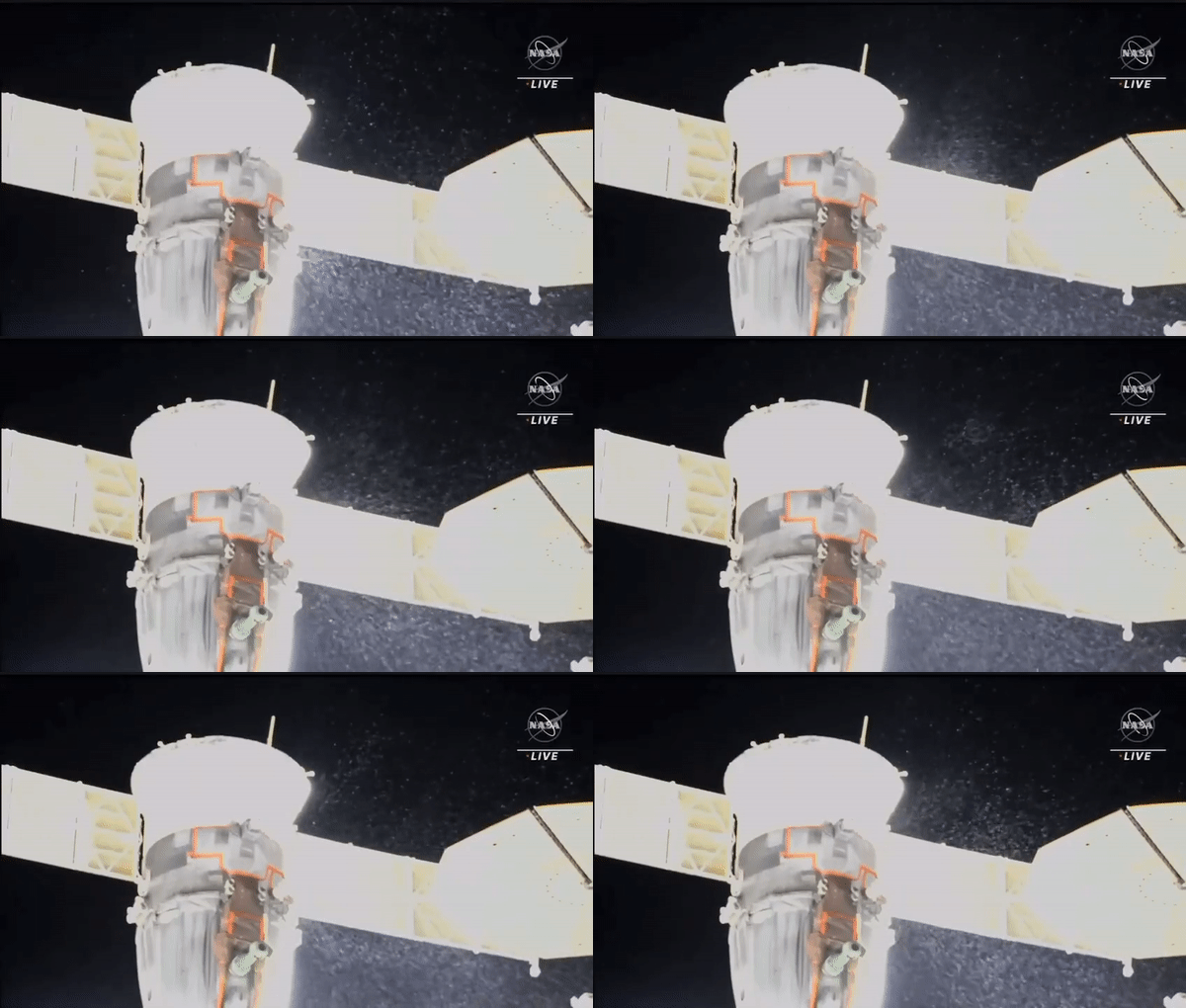
A potentially serious issue occurred at the International Space Station this week when Soyuz MS-22 developed a coolant leak in the early hours of Thursday, December 14th, almost 3 months after the vehicle had docked with the station to deliver Russian cosmonauts Sergey Prokopyev and Dmitry Petelin, together with American astronaut Francisco Rubio to commence a 6-month tour of duty.
Named for Konstantin Tsiolkovsky, the father of Russian cosmonautics, the vehicle experienced an uncontrolled leak of ammonia coolant which started at 00:45 UTC and ran for several hours, generating stream of material jetting outwards from the vehicle and causing the station crew to have to stabilise the structure.
At the time the leak was detected, cosmonauts Petelina and Prokopyev were preparing to embark on a spacewalk to carry out maintenance work on the Russian segment of the ISS, where the Soyuz is docked. The EVA was called off due to concerns the cosmonaut’s spacesuits could be contaminated with the hazardous coolant fluid.
A second Russian EVA set for December 21st was also later cancelled over concerns about the leak; however, NASA initially indicated a spacewalk due to talk place on the US / International side of the station would go ahead, later deciding to postpone it in favour of assisting Roscosmos in trying to assess the amount of damage caused to the Soyuz – and possibly to the ISS.
As the leak curtailed, cosmonaut Anna Kikina – the first Russian to fly to the ISS aboard an American commercial crew vehicle as a part of a seat exchange programme between NASA and Russian space agency Roscosmos – used a European-built robotic arm attached to the Russian Nauka science module delivered to the ISS in 2021 to inspect the Soyuz craft. Further inspections by both the Russians and Americas using their respective robot arms are also being scheduled.
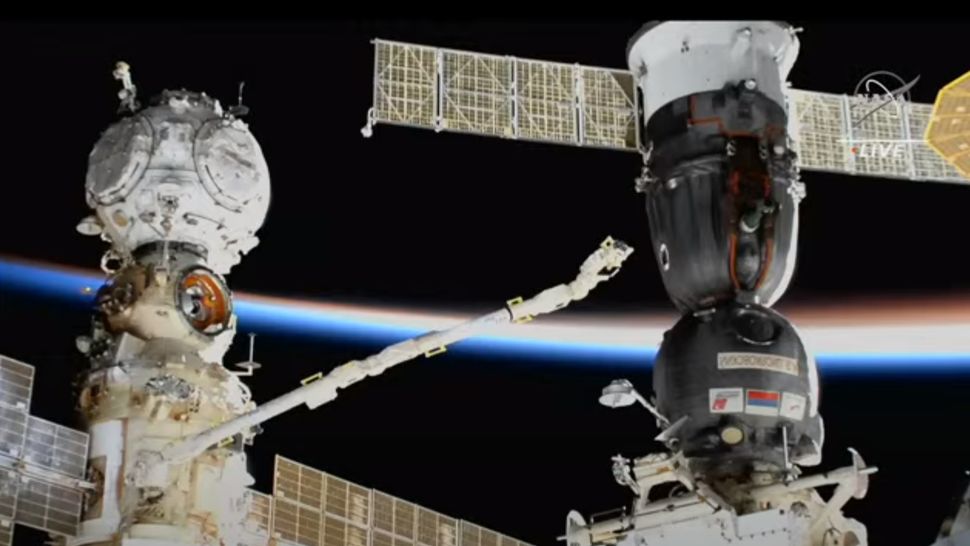
The exact nature of the leak is unknown. However, the former head of spaceflight safety at the European Space Agency Tommaso Sgobba, believed the leak occurred with the vehicle’s active coolant system, most likely crippling it “beyond repair”. This appeared to be borne out both by the images captured by Kikina using the Nauka module’s robot arm – which shoe extensive damage to the outer skin of the instrument and assembly compartment of the vehicle. Since the leak, Roscosmos has reported the interior temperatures of the vehicle’s pressure modules had risen to 30C which, despite being referred to as being within “acceptable limits”
On Friday, December 16th, 2022, the Russian space agency began remote testing of a number of the vehicle’s systems – including its thrusters – in an attempt to ascertain its space-worthiness.
If the vehicle is unfit to fly, it means Prokopyev, Petelin and Rubio will be unable to use it to make their scheduled return to Earth in March 2023 – although reports that this leaves the three “stranded” in space are somewhat exaggerated. There are a number of ways in which the three can be returned to Earth either individually or collectively:
- Soyuz is fully capable of automated flight and docking with the ISS (it can use the same system as the Progress re-supply vehicles – themselves essentially uncrewed Soyuz – to reach the ISS and provide the three with a ride home.
- Failing this and allowing for the necessary crew alterations, both Soyuz and Crew Dragon can fly to the ISS with a vacant seat, which can then be used by one of the MS-22 crew.
- The Boeing CST-100 Starliner is due to make a crewed flight to the ISS in April / May 2023, a month or two after MS-22 is scheduled to return. It could, with some adjustment to the mission, be used to return one or two of the MS-22 crew as well as the main crew at the end of its week-long stay at the ISS.
Of these three options, the first would appear to be the most likely. For now however, assessments of MS-22’s overall condition are on-going and (for now) leave the door open on a fourth option: if the vehicle is deemed safe to make an immediate return to Earth, the three crew members curtail their mission and come home three months early.
The Artemis 1 mission to cislunar space is a potential watershed moment in space exploration., potentially the first genuine step in a human return to the Moon, with the potential to reach even further into the solar system. It’s a mission I covered in these pages over a number of articles, up to an including the previous piece. However, for those who would like to relive it in a compressed manner NASA has released a video of the mission’s highlight from launch to splash-down.
Running to 24 minutes – just shy of a total reflecting the duration of the mission in days – the video is a fascinating compression of the mission, presenting many iconic images of the vehicle, the Moon and Earth.
Continue reading “Space Sunday: spaceship leaks, exo-Earths & an ancient solar observatory”









 Inara Pey: Living in a Modemworld