Space Sunday: Mars missions and the Soyuz leak

NASA’s Mars 2020 Perseverance rover has started preparations to have some of the samples it has gathered to be returned to Earth for extensive analysis.

Since its arrival on Mars in February 2021, the rover has been exploring Jezero Crater and collecting samples of sub-surface rocks in much the same manner as its older sister, Curiosity, which arrived within Gale Crater half a world away on Mars 12 years ago.

Some of these samples have been subject to on-board analysis by the rover’s internal lab, but for the most part they have been sealed in special tubes stored in an on-board cache, part of a total volume of 43 such tubes it carried to Mars tucked within its underside.

The idea behind the tubes – one of which has been used to collect a sample of the Martian atmosphere, and five more contain various materials intended to capture particulates in the ambient environment – is that they would form one or more sample caches Perseverance could deposit at locations where they could later be collected for return to Earth by a European-American sample-return mission.

Thus, on December 21st, 2022, the rover started building the first of these caches with the “drop” of the first tube to be selected for surface caching. The operation involved the rover parking at a recognisable feature within Jezero crater – dubbed “Three Forks” – and then rotating the rotunda of sample tubes so that the selected tube – containing samples of igneous rock collected at the start of 2022 – could be released and dropped to the Martian surface. Then, to confirm the operate had succeeds, and the tube wasn’t snagged somewhere in the mechanism, NASA commanded the rover to use its robot arm to peer down between its wheels and use the camera mounted on the end of the arm to confirm the position of the tube and check its overall condition.

Somewhat resembling a light sabre from the Star Wars franchise, the sample tubes are made up of a mix of materials designed to protect their contents from the rigours of being placed out in the harsh Martian environment and and rick of contamination by solar radiation or by the future process of transferring them to the vehicles that will be used to return them to Earth.
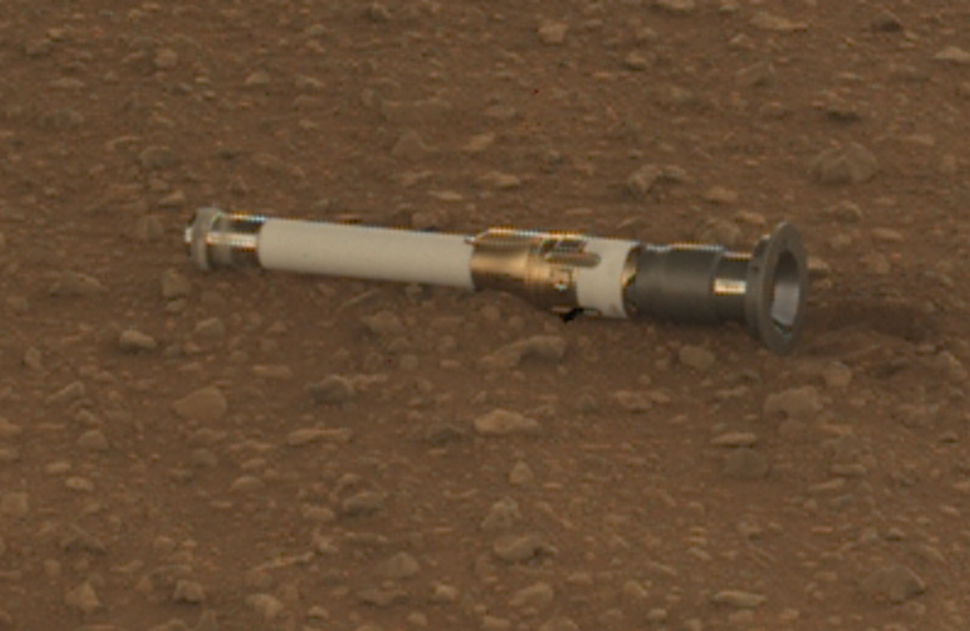
Resembling a Star Wars light sabre, a sample tube dropped by the Mars 2020 rover Perseverance on December 21st marks the start of an operation to place 10 sample tubes in a cache for collection by a future mission which will return them to Earth. Credit: NASA

This resemblance to a light sabre is something that has not been lost on the mission team at NASA’s Jet Propulsion Laboratory.

I’ve been holding out my hand to my computer screen to see if the tube will be transported from Mars, since as director, I’m pretty sure the Force is with me, right? OK, so no joy so far, but I’ll keep trying!

– Laurie Leshlin, NASA’s Jet Propulsion Laboratory director

A photo of the “Three Forks” cache site in Jezero Crater, Mars, depicting the points at which the ten sample tubes will be dropped by the Perseverance rover. Credit: NASA

In all, ten of the 22 tubes so far used by the rover will be dropped around the “Three Forks” location – each one in its own drop point to facilitate easier pick-up. The second of the ten – containing the longest core sample thus far collected by the rover, comprising sedimentary rock taken from the edge of an ancient outflow delta in the crater – was dropped on December 22nd. A second cache of tubes will be established elsewhere in the crater at a later period in the rover’s mission to offer an alternate collection point for samples.

The current plan for the sample-return mission (July 2022) requires an orbiter / return vehicle to be supplied by the European Space Agency and delivered to Mars orbit in May 2028. At around the same time, a Sample Retrieval Lander built for NASA, will also arrive on Mars relatively close the the selected sample cache and carrying an sample ascent vehicle and two small helicopters similar to Ingenuity, already operating on Mars in concert with Perseverance.

The Mars Sample-Return Mission elements. top: the ESA- built orbiter / return vehicle; right: the sample lander with the ascent vehicle above it, carrying the sample back to the orbiter; left: the Perseverance rover and an Ingenuity-class Mars helicopter, one or other of which will be used to transfer sample tube to the lander vehicle, which will load them into the ascent vehicle. Credit: NASA / ESA.

Perseverance, which will have returned to the cache site in the interim, will then collect the sample tubes and pass them to the lander vehicle, which will then use a special robot arm to stow them in the ascent vehicle. Should Perseverance be unable to carry out the collection and transfer, the two helicopters will do so instead. Once all the samples have been collected, the ascent vehicle will launch to a rendezvous with the orbiter, and the containment unit with the sample transferred to it for the return to Earth, arriving in 2033.

Goodnight, InSight

As one team at NASA’s Jet Propulsion Laboratory were celebrating the success of the latest phase of their mission, another team was saying a final “farewell” to their mission vehicle.

Having operated for a total of four years on Mars – two years longer than its primary mission period – the NASSA InSight lander’s mission was officially brought to an end on December 21st, 2022, its mission team no longer able to communicate with it.
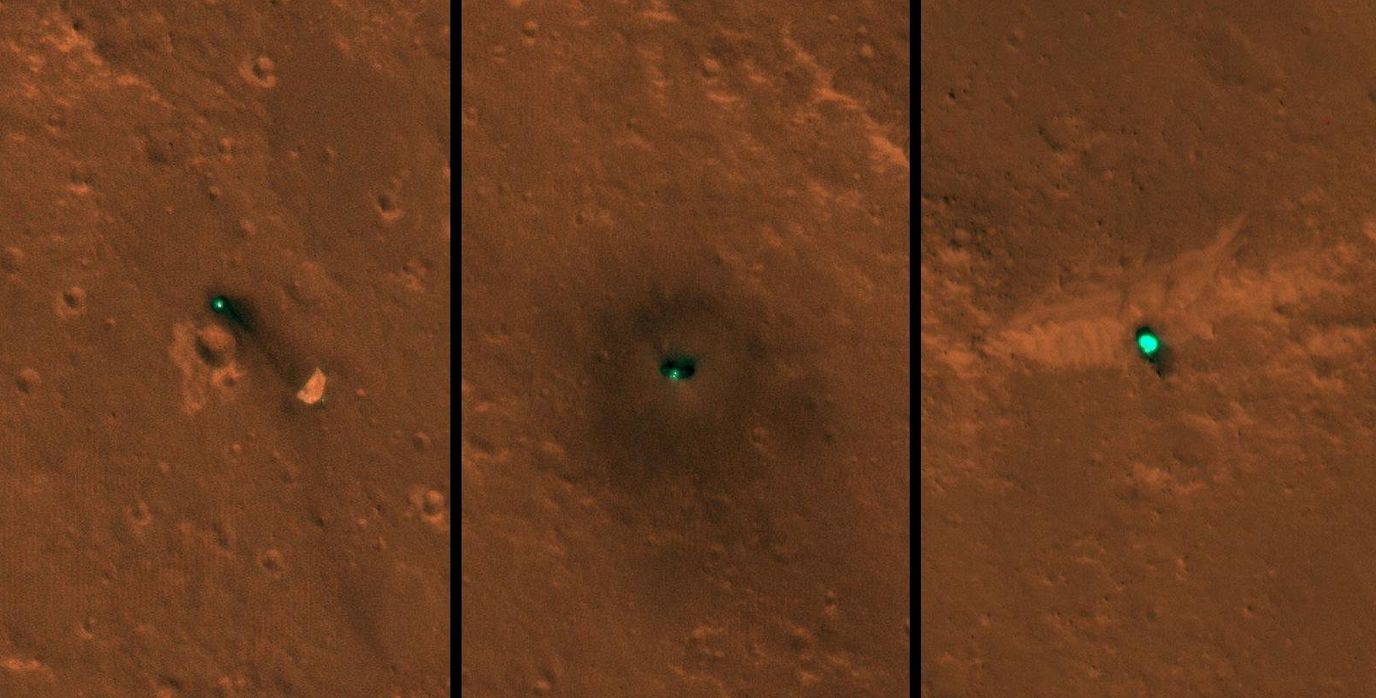
InSight on Mars, December 1 2018, on Flickr
Three images captured by the HiRISE camera on NASA’s Mars Reconnaissance Orbiter, released on December 13th, 2018. Left: the lander’s aeroshell and parachute. Right: the heat shield, discarded after EDL and ahead of parachute deployment on November 26th, 2018. Centre: InSight itself with a surrounding ring of regolith blasted by the lander’s landing motors. The teal colour is not genuine, but the result of sunlight being reflected off of the lander and its parts saturating the HiRSE imaging system. Credit: NASA/JPL

Whilst not as exciting as an ambulating rover mission, InSight – short for  INterior exploration using Seismic Investigations, Geodesy and Heat Transport – was a massively ambitious mission, full details of which can be found in Space Sunday: insight on InSight. As the name suggests, the overall aim of the mission was to gain information on the processes going on deep within Mars.

To achieve this, the lander notably included two experiments it had to transfer from its deck to the surface of Mars, post-landing. One of these experiments, the Heatflow and Physical Properties Package (HP3) and involving a self-propelled “Mole” designed to investigate how much heat is emanating from Mars’ core, did not fare too well, the Mole becoming stuck very early in its attempt to burrow into the ground.

However, the second surface package, SEIS (Seismic Experiment for Interior Structure) – the primary mission element for the lander – proved to be highly successful in its goal of recording details of “marsquakes” and other sound-generating events within and on the planet (such as recording meteor impact later traced to a new 150m diameter crater on the planet), allowing scientists build up a clearer understanding of the planet’s internal structure and activity.

In all, SEIS measured over 1300 seismic events in 4 years, marking Mars as still being geologically active deep below its surface. Fifty of these events were “loud” enough to reveal information about their location on Mars, with a large cluster of them coming from Cerberus Fossae, a region of the planet having been thought to be geologically active relatively recently in its 4.5 billion year history, with many “young” surface features.

SEIS also showed that the Martian core is molten but is larger than thought and less dense than the lower crust. Lighter elements mixed with molten iron in the core lower its density, which explains how the core can still be molten even after cooling considerably.

As a static lander, InSight always had a limited lifespan; as a solar-powered vehicle, its panels would inevitably become so coated in dust and subject to deterioration in the harsh Martian environment that they would no longer be able to generated sufficient power to charge the lander’s batteries.  However, it had been hoped that dust devils, tiny Martian tornadoes created during the changing of the Martian seasons, might help “clean” the panels in much they same way they have with the solar-powered MER rovers. Unfortunately, this was not the case – possibly because the 2m diameter solar arrays used by the lander were simply too big for passing dust devils to effectively blow accumulated dust off of them.

Continue reading “Space Sunday: Mars missions and the Soyuz leak”

A TONAL return in Second Life

TONAL estate, December 2022 – click any image for full size
On this grid I actualize the worlds I imagine, conjure my wildest daydreams, and walk a path unknown. I am here to create a fantasy for others to enjoy. Landscaping is my medium, my love language, and my story.

– TONAL (Avalyn Aviator)

At the start of 2022 I visited the TONAL brand regions, held and designed by TONAL (Avalyn Aviator) who, despite hailing from California, has a clear love of France. At the time, the two regions offered an engaging mix of Parisian cityscape and open French countryside (see: A trip to France in Second Life); since then, the estate has grown somewhat. So, given this, and the fact that I had a timely reminder from Shawn Shakespeare concerning the estate, I thought bookending the year somewhat with a return visit as 2022 draws to a close might be a good idea.

TONAL estate, December 2022
Gone now is the cityscape I encountered in January 2022; instead, the three core regions of the estate offer a more rural setting, caught in the depths of winter. At the western end of these three regions sits the open countryside of Lake Siren, offering a memory of Village des Chasseurs de la Valle de Londyn which stood within it at the time of my January 2022 visit. However, this is just an echo; the landscape has changed considerably, now being built around a smaller village, within which can be found properties available for rent.

This is curious place, inasmuch is sitting in the middle are a couple of light aircraft parked on a small apron – although how they got here is a mystery; however, each has its own little secret. Touch the red-and-white DSN Debonair and you’ll be transported to your home location; the C90 King Air, meanwhile offers an experience-based teleport to the TONAL airport, sitting further to the west of the regions I’m exploring here, and so beyond the scope of this article.

TONAL estate, December 2022

Close to this village sits a rather interesting camp site (or I assume it is), although whether units here, both on the ground and up on tree boughs, can be rented was not immediately clear to me. To the north of the village, the land drops away around the edge of a narrow-necked inlet cutting into the rugged landscape. Fed by a series of waterfalls dropping into it from two ends, the inlet forms a T-shape, the east side of its stem forming a long tongue of land ending in a bridge passing over the water’s neck.

To the north of the region, the land is largely given over to a private house and grounds, whilst westwards the land opens out in rolling, snowy countryside. Here can be found rezzing points, allowing visitors to drop a car or – as I would suggest – a horse or other rideable, and take to exploring. The major road runs more-or-less due west, and sadly doesn’t offer a route up to the façade of the hilltop hotel.

TONAL estate, December 2022

Travel far enough westwards along the road and you’ll come to a stone bridge providing access to the third of the regions I explored. The home of the city setting at the time of my start-of-year visit, this region – TONAL Family – is now given over to the huge and impressive Château de Chantilly. Open to the public, this contains echoes of the city build; its rooftop bar brings to mind the (more ostentatious) Jardin et Salon de Thé found within the January build, whilst the considered use of statues in the ground also helps give a sense of continuity between the two very different settings – something I always enjoy finding.

Within the chateau there is much to be found: an art gallery, museum, library, lounges, a spa, the Chateau also offers luxury rooms for those looking for a place in which to spend time. Details of the rooms and rates can be found on the TONAL website, which also provides information on the estate’s rentals and the TONAL airport, mentioned above. Those staying at the chateau gain access to all of its facilities, which also include horse riding, hunting, swimming and horse racing.

TONAL estate, December 2022

Taken together, these three regions within the TONAL estate offer an interesting and generally photogenic visit with plenty of opportunities for exploration. However, I do have to be honest; in places, there is a lot going on, and as a result frame rates can take a hit, so be prepared to drop your draw distance or disable Shadows (if used), other than when taking photos.

SLurl Details

The TONAL estate is rated Moderate.

CK’s Ode to Snowmen in Second Life

NovaOwl Sky Gallery: CK Ballyhoo – Ode to Snowmen

Theme for art exhibitions is not a new idea – many, many art exhibitions are built around a theme, whilst individual works are frequently used by artists to express an idea or ideal or theme, often with a defined commentary. Such themes can be complex and layered; hinted at, rather than openly expressed, offering their audience suggestions to prod their own cognitive faculties. Others are more direct in tone and theme, presented as a direct commentary – or simply as a celebration.

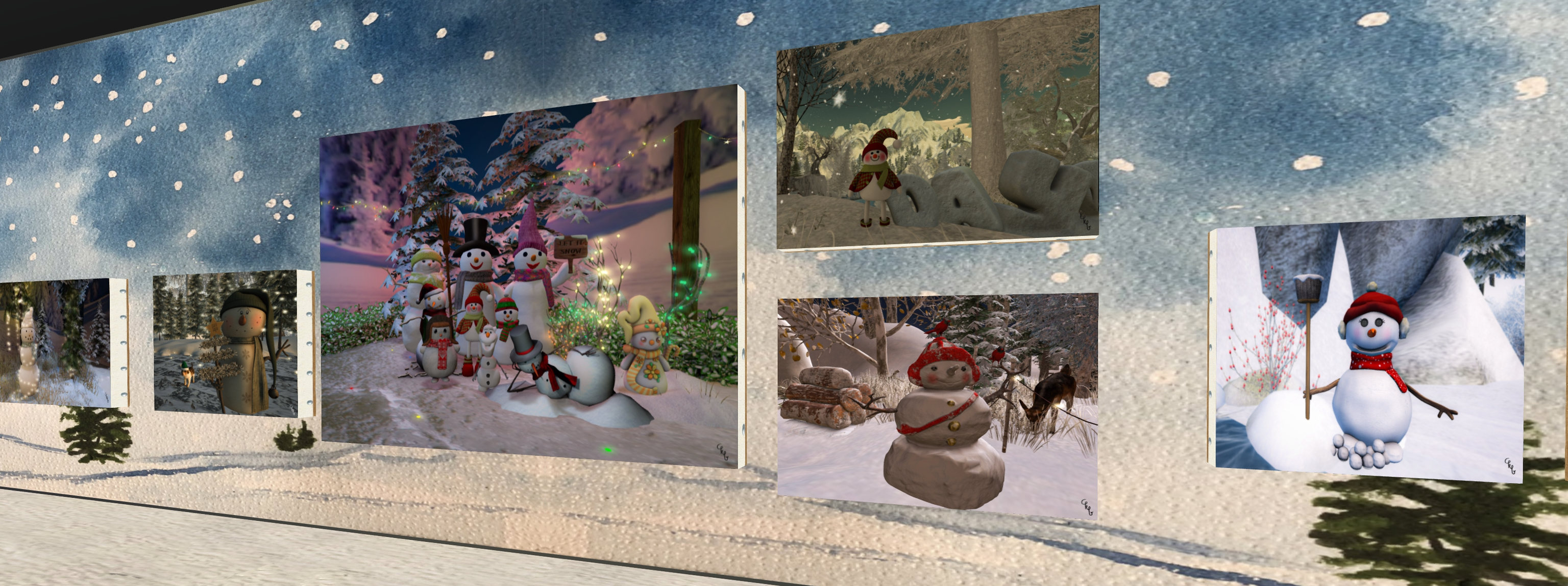
Ode to Snowmen falls cleanly into that last category. Presented by CK (Ceakay Ballyhoo) at the NovaOwl Sky Gallery, curated by curated and operated by ULi Jansma, Owl Dragonash and CK herself, this is an unbashed celebration of winter snowscapes and the joy and humour found within the creation of snowmen.

NovaOwl Sky Gallery: CK Ballyhoo – Ode to Snowmen

Naturally split between the two levels of the gallery, the exhibition features images of snowmen CK has found in her travels across Second Life, from the massive sculpture at the heart of Linden Lab’s Winter Wonderland through to snowmen (and snowwomen and their children!) getting up to all sorts of activities and mischief from simple family portraits to skiing (yes, some snowmen have legs!) to peeping in through windows to see what is going on in those warm places which we love but are anathema to snow folk.

With the floorspace covered in snow and dotted with paintings and drawings of snow-laden fir trees and snowmen, this level of the exhibition also stand as a reminder of the immersive storytelling installations CK used to build in-world, often working with artists such as Silas Merlin and CybeleMoon (Hana Hoobinoo).

NovaOwl Sky Gallery: CK Ballyhoo – Ode to Snowmen

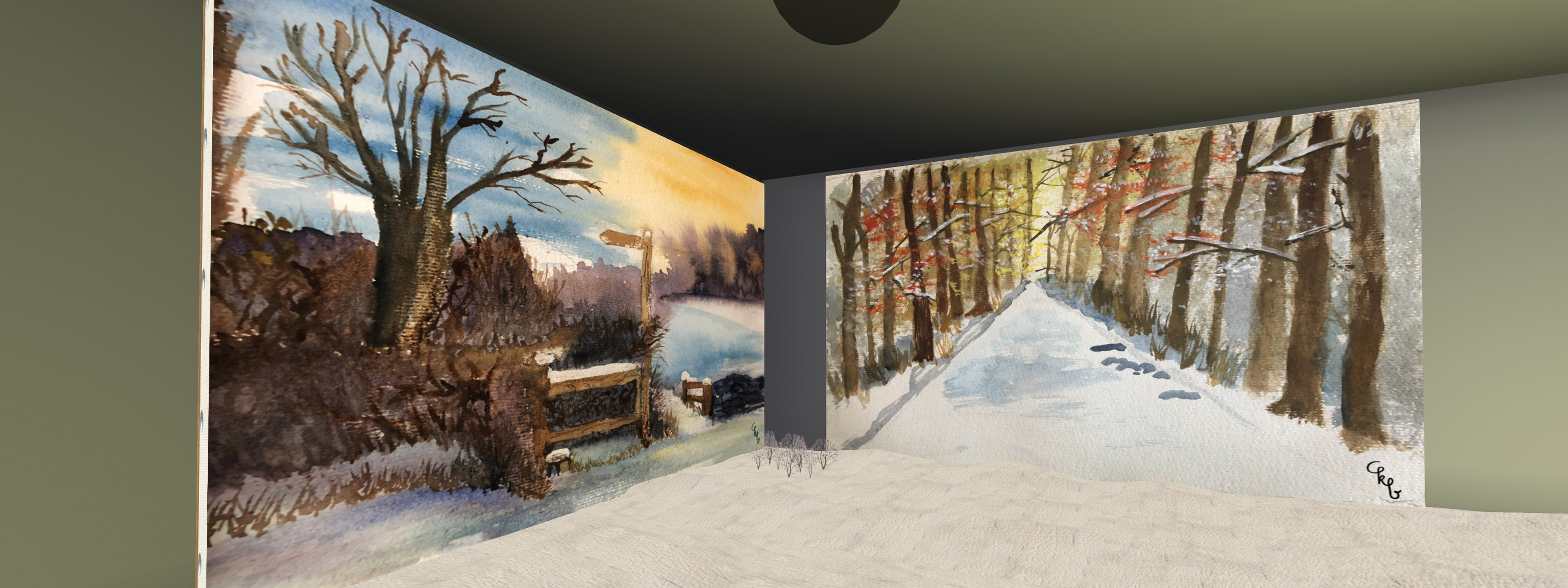
The upper floor of the exhibition features a set of seven watercolour paintings by CK celebrating winter landscapes. Collectively, they offer views which bring to mind lyrics from songs like Walking in a Winter Wonderland and (for me, as I love its haunting tones – particularly in Isao Tomita’s evocative version) Debussy’s Des pas sur la Neige (Footprints in the Snow), itself said to have been inspired by a painting of a winter snowscape.

From snow-covered paths guarded by denuded trees standing to attention on either side, to frozen ponds suggesting an invitation to go skating, and signs pointing the way to trails lying just out-of-sight relative to the painting, these are all warm, inviting pieces which call to the fore childhood memories of the wonder of snow and (perhaps for some) romantic walks through pristine fields of snow with a loved one. All of this is overseen by several snowmen painted on one wall, and several on the floor which blend nicely with one of the paintings.

NovaOwl Sky Gallery: CK Ballyhoo – Ode to Snowmen

A fun, easy-on-the-eyes exhibition presented in a timely manner for the holiday season, Ode to Snowmen will be open through until the end of December 31st, 2022 – so get your visit in soon!

SLurl Details

Second Life 2022/23: the Lab’s review & preview (with my own notes!)

Stock image

On Friday, December 23rd, Linden Lab published their review of 2022, which also included a quick look ahead to 2023. As this time of year when, in the past, I’ve offered a (sometimes multi-part) personal look both back and forward, I this that this year, as with 2022, I’d take a look at the Lab’s look back / look forward and add some of my own thoughts as well.

Linden Lab: People and the Media

2022 got off to something of a bang when on Thursday, January 13th, 2022 Linden Lab officially announced that High Fidelity Incorporated was now an official investor in the company.

This news was significant on a number of levels; most particularly the fact that the arrangement meant that Philip Rosedale, one of the original co-founders of Linden Research (aka Linden Lab), would be supporting the company’s development and direction as a special Strategic Advisor role whilst maintaining his role as CEO and co-founder of High Fidelity Inc.

Philip Rosedale: inwards investment to LL and a role as Strategic Advisor

At the time the new was made public, I speculated whether – given the deal involved the transfer of patents from High Fidelity, a company specialising in spatial audio in virtual spaces – this might see a re-vamp of Second Life’s voice / audio capabilities to encompass the full spatial audio offered by Hi Fi. Well, as it turned out that was a case of barking up the wrong (Linden) tree!

One of the immediate outcomes of this announcement was a renewal of interest in Second Life on the part of tech media, was assorted interviews with Philip Rosedale and also Executive Chair Brad Oberwager; in this, Philip Rosedale’s influence cannot be underestimated.

As the co-founder of Second Life, one of the longest-running immersive virtual worlds, and one of the first  to try to recapture the genie with the founding of High Fidelity of 2013, he has remained true to the ideals of establishing “the metaverse”, and very vocal in his views on privacy, user security and rights, opposition to the idea of ad-driven platforms and approaches wherein the user is the product, whilst also offering clear-sighted views on virtual currencies and the UGC market – as a look through his Twitter profile will reveal. This makes him well-placed to discuss “the metaverse” as a would with reporters and columnist – and in doing to, to place Second Life front-and-centre in their minds.

Second Life users got to hear from Philip directly after the announcement, when he was a guest with Brad Oberwager (with whom he is good friends) on Lab Gab (video and summary here), and also via a Twitter Space event he hosted (summary and audio extracts here – sadly the original event is no longer available via Twitter). More widely, he was a key voice in a four-part podcast series by the Wall Street Journal: How to Build a Metaverse,

User Benefits

2022 saw some interesting user benefits popping out across the months. The arrival of both the Premium Plus and Plus subscription plans, bracketing the original Premium, are both well-known, and both have proven popular. While there are no active plans to do so at present, it has been indicated that other subscription package options might be considered, with some within the Lab somewhat keen on an a-la carte approach: you pay for the options you select from a list. IF this were to come to be at some point in the future, it could prove interesting (just please do not expect anything like it in 2023!).

Other subscription-based “benefits” made available in 2022 were the removal of VAT surcharges on Monthly and Quarterly (where applicable) payment options, levelling the cost of subscriptions for those in VAT-paying countries (VAT was removed from annual payment some time ago); and the reduction in tier fees payable on Mainland parcels of 8192 sq m and above, up to a full region. In terms of payments, the cost of Name Changes for Premium members was reduced to US $34.99 (+VAT), whilst the capability was made available to Plus and Basic account holders at the original US $49.99 (+ VAT).

Technical Front

Unlike 2021, 2022 saw the Lab working a lot more on user-facing updates and capabilities (2021 being devoted to optimising SL server and simulator performance on AWS). Much of this is is recorded in the Lab’s review, but I’d venture to suggest the most impactful aspect of this work has been the release of the Performance Improvements, and the adoption of these updates by the majority of TPVs, bringing significant boost to viewer frame rates as a result of a lot of code and thread refactoring. This work in turn has paved the way for more improvements, supported by work by Beq Janus of the Firestorm team, in the upcoming Performance Floater / Auto-FPS RC viewer, which should be promoted to release status early in 2023.

This work also cleared the way for a significant project which did not quite make it to release status in 2022: the PBR Materials / Reflection Probes project, which will see Second Life move to utilising the glTF 2.0 specification for runtime asset delivery format, intended to bridge the gap between 3D content creation tools and modern graphics applications. This is important because the specification provides a more fluid and predictable workflow from tools like Substance Painter, Blender, et al, into Second Life than can be achieved through the current mixed-format approach to content creation and import.

The initial element of the project focuses materials use (together with the implementation of Reflection Probes) provides a recognised approach to supporting physically-based rendering (PBR) in SL, whilst the glTF specification as a whole from content creation in external tools right the way through to importing that content (including replacing the Collada .DAE model format with glTF as some point down the road.

Sample of PBR materials and detail (r), compared to SL’s “legacy” materials (l). Image courtesy of Runitai Linden’s PBR work 

This work could revolutionise how Second Life looks indoors and out going forward; in addition, it pushes the platform to a position where it is potentially, much easier for content creators familiar with other platforms to dip their toes into a possible (for them) new market in which to sell their creations.

A key thing with the glTF / PBR work is the manner in which the Lab has engaged with the community: the viewer development work has been relatively open for creators to join-in with, see and test; feedback and suggestions have been actively sought, and the work has very much had a element of users and the Lab working together to bring about a capability that is not only needed, but which will be welcomed and used.

Reflection probes are invisible objects which produce a cubemap of a defined area to generate “reflections” of that environment on suitable, local surfaces (in this case, the two spheres). Image courtesy of Runitai Linden’s PBR work

This collaborative approach has also been evident in the other major technical project for 2022: Puppetry. Originally called “avatar expressiveness”, this started as a means of capturing head and arm movement via webcam and having the avatar mimic them. However, thanks to user involvement and testing, the project has been revised and improved, allowing the support of multiple hardware devices for capture, and extending the range of capture close to full-body.

Puppetry is a project championed by Philip Rosedale, and could well leverage knowledge and experience gained by High Fidelity, several of who transferred into Linden Lab as a part of Hi-Fi’s start-of-year investment, including Leviathan Linden (who was also once Andrew Linden, one of the original LL employees) who was working on the concept as far back as 2014, as the video below demonstrates – with Andrew providing backing vocals. Within it, it’s not the quality of the avatars that is important, it is the way the guitar strumming matches the music, and the facial expression match Emily’s as she sings (although capturing facial isn’t currently part of the SL puppetry project).

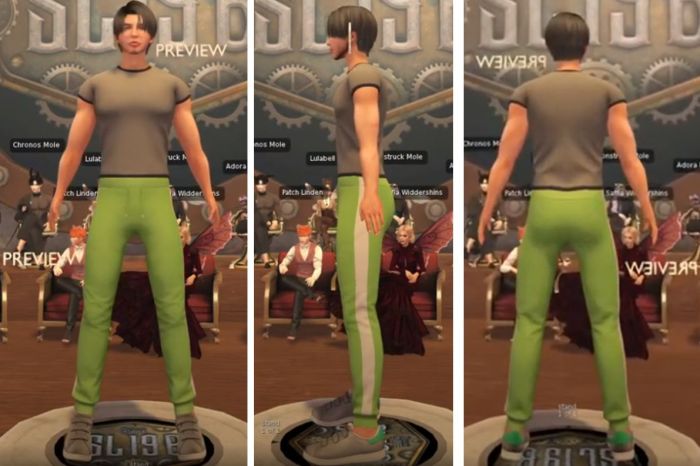
Another project imitated in 2022 – or at least previewed – is all-mesh Starter Avatars. First revealed at SL19B the intent is for this avatars is to ease the pain-points new users face in trying to get their heads around selecting, and customising existing avatar bodies and heads. Given the Lab hopes this project will both encourage a new ecosystem on clothing and accessories created by the community for use with the new avatars but also see these avatars as being a stepping-stone to help new users get settled and then move on to more commercial offerings, it is going to have to step a fine line.

Also, taking their all-in-one nature as seen at SL19B, I’m admittedly curious how these new avatars will make converting from them to use “commercial” mesh bodies / heads any less confusing than it is at present for people shifting from system / starter avatars to commercial offerings.

A preview version of the new, single mesh (head-to-toe) avatar, revealed at SL19B and a part of the new user experience work underway at Linden Lab

Looking Ahead

In looking ahead to 2023, LL pointed to a number of project / initiatives, some of which were anticipated (new user experience et al); further performance improvements (including those noted above) and further scripting improvements.

A couple of surprises with the list, however, were mention of:

  • New centralised “hubs” to better connect residents to the communities that match their passions and interests.
  • First peek at a world and avatar centred mobile-first Second Life experience.

The second of these is intriguing, given the start-stop-push-to-the-side nature of the iOS “SL Mobile” app project. Whether this hint means LL a have been back working on this and expanding its capabilities on the QT, or whether it might mean they’ve opted to buy-in a solution or turn to a streaming solution (which in turn potentially offers the highest fidelity with the viewer in terms of rendering), isn’t clear. All three have been hinted at as possible directions at various points in 2022, and – assuming an equitable price plan could be developed – it’s not as if LL doesn’t have exposure to viewer streaming options, thanks to the Pelican project of around 12 years ago, or (more particularly) the short-lived SL Go solution provided by OnLive.

The centralised hubs is an interesting in terms of its implementation; LL is already revamping the entire “land journey” for users – how to obtain mainland, lease a region from LL directly through to how to find and rent late from private estates – so there is a question here as to whether this new hubs will be hooked into this work, providing a means for users to more easily obtain land and become a part of a community. Or, might it be a means to offer added value to Community Gateways – or even a revamp of Place Pages (which never really took off) to make them more responsive to communities and groups – thus offering both the means to access these new hubs from without SL as well as from within.

Not mentioned in the official blog post are the plans for the Marketplace. With MP Search updated, the road is apparently clear for the 2023 deployment of Marketplace Styles: allowing multiple versions of an object (e.g. different colours of the same jacket or dress) to appear in a single listing. There is also the mention that 2023 might also see the start of work to build a completely new Marketplace and (eventually) migrate users to it. Just don’t expect the work to be completed in 2023 (if it does get started).

Continue reading “Second Life 2022/23: the Lab’s review & preview (with my own notes!)”

Happy Holidays to All!

Wishing you all a very Peaceful and Happy Holiday Season, with my sincere thanks for reading / following my random thoughts through another year!

Hera’s Steampunkian Whitechapel in Second Life

Whitechapel, December 2022 – click any image for full size

Just over a year ago, Hera (Zee9) revealed her take on Whitechapel, the district of East End London infamous for the predatory wandering of Jack the Ripper and, as a result, the influence for many a film and TV series – perhaps most recently that of BBC’s Ripper Street, with its mix of the fictional stories built around very real figures from the period (notably Edmund Reid, and to a lesser extent Frederick Abberline, although after Season 1 the series strayed much, much further from the story of Edmund Reid).

At the time, the build was fascinating (as Hera’s builds inevitably are) in weaving together her own vision for the district and its rich history together with and equally rich mix of fiction. At the time, the fictional elements included not only Ripper Street, noted by the presence of the H Division station, but also touches of Penny Dreadful, the Jekyll and Hyde and Frankenstein stories, and more – all of which I noted at the time in Hera’s Whitechapel in Second Life.

Whitechapel, December 2022

Well, as of mid-December(ish). Hera’s Whitechapel is back, together with another of her popular builds, that of Whitby – a setting I have twice covered in these pages, in October 2021 and again in April 2022. The two locations are reached via a common landing point, and each is accessed via teleport points at the posters alongside their respective trains, and both recreate the look and ambience of their previous iterations whilst also offering some new twists.

However, while I recommend Whitby to both Hera’s fans and to those who have not previously had the opportunity of seeing her unique take on the town and its links to Bram Stoker’s Dracula (with Hera augmenting this with a few additional fictional and real touches), I am here focusing on her Whitechapel build, as it offer a nice twist on the original iteration.

Whitechapel, December 2022

Unless you read the introductory note card available at the landing point, this twist might not initially be obvious on arrival within the setting – which remains the Whitechapel underground station. But climb the steps up to street level, and it starts to make its presence felt in a very subtle manner. Firstly, there are the street lights; hardly the typical gas lamp of late Victorian London (which, by the 1880s were starting to be converted to electric use within the City of London, if not its outlying districts), these are bulky units with pressure tanks, gauges and valves, suggesting stream is their medium for energy.

Similarly, whilst the early automobiles from the original build are present, several are now apparently steam-powered, adding to the sense that this version of Whitechapel has stepped sideways into Steampunk. This is further added to when one looks up to sky two great steam-powered airships overhead, one apparently following the line of a street towards its eventual destination, the other moored alongside a tall iron-built tower connected to a part of the elevated metal walkways that cling to the sides of many of the buildings and reached by the occasional stairs dropping to ground level.

Whitechapel, December 2022

Just across the road are the first hints of the fictional links waiting to be discovered: Sweeny Todd’s infamous barbershop has been transplanted from Fleet Street to Whitechapel’s Commercial Road, together with Mrs. Lovett’s pie shop. As with the original story, these two places of business are separated (courtesy of an intervening alleyway), but sadly no underground tunnel links the two for the transfer of victims.

Its an interesting place for the couple / partners in crime to go about their business, given they are located just across the street from the H Division headquarters building from which Edmund Reid and his men might instantly sally forth to solve a crime. Or if not a crime, then to make their way to the other end of Commercial Road  and Spitalfields’s famous Ten Bells pub to sup a hard-earned pint at the end of a long shift (a pub that remains open to this day – so do be sure to step inside when visiting Hera’s Whitechapel!).

Whitechapel, December 2022

And speaking of Edmund Reid; the mixing of Steampunk with the fictional world of Reid and H Division is seen in Ripper Street actually has the strand of a link to the detective’s real life: in 1883, the Balloon Association of Great Britain awarded him a gold medal for his record-breaking ascent in the balloon Queen of the Meadow from London’s Crystal Palace – one of over 20 flights he made by balloon (and if that weren’t enough to earn him at least a documentary on his life – in 1877 he was the first person to make a descent by parachute from an altitude of 1,000 ft!).

This iteration of Whitechapel retains other element from the original. There is Hanbury Street, where both Florence Eleanor Soper, the daughter-in-law of General William Booth of The Salvation Army, established The Women’s Social Work in 1884, and the location of the yard in which Jack the Ripper’s second canonical victim, Annie Chapman, was found; then there’s Berner Street, Miller’s Court, Buck’s Row and Mitre Square, the locations of the Ripper’s other four canonical victims.

Whitechapel, December 2022

Whilst seeking these out, explorers might also happen across the office of Messrs. Scrooge & Marley (adding a nice Dickensian seasonal twist to the setting), and the apothecary of one Dr. H. Jekyll, together with H. Rider Haggard’s (et al) Allan Quartemain’s townhouse, and Dr. Frankenstein’s loft lab, all of which also carry forward from the original. New (I think) to this build is the Grand Guignol theatre, hopping across the channel from Paris, and – referencing both the seamier side of the East End and giving a slight Sherlockian twist to things – a slightly hidden opium den. A further location I don’t recall from the original (but am obviously open to correction on this) is the Freemason’s lodge.

So, whether you’re new to Hera’s Whitechapel or familiar with the earlier iteration, you’re in for a treat of discovery should you drop-in this time around. However, should you add it to your list of places to visit, might be best to do so sooner rather than later; Hera has tended to take down her recent builds within a couple of weeks or so of opening them.

Whitechapel, December 2022

My thanks to Shawn Shakespeare for the nudge on Whitby / Whitechapel returning to SL.

SLurl Details