After my almost back-to-back forays of late into art exhibitions that either focus on, or lean towards, hybrid art and the use of AI tools (notably MidJourney), I thought I would do a little course adjustment and offer a look at some Second Life based photographic art. To that end, I trundled off to NovaOwl Gallery, curated and operated by ULi Jansma, Ceakay Ballyhoo & Owl Dragonash.
It this there, within the ground-level gallery space, that people can find – through until the end of 2022 – an exhibition of art by Alex Riverstone, an artist whose work I have appreciated for some to and always enjoy witnessing. This is a modest exhibition, featuring a baker’s dozen of pictures by Alex; however, it stands as proof that quantity isn’t necessarily everything: quality accounts for more.
Second Life has allowed me to enjoy it in a different way: allowing the exploration of scenes, poses and angles which wouldn’t be practical in the real world.
– Alex Riverstone
NovaOwl Gallery, November 2022: Alex Riverstone
On first viewing the exhibition, I was struck by the apparent disconnect between its title – Melancholia – and the subject matter of the images presented.
In purely medical terms, melancholia is a subtype of depression, characterised by a number of symptoms such as severely depressed mood, pervasive anhedonia, and lack of emotional responsiveness. As a concept, it has a history dating back to ancient medicine in Europe, and was long regarded as one of the the four temperaments matching the four humours. However, whilst the pieces Alex presents within the exhibition can be called many things – artistic, picturesque, engaging, and so on – none immediately strike one as being of a depressed or melancholic nature when looked upon.
However, in their visual richness they do encompass another interpretation of “melancholia”, one popular in the Renaissance when it was taken as a sign of artistic genius; and there is plenty of artistic expression to be found in each of these pieces from their initial composition, through their processing and presentation and finishing with their titles, such that each one stands as a unique image capable of carrying our imaginations into a world of self-made narrative.
NovaOwl Gallery, November 2022: Alex Riverstone
And it is within that narrative that we chose – as this is purely subjective – to see some of the images as how aspects of melancholia might be visualised in a picture or painting. For example, take the Duality images (7, 8 and 9). within them are hints of melancholic traits we might chose to see: the absence of anyone to enjoy the flying kites and the puppies on the bridge perhaps echoing feelings of anhedonia; the empty chairs speaking to the loneliness of depression / melancholy; the tree with its suggestion of a figure hanging by their wrists from it suggesting despondency. Others, through their titles perhaps whisper more keenly on the subject – as with the Wall and Lonesome Cottage. Even the loungers of Summer Holiday, fading into the white-out of the picture as they do, might be taken as a metaphor for the emptiness of melancholia.
But these interpretations are, as note, entirely subjective. Whether you opt to see then or prefer to take the presented pieces purely as an expression of Second Life’s multifaceted beauty really doesn’t matter; this is Second Life photography rendered as art in a manner that is genuinely captivating and worth visiting.
It’s time to highlight another week of storytelling in Voice by the staff and volunteers at the Seanchai Library – and this week previews the launch of a very special event.
As always, all times SLT, and events are held at the Library’s home in Nowhereville, unless otherwise indicated. Note that the schedule below may be subject to change during the week, please refer to the Seanchai Library website for the latest information through the week.
Monday, November 21st, 19:00: Reality Check
In a bizarre future, It takes place in a bizarre future, the technological singularity has occurred. The world have now become a place of biological fabricators, eight-legged cows, talking dogs, microscopic surveillance bots, and mid-life genetic upgrades for humans.
Life is not easy for many in a world where everyone is subject to police and government surveillance, and married couple Joe and Maddie are trying to make their way on their a small farmstead, trying to remain as unnoticed as possible.
But one morning, they are forced to drive off a “farm” a mix of machine, Ai and human, that has decided it is going to fly to Jupiter – and to do so, it intends to use an mix of enzymes and tree sap which, when combined, have a habit of wiping out all life in the area. To prevent this, Joe sets out devising the means to destroy the farm without the police becoming aware of his intent.
At the same time Maggie withdraws into herself, and Joe believes he may have to use a back-up and recreate her through the fabricator. However, he, the farm and Maddie are about to come together in the most unexpected of ways.
Gyro Muggin’s reads the 2003 short story by Charlie Stross.
Tuesday, November 22nd, 19:00: Tales from Life: Lesser Known Stories from History that Read like Fiction
Thursday, November 24th, 19:00: Alice’s Restaurant
A Seanchai Library Thanksgiving tradition with Shandon Loring.
As Thanksgiving arrives in the United States, Shandon Loring presents singer-songwriter Arlo Guthrie’s famous 1967 musical monologue, Alice’s Restaurant Massacree (also popularly known as Alice’s Restaurant, and the inspiration of the 1969 Arthur Penn film of that name, starring Guthrie himself).
Aside from the opening and closing chorus, the song is delivered as the spoken word accompanied by a ragtime guitar. The story is based on a true incident in Guthrie’s life when, in 1965, he (then 18) and a friend were arrested for illegally dumping garbage from Alice’s restaurant after discovering that the town dump was closed for the Thanksgiving holiday.
What follows is a complicated, ironic and amusing story told in a deadpan, satirical tone, which encompasses fines, blind judges, guide dogs, 27 8×10 copiously annotated glossy photos related to the littering, frustrated police officers, the Vietnam War draft and, ultimately, the inexplicable ways in which bureaucracy moves to foil itself, just when you’ve given up hope of foiling it yourself.
Don’t be late – the entire presentation is just 20 minutes in length!
Advanced Notice: The Dickens Project
The Dickens Project has officially announced an opening date of December 8th, 2022 and will run through until January 3rd, 2023. Old favourite guests and features will return along with an exciting new land configuration and new collaborators. Details to be published in due course!
Logos representative only and should not be seen as an endorsement / preference / recommendation
Updates from the week through to Sunday, November 20th, 2022
This summary is generally published every Monday, and is a list of SL viewer / client releases (official and TPV) made during the previous week. When reading it, please note:
It is based on my Current Viewer Releases Page, a list of all Second Life viewers and clients that are in popular use (and of which I am aware), and which are recognised as adhering to the TPV Policy. This page includes comprehensive links to download pages, blog notes, release notes, etc., as well as links to any / all reviews of specific viewers / clients made within this blog.
By its nature, this summary presented here will always be in arrears, please refer to the Current Viewer Release Page for more up-to-date information.
Note that for purposes of length, TPV test viewers, preview / beta viewers / nightly builds are generally not recorded in these summaries.
Official LL Viewers
Release viewer: version 6.6.7.576223 – MFA and TOS hotfix viewer – November 1 – No change.
Release channel cohorts::
Maintenance P (Preferences, Position and Paste) RC viewer updated to version 6.6.8.576431 on Monday, November 14.
Aoi-ike, November 2022 – click any image for full size
Jade Koltai has opened a new region design in the tradition of the work she started with the late (and still missed) Serene Footman. It offers a personal interpretation of Japan’s famous Blue Pond (青い池, Aoi-ike), located in the country’s second-largest island, Hokkaidō.
Occupying a homestead region, Aoi-ike presents the pond in the depths of winter, offering visitors a setting blanketed in snow to explore and plenty of opportunities for suitable time-of-year photographs. Pride of place is given to the pond itself, the waters the rich azure blue of the original, albeit caught beneath a cloud-laden sky.
Aoi-ike, November 2022 – click any image for full size
The physical world Blue Pond is entirely artificial, the result of work intended to protect the town of Biei following the December 1988 through March 1989 eruptions of Mount Tokachi. These caused a series of pyrrolastic events and associated mudflows which threatened the town, so following them, a series of dams were built to prevent future eruption-generated mudflows which might use the Biei River as a root through the locale.
In doing so, the dam trapped the water of the Shirahage waterfall, a series of falls passing over a cliff rich in aluminium to reach the river. This aluminium, coupled with volcanic sulphates in the water which whiten the rocks on the bed of the pond and so heightening their light-reflecting nature, gives the water of the pond its distinctive blue sky colour.
Aoi-ike, November 2022 – click any image for full size
This unlikely colour is not the only interesting feature of the lake; the plants present also participate in the surreal atmosphere of the place. While the pond is surrounded by living trees, in the middle there are skeletons of larch and birch that once grew on the ground before the formation of the pond. These trees are also present in Jade’s build, although the upriver falls are understandably absent.
Blended with a region surround that helps represent the surrounding mountains (the region around Biei is famous for a mountainous hiking trail that loops between Mount Tokachi and the (slightly) smaller Mount Biei as it sits between the Biei and Shintoku townships). While this loop is too big to recreate in a region, it is possible to circumnavigate the pond on foot along both trails and open ground – although if you have a wearable horse, the setting is also ideal for horse riding.
Aoi-ike, November 2022 – click any image for full size
The lightly wooden and most flat land is heavy in snow and light on structures – the latter comprising a Finnish-style suoja, a metal watchtower, a covered bridge, a little Japanese hut, and a flat-roofed cabin. Cosily furnished, the cabin offers the best respite from the snow and cold, the décor continuing the Japanese theme very nicely. The souja offers a small retreat with a comfy bed and the bridge includes a trio of theatre-like chairs warmed by a heater and where those using them can have a hot cup of tea.
Perhaps the most unusual feature in the setting is located on its northern edge, a short walk from the landing point. It takes the form of a large stone sculpture of a cat seated on a stone plinth and backed by a lower stone wall. It appears a little shrine-like in nature (if a big shrine!), and adds an interesting twist of character to the setting.
Aoi-ike, November 2022 – click any image for full size
Wildlife can be found scattered across the region – deer, owls, bear, cranes, weasels, and black swans – although some might need a little seeking out in order to spot. Also waiting to be found are further places to sit outside of those already mentioned: benches, deck chairs, and so on.
Easy to explore, reflective of the location that inspired it without being heavily tied it it, Aoi-ike presents an engaging winter setting for people to enjoy, entirely free from the more usual “seasonal” trappings generally found in winter-themed reasons at this time of year.
Aoi-ike, November 2022 – click any image for full size
Elven Falls Art Collective, November 2022: Chuck Clip
Chuck Clip has perhaps been most widely known as a tireless promoter and curator of art in Second Life through his Sinful Retreat regions, which have housed a stunning mix of personal art as well as exhibitions and a home for both 2D and 3D artists from across the platform and the world at large. However – and as I’ve noted in the past in these pages – he is himself an accomplished artist in the physical world and in Second Life (where he has also exhibited widely, if often quietly), working in a range of digital mediums, including prims, which he still sculpts today in preference to using mesh and external-to-SL tools like Blender.
I’ve long been attracted to Chuck’s work, particularly his 2D art, because of its powerful expressiveness, and his ability to take and mix a range of digital techniques to create pieces of art that are visually captivating and impactful whilst carrying messages of social conscience either directly or through more esoteric means using the surreal, the fantastic and the dark – elements which may be born in part out of his own life path – to offer insights into the human psyche, love, life, death, religion, and the (my term here) ambivalent nature of the human condition.
Elven Falls Art Collective, November 2022: Chuck Clip
I went to Rochester Institute of Technology initially for medical illustration. After set backs with mental illness, I returned to school, graduating from duCret School of Art for graphic design. Aside from a few small shows in local galleries, mostly I freelanced to make ends meet … My 2D work is created mostly digital using a variety of methods, from photography, to digital painting, to compositing, and more recently, using artificial intelligence to enhance and evolve these pieces into something entirely new.
– Chuck Clip
Many of these aspects of Chuck’s work can be seen and appreciated at Elven Falls Art Collective, owned and operated by operated by Ant (AntoineMambazo) and Aires Hax, where the main gallery is currently given over to an extensive exhibition of chuck’s art across its two floors and which opened on November 18th, 2022.
Elven Falls Art Collective, November 2022: Chuck Clip
Starting with the two pieces facing visitors as they enter the gallery’s foyer and progressing right throughout the seven halls (three on the lower floor, four on the upper, reached via the foyer elevator) this is a veritable tour de force of artistry at its finest. Each and every piece is layered both in terms of its physical composition and its meaning / interpretation. Some aspects of the pieces offer might disturb the sensitive; other might upset the deeply religious – but all will challenge and give pause for thought as to the statements each carries.
The narratives found within the offered works may be as direct as highlghting the role of formalised religion has often played fomenting war, death, and destruction (the entire upper rear hall of the gallery); or more subtle reflections on human nature – such as the mindset setting behind the avatars we encounter in Second Life (Behind the Avatar, within the lower floor, right-side hall) or the fact that as evolved as humanity might appear, we are as a race still prone to the drive of the primeval within us (Modern Man, within the lower floor right-hand hall).
Elven Falls Art Collective, November 2022: Chuck Clip
Each of the seven halls in the gallery also offers a 3D sculpture by Chuck. Each offers something of a reflection of the core themes to be found within the 2D art presented within it (perhaps most powerfully through Holy War, again to be found in the gallery’s upper rear hall); however, they also stand as a statement to artistic expression in Second Life, as Chuck also notes in his biography:
As a prim sculptor I’m largely self taught. I learned by trial and error and by going to places where the works of the old prim sculptors are still shown, examining them for hours on end just trying to figure out what they did to achieve certain effects. I am forever indebted to the old prim sculptors, for they paved the way for people like me. It is their legacy that I try to perpetuate as prim sculpture slowly but surely becomes a lost art in SL. Second Life has provided us with this wonderful medium, and it is my hope that one day it becomes recognized again for the greatness it can achieve.
Chuck Clip
Elven Falls Art Collective, November 2022: Chuck Clip
Bold, emotionally-charged, rich in narrative and marvellously enfolding digital and virtual artistry, Chuck Clip is a genuine maestro of digital art, and his exhibition at Elven Falls Art Collective stands as a powerful underscoring of this fact.
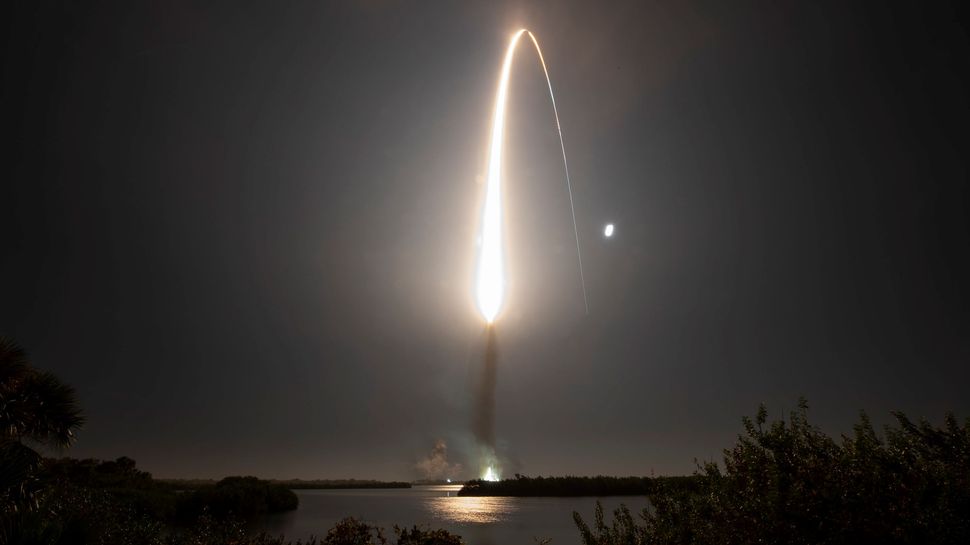
NASA’s SLS rocket soars into the Florida early morning sky, November 16th, 2022, at the start of the Artemis 1 mission to cislunar space.. Credit: United Launch Alliance
On November 16th, 2022 NASA launched what is – for a time at least – the world’s most powerful rocket, the Space Launch System (SLS), on its maiden flight. The uncrewed mission marks the first flight of a human-capable vehicle to the vicinity of the Moon under the aegis of NASA’s Project Artemis.
Lift-off came at 06:47 UTC on the morning, and the rocket – roughly the size of the Apollo Saturn V but massing around 400 tonnes less and with engines generating 5 meganewtons greater thrust – was no slow climber like Saturn V; instead it fairly leapt into the night sky, thundering from 0 to 120 km/h in just a handful of seconds as it lifted an Orion capsule and service module away from the launch pad and on their way to orbit.
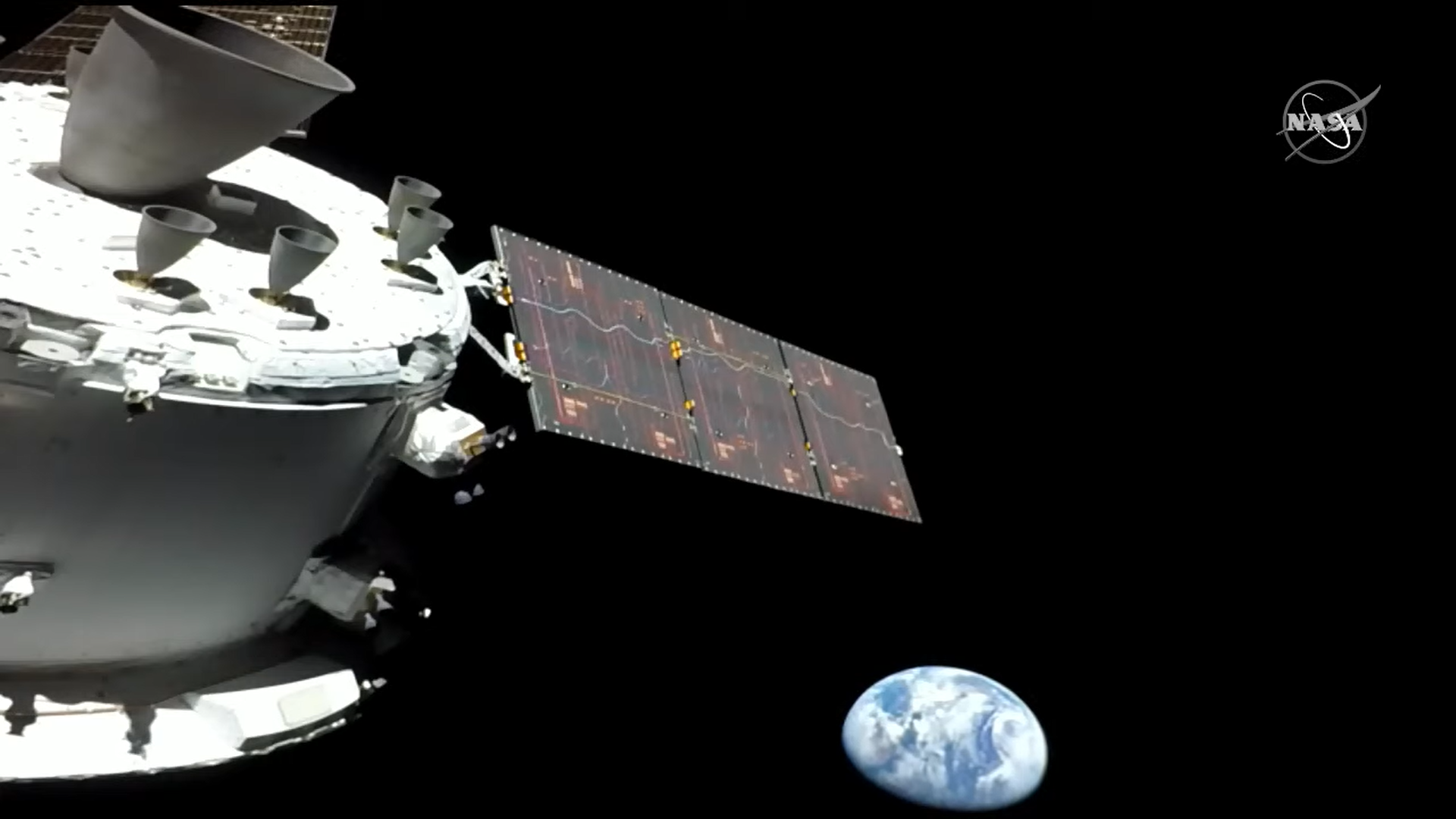
The view home: a camera mounted on one of Orion’s four solar arrays looks back at Earth from a distance of almost 92,000 km, 12.5 hours after launch as the vehicle makes a sweeping 6-day arc out from Earth to the Moon. Credit: NASA TV
It was actually a launch that also nearly didn’t take place (again); during fuelling operations immediately ahead of the launch, a leak was detected. Such leaks have been the bane of this rocket’s existence, and for a time it was uncertain if NASA would stop or delay the fuelling operation – and even scrub the entire launch attempt.
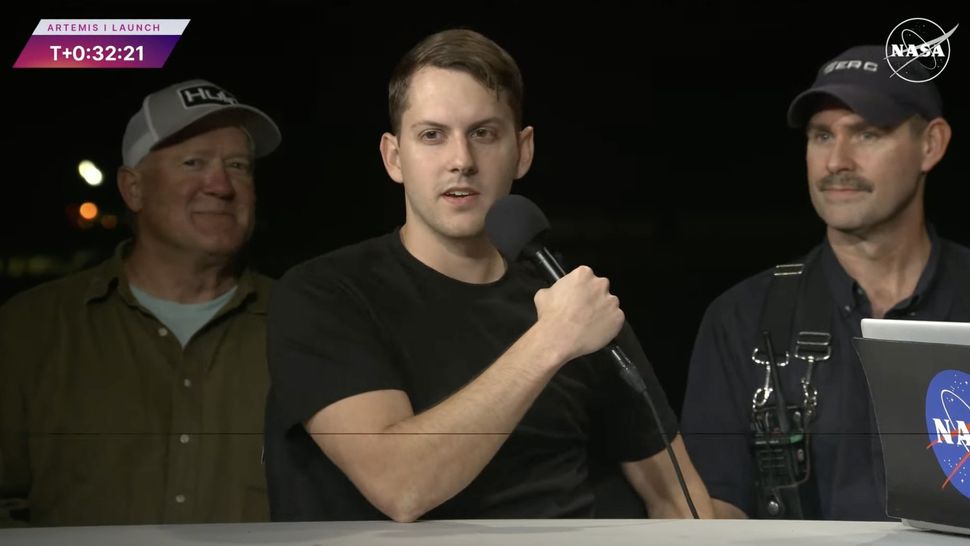
Instead, a risky decision was taken to send in a Red Team to Pad 39B at Kennedy Space Centre to try to fix the leak with the liquid hydrogen propellant feed at the base of the rocket, even with propellants in the tank and the risk of a spark causing an explosion. The team – engineers Trent Annis, Billy Cairns and Chad Garrett worked under the “living” rocket – these monsters do not stand quietly when even partially fuelled, they creak, groan and periodically vent excess gasses – to tighten the “packing nuts” designed to hold the seals on the propellant feed line tightly in place. The crew arrived on the pad just 3.5 minutes ahead of the launch and had to work fast to fix the issue if a launch scrub was to be avoided.
The three-man Red Team address reporters following their trip to the launch pad to fix a liquid hydrogen propellant leak during fuelling operations. Credit: NASA TV
Obviously, the team was successful – which does not lessen the risks they took as unsung heroes of the launch – and at 07:01 UTC, the Interim Cryogenic Propulsion Stage (ICPS) upper stage of the rocket placed the Orion vehicle in an initial orbit, and just over 30 minutes afterwards, the Orion service module successfully deployed the four solar arrays required to provide it and Orion with electrical power.
An hour later, after raising Orion’s orbit, the IPCS stage re-lit is engines to propel Orion from Earth orbit and into a trans-lunar injection orbit at 08:37 UTC, the stage separating from the space vehicle at 09:13 UTC.
Since then, the mission has progressed precisely as planned. At 14:30 UTC, Orion completed its first engine burn, correcting its flight to the Moon, and then late in the day a camera mounted on one of the service module’s solar panels captured a shot of Earth as seen from the vehicle, already almost some 92 thousand kilometres from Earth. On November 18th, the vehicle returned a further image of Earth – in greyscale – as it reached the 299,000 km from Earth mark.
A view of Artemis 1 simulated by AROW – he Artemis Real-time Orbit Website – showing the vehicle as it approaches the Moon on Sunday, November 20th. Note the vehicle appear to be travelling sideways in order to keep its solar arrays facing the Sun. Credit NASA AROW
The next major milestone for the flight comes on Monday, November 21st, 2022, Orion will complete the first stage of its leisurely, widely-curved outbound flight to the Moon. At 12:44 UTC on that day, with the vehicle passing around the far side of the Moon at a distance of 130 km, the vehicle will undertake a 2.5 minute burn of its main engine to direct itself into a distant retrograde orbit (DRO) which will carry it as far as 432,000 km from Earth.
The critical aspect of this manoeuvre is that it will occur when the vehicle is out-of-communication with Earth, thanks to the Moon being in between. The entire manoeuvre will therefore be carried out entirely by the onboard flight systems.
The flight so far has tested almost all of Orion’s flight, navigation and other systems, with only 13 issues, the majority defined as “benign”, being recorded. The most significant issue has been the star tracker – part of the flight navigation system. This was getting “dazzled” by thruster plumes as the vehicle adjusted its orientation during flight. While the tracker itself was designed to ignore the plumes, their brightness did confuse the flight software – something that hadn’t been considered could happen during testing. However, now it has been identified, the problem can be dealt with by Mission Control.
More substantial damage was actually done by the rocket itself at launch; the sheer power on the four RS25 engines and two solid rocket boosters did unspecified, but apparently extensive, damage to the mobile launch platform and launch tower. How much damage they sustained is unclear, but Pad 39B has been known to cause launch platforms using it damage. This was particularly noticeable following the launch of Apollo 10 in ay 1969 and again with the Ares 1-X launch in October2009 which resulted in some US $800 million in damages to the pad, platform and tower – although this was in part due the vehicle having to be launched slightly off-vertical, resulting exhaust plume physically striking the tower.
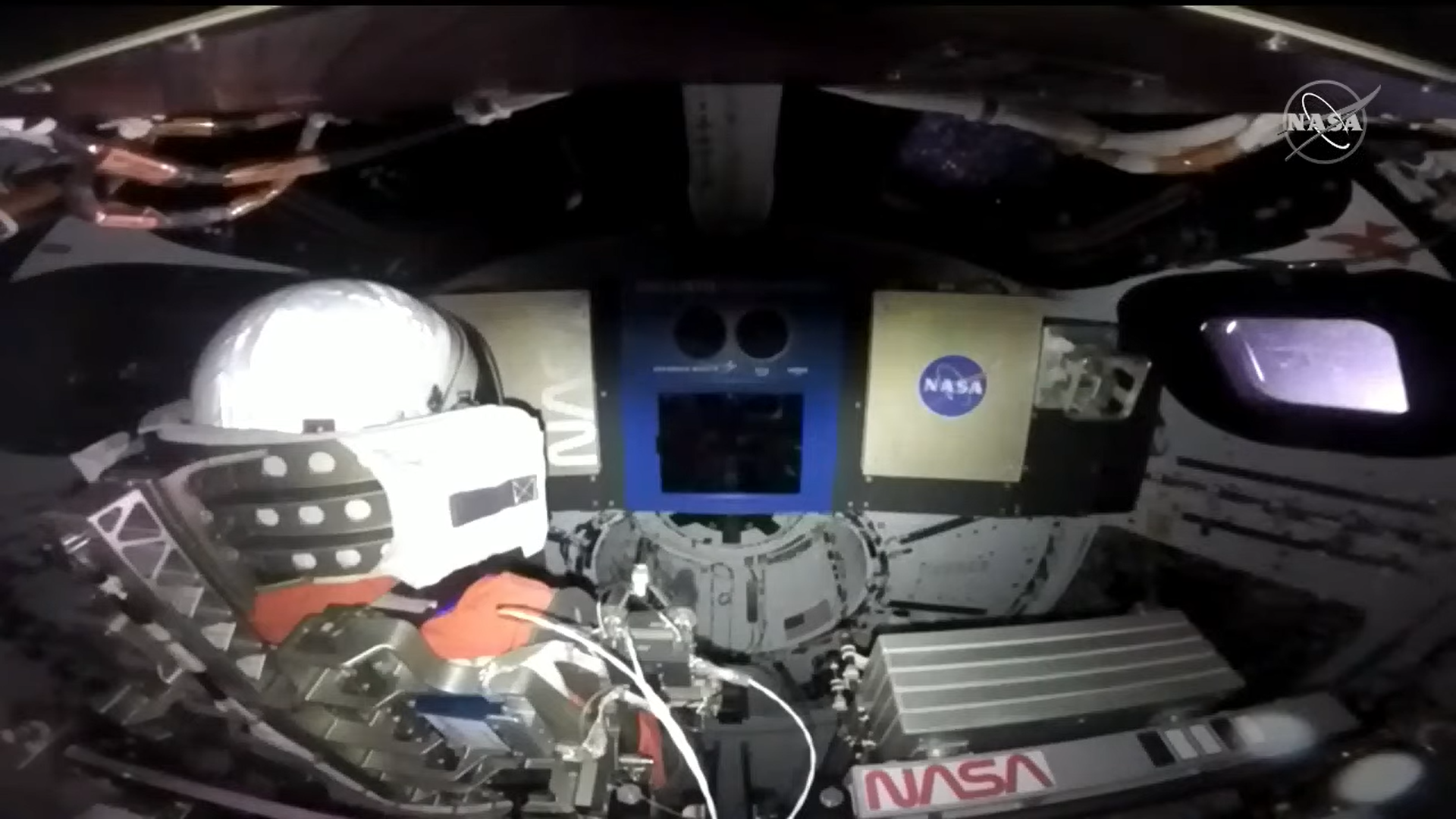
The view inside Orion: “Commander Moonikin Campos” seated in the command position aboard Orion, facing a set of dummy digital display panels. The mannequin is testing the Orion Crew Survival System Suit (OCSSS), designed to keep crew alive in the event of the vehicle’s life support system experiencing a malfunction. Credit: NASA TV
As I noted in my previous Space Sunday report, Orion is carrying a range of experiments onboard, all of which are being monitored throughout the flight. Chief among these are the radiation experiments which will come into their own as the vehicle enters its extended orbit around the Moon, where it will remain through until it again uses the Moon to swing itself back onto a return course to Earth in December 2022.
If you want to interactive track Artemis 1, you can do so via NASA’s Artemis Real-time Orbit Website (AROW). In the meantime, the video below captures the stacking of the Artemis 1 SLS vehicle inside the Vehicle Assembly Building at Kennedy Space Centre, together with the original roll-out to the pad earlier this year, and the night-time roll-out ahead of the launch, together with the initial phase of the mission’s ascent to orbit.


 As Thanksgiving arrives in the United States, Shandon Loring presents singer-songwriter Arlo Guthrie’s famous 1967 musical monologue, Alice’s Restaurant Massacree (also popularly known as Alice’s Restaurant, and the inspiration of the 1969 Arthur Penn film of that name, starring Guthrie himself).



 Inara Pey: Living in a Modemworld