In April, I wrote about an exhibition of art featured as the opening exhibit for The Antiquorum Art Gallery within Patch Thibaud’s stunning Hanging Gardens region build. Entitled Landscapes – My Personal View, the exhibition featured the art of long-term Second Life resident Alexa Bouras – although I believe it marked my first full exposure to her work (see Alexa’s personal view of Second Life). I was immediately captivated by Alexa’s work for its reichness of content, style and narrative and noted at the time that I looked forward to seeing more of Alexa’s art.
Well, I’m pleased to say that wish has been granted – for all of us – as Alexa has a new gallery space, one still located within the Hanging Gardens of Babylon region, but occupying its own skybox as provided by the region’s holder, Cristabella Loon. Alexa was kind enough to drop me a line about her new artistic home over the weekend, and as soon as the opportunity arose, I hopped over to take a look.
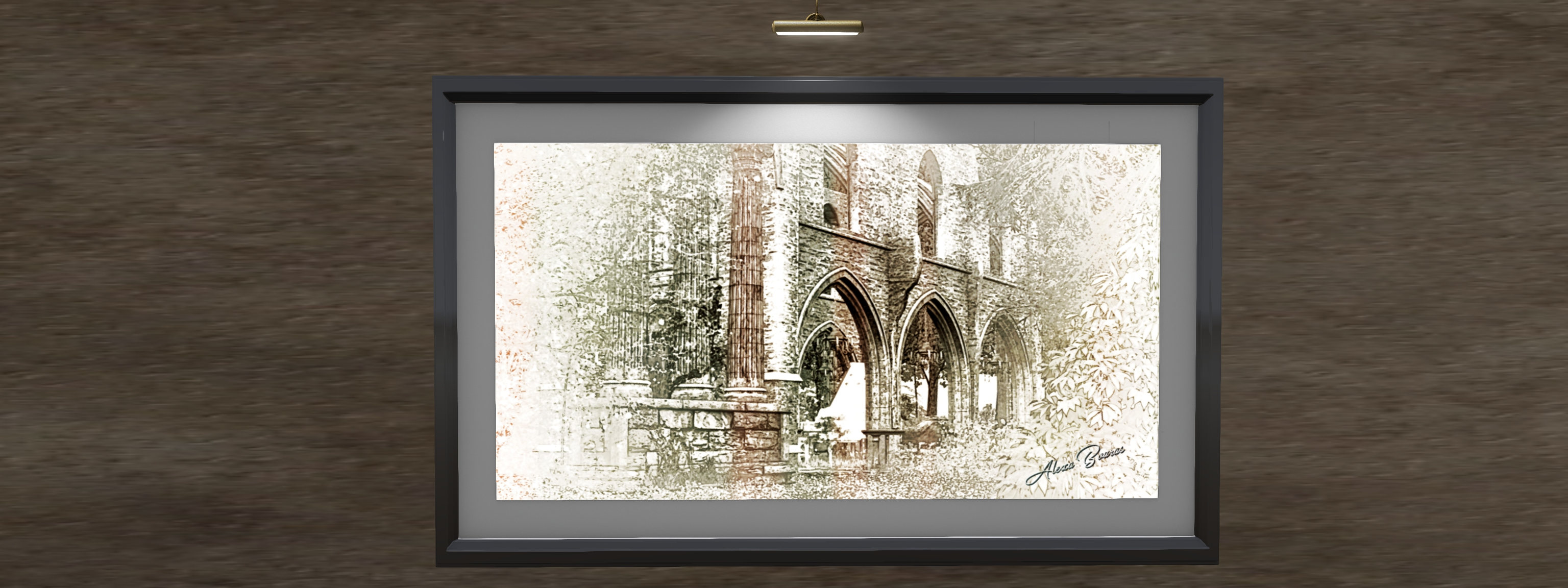
Alexa’s Art Gallery – Alexa Bouras
Offered as a spacious cube with a mezzanine level to one side, the skybox provided to Alexa is of a modern interior design highly suited to her art, with a central water feature on the lower floor and a sweeping, suspended staircase rising above it to reach the mezzanine. This split in floor space allows Alexa to display her work in different formats and sizes, with large pieces displayed along the walls of the more “open” space to the front of the skybox, and smaller more intimately-sized pieces displayed along the walls of the lower floor beneath the mezzanine and around the mezzanine itself.
The art presents a rich mix of styles and subjects, including the Second Life landscapes-processed-as-paintings I found to be so richly evocative with Landscapes back in April 2022, together with pieces which can be regarded as drawings and / or etchings (notably the uttering captivating Anya’s Awakening, which is simply gorgeous), and those which are, by dint of angle, focus and subject, beautifully intimate in their content.
Alexa’s Art Gallery – Alexa Bouras: Anya’s Awakening
By “intimate” I do not necessarily mean they are avatar studies and / or in any way NSFW; quite the reverse, in fact. These are pieces focused on what might be regarded as the mundane, the often unnoticed or the everyday, but in a manner which grants them their own unique beauty and story through Alexa’s use of angle, focus, colour and depth of field.
These pieces are most obviously found along the back wall of the mezzanine level, where sit two absolutely delightful pieces captured at Longing Melody (see: Visiting Longing Melody in Second Life) which tell as entire story about the life and work of an artist, together with a third piece from the same region which I guarantee will capture the heart of any piano player (including myself) for the way it captures the story of these majestic instruments.
With their tight focus and unique perspectives, these appear to be part of a further evolution of Alexa’s artistic expressiveness and her growing mastery of a medium which she has come to out of a need to express herself creatively, rather than the application of skills and knowledge initially gained through the physical world. It’s a growth in techniques which I find admirable within a Second Life artist (particularly as my own attempts remain decidedly one-dimensional!), offering as it does new avenues to be explored by both the artist and their audience.
Alexa’s Art Gallery – Alexa Bouras
Utilising the region’s day / night cycles, with point lights to illuminate the art during the latter (so do make sure you have Advanced Lighting Model (ALM) enabled via the viewer’s Graphics Preferences!), Alexa’s Art Gallery makes for a genuinely engaging visit, presenting the opportunity to view (and purchase, if you’re so taken) the art of a very visual and engaging Second Life artist.
Official poster for the DART mission, a joint NASA-John Hopkins University Applied Physics Laboraroty (JHUAPL) mission. Credit: NASA
Monday, September 26th 2022 will see NASA’s Double Asteroid Redirection Test (DART) reach its primary goal when a small space probe will collide with an asteroid called Dimorphos in an attempt to test a method of planetary defence against near-Earth objects (NEOs) by deflecting their path around the Sun via a kinetic impact.
The risk we face from Earth-crossing NEOs – asteroids and cometary’s fragments that routinely zoom across or graze the Earth’s orbit as they follow their own paths around the Sun – is not insignificant. More that 8,000 of such objects are currently being tracked, and that number is still rising. Such objects range in size from the relatively small to objects like the infamous 99942 Apophis (370m along one axis). which were it to strike Earth, would result in an estimated explosive force equivalent to 1,000 megatons, through to objects large enough to result in possible extinction events.
In 2013, a cometary fragment roughly 20m across entered Earth’s atmpsohere to explode 26km above the the Russian oblast of Chelyabinsk with a force of 400–500 kilotons of TNT. The resulting shockwave damaged some 7,200 buildings and injured over 1,500 people in 6 cities. This image captures the fragment’s path as it burnt up through the denser atmosphere. with the poiint of its explosive destruction marked by a distinctive “mushroom cloud” towards the right-hand end of the trail. Credit: Alex Alishevskikh
Over the years, various means of prevent such an impact have been suggested, with one of the most popular being the use of the kinetic energy from one or more impacts against the threat to alter its orbital track around the Sun so it would miss Earth. It is a popular option because if we get sufficient warning about a threatening object, it should be possible to plan an intercept mission to strike it at a point in its orbit where only a very small deflection in its track would be enough to ensure it misses Earth, allowing smaller, more manageable payloads to be used.
DART is the final incarnation of what started as two independent missions by NASA and the European Space Agency (ESA) to achieve the same goal. These were then combined into a single mission – AIDA (for Asteroid Impact & Deflection Assessment(, which would have seen ESA launch a observation platform intended to fly to the designated target asteroid and carry out observations and analysis prior to NASA’s DART impactor arriving, and then observing the impact on the latter and the effect it had on the target’s orbit.
However, the ESA element of the mission was cancelled, leaving NASA to push ahead with DART, with the role of observing the impact taken over by Earth-based based observatories and a small payload carried by DART. To compensate, ESA now plans to launch Hera in October 2024, a mission and vehicle that will rendezvous with the target asteroid in 2027 to observe the overall results of the DART mission.
Dimorphos, the target for DART, is actually a relatively small asteroid, some 170m across (but still large enough to result in considerable destruction and loss of life were it to enter Earth’s atmosphere and explode). It has been selected for a combination of reasons, the most pertinent being it is actually the moon of a much larger asteroid, 65803 Didymos (Greek for “twin”), itself a NEO forming part of the Apollo group, and noted as being potentially hazardous to Earth. It is around 780m across, and it orbits the Sun every 770 days, its orbit eccentric enough for it to cross both the orbits of Earth and Mars, and thus present a potential impact hazard to both.
Dimorphos (Greek: “having two forms” and discovered in 2003, seven years after Didymos was first located) occupies an equatorial and near-circular orbit around Didymos with a period of 11.9 hours. This makes it an attractive target because its position is easy to calculate / track, and the fact that it is orbiting a large object means that the angle of deflection as a result of DART’s impact can be directly measured against its motion around Didymos, and from this it will be possibly to extrapolate the amount of deflection achieved had Dimorphos been a solo asteroid en route to a collision with Earth.
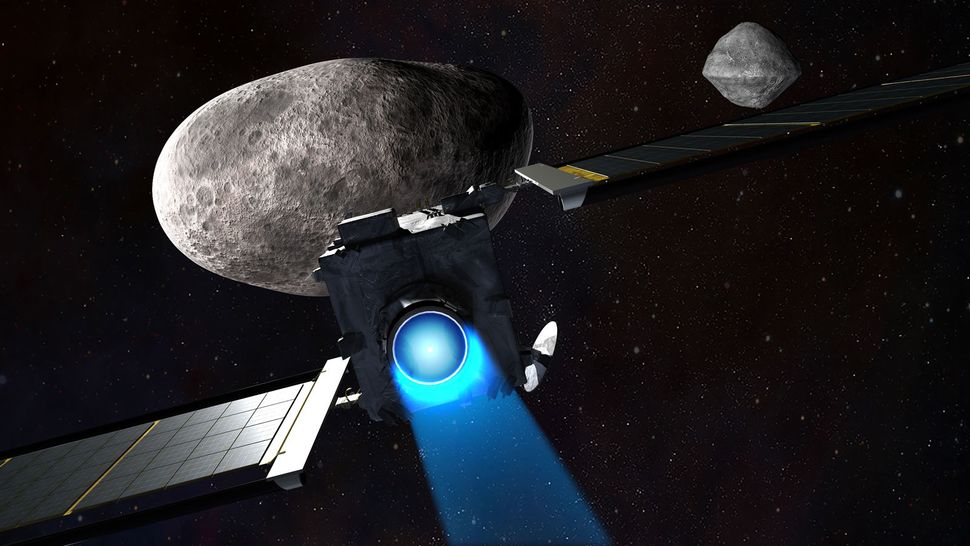
DART launched on November 24th, 2021 atop a Falcon 9 rocket. In order to impact the asteroid at a speed sufficient to affect its velocity, the vehicle has been propelled towards its target by a solar-powered NEXT ion thruster, and will strike Dimorphos head-on at a speed of 6.6 kilometres per second. This should be sufficient to effectively slow it in its orbit around Didymos and result in a charge to the orbital period and shape. Given Dimorphos is large enough to exert some gravitational influence over its parent, it is expected that Didymos’ velocity and orbit will also be affected to a small degree.
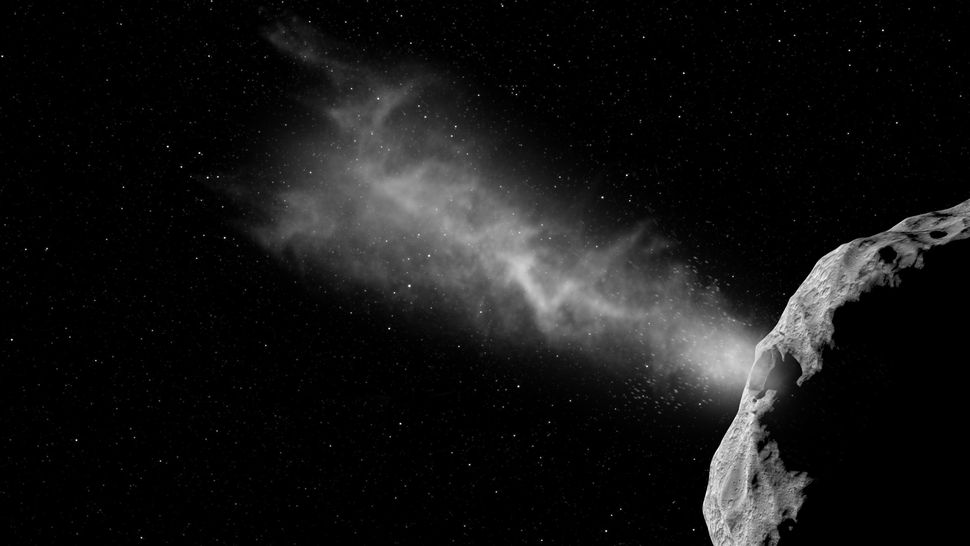
An artist’s impression of how the LICIACube cubesat might witness the outflow of ejecta from DART’s impact into Dimorphos. Credit: ESA / Italian Space Agency
Exactly how small or obvious all these changes will be is unknown – we simply do not know the topography of Dimorphos to know where and how DART will strike it. However, to assist with Earth-based observations of the impact, earlier this month DART released the Light Italian CubeSat for Imaging of Asteroids (LICIACube).
Built by the Italian Space Agency, this cubesat is now on a trajectory that will carry it through the Didymos / Dimorphos pairing, allowing it to observe and hopefully record DART’s impact and also gather initial data on the immediate results of the impact – although it is estimated that it will be a week or so before the overall effects of the impact can be properly interpreted. Similar cubesats, originally dubbed “Luke” and “Leia” but now officially called Milani and Juventas (a case of football winning out over Star Wars in the Italian science team?) will accompany the Hera mission in 2024.
DART itself carries little in the way of science instruments related to the mission, other than a 20 cm aperture camera called Didymos Reconnaissance and Asteroid Camera for Optical navigation (DRACO, which should record and return images of both Didymos and Dimorphos right up to the actual impact). However, it is in many respects also a technology demonstrator, making use of the Roll Out Solar Array (ROSA) system recently deployed to the International Space Station, and which allows for more efficient harvesting of sunlight over a smaller area of solar array surfaces to generate power, and also RLSA, the spiral Radial Line Slot Array, a new type of compact and lightweight high gain communication antenna.
An artist’s impression of the NASA DART vehicle under propulsive thrust from its ion engine, moments before impacting with the asteroid Dimorphos. Credit: NASA
Currently, DART remains on course for an impact with Dimorphos at 23:14 UTC on Monday, September 26th, 2022. The images returned by the DRACO camera ahead of the impact will mark only the 6th time we have received close-up images of the surface of an asteroid.
Big Boosters: SpaceX Booster 7’s Seven and Artemis 1’s Weather Delay
It’s been a week of ups and downs for the two big boosters which are most prominently on spaceflight enthusiasts’ minds.
At the SpaceX Starbase Facility in Boca Chica, Texas, Booster 7, the vehicle seen as the favourite to lift the company’s massive Starship into the sky on the system’s first orbital attempt, completed a second spin-start test of seven of its 33 Raptor 2 engines on September 19th. This looked to be a different selection of motors to those tested the previous week, meaning that between 14 and 17 of the booster’s motors have now completed spin-starts. Nor was this the end of things: just a few hours after the spin-start – which lasted around 13 seconds – the booster was re-pressurised with fuel and warning given of a further engine test.
This was a full static fire of seven of the engines, marking the largest number of Raptor 2 motors to go through such a test thus far. Slow-motion payback of high-speed film shot of the event reveals that – as with the spin-start tests – rather than igniting all seven engines simultaneously, engine ignition was staggered, which might be indicative of how actual orbital launches will be managed; staggering engine starts by just a few milliseconds could help with reducing noise vibration resulting from all 33 engines coughing into life at the same time, and may even help reduce the amount of sound being deflected back up against the vehicle and the launch stand.
Following this test, SpaceX announced that, rather than remaining at the orbital launch facility for further engine tests, Booster 7 would be returned to the production centre at Starbase for “robustness upgrades”, and Booster 8 would replace it on the orbital launch mount to undergo its own testing. Whilst not entirely clear from the tweets given, it appears these tests will include a full wet dress rehearsal (WDR), which could involve stacking the booster with Starship 24, then fully tanking them and proceeding through a launch countdown that stops short of engine ignition. Then, after this, there will be a full 33-motor static fire test for a booster.
Whether this means Booster 8 will overtake Booster 7 to become the vehicle to make the first orbital launch attempt with a Starship on top, or whether the two boosters will again be swapped to allow Booster 7 make the attempt – which SpaceX appear to be hoping to make in November (still subject to the granting of an FAA license) – is unclear.
Either way, Booster 7 was removed from the launch mount mid-week, and the launch mount itself then went through a series of tests of its upgraded sound suppression system, which appears to deliver both water and nitrogen as to the flame pit of the launch table to both absorb sound (and reduce the potential for it causing damage to the vehicle or launch facilities) and reduce the risk of unexpected fire.
Booster 8 (centre left) imaged on Highway 4, Boca Chica, on its way to the Starbase test and launch facilities. Just to the right of the booster stands Starship 24, located on a sub-orbital test stand. Centred in the photo is the orbtial launch tower, with the mechazilla lifting arms lowered and rotated away from the launch table and Booster 7 (hidden by the bulk of the launch tower). Credit: NASASpaceflight.com (not a NASA afilliate)Meanwhile, on September 21st, NASA held a further fuelling test of the massive Space launch System rocket that will launch the uncrewed Artemis 1 mission to cislunar space. Earlier attempts to complete this test – a critical final step in readying the massive launcher for its maiden flight – had to be curtailed due to leaks in the liquid hydrogen fuel feed system at the base of the rocket, leading to padside repairs, as I noted in my previous Space Sunday update.
While the September 21st test also encountered leaks with the liquid hydrogen propellant flow, they were now sufficient to curtail operations, and the tst was successfully completed with both the core and upper stage liquid oxygen and liquid hydrogen tanks being fully fuelled roughly 6 hours after operations commenced.
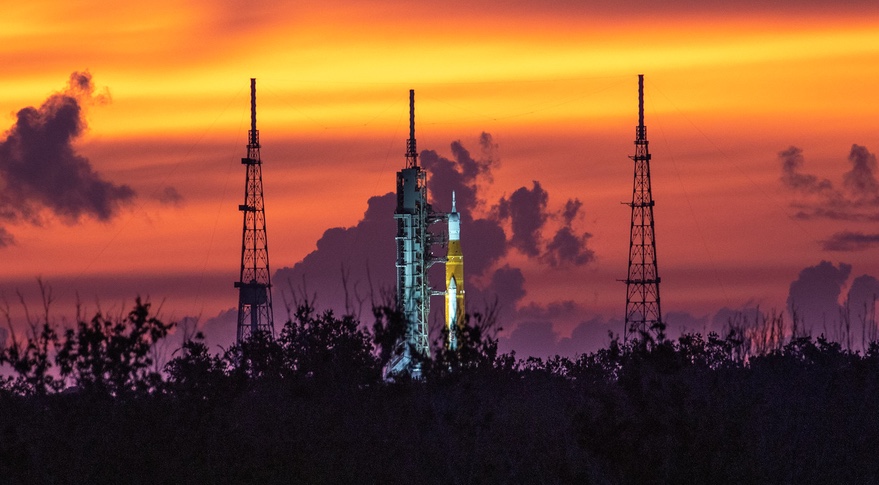
One September 23rd, and after post-test checks on the vehicle, NASA held a press conference to confirm they would be making a launch attempt on Tuesday, September 27th, 2022 – only to have to call off the attempt on the 24th September due to tropical storm Ian threatening to roll across Florida and over the Space Coast, potentially requiring the vehicle to be rolled back to the safety of the Vehicle Assembly Building (VAB).
The Artemis 1 SLS booster on launch pad 39-B at Kennedy Space Centre. Credit: NASA
At the time of writing, no final decision had been announced regarding the roll-back proceeding. Should it occur, it is likely to occur overnight (local time) on Sunday 25th / Monday 26th September). This roll-back would mean the earliest launch opportunity would be October 2nd; however, this is a date in doubt due to the planned October 3rd launch for the NASA / SpaceX Crew 5 mission to the ISS from neighbouring Pad 39A. As both pads within launch Complex 39 at Kennedy Space Centre use the same infrastructure, back-to-back launches from the two pads are logistically difficult, and was there are further windows for the Artemis 1 launch, letting this slip is seen as preferrable to disrupting ISS operations.
The one good piece of news for Artemis 1, is that the flight termination system (FTS) has received a recertification waiver from the US Space Command at Cape Canaveral Space Centre. The FTS is used to destroy a rocket should it veer off-course post-launch. However, its batteries have a limited service life, and so packages need routine re-certification to state their batteries are suitable for use – or the batteries require replcing. Re-certification / replacement means returning the vehicle to at VAB, further delaying any launch. However, the USSC has agreed that the package on the SLS could have the recertification delayed until mid-October, allowing the vehicle o be available for the late September / early October launch windows.
JWST Update: Images and Issues
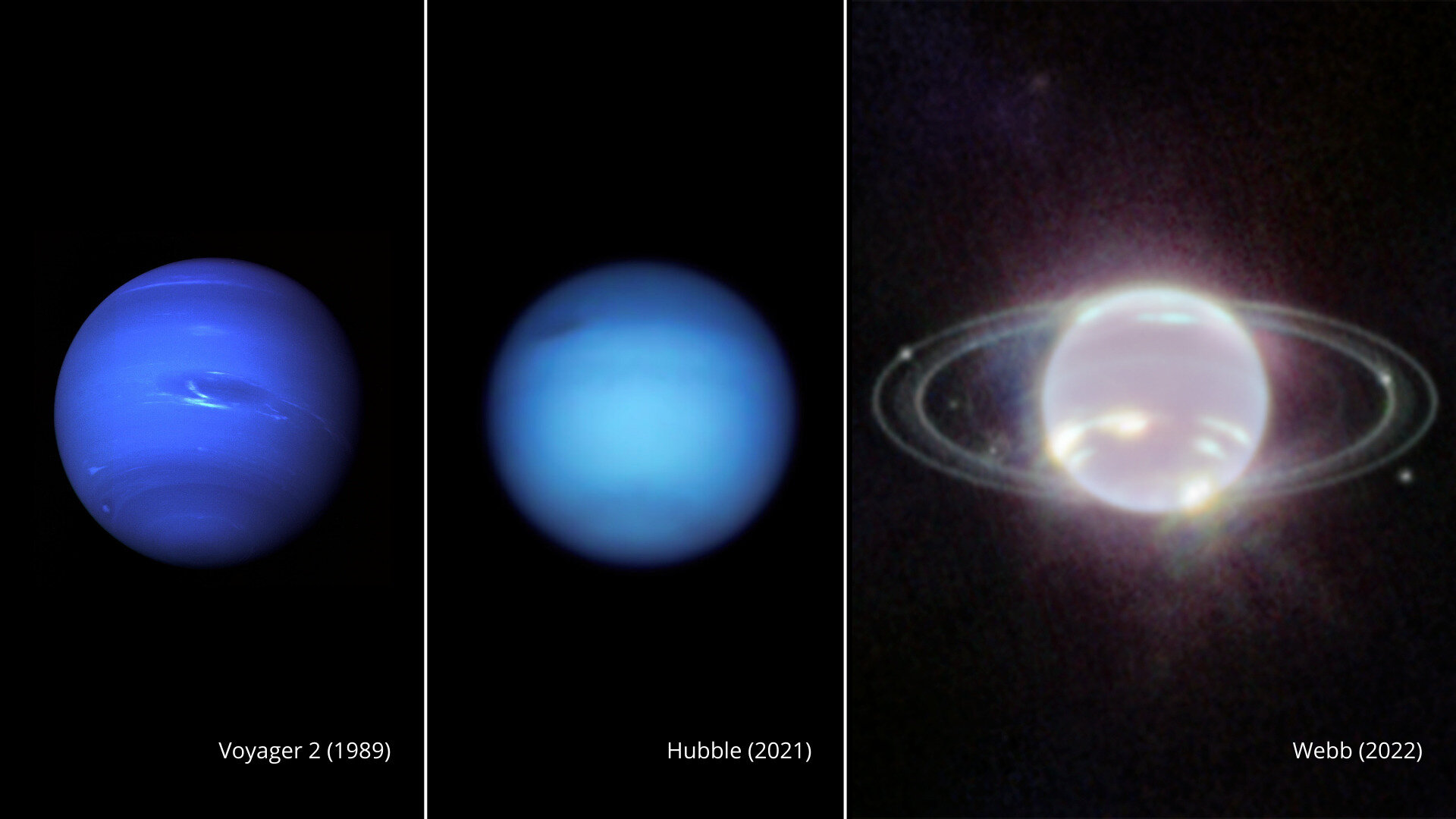
On September 24th, NASA released images of the solar system’s outermost planet, as captured by the James Web Space Telescope. The pictures, taken in July 2022, show not only Neptune’s thin rings, but its faint dust bands, never before observed in the infrared, as well as seven of its 14 known moons.
Neptune, its rings and some of its moons as seen by JWST in July 2022. Credit: NASA
Neptune has fascinated researchers since its discovery in 1846. Located 30 times farther from the Sun than Earth, it is characterised as an ice giant due to the chemical make-up of its interior, whilse because of the great amounts of methane and heavier elements within its atmosphere, it has a disntinctive ocean blue colouring when seen in visible light.
The JWST images capture Neptune in the near-infra-red wavelengths which are readily absorbed by the planet’s atmosphere. This results in it appearing very differently to how it appears in visible light, looking light a misty, crystal marble lit from within by bright streaks – actually the atmospheric interactions only previously hited at b the passge of high-althitude cloud zipping around the planet. Beyond it, and more particularly, the planet’s ring and dust system is revealed in the clearest detail seen in more than 30 years.
Three views of Neptune over the decades, each revealing different information about the planet and its rings. Credit: NASA
Among the seven moons also captured in the JWST images is massive Triton, which appears to float over Neptune like a giant star – the result of the moon reflecting around 70% of the sunlight striking it, thanks to the frozen sheen of condensed nitrogen covering it.
The images of Neptune came at a time when it was confirmed the observatory has developed a minor issue. This lays with a grating wheel mechanism within the Mid-Infrared Instrument (MIRI), resulting in suspension of one of the instrument’s four operating modes (medium-resolution spectroscopy observations). The other three observing modes — imaging, low-resolution spectroscopy and coronagraphy — are not affected, and observations using those modes of MIRI are continuing.
Naptune and its rings and moons, as omaged by JWST in July 2022. Credit: NASA
The cause of the friction within the mechanism is not clear. Hoever, NASA made it clear the decision to suspend the affected operations with MIRI was not as a result of failure, but rather “an abundance of caution” so that engineers could review telemetry data from the instrument and the mechanism in order to understand the extent of the issue, what might be done to correct it and the potential for impact on mid-range spectroscopy data already gathered by the instrument. In the meantime, mission managers remain confident MIRI will return to full operations in the near future.
It’s time to highlight another week of storytelling in Voice by the staff and volunteers at the Seanchai Library – and this week previews the launch of a very special event.
As always, all times SLT, and events are held at the Library’s home in Nowhereville, unless otherwise indicated. Note that the schedule below may be subject to change during the week, please refer to the Seanchai Library website for the latest information through the week.
Sunday, September 25th, 13:30: Evil Under the Sun – Finale
The are times when even Belgian ex-pat detective Hercule Poirot needs a break from his chosen vocation; so when the opportunity arises for him to enjoy a holiday in Devon at the Jolly Roger Hotel (inspired by the Burgh Island Hotel) located on a tidal island just off the south Devonshire coast, he looks forward to the chance of a little R&R.
Evil Under the Sun – a Seanchai Library special event
Whilst at the hotel, he encounters the other guests, notably Arlena Marshall who, desire being at the hotel with her husband Kenneth and step-daughter Linda, spends a lot of her time flirting with Patrick Redfern – much to the anger of Redfern’s wife, Christine and the disgust of her step-daughter. Also among the guests is Rosamund Darnley, who was once sweethearts with Kenneth Marshall.
Trying to keep himself apart from the intrigue, Poirot finds himself drawn into the middle of things and in need of his most particular deductive skills when Arlena Marshall is found dead on the sand of a secluded cove across the little island far from the hotel; a place where she apparently had a secret assignation…
Evil Under the Sun – a Seanchai Library special event
Join David Abbott, Corwyn Allen, Gloriana Maertens, Elrik Merlin, Kayden Oconnell, and Caledonia Skytower as they commence a reading of the 23rd adventure for Agatha’s Christie’s hero, first published in 1941, within the setting of the Jolly Roger Hotel. Should you wish, you can also enjoy the hotel’s grounds and facilities, partake of a little fun – and visit the cove which proved fatal for Arlena Marshall.
Note: the setting for Evil Under the Sun will close on Wednesday, September 28th.
Two New York Police Department detectives investigate a series of suspicious deaths across New York City. These are revealed to be the work of a race of intelligent beings descended from canids, called the Wolfen.
The novel is told from the point of view of the human characters as well from the Wolfen themselves. The savage killing of two New York City policemen leads two detectives, a man and a woman bound together by a strange, tough passion, to hunt down the wolfen – once called werewolves.
Sophie has the great misfortune of being the eldest of three daughters, destined to fail miserably should she ever leave home to seek her fate. But when she unwittingly attracts the ire of the Witch of the Waste, Sophie finds herself under a horrid spell that transforms her into an old lady. Her only chance at breaking it lies in the ever-moving castle in the hills: the Wizard Howl’s castle.
To untangle the enchantment, Sophie must handle the heartless Howl, strike a bargain with a fire demon, and meet the Witch of the Waste head-on. Along the way, she discovers that there’s far more to Howl—and herself—than first meets the eye.
Caledonia Skytower reads Diana Wynne Jones novel.
Wednesday, September 28th 19:00: Seanchai Flicks – Spooky Edition
The Seanchai cinema space plays host to videos and throw popcorn around!
Thursday, September 29th, 19:00: The October Country
Stories by Ray Bradbury read by Caledonia Skytower.
Mousehole, September 2022 – click any image for full size
It’s been over a year since my first (and until now, only) visit to Mousehole, the second of Tolla Crisp’s regions to carry her Cornish theme (mixed with broader flavours from Europe). That visit, in June 2021 (see: A corner of Cornwall in Second Life), was made notlong after the region had opened, and saw it feature elements inspired by the ancient Cornish fishing village of Mousehole (pronounced maʊzəl, orPorthenys in Cornish) – at one time one of the busiest fishing ports, far down towards the very tip of England’s “toe”, on the southern coast of Cornwall.
At the time of that visit, Mousehole directly abutted Tolla’s Frogmore (now in its 5th iteration); however, time has passed and now Frogmore Cottage – a region given over mostly to rentals but with public paths winding through it – sits between the two.
Mousehole, September 2022
Now sitting within a Homestead region, Mousehole has perhaps lost its more recognisable links to its physical world namesake – but in doing so it has lost none of its charm or beauty. Built by Dandy Warhlol (Terry Fotherington), in keeping with past builds for both Mousehole and Frogmore – and doubtless with a lot of input from Tolla – the region now presents itself as mix of small, rugged islands of the kind that might be found around the Cornish and Devonshire coasts, and flooded lowlands.
The landing point sits on the main landmass for the region, a squat island marked by a shale shoreline to the south from which rises an impressive rock formation which, from some angles at least, is perhaps mindful of a seal or sea lion sitting on the shore, head raised to the sky. The rest of the island points north from here, taking first the form of a flat-topped shoulder of cliffs before dropping down to lowlands where sits a tiny hamlet. Far smaller than Mousehole, this nevertheless recalls both the village and the June 2021 build thanks to the sign from the old pub hanging on the wall of what might have once been a fisherman’s house, but which now looks deserted.
Mousehole, September 2022
This little hamlet, with its mix of houses that suggests both English and European influences, sits with a small harbour facing north and east towards the two Frogrmore regions.However, it is separated from them be a low-lying island which both shelters its moorings and is home to one of the region’s two large sandy beaches – the other sitting under the “sea lion rock” and the table-top cliffs of the main island.
Three further isles help complete this little archipelago. Two sit side-by-side astride a narrow channel to the north of the main island. Linked be a wooden bridge spanning the separating gorge, they are repectively the home of a smattering of further houses and buildings, and a single little pavilion.
Mousehole, September 2022
Westwards sits a rugged blob of an island, its flat top home to ancient ruins whilst carrying a hint of Cornish moorlands even whilst a tall white lighthouse rises from their southern extent. Little bridges connect these latter isles to the hamlet, presetting the means for visitors to explore all of them on foot, despite the swirling waters churning the channels between them.
Throughout all of this there is, as one would expect, a wealth of detail both on land and on the water. In the case of the latter and despite the visible turbulence of white-capped foam suggesting shallows and rocks beneath, it is clear that the channels separating the islands are an important part of life here. Rowing boats are moored throughout, and Dandy has made clever use of a farmhouse design to incorporate water and moorings neatly into its layout, the overall design of the house offering that twist of European influence mentioned earlier without making with house feel out-of-place in this setting.
Mousehole, September 2022
Those wishing to reach the Frogmore regions – or get to Mousehole from them – can do so via low wooden bridges which connect with a rocky spine rising from between Mousehole and Frogmore Cottage (and indeed, straddling the two regions). When coming from Frogmore Cottage, this slender island, windswept and battered by the tide, offers a warm greeting, a small cafe and a familiar sight across Cornwall in the form of hardy little ponies.
As always with Mousehole / Frogmore there are many opportunities for photography here, and the default EEP setting does much to help reinforce the idea that this is a part of Cornwall which is saying “goodbye” to summer skies and sunny days, and preparing itself for the arrival of the harsher days of winter. Well worth a visit.
Puppetry demonstration via Linden Lab – see below. Demos video with the LL comment “We have some basic things working with a webcam and Second Life but there’s more to do before it’s as animated as we want.”
The following notes have been taken from chat logs and audio recordings of the September 8th and September 22nd Puppetry Project meetings held at the Castelet Puppetry Theatre on Aditi. These meetings are:
Generally held on alternate weeks to the Content Creation User Group (CCUG), on same day / time (Thursdays at 13:00 SLT).
A mixed Voice / text chat format – attendees are not obligated to use voice when asking questions, but will need to listen to voice to hear the entire meeting.
Notes in these summaries are not intended to be a full transcript of every meeting.
Project Summary
Previously referred to as “avatar expressiveness”,
Puppetry is intended to provide a means by which avatars can mimic physical world actions by their owners (e.g. head, hand, arm movements) through tools such as a webcam and using technologies like inverse kinematics (IK) and the LLSD Event API Plug-in (LEAP) system.
Note that facial expressions and finger movements are not currently enabled.
Most movement is in the 2D plain (e.g., hand movements from side-to-side but not forward / back), due to limitations with things like depth of field tracking through a webcam, which has yet to be addressed.
The back-end support for the capability is only available on Aditi (the Beta grid) and within the following regions: Bunraku, Marionette, and Castelet.
Puppetry requires the use of a dedicated viewer, the Project Puppetry viewer, available through the official Second Life Alternate Viewers page.
No other special needs beyond the project viewer are required to “see” Puppetry animations. However, to use the capability to animate your own avatar and broadcast the results, requires additional work – refer to the links below.
There is now a Puppetry Discord channel – those wishing to join it should contact members of LL’s puppetry team, e.g. Aura Linden, Simon Linden, Rider Linden, Leviathan Linden (not a full list of names at this time – my apologies to those involved whom I have missed).
For those experimenting with Puppetry, Jiras (bug reports / fixes or feature requests) should be filed with “[Puppetry]” at the start of the Jira title.
Those wishing to submit code (plug-ins or other) or who wish to offer a specific feature that might be used with Puppetry should:
Discuss them with the Puppetry team: and work with them to ensure a proper convergence of ideas.
Be signed-up to the Lab’s contribution agreement in order for submitted code to be accepted for review / use:
Note: timing issues on my part meant I was unable to attend the first third of this meeting.
It is acknowledged that the current Puppetry viewer (viewer branch DRTVWR-558) is somewhat crashy and subject to some looping issues.
One aspect of Puppetry that should be highlighted is the ability for it to work alongside / in concert with existing SL animations – so you can be running a dance animation and still wave to a friend using puppeteering without the two animations clashing.
It is acknowledged that to ensure some reasonable smoothness of movement and to prevent things like movement conflicts between joints, there will need to be a more formalised animation constraints system. The current plan is to make this configurable via XML.
It is also acknowledged that tracking in general needs to be tightened within the plug-in code.
Puppetry does not currently interact with the Havok physics system (puppetry is largely viewer-side; physics – with the exception of some special use sub-libraries – is largely simulator-side).
The protocols which are used server-side to support Puppetry are not set in stone at this point; cases which require additional messaging, etc. can be discussed with the Puppetry team members from the simulator / server side of LL (e.g. Rider and Simon Linden).
Direct avatar interactions (e.g. shaking / holding hands, swinging a tennis racket to strike a ball, etc.): the IK system could help enable this, but it would also require a lot more work on the avatar / world mapping system to be fully possible, and this work has yet to be tackled (if it is to be tackled as a part of this initial Puppetry work).
The project is, at this point, fairly open as to where it might go: these initial project meetings are geared towards developers who may be interested in contributing and pushing elements of the project forward (e.g. support for full body tracking, etc.). Obviously, at some point, constraints will be placed on what is to be initially delivered.
Plugins (Pros and Cons)
Requests were made for the Puppetry system to support OpenXR (as well as LEAP). It was indicated that OpenXR would be considered as a default if a suitable plug-in were to be developed and contributed to Linden Lab for proper vetting and formal inclusion in the viewer.
The fact that the Puppetry project is using plug-ins raised concerns over system security. Plug-ins are executable, and so if accepted to run, a malicious plug-in could do considerable harm to a person’s system.
LL is aware of this, and is actively trying to minimise risk as far as possible.
However, safety also lay with users – do not download viewers from unofficial sites / sites that cannot be trusted; do not accept and run plug-ins that are passed around through forums, etc.
The benefits of using plug-ins was summarised as:
Speed of internal development / testing: there is no need to run a complete viewer build process simply because a couple on lines of code have been changed in testing; only the plug-in needs to be updated.
Extensibility: plugs-ins allow for more flexible support of additional creation tools or to add support for additional data formats (e.g. as with OpenXR) / hardware / programming languages (e.g. Python, C++, etc.).
Performance: using plug-ins allows the required additional processing such as webcam capture, processing and translation to be handed-off the separate processing threads within a computer from the viewer, thus preventing the latter losing performance by having to do the processing itself.
User assurance: removing things like the webcam controls to a plug-in that is not run by default as a de facto part of the viewer’s processing will (hopefully) remove fears about webcams somehow being used to “spy” on users.
Summary of September 22nd Meeting
It is hoped an updated version of the Puppetry Project Viewer will be available via the Alternate Viewers page in week #39 (commencing Monday, September 26th). This includes fixes and updates to the motion logic that should make avatar motion more predictable.
In terms of device support for puppeteering, any device that can be recognised as a joystick should be supportable within the Puppetry viewer (utilising the existing Joystick support options through Preferences) – although some refinement to the controls may be required via LL.
LSL support for puppeteering: nothing has been defined at present, but there are some ideas as to what might be needed / nice to have. It has been suggested LSL support is a subject for discussion at the next meeting.
Simon Linden has pushed a couple of capabilities:
A simple poser contained in a side branch of the LEAP repository. This reads a basic JSON file with bone positions (rotations) for all 133 bones in the avatar skeleton and sends it as LEAP data to the viewer for animating the avatar. Thisfile can be live-edited, and is desgined to help those working with puppeteering to experiment with it in an easy format – it will not be an end feature for the project.
Added a further branch to the Puppetry viewer repository called DRTVWR-558 Data Packing. This converts the data going from the viewer to the server onwards to a more efficient format, allowing the full animation data set to be contained in a single packet for transmission.
However, this format is incompatible with the existing data format used within viewers built via DRTVWR-558; so as viewers are built using the newer code, this will not be able to show puppeteering using the older format, and vice-versa.
Those involved in experimenting with Puppetry should therefore switch to the viewer using the updated data format, once this is made available through the Alternate Viewer page, as it will be replacing the current data format going forward.
Leviathan Linden has suggested that if LL can transmit all bone data in compressed format, then they may not need to send IK targets and have the viewer manage the IK for all avatars in a scene, but rather have the viewer run the IK for a user’s avatar and then stream the avatar’s entire state, reducing the load on the viewer.
Pelvis Movement / Full Body Tracking / OpenXR Support
There was initial discussion about supporting local joint offsets and particularly off-setting the avatar pelvis to allow for subtle movements without actually moving the avatar.
This is somewhat similar to scripted animations, such as stands with an AO system – the avatar appears to step forward / back / walk in circle, but it is not physically moving as far as the simulator is concerned – the motions are the result of the avatar pelvis being offset from it’s actual position as seen by the simulator, and the animations running based on that offset.
There was some initial confusion over this and physically moving the avatar, as such, it was suggested this be referred to as “pelvis movement, rather than “offsetting joints / bones”.
Part of the reason for this discussion is because several non-Linden developers have been experimenting with partial and full-body tracking via OpenXR, and have found that not being able to move the pelvis within Puppetry can lead to issues of floating, etc., when an avatar kneels or crouches (as seen within existing SL animations) – the result of the legs being pulled up towards the pelvis, rather than the pelvis being moved towards the ground.
In addition this work has noted:
If Second Life were to return the “full” appearance data for an avatar (i.e. after allmesh transforms, slider data,, baked appearance information, etc.) has been applied, rather than the “raw” skeletal appearance, better calculations could be made around the pelvis height from the floor.
The approach works equally well with partially body tracking via a Rift S headset, and fully body tracking using alve headsets and Kinect devices.
However, it currently uses Blender as a conduit for translating movement within an OpenXR rig to the Second Life puppeteering rig, and would benefit enormously from a dedicated OpenXR plug-in, and the developers are willing to provide data data gathered from the work they’ve thus far completed to help facilitate this.
Separately to this, OPEN-363 “[Puppetry] [LEAP]: Add native OpenXR plugin” has been raised, but is (at the time of writing) awaiting review.
The above formed a nucleus of the discussion for much of the meeting with the ability to move the avatar pelvis now being seen as more of a priority requirement, with Leviathan Linden indicating they will try to look specifically at this between now and the next meeting.
Date of Next Meeting
Thursday, October 13th, 2022 – but check the SL public calendar to confirm.
Corsica Tourist Centre and Tea Garde – start of the CSC Art Trail
A while back, and via Owl Dragonash, I received an invitation to explore (and possibly participate in) the Art Trail at Corsica South Coasters. While I have not directly participated, I did finally manage to get my bum and feet over to Corsica and take a walk along the Art Trail – and enjoyed doing so.
As the name suggests, the Art Trail is an open-air walk along the southern coast of Corsica, winding its way between the Corsica Tourist Centre and Tea Garden and Port Emyniad, with the former noted at the starting point; although there is no reason why trail-walkers can start from the Port and follow the signs backwards – there is no order into how the path is followed and the order in which the art is viewed.
CSC Art Trail, Corsica – just follow the signs!
It’s a route that takes in a number of sights along the south coast of Corsica, including gallery spaces at Port Emynaid and Ceakay Ballyhoo’s gallery (Ceakay is one of those – along with Owl, Catori Mistalker and Bijoux Barr – responsible for the trail) and others, as well as the trail itself marked both by trailside signs and mounted art from participating artists, either just for exhibition purposes or for sale.
The walk takes about 5-6 minutes when going directly from point-to-point. However, such is the nature of the walk, coupled with the opportunities to witness the art on display both along the trail and within the many studio galleries, and well as catching other points of interest along the way. Doing so can draw a walk out into a very pleasant stroll, with the route itself home to a number of teleport station that provide access to additional points of interest within Corsica.
CSC Art Trail – Isle Biedermann and MJ Biedermann (MarjorieBrickard)
The Art Trail is intended to be an “eternal” art display (although pieces and galleries might naturally change over time), and artists from across Second Life are invited to participate along the trail-side art frames. Artists wishing to have work displayed along the walk can do so by:
Select one piece of their art as both a texture an a framed / on canvas piece of part – both to be set to Full permissions.
Send the art and texture in a folder to Ceakay Ballyhoo, together with the following:
If the art is to be sold – the permissions to be set against the art if it is to be sold & the price at which it is to be offered.
A copy of your biography as an artist and / or information on the art you would like to share.
Ceakay will then set the art up on one of the available art frames along the trail.
The galleries at Port Emyniad
Any question about the Art Trail should be directed to one of Ceakay Ballyhoo, Bijoux Barr (bijouxbarr) or Catori Mistalker.








 Sophie has the great misfortune of being the eldest of three daughters, destined to fail miserably should she ever leave home to seek her fate. But when she unwittingly attracts the ire of the Witch of the Waste, Sophie finds herself under a horrid spell that transforms her into an old lady. Her only chance at breaking it lies in the ever-moving castle in the hills: the Wizard Howl’s castle.


 Inara Pey: Living in a Modemworld